
TOP 2
CLASSROOM GEOBOARDS
Ten boards vs. thirty · Grids · Classroom practice

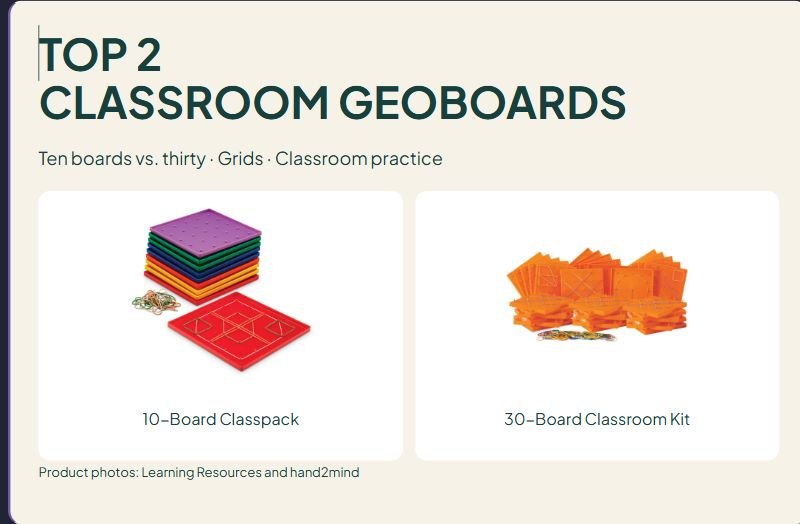
10-Board Classpack

30-Board Classroom Kit
Product photos: Learning Resources and hand2mind
Affiliate disclosure: As an Amazon Associate I earn from qualifying purchases. Purchases through our links may earn a commission at no additional cost to you.
A geoboard lets students stretch bands around pegs to form shapes, then change one part of the shape while discussing what stays the same. Choosing a set is partly about quantity, but the peg layout matters too. A small square grid, a circular arrangement and a dense grid support different kinds of examples.
This comparison covers two manufacturer-documented options. Learning Resources offers a ten-board 5-by-5 set. hand2mind offers a thirty-board kit with square and circular sides. These are alternatives for different teaching arrangements, not a ranking based on hands-on testing. We have not measured peg strength, band lifespan or classroom learning outcomes.
Quick comparison
| Set | Model/item | Documented layout and quantity | Practical use | Main check |
|---|---|---|---|---|
| Learning Resources Geoboards | LER0153 | Ten boards with a 5-by-5 peg grid; bands included | Small-group shape and measurement work | Do not infer a circular reverse side from this product description |
| hand2mind Geoboards Classroom Kit | 86993 | Thirty 7½-inch boards; 5-by-5 grid on one side, 12-pin circular arrangement with radius and diameter pegs on reverse | Whole-class responses and comparing layouts | A larger supply than a small group may need |
1. Learning Resources 5-by-5 Geoboards: a simpler grid for group work
The LER0153 pack contains ten boards and rubber bands. The manufacturer describes a 5-by-5 peg grid for shapes, symmetry, area, perimeter and spatial relationships. Its product header lists ages 5+ and a small-parts warning for children under 3.
A simpler grid can keep a beginner task focused. Students can form a rectangle, move one corner, compare two shapes or describe a path between pegs. Ten boards suit a small group or paired work in a larger class, depending on whether each learner needs to give an independent response.
Reasons to choose it: The package includes bands, so it is more than a supply of bare boards. A smaller number of peg positions can make a demonstration easier to describe. The ten-board quantity can fit a guided table without buying a full-class kit.
Limitations: The reviewed primary description establishes the square grid but does not establish a circular reverse side, overall board dimensions or band material. Do not transfer those specifications from another brand's similar-looking board. Ten boards do not provide independent tools for thirty students at once.
Try this activity: Make a rectangle spanning two unit intervals across and three down. Ask students to count the unit squares inside it and the unit edge lengths around it. Explain why the area is six square units and the perimeter is ten units. Count spaces between pegs, not the number of pegs.
2. hand2mind Classroom Kit: two layouts in a thirty-board supply
Item 86993 contains thirty plastic boards, rubber bands and a storage container. Each board measures 7½ inches square. One side has a 5-by-5 peg grid; the reverse has a 12-pin circular layout plus radius and diameter pegs. The manufacturer lists grades K–8 and advertises a 12-month virtual-manipulative subscription; confirm current access terms if that feature matters to you.
The important difference is the reverse layout. A circular arrangement provides a different frame for comparing shapes, positions and lines through the center. It does not simply add more square-grid space.
Reasons to choose it: One board supports two kinds of construction. The thirty-board supply can support one board per learner in a class of thirty. The included storage container gives the class supply a defined place between lessons.
Limitations: Turning the board over removes access to the first construction, so take a drawing or discuss it before switching sides. The manufacturer page reviewed does not establish that the included bands are latex-free. Grades K–8 describe a broad teaching range rather than a promise that every activity suits every learner in those grades.
Try this activity: On the circular side, make a straight line through the center using opposite outer pegs. Discuss how that differs from a line joining two outer pegs without passing through the center. Use the manufacturer's supplied center-related peg arrangement to support the explanation, and verify the actual board before preparing a printed task sheet.
How to choose a classroom geoboard set
Start with the response format. If every learner must show a shape at the same time, provide enough boards for independent work. If the lesson involves a paired explanation, sharing can be part of the plan. Make that choice deliberately rather than discovering a shortage halfway through the activity.
Next choose the peg layout. A square grid supports comparisons based on unit intervals. A circular layout gives a different arrangement for exploring lines and symmetry. Check the exact layout before adapting a task card or asking learners to describe peg positions.
Check the bands as carefully as the boards. Confirm included quantities, materials and suitable replacement sizes on the exact package. Inspect the equipment according to its instructions and remove damaged bands from use. Model placing and moving bands gently; do not turn them into projectiles or overstretch them.
Finally, check access. Some learners may find stretching a band around pegs difficult. Let them direct an adult or partner, describe a shape, or record it another way when that better serves the mathematical goal. Do not interpret difficulty manipulating the equipment as proof of difficulty understanding geometry.
Avoid these common mathematical mix-ups
Count intervals rather than pegs. Two adjacent pegs mark one unit interval. A side touching four equally spaced pegs spans three intervals. Agree on the unit before calculating a perimeter.
Separate area from perimeter. Area measures the surface enclosed, while perimeter measures distance around the boundary. Start with rectangles and straight grid-aligned sides before assuming that a diagonal band has the same length as a horizontal unit interval.
Keep the reference whole clear in fraction work. If a particular outlined region represents one whole, keep that reference visible while comparing parts. A half of one region does not necessarily have the same area as a half of a different-sized region.
Ask for an explanation after a construction. A student may reproduce a shape by following a picture. Ask how they know two sides match, where a symmetry line lies or why a total is correct. The reasoning matters as much as the finished band arrangement.
Common questions
Does every geoboard have a circular side? No. The reviewed description for hand2mind 86993 explicitly establishes one. Do not assume that feature for another product unless its exact listing or package confirms it.
Are the included bands latex-free? This comparison does not establish that either set is latex-free. Check the exact product and replacement-band materials when they matter to your setting.
Can I use the same printed task cards with every board? Check the layout, coordinates and scale first. A square-grid task may not translate directly to a circular side or to a board with different spacing.
For composing shapes with separate solid pieces instead of stretched bands, the math linking cubes comparison covers another hands-on format. These tools require different handling actions, so choose the one that fits the task.


Leave a Comment