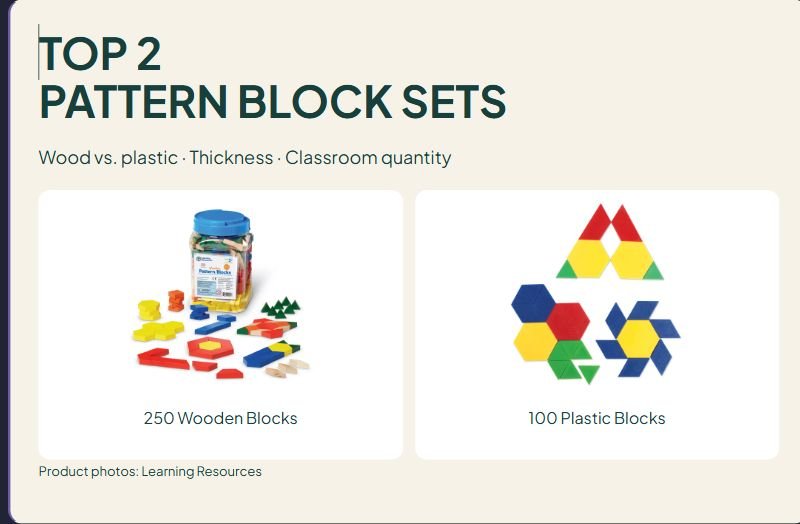

TOP 2
PATTERN BLOCK SETS
Wood vs. plastic · Thickness · Classroom quantity

250 Wooden Blocks

100 Plastic Blocks
Product photos: Learning Resources
Affiliate disclosure: As an Amazon Associate I earn from qualifying purchases. Purchases through our links may earn a commission at no additional cost to you.
Pattern blocks can support a simple shape-sorting task or a discussion about how smaller shapes make a larger one. The right set depends on where the lesson happens: at a desk, in a small group, or on a magnetic demonstration board.
This guide compares two Learning Resources desk sets with different materials and quantities. The wooden pack contains 250 pieces and the plastic pack contains 100. A larger piece count does not automatically make a product the better choice.
The comparison uses manufacturer specifications and descriptions. We have not performed hands-on testing or measured durability, and no customer rating is claimed. Check the exact model and contents on the US listing before ordering.
Compare the formats
| Set | Model | Verified format | Suitable purpose | Main limitation |
|---|---|---|---|---|
| Wooden Pattern Blocks | LER0334 | 250 wooden pieces, 1 cm thick, six shapes and colors, storage bucket | Tabletop geometry and open-ended designs | Pattern cards sold separately |
| Plastic Pattern Blocks | LER0634 | 100 plastic pieces, 0.5 cm product format, six shapes and colors | Flat designs and smaller working supplies | Fewer pieces than the wooden pack; no included cards established |
1. Wooden Pattern Blocks, Set of 250: a larger tabletop supply
The LER0334 pack contains 250 wooden blocks in six shapes and colors. The manufacturer specifies a 1 cm thickness and a storage bucket. It describes the pieces as thick enough to stand on desktops, allowing upright arrangements as well as flat designs.
This format suits a teacher who wants a shared supply for sorting, composing shapes and open-ended work. A larger bucket can provide more pieces for several groups, but you still need to check the distribution of individual shapes before planning identical tasks for everyone.
Reasons to choose it: The thicker profile offers a different handling experience from thin flat pieces. The bucket provides a place to return the blocks. The larger total can be helpful when designs require repeated shapes.
Limitations: Pattern cards are explicitly sold separately. The pack should not be presented as a ready-made sequence of printed challenges. The manufacturer's broad references to stacking do not establish how tall or stable a particular structure will be. Check the real pieces and the working surface before assigning an upright construction task.
Try this lesson: Ask children to build a shape, describe its sides and corners, then recreate it with a different combination of blocks. Keep the focus on the mathematical explanation. An attractive picture can start a conversation, but copying a picture alone does not show that a learner understands the relationship between shapes.
The manufacturer lists ages 3+ and warns that small parts are unsuitable for children under 3. Follow the product label and supervise according to individual needs.
2. Plastic Pattern Blocks, Set of 100: a thinner desk format
The LER0634 is the manufacturer's 0.5 cm plastic set of 100. It contains six shapes in six colors and is described for sorting, patterning, composing larger shapes, symmetry and area exploration.
The main purchasing distinction is the format: fewer pieces and a thinner profile than the wooden set. Choose it when that supply fits the activity rather than assuming that every class needs the largest pack.
Reasons to choose it: A 100-piece supply can suit a smaller working group. Plastic pieces provide an alternative to wood. The thinner format is relevant when children are laying out flat designs rather than standing blocks upright.
Limitations: Do not infer that this set includes task cards, a particular container or a fixed number of each shape; those details were not established by the primary description reviewed here. One hundred pieces also do not equal one hundred student kits. Some designs may need more of a particular shape than the pack provides.
Try this lesson: Start an alternating pattern with two shapes. Ask the learner to continue it, identify the repeating unit and create another pattern with the same structure using different shapes. Then deliberately introduce a mismatch and ask where the rule changed.
The manufacturer lists ages 3+ and a small-parts warning. If a child needs larger items or has difficulty picking up thinner pieces, consider access needs alongside the mathematical task.
What to check before choosing pattern blocks
Begin with the teaching format. A student desk supply supports handling and individual responses. Decide whether students will work alone or share within a group before choosing a pack quantity.
Next check the shapes required for your activity. A high total can still leave a group short of one shape. Prepare one sample of the task, count the pieces it requires, then multiply by the number of working groups. Leave a few spare pieces if missing items would interrupt the lesson.
For printed outlines, check scale. A print setting such as fit to page can alter an outline size. Compare a real piece with the printed outline before making a class set of copies.
Consider handling and contrast. Color can help organize pieces, but teach shapes by their properties as well as their colors. A child should be able to identify a triangle by its sides and corners rather than needing to remember that one particular triangle is green.
Finally, choose a storage routine. Use a tray or defined work area to reduce pieces spreading across the floor. Count or sort materials as part of the return process. Keep small pieces away from children for whom they are unsuitable.
Three ways to make a lesson more useful
Ask for explanations. After a learner completes a design, ask how they selected the pieces and whether another arrangement would work. A correct final picture may come from trial and error; an explanation gives more information about the learner's reasoning.
Keep the whole consistent in fraction work. If a hexagon represents one whole, compare pieces against that same whole throughout the example. Changing the reference shape without explaining it can make a fraction label misleading. Physically check that pieces cover the reference shape without gaps or overlaps before discussing the relationship.
Separate area from piece count. Two designs with the same number of pieces do not necessarily cover the same area. Ask learners to compare the actual space covered. Length and area measure different things, so make the unit explicit when comparing a design.
Frequently asked questions
Are pattern blocks the same as a tangram? A traditional tangram has a specific seven-piece arrangement. These sets contain repeated pattern-block shapes. Although some manufacturer wording mentions tangram-style puzzles, do not assume that a standard tangram template will match the pack.
Does the wooden set include activity cards? No. The manufacturer explicitly states that pattern cards are sold separately. Open-ended designs and teacher-created activities are still possible without them.
Should every student have an entire pack? No. Plan around the pieces each activity requires. One shared supply may serve several groups, while an individual response task needs enough of the required shapes for every learner.
Which format should I choose first? Choose the wooden set when its thicker format and larger supply fit the task. Consider the thinner plastic set when a smaller desk supply fits your lesson. Confirm the exact model and pack contents before buying.
For a different way to represent equal parts of a consistent whole, compare our fraction tiles, towers and circles. Choose the representation for the explanation you want learners to make.



Leave a Comment