

Planning and organization deficits show up in small, familiar moments: a science packet found crumpled under a lunch box, a project started the night before it is due, a desk so full that the math book disappears every morning. The student often knows what to do. The trouble is turning that knowledge into a plan, a place for things, and a start time.
This guide walks you through five steps to support a student with these difficulties: name the exact problem, build one home for materials, break big work into dated steps, teach a daily planning routine, and review the system with the student and family. By the end, you will have a short, testable plan instead of a pile of reminders.
Examples are fictional. Adapt to the student’s goals and agreed supports. This is guidance, not a diagnosis.
At a glance
- Describe the problem as a specific moment, such as “loses homework between school and home.”
- Give every important item one home and practice putting it there.
- Turn every long assignment into dated mini-steps the student can see.
- Teach a short daily planning routine and practice it like any other skill.
- Review one simple measure every few weeks and change one thing at a time.
1. Name the planning and organization deficits you actually see
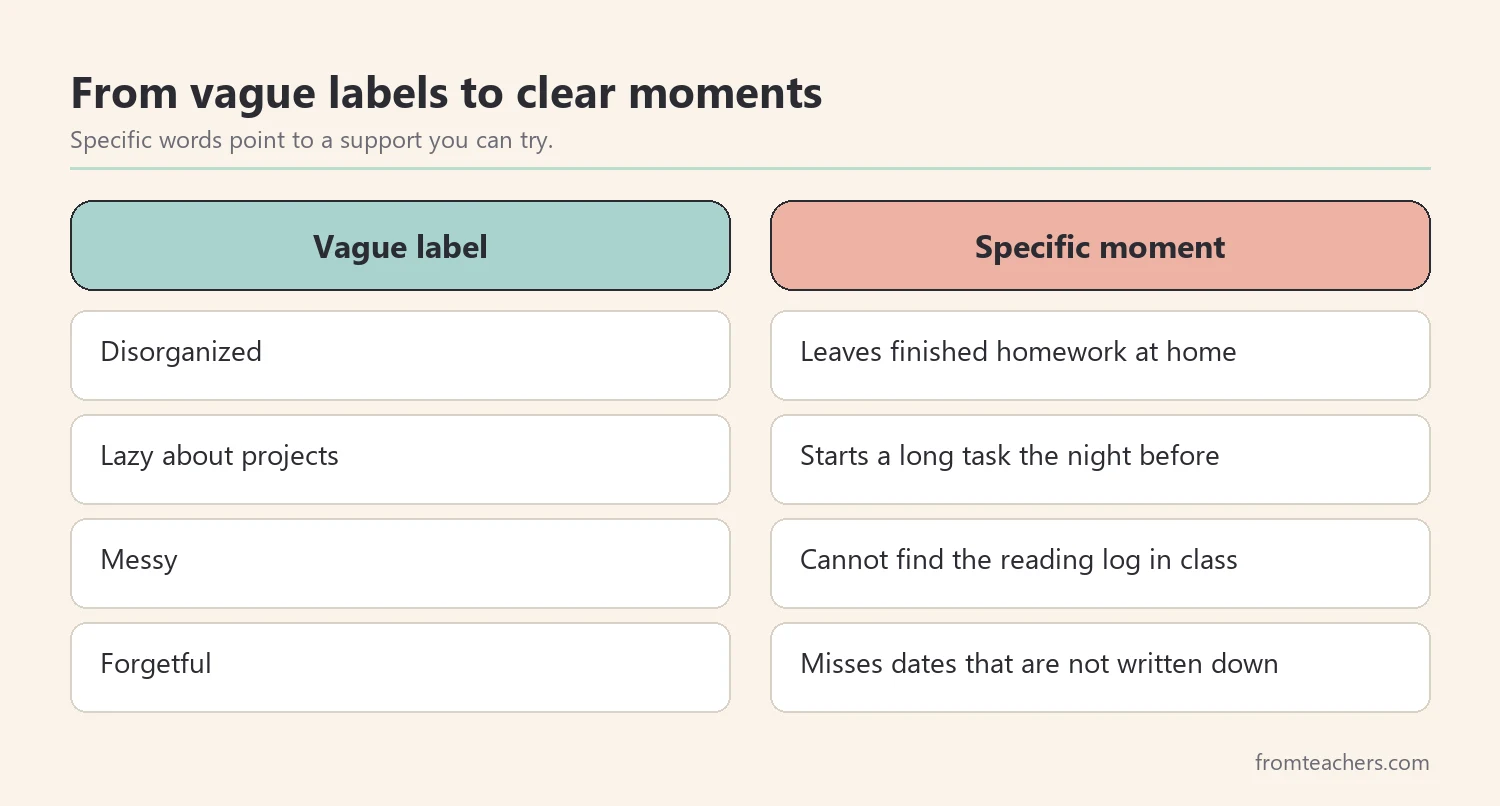
First, avoid labels like “disorganized” or “lazy.” They do not tell you what to change. Instead, describe planning and organization deficits as moments you can observe: what happened, when, and what came right before it.
Next, collect notes for about a week. A sticky note per day is enough. Write the moment, the task, and the result. Patterns appear quickly. For example, a student may manage short worksheets well but fall apart with any task that lasts longer than two days.
Meet our fictional student, Leo, a sixth grader. Leo is curious and quick in discussions. However, he misses about half of his homework deadlines, and his binder has no sections. His teacher wrote down four moments during one week.
| Moment observed | Type of difficulty |
|---|---|
| Homework done but left at home | Materials and transitions |
| Book report started the night before | Planning long tasks |
| Could not find his reading log | Materials system |
| Forgot a permission slip deadline | Tracking dates |
As a result, the team could see that Leo had two main needs: a materials system and a way to plan multi-day work. That is far more useful than “Leo needs to be more organized.” Also, write what already works. Leo always remembers his soccer practice, because the time is the same every week and his coach texts a reminder. That tells you fixed routines and outside cues help him.
Questions to ask while you observe
- Does the problem happen with materials, with time, or with long tasks?
- Is it worse in one subject, one room, or one time of day?
- What happens right before the moment, such as a rushed dismissal?
- Which tasks does the student manage well, and what is different about them?
These questions keep the focus on the situation rather than the child. In addition, they help you share clear notes with the family and the rest of the team. When everyone describes planning and organization deficits in the same concrete words, it is much easier to agree on one first step.
2. Build one home for every item
Many planning and organization deficits start with materials. If papers have no fixed home, they end up in every pocket, folder, and backpack corner. The fix is simple to describe and harder to keep: one home per item, labeled, and practiced daily.
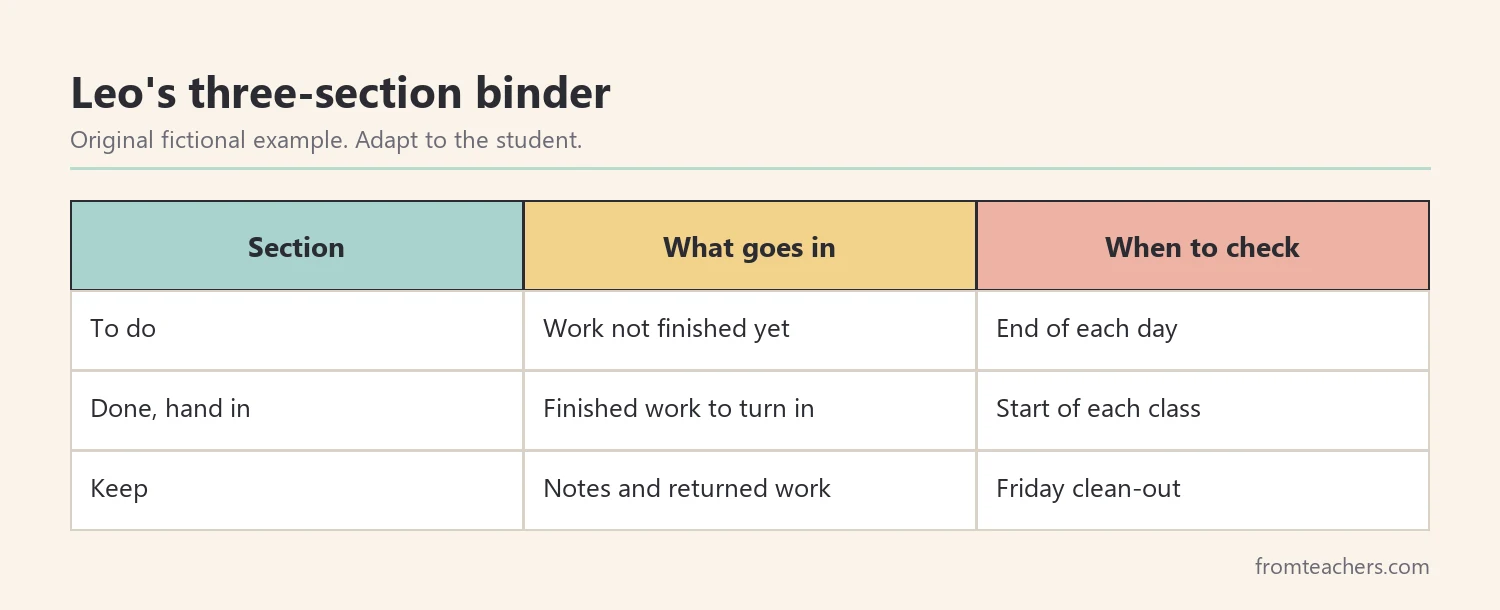
Start with the smallest system that covers the problem. For Leo, the team chose one binder with three tabs: “To do,” “Done, hand in,” and “Keep.” His teacher color-coded the tabs and added a clear pocket at the front for anything that needed a parent signature.
Then, teach the system. Do not just hand it over. Model where each paper goes, let the student sort five sample papers, and check the binder at the same time each day for two weeks. In addition, build a two-minute desk reset into the end of the day so loose papers never pile up.
- One binder or folder per subject group, never one per worksheet.
- Labels with words and simple icons for younger students.
- A fixed time for clean-out, such as Friday after lunch.
- A spare set of basic supplies kept in the classroom.
Finally, keep home and school consistent. If the family uses the same “To do” and “Done” words, the student does not have to learn two systems. Short, shared language matters more than an expensive planner.
Also, think about the workspace itself. A desk crammed with old worksheets makes every search slower. For students with planning and organization deficits, a clear surface with only today’s materials reduces the number of decisions they have to make. Keep a small tray for “today” and move everything else to the binder or a cubby.
3. Break long assignments into dated steps
Long tasks are where planning and organization deficits cost the most. A book report due in two weeks feels far away until it suddenly is not. Because the student cannot see the middle steps, the task stays in one big, scary block.
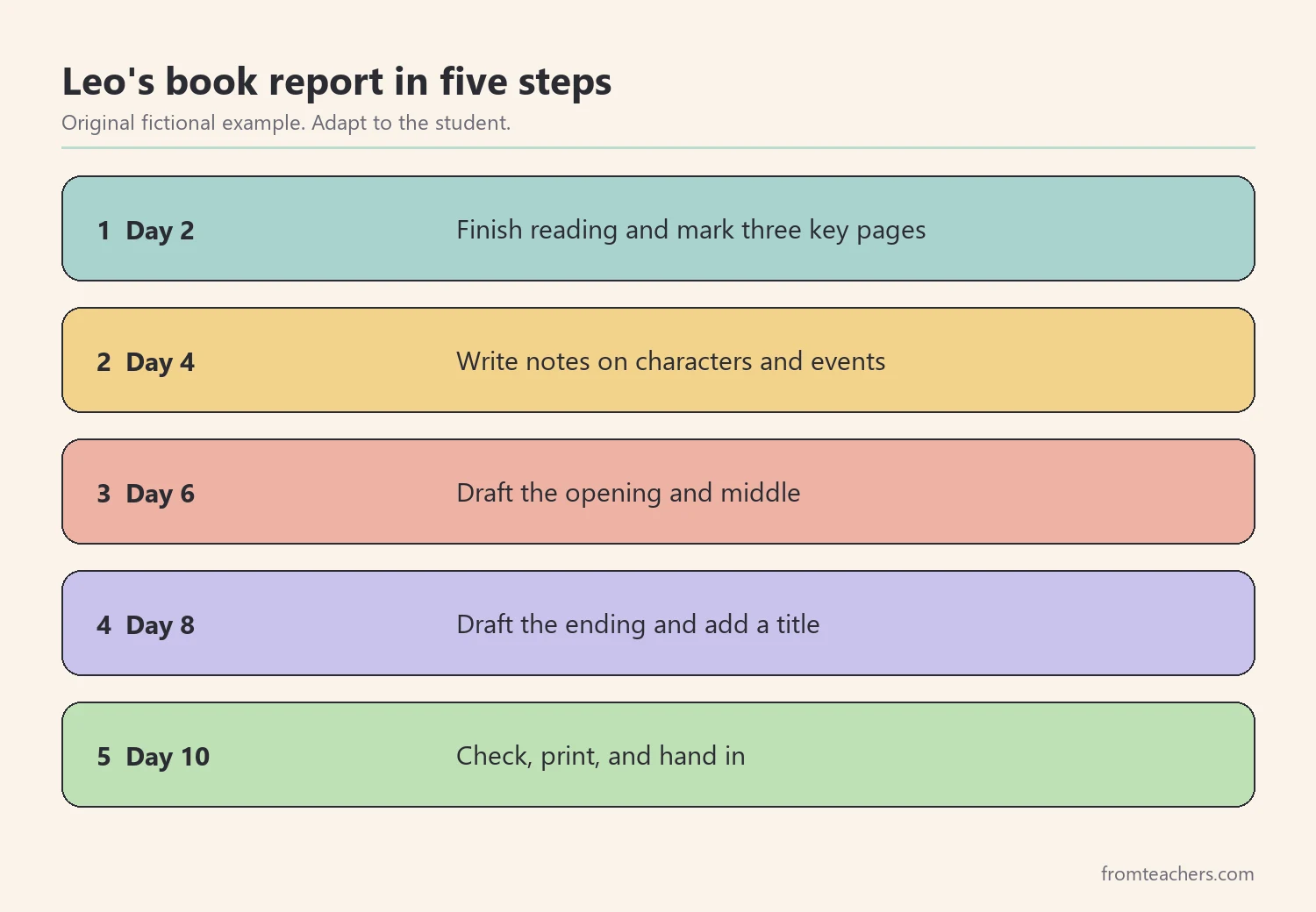
Therefore, break the task into four or five mini-steps and give each one a date. Put the dates on a paper calendar or the student’s planner, not only in your head. For the first few projects, write the steps with the student. Over time, let the student propose the steps while you check them.
For example, Leo’s book report became five steps across ten school days. His teacher added a quick check-in at each step, which took less than a minute.
In addition, estimate the time for each step together. Then compare the guess with the real time afterward. This builds an honest sense of how long work takes, which many students with planning difficulties lack. If you want ready-made ideas for these moments, the planning and organization strategy tables pair everyday problems, like an overstuffed schedule or a poor time estimate, with a fix and its benefit.
Next, plan for setbacks. A sick day or a surprise assembly can push a step back. Teach the student what to do when that happens: move the step to the next open day and tell the teacher. Because planning and organization deficits often lead to panic when plans change, a simple “move it, then tell” rule keeps a small delay from turning into a missed deadline.
4. Teach a daily planning routine for planning and organization deficits
Next, give the student a short routine that happens at the same time every day. A good routine takes three to five minutes and has the same steps each time. Students with planning and organization deficits benefit from repetition, because the routine slowly becomes automatic.
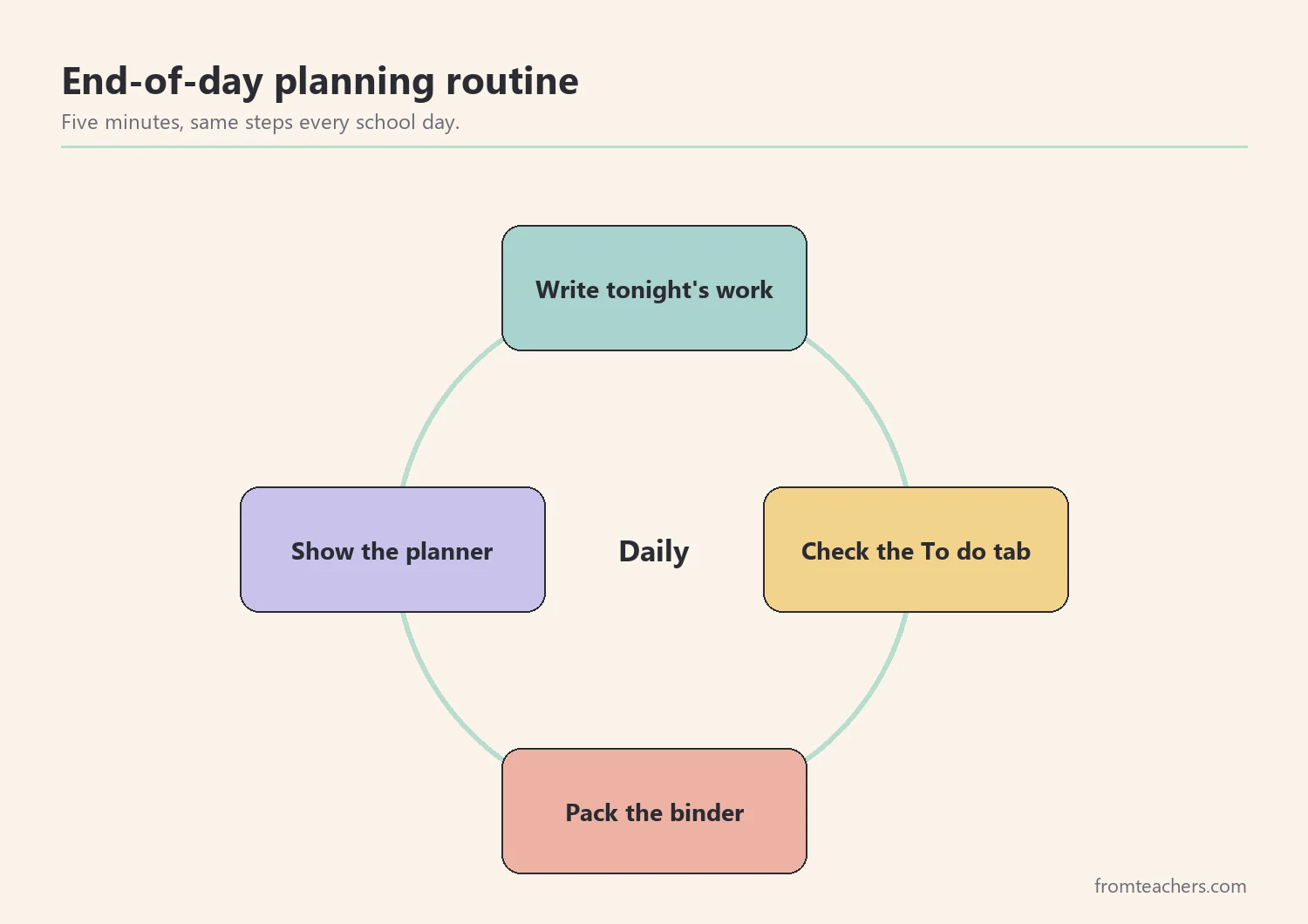
Leo’s routine happens in the last five minutes of the school day. He opens his planner, writes tonight’s work, checks the “To do” tab, packs the binder, and shows his planner to the teacher for a quick initial. At first, the teacher walked through every step with him. After two weeks, she only checked the final page.
Here are a few tips for teaching the routine well:
- Model the routine aloud while the student watches.
- Practice it in calm moments, not only when work is due.
- Use a short checklist taped inside the planner.
- Praise the routine itself, not only finished homework.
- Fade your prompts slowly, one step at a time.
Also, link the routine to something that already happens. For example, if the class always lines up for dismissal at 2:55, the planning routine starts at 2:50. That way, the bell becomes a built-in reminder.
For older students, add a short weekly planning session as well. On Monday morning, the student looks at the whole week, notes tests and due dates, and picks one evening for each long task. This weekly view is where many students with planning and organization deficits gain the most, because it turns a blur of days into a visible plan. Keep it short, about ten minutes, and do it together until the student can lead it.
5. Review the system with the student and family
Finally, check whether the plan works. Choose one or two measures that are easy to count, such as assignments turned in on time each week or the number of mornings the binder came back complete. Review the numbers every three to four weeks.
Then, involve the student. Ask what feels easier, what still feels hard, and what they would change. Students who help design the system are more likely to use it. For planning and organization deficits, this ownership is part of the skill itself.
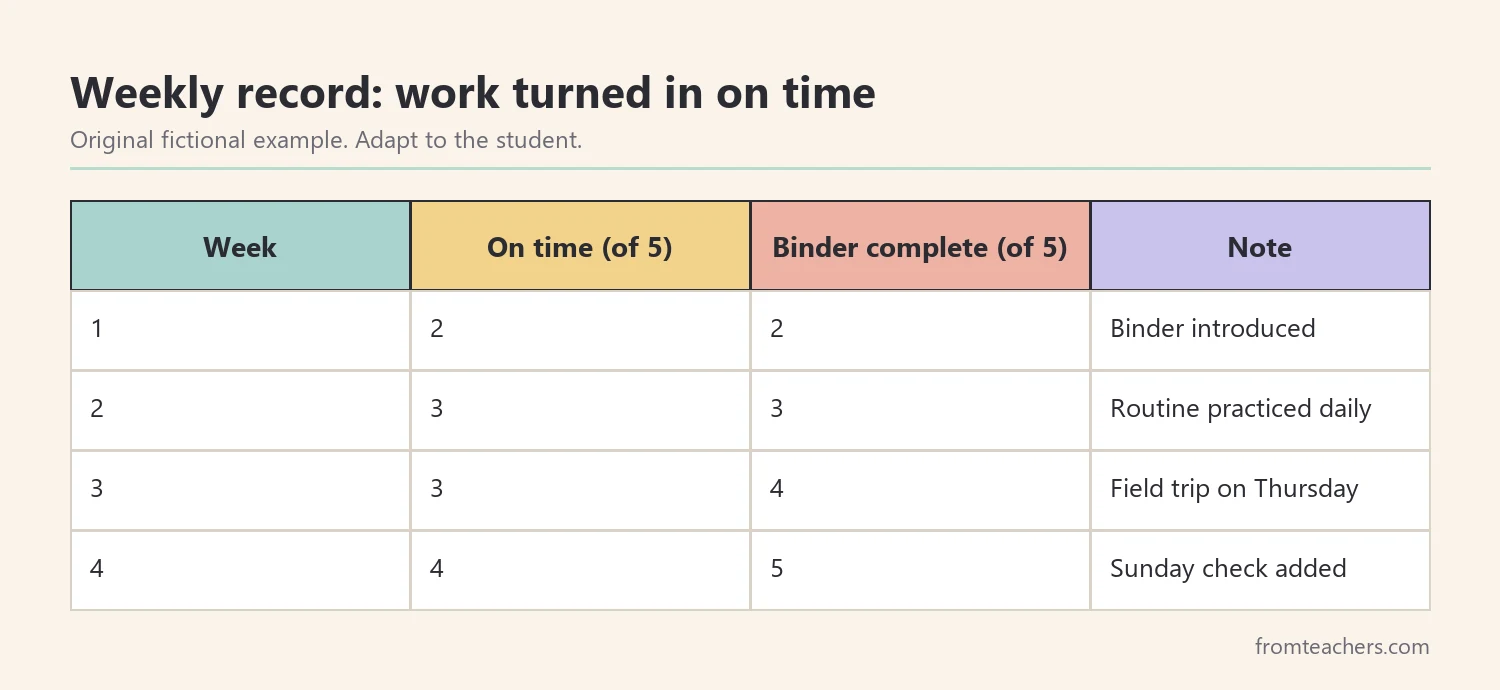
In Leo’s case, the family noticed that Sunday evenings were still stressful. Together, they added a ten-minute Sunday check of the planner for the week ahead. As a result, the following month went more smoothly. Change only one thing at a time, so you know what made the difference.
When the student shows steady progress, start fading support. Move from daily teacher checks to every other day, then to a weekly check. Keep the materials system and the routine, because those are the long-term tools.
In addition, share wins with the family in plain terms. A short note such as “Leo turned in four of five assignments this week and packed his binder alone on three days” is more useful than a general “doing better.” Clear updates help everyone keep supporting planning and organization deficits in the same way at school and at home.
Common mistakes and how to avoid them
- Buying a complex planner first. Instead, start with the simplest tool the student will actually open.
- Giving reminders instead of teaching. Reminders help today, but a taught routine helps all year.
- Changing everything at once. Change one part of the system, then watch for two or three weeks.
- Treating missed work as a motivation problem. Look first at the plan and the materials system.
- Stopping support too early. Fade slowly and keep the core routine in place.
Questions teachers and parents ask about planning and organization deficits
Are planning and organization deficits the same as ADHD?
No. Planning and organization deficits are common in students with ADHD, but many other students struggle with these skills too. Only qualified professionals can evaluate a student. Meanwhile, the classroom supports in this guide can help any student who needs them.
How long does it take to see progress?
It varies. Many teams notice small changes within a few weeks of daily practice. However, lasting habits often take a full term or longer, so keep the routine going.
Should I use a paper planner or a digital one?
Use the tool the student will open every day. Some students do better with paper they can see and touch. Others prefer a phone or tablet reminder. Try one for a few weeks and review.
What can parents do at home?
Parents can use the same words as school, set a regular homework time, and do a short weekly planner check. A fixed spot for the backpack near the door also helps.
Can these supports be written into an IEP or 504 plan?
Yes, teams often include organization supports such as planner checks or chunked assignments. Talk with the student’s team about what fits their plan.
Related reading: Effective ADHD Classroom Strategies to Support Student Success, Accommodations vs Modifications in Special Education: The Difference Explained, and 5 Practical Teaching Tips to Boost Classroom Focus and Learning.
A companion resource for planning and organization deficits:
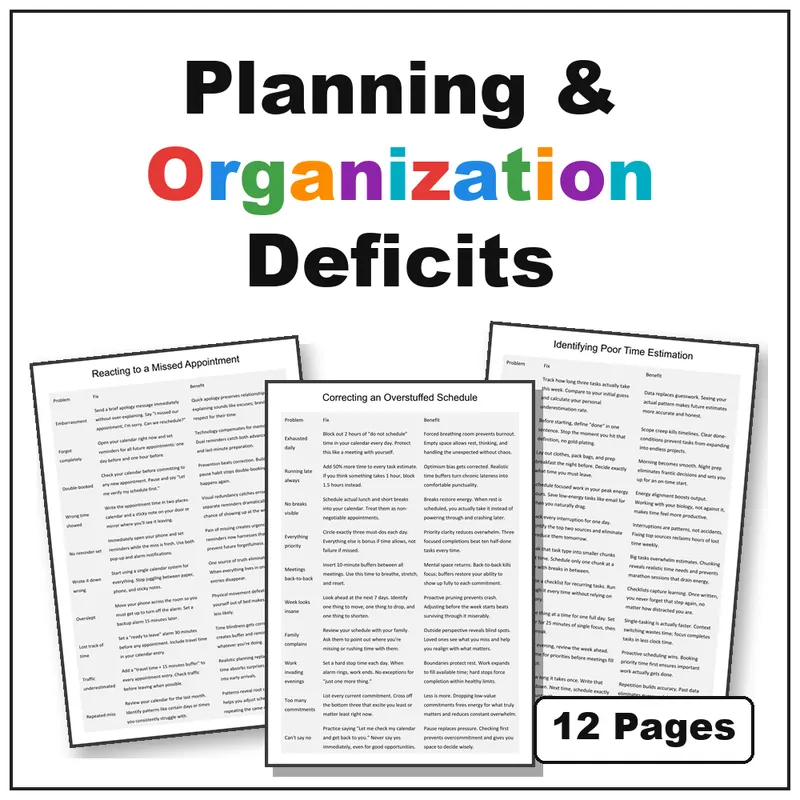
Planning & Organization Deficits | Strategies for Organizing Work and Time: 12 printable strategy tables that give a clear fix and benefit for everyday problems such as missed deadlines, lost papers, and cluttered workspaces.
Sources and scope
- Center on the Developing Child, Harvard University: background on executive function skills such as planning and working memory.
- Understood.org: practical articles for families and teachers on organization and learning differences.
- IRIS Center, Vanderbilt University: free modules on classroom routines and evidence-based practices.
- CDC ADHD information: general background on ADHD in children, including school supports.
This guide covers everyday classroom and home strategies for organizing materials, work, and time. It does not cover diagnosis or formal evaluation, which belong to qualified professionals and the student’s team.
Key takeaways
- Describe planning and organization deficits as specific moments, not personality traits.
- Give every item one home and practice the system daily.
- Turn long assignments into dated mini-steps the student can see.
- Teach a short daily planning routine linked to an existing cue.
- Review simple data with the student and family, then fade support slowly.










Leave a Comment