

Planning and organization skills shape almost every school day, even when no one names them. Picture an eighth grader who finished his history project on time, then could not find it the morning it was due. His locker is packed with crumpled papers, his planner is mostly blank, and he finds out about tests the day before. He is capable. The system around his work is missing.
This guide gives you five steps for building that system with a student. By the end, you will be able to pinpoint the everyday problems, set up one home for papers, teach backward planning for deadlines, build a weekly workspace reset, and check progress so the student gradually takes over.
Examples are fictional. Adapt to the student’s goals and agreed supports. This is guidance, not a diagnosis.
At a glance
- Missed deadlines, lost papers, and cluttered workspaces each need a specific fix.
- One home for papers works better than several folders the student never uses.
- Backward planning turns a far deadline into small dated steps.
- A short weekly reset keeps the system from falling apart.
- Adults model and check at first, then hand the routine to the student.
1. Pinpoint the everyday problems
First, list exactly what goes wrong. “Disorganized” is too broad to fix. Instead, look for the specific moments where the student’s work gets lost, forgotten, or late. Common examples include homework done but not turned in, assignments never written down, long projects started the night before, and a desk or bag so full that nothing can be found.
Next, watch for a week and keep simple notes. Record the date, what happened, and where the breakdown was. For example, “Tuesday, science worksheet done at home, left in the kitchen.” Or “Thursday, did not know about the quiz, nothing in the planner.” Each note points to a different gap.
Then, sort the notes into three groups: time problems, paper problems, and space problems. Time problems involve deadlines and planning ahead. Paper problems involve losing or forgetting materials. Space problems involve desks, lockers, and bags. Most students have one group that causes the most trouble.
Meet Ethan, a fictional eighth grader with ADHD. His advisor, Ms. Huang, gathers notes from three teachers and his family. In two weeks, Ethan had six missing assignments. Four were finished but never turned in. Two were long assignments he did not start until the night before. His backpack held papers from several months ago.
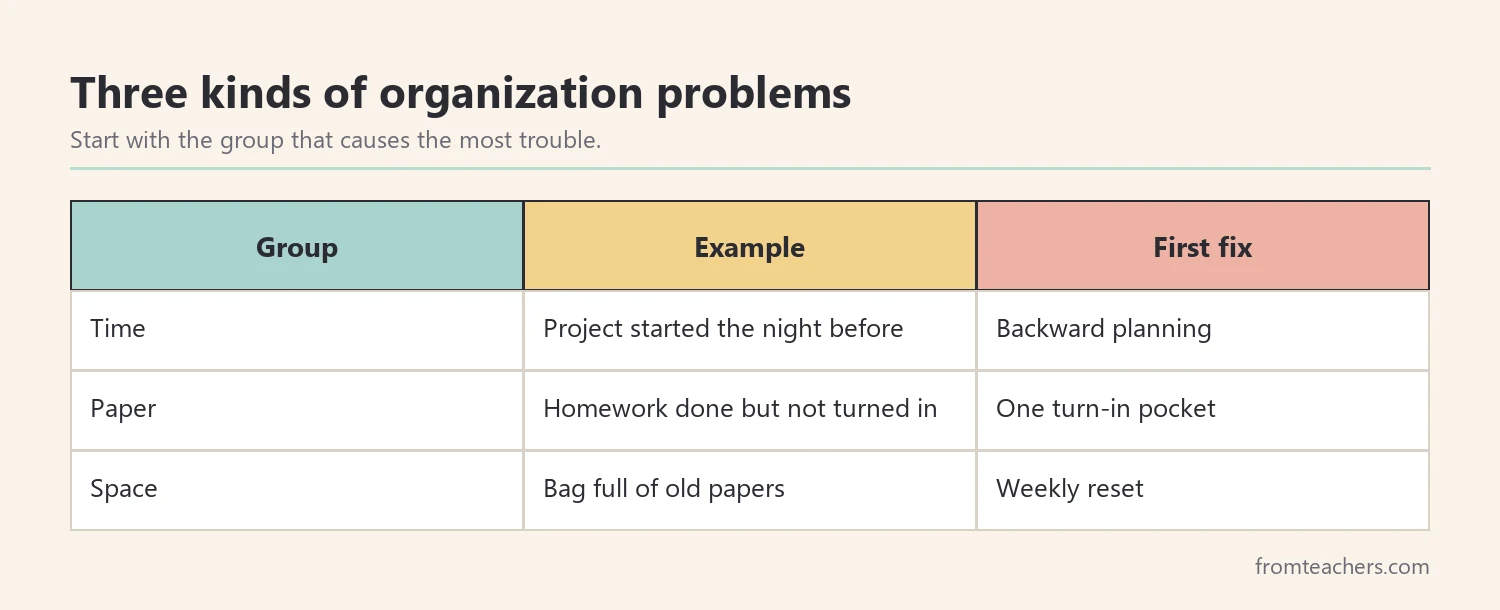
Finally, choose one group to work on first. For Ethan, paper is the biggest problem, because finished work is not getting credit. Fixing that first gives quick wins and builds trust in the plan.
Also, ask the student what they think goes wrong. Many students already know where things fall apart, even if they have not found a fix. A short, judgment-free conversation often uncovers details adults miss, such as a binder that is too heavy to carry or a planner that does not fit in the bag.
2. Set up one home for papers
Now, build a simple paper system. When it comes to planning and organization skills, simple beats impressive. A student who struggles with organization is unlikely to keep up a color-coded binder with eight tabs. One clearly labeled folder with two sides is far more likely to work.
A common setup is a single “take home” folder with two pockets: “To do” on one side and “To turn in” on the other. Every paper goes into one of those two pockets. When homework is finished, it moves straight to “To turn in” and goes back in the bag that night.
| Problem | Simple fix | Who checks at first |
|---|---|---|
| Finished work left at home | “To turn in” pocket | Family at bedtime |
| Loose papers in the bag | One folder for every class | Advisor on Friday |
| Forgets to hand work in | Turn-in check at class start | Classroom teacher |
Next, add a turn-in moment. Ask teachers to prompt the student at the start of class: “Anything in your turn-in pocket?” At first, the prompt is from the teacher. Later, the student checks on their own.
For Ethan, the team agrees on one folder for all classes. His family checks the “To turn in” pocket at bedtime for the first two weeks. His teachers give a quick turn-in prompt. In week one, Ethan turns in every finished assignment.
Moreover, keep the system the same in every class. If each teacher asks for a different binder, the student has to remember several systems at once. When possible, agree on one approach across the team.
3. Teach backward planning for planning and organization skills
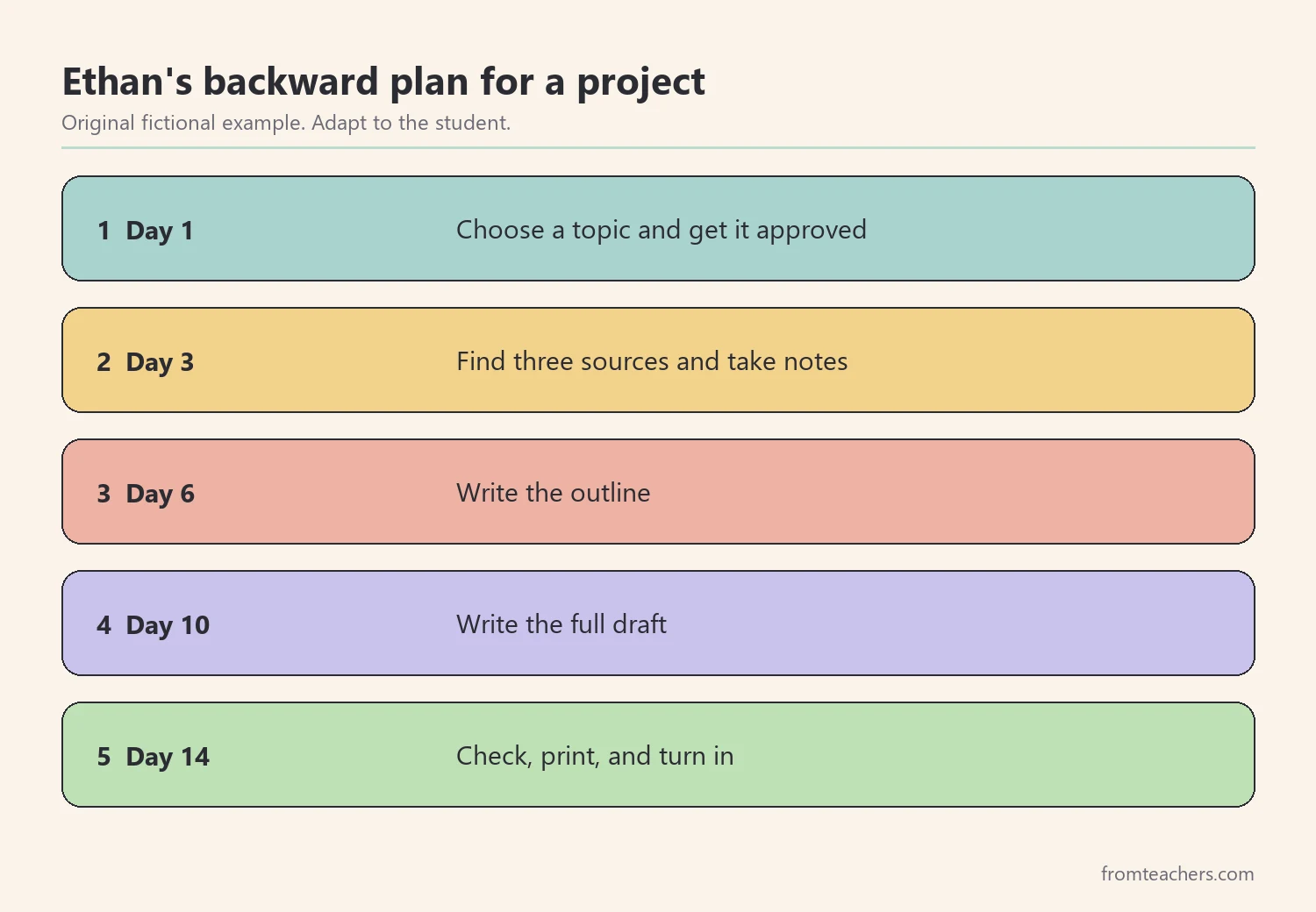
Next, help the student plan time. Long assignments are hard for many students because the deadline feels far away until it is suddenly tomorrow. Backward planning breaks a due date into small dated steps, starting from the end and working back.
Start with the due date and ask, “What has to be done the day before? The week before?” Write each step with its own date. Keep steps small enough to finish in one sitting. Then, put those dates in the planner, not only the final due date.
Then, teach the student to use the planner every day at the same time, such as at the end of each class or at the end of the school day. A daily check takes two minutes and prevents most surprises. Make it part of the routine, not an extra task.
Also, build in a little extra time. Many students underestimate how long tasks take. Adding one buffer day before the due date leaves room for a sick day, a busy weekend, or a step that takes longer than expected. Over time, the student can compare planned and actual time and get better at estimating.
For Ethan, Ms. Huang sits with him for ten minutes when a new project is assigned. Together, they write five dated steps. He checks off each step in his planner. His next project is turned in on time, with no late-night rush.
If you want a ready-made reference, the planning and organization strategy tables from berchid.com give a clear fix and benefit for common everyday problems such as missed deadlines, lost papers, and cluttered workspaces. They are handy when you are deciding which fix to teach next.
4. Build a weekly workspace reset
Then, plan a regular clean-up. Even a good system slowly fills with clutter. A short weekly reset, at the same time every week, keeps the system working before it falls apart.
A reset can take ten to fifteen minutes. The student empties the bag, sorts papers into keep, file, and recycle, checks the planner for the coming week, and restocks supplies. Doing this at school on Friday, with an adult nearby at first, works well for many students.
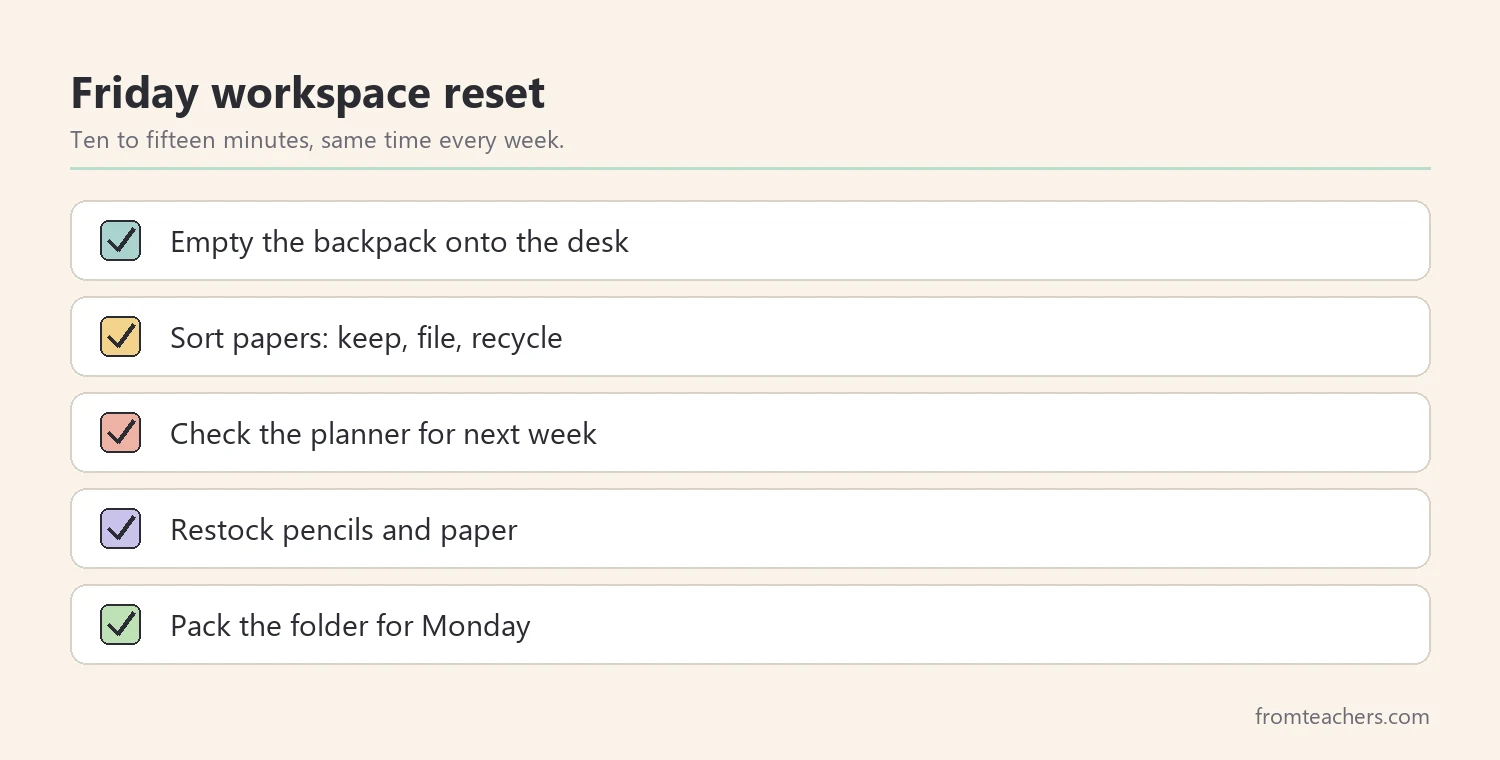
Next, keep the reset predictable. Use the same checklist every week. Over time, the student will need the checklist less, but having it written down removes the need to remember every step.
Also, apply the same idea to the desk and the locker. A quick daily tidy at the end of the day, such as two minutes to put things back, prevents the big mess that takes an hour to fix.
For Ethan, the Friday reset happens during advisory. In the first week, Ms. Huang works beside him. By week three, he completes the checklist alone and shows her the result. His backpack now has one folder, a planner, and a pencil case, instead of months of old papers.
Meanwhile, think about where things live at home. A set spot for the backpack, the folder, and the planner, such as a hook or a basket by the door, means the student does not have to search each morning. Families can use the same weekly reset checklist on Sunday evening if Friday at school is not possible.
In addition, celebrate a clean start. Students who struggle with organization often hear about what is missing. Noticing a tidy bag or a filled-in planner out loud builds confidence in the system.
5. Check progress and hand over the system
Finally, track whether the plan is working and gradually step back. Strong planning and organization skills grow when students practice the routines with less and less adult help. The goal is a student who runs the system on their own.
Keep a simple record. Each week, count missing assignments and note how much adult help the student needed with the folder, the planner, and the reset. Compare the numbers across weeks.
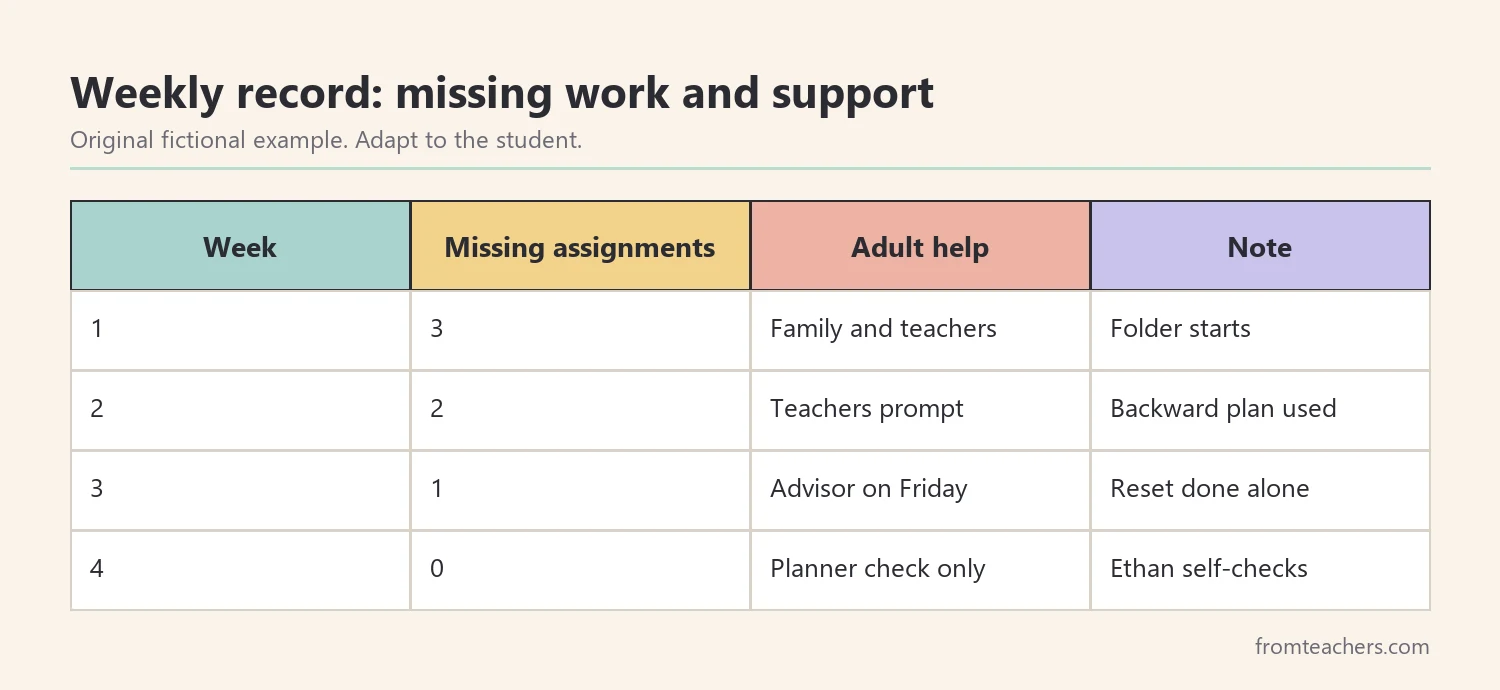
For Ethan, missing assignments drop from three in the first week to zero in the fourth. At the same time, his family stops checking the folder every night, and his teachers stop prompting at the start of class. He now does the turn-in check himself.
Then, review the plan every few weeks with the student, the family, and the team. Ask what is working, what still feels hard, and what to change. New classes, new schedules, and longer projects may call for a small adjustment.
Also, expect some slips. A new semester, a busy sports season, or a family event can throw the system off. When that happens, return briefly to the earlier level of support, then fade again. A short step back is not failure. It is part of building a habit that lasts.
Moreover, fade supports one at a time. If you remove every support at once, the system may collapse. Removing one step, watching for two weeks, and then removing the next keeps progress steady.
Common mistakes and how to avoid them
- Building a complex system. Fix: start with one folder and one planner, then add only what is needed.
- Writing down only due dates. Fix: use backward planning to date every step of a long assignment.
- Cleaning out the bag for the student. Fix: guide the reset with a checklist, then let the student do it.
- Using a different system in every class. Fix: agree on one approach across the team.
- Stopping all support at once. Fix: fade one support at a time and watch the data.
Questions teachers and parents ask about planning and organization skills
At what age should students manage their own organization?
It varies widely. Many students need adult support well into middle and high school, especially with long projects. Start where the student is and build independence step by step.
Is a paper planner or a digital planner better?
Either can work. The best planner is the one the student actually uses every day. Try one for a few weeks, track how often it is used, and switch if it is not working. Some students do well with a paper planner for daily tasks and a phone reminder for big deadlines.
Why does my child finish homework but not turn it in?
This is a very common paper problem. A single “To turn in” pocket and a quick turn-in prompt at the start of class often fix it quickly.
How can families help without taking over?
Families can check the folder and planner at first, then shift to asking questions such as “What is in your turn-in pocket?” That keeps the student in charge while still offering support.
Should organization supports be part of an IEP or 504 plan?
If organization difficulties affect learning across classes, the team may discuss supports such as a check-in routine, planner checks, or extended time for long projects. Bring your data to that conversation.
Related reading: ADHD in Children: A Guide to Effective Classroom and Home Support, Effective ADHD Classroom Strategies to Support Student Success, and How Parents and Teachers Can Team Up for Special Education Success.
A companion resource for planning and organization skills:
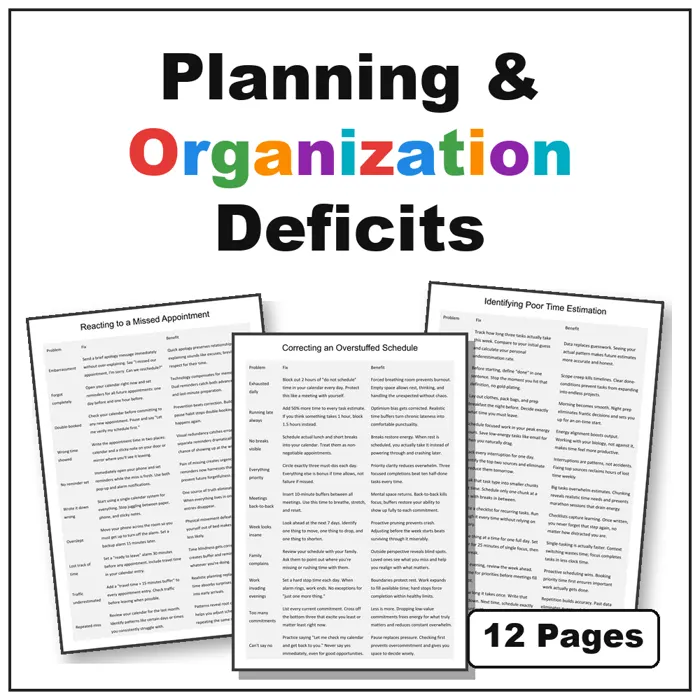
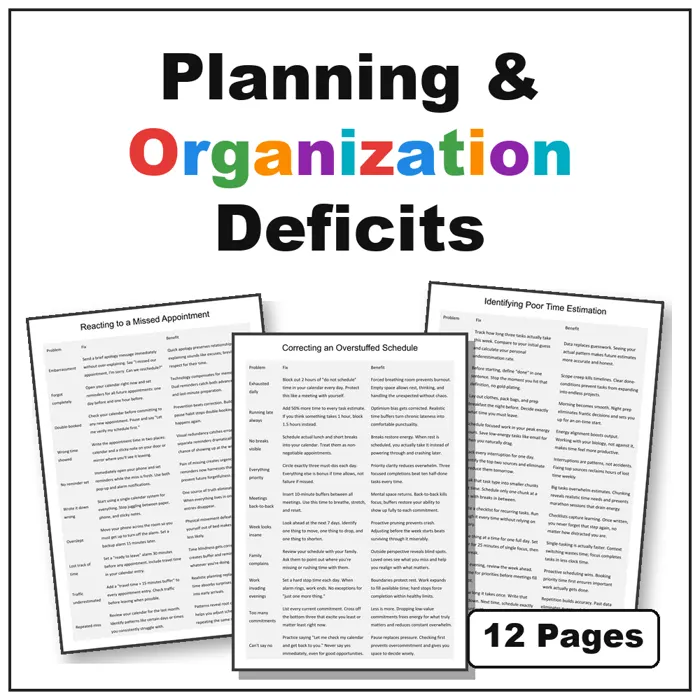
Planning and Organization Deficits: Strategies for Organizing Work and Time: 12 strategy tables that give a clear fix and benefit for everyday problems such as missed deadlines, lost papers, and cluttered workspaces.
Sources and scope
- Understood.org: plain-language information on executive function, ADHD, and organization for families and teachers.
- CHADD: a national organization offering information and support on ADHD for families and educators.
- IRIS Center, Vanderbilt University: free modules on classroom supports and evidence-based practices.
- IDEA, U.S. Department of Education: the law behind special education services and IEPs.
This guide covers practical routines for organizing papers, time, and workspaces at school and at home. It does not replace an evaluation or individualized guidance from the student’s team.
Key takeaways
- Sort organization problems into time, paper, and space, and start with one.
- Use one simple folder with a “To turn in” pocket.
- Teach backward planning so every step of a long task has a date.
- Hold a short weekly reset with a checklist.
- Track missing work and fade adult support one step at a time.










Leave a Comment