

Starting schoolwork can be the hardest part of the whole task for many students. Picture a fourth grader during writing time. She opens her notebook, looks at the prompt, sharpens her pencil twice, and asks to get water. Fifteen minutes later, the page is still blank. She is not refusing; she simply cannot find the way in.
This guide gives you a five-step process for teaching task initiation: find out why starting is hard, teach students to look and shrink the task, prepare materials and use a short timer, use starter strategies and kind self-talk, then teach help-seeking and track progress. By the end, you will have a routine a student can follow on their own.
Examples are fictional. Adapt to the student’s goals and agreed supports. This is guidance, not a diagnosis.
At a glance
- Getting started is a skill that can be taught, not a sign of laziness.
- Understanding the task and shrinking the first step lowers the barrier.
- A ready workspace and a very short timer create momentum.
- Starter strategies and positive self-talk move students from stuck to moving.
- Asking for help is part of the plan, and a weekly record shows progress.
1. Find out why starting schoolwork is hard
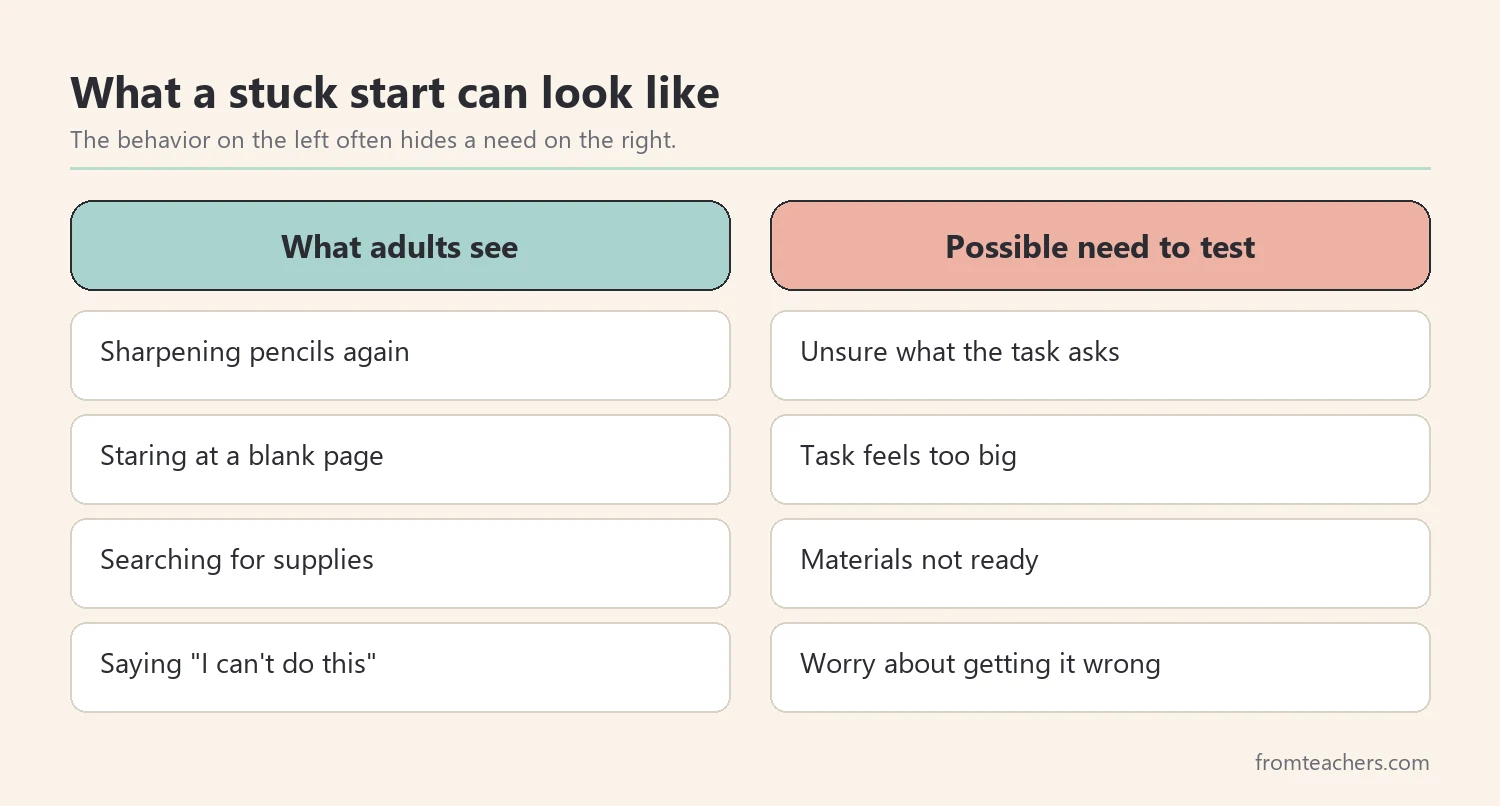
First, look closely at the moment before work begins. Avoidance often looks like sharpening pencils, searching for supplies, or chatting. However, the behavior usually hides a need. The student may be unsure what the task asks, overwhelmed by its size, missing materials, or worried about getting it wrong.
Next, collect a few days of quick notes. Write the subject, how long it took to start, and what the student did while stuck. Patterns usually appear fast. For instance, a student may start math easily but freeze on every writing task.
Then, ask the student. Questions like “What is the hardest part about starting?” or “What do you think about when you look at the page?” often give useful answers. Some students say the task looks huge. Others say they do not want to make a mistake.
| Day | Subject | Minutes to start | What I saw |
|---|---|---|---|
| Mon | Writing | 10 | Sharpened pencil, asked for water |
| Tue | Math | 2 | Started after one reminder |
| Wed | Writing | 8 | Stared at the prompt |
In addition, remember that difficulty with task initiation is common in students with ADHD, anxiety, and other executive function challenges. It is not a character flaw. Framing it as a skill to build changes how both adults and students talk about it.
Worked example. Nora, a fictional fourth grader, starts math within a couple of minutes but takes about nine minutes on average to start writing. When asked, she says, “I don’t know what to write first.” Her teacher decides the first target is understanding the task and shrinking the first step.
2. Teach students to look at the task and shrink the first step
Starting schoolwork gets easier once the student knows exactly what is being asked. So, the first step is to look: read or listen to the directions, check the visual schedule or task list, and notice the materials needed. Understanding the task lowers anxiety and prepares the brain to begin.
Next, shrink it. Ask the student to choose the easiest part, make the first step tiny, and tell themselves “Just start here.” Small steps feel doable and help motivation get going. For example, “Write a story” becomes “Write the name of my main character.”
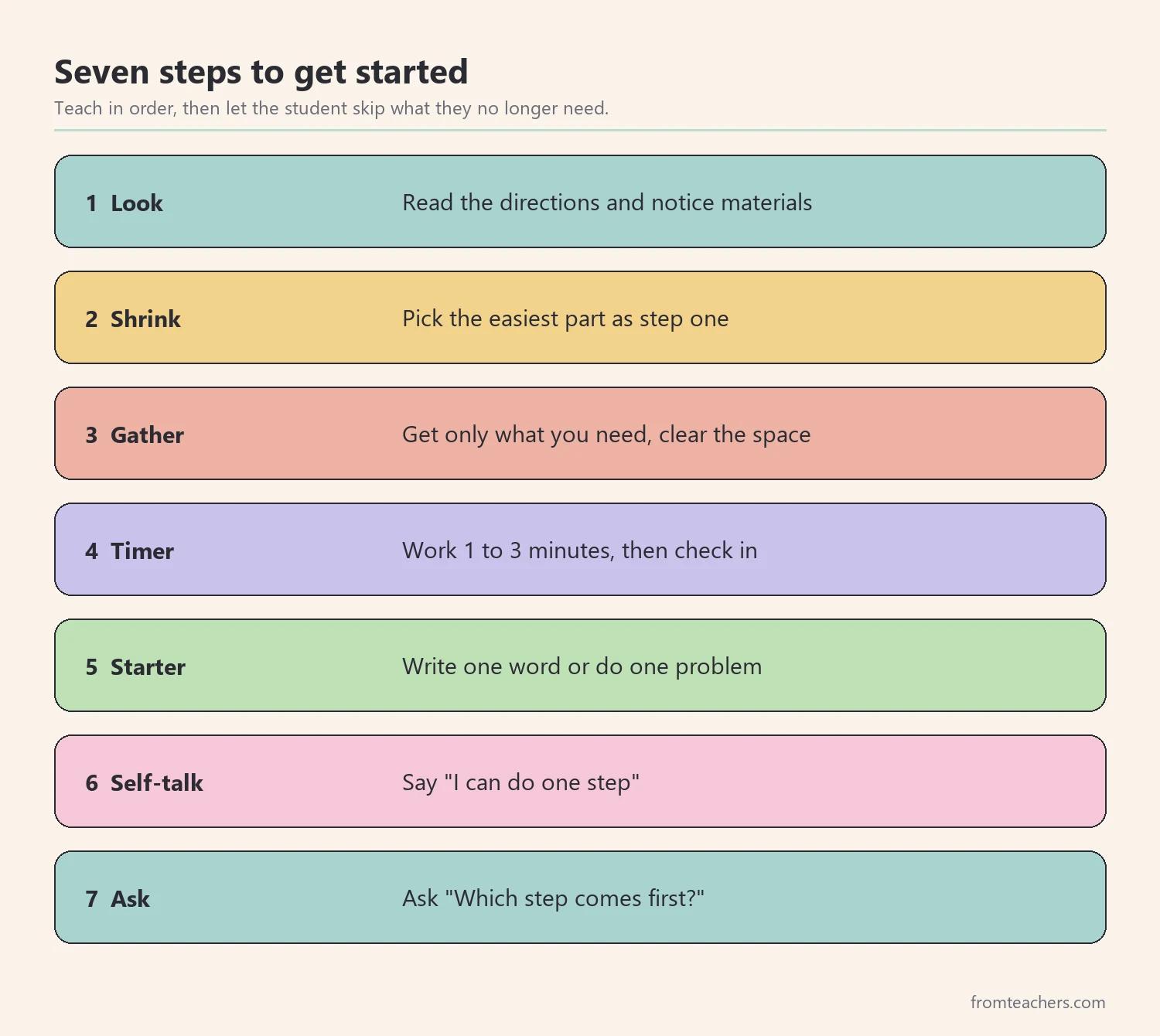
Use a short sequence of seven steps that the student can follow in order. Each step has a clear job and a reason. Over time, students can skip steps they no longer need.
Shrinking works for every subject. In math, the first step might be copying the first problem. For reading, it might be finding the page number. In science, it might be writing the title of the lab. When starting schoolwork feels this small, most students can do it.
Model it with a think-aloud
Teach the look and shrink steps with a think-aloud. Hold up a real assignment and say, “First, I read the directions. It says write three sentences about my weekend. The easiest part is saying where I went. My first step is just writing the word park.” Students need to hear what this sounds like.
A visual helps students follow the sequence without an adult beside them. The Task Initiation Steps poster with a “why this helps” note for each step lays out all seven steps in order, which makes it easy to point to during a think-aloud or a quiet reminder.
Worked example. During writing time, Nora’s teacher kneels beside her and asks her to read the prompt aloud. Together they underline the key words. Nora chooses her first tiny step: write the name of her dog.
3. Prepare materials and set a short timer
A ready workspace removes obstacles. Therefore, teach students to get only what they need, clear the workspace, and put away distractions. Searching for a missing eraser can easily become a reason not to start.
Next, prepare materials in advance when possible. A labeled folder with the paper, a pencil, and any word bank or graphic organizer saves time. For students who struggle most, place materials on the desk before the work period begins.
Then, use a very short timer. Try one to three minutes to begin. The student works until the timer rings, then may take a short break if needed. Timers create momentum and make starting feel less overwhelming, because the commitment is tiny.
Most students keep going after the timer ends once the hardest part, starting, is over. If they do stop, that is fine. They have already practiced the skill, and the next start will be easier.
| Timer length | When to use it |
|---|---|
| 1 minute | Very hard starts or new routines |
| 2 minutes | Most students learning the routine |
| 3 minutes | Students who start fairly well already |
Keep the timer predictable
Keep the timer predictable, too. Use the same timer, in the same spot, with the same words each time: “Two minutes, then we check.” Routine language becomes part of the cue, and starting schoolwork begins to feel automatic rather than like a new decision every lesson.
Choose a visual timer when you can. Seeing time pass helps many students more than hearing a beep at the end. Moreover, a visual timer is quiet, so it will not disturb classmates.
Worked example. Nora’s writing folder now holds lined paper, a pencil, and a small word bank. She sets a two-minute sand timer and writes until the sand runs out. On most days, she keeps writing after it ends.
4. Use starter strategies and positive self-talk for starting schoolwork
A starter strategy is any tiny action that turns stuck into moving. The idea is simple: starting anywhere helps the brain shift. The student does not need to start at the beginning; they just need to start.
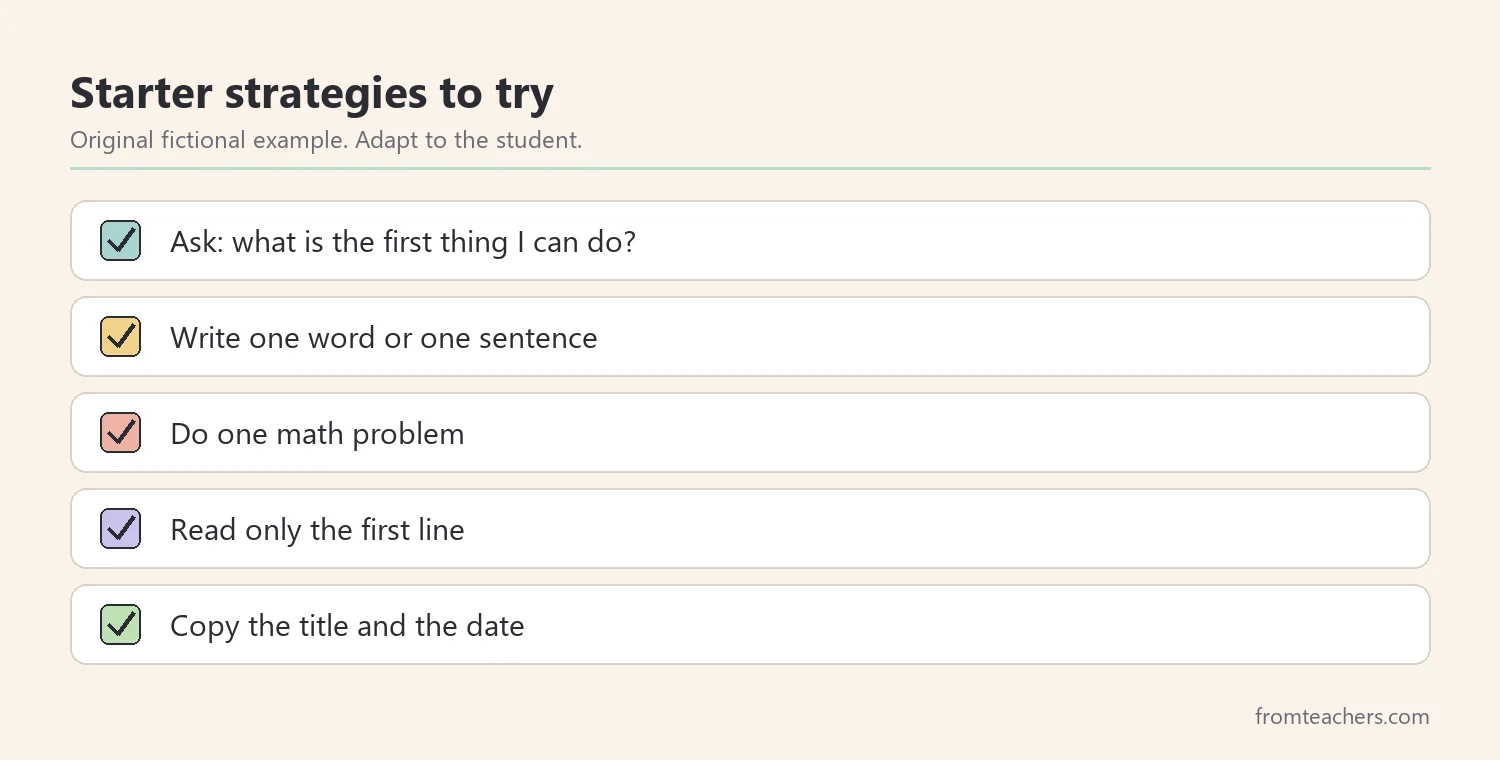
Teach a few options and let the student choose. “What is the first thing I can do?” is a great general question. Writing one word or one sentence, doing one math problem, or reading the first line all work well. Over time, the student learns which starter fits which subject.
Next, add positive self-talk. Many students who struggle with starting schoolwork carry thoughts like “I’ll never finish” or “I have to get it perfect.” Replace them with supportive phrases: “I can do one step.” “Starting is the hardest part.” “I don’t need to finish everything right now.”
Practice the phrases out loud at first, then quietly, then in the student’s head. Supportive thoughts calm the brain and make it easier to begin. In addition, model your own self-talk: “This email feels long. I’ll just write the first line.”
| Stuck thought | Starter phrase |
|---|---|
| This is too much. | I can do one step. |
| Everything has to be perfect. | I can fix it later. |
| I don’t know how to begin. | What is the first thing I can do? |
Worked example. Nora keeps a small card with three phrases in her folder. When she feels stuck, she reads “I can do one step” and writes the first word. By week three, she says the phrase quietly without looking at the card.
5. Teach help-seeking and track starting schoolwork progress
Sometimes a student is still stuck after trying every step. That is when asking for help is the right move. Teach clear phrases: “Can you help me start?” “Which step comes first?” “I’m not sure what to do next.” A quick prompt or model from an adult can unlock momentum.
Practice help phrases when the student is calm, just like starter phrases. Role-play a stuck moment and let the student choose the words. Asking early is better than waiting silently, so praise a quick request for help as a good choice, not a failure at starting schoolwork alone.
Make asking easy and safe. Some students prefer a help card on the desk to raising a hand. Respond quickly and keep your help small: show the first step, then step back.
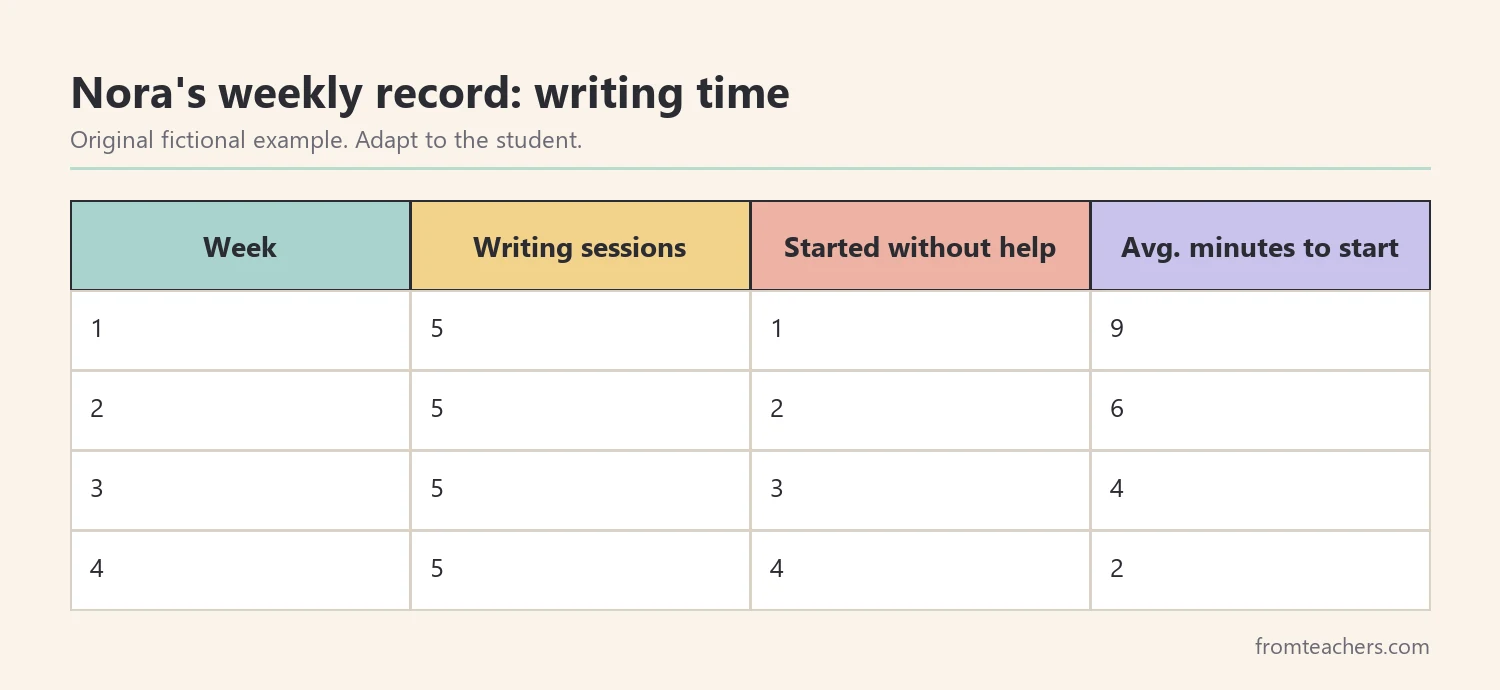
Next, keep a short weekly record. Count work sessions, how many the student started without adult help, and the average minutes to start. These numbers show whether the routine is working.
Track progress over time
In this example, Nora started 1 of 5 writing sessions without help in week one and 4 of 5 in week four. Her average time to start dropped from 9 minutes to 2. That trend means the team can begin fading support.
Fade one support at a time. For example, move from the teacher prompting the steps, to pointing at the poster, to Nora using her folder card alone. If starting slips during a busy week, add one support back for a few days.
Finally, share the record with the family and, where relevant, the IEP or 504 team. Families can use the same steps and phrases for homework so the routine is consistent across settings.
Worked example. After four weeks, Nora’s teacher shares the record at a family check-in. Her parents start using the two-minute timer for homework, and Nora’s team agrees to review again next month.
Common mistakes and how to avoid them
- Treating stuck starts as defiance. Fix: look for the need behind the behavior and test one idea.
- Giving the whole task at once. Fix: help the student pick one tiny first step.
- Setting a long timer. Fix: start with one to three minutes.
- Doing the first step for the student every time. Fix: show it once, then fade to a point or a wait.
- Not tracking progress. Fix: record minutes to start and starts without help each week.
Questions teachers and parents ask about starting schoolwork
Is trouble starting tasks a sign of ADHD?
Difficulty with task initiation is common in ADHD, but many students without ADHD struggle too. Only qualified professionals can evaluate for ADHD. You can still teach the skill to any student who needs it.
How long until a student starts on their own?
It varies widely. Many students show change within a few weeks of daily practice. Track minutes to start so you can see small improvements.
Should I let a student skip the hard part?
Starting with an easier part is fine and often helpful. The goal is to get moving, then return to the harder part with momentum. Make sure the whole task still gets completed over time.
What about students who say “I can’t”?
Acknowledge the feeling, then shrink the task: “It feels like a lot. What’s one word you could write?” Pair this with a starter phrase and a short timer.
Can the whole class use this routine?
Yes. Teaching the steps to everyone builds shared language and reduces stigma. Individual students can then get extra practice or a personal card.
Related reading: Demand avoidance and school refusal, ADHD classroom strategies for student success, and Special education strategies.
A companion resource for starting schoolwork:
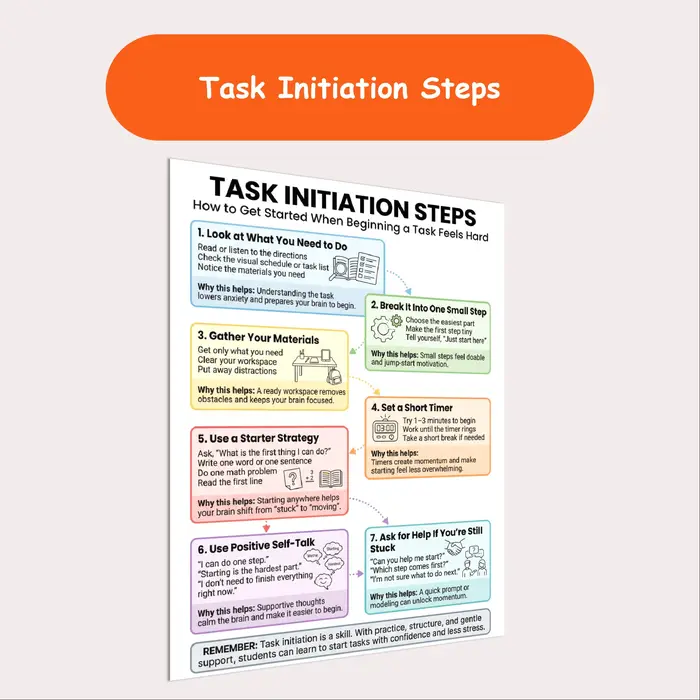
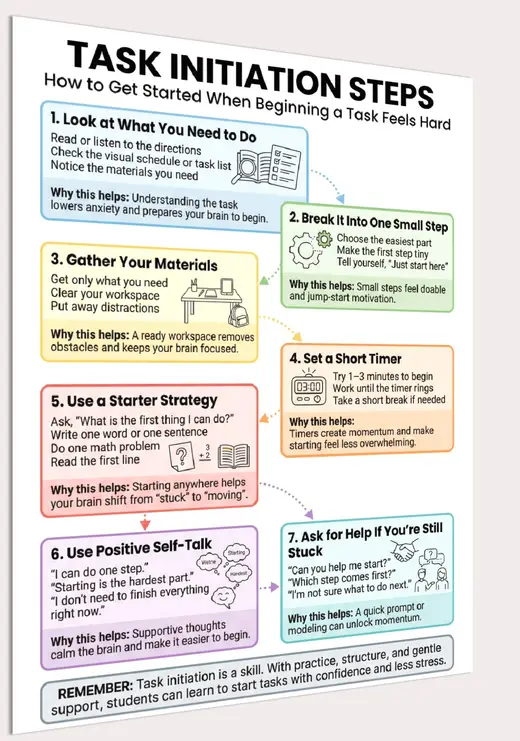
Task Initiation Steps Poster: a printable executive function poster that shows students how to get started when beginning a task feels hard. Seven steps, each with a “why this helps” note, for ADHD and special education support.
Sources and scope
- CHADD: information for families and educators on ADHD and executive function at school.
- Understood.org: practical articles on executive function, including getting started on tasks.
- IRIS Center, Vanderbilt University: free modules on self-regulation and evidence-based practices.
- IDEA, U.S. Department of Education: the law behind special education services and IEPs.
This guide covers everyday classroom and home strategies for getting started on tasks. It does not cover diagnosis or evaluation of ADHD or anxiety, which belong to qualified professionals.
Key takeaways
- Starting schoolwork is a teachable skill, not a motivation problem.
- Look at the task, then shrink the first step until it feels doable.
- Prepare materials and use a one to three minute timer.
- Use starter strategies, kind self-talk, and clear help phrases.
- Track minutes to start and fade support one step at a time.








Leave a Comment