

Cognitive flexibility for students means being able to shift plans, see another way, and adapt when something changes. Picture a seventh grader who learns that the science lab is canceled and the class will watch a video instead. He argues, refuses to take out his notebook, and repeats, “But we were supposed to do the lab.” For him, the change feels like the whole day has gone wrong.
This guide gives you five steps to build cognitive flexibility for students: spot rigid patterns, name them, teach flexible strategies, prepare for change, and practice with review. By the end, you will be able to help students loosen fixed thinking and adapt with less stress.
Examples are fictional. Adapt to the student’s goals and agreed supports. This is guidance, not a diagnosis.
At a glance
- Rigid thinking often shows up when plans change, rules shift, or a problem has more than one answer.
- Naming the thinking pattern helps students step back from it.
- Flexible thinking can be taught with short, repeatable strategies.
- Previewing change and planning a Plan B lowers stress.
- Regular, low-stakes practice turns strategies into habits.
1. Spot rigid thinking patterns
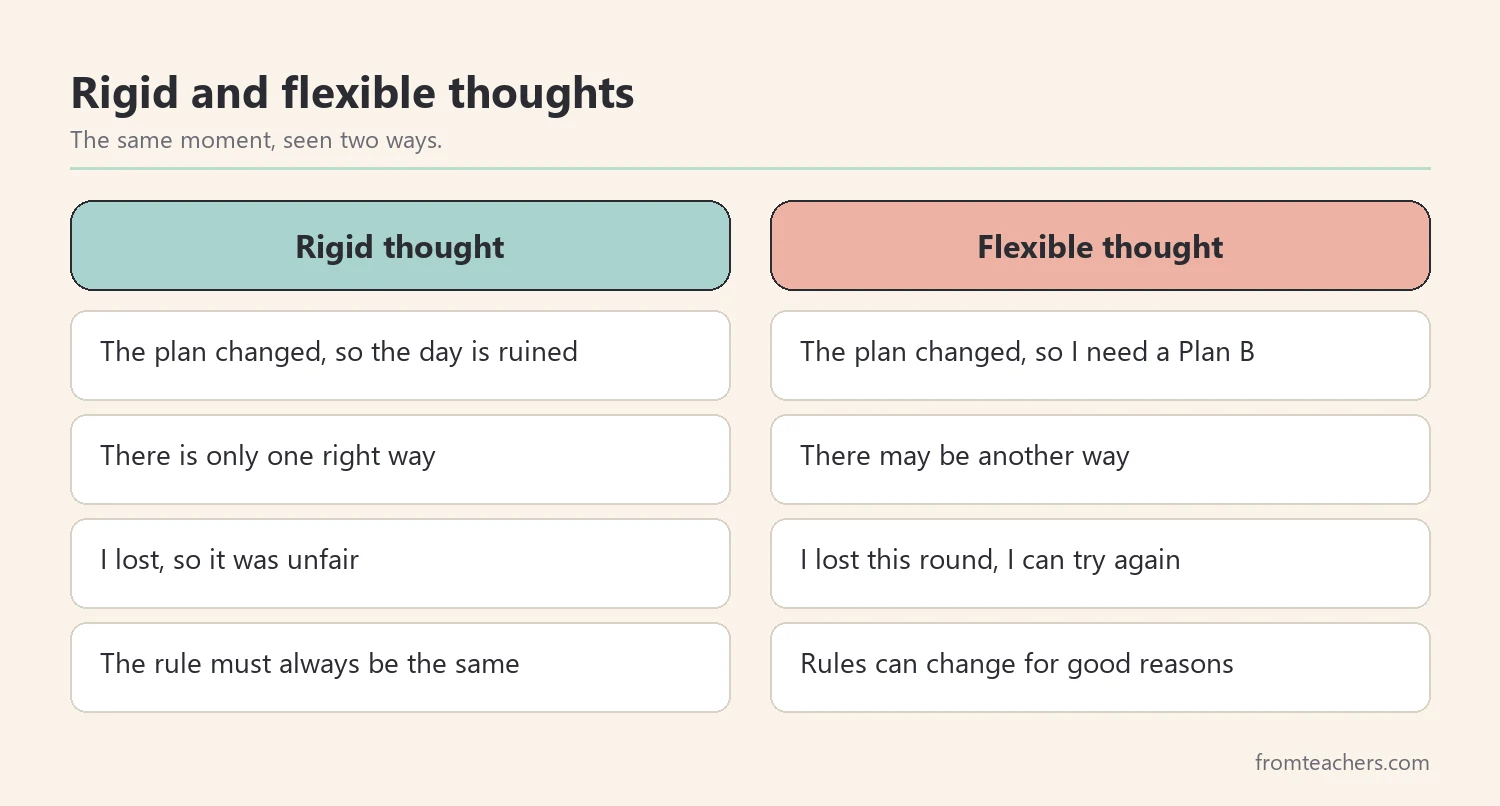
First, notice where students get stuck. Rigid thinking often appears when a plan changes, a rule is applied differently, a game is lost, or a problem has more than one correct answer. Students may argue, shut down, repeat the same point, or insist there is only one right way.
Next, look for common triggers. Unexpected schedule changes, substitute teachers, new seating, group work, and open-ended tasks are frequent ones. Some students cope well with routine and struggle as soon as something shifts. Knowing these triggers lets you plan cognitive flexibility for students around the moments that matter most, instead of reacting after each one.
Also, notice what the rigidity protects. For many students, a fixed plan feels safe and predictable. When the plan breaks, they feel anxious or out of control. So, building cognitive flexibility for students is less about changing their personality and more about giving them tools to feel safe during change.
Keep short, factual notes
In addition, keep short, factual notes. Write the situation, what the student said or did, and how long it took to recover. “Lab canceled, argued for six minutes, joined after a choice was offered” tells you much more than “inflexible.” Over a few weeks, these notes show whether your work on cognitive flexibility for students is making recovery faster.
Then, look for strengths, too. Students who like rules and routines are often reliable, careful, and good with detail. Good plans for cognitive flexibility for students build on these strengths instead of fighting them.
Worked example. Jonah is a fictional student in grade 7. His teacher, Ms. Chen, notices that he does well with clear routines but struggles with change. Over two weeks, she records 6 moments of rigid reactions: 3 after schedule changes, 2 during group work, and 1 after losing a class game.
2. Name the thinking pattern together
Next, help the student notice their own thinking. Naming a pattern creates a small distance from it. Instead of “I’m right and everyone else is wrong,” the student can learn to think, “This is my stuck thinking showing up.”
For example, use simple, neutral names. “All-or-nothing thinking” describes seeing only perfect or ruined. “One-right-way thinking” describes believing there is only one correct method. “Stuck on the plan” describes difficulty when plans change. Keep the language kind and never mocking.
Also, talk at a calm time, not in the middle of a reaction. A short chat after class works well. Ask, “When the plan changed today, what did your brain tell you?” Then offer one of the pattern names and ask if it fits.
Show that everyone gets stuck
Meanwhile, share that everyone has stuck thinking sometimes. Model it yourself: “I planned to use the projector, and it broke. My first thought was that the lesson was ruined. Then I remembered I could use the board.” This shows that cognitive flexibility for students is a skill adults use, too.
In addition, write the pattern names on a small card the student can keep. Over time, the student can point to the card instead of explaining, which is easier when feelings run high. Naming patterns is often the first visible sign that cognitive flexibility for students is starting to grow.
Worked example. After class, Ms. Chen asks Jonah what happened when the lab was canceled. He says, “It was supposed to be the lab. Now the day is ruined.” Ms. Chen shows him a card with three pattern names. Jonah picks “stuck on the plan” and adds, “and all-or-nothing.”
3. Teach strategies for cognitive flexibility for students
Once students can name the pattern, teach a few strategies they can use. Keep the list short. Two or three strategies, practiced often, work better than ten that are rarely used.
For example, “Plan B” teaches students that most plans have a backup. “More than one way” invites students to find a second method for solving a problem. “Big deal or little deal” helps students size a problem before reacting. Each strategy gives the student a concrete action instead of a vague instruction to “be flexible.” Concrete actions are what make cognitive flexibility for students teachable, because the student knows exactly what to do next.
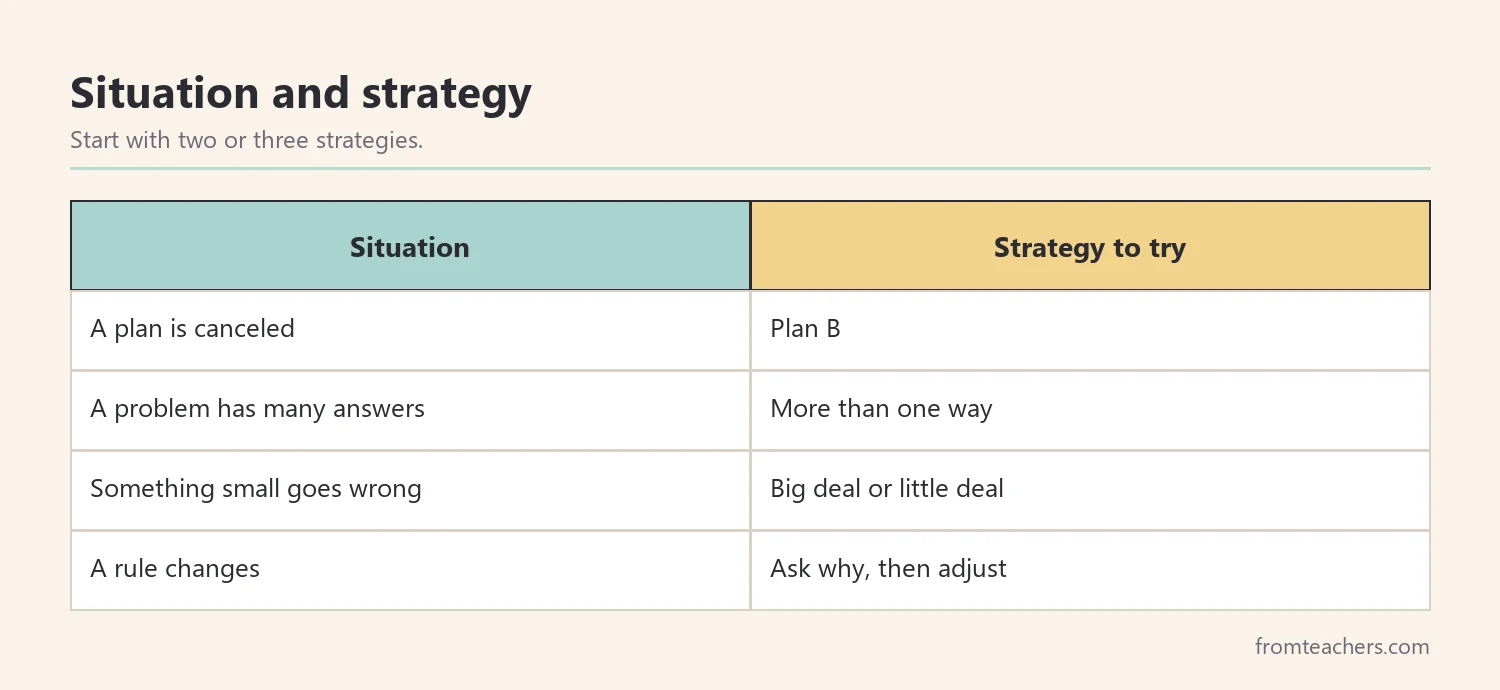
Also, model each strategy out loud during real moments. “Our assembly got moved. Plan B is that we’ll start the reading early.” When students hear adults think flexibly, the strategies feel normal and useful.
For a ready-made set of responses, the cognitive flexibility training strategy tables offer 12 tables with clear, step-by-step responses for moments like unexpected change and fixed mindsets, which saves planning time.
Meanwhile, practice with low-stakes puzzles and games. Riddles with more than one answer, “what else could this be?” picture tasks, and games where rules change halfway are fun ways to build cognitive flexibility for students without pressure.
Worked example. Ms. Chen teaches Jonah two strategies: Plan B and big deal or little deal. They practice with a game where the rules change every five minutes. At first, Jonah protests. By the third round, he says, “Okay, Plan B,” and keeps playing.
4. Prepare for unexpected change
Next, reduce the shock of change. Many students cope better when they know change is possible. A simple preview, such as “Today’s plan might change, and if it does, we’ll use Plan B,” prepares the brain before anything happens.
Also, use a visual schedule with a space for changes. A small “change” card or a question mark slot shows that changes are a normal part of the day. When a change happens, move the card and explain the new plan calmly.
In addition, teach a short calm-down routine for the moment a change hits. One simple routine has four steps: stop, breathe, list options, and choose one. Practice it when students are calm, so it is ready when they are not.
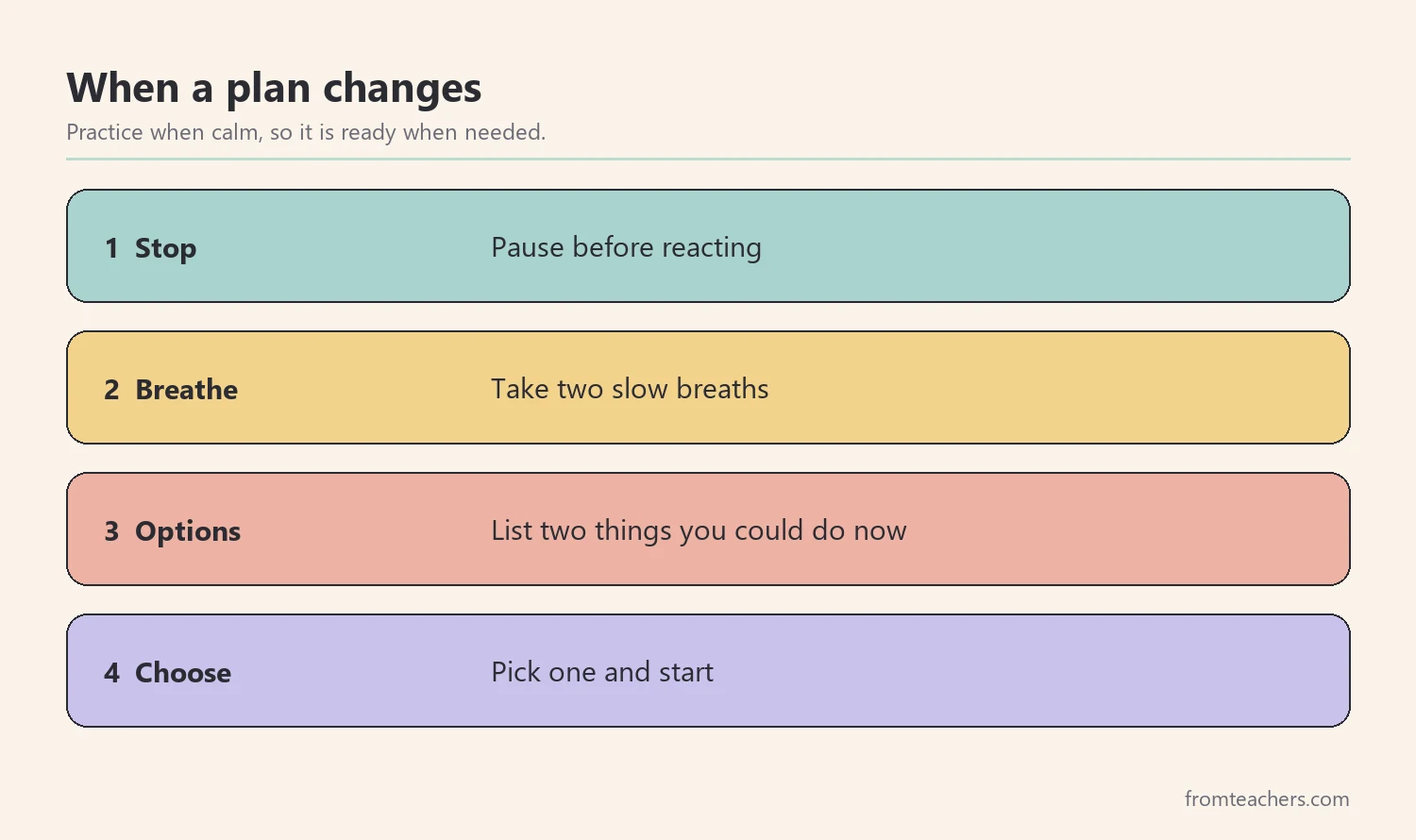
Meanwhile, give choices within the change. “The lab is canceled. Would you like to take notes on the video or draw a diagram?” A choice returns a sense of control, which helps cognitive flexibility for students grow during real moments of stress.
Then, praise the recovery, not just the result, because recovery is where cognitive flexibility for students becomes visible. “You were upset when the plan changed, and you used your Plan B. That was flexible thinking.” Specific praise shows students exactly what to repeat.
Worked example. Ms. Chen adds a change card to the class schedule. One morning, an assembly moves to a different time. She says, “Change card. Plan B is reading first.” Jonah frowns, uses his stop and breathe steps, and joins the reading after about two minutes.
5. Practice and review cognitive flexibility for students
Finally, build practice into the week. Short, regular practice works better than one long lesson. A two-minute warm-up with a flexible-thinking puzzle, a quick Plan B question, or a “find another way” math problem keeps the skill active.
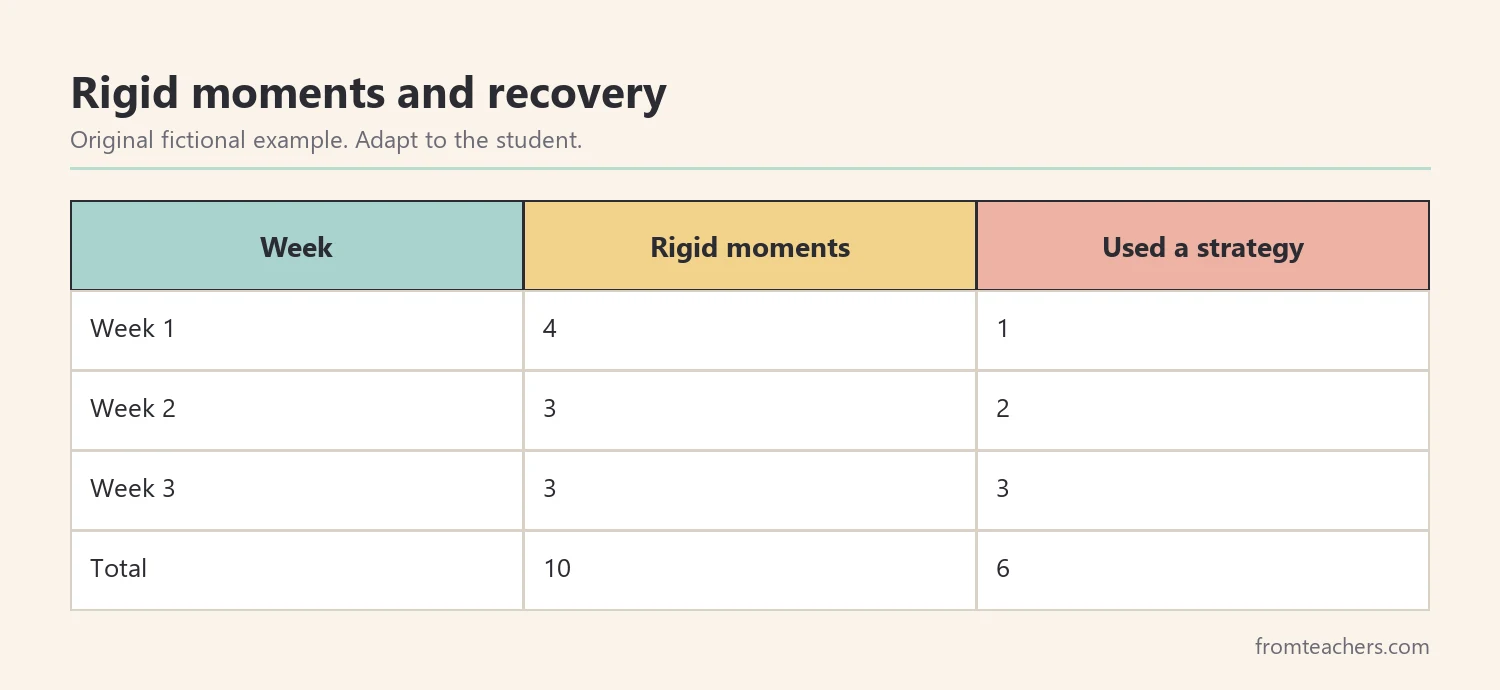
Also, keep a simple record. Track how many rigid reactions happen each week and how many times the student used a strategy to recover. A few tally marks are enough.
Next, review with the student. Ask, “Which strategy helped most?” and “When was it hardest to be flexible?” This reflection builds self-awareness, which supports long-term growth. Students who can describe their own progress tend to use their strategies more often, and that habit is the real goal of any plan for cognitive flexibility for students.
Bring families into the practice
In addition, share progress with the family. Parents can use the same strategy names at home, such as Plan B for a canceled outing. Consistent language at school and home helps cognitive flexibility for students grow faster.
Then, fade prompts slowly. Move from adult reminders to a pointed card, then to the student naming the strategy on their own. If stress rises during a busy season, bring supports back for a while. That is normal.
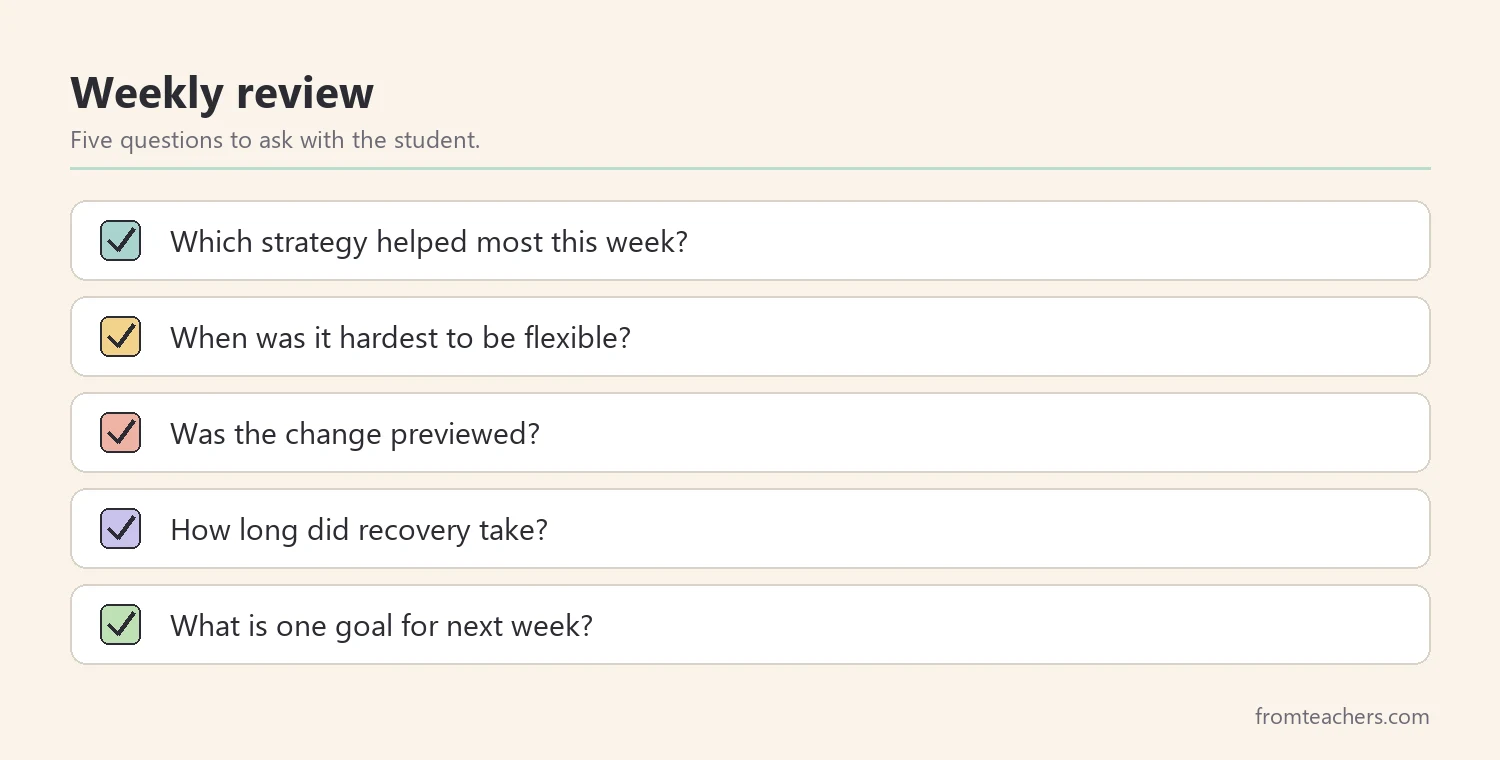
Worked example. Ms. Chen tracks Jonah for three weeks. In week 1, he had 4 rigid moments and used a strategy in 1. By week 2, he had 3 rigid moments and used a strategy in 2. In week 3, he had 3 rigid moments and used a strategy in all 3. Across three weeks, that is 6 of 10 moments with a strategy, and his recovery time is shorter.
When rigid thinking needs a wider team
Sometimes, rigid thinking is very strong, causes daily distress, or appears across home, school, and friendships. In those cases, share your notes with the family and the student’s support team.
Also, check whether the student’s plan includes supports for change and goals for cognitive flexibility for students, such as visual schedules or previews. Your records give the team useful evidence for that conversation.
Finally, keep classroom routines kind and predictable. Building cognitive flexibility for students works best when they also feel safe.
Common mistakes and how to avoid them
- Telling students to “just be flexible.” It names the goal but not the action. Fix: teach a specific strategy.
- Teaching during a meltdown. Students cannot learn new skills when upset. Fix: teach at calm times.
- Surprising students with every change. Shock increases resistance. Fix: preview that change is possible.
- Using too many strategies. None become habits. Fix: start with two or three.
- Treating rigidity as defiance. It often reflects anxiety. Fix: respond calmly and offer choices.
- Skipping practice. Skills fade without use. Fix: build short practice into each week.
Questions teachers and parents ask about cognitive flexibility for students
What is cognitive flexibility?
It is the ability to shift thinking, switch between tasks, and adapt when plans or rules change. It is often described as one part of executive function, alongside skills like working memory and self-control.
Can flexible thinking really be taught?
Yes. Students can learn and practice specific strategies, such as Plan B or finding another way. Progress is usually gradual, so regular practice and patience matter.
Is rigid thinking a sign of autism?
Rigid thinking can be part of many profiles, and it also appears in students without any diagnosis. Only qualified professionals can diagnose. Your role is to observe, support, and share concerns with the team.
How can parents help at home?
Parents can preview possible changes, use the same strategy names as school, and praise flexible moments. Small games where rules change are a fun way to practice together.
What age is best to start?
Any age. Younger children can practice simple “Plan B” games, while older students can learn to name their thinking patterns. Adjust the language and examples to the student.
Related reading: Spectrum Voices: Essential Strategies for Navigating High-Functioning Autism, Meltdowns vs Tantrums: A Guide to Understanding and Responding, and Bridging Gaps in Special Education: Practical Strategies for Teachers.
A companion resource for cognitive flexibility for students:
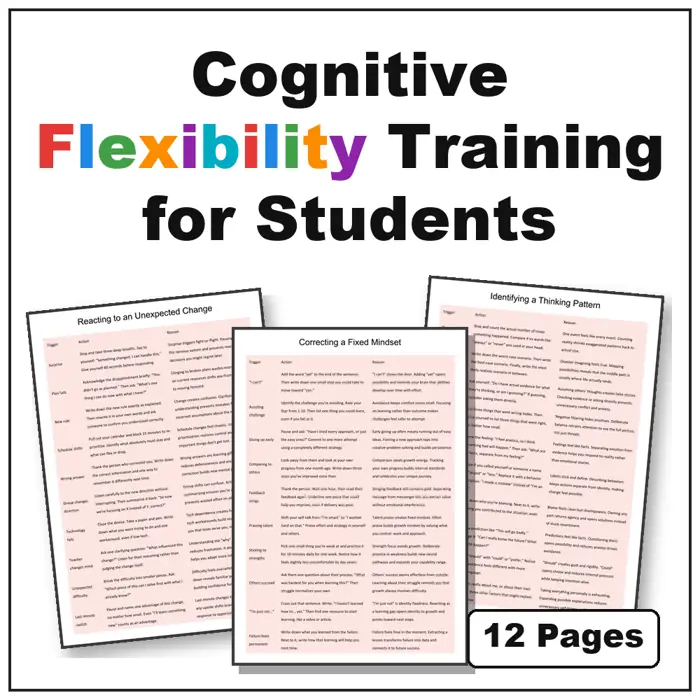
Cognitive Flexibility Training for Students: Flexible Thinking Strategies: 12 strategy tables with clear, step-by-step responses that help students loosen fixed thinking and adapt with less stress when plans change or a problem has more than one answer.
Sources and scope
- Center on the Developing Child, Harvard University: information on executive function, including cognitive flexibility.
- Understood.org: family-friendly information on learning and thinking differences.
- IRIS Center, Vanderbilt University: free modules on behavior and classroom supports.
- Child Mind Institute: articles for families and educators on anxiety, behavior, and learning.
This guide covers practical classroom and home strategies for students who struggle with change and fixed thinking. It does not replace evaluation, diagnosis, or the decisions of the student’s support team.
Key takeaways
- Cognitive flexibility for students can be taught with short, concrete strategies.
- Name thinking patterns kindly, at calm times.
- Preview change and teach a Plan B routine.
- Offer choices within changes to restore a sense of control.
- Practice weekly, track recovery, and fade prompts slowly.










Leave a Comment