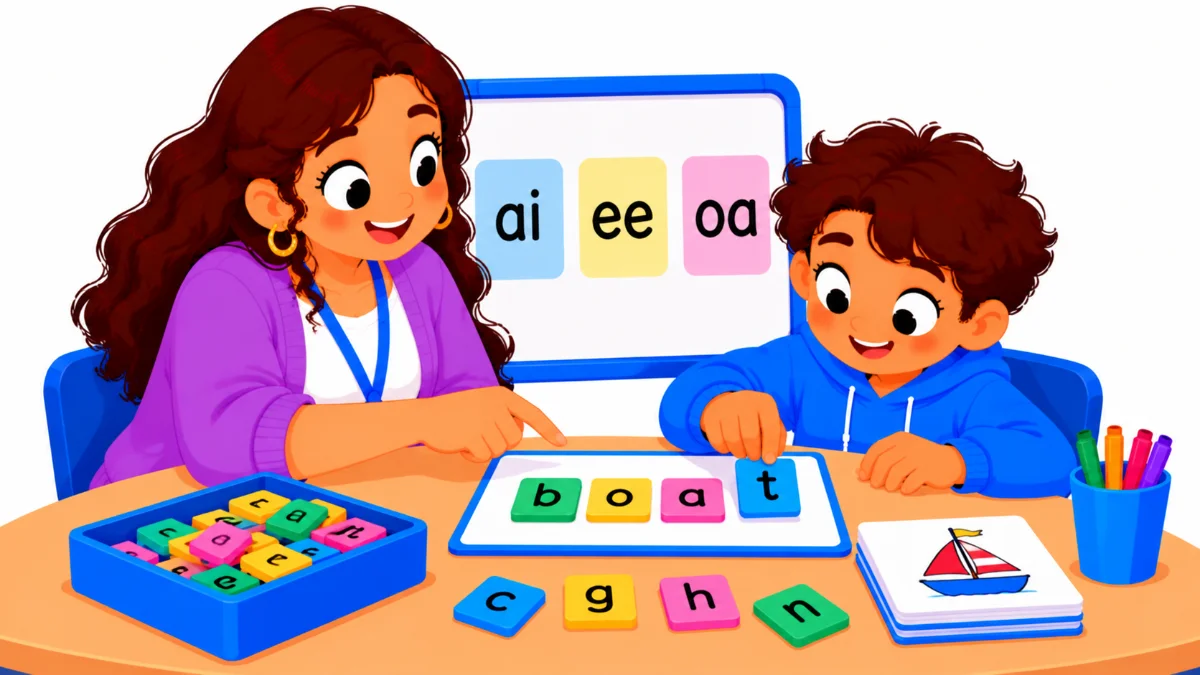

Teaching vowel teams is often the point where a struggling reader either gains real momentum or starts guessing again. Picture a grade 3 intervention group. Owen, who has dyslexia, reads “cat,” “map,” and “cake” with confidence, then meets “boat,” says “bot,” and glances at the pictures for a clue.
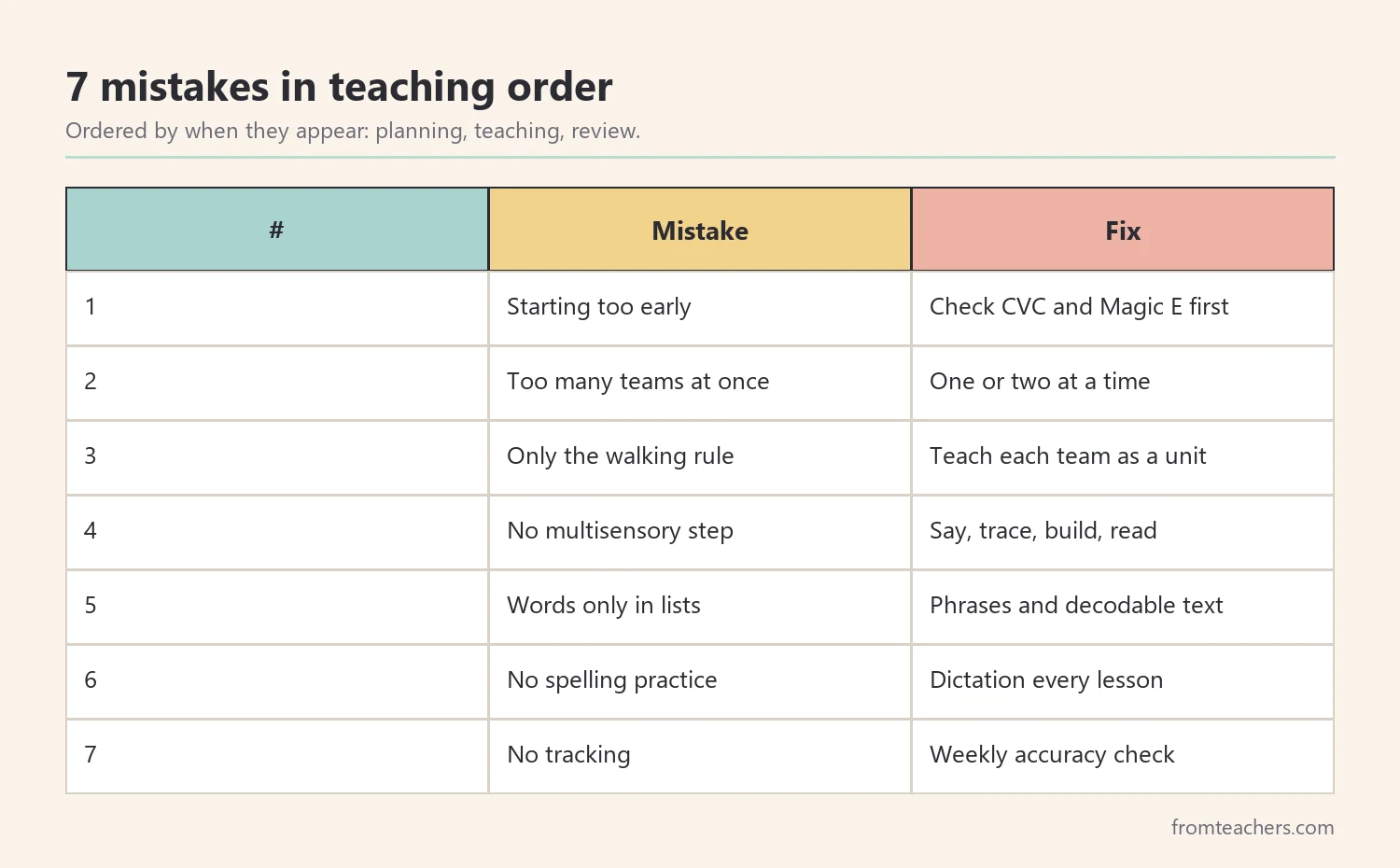
This list covers seven common mistakes to avoid when teaching vowel teams, ordered by when they usually appear in an intervention sequence, from planning to practice to review. By the end, you will know how to check readiness, introduce teams in a clear order, practice with multisensory routines, and track progress without guessing.
Examples are fictional. Adapt to the student’s goals and agreed supports. This is guidance, not a diagnosis.
At a glance
- Check that CVC and Magic E words are secure before vowel teams.
- Introduce one or two vowel teams at a time.
- Teach each team as a unit, not with a rule that often fails.
- Use multisensory routines and move to decodable text.
- Pair reading with dictation and track accuracy weekly.
How we ordered these mistakes
We did not rank these mistakes by how “bad” they are, because that would be a made-up score. Instead, they follow the order in which they tend to happen during teaching. The first mistakes occur before the first vowel team lesson. The middle ones occur during instruction. Then, the last ones occur when you review and move on.
Therefore, you can use the list as a checklist for planning a whole unit. Each item includes what goes wrong, why it matters, and what to do instead, with Owen as a running example.
The ready-made option: a structured phonics guidebook
If you want a complete sequence instead of building one from scratch, the CVC, Magic E and Vowel Teams bundle for dyslexia intervention is a 55-page professional guidebook. It covers understanding dyslexia and the science of reading, foundations of structured literacy with multisensory techniques, step-by-step teaching sequences for CVC words, Magic E, and vowel teams, and assessment and progress monitoring guidance.
It also includes a sample twelve-week curriculum plan and seven printable templates. That makes it a practical backbone for the routines described below.
1. Starting vowel teams before CVC and Magic E are secure
What goes wrong: vowel teams build on earlier patterns. If a student still confuses short vowels or misreads silent e words, adding two-letter vowel spellings increases the load quickly.
Why it matters: structured literacy approaches teach skills in a planned sequence, from simpler to more complex patterns. Skipping ahead often leads to guessing.
What to do instead: check readiness with a short list of mixed CVC and CVCe words. If the student reads most of them accurately and without long pauses, move on. If not, spend a little more time on the earlier patterns.
Example: Owen read nearly all CVC words correctly but mixed up “hop” and “hope.” His tutor, Ms. Grant, added one more week of CVC versus CVCe minimal pairs before starting vowel teams.
2. Teaching too many vowel teams at once
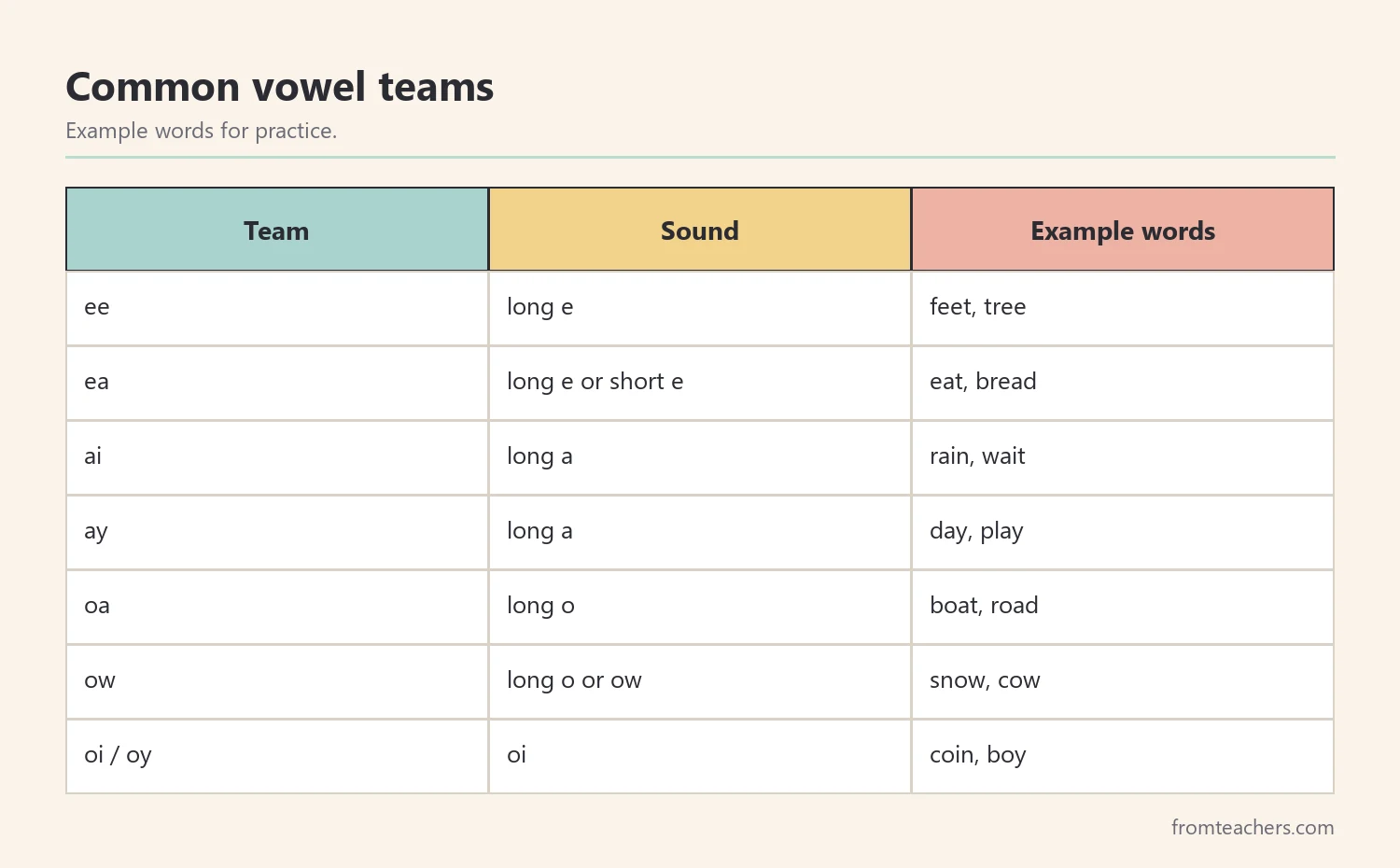
What goes wrong: introducing ai, ay, ee, ea, oa, and ow in the same week can blur them together.
Why it matters: students with dyslexia often need many practice opportunities to connect a spelling to a sound. Too many new spellings reduce the practice each one gets.
What to do instead: introduce one or two teams at a time, often grouped by sound. For example, teach ee first, then ea as another spelling for the same sound. Add a new team only when the previous one is fairly secure.
Example: Ms. Grant started with ee and ai, then added ay and oa over the next weeks. Owen practiced each pair for several sessions before anything new appeared.
3. Relying only on the “two vowels go walking” rule
What goes wrong: the rhyme says the first vowel does the talking. It works for words like “rain” and “boat,” but many common words break it, such as “bread,” “book,” and “said.”
Why it matters: when a rule fails often, students may stop trusting phonics and go back to guessing.
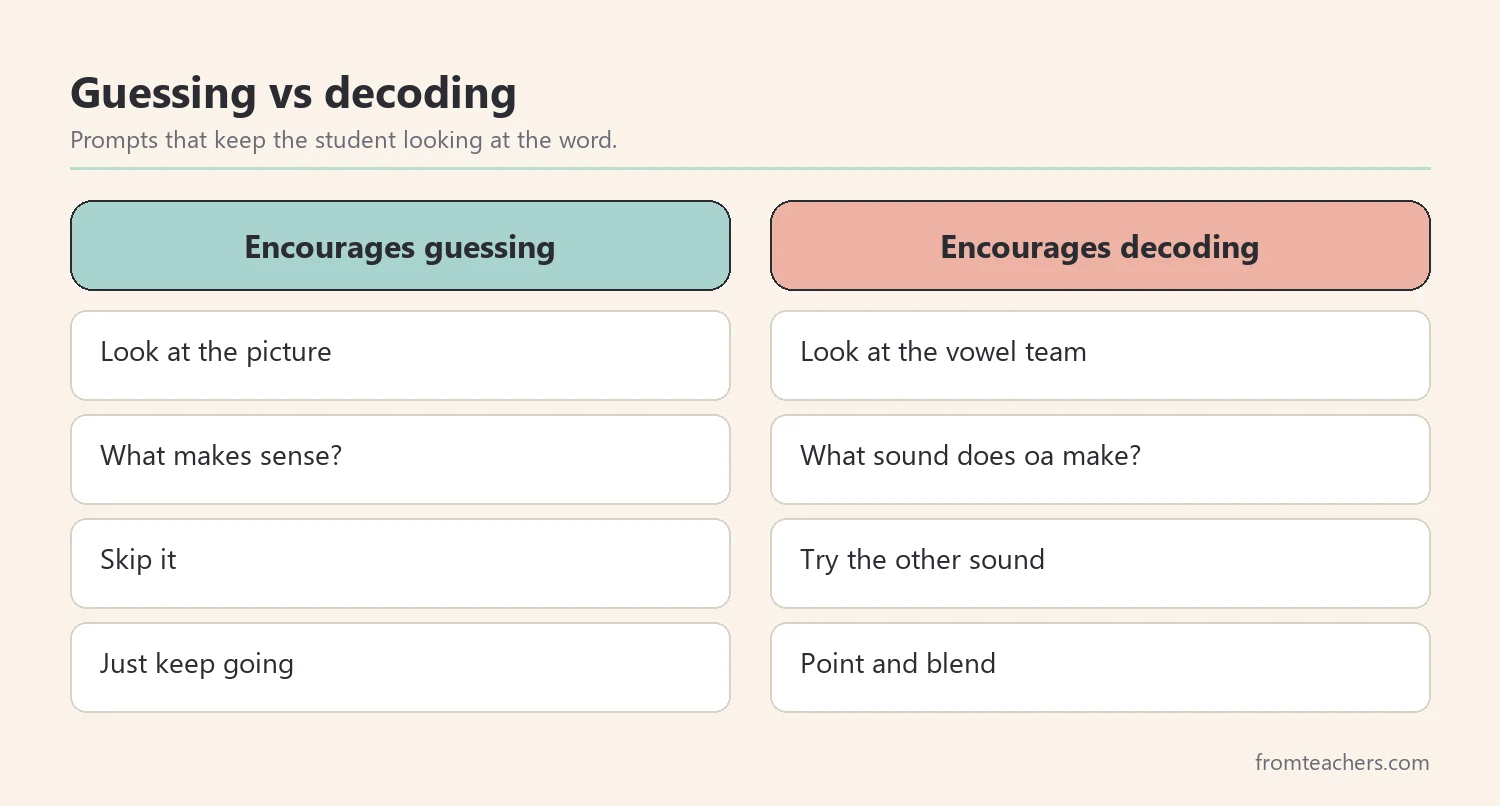
What to do instead: teach each vowel team as a unit with its own sound or sounds. For teams with more than one common sound, such as ea or ow, teach students to try the most common sound first, then the other, and check which makes a real word.
Example: When Owen read “snow” as “snou,” Ms. Grant prompted, “ow has two sounds. Try the other one.” Owen tried again and read “snow.”
4. Skipping the multisensory step
What goes wrong: the student only looks at flashcards and says the sound.
Why it matters: structured literacy often uses multisensory routines, such as saying, tracing, writing, and building words with tiles, so the student links the spelling and sound through several channels.
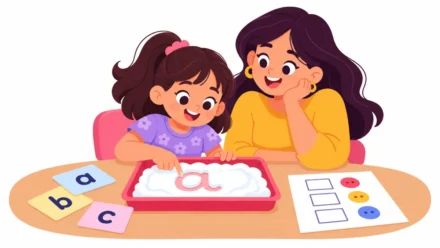
What to do instead: for each new team, have the student see it, say the sound, trace or write it while saying the sound, and build words with letter tiles. Then read those words in short phrases.
Example: Owen wrote “ai” in large letters on a whiteboard while saying the sound, then built “rain,” “pail,” and “wait” with tiles. The tiles made the two-letter team feel like one unit.
5. Practicing words only in isolation
What goes wrong: the student reads lists well but stumbles when the same words appear in a story.
Why it matters: the goal is reading connected text. Word lists are a step, not the destination.
What to do instead: move from words to phrases to decodable sentences and short texts that use the taught patterns. Mix in earlier patterns so the student has to look carefully at each word.
Example: After word lists, Owen read phrases like “a green tree” and “wait for the train,” then a short decodable passage. His accuracy dipped at first, then rose within a week.
6. Not teaching spelling alongside reading
What goes wrong: the student reads “boat” but writes “bote.”
Why it matters: spelling asks the student to choose between several spellings for the same sound. Without practice, that choice stays random.
What to do instead: include short dictation in every lesson. Start with words that use only one spelling for a sound, then add choices with simple guidance, such as “ay often comes at the end of a word, ai often comes in the middle.”
Example: Owen practiced sorting “day,” “rain,” “play,” and “train” into ai and ay columns. After a few sessions, his written spelling improved, too.
7. Not tracking progress
What goes wrong: the team relies on impressions such as “he’s getting it.”
Why it matters: progress monitoring shows when to move on, when to reteach, and how to report to families and the IEP team.
What to do instead: once a week, ask the student to read a short list of taught vowel team words and a few review words. Record the number correct. Also note any patterns in errors.
Example: Here is Owen’s weekly check across five weeks.
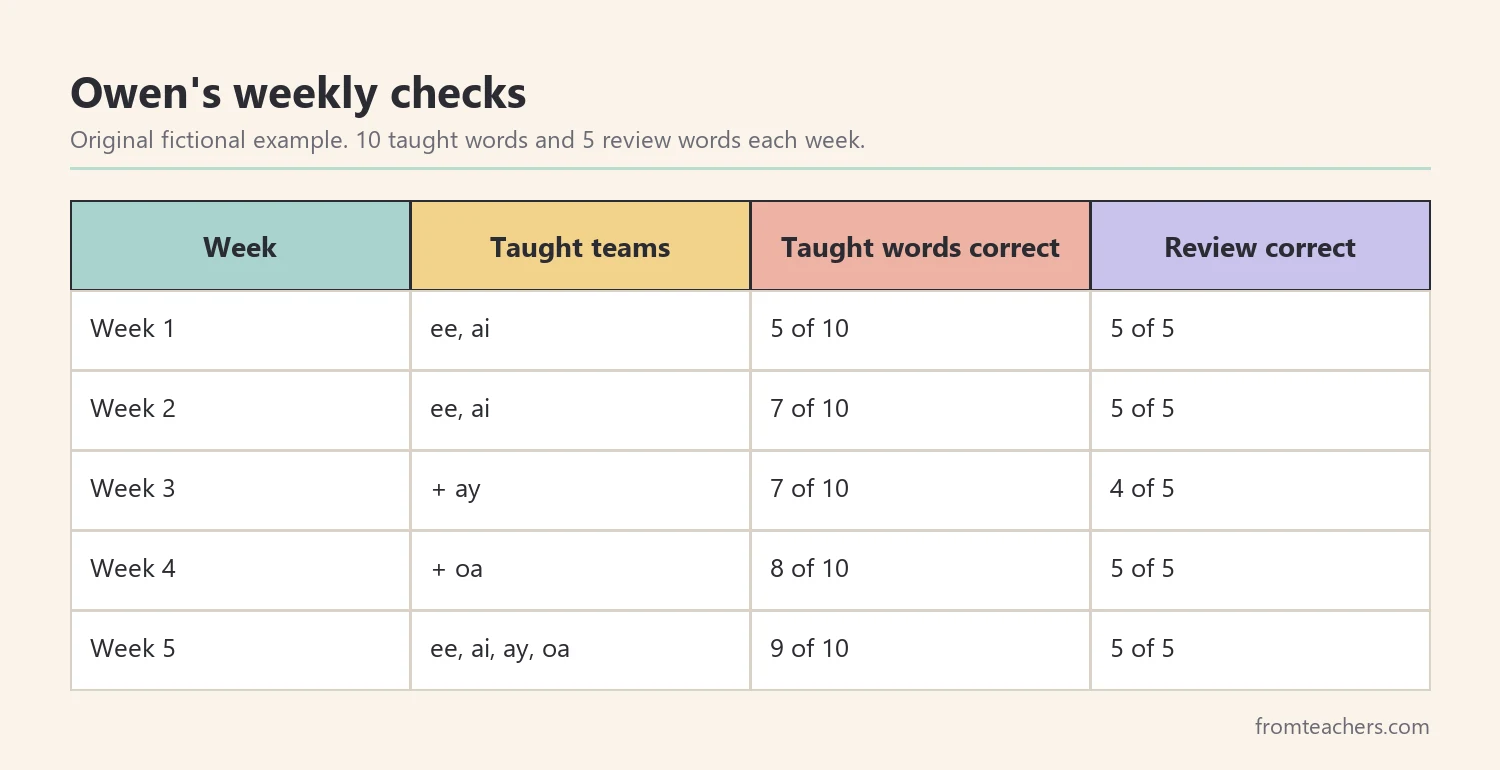
The pattern was clear. Accuracy on taught teams rose steadily, while review words stayed high. That told Ms. Grant the pace was right, so she added two new teams in week six.
A simple lesson flow for teaching vowel teams
Most sessions can follow the same short structure. Consistency lowers the load for the student, because they know what comes next. Here is a four-part flow that many structured literacy lessons share.
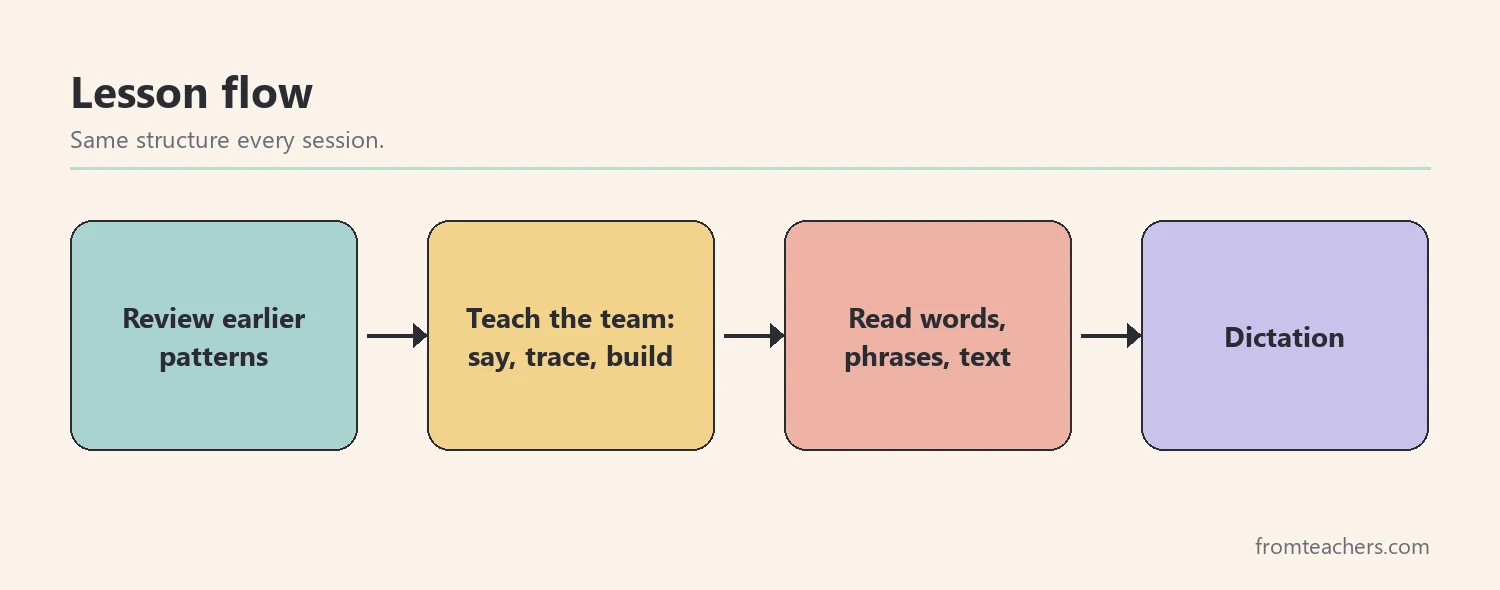
First, review earlier patterns for a few minutes. Next, introduce or practice the target team with a multisensory routine. Then read words, phrases, and a decodable text. Finally, finish with dictation. A session of this kind fits comfortably in a typical small-group intervention block.
In addition, keep a simple record after each session: which teams were practiced, how accurate the student was, and what to review next time. These notes make it much easier to adjust the next lesson.
Supporting the student beyond the lesson
Teaching vowel teams goes faster when the classroom and home support the same patterns. Share the current teams with the classroom teacher so they can point them out during reading. Moreover, send home a short list of words and a decodable text for practice.
Also, protect confidence. Students with dyslexia have often experienced a lot of failure with reading. Celebrate accurate reading, not speed, and remind the student that patterns can be learned. Owen’s family kept a “words I can read” list on the fridge, and he added to it every week.
In addition, keep the materials age-respectful. Older students working on early patterns may feel embarrassed by texts written for young children. Choose decodable passages with mature topics where you can, and explain the purpose of each activity. When students understand why they are practicing, they usually engage more.
Finally, coordinate with the team. Reading specialists, special education teachers, and speech-language pathologists may all be working on related skills. Sharing the sequence avoids mixed messages.
Questions teachers and parents ask about teaching vowel teams
Which vowel teams should I teach first?
Many programs begin with common, fairly consistent teams such as ee, ai, ay, and oa, then move to teams with more than one sound, such as ea, ow, and oo. Follow the sequence in your chosen program for consistency.
How long should a student practice each team?
It varies. Move on when the student reads and spells the pattern accurately in words and sentences, not on a fixed calendar date. Weekly checks help you decide.
Are vowel teams the same as diphthongs?
Not exactly. “Vowel team” describes a spelling of two or more letters. Some vowel teams spell a diphthong, a sound that glides, such as oi in “coin,” while others spell a single long vowel sound, such as ee in “feet.”
Should I use nonsense words?
Some teachers use short nonsense words to check decoding, because the student cannot rely on memory. Use them sparingly and explain that they are “silly words” for practice.
Can parents help with teaching vowel teams at home?
Yes. Short, positive practice with the words and texts sent from school works well. Five to ten minutes of reading together is more helpful than a long, stressful session.
Related reading: Dyslexia Solutions in the Classroom, Dyslexia in Education: Understanding, Innovating, and Empowering, and The Power of Data Tracking in Special Education.
You may also need: Multisensory Learning Strategies for Children with Dyslexia.
A companion resource for teaching vowel teams:
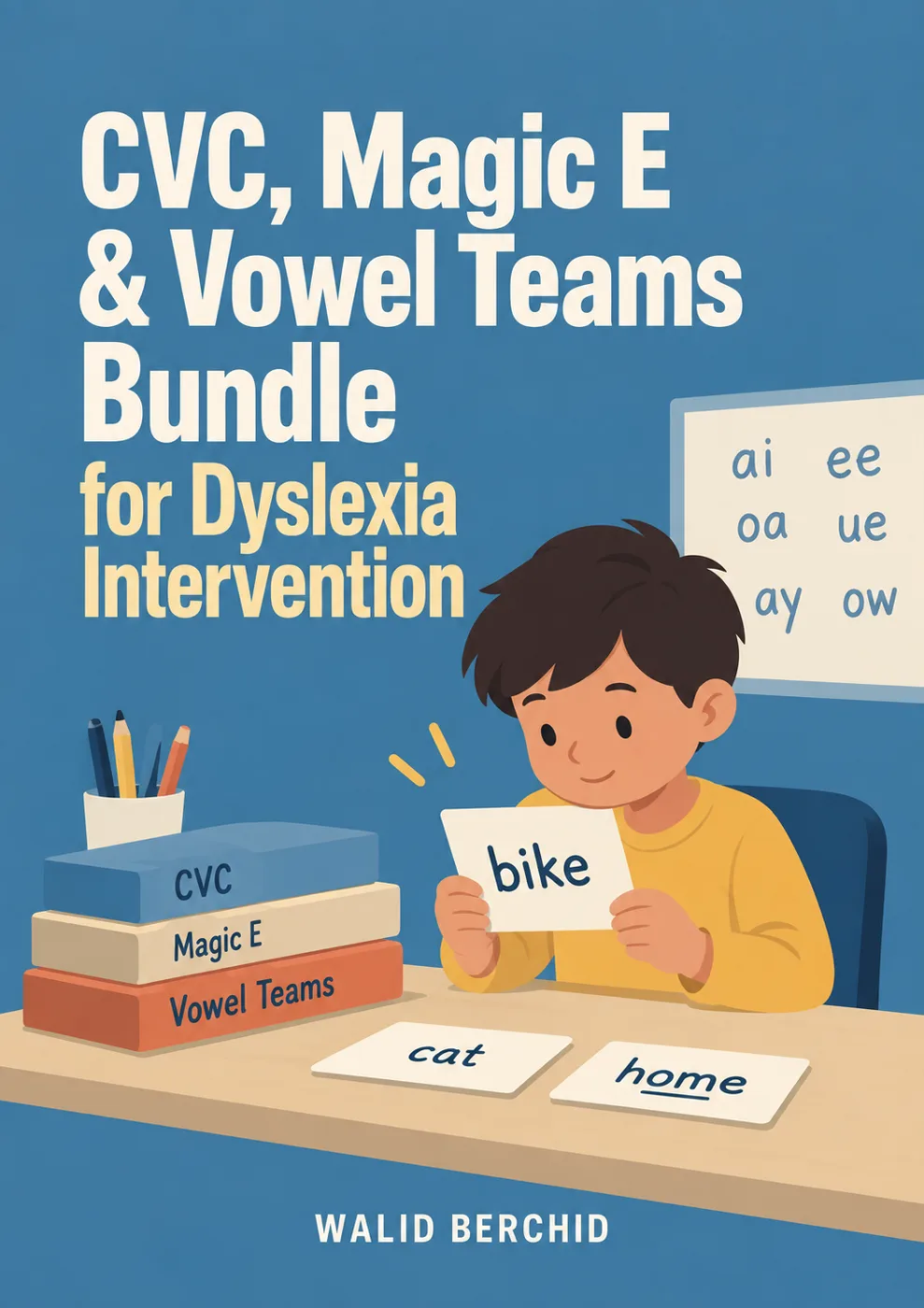
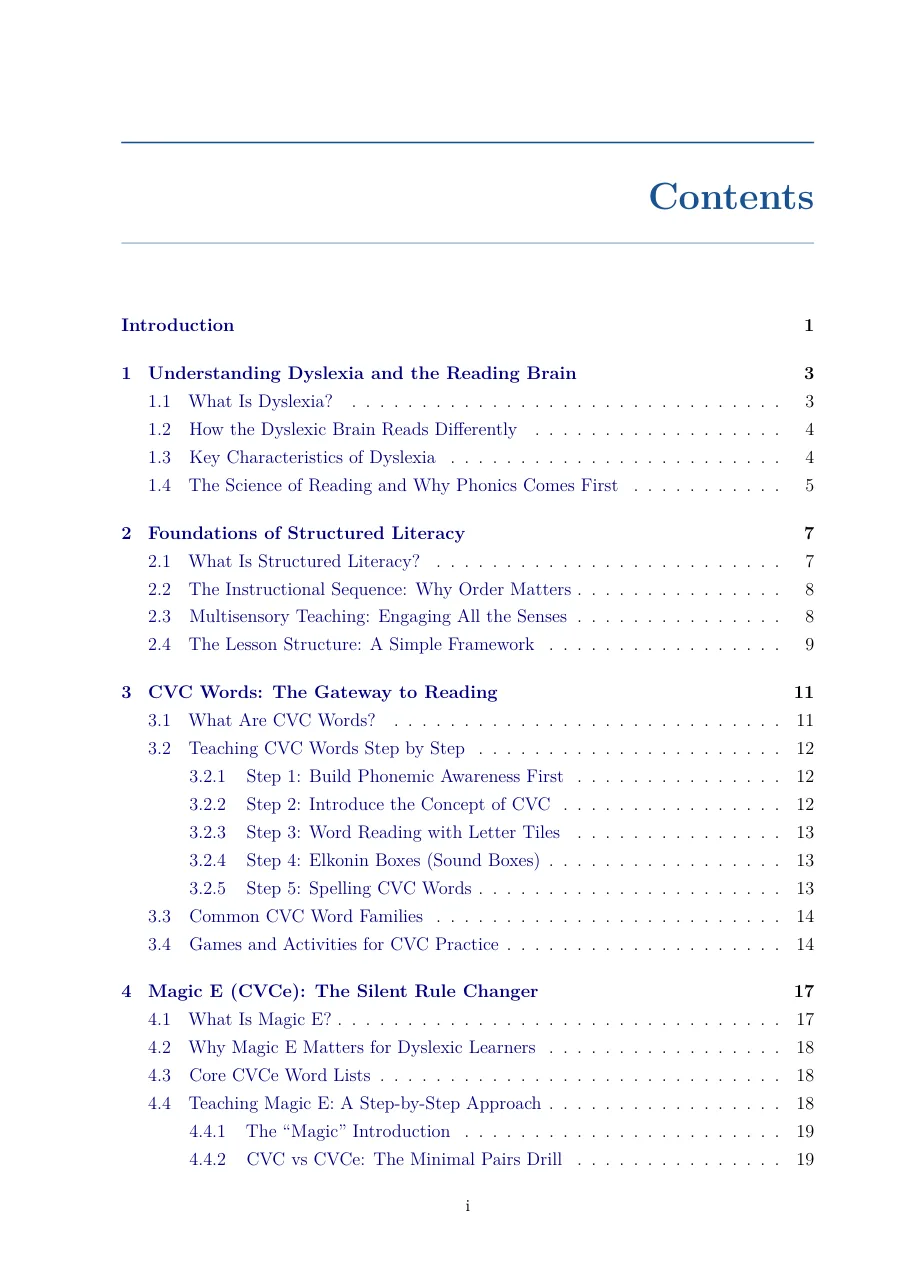
CVC, Magic E and Vowel Teams Bundle for Dyslexia Intervention: a 55-page professional guidebook covering dyslexia and the science of reading, structured literacy with multisensory techniques, step-by-step sequences for CVC words, Magic E and vowel teams, assessment and progress monitoring, a sample twelve-week plan, and seven printable templates.
Sources and scope
- International Dyslexia Association: information on dyslexia and structured literacy for educators and families.
- What Works Clearinghouse: reviews of education research, including practice guides on foundational reading skills.
- IRIS Center, Vanderbilt University: free modules on reading instruction and progress monitoring.
- National Center for Learning Disabilities: resources for families and educators on learning disabilities.
This list covers classroom and intervention practice for teaching vowel teams. It does not cover diagnosis of dyslexia or formal assessment, which are carried out by qualified professionals.
Key takeaways
- Check that CVC and Magic E are secure before teaching vowel teams.
- Introduce one or two teams at a time and teach each as a unit.
- Use multisensory routines and move from words to decodable text.
- Teach spelling with dictation in every lesson.
- Track weekly accuracy to decide when to move on.




Leave a Comment