

Strong pattern recognition can be a student’s greatest learning tool and, at times, a source of real frustration. Picture a fourth grader who spots the rule in a number sequence before the teacher finishes writing it, and who notices that the lunch line always moves faster on Tuesdays. The same student melts down when a spelling word breaks the rule she just learned, and struggles when the class schedule changes without warning.
This guide gives you five steps to support students like her. By the end, you will be able to recognize the signs, put the strength to work in lessons, teach students to handle exceptions, prepare them for randomness and change, and track how the supports are working.
Examples are fictional. Adapt to the student’s goals and agreed supports. This is guidance, not a diagnosis.
At a glance
- Students with strong pattern recognition notice connections others miss.
- The same strength can lead to overgeneralizing rules or struggling with randomness.
- Give these students real patterns to explore and explain.
- Teach exceptions and uncertainty directly, as part of the pattern.
- Track both the strength and the hard moments to guide support.
1. Recognize the signs of strong pattern recognition
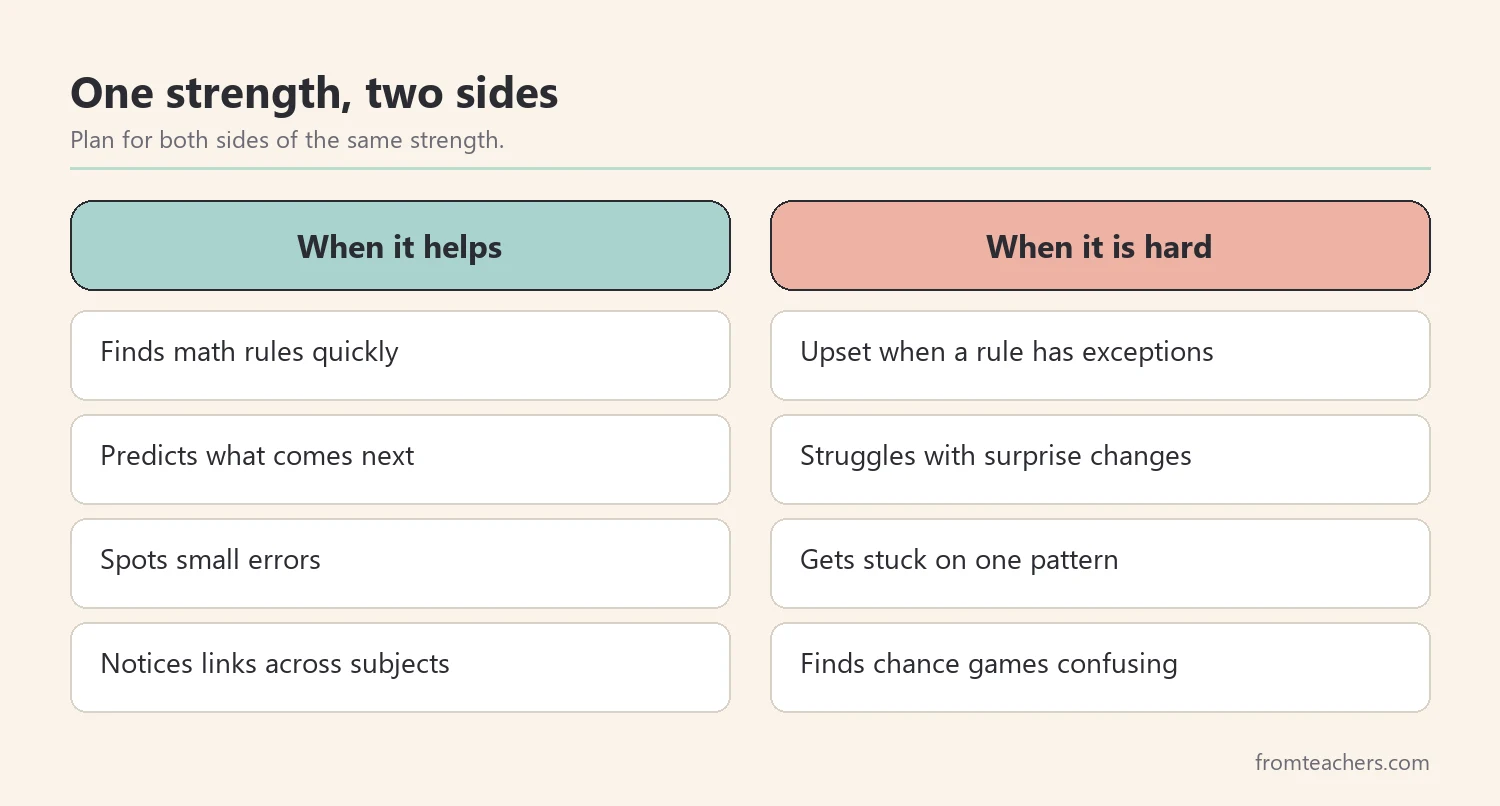
First, learn what this strength looks like in daily school life. A student with strong pattern recognition often notices rules, repetitions, and links quickly. They may predict what comes next in a story, spot errors in a sequence, find shortcuts in math, or notice small changes in the classroom that others overlook.
Next, notice the other side of the strength. The same student may apply a rule too widely, insisting that every word ending in “-ough” must sound the same. They may find it hard when something seems random, such as a surprise assembly or a game based on chance. They may also get stuck on a pattern they noticed and find it hard to move on.
Then, keep a short log for a week. Write down moments when the strength helped and moments when it caused frustration. For example, “Math, found the rule for the sequence in 30 seconds.” Or “Spelling, upset when ‘said’ did not follow the vowel rule.”
Meet Lena, a fictional fourth grader. Her teacher, Mr. Davis, notices that Lena is often the first to see patterns in math and science. However, she becomes upset when rules have exceptions, and she has a hard time on days when the schedule changes. On two days this month, she refused to play a dice game in math because “it doesn’t make sense.”
Finally, talk with the family. Families often see the same pattern at home, such as noticing every detail of a routine or becoming upset when plans change. Their observations help you build a fuller picture of the student.
Also, avoid treating the strength as a problem. The goal is not to make the student notice fewer patterns. Instead, it is to help them use the strength well and manage the moments when patterns do not hold.
2. Put strong pattern recognition to work in lessons
Now, give the student real patterns to explore. Students with strong pattern recognition often learn best when they can discover rules for themselves. Instead of telling them the rule, show several examples and ask them to find it.
Useful activities include number and shape sequences, sorting tasks, coding and logic puzzles, finding patterns in data, spotting structure in poems, and comparing word families. These tasks let the student use the strength while building academic skills.
| Subject | Pattern task | What the student explains |
|---|---|---|
| Math | Find the rule in a sequence | How the rule works |
| Reading | Compare word families | What the words share |
| Science | Look for trends in a data table | What changes and why |
| Writing | Study the structure of a poem | How lines repeat |
Next, ask the student to explain the pattern. Putting a rule into words strengthens understanding and builds communication skills. It also shows you whether the student truly understands the pattern or is guessing.
For Lena, Mr. Davis adds a weekly “pattern challenge” to math. Lena finds the rule and then writes two sentences explaining it. She also helps design a pattern challenge for the class once a month, which gives her a positive role.
Also, connect patterns across subjects. A student who notices that fractions, music rhythms, and repeating art designs share a structure is building deep understanding. Invite those connections out loud, and let the student share them with classmates when it fits the lesson.
Moreover, offer extension when the student is ready. A student who finds the rule quickly may need harder patterns or open questions, such as “Will this pattern always work? How could you test it?” Those questions lead naturally to the next step.
3. Teach exceptions as part of the pattern
Next, help the student handle rules that do not always hold. One of the main challenges for these students is overgeneralizing: applying a rule to every case, even when it does not fit. Teaching exceptions directly makes them less upsetting.
Start by naming exceptions as normal. Explain that many rules, in spelling, grammar, science, and daily life, work most of the time but not always. Then, give the student a place to collect exceptions, such as an “Exceptions list” in a notebook. That turns exceptions into part of the pattern rather than a break in it.
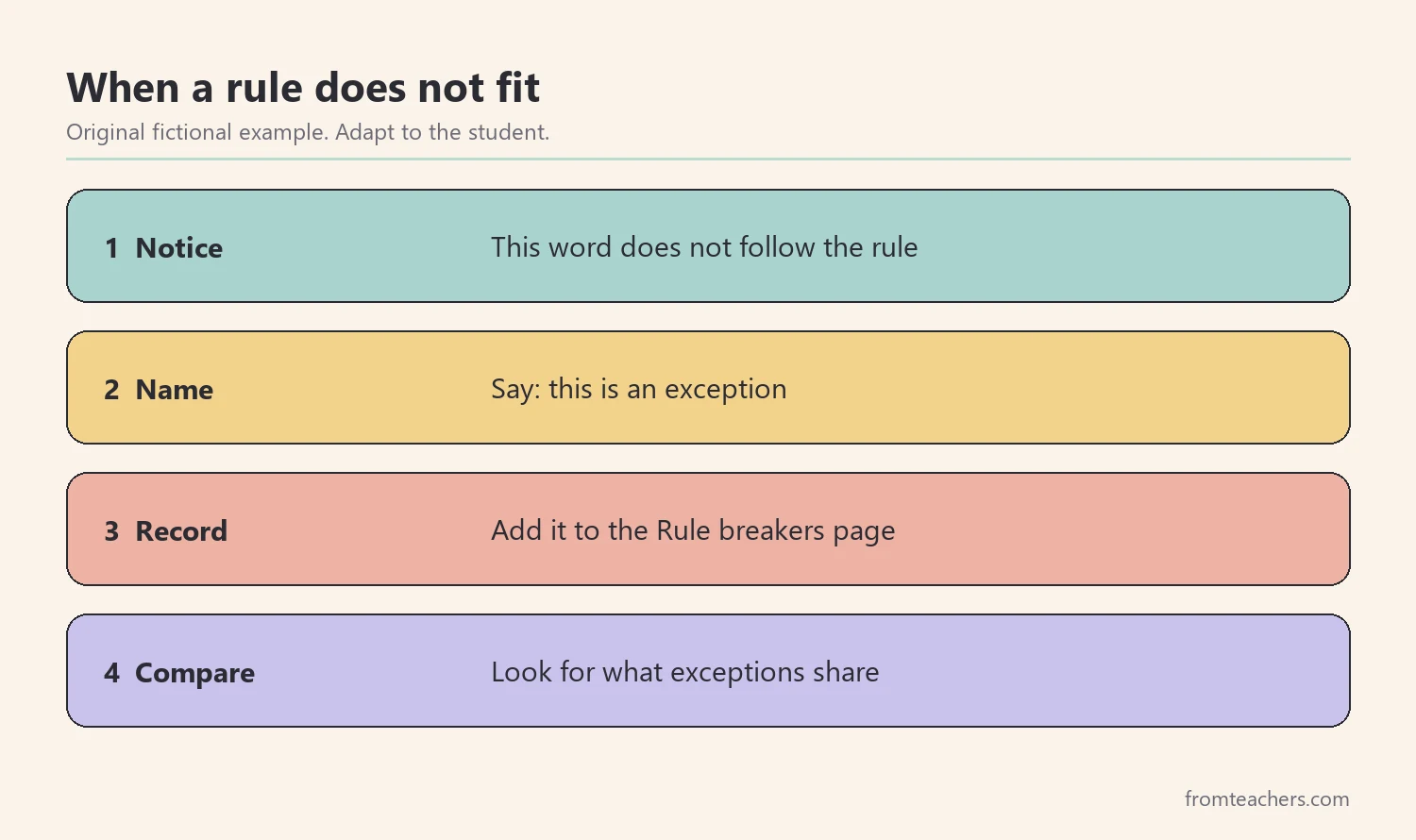
Then, use the language of probability. Phrases like “usually,” “most of the time,” and “sometimes” help students understand that a pattern can be strong without being perfect. Ask, “How often does this rule work? What do the exceptions have in common?”
In addition, model your own response to exceptions. When you meet a word or a fact that breaks a rule, say it calmly: “Interesting, this one is different. Let’s add it to the list.” Students learn a great deal from how adults react to surprises.
For Lena, Mr. Davis introduces a “Rule breakers” page for spelling. When a word does not follow the rule, Lena adds it to the page. After a few weeks, she starts noticing patterns among the exceptions, which she finds interesting rather than upsetting.
If you want a set of ready-made supports, the pattern recognition support strategy tables from berchid.com give a sign, a support, and its impact for situations such as overgeneralizing and struggling with randomness.
4. Prepare for randomness and change
Then, help the student cope with things that do not follow a clear pattern. Chance games, surprise events, and schedule changes can feel unsettling for a student who relies on patterns to make sense of the world. Preparation and clear language reduce that stress.
First, preview changes when you can. A quick note on the board, such as “Today: assembly at 10:00, so math moves to 11:00,” gives the student time to adjust. For unexpected changes, a consistent phrase like “Plan B today” helps signal that a change is happening and that it is manageable.
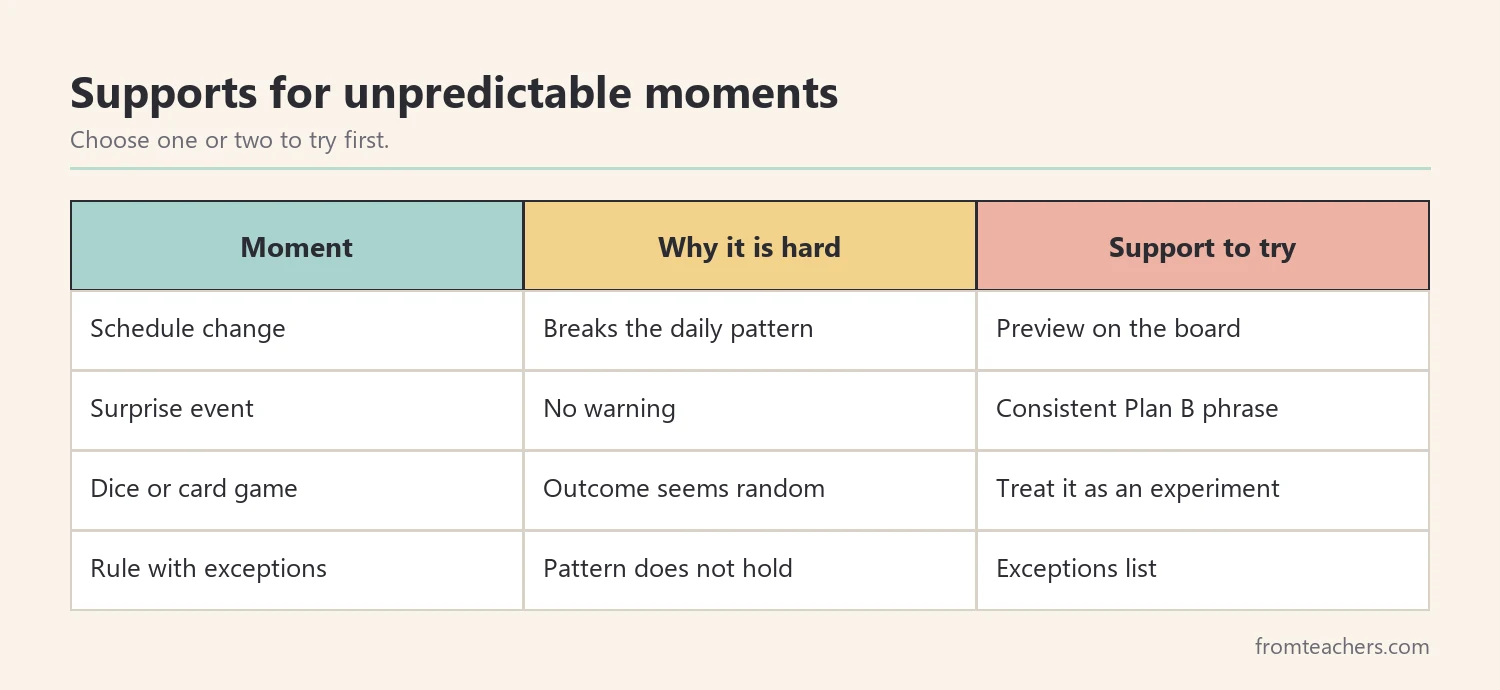
Next, teach randomness as a concept. In math, explore chance with coins and dice, and talk about how short runs can look like patterns even when outcomes are random. This makes randomness something to study rather than something to fear.
For Lena, Mr. Davis turns the dice game into an experiment. Lena records 50 rolls and looks at what happens. She notices that each number shows up about the same number of times over many rolls, but not in a predictable order. She later says, “So random has its own kind of pattern.” That insight makes the game feel less frustrating.
Meanwhile, give the student a way to ask about changes. A small card that says “What is the new plan?” lets the student request information without interrupting the class or showing distress. Answering that question briefly and calmly often settles the moment quickly.
Also, build in flexibility practice. Occasionally change a small, low-stakes part of the routine on purpose, and talk about it afterward. Practicing small changes in a safe way can make bigger changes easier to handle.
In addition, keep an eye on stress. If changes regularly lead to strong distress, involve the student’s team, the school counselor, or other professionals who know the student.
5. Track the strength and the hard moments
Finally, record both sides. Tracking only the difficulties gives an incomplete picture. For these students, it helps to note how often the strength is used well and how often exceptions or changes lead to frustration.
Keep the log simple. Each week, count pattern challenges completed, exceptions the student added to their list, and moments of strong upset linked to rule breaks or changes. Compare the numbers over several weeks.
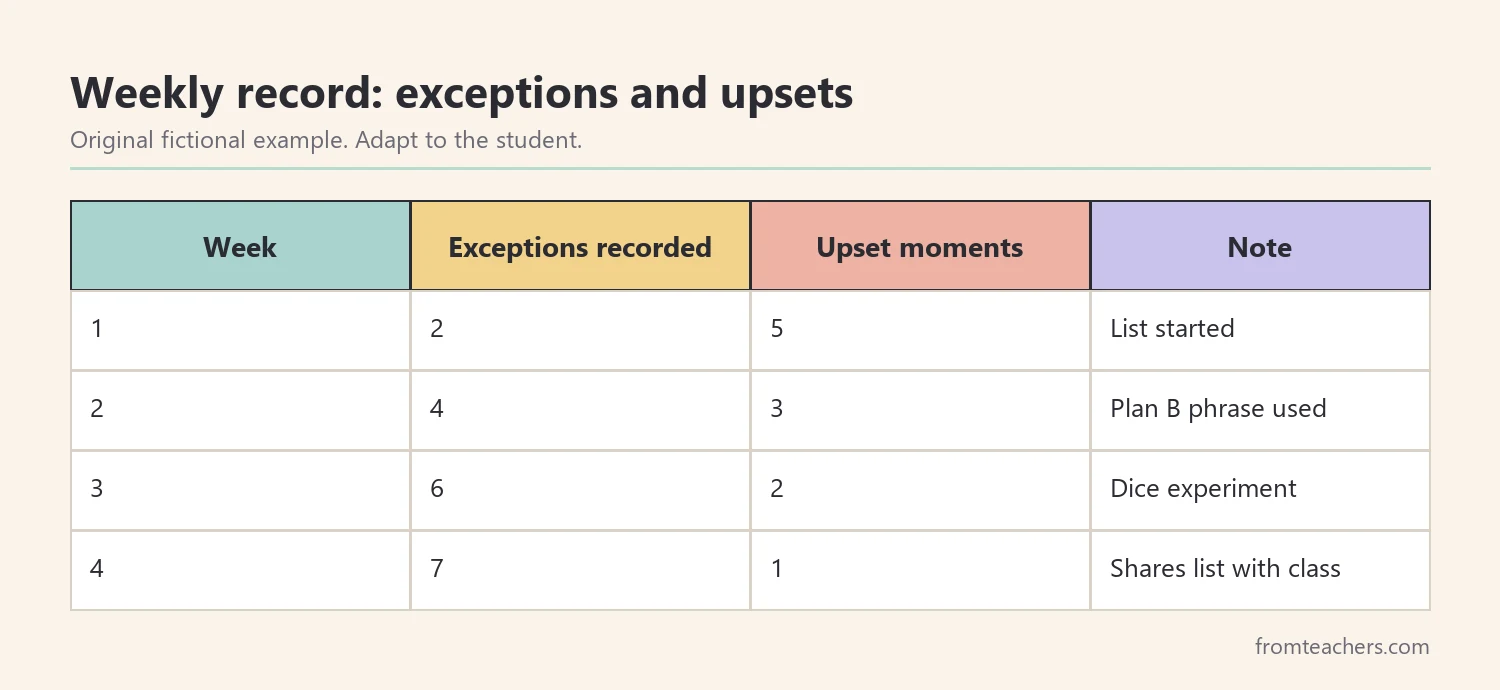
For Lena, upset moments drop from five in the first week to one in the fourth week. At the same time, she records more exceptions in her notebook, which shows she is handling rule breaks in a calmer way.
Also, ask the student to reflect. A short question at the end of the week, such as “What surprised you this week, and how did you handle it?”, builds self-awareness. Over time, the student may begin to plan their own strategies for changes and exceptions.
Then, review the data every few weeks with the student, the family, and the team. Ask which supports help most, and which situations are still hard. Adjust the plan as the student grows and as the school year brings new routines.
In addition, watch for growth in flexibility, not only calm. A student who used to refuse a dice game and now joins in with a few complaints has made real progress. Small steps like that are worth noting and celebrating with the student and the family.
Moreover, share the strength with future teachers. A short note about what helps, such as pattern challenges and an exceptions list, gives the next teacher a strong starting point.
Common mistakes and how to avoid them
- Treating the strength as a problem. Fix: plan lessons that let the student use pattern skills well.
- Telling the student the rule every time. Fix: show examples and let them find the rule.
- Ignoring exceptions until they cause upset. Fix: teach exceptions as a normal part of rules.
- Springing changes without warning. Fix: preview changes and use a consistent “Plan B” phrase.
- Tracking only the hard moments. Fix: record the strength too.
Questions teachers and parents ask about strong pattern recognition
Is strong pattern recognition linked to giftedness or autism?
It can appear in many students, including those identified as gifted, autistic, or twice exceptional, and in students with no label at all. Focus on the student’s actual strengths and needs rather than a label.
Why does my child get upset when rules have exceptions?
For a student who relies on patterns, an exception can feel like the world stopped making sense. Naming exceptions as normal and keeping a list of them often helps.
How can I challenge a student who sees patterns quickly?
Offer harder patterns, open questions, and chances to explain or design patterns for others. Ask the student to test whether a rule always works. Projects that involve collecting and analyzing real data can also be a strong fit.
Can games of chance help?
Yes. Exploring dice, coins, and spinners as experiments helps students see that randomness has its own kind of order over many trials.
Should these supports be part of an IEP or 504 plan?
If difficulties with change or exceptions affect learning across settings, the team may discuss supports such as change previews or extension work. Bring your observations and data to the meeting.
Related reading: Spectrum Voices: Essential Strategies for Navigating High-Functioning Autism, Learning Styles Student Success Guide, and Special Education Strategies: 10 Powerful Ways Teachers Can Succeed.
A companion resource for strong pattern recognition:


Students with Extremely High Pattern Recognition: Support Strategies: 12 strategy tables that give a sign, a support, and its impact for situations such as overgeneralizing and struggling with randomness.
Sources and scope
- National Association for Gifted Children (NAGC): information on supporting advanced learners and twice-exceptional students.
- IRIS Center, Vanderbilt University: free modules on differentiated instruction and evidence-based practices.
- Understood.org: plain-language information on learning and thinking differences for families and teachers.
- IDEA, U.S. Department of Education: the law behind special education services and IEPs.
This guide covers practical classroom and home strategies for students who notice patterns very strongly. It does not diagnose any condition or replace guidance from the student’s team.
Key takeaways
- Recognize both the strength and the hard moments it can bring.
- Let students discover and explain patterns in lessons.
- Teach exceptions as a normal part of rules.
- Preview changes and explore randomness as a concept.
- Track both the strength and the upsets, and review with the family.










Leave a Comment