

Special education letters give parents a clear, calm way to ask the school for help and to keep a record of what was asked. Picture a parent who mentions her son’s reading struggles at pickup, then again at a conference, and then in a quick phone call. Everyone is friendly, yet months pass and nothing changes. There is no record of exactly what she asked or when.
This guide shows you how to write letters that get positive results in five steps: understand why letters work, set one clear purpose, use a simple structure, keep the tone factual and respectful, and follow up with good records. By the end, you will be able to write a letter that is easy for the school to understand and act on.
Examples are fictional. Adapt to the student’s goals and agreed supports. This is guidance, not legal advice or a diagnosis.
At a glance
- Written requests create a clear, dated record that conversations do not.
- Each letter works best with one main purpose.
- A simple structure makes your request easy to read and act on.
- Factual, respectful language builds partnership.
- Follow-up letters and a simple log keep things moving.
1. Understand why special education letters work
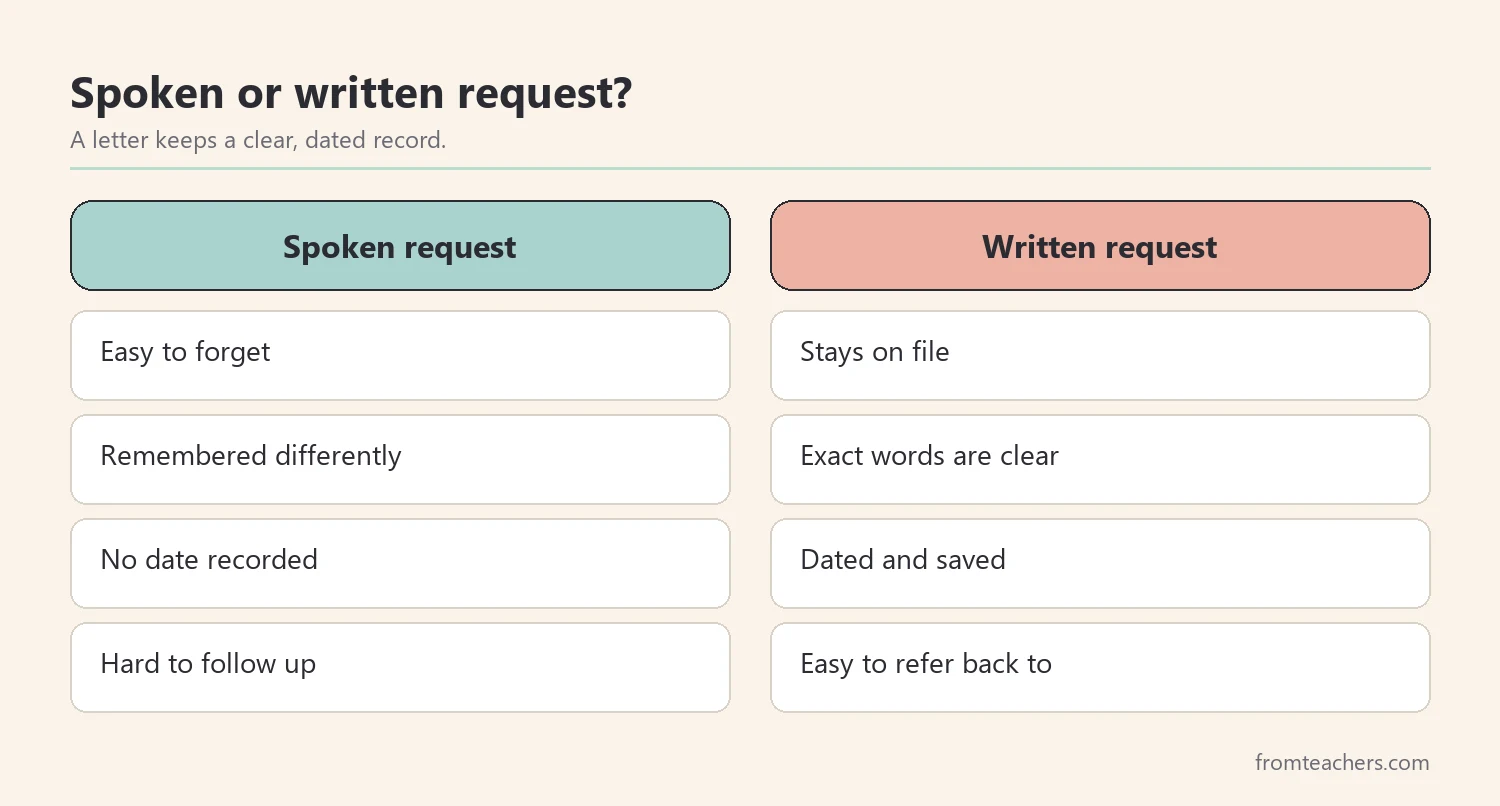
First, know what a letter does that a conversation cannot. Spoken requests are easy to forget, misunderstand, or remember differently. A letter states exactly what you asked, when you asked it, and why. That clarity helps everyone, including busy school staff, who may receive many special education letters and requests each week.
Next, think of special education letters as part of a paper trail. A dated letter, or an email you save, shows the history of your concerns and requests. If questions come up later, you can point to what was said instead of relying on memory.
Also, some requests are commonly made in writing. For example, in the United States, parents often request a special education evaluation in writing, and many schools and parent centers recommend doing so. Check with your school or your state’s parent training and information center for local guidance.
In addition, a letter gives you time to think. You can choose your words, include facts, and remove anything that might distract from your request. A calm letter written at the kitchen table often works better than a rushed conversation in a hallway.
Then, remember that a letter is a tool for partnership, not conflict. Most teachers and administrators want to help. Clear special education letters make it easier for them to do that.
Worked example. Ms. Rivera is the fictional parent of Daniel, a grade 3 student who struggles with reading. She has mentioned her concerns three times in conversations, but nothing is written down. She decides to write a short, dated letter to the school.
2. Set one clear purpose for your letter
Next, decide what you want the letter to achieve. Special education letters work best when they focus on one main purpose. Common purposes include requesting an evaluation, asking for a meeting, sharing new information, asking about progress, or confirming what was agreed at a meeting.
For example, write your purpose in one sentence before you start. “I want to request an evaluation for Daniel’s reading.” “I want to ask for a meeting about Daniel’s homework.” If you cannot say it in one sentence, the letter may be trying to do too much.
Also, separate different issues. If you have a concern about reading and a separate concern about bus transportation, consider two letters. Separate letters are easier to route to the right person and easier to track. Focused special education letters also make your log simpler later.
In addition, think about who should receive the letter. A classroom concern may go to the teacher. An evaluation request may go to the principal or the special education coordinator. If you are unsure, ask the school office who handles special education requests.
Meanwhile, gather your facts before writing. Note what you have seen at home, what the teacher has told you, and any work samples or reports. Facts make special education letters stronger and clearer.
Worked example. Ms. Rivera writes her purpose on a sticky note: “Request an evaluation for Daniel’s reading.” She gathers two recent reading assessments, a note from his teacher, and her own observations of homework time.
3. Use a simple structure for special education letters
Next, organize the letter so it is easy to read. A simple five-part structure works for most special education letters. Start with the date and the child’s details, then state your purpose, give background facts, make a specific request, and close with a thank-you and your contact details.
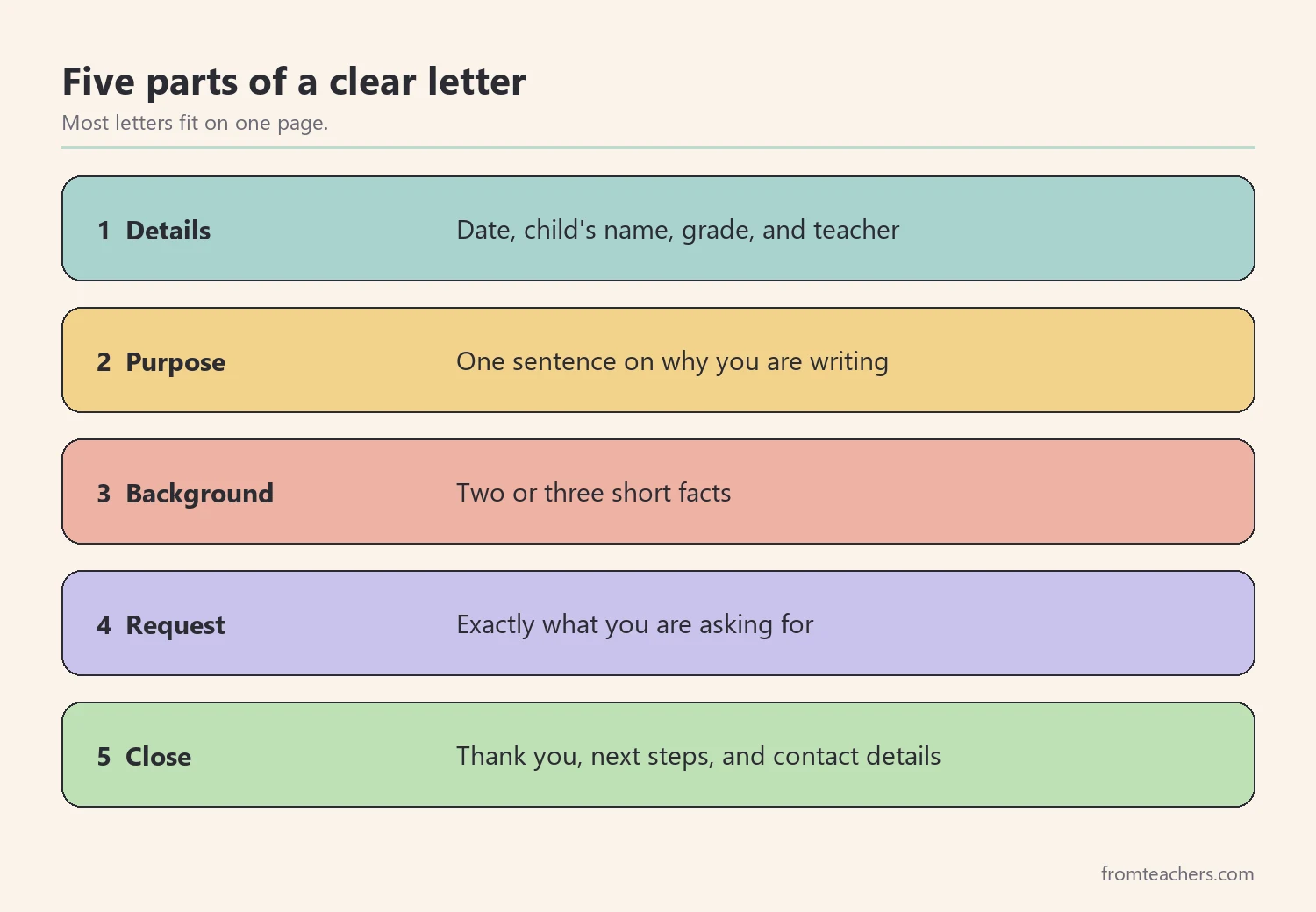
Also, keep each part short. One or two sentences for the purpose and request is usually enough. Background facts can be a short list. Shorter letters are more likely to be read carefully and acted on quickly.
In addition, make your request specific. “Please help Daniel” is kind but vague. “I am requesting a full evaluation of Daniel’s reading needs” is specific. A specific request is easier for the school to respond to. Of all five parts, the request is where special education letters most often go wrong, so spend extra time on it.
For more guidance on structure and follow-up, the Art of Writing Letters That Get Positive Results guide walks parents through why letters work, how to structure them, and how to follow up.
Meanwhile, ask for a response. A polite line such as “Please let me know the next steps” invites a reply without sounding demanding. It also gives you a natural reason to follow up later if you hear nothing.
Worked example. Ms. Rivera’s letter has five short parts: Daniel’s name, grade, and teacher; her purpose; three facts about his reading; her specific request for an evaluation; and a thank-you with her phone number and email. The letter fits on one page.
4. Keep the tone factual and respectful
Next, check the tone. It is natural to feel worried or frustrated when your child is struggling. Still, special education letters work best when they stay calm, factual, and respectful. A respectful tone keeps the focus on your child.
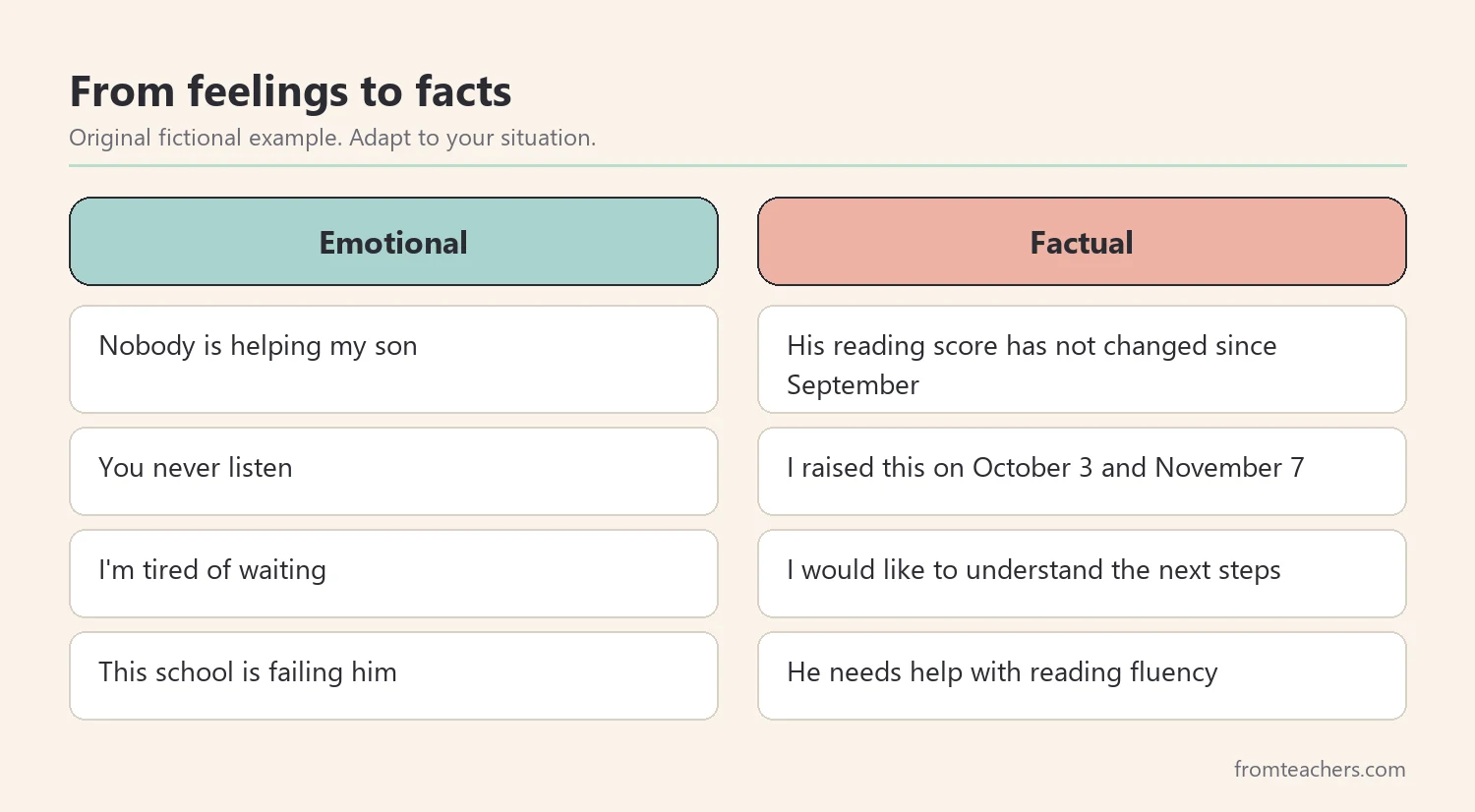
For example, replace emotional statements with facts. Instead of “Nobody is helping my son,” write “Daniel’s reading score has not changed since September.” Instead of “You never listen,” write “I raised this concern on October 3 and November 7.”
Also, recognize what is going well. A sentence like “Daniel enjoys his class and speaks warmly of his teacher” shows goodwill. It reminds everyone that you are on the same side.
In addition, avoid long explanations. Include the facts that support your request and leave out unrelated history. If you need to share more, you can do it in a meeting.
Meanwhile, consider asking someone you trust to read the draft. A partner, friend, or parent advocate can often spot a sentence that sounds sharper than you intended. A second reader also checks that the request is clear to someone who does not know your child. Many families find that this small step makes their special education letters shorter, calmer, and more effective, because the reader asks simple questions such as “What exactly do you want the school to do?”
Then, read your letter aloud before sending it. If any sentence sounds angry or blaming, rewrite it. If possible, wait until the next day, then reread it with fresh eyes. Calm special education letters are easier for schools to act on.
Worked example. Ms. Rivera’s first draft says, “I’m tired of waiting for help.” She changes it to, “I first shared this concern in October, and I would like to understand the next steps.” She also adds a line thanking Daniel’s teacher for her support.
5. Follow up and keep records
Finally, follow up. Sometimes letters get lost or delayed. If you do not hear back within a reasonable time, send a short, polite follow-up that refers to your first letter by date.
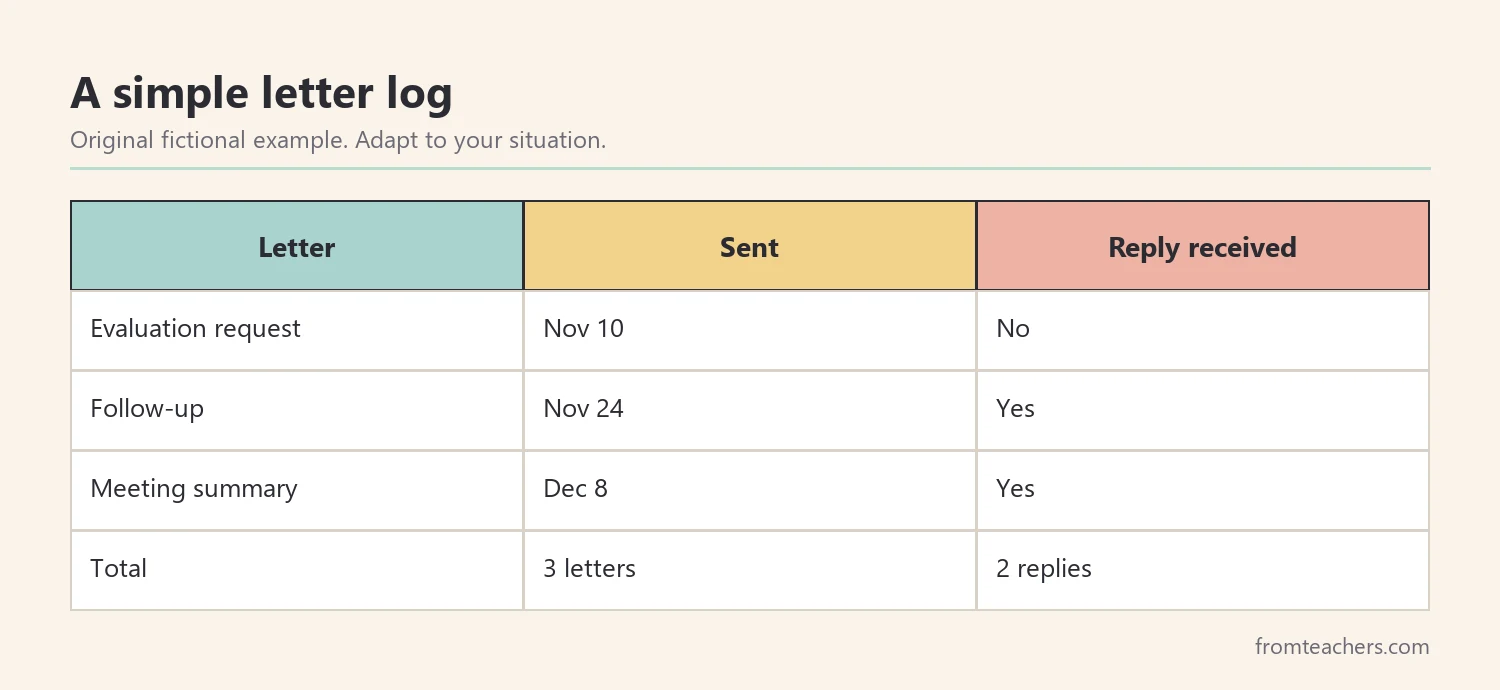
Also, keep copies of everything. Save emails in a folder, keep paper copies in a binder, and note the date each letter was sent and how. A simple log helps you see what is still waiting for a reply.
Next, confirm agreements in writing. After a meeting or phone call, send a short letter summarizing what was agreed. “Thank you for meeting today. My understanding is that …” This helps everyone remember the same plan.
In addition, stay patient and persistent. Schools have processes and timelines. Polite, clear special education letters, sent consistently, usually move things forward more effectively than repeated phone calls.
Then, seek support if you need it. Parent training and information centers, advocacy groups, and school staff can help you understand your options. You do not have to do this alone. Many parent centers can also review special education letters and suggest clearer wording.
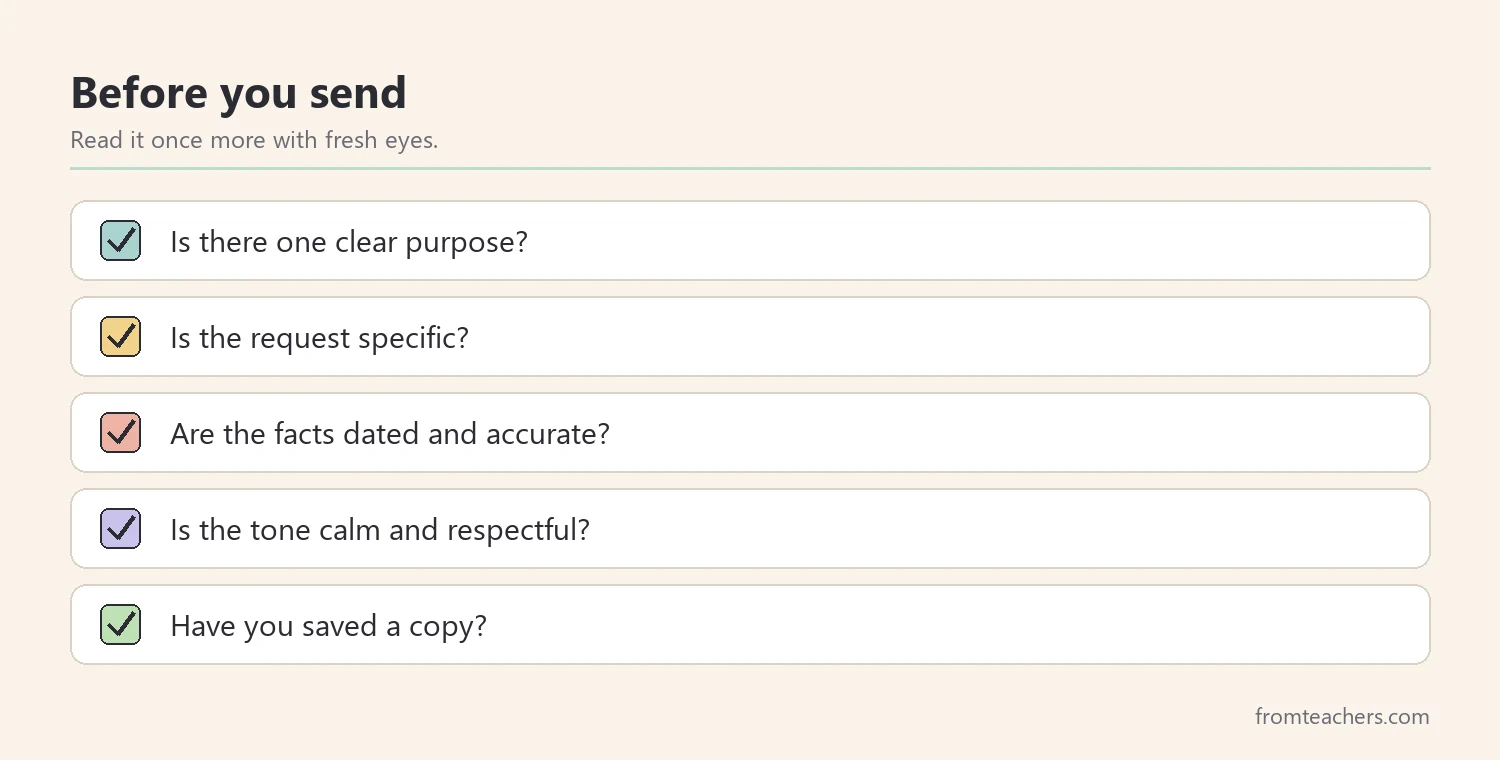
Worked example. Ms. Rivera logs three letters over the term: the evaluation request, a follow-up, and a meeting summary. The school replies to the follow-up and the meeting summary. That is 2 replies for 3 letters, and the evaluation is now scheduled. Her log shows the whole history on one page.
Email or paper?
Both can work. Email is fast and automatically dated, which makes it easy to keep records. Paper letters can feel more formal and may suit some schools better.
Also, whichever you choose, keep a copy. If you send email, save it in a dedicated folder. If you send paper, keep a copy and note the date you delivered or mailed it.
Finally, ask your school if they prefer a certain format for special education requests. Following their process can save time.
Common mistakes and how to avoid them
- Only asking in conversation. There is no record. Fix: put important requests in writing.
- Covering too many issues. The main request gets lost. Fix: one purpose per letter.
- Writing while upset. Strong emotion can distract from the request. Fix: wait, reread, and revise.
- Making vague requests. The school is unsure what to do. Fix: state exactly what you are asking for.
- Not keeping copies. You lose track of what was sent. Fix: keep a simple log and copies.
- Skipping follow-up. Letters can be missed. Fix: send a polite follow-up that refers to the first letter.
Questions teachers and parents ask about special education letters
Do I need a lawyer to write a letter to the school?
Most parents write their own letters. A clear, factual letter is often enough. If you face a serious dispute, you may want advice from an advocate or a parent center.
How long should the letter be?
Usually one page. Short letters with a clear purpose and a specific request are easier for schools to read and act on.
Who should I send the letter to?
It depends on the request. Classroom concerns may go to the teacher. Evaluation requests often go to the principal or special education coordinator. Ask the school office if you are unsure.
What if the school does not respond?
Send a polite follow-up that refers to your first letter by date. If you still do not hear back, contact the principal or district office, and keep records of each step.
Can teachers use this approach, too?
Yes. Teachers can use the same structure when writing to families or colleagues: one purpose, clear facts, a specific request, and a respectful tone.
Related reading: How Parents and Teachers Can Team Up for Special Education Success, How Teachers Communicate With Parents in Special Education: Building a Strong Partnership, and Special Education: A Complete Guide for Parents and Educators.
A companion resource for special education letters:
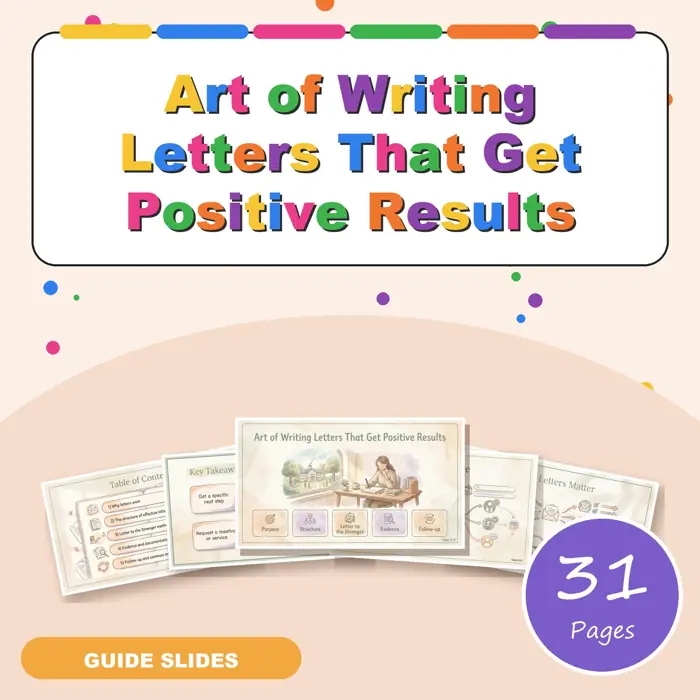
Art of Writing Letters That Get Positive Results: Special Education Letter Guide: a practical guide to writing clear, effective letters to the school about a child’s special education needs, covering why letters work, how to structure them, and how to follow up.
Sources and scope
- IDEA, U.S. Department of Education: the federal law behind special education, including parent participation.
- Center for Parent Information and Resources: a hub for parent training and information centers across the United States.
- Wrightslaw: information for parents and advocates on special education law and advocacy.
- Understood.org: family-friendly information on learning differences and working with schools.
This guide covers practical letter-writing for parents communicating with schools about special education needs. It is not legal advice and does not replace guidance from your school, district, or a qualified advocate.
Key takeaways
- Special education letters create a clear, dated record.
- Give each letter one clear purpose and a specific request.
- Use a short, five-part structure.
- Keep the tone factual, calm, and respectful.
- Follow up politely and keep copies of everything.






Leave a Comment