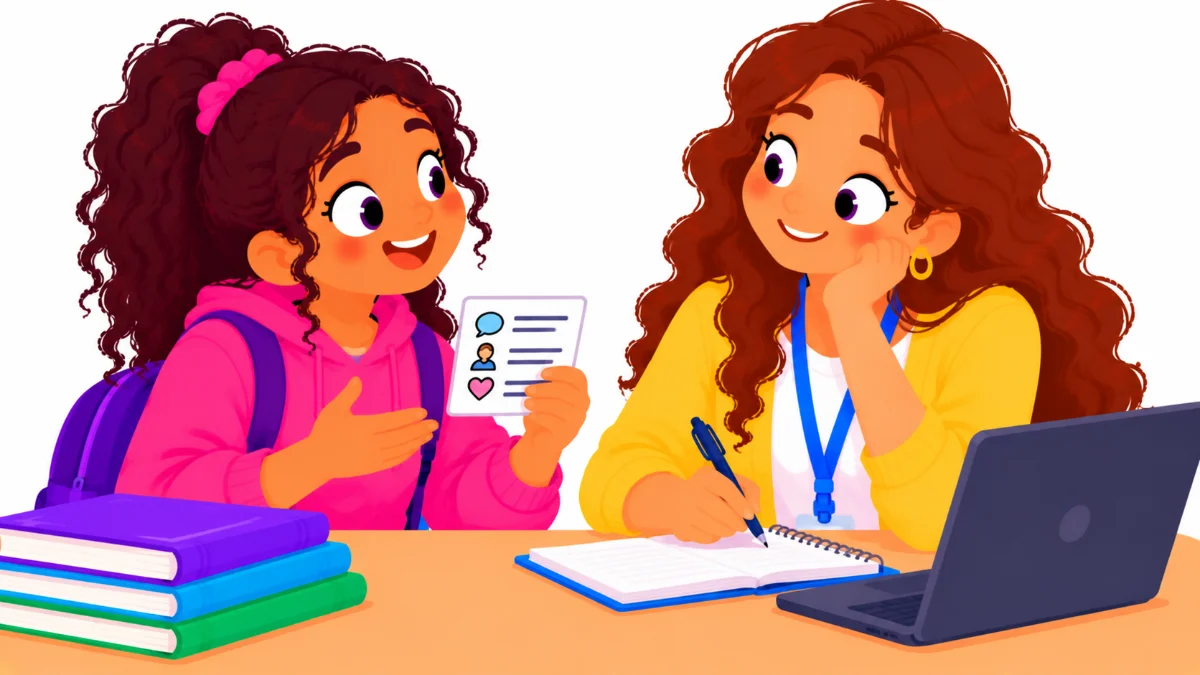

Self-advocacy examples are easiest to understand in a real moment: a student cannot see the board, has not understood the directions, and sits quietly for twenty minutes instead of asking. Later, the work comes back unfinished, and nobody knows why. The student needed one sentence and the confidence to say it.
By the end of this guide, you will be able to teach what self-advocacy is, help students name their strengths and needs, give them scripts for common situations, practice requesting accommodations, and track growth over time. Examples are fictional. Adapt to the student’s goals and agreed supports. This is guidance, not a diagnosis.
At a glance
- Self-advocacy is a set of teachable skills, not a personality trait, and self-advocacy examples make it concrete.
- Students first need words for their strengths, needs, and supports.
- Short scripts make speaking up easier in real classroom moments.
- Rehearsal in low-stakes settings builds confidence before real use.
- Count independent requests over time to see real growth.
1. Teach what self-advocacy means, with self-advocacy examples
First, give the idea a simple definition. Self-advocacy means knowing what you need and asking for it respectfully. For students with disabilities, it also means understanding their supports and their rights. Many students have never heard the word, so start with plain language.
Next, show self-advocacy examples instead of only describing them. A short story, a role-play, or a video clip of a peer asking for help makes the idea concrete. Then ask: What did the student need? What did they say? What happened next?
Also, address fear early. Some students worry that asking for help will look like failure or annoy the teacher. Name that worry openly and explain that asking is a skill adults use every day at work and at home.
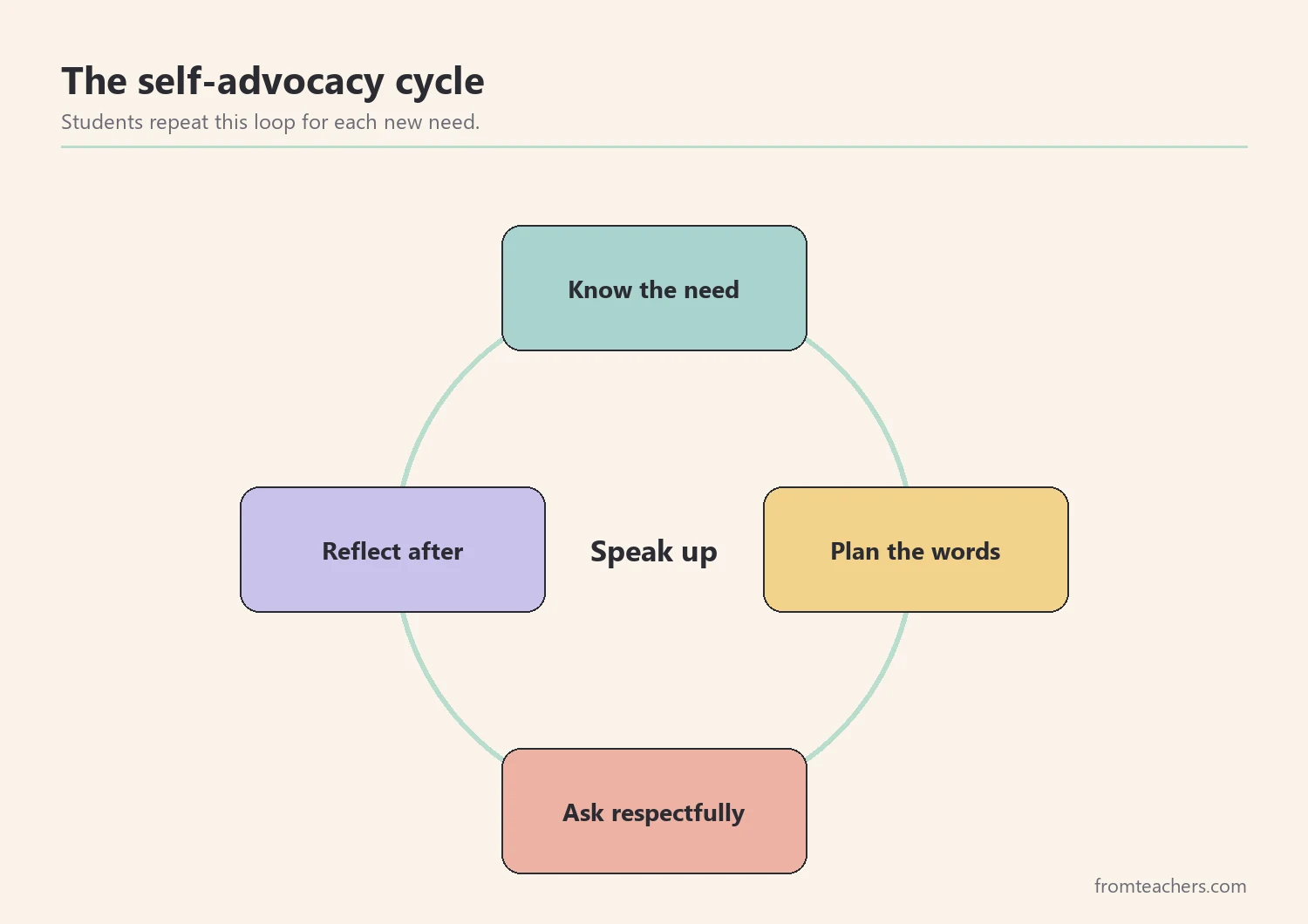
Worked example. Priya is a fictional student in grade 8 with a reading disability and an IEP. When her teacher asks what self-advocacy means, Priya says, “Getting in trouble for complaining.” So the teacher shows two short self-advocacy examples: a student asking to have directions repeated, and a student asking for a quieter spot during a test. Priya notices that neither student was in trouble. That becomes the starting point.
2. Help students name their strengths and needs
Next, help the student build a short personal profile. A student cannot ask for what they need if they cannot describe it. Start with strengths, because they build confidence and point toward strategies that already work.
Use simple tools. A strengths portfolio with a few pieces of work the student is proud of works well. A short success journal, with one line about something that went well each day, also helps. Then add needs in the student’s own words, such as “Long texts make me tired” or “I need directions written down.”
| Prompt | Sample student answer |
|---|---|
| I am good at… | Explaining ideas out loud |
| I learn best when… | I can listen to the text |
| Something hard for me is… | Reading long pages quickly |
| A support that helps me is… | Audio books and extra time |
Then, connect each need to a support. This link is the base of almost all self-advocacy examples later in the guide. When students can say “I need X because Y,” the request sounds clear and reasonable.
However, keep the profile private and respectful. The student decides what to share and with whom. Teachers can model this with self-advocacy examples that show a student sharing only what is needed, such as “I work better with written directions,” without explaining a diagnosis.
Worked example. Priya fills in the prompts with her teacher. She writes that she is good at discussions and learns best when she can hear a text. She lists reading long pages as hard and audio text as a support. For the first time, she has words she can use with other teachers.
3. Give students scripts: self-advocacy examples for daily moments
Now turn needs into words. Scripts are short sentences students can learn, adapt, and use. They lower the stress of speaking up because the student does not have to invent the words in the moment. Over time, students change the scripts into their own style.
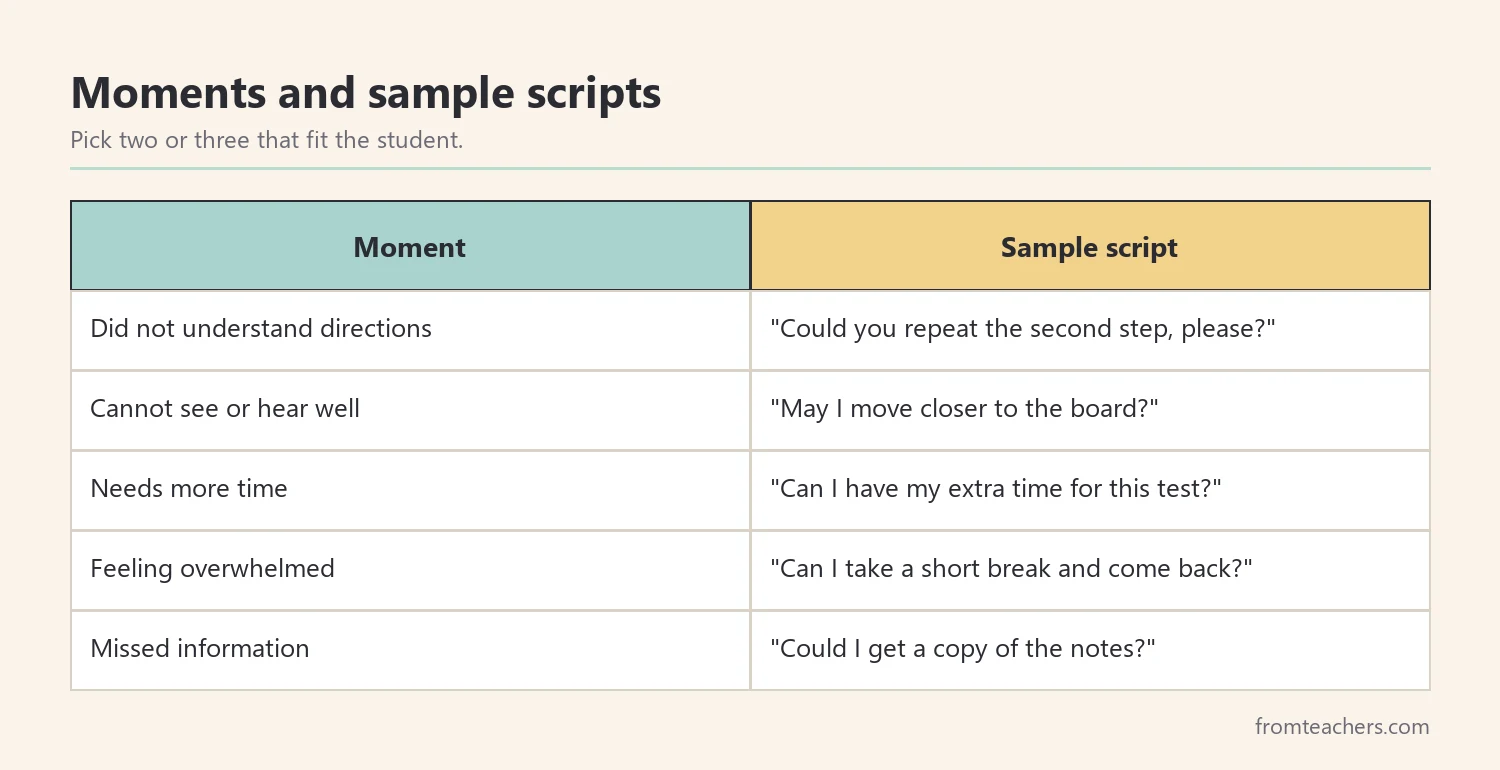
Start with the most frequent situations. The table below lists self-advocacy examples for common classroom moments. Choose two or three that fit the student, write them on a small card, and practice them first.
| Moment | Sample script |
|---|---|
| Did not understand directions | “Could you repeat the second step, please?” |
| Cannot see or hear well | “May I move closer to the board?” |
| Needs more time | “Can I have my extra time for this test?” |
| Feeling overwhelmed | “Can I take a short break and come back?” |
| Missed information | “Could I get a copy of the notes?” |
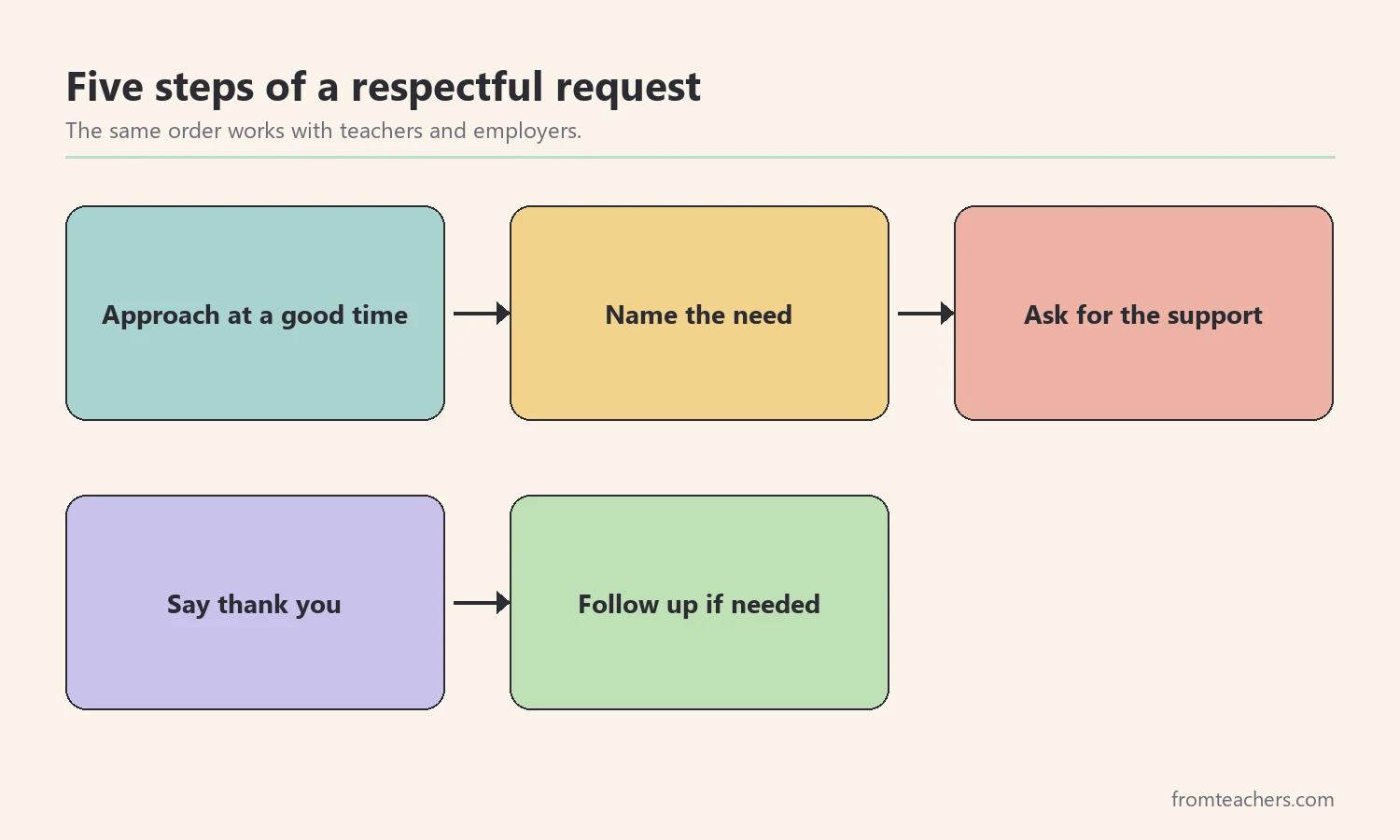
Also, teach the shape of a good request. Most self-advocacy examples follow the same order: get the adult’s attention at a good time, name the need, ask for the support, say thank you, and follow up if needed. This order works with teachers, coaches, and later with employers.
In addition, collect new self-advocacy examples from the student’s own week. When a student says, “I didn’t know how to ask,” write the moment down and build a script for it together. Over a few weeks, the card becomes a personal list that fits the student’s real day.
Worked example. Priya chooses two scripts: asking for audio text and asking for directions to be repeated. She keeps them on a card inside her binder. Her teacher reminds her that a good time to ask is at the start of work, not in the middle of a lesson.
4. Teach students to understand and request their accommodations
Next, help students understand their own plan. Many students with an IEP or a 504 plan cannot name a single accommodation they have. Yet requesting agreed supports is one of the most practical self-advocacy examples there is, and it matters more as students move to high school and beyond.
Read the accommodations section together in plain words. Then ask the student to explain each support back to you: what it is, when it applies, and why it helps. Finally, practice asking for one support in a role-play before using it for real.
- List the student’s accommodations in short, plain sentences.
- Explain the difference between a request and a demand.
- Practice what to do if an adult forgets or says no.
- Invite the student to share one goal at their next IEP meeting.
If you want a structured sequence for this, the self-advocacy skills toolkit for students includes tables on understanding rights and accommodations under IDEA and Section 504, along with communication and confidence-building steps.
Worked example. Priya learns that her IEP includes extra time and audio versions of long texts. She practices saying, “I have audio text in my plan. Could I get the audio for this chapter?” With her teacher’s help, she also plans what to say if a substitute does not know about it: “It’s in my IEP. Could you check with my case manager?”
5. Build confidence through rehearsal and reflection
Then, practice before the real moment. Confidence grows from successful attempts, so start where success is likely. Role-play with a trusted adult first, then with a peer, then with a teacher who knows the plan. After that, try a real request in a calm setting.
Use short affirmations that are true and specific, such as “I know what helps me learn.” In addition, frame mistakes as practice. If a request did not go well, ask what to change next time instead of treating it as failure.
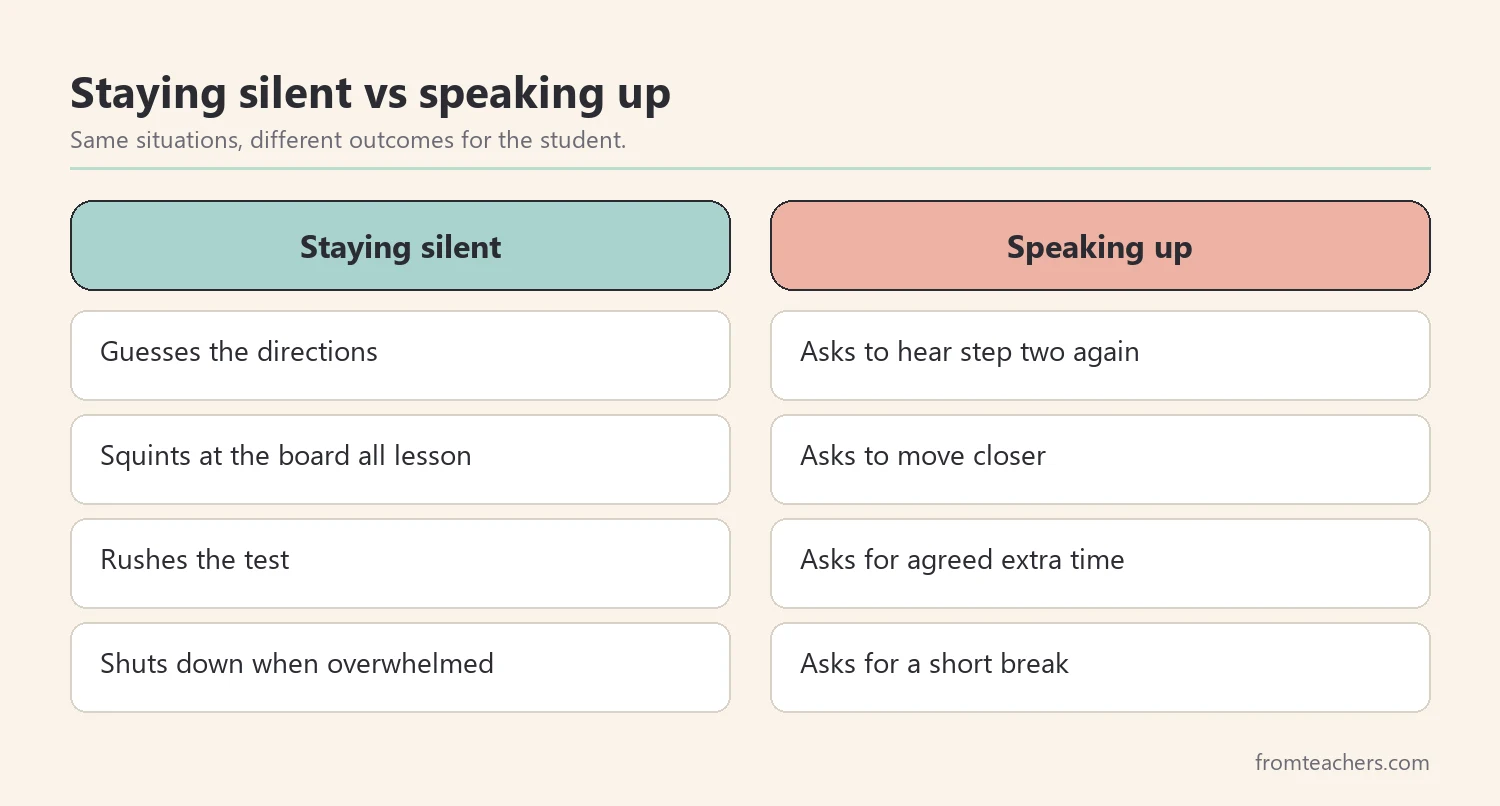
After each real request, take one minute to reflect. What did you ask? How did the adult respond? What will you say next time? Short reflections turn single self-advocacy examples into a lasting habit.
Worked example. Priya rehearses her audio text request twice with her case manager, then once with her English teacher, who knows the plan. On Thursday she asks her science teacher for real. It works, and she writes one line in her success journal: “I asked and got it.”
6. Practice decisions and track self-advocacy growth
Finally, widen the skill to decision-making. Self-advocacy includes choosing, planning, and prioritizing. Start with low-stakes choices, such as which task to do first. Then move to planning backward from a due date and deciding when to ask for help.
Also, look beyond the classroom. Self-advocacy examples from daily life include asking a coach to explain a drill again, telling a doctor about a symptom, or asking a store worker where an item is. When students see that the same skill works everywhere, they practice it more often. As a result, school requests start to feel normal rather than risky.
Next, track progress simply. Count how many times the student needed a support and how many times they asked for it without a reminder. A weekly tally gives a clear picture and shows the student their own growth.
| Week | Times support was needed | Asked without a reminder |
|---|---|---|
| 1 | 5 | 1 |
| 2 | 5 | 2 |
| 3 | 4 | 3 |
| 4 | 5 | 4 |
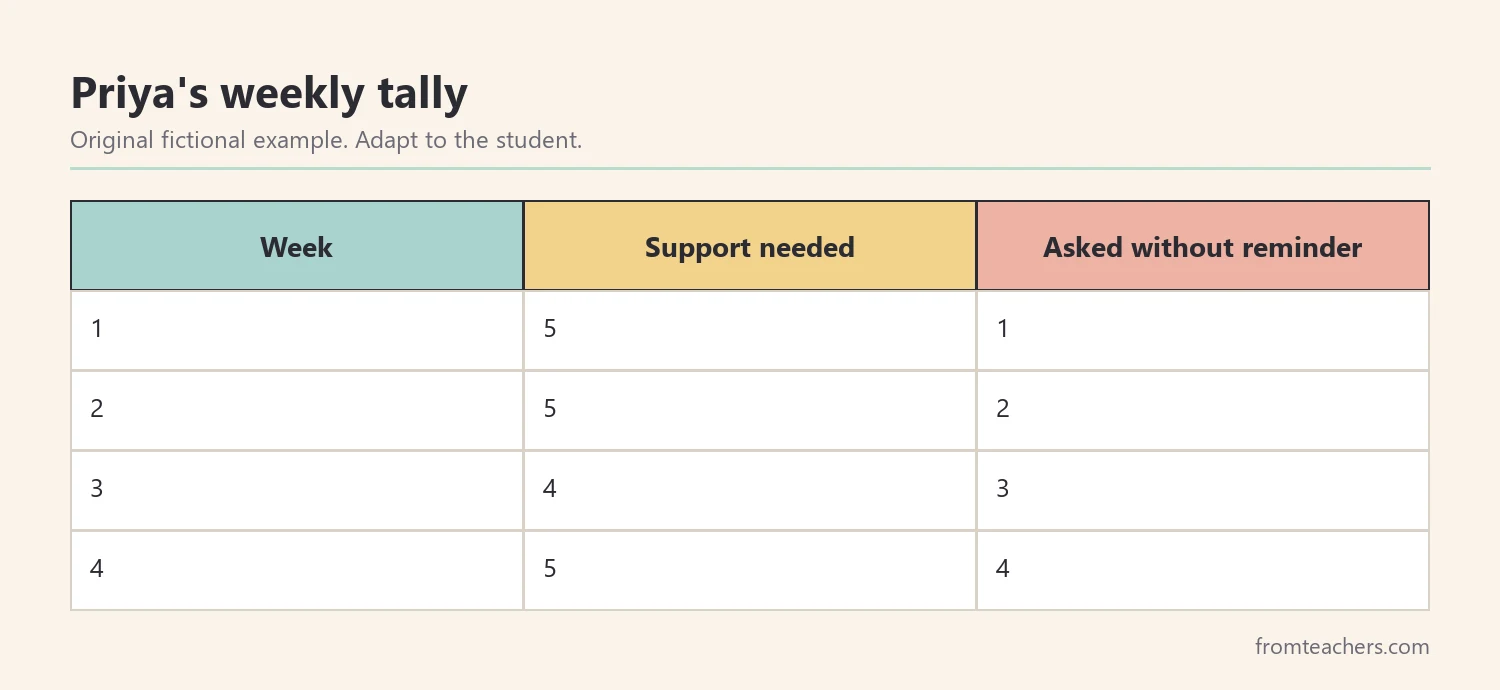
Worked example. In week 1, Priya asks on her own in 1 of 5 situations. By week 4, she asks in 4 of 5. Her team shares the tally with her family and sets the next step: Priya will explain one accommodation herself at her spring IEP meeting.
Common mistakes and how to avoid them
Many plans built on self-advocacy examples stall for simple reasons. Fortunately, each has a clear fix.
- Telling students to “just speak up.” Fix: teach specific scripts and practice them.
- Skipping strengths. Fix: start every profile with what the student does well.
- Keeping the IEP a secret from the student. Fix: explain supports in plain words.
- Going straight to high-stakes moments. Fix: rehearse in safe settings first.
- Adults answering for the student. Fix: pause and let the student try first.
- Not tracking growth. Fix: keep a weekly tally and share it with the student.
Questions teachers and parents ask about self-advocacy examples
At what age should students start learning self-advocacy?
Young children can learn simple requests such as “Can you help me?” or “I need a break.” The skills grow with age, from basic requests in elementary school to explaining accommodations and joining IEP meetings in middle and high school.
What are good self-advocacy examples for younger students?
Raising a hand to ask for help, saying “I don’t understand,” asking for a quiet space, or telling an adult when something is too loud. Picture cards can support students who are still building spoken language.
How can parents practice at home?
Give children chances to speak for themselves, such as ordering food or asking a librarian for a book. In addition, use the same scripts the school uses, so the words become familiar in both places.
What if a teacher says no to a request?
Teach students to stay calm and ask a follow-up question, such as “Could we talk about it after class?” If the support is in the IEP or 504 plan, they can then tell their case manager or a family member.
How do I know self-advocacy is improving?
Compare the student’s requests with the self-advocacy examples you taught. Look for more requests made without reminders, clearer wording, and requests made with new adults. A simple weekly tally shows these changes over time.
Related reading: Accommodations vs Modifications in Special Education: The Difference Explained, Navigating the Path to Adulthood: Building Essential Life Skills, and How Teachers Communicate With Parents in Special Education.
A companion resource for teaching with self-advocacy examples:
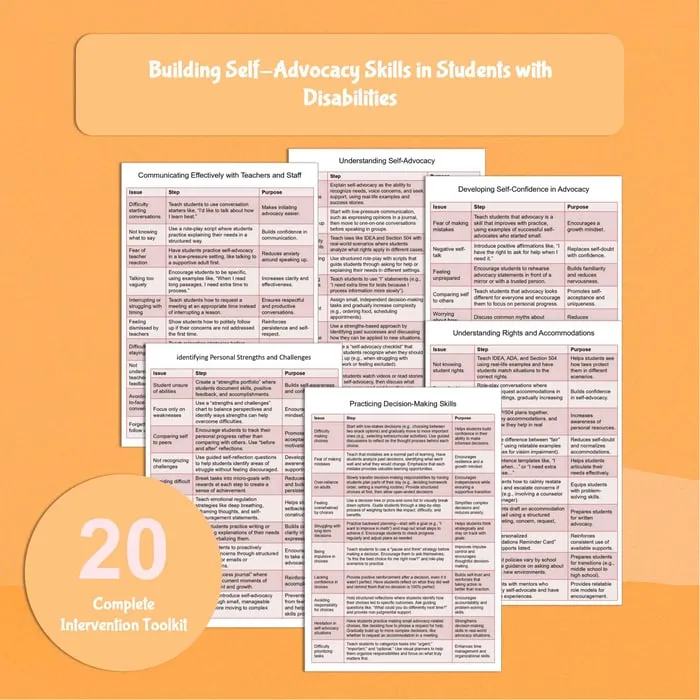
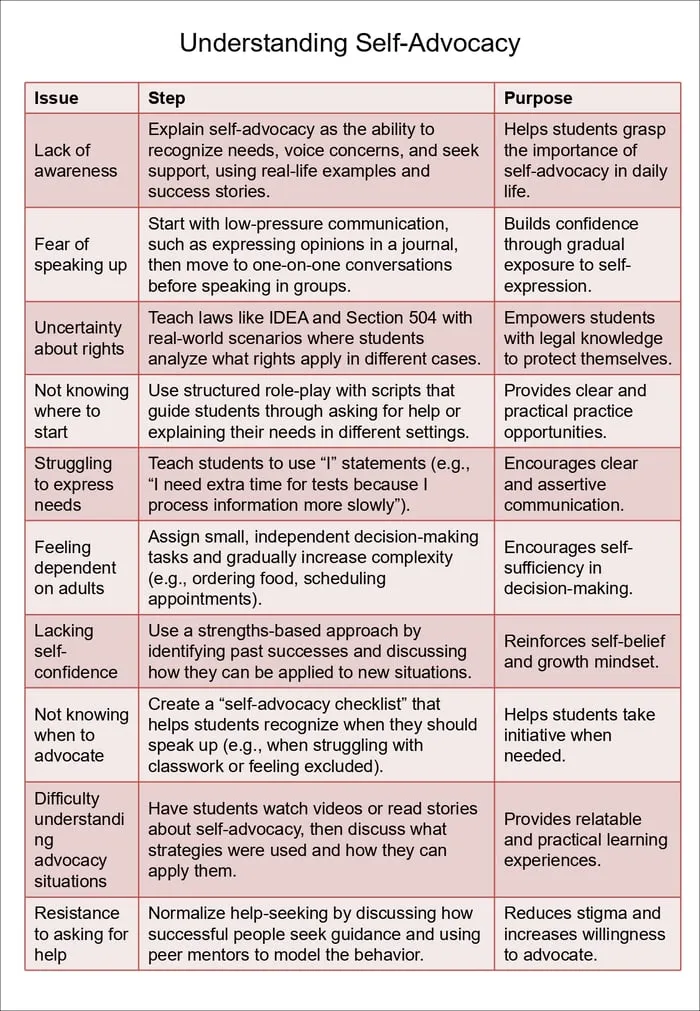
Self-Advocacy Skills Toolkit for Students: 20 intervention pages, each pairing a self-advocacy issue with a teaching step and its purpose, covering strengths, communicating with staff, rights and accommodations, confidence, and decision-making.
Sources and scope
- IDEA, U.S. Department of Education: the law behind IEPs and student participation in planning.
- IRIS Center, Vanderbilt University: free modules on transition planning and student involvement.
- Understood.org: articles for families and teachers on self-advocacy and learning differences.
- CAST: the organization behind Universal Design for Learning, including learner agency.
This guide offers self-advocacy examples and classroom and home strategies for teaching the skill. It does not give legal advice about IEP or 504 rights, which families can discuss with their school team.
Key takeaways
- Self-advocacy examples make an abstract idea concrete for students.
- Students need words for their strengths, needs, and supports first.
- Short scripts and a clear request order make speaking up easier.
- Rehearse in safe settings, then reflect after each real request.
- Track independent requests weekly and share progress with the student.





Leave a Comment