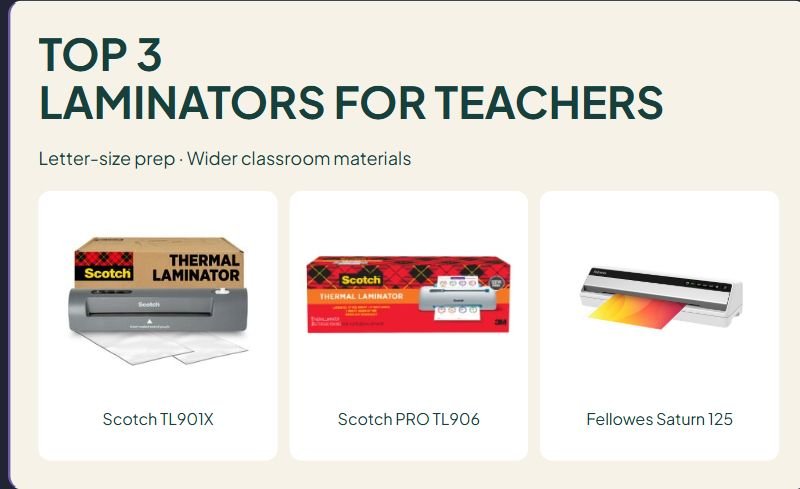

TOP 3
LAMINATORS FOR TEACHERS
Letter-size prep · Wider classroom materials

Scotch TL901X

Scotch PRO TL906
Fellowes Saturn 125
Affiliate disclosure: As an Amazon Associate I earn from qualifying purchases. We may receive a commission when you buy through our links, at no extra cost to you.
The best laminator for a teacher depends on the materials being prepared. Letter-size visual schedules do not need the same opening as wider classroom signs. Warm-up time matters for short preparation sessions, while pouch compatibility and a clear feeding routine matter every time you use the machine.
This research-based guide compares three models and their documented features. We have not tested these machines, timed their output, or measured jam rates. The picks describe useful applications rather than a laboratory ranking.
Check the model number: The Scotch TL1302Z is subject to an October 15, 2026 recall for overheating and fire risk. It is excluded here. If you own that model, stop using it, unplug it, and follow the CPSC recall instructions. Do not identify a machine by brand or color alone.
Teacher laminators at a glance
| Model | Document width | Pouch settings | Consider for | Main trade-off |
|---|---|---|---|---|
| Scotch TL901X | Up to 9 inches | 3 and 5 mil thermal | Letter-size preparation | Limited width for larger materials |
| Scotch PRO TL906 | Up to 9 inches | 3 and 5 mil thermal | Letter-size prep with LED controls | Same width limit as TL901X |
| Fellowes Saturn 125 | 12.5-inch entry | 3, 4, 5 mil hot; cold mode | Wider materials and short prep sessions | Larger machine; check generation |
Three laminators for different teacher workflows
1. Scotch TL901X: for routine letter-size preparation
The TL901X uses two heated rollers and offers settings for 3-mil and 5-mil thermal pouches, with a maximum width of 9 inches. The manufacturer describes a pouch-release lever and output of about one letter-size page per minute. It specifies a grounded 120V outlet and says not to use a voltage or outlet converter.
Why consider it: Its size range suits many letter-size schedules, classroom labels, and small teaching cards arranged within a compatible pouch.
What to weigh: A compact machine cannot handle a wider project merely because the paper can be folded. Measure the complete pouch, follow the feed instructions, and leave room behind the unit for the finished sheet.
Practical fit: Consider it when most projects begin with U.S. letter paper and your school does not already provide convenient laminating access.
Scotch TL901X specifications and product source
Check Scotch TL901X on Amazon.com →
2. Scotch PRO TL906: for letter-size prep with different controls
The TL906 also accepts 3-mil and 5-mil pouches up to 9 inches wide. Its published features include LED controls, Never Jam technology intended to prevent misfeeds, and shutoff after one hour. The current manufacturer description gives a five-to-six-minute warm-up and 15-inch-per-minute feed speed.
Why consider it: Compare its controls and feed features with the TL901X when both fit the materials you make.
What to weigh: It does not expand the working width. “Never Jam” is a feature name, not a guarantee that every pouch will feed correctly. Buying a PRO label alone does not establish that the result will be better for your classroom.
Practical fit: Choose based on the controls, current offer, and instructions you prefer. A functioning letter-size machine you already own may meet the same need.
Scotch PRO TL906 specifications and product source
Check Scotch PRO TL906 on Amazon.com →
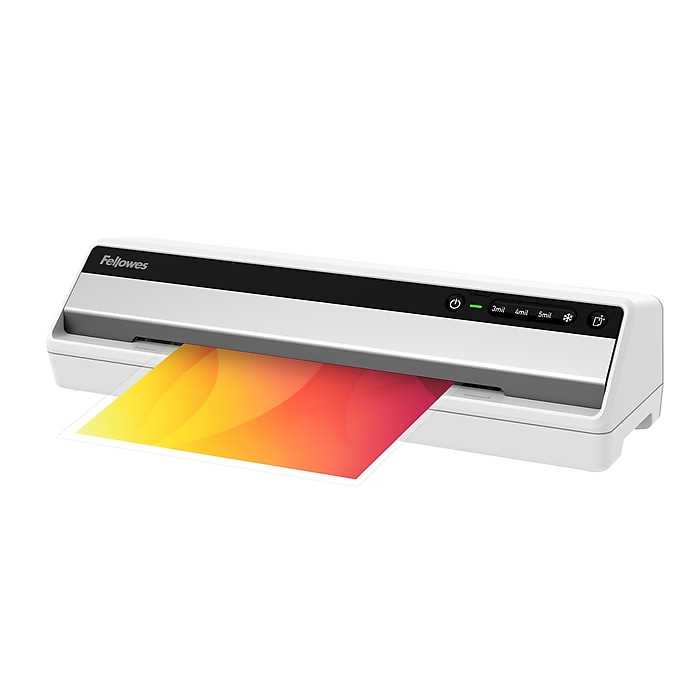
3. Fellowes Saturn 125: for a wider entry and faster warm-up
The current Saturn 125 listing has a 12.5-inch entry and a stated 60-second warm-up. It lists 3-, 4-, and 5-mil hot-pouch settings, a cold mode for self-adhesive pouches, a release lever, and a CleanAlert maintenance reminder. These features make it worth comparing when a 9-inch machine is too narrow.
Why consider it: The wider opening accommodates a broader range of materials, while the short stated warm-up can suit brief preparation sessions.
What to weigh: Measure the whole pouch and the available work surface. A 12.5-inch entry does not mean every poster fits. Older Saturn 3i documentation and current Saturn 125 listings differ in some specifications, so match the offered generation and manual before buying.
Practical fit: List your widest recurring project first. Pay for the extra width when it solves that recurring need, rather than assuming larger is automatically better.
Fellowes Saturn 125 specifications and product source
Check Fellowes Saturn 125 on Amazon.com →
How to choose a laminator without buying unnecessary features
Measure the pouch, not just the paper
The pouch extends beyond the document. Check the machine’s entry width against the complete pouch size. Also check the maximum combined thickness permitted in the manual; a pouch setting is not permission to feed any thickness of cardstock or added decoration.
Understand 3 mil and 5 mil
A mil is one-thousandth of an inch, not a millimeter. Pouch packaging uses this measurement to describe film thickness. Check how the supplier states the measurement and select the machine setting instructed for that pouch. The choice affects flexibility and feel; it does not establish that a finished card is suitable for every learner.
Separate warm-up from finishing time
A machine can reach its ready state quickly yet still take time to feed each pouch. Plan for loading, feeding, cooling, trimming, and sorting. Compare your actual preparation batch, rather than assuming the shortest warm-up gives the shortest total job.
Account for ongoing supplies
Consider pouch size, thickness, pack quantity, storage, and cleaning supplies specified by the manufacturer. Check the seller, warranty, return terms, and U.S. electrical requirements of the exact machine. We leave prices to the live retailer listing because offers change.
A manageable classroom-material preparation routine
- Print and check one sample at the intended size.
- Lay out the pieces within the pouch while retaining the borders required by its instructions.
- Allow the machine to reach its ready state and choose the correct setting.
- Feed the pouch in the direction stated in the manual, on a clear, stable work surface.
- Let the finished material cool before handling or trimming it.
- Inspect the edges and seal before classroom use.
Keep hot equipment and cords in an adult-controlled preparation area. Follow the manual for release, cleaning, cooling, and storage. If a pouch jams, use the specified release procedure rather than pulling against powered rollers.
For classroom organization around the materials, explore our Teacher Life and Classroom guides. For another preparation-station tool, see our electric and manual pencil sharpener comparison.
What to look for in customer reviews
Look for the exact model, pouch brand and thickness, project size, and length of ownership. Reports about repeated misfeeds, seal quality, maintenance, or controls are more useful when the reviewer explains those conditions. Check whether the listing combines older and newer versions before treating its average rating as evidence for the offered machine.
This guide does not reproduce Amazon reviews or claim independent test results. Use the tagged product links to inspect current customer feedback and the selected offer alongside the specifications.
Teacher laminator questions
Do teachers need a personal laminator?
Not always. Check the school workroom, printing service, or an existing machine first. A personal unit makes sense when its access, size, and permitted use solve a recurring preparation problem.
Can I laminate heat-sensitive documents?
Do not assume a thermal pouch is suitable. Check the original material and the machine instructions. A cold setting requires compatible self-adhesive supplies; it does not turn an ordinary thermal pouch into a heat-free product.
Can I cut out small cards after laminating?
Follow the pouch instructions for layout and sealed borders. Cutting into a required seal can let layers separate. Inspect the result and avoid sharp corners or loose film in classroom materials.
Which model is best for wider sheets?
Of these three, the Saturn 125 has the widest entry. Measure the complete pouch before choosing it. Very large posters may require a different machine or a school service.
How can I check a laminator recall?
Read the model number on the machine or packaging and compare it with the CPSC and manufacturer notices. The TL1302Z notice linked above applies to that specific model; a similar brand name or photograph is not enough to establish a match.
Start with the materials you make most
For letter-size prep, compare the TL901X and TL906 against your current equipment and budget. For a recurring need for wider pouches, consider the Saturn 125. Matching width, supplies, controls, and workspace is more useful than buying extra features without a clear job for them.






Leave a Comment