

Questions to ask about accommodations can turn a rushed fifteen-minute conference into a useful conversation. Many parents leave conferences knowing their child’s grades but not whether the supports in the IEP or 504 plan are actually happening. Picture Mrs. Nguyen, whose son Ben, age 10, has a 504 plan with extended time, preferential seating and a copy of class notes. At his fall conference, she heard “He’s doing fine,” but not much more.
This list is for parents and caregivers of children with IEPs or 504 plans. It ranks ten questions from the easiest to ask in the first minutes of a conference to the more detailed ones that may need a follow-up meeting. Ben appears as the fictional example, so you can see how each question leads to clearer information.
Examples are fictional. Adapt to the student’s goals and agreed supports. This is guidance, not a diagnosis.
At a glance
- Bring a short list of your child’s accommodations.
- Ask whether each one is used, not just whether it exists.
- Ask how your child responds to each support.
- Request a simple written update if time is short.
- Take formal change requests to the IEP or 504 team.
How we ranked these questions
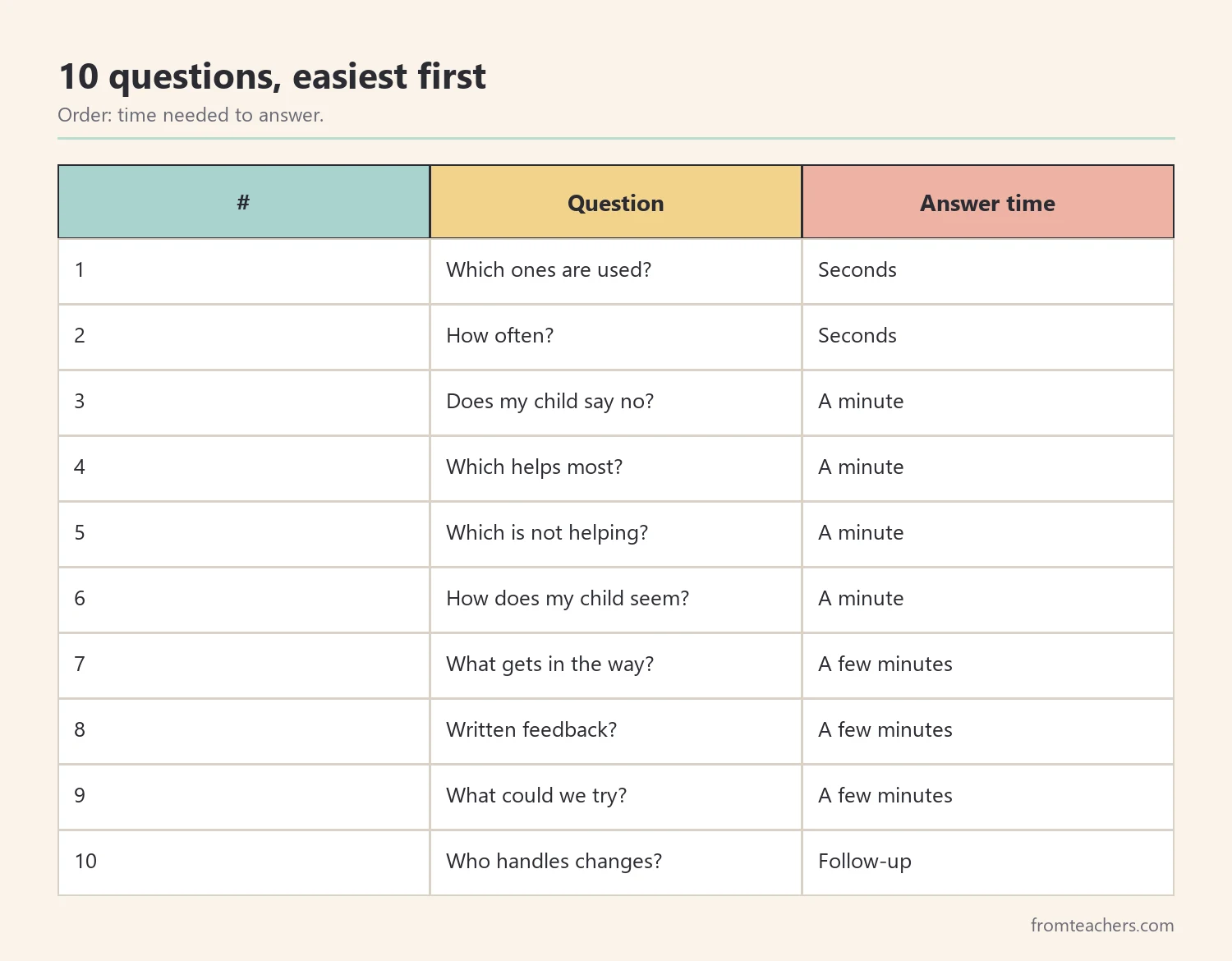
We ranked the ten questions from the easiest to ask, which take a few seconds to answer, to the more detailed ones that may need data or a second meeting. If your conference is short, start at the top. If you have more time, work further down the list.
The goal is not to test the teacher. It is to build a shared picture of what helps your child. Most teachers appreciate parents who come prepared with specific, friendly questions. Figure 1 shows the ranking.
1. Which accommodations are you using right now?
Why ask it: it checks that the teacher knows the plan and gives a quick overview.
What to listen for: a specific list that matches the plan. If something is missing, ask about it kindly.
Example: Ben’s teacher named extended time and seating, but not notes. Mrs. Nguyen asked, “What about the copy of class notes?” The teacher said she would check with the case manager.
2. How often does my child use each one?
Why ask it: a support on paper is not the same as a support in use. Some students decline supports, and some supports are rarely offered.
What to listen for: rough numbers, like “on every test” or “about half the time.”
Example: the teacher said Ben used extended time on two of four tests and declined it twice.
3. Does my child ever say no to a support?
Why ask it: declining a support often has a reason, such as embarrassment, timing or not needing it.
What to listen for: any pattern, such as declining in front of friends or at the end of the day.
Example: Ben declined extended time when it meant missing lunch with friends. That was a scheduling problem, not a lack of need.
4. Which support seems to help most?
Why ask it: it focuses on what works, which is useful for planning and positive for your child.
What to listen for: examples of work, grades or behavior that improved with the support.
Example: the teacher said Ben’s test scores were higher when he used the full extra time.
5. Is any support not helping?
Why ask it: supports that do not help take time and attention away from ones that might.
What to listen for: honest observations, such as “seating does not seem to change much.”
Example: the teacher noticed Ben focused better near the window than at the front, which surprised everyone.
6. How does my child seem when using the supports?
Why ask it: it reveals comfort, confidence and possible stigma.
What to listen for: words like relaxed, embarrassed, confident or frustrated.
Example: the teacher said Ben seemed relaxed with notes but uncomfortable leaving the room for extra time.
7. What gets in the way?
Why ask it: barriers are often practical, such as room changes, schedules or missing materials.
What to listen for: problems you or the team can solve.
Example: extended time required a different room, and the room was often booked. The case manager could fix that.
8. Can you share feedback in writing?
Why ask it: conferences are short, and written notes are easier to bring to the IEP or 504 team.
What to listen for: a simple plan, such as a one-page update before the next review.
Example: Mrs. Nguyen asked if the teacher could complete a short classroom accommodation feedback form with an effectiveness rating, engagement, challenges and suggested changes. The teacher agreed to send it before winter break.
9. What could we try next?
Why ask it: teachers often have practical ideas that parents never hear about.
What to listen for: small changes the teacher could try now and bigger ones for the team.
Example: the teacher suggested letting Ben take extended time during a study period instead of lunch.
10. Who should I contact about changes?
Why ask it: formal changes to an IEP or 504 plan go through the team, usually through a case manager or coordinator.
What to listen for: a name and a way to reach them.
Example: the teacher gave Mrs. Nguyen the 504 coordinator’s email. She requested a short review meeting.
A sample notes table
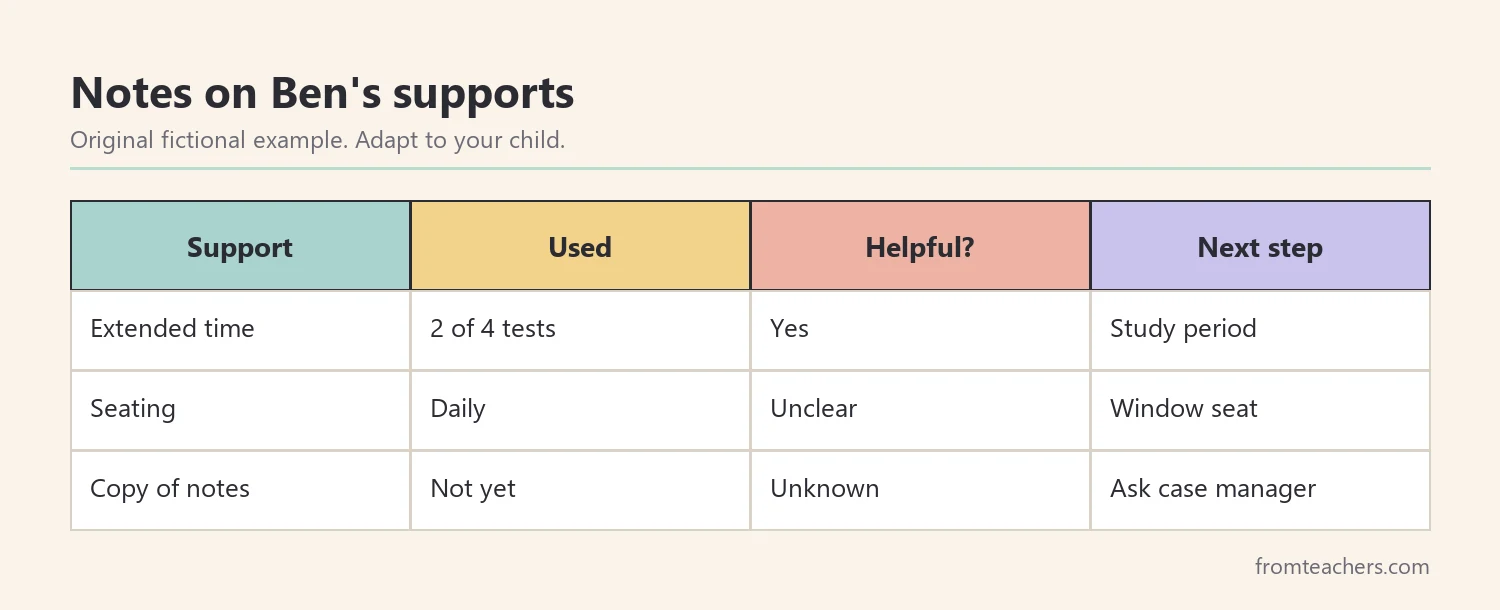
Many parents find it helpful to take notes in a simple table during the conference. The table below shows Mrs. Nguyen’s fictional notes for Ben. It shows the format only.
| Accommodation | Used | Helpful? | Next step |
|---|---|---|---|
| Extended time | 2 of 4 tests | Yes | Move to study period |
| Preferential seating | Daily | Unclear | Try window seat |
| Copy of notes | Not yet | Unknown | Ask case manager |
Before, during and after the conference
Asking good questions to ask about accommodations is easier with a little preparation. Figure 4 shows a simple routine.
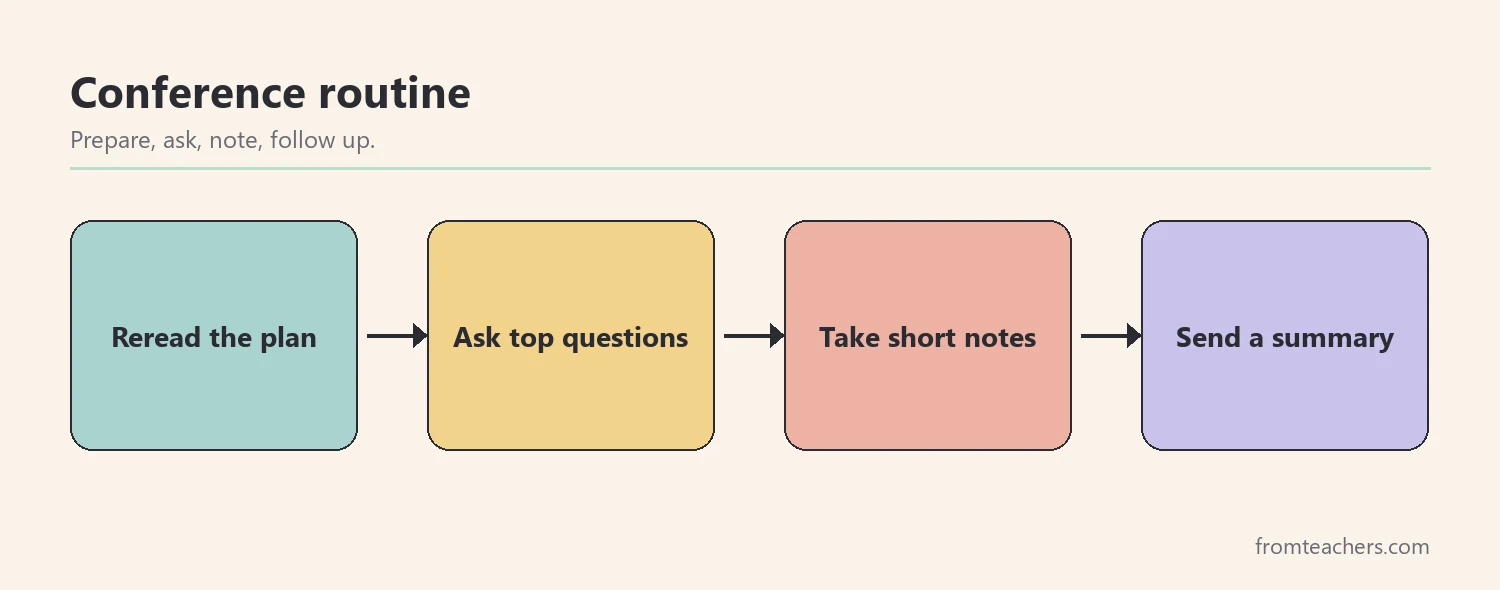
Before the conference, reread the plan and pick your top three questions. During the conference, take short notes. Afterwards, send a friendly email that summarizes what you heard and any agreed next steps. That email becomes a useful record for later meetings.
Including your child
Older children can share what they think about their supports. Before the conference, ask your child a few simple questions: “Which help do you like most? Is there anything you do not use? Why?” Their answers often explain patterns that teachers notice but cannot explain.
In Ben’s case, he told his mom that he skipped extended time because it meant missing lunch. That one comment helped the adults solve the problem faster.
Keep the conversation light and short. Children are more honest when the questions feel like curiosity rather than a check-up, so ask on a walk or during a car ride instead of across the kitchen table.
Adjusting the questions for your child’s age
The same ten questions work from elementary to high school, but the focus shifts. For younger children, teachers usually offer the supports, so ask how adults set them up and remind the child. For example, “Who reminds Ben that he can have extra time?”
In middle school, children have several teachers and start to choose whether to use supports. Ask each teacher whether your child requests supports or waits for them, and whether supports look the same across classes. Differences between teachers are common and worth discussing with the case manager.
In high school, students should lead more of the conversation. Invite your teen to ask one or two of the questions directly. This practice prepares them for college and work, where they will need to request accommodations themselves.
If the answers worry you
Sometimes the conference reveals that a support is not being provided at all, or that your child is struggling more than you knew. Stay calm and focus on next steps. Thank the teacher for being honest, write down what you heard and contact the case manager or 504 coordinator the same week.
If problems continue, you can request a team meeting in writing. Parent centers in every state offer free guidance on how the process works, and the resources in the sources section below explain your options in plain language.
Common mistakes and how to avoid them
- Only asking about grades. Fix: ask about supports, too.
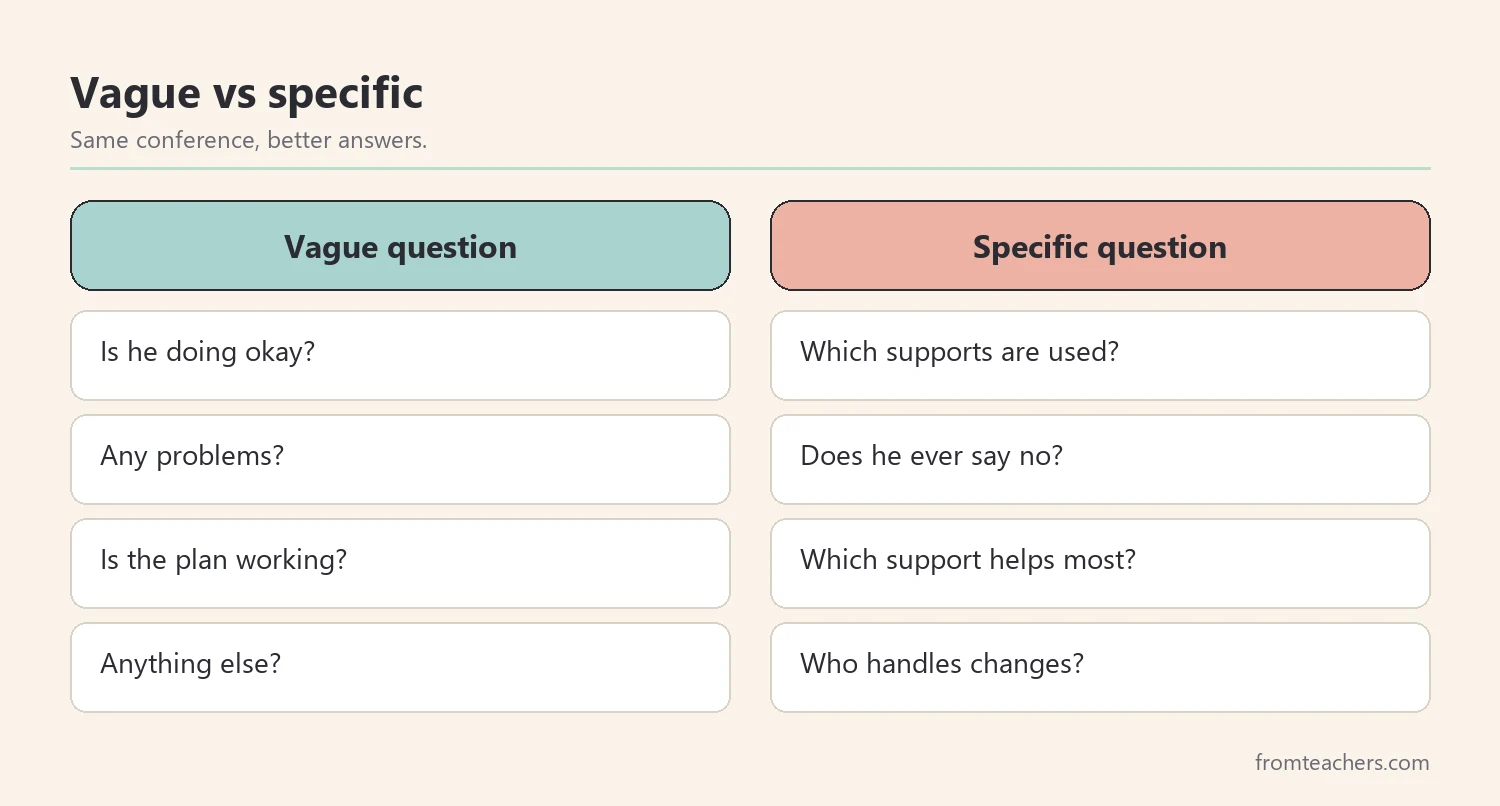
- Asking “Is he doing okay?” Fix: ask specific questions about each accommodation.
- Trying to change the plan at the conference. Fix: request a team meeting for formal changes.
- Not writing anything down. Fix: take short notes and send a summary email.
- Leaving your child out. Fix: ask your child’s view beforehand.
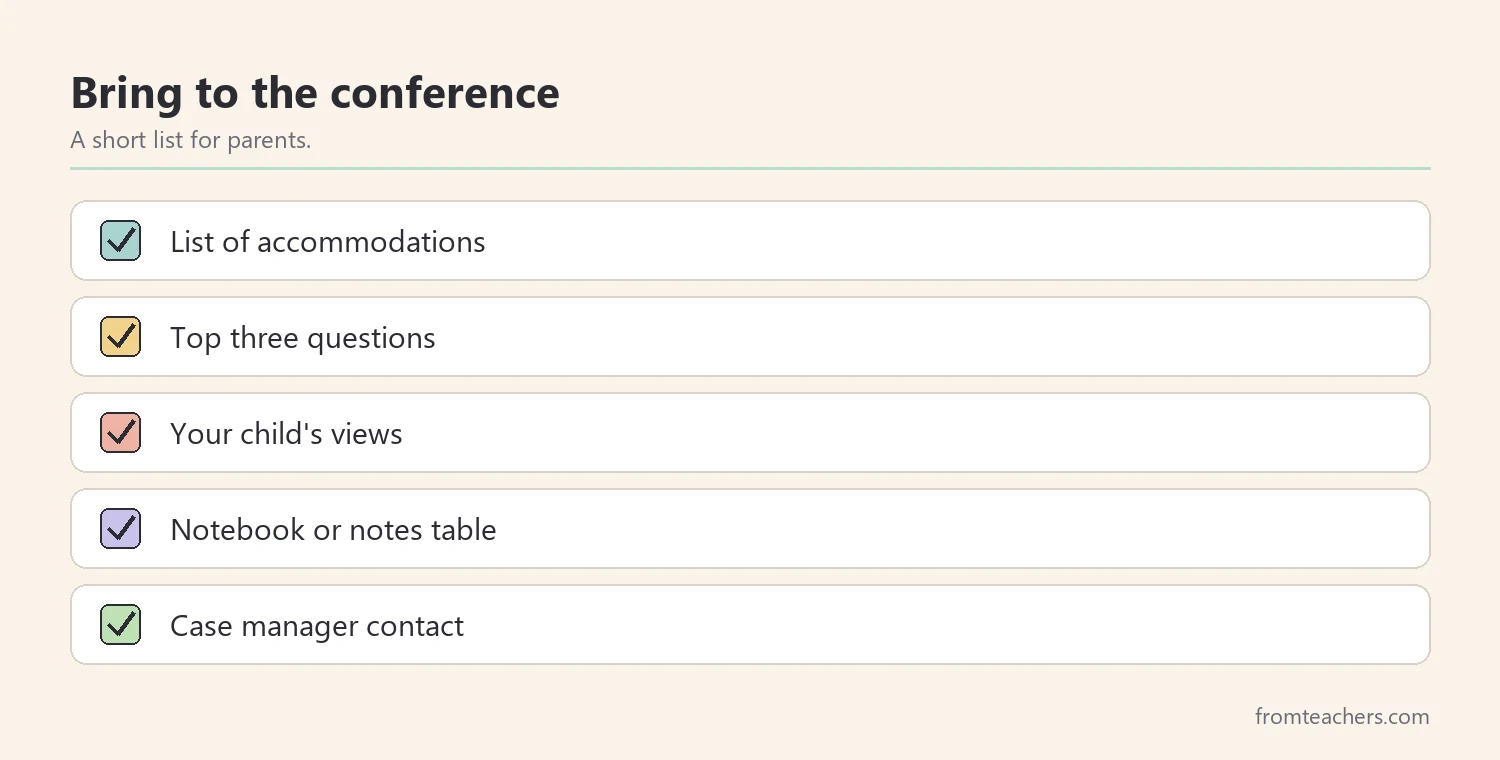
Figure 5 is a short list you can bring to any conference.
Parent FAQ: questions to ask about accommodations
What if the teacher does not know about the accommodations?
Stay calm and friendly. Ask who can share the plan with the teacher, and follow up with the case manager or coordinator.
Can I ask for data?
Yes. You can ask how the school tracks whether accommodations are used and helpful. Simple notes or forms are often enough.
Is a conference the right place to change a 504 plan?
Usually not. Conferences are for sharing information. Formal changes happen through the IEP or 504 team.
What if I only have ten minutes?
Ask the first three questions and request a written update for the rest.
Should I bring the whole plan?
A one-page list of accommodations is usually easier to use during a short conference.
Related reading: Accommodations vs Modifications in Special Education, Teacher-Parent Communication in Special Education, and Effective ADHD Classroom Strategies.
You may also need: Accommodations and Modifications Tracker: Editable IEP Forms.
A companion resource for parents and teachers talking about accommodations:
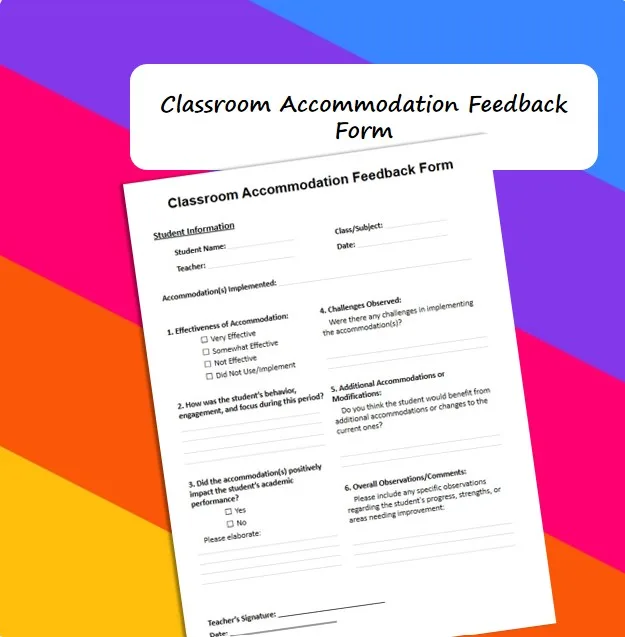
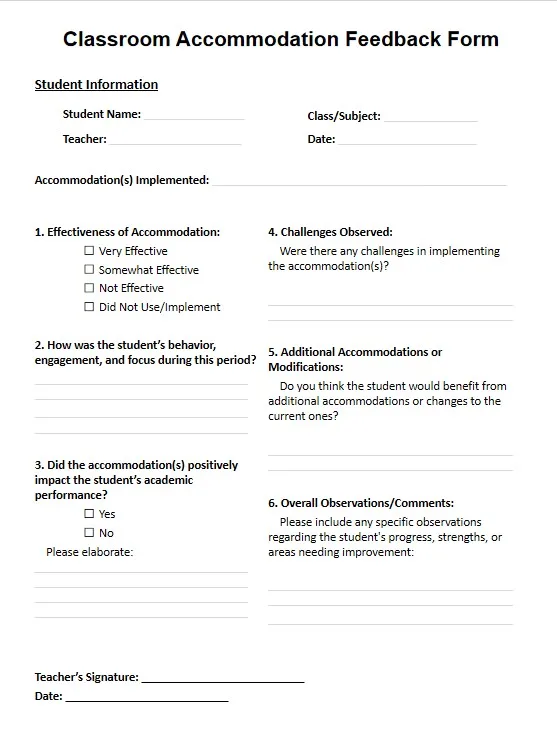
Classroom Accommodation Feedback Form IEP 504 Effectiveness Tracker: a one-page form with student, teacher, date and class fields, accommodations implemented, an effectiveness rating from very effective to did not use, questions on behavior, engagement and academic impact, challenges observed, suggested additional accommodations or modifications, overall comments and a signature line.
Sources and scope
- Center for Parent Information and Resources: plain-language information on IEPs, 504 plans and accommodations.
- Understood: Accommodations: an explainer on what accommodations are and how they work at school.
- Wrightslaw: information for parents on special education law and advocacy.
- National Center for Learning Disabilities: resources for families of students with learning disabilities.
This guide helps parents prepare for conversations with teachers. It is not legal advice, and formal changes to accommodations are made through the IEP or 504 team.
Key takeaways
- Good questions to ask about accommodations focus on use, not just existence.
- Ask how often supports are used and whether your child declines them.
- Look for practical barriers and simple next steps.
- Request written feedback when time is short.
- Take formal changes to the IEP or 504 team.










Leave a Comment