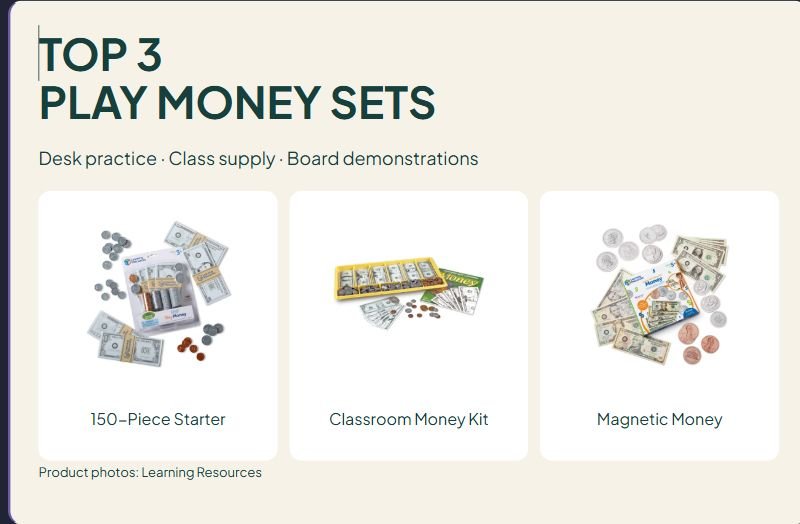

TOP 3
PLAY MONEY SETS
Desk practice · Class supply · Board demonstrations

150-Piece Starter

Classroom Money Kit

Magnetic Money
Product photos: Learning Resources
Affiliate disclosure: As an Amazon Associate I earn from qualifying purchases. Purchases through our links may earn a commission at no additional cost to you.
The best play money set for a lesson depends on who will handle it and what they need to see. A small pack can work for a pretend shop at home. A larger classroom kit provides a wider supply for group activities. Oversized magnets make a teacher's example easier to display, but do not replace individual practice sets.
These three Learning Resources products address those different jobs. This is a comparison of manufacturer descriptions, not a hands-on test. No customer review, rating or learning outcome is implied. Before buying, confirm the exact model, currency, quantities and current listing contents.
Compare the three formats
| Product | Model | Documented contents | Practical use | Main limitation |
|---|---|---|---|---|
| Pretend & Play Play Money | LER2725 | 150 pieces: 60 paper bills and 90 plastic coins | Home practice or a shared small-group shop | Limited denominations compared with the large kit |
| Giant Classroom Money Kit | LER0106 | Plastic US coins and paper bills from $1 through $100, with jumbo tray and clear lid | Organizing a class supply for repeated math activities | More pieces and denominations to manage |
| Double-Sided Magnetic Money | LER5080 | 45 magnetic pieces: 36 enlarged coins and 9 oversized bills | Modeling money on a magnetic board | A demonstration supply rather than a class pack |
1. Pretend & Play Play Money: a smaller starting supply
The LER2725 pack contains 150 pieces. The manufacturer's own questions and answers specify 60 paper bills in $1, $5, $10 and $20 denominations, plus 90 plastic coins covering pennies, nickels, dimes and quarters. That range supports coin identification, equivalent amounts, basic totals and simple shopping activities without introducing every denomination at once.
Why choose it: The narrower selection is manageable for a parent or tutor. Paper bills and separate plastic coins let children sort two forms of currency. A learner can build the same amount in more than one way, rather than only naming a printed picture.
Limitations: A 150-piece total is not 150 complete student sets. If each learner needs several quarters and dimes, the quantity of each denomination matters more than the total. The current manufacturer page describes bills as actual size, while a search result for an Amazon listing describes a three-quarter scale version. Do not promise bill dimensions until the exact US listing and version are reconciled. The primary page also gives two different sets of overall dimensions; neither should be treated as a verified bill measurement.
Try this lesson: Put out a quarter, two dimes and one nickel. Ask the learner to make 25 cents in two ways. Then make 30 cents and explain which coins changed. Use only the denominations needed for the activity so the supply does not become a sorting distraction.
The checked US listing for B01LZS1L48 gives this more specific breakdown. Confirm the current package before planning identical supplies for several learners:
| Denomination | Listed quantity |
|---|---|
| $1 bill | 20 |
| $5 bill | 20 |
| $10 bill | 10 |
| $20 bill | 10 |
| Penny | 30 |
| Nickel | 20 |
| Dime | 20 |
| Quarter | 20 |
That totals sixty bills and ninety coins. For example, the twenty listed quarters could supply four quarters each to five groups, provided no other activity needs quarters at the same time. Keep denomination quantities separate from face value: twenty quarters represent five dollars of pretend value, not twenty dollars.
The manufacturer labels this model ages 3+ and warns of small parts that are unsuitable for children under 3. Supervise use according to the child's needs and the product label.
2. Giant Classroom Money Kit: a wider organized supply
The LER0106 kit includes pennies, nickels, dimes, quarters, half-dollars and dollar coins. Its paper money covers $1, $5, $10, $20, $50 and $100. The manufacturer describes a jumbo storage tray with a see-through lid, which can support a routine for taking out and returning denominations after a lesson.
The larger range makes sense when students move from coin values to mixed bills and coins. It also lets a teacher keep advanced denominations available without using them in every beginner activity.
Why choose it: A shared class supply can support center rotations and repeated money tasks. Separate denominations make it possible to build different representations of the same amount. The tray gives the materials a defined storage location.
Limitations: The word giant describes a classroom kit; it does not establish that every individual coin and bill is oversized. The manufacturer's quantity wording groups pennies, nickels, dimes and quarters after the number 100 without making the per-denomination interpretation completely explicit in the text captured for this comparison. Verify the pack breakdown on the exact listing rather than presenting a calculated total as certain. More denominations also mean more sorting and more opportunities to lose a needed value.
Try this lesson: Give pairs a small selection for a pretend purchase costing $3.65. Ask them to pay the exact amount, then represent it another way. For a later lesson, pay with $5 and count up from $3.65 to $5 to find $1.35 in change. Explain that the amount paid and the change together must equal $5.
The manufacturer lists ages 5+ and a small-parts warning. A large supply should stay in adult-managed storage between activities when loose pieces would be unsuitable.
3. Double-Sided Magnetic Money: a shared visual example
The LER5080 set has 45 magnetic pieces: 36 enlarged coins and nine oversized bills. The manufacturer describes printing on both sides and use for identifying money, counting amounts and modeling change.
These pieces serve a different purpose from a bag of student money. A teacher can arrange an amount on the board while students explain what they see, then change one piece at a time to illustrate an equivalent amount.
Why choose it: Enlarged pieces can make a demonstration easier to follow. Magnets allow an arrangement to stay in place on a suitable board. A limited display can focus a class on one worked example.
Limitations: Check that your board is magnetic. A surface being called a whiteboard does not guarantee magnets will adhere to it. Forty-five pieces are not enough to assume every student receives a complete supply. Visibility also depends on room size, contrast and where children sit; the manufacturer's claim that everyone can see is not a substitute for checking your own room.
Try this lesson: Display 40 cents with four dimes. Ask students for a different representation and replace the pieces with one quarter, one dime and one nickel. Count the total again. Pair the demonstration with student money or a written response so learners do more than watch.
What matters more than a high piece count
Start with the denominations required by your lesson. A beginner matching pennies, nickels, dimes and quarters does not need a large stack of $100 bills. A lesson on paying for a $12.40 purchase needs a different selection from a coin-sorting task.
Next decide whether the supply is for demonstration, partners or individual response. Divide the available quantities by the number of working groups, then check that each group has the values needed for the activity. Avoid calculating only pieces per student; five pieces with the wrong denominations may not support the task.
Confirm that the set represents US currency. Pictures and product names can resemble versions sold for other countries. Model numbers and listing contents are more reliable than a broad product-family name.
Consider storage before the first lesson. Label compartments by denomination and model a return routine. Begin with a small working amount on each table, keeping the rest in storage. Check pieces before and after the activity when children may place objects in their mouths.
A practical progression for money lessons
Begin by identifying coins and bills. Discuss the printed value instead of assuming the largest coin has the greatest value. Move to counting collections of one denomination, then combine two familiar denominations before mixing everything together.
Use equivalence next: five pennies equal one nickel, two nickels equal one dime, and four quarters equal one dollar. Ask students to build the relationships and explain them. A display of equal values can support a conversation about why counting pieces is different from counting money.
Introduce a simple shop with a few clearly marked prices. Take turns as customer and cashier. Start with exact payment, then introduce change when the learner is ready. Compare the amount paid with the price, and check the result together.
Finally, connect practice to familiar situations. A pretend snack purchase, a classroom supply shop or saving toward a small goal gives the numbers a purpose. Physical cash practice does not automatically teach card payments or a bank balance; discuss those separately when relevant.
Common questions
Which set is best for home use? The 150-piece LER2725 is the smaller format in this comparison. Check its actual denomination quantities against the activities you want to do before choosing it.
Are magnetic money pieces enough for a class? They can support a demonstration. Individual or partner practice requires enough additional manipulatives or another response method.
Should I introduce every denomination at once? A limited selection can keep an early task focused. Add other values as the learner can identify and compare the current ones.
Can I assume play money matches real money in size? No. Versions and formats differ, and magnetic demonstration pieces are deliberately enlarged. Verify the exact product version if physical size matters to your teaching goal.
For another way to represent ones, tens and hundreds alongside money tasks, see our base-ten blocks comparison. Keep currency values and place-value units explicit when moving between the two models.




Leave a Comment