
TOP 3
GEAR BUILDING SETS
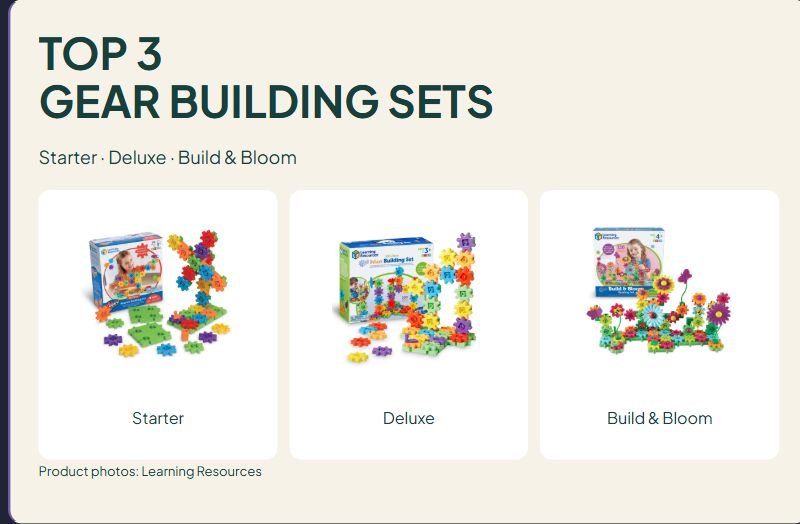
Starter · Deluxe · Build & Bloom

Starter

Deluxe

Build & Bloom
Product photos: Learning Resources
Affiliate disclosure: As an Amazon Associate I earn from qualifying purchases. Purchases through our links may earn a commission at no additional cost to you.
Gear building sets offer a concrete question for a classroom center: what changes when one connected gear turns? The right pack depends on the pieces students need to work with, rather than the largest number printed on the box. A set with more decorative pieces may offer fewer useful gears than its total count suggests.
These three Learning Resources Gears! Gears! Gears! options include two related basic building sets and a flower-themed alternative. This is a specification-based comparison, not a hands-on test or a ranking of independently tested mechanisms. The activities below are editorial suggestions. We have not verified customer review excerpts for this guide.
Quick comparison of gear building sets
| Set | Listed contents | Strongest reason to choose it | Main limitation |
|---|---|---|---|
| Starter, LER9148 | 60 pieces: 28 gears, 14 pillars, 13 six-way axles, four bases, one crank | A smaller basic inventory for an introductory shared build | Only one crank; group roles still need planning |
| Deluxe, LER9162 | 100 pieces: 46 gears, 26 pillars, 21 six-way axles, six bases, one crank | More basic gears and supporting pieces | More parts to manage, with the same one-crank count |
| Build & Bloom, LER9214-D on the manufacturer page | Garden-themed gears, flowers, stems and insects; Amazon describes 116 pieces, while the manufacturer page says 117 | A flower-garden theme for moving constructions | Conflicting total counts; decorations are not all gears |
The Starter and Deluxe manufacturer pages list ages 3+. Build & Bloom lists ages 4+. All three pages carry a small-parts warning for children under 3. Follow the current package instructions and age guidance, and supervise the activity according to the children and setting.
1. Starter Building Set: a focused introduction
The Starter includes 28 gears, 14 square pillars, 13 six-way axles, four interlocking bases and one crank handle. An activity guide is also listed. The manufacturer says it is compatible with other Gears! Gears! Gears! sets, which may matter if the classroom already owns that line.
Why consider it: The smaller inventory can make it easier to prepare a deliberately limited building challenge. Set out a few gears and supports rather than every piece at once. Ask students to make one connected arrangement turn, then change one connection and describe what happened.
Limitations: Sixty pieces does not mean 60 independent building positions. Bases, supports and turning access all affect a group activity. The one supplied crank should be part of the sharing plan. Do not promise a fixed number of simultaneous projects from the total piece count alone.
A first activity: Build two touching gears on a stable base. Before turning one slowly, ask students to predict what the second will do. Add a third gear and ask for another prediction. Tie the explanation to the arrangement students can actually see.
Choose it when: You want a basic construction inventory for a first gear center, or a smaller extension to a compatible collection you already have.
2. Deluxe Building Set: more basic construction pieces
The Deluxe inventory includes 46 gears, 26 square pillars, 21 six-way axles, six interlocking bases and one crank handle, plus an activity guide. Compared with Starter, that is 18 more gears, 12 more pillars, eight more axles and two more bases. Together, those additions account for the 40-piece difference.
Why consider it: The extra pieces provide more material for extending a basic construction. A group can compare a short connected arrangement with a longer one, or investigate how different supports affect the stability of its build. Those are possible activities, rather than guaranteed outcomes of buying the larger pack.
Limitations: The Deluxe still has one crank handle. A bigger box does not automatically remove waiting or turn-taking. It also creates more pieces to sort and recover after a session. Check the actual selected listing: the verified Amazon page describes the 100-piece Deluxe in standard retail packaging.
A group activity: Assign rotating roles: builder, turner, observer and sketcher. Ask the group to sketch a successful arrangement before dismantling it. Next session, give them the sketch and ask what they would change. Rotate roles so one child does not keep control of the moving parts.
Choose it when: The basic gear format already fits your lesson and the smaller inventory would constrain the constructions you want students to attempt.
3. Build & Bloom: a moving flower-garden theme
Check LER9214-D on Amazon.com →
Build & Bloom adds flowers, wiggly stems, butterflies, bees and garden accessories to the gear-building format. The manufacturer page identifies model LER9214-D and describes interchangeable parts. Its theme may suit an invitation to design a moving garden, with students explaining which connections make parts move.
Why consider it: The garden gives a different design prompt from an abstract collection of gears. Students can plan the appearance of a garden and then examine which parts actually transmit motion. Keep those two goals explicit: an attractive arrangement and a working connection are different things to evaluate.
Important package check: The current Amazon listing describes a 116-piece set; the manufacturer page says 117. We could not resolve that difference from the two pages. Confirm the seller's current package contents before ordering, especially if you need a particular inventory. This guide does not promise either count as a guaranteed delivered quantity.
Limitations: The total includes decorative pieces and is not a gear count. It is therefore misleading to compare its advertised total directly with the Starter's 28 gears or Deluxe's 46 gears. The manufacturer age label is also 4+, rather than the 3+ labels on the two basic sets.
A design activity: Ask students to identify a piece that transmits motion and a piece used for decoration. Have them demonstrate their answer by turning the connected arrangement. If the design does not move, inspect one connection at a time instead of forcing the handle.
Choose it when: The flower theme serves your construction prompt and you are comfortable checking the package discrepancy before purchase.
How to plan a useful gear center
Count the parts that limit the activity
Write down the gears, bases, supports and crank handles needed for the task. Then decide which children will build together and which roles they will rotate through. A headline count is a mixture of components, not a measure of how many students can work independently.
Make the question smaller than the box
Begin with one observable question, such as what happens to the next touching gear when the first turns. Once students can demonstrate and describe that arrangement, change one feature. Putting every available part into a tall construction at the start can make it harder to identify why the movement stops.
Plan storage before adding another pack
Use trays or clear work boundaries to keep loose pieces from spreading across the room. Count the components used in a challenge before and after the session. If you combine compatible packs, keep a record of the inventory you actually have rather than relying on the original box totals.
Questions before buying
Is Deluxe automatically better than Starter?
No. Deluxe supplies more basic components, but the right choice depends on the intended build and group plan. Both list one crank handle. A smaller pack can be sufficient for a focused demonstration or rotating center; a larger one makes sense when you have a concrete need for more gears and supports.
Are all 117 advertised Build & Bloom pieces gears?
No. The total includes garden components such as flowers, insects and stems. There is also a 116-versus-117 discrepancy between the verified Amazon page and manufacturer page. Check current package details instead of treating the advertised total as a verified gear quantity.
Does buying a gear set guarantee STEM learning?
No product alone guarantees a learning result. The useful work is in predicting, building, observing and explaining the connections. Choose the materials for a clear activity and adapt participation when joining or turning pieces makes the task harder for an individual learner.
For a separate building format with pieces used to model quantities, see our math linking cube comparison. Choose the construction materials for the explanation you want students to make.




Leave a Comment