

Articulation data sheets turn a busy speech session into clear evidence of progress. Picture Theo, a first grader working on the /k/ sound. In twenty minutes he practices dozens of words, gets some right, some close, and some not yet. Without a record, all that effort becomes a vague memory: “He did pretty well today.”
This guide shows you how to set up and use data sheets that answer real questions. You will learn how to choose targets and levels, set up a clean sheet, score trials consistently, calculate accuracy and decide when to move on, and track carryover outside the therapy room. By the end, you will have a simple routine you can repeat for every student on your caseload.
Examples are fictional. Adapt to the student’s goals and agreed supports. This is guidance, not a diagnosis.
At a glance
- Name the target sound, the word position, and the level before the session starts.
- Use the same sheet layout every time so data is easy to compare.
- Score each trial right away with a simple, consistent code.
- Turn counts into a percentage and compare across sessions, not single days.
- Track carryover in class and at home, not only in the therapy room.
1. Choose targets and levels for your articulation data sheets
First, decide exactly what you are measuring. Good articulation data sheets name three things: the target sound, the position in the word, and the level of practice. For example, “/k/ in the initial position at the word level” is clear. “Working on /k/” is not.
Speech sound practice usually moves through levels from simple to complex. Many clinicians start with the sound in isolation, then syllables, words, phrases, sentences, and finally conversation. The exact sequence depends on the student and on the speech-language pathologist’s clinical judgment.
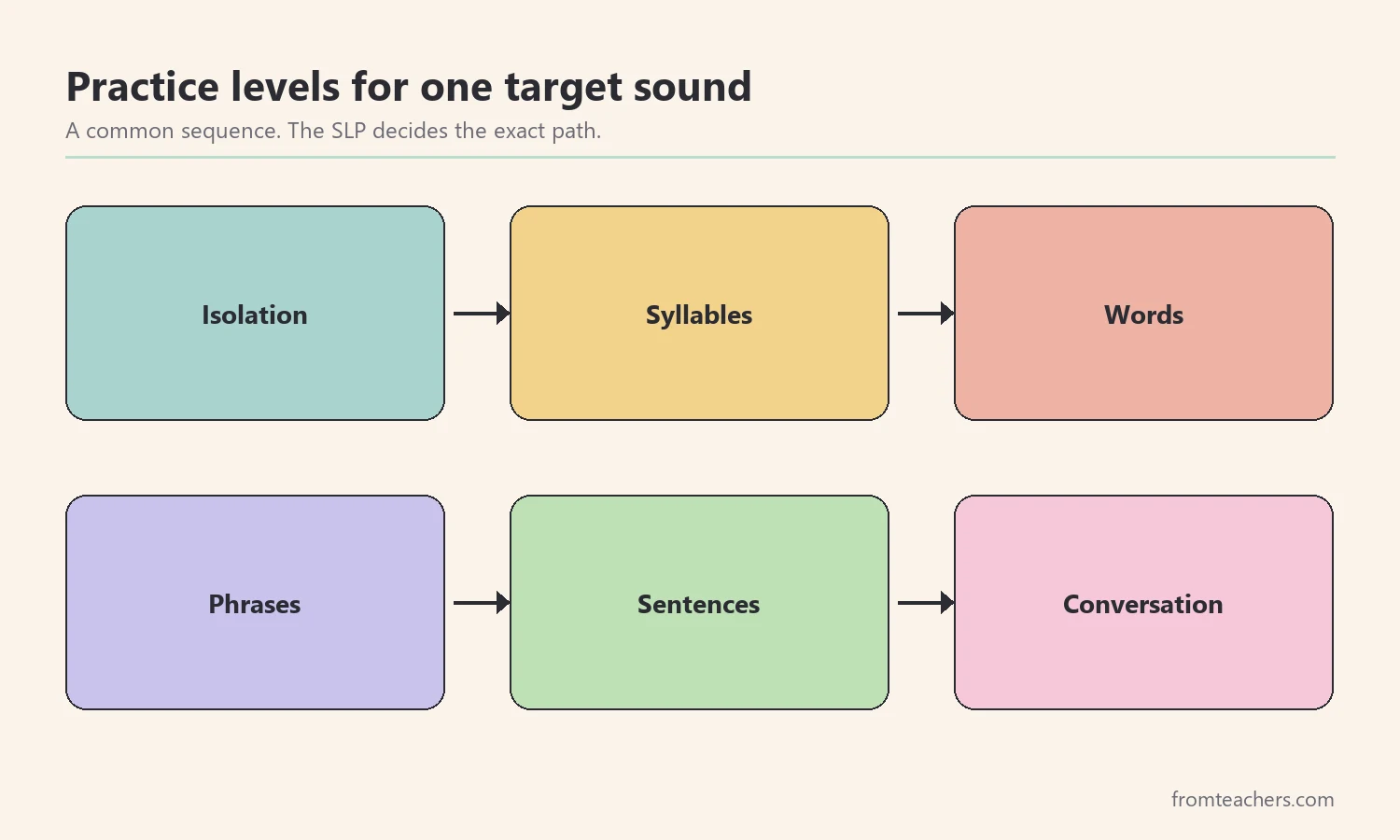
Next, pick one main level for each session. Mixing too many levels on one sheet makes the numbers hard to read. If you move up a level mid-session, start a new section on the sheet.
Likewise, keep the practice materials simple. Picture cards, a short game board, or a small set of objects can all work well. The goal is many clear attempts in a short time, not an elaborate activity that leaves little room for practice. When the activity is quick and familiar, students can focus on the sound itself.
Also, choose your word list in advance. A short list of familiar, picturable words helps young students stay focused. A speech sound stimulus word list, organized by sound and position, saves you from searching for words during the session.
For Theo, his SLP chose /k/ in the initial position at the word level. She picked ten words such as “cat,” “cup,” “key,” and “car,” and planned two rounds of each word. In short, the sheet would hold 20 trials for one clear target.
Before the first session, check the target against the student’s IEP goal. If the goal says “/k/ in all word positions in sentences,” your articulation data sheets should show a clear path from today’s level toward that goal. That link makes your data meaningful to the whole team.
2. Set up clean, repeatable articulation data sheets
Then, build or choose a sheet layout you can use every time. Consistency matters more than design. When every sheet looks the same, you can compare sessions at a glance and share them with colleagues.
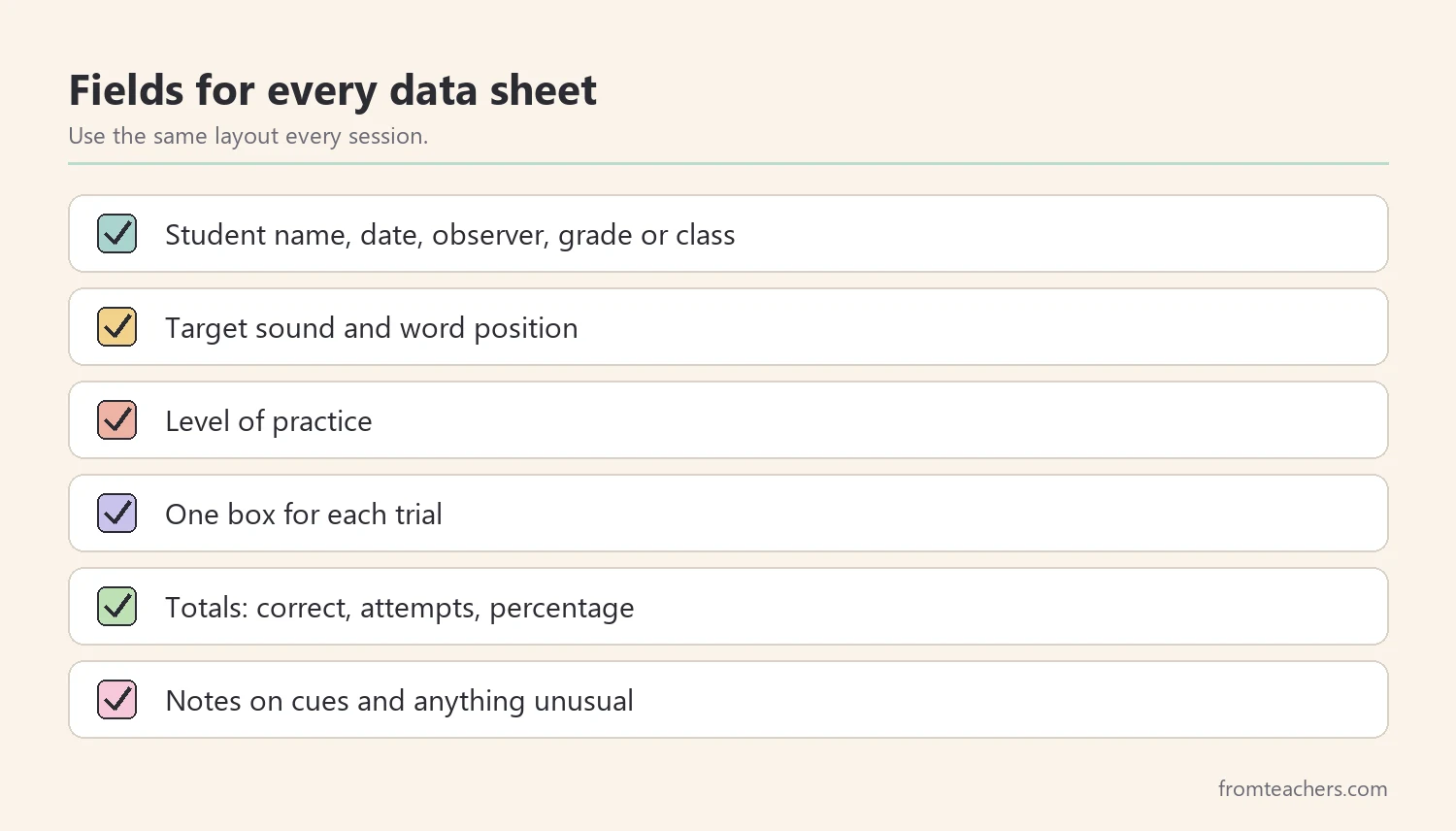
Most useful articulation data sheets include these fields:
- Student name, date, observer, and grade or class.
- Target sound and word position.
- Level of practice, such as word or sentence.
- A row or box for each trial.
- Totals: correct, attempts, and percentage.
- A short note on cues used and anything unusual.
In addition, keep separate sheets for different purposes. An initial sound production tracker helps you screen many sounds quickly. A single word tracker works for word-level drills, a sentence sheet for longer productions, and a tally log for comparing accuracy across sessions. If you want these ready to print, the Articulation Tracking Data Sheets for speech therapy progress monitoring include each of these sheet types in one 12-page set.
For Theo, the SLP used a single word tracker with 20 trial boxes, plus a notes line. She filled in the header before Theo arrived, so the session started right away.
Also, decide where the sheets live. A single binder or folder per student, kept in date order, makes it easy to find last week’s numbers. When articulation data sheets are scattered across desks and bags, patterns get lost and progress reports take far longer to write.
3. Score each trial on articulation data sheets consistently
Next, decide how you will score before the session begins. A simple code works best: a plus sign for a correct production, a minus sign for an incorrect one, and an optional letter for the type of error. Whatever code you choose, use it the same way every time.
| Mark | Meaning |
|---|---|
| + | Correct production |
| – | Incorrect production |
| S | Substitution, such as /t/ for /k/ |
| C | Correct only with a cue |
Also, record cues honestly. A production that is correct only after a model or a visual cue tells you something different from an independent one. Many SLPs count only independent correct productions toward accuracy and note cued ones separately. Follow the approach your team agrees on, and write it at the top of your articulation data sheets.
For instance, if Theo says “cat” correctly right after the SLP models it, she marks C. If he says it correctly on his own when he sees the picture, she marks a plus sign. Over time, the share of plus signs should grow while the share of cued marks shrinks.
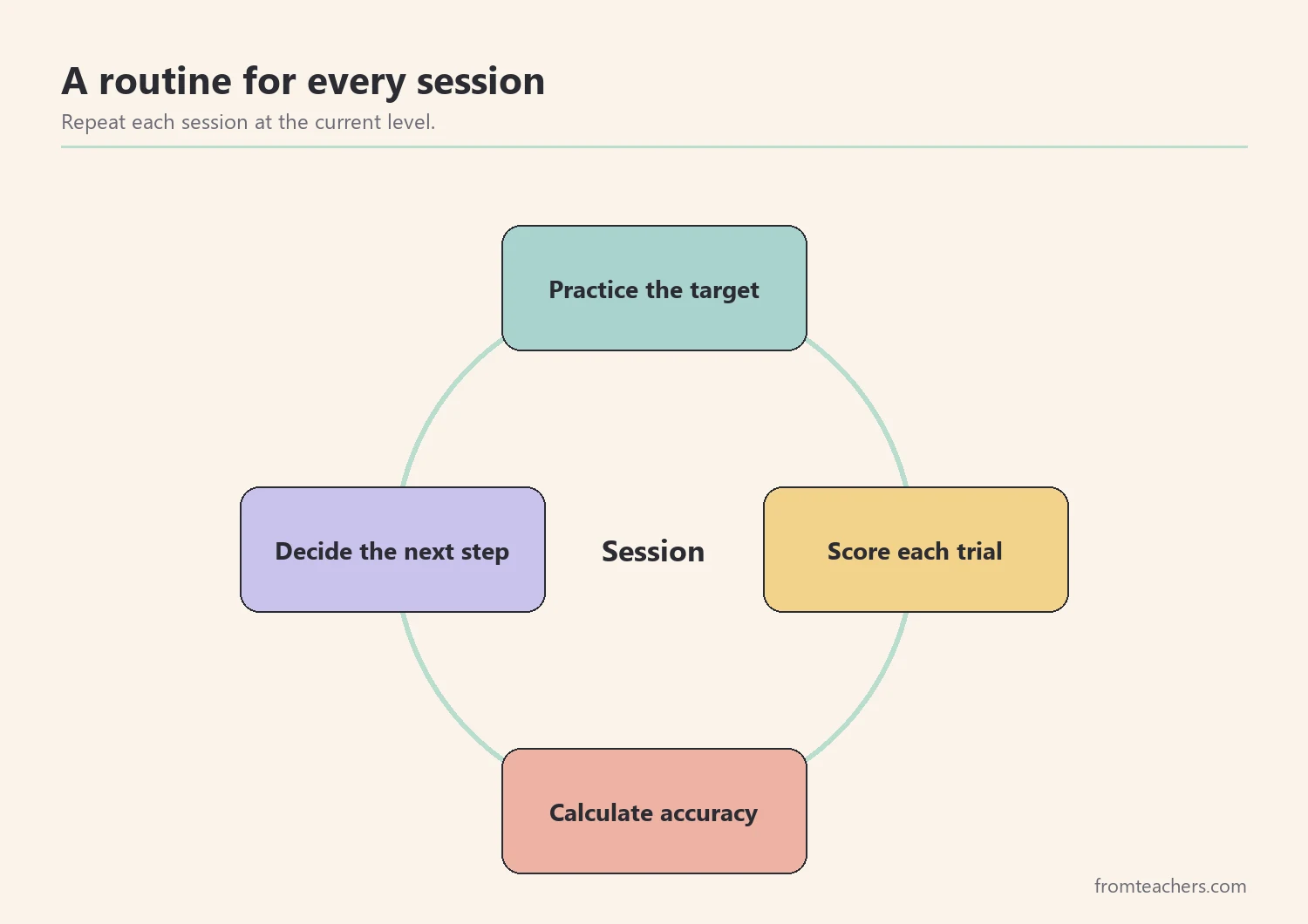
Moreover, score right away. Waiting until the end of the session leads to guesses. A quick mark after each word keeps the data honest and lets you adjust the practice as you go.
For Theo, the SLP marked each of his 20 trials as it happened. Several errors were “tat” for “cat,” so she marked them S and noted that /t/ was replacing /k/. That pattern guided her cueing for the next round.
In addition, error codes help you plan. A substitution pattern, such as /t/ for /k/, often calls for a different cue than a distortion or an omission. When articulation data sheets show the type of error and not just a minus sign, the SLP can choose the next practice step with more confidence.
4. Calculate accuracy and decide when to move on
After the session, turn the marks into a percentage. Divide the number of correct productions by the total number of attempts, then multiply by 100. For example, 16 correct out of 20 attempts is 80 percent.
However, one good session is not enough to move up a level. Look for a steady pattern across several sessions. Many SLPs set a criterion, such as a target percentage across a set number of sessions, but the exact rule should come from the student’s goals and your team’s practice. Write that rule on your articulation data sheets so anyone reading them understands the decision.
For Theo, the SLP tracked four sessions at the word level, each with 20 attempts. In session 1 he had 10 correct, which is 50 percent. Session 2 brings 13 correct, or 65 percent. In session 3, 16 correct, or 80 percent. By session 4, it reaches 17 correct, or 85 percent. Because his team’s rule was 80 percent or higher in two sessions in a row, Theo met it in sessions 3 and 4 and moved to the phrase level.
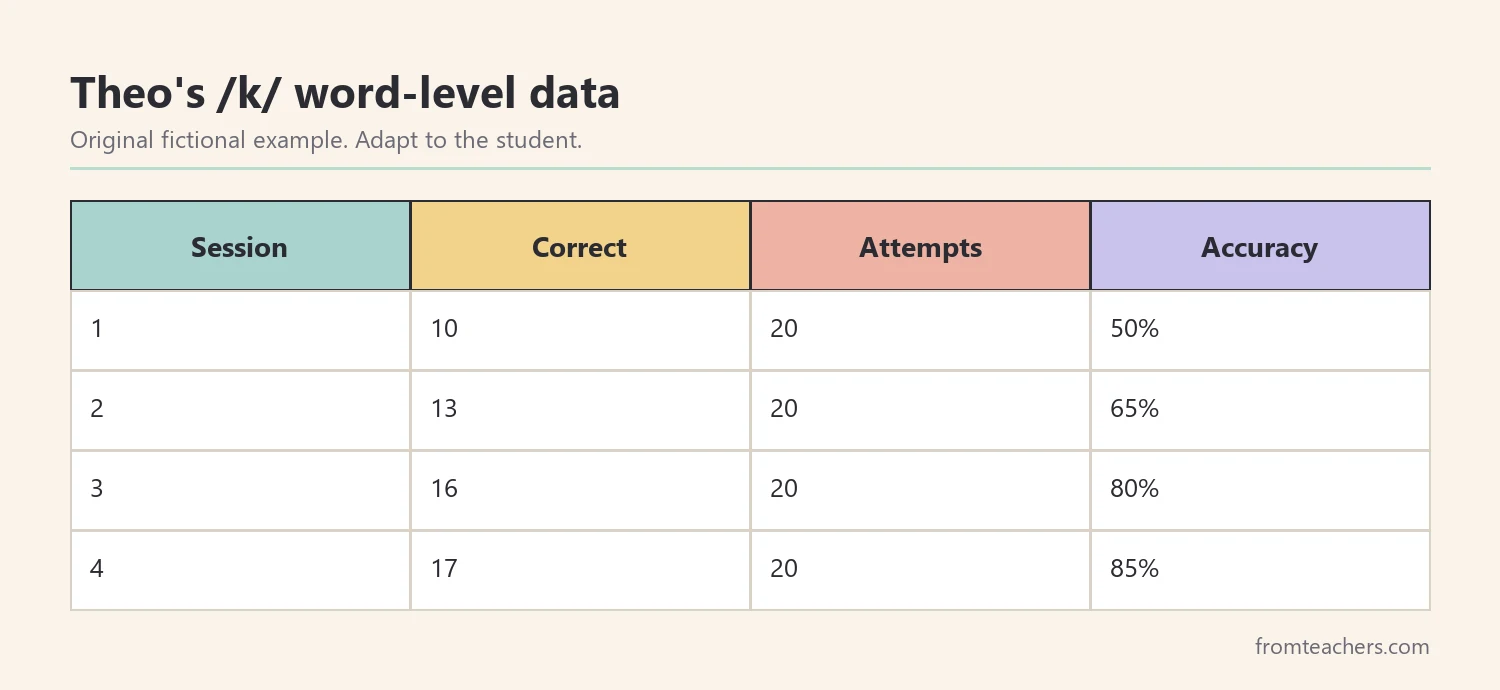
In addition, a tally and progress log makes this pattern easy to see. One line per session, with the date, level, correct, attempts, and percentage, shows growth over weeks. As a result, progress reports become much faster to write. Above all, articulation data sheets used this way turn each session into one more point on a clear line of growth.
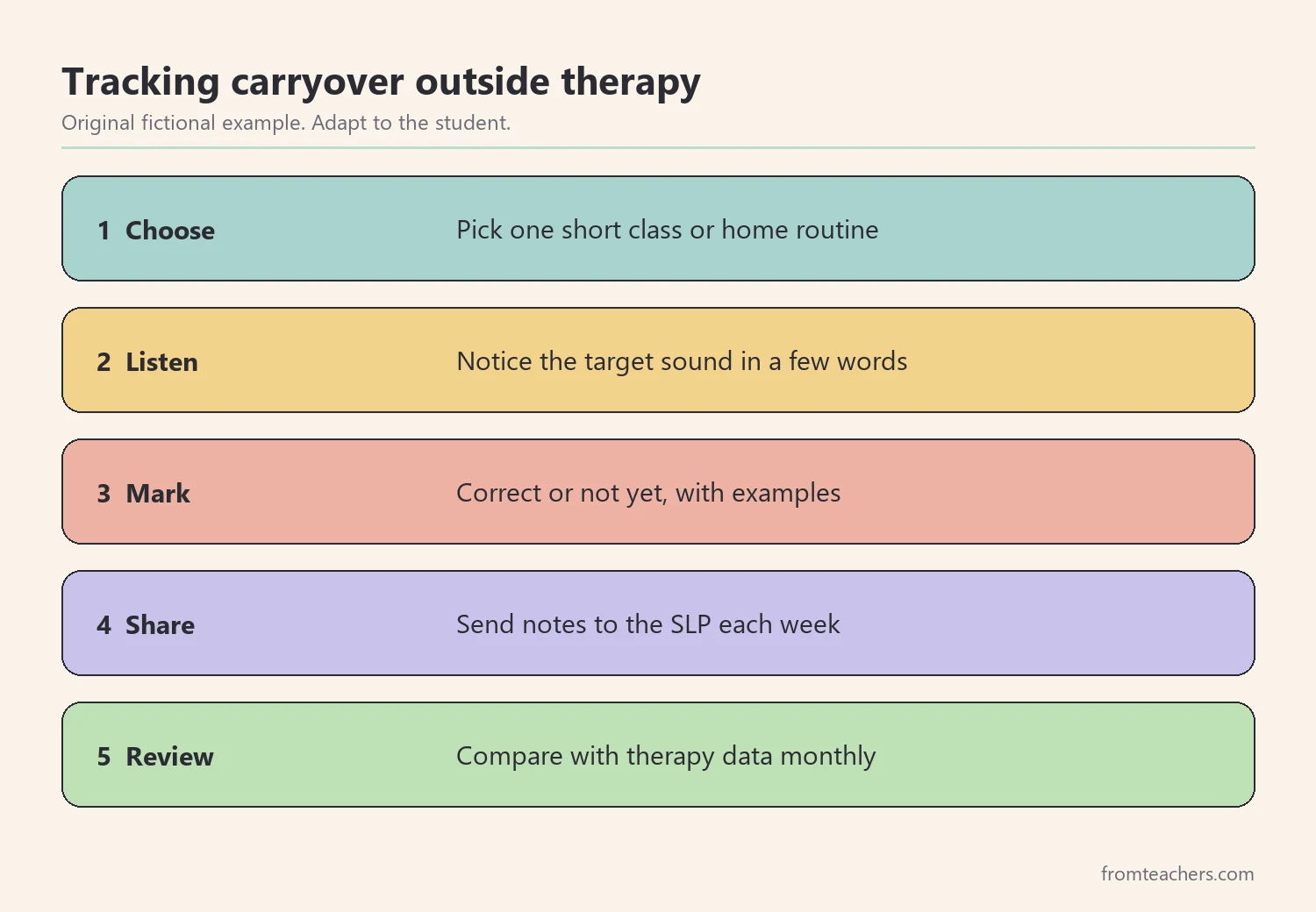
5. Track carryover beyond therapy with articulation data sheets
Finally, the real goal is clear speech in everyday life. A student who says /k/ perfectly in the therapy room but not in class has not finished the job. Carryover data shows whether new skills are reaching real conversations.
Keep carryover tracking light. For instance, ask the classroom teacher to listen during one short activity a week, such as morning share, and mark whether the target sound was correct in a few words. Similarly, ask families to notice the sound during a routine like dinner or reading together.
Use a separate carryover sheet so these observations do not mix with structured drill data. Note the setting, the observer, and a few examples. Over time, articulation data sheets from different settings give you a fuller picture than therapy data alone.
For Theo, his teacher listened during morning share once a week. In the first week she heard “cat” and “can” correct but “car” as “tar.” Three weeks later, she noted mostly correct /k/ words during share. His parents reported similar progress at dinner. Consequently, the SLP added a carryover goal to his next progress report.
Moreover, share a short summary with the family and teacher. One sentence on the current level, one recent accuracy figure, and one thing to listen for at home is enough. When everyone sees the same articulation data sheets, practice at school and at home pulls in the same direction.
Common mistakes and how to avoid them
Even well-designed articulation data sheets lose value when small habits slip. Watch for these common problems.
- Vague targets. Fix: name the sound, position, and level on every sheet.
- Scoring from memory. Fix: mark each trial right after it happens.
- Mixing cued and independent trials. Fix: use a separate code for cued productions.
- Moving up after one good day. Fix: wait for a steady pattern across sessions.
- Ignoring carryover. Fix: collect a short weekly observation from class or home.
Questions teachers and parents ask about articulation data sheets
How many trials should articulation data sheets include per session?
There is no single rule. Many clinicians use a fixed number, such as 20, so percentages are easy to compare. The most important thing is to use the same number across sessions at the same level.
Who should fill in the sheets?
Usually the speech-language pathologist or an SLP assistant under supervision fills in drill data. Teachers and families can add short carryover notes. Each observer should write their name on the sheet, so the articulation data sheets show who saw what and where.
What does 80 percent accuracy mean?
It means the student produced the target correctly in 8 out of every 10 attempts. For example, 16 correct out of 20 is 80 percent. Whether that is enough to move on depends on the student’s goals and the team’s criteria.
Can parents keep articulation data at home?
Yes, in a simple form. A parent can note a few words during a daily routine and mark them as correct or not yet. However, home practice should follow the SLP’s guidance, so ask what to listen for.
How do data sheets help with IEP progress reports?
Data sheets give you dated, specific evidence. Instead of “Theo is improving,” you can report accuracy across sessions and levels. That makes progress clear to families and the IEP team. Over a full term, a binder of articulation data sheets tells a clear, dated story of growth.
Related reading: The Power of Data Tracking in Special Education, Special Education Accommodation and Modification Tracker, and How Teachers Communicate With Parents in Special Education.
A companion resource for articulation data sheets:
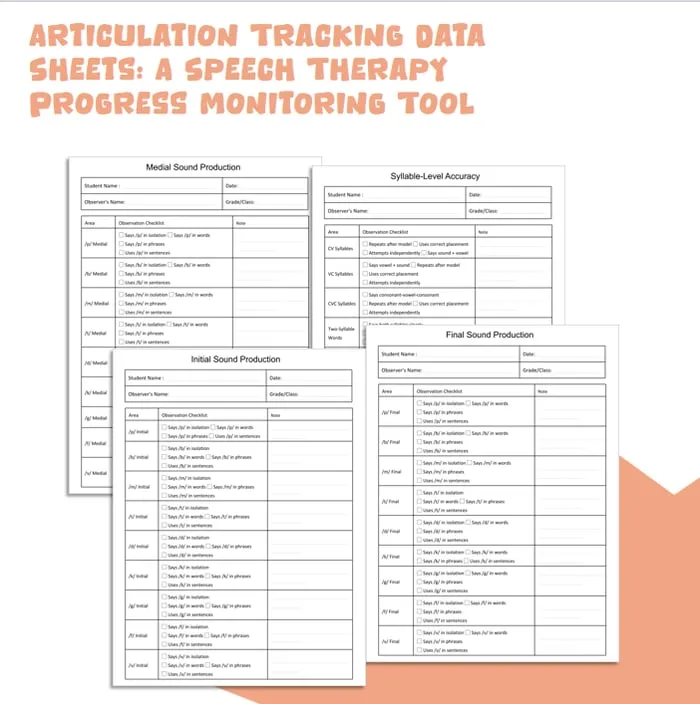
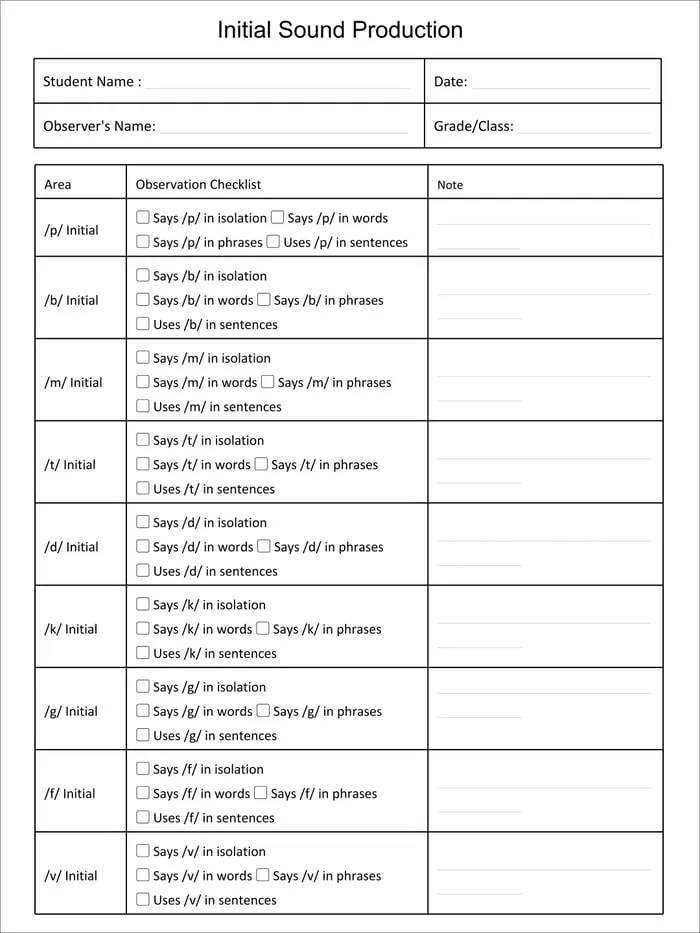
Articulation Tracking Data Sheets: A Speech Therapy Progress Monitoring Tool: a 12-page set of blank, fillable sheets, including an initial sound production tracker, single word and sentence level trackers, a stimulus word list, a tally and progress log, and a carryover patterns sheet.
Sources and scope
- American Speech-Language-Hearing Association (ASHA): professional information on speech sound disorders and the role of speech-language pathologists.
- National Institute on Deafness and Other Communication Disorders (NIDCD): general health information on speech and language development.
- IRIS Center, Vanderbilt University: free modules on progress monitoring and data-based decisions.
- IDEA, U.S. Department of Education: the law behind IEPs, related services, and progress reporting.
This guide covers practical data collection for articulation practice in schools. It does not cover evaluation, diagnosis, or treatment decisions, which belong to a licensed speech-language pathologist and the student’s team.
Key takeaways
- Articulation data sheets work best when the sound, position, and level are clearly named.
- Use one consistent layout and one scoring code every session.
- Calculate accuracy as correct divided by attempts, and look for patterns across sessions.
- Write your team’s criterion for moving on directly on the sheet.
- Track carryover in class and at home to see real-life progress.










Leave a Comment