

Good session data sheets let a therapy provider record a whole session in a few quick marks and still know exactly what happened a month later. Picture a speech therapist at a small table with a second grader, a stack of picture cards, and twenty minutes on the clock. Halfway through, she realizes her notes from last week say only “did well,” and she cannot tell whether the student improved.
This guide walks you through a five-step process: pick the right format, write targets with clear criteria, collect data without slowing the session, turn marks into honest percentages, and review the numbers so they guide your next plan. By the end, you will have a simple system you can use with any caseload.
Examples are fictional. Adapt to the student’s goals and agreed supports. This is guidance, not a diagnosis.
At a glance
- Choose a sheet format that matches how you plan: by skill, task, activity, or capability.
- Write every target with a criterion you can count, such as 8 of 10 trials.
- Use fast marks during the session and write notes in the last two minutes.
- Calculate percentages the same way every time so numbers can be compared.
- Review a few weeks of data before you change a goal or a strategy.
1. Choose session data sheets that match how you work
First, think about how you actually plan a session. Some providers plan around discrete skills, such as producing /s/ at the start of words. Others plan around an activity, like an obstacle course, and watch which skills appear. Still others think in broad capabilities, such as attention or motor planning.
Because of this, one template rarely fits every provider. Session data sheets work best when the columns mirror your planning. If the sheet fights your thinking, you will skip it on busy days.
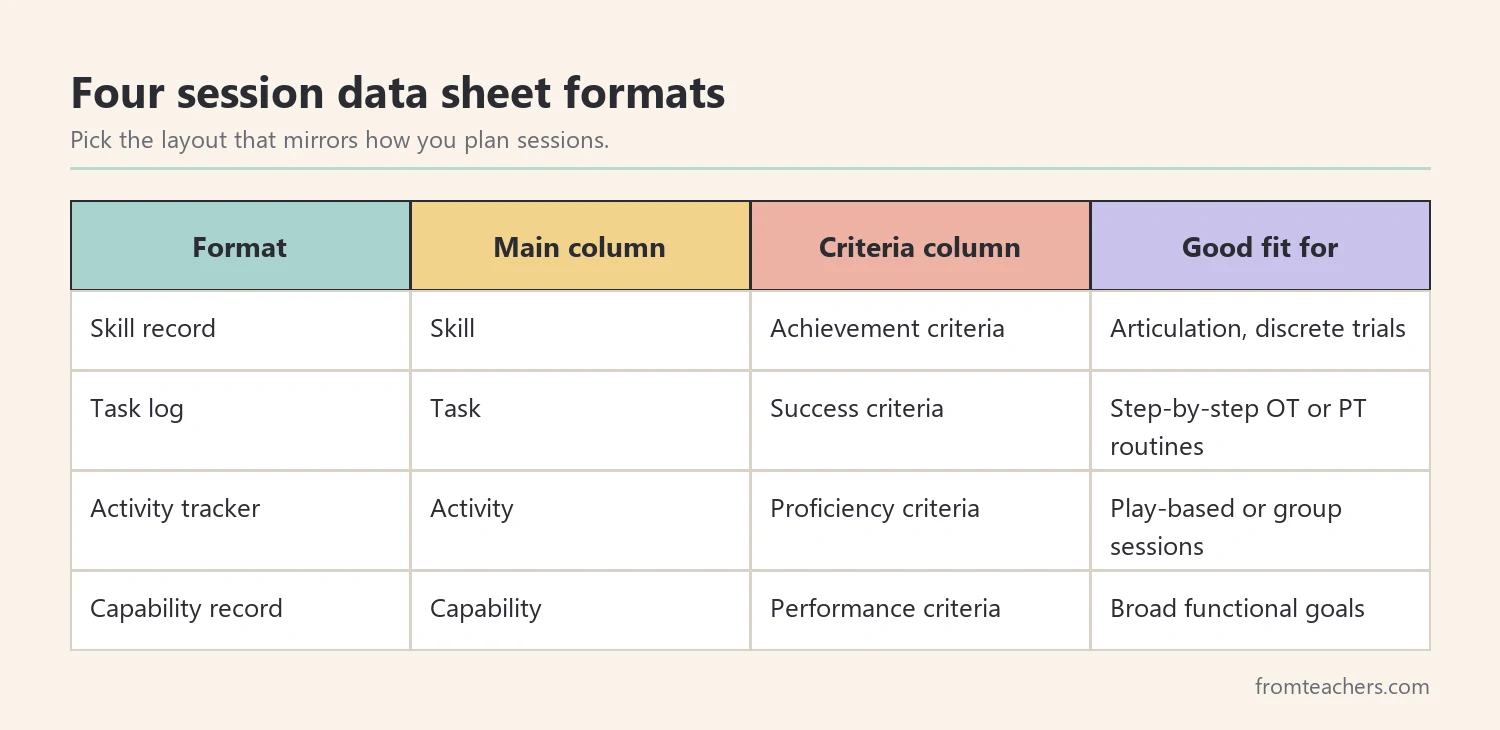
Here is a quick way to match a format to your style.
| Format | Main column | Good fit for |
|---|---|---|
| Skill record | Skill and achievement criteria | Discrete trial or articulation work |
| Task log | Task and success criteria | Step-by-step routines in OT or PT |
| Activity tracker | Activity and proficiency criteria | Play-based or group sessions |
| Capability record | Capability and performance criteria | Broad functional goals |
For example, meet Leo, a fictional second grader who sees a speech therapist twice a week. His goals cover /s/ in the initial position of words and answering “wh” questions about a short story. His therapist plans by skill, so she picks a skill-based record for Leo.
Next, check practical details. Six rows per sheet is usually enough for one session with several targets. A percentage column on the right lets you see accuracy at a glance. Finally, keep one filled-in sample nearby so new staff can see how the sheet is meant to look.
In addition, think about who else will read your session data sheets. A teacher, a case manager, or a substitute provider may need to understand them without asking you. Clear headings and a short key at the top make that possible. If a colleague can pick up your sheet and run the next session, the format is doing its job.
2. Write targets and criteria you can actually count
A sheet is only as useful as the targets written on it. Vague targets, like “work on speech,” produce vague data. Instead, write each target so that two different adults would mark it the same way.
Start with the skill or task in plain words. Then add the criterion, which tells you what success looks like. Good criteria name a number of trials, a level of support, or both. For instance, “8 of 10 trials with no more than one verbal cue” is clear and countable.
Also, make sure each target on your session data sheets connects to an IEP goal or a treatment plan objective. This link matters at progress report time. When a parent asks how a goal is going, you can point to the row that measures it.
Here is how Leo’s therapist sets up her rows.
| Skill | Achievement criteria |
|---|---|
| /s/ initial, single words | 8 of 10 trials, no cue |
| /s/ initial, short phrases | 8 of 10 trials, one cue allowed |
| Answer “who” questions | 4 of 5 questions after a short story |
| Answer “where” questions | 4 of 5 questions after a short story |
Notice that each row is small and specific. As a result, the data will show exactly which step Leo has mastered and which one needs more practice.
Then decide what counts as a prompt. Write your prompt codes at the top of the sheet, such as V for verbal cue, M for model, and G for gesture. Everyone who uses your session data sheets should use the same codes. Otherwise, a “plus” from one adult and a “plus” from another mean different things.
Before you print a stack of session data sheets, test your targets with a colleague. Ask them to read each row and explain what a correct response looks like. If their answer differs from yours, rewrite the row. This five-minute check saves weeks of data that nobody can interpret.
3. Collect session data without slowing the session
The hardest part is recording while you teach. You need your eyes on the student, not on the clipboard. Therefore, keep your marks fast and simple.
Before the student arrives, write the date, session length, and targets on the sheet. Place it on a clipboard at your side, not between you and the student. Next, use quick symbols during practice: a plus for correct, a minus for incorrect, and a prompt code when you helped.
During Leo’s Tuesday session, his therapist runs ten picture cards for /s/ in single words. She marks each trial as she flips the card. In addition, she keeps a tally for the story questions on the same line.
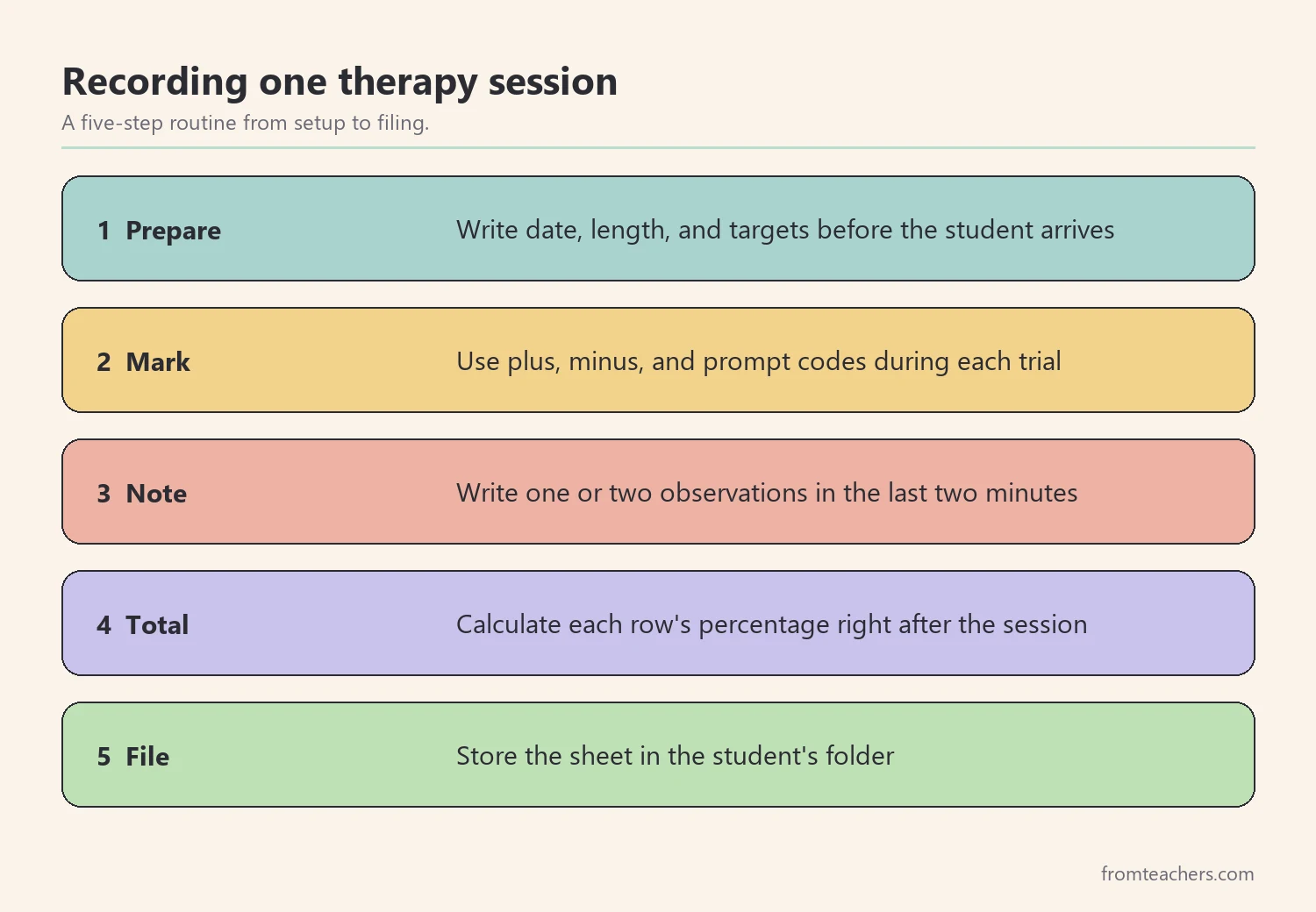
Save notes for the last two minutes. While the student chooses a sticker or packs up, write one or two short observations. Good notes describe what you saw, such as “more accurate after a model” or “tired after recess.” Avoid guesses about why, unless you mark them clearly as a hunch to check.
If you work in groups, give each student a row on the same sheet. Alternatively, use an activity-based tracker and record which skills each child used during the game. Either way, session data sheets should not pull you away from the students for more than a few seconds at a time.
Furthermore, protect your session data sheets from the usual classroom hazards. A clipboard with a clear cover keeps marks readable after glue sticks and snacks. Keep spare blank copies in your therapy bag, so a surprise schedule change never leaves you writing on scrap paper that gets lost.
For a ready-made start, the session data record sheets in four formats include skill, task, activity, and capability layouts with six rows each, criteria columns, and a percentage column.
4. Turn marks on session data sheets into honest percentages
Once the session ends, convert your marks into a number. The basic formula is simple: correct trials divided by total trials, times 100. However, consistency matters more than the math.
First, decide whether prompted trials count as correct. Many providers count only independent correct responses toward mastery and list prompted ones separately. Whatever you choose, write the rule on the sheet so the percentage always means the same thing.
Next, total each row before the next session. If you wait a week, details fade. A quick total right away also tells you what to plan next time.
Here is Leo’s Tuesday record.
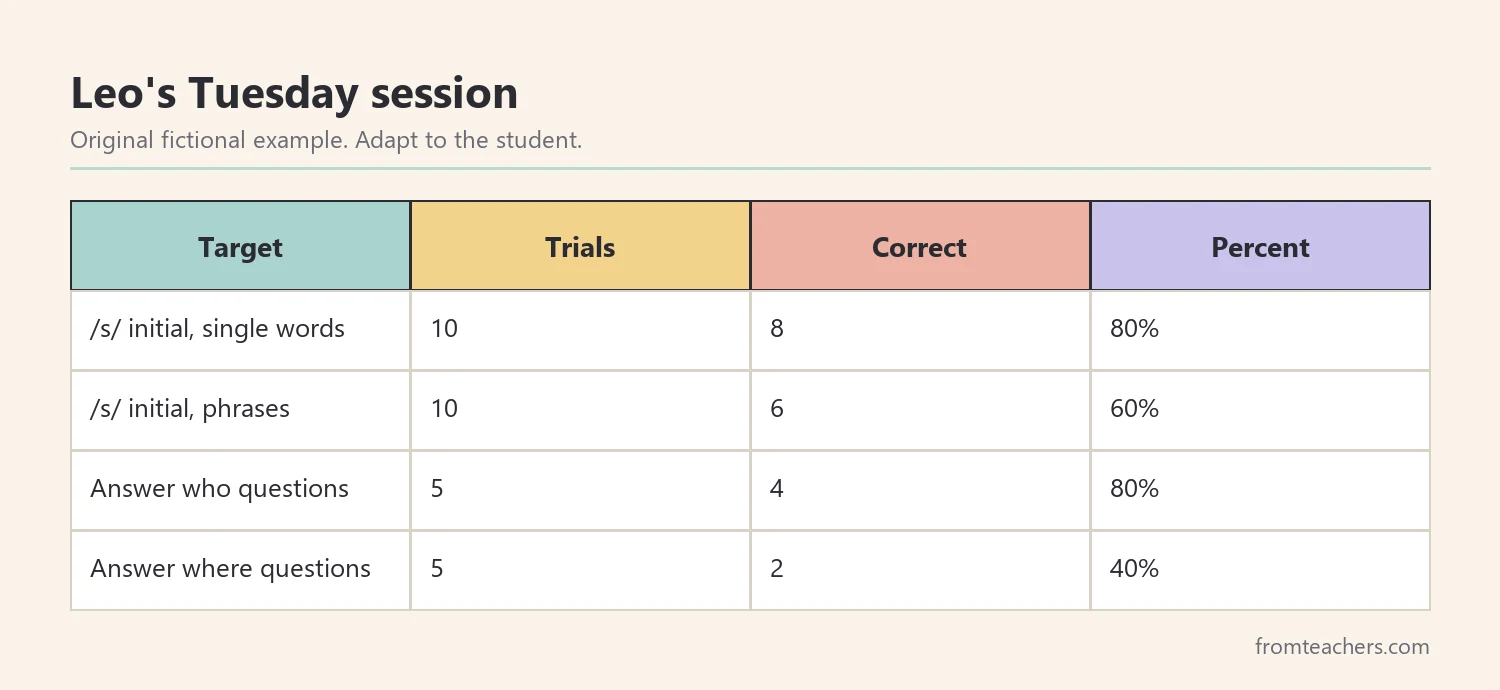
Look at the numbers. Leo produced /s/ in single words correctly on 8 of 10 trials, which is 80% and meets the criterion. In phrases, he was correct on 6 of 10, or 60%. For “who” questions he answered 4 of 5, which is 80%, and for “where” questions he answered 2 of 5, or 40%.
So one session already points to a plan: keep single words as maintenance, give phrases more practice, and add visual support for “where” questions. Even so, one session is not a trend. Session data sheets earn their value when you line up several sessions side by side.
Meanwhile, keep the math visible. Writing “8/10 = 80%” in the percentage column takes two extra seconds. Yet it lets anyone who reads your session data sheets check the calculation and trust the number.
Also, be careful with small numbers. Two of five is 40%, but one more correct answer would jump it to 60%. When trials are few, write the raw count next to the percentage so readers see the full picture.
5. Review session data sheets and adjust the plan
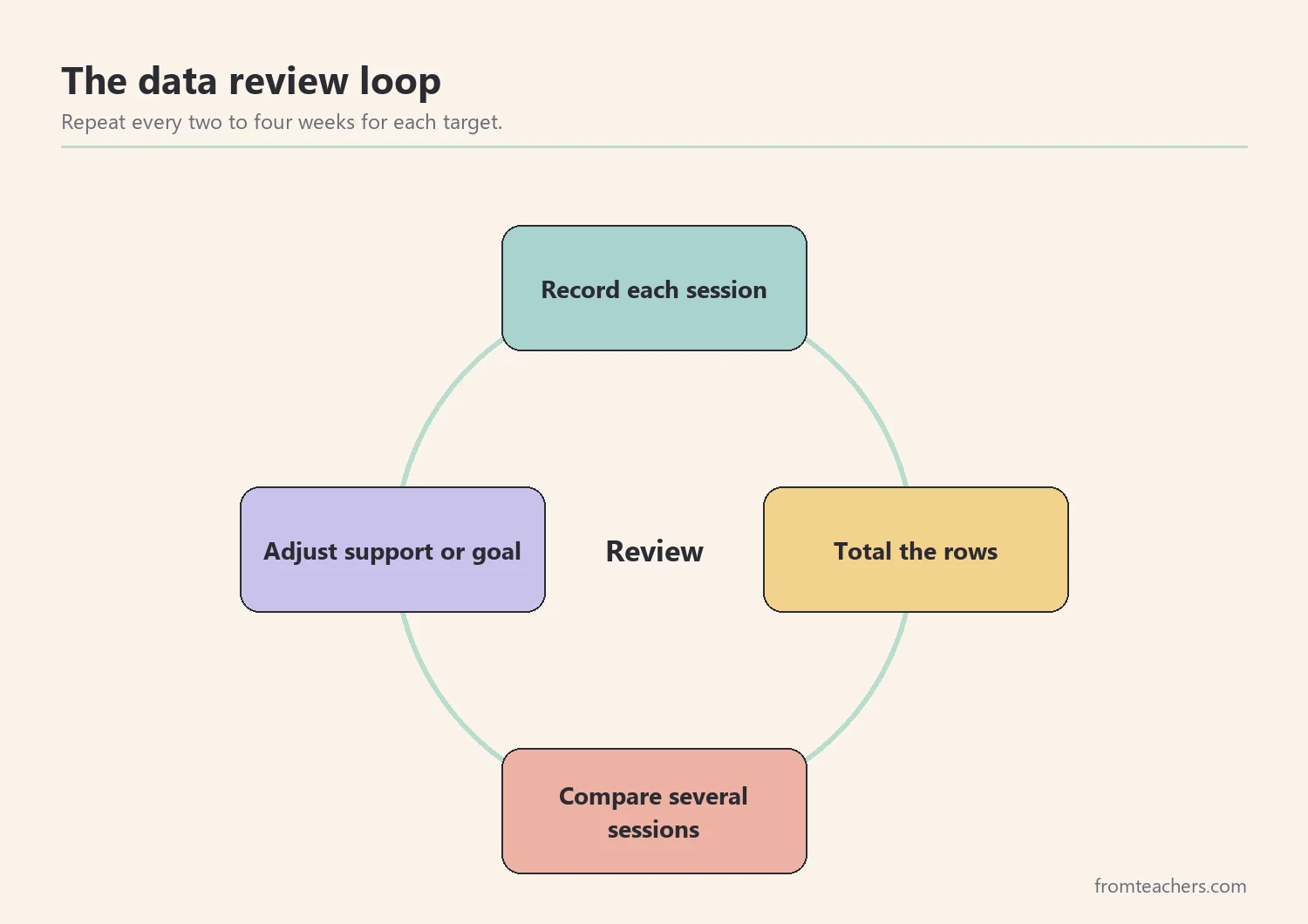
Data only helps if someone looks at it. Set a regular review, for example every two weeks, and line up the percentage column for each target.
Look for three patterns. First, a steady climb means the strategy is working, so keep going. Second, a flat line for several sessions means something should change, such as the level of support or the type of practice. Third, a sudden drop may signal something outside therapy, like illness or a schedule change, so check your notes before changing the plan.
Here is Leo’s “where” question target across four sessions.
| Session | Correct | Total | Percent |
|---|---|---|---|
| 1 | 2 | 5 | 40% |
| 2 | 2 | 5 | 40% |
| 3 | 3 | 5 | 60% |
| 4 | 4 | 5 | 80% |
After session 2, his therapist added a small picture map of the story setting. By session 4, Leo met the 4 of 5 criterion. Because she wrote the change in the notes column, the team can see exactly what helped.
Finally, share the story behind the numbers. In an IEP meeting, a short summary such as “40% to 80% over four sessions after adding a picture map” is clear for families. Keep session data sheets in one folder per student so you can pull them quickly for meetings, progress reports, and handoffs to another provider.
Lastly, when a student moves to a new provider or school, hand over a short summary along with the session data sheets. List each target, the latest percentage, and the strategy that helped most. This keeps progress from starting over at zero.
Common mistakes and how to avoid them
- Vague targets. “Improve articulation” cannot be measured. Fix: name the sound, position, level, and a countable criterion.
- Mixing prompted and independent trials. This inflates progress. Fix: write a clear rule at the top of the sheet and follow it every time.
- Writing long notes mid-session. You lose eye contact and pacing. Fix: use quick marks during practice and save notes for the last two minutes.
- Reporting percentages without raw counts. Small trial numbers can look dramatic. Fix: show “3 of 5 (60%)” rather than “60%” alone.
- Changing the plan after one bad day. One session is not a trend. Fix: review at least three or four sessions before changing a goal.
- Using a format that does not fit. A skill grid frustrates a play-based provider. Fix: pick the format that matches how you plan.
Questions teachers and parents ask about session data sheets
How many targets should one sheet hold?
Most providers work on two to six targets in a session. A sheet with six rows covers that range without crowding. If you need more, the session is probably trying to do too much at once.
Should prompted responses count toward mastery?
That depends on the goal. Many goals specify independent responses, so prompted trials are recorded but not counted as correct. Check the goal wording and write your rule on the sheet.
Can teachers and paraprofessionals use the same session data sheets?
Yes, if everyone uses the same targets, criteria, and prompt codes. A short training with one filled-in example helps. Shared sheets also make it easier to see whether a skill carries over into the classroom.
How often should I review session data sheets?
Every two to four weeks works for most goals. Review sooner if a student is clearly stuck or clearly ready to move on. Regular review keeps the data tied to real decisions.
What should parents look for on session data sheets?
Parents can look at the target, the criterion, and the trend in percentages over time. The notes column often explains what helped. It is fair to ask the provider how prompted responses were counted.
Related reading: The Power of Data Tracking in Special Education, Special Education Tracking Tools, and Teacher and Parent Communication in Special Education.
A companion resource for session data sheets:
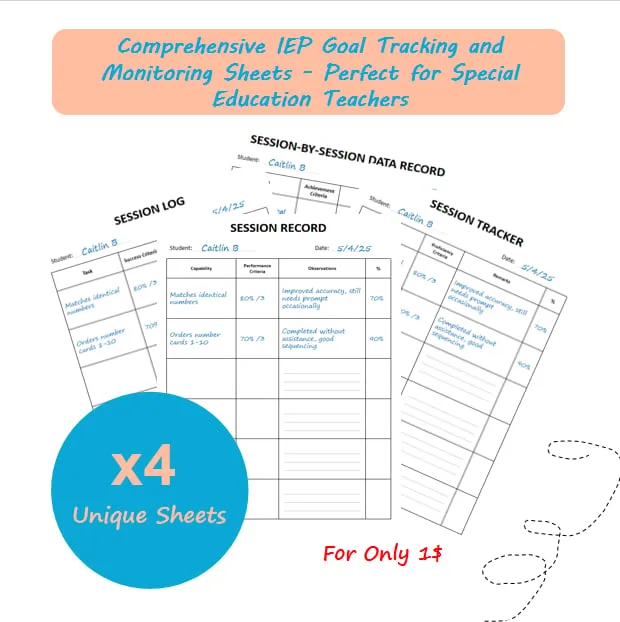
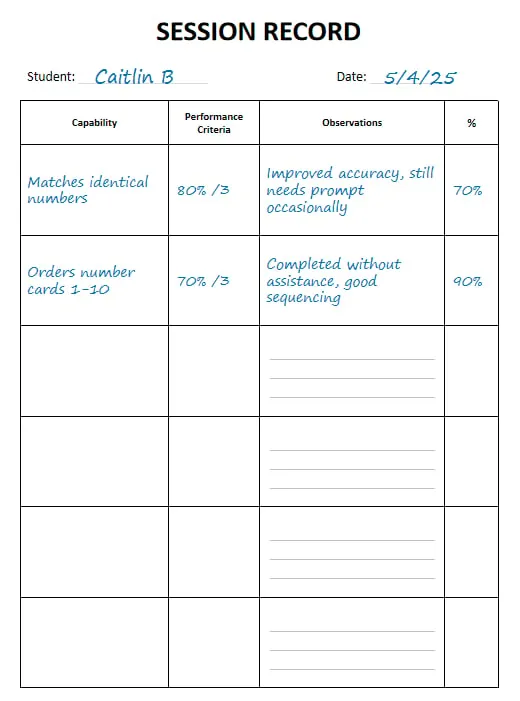
Session Data Record Sheets: 4 Unique Sheets: four ready-made formats (skill, task, activity, and capability) with criteria, notes, and percentage columns, six rows per sheet, and one filled-in example. Useful for speech therapy, OT, ABA, and other related services.
Sources and scope
- IRIS Center, Vanderbilt University: free modules on progress monitoring and data-based decision making.
- American Speech-Language-Hearing Association (ASHA): professional guidance for speech-language pathologists, including documentation practice.
- IDEA, U.S. Department of Education: the law behind IEPs, related services, and progress reporting.
- What Works Clearinghouse: reviews of education research and practice guides.
This guide covers practical session-level data collection for school-based therapy and related services. It does not cover clinical assessment, billing documentation, or discipline-specific licensing requirements, which follow your profession and district rules.
Key takeaways
- Session data sheets work best when their columns match how you plan.
- Write every target with a countable criterion and shared prompt codes.
- Mark quickly during practice and write notes at the end.
- Calculate percentages the same way every time and show raw counts.
- Review several sessions before you change a goal or strategy.










Leave a Comment