

ADHD focusing tips work best when they make the brain’s job easier instead of asking a student to simply “try harder.” Picture a sixth grader staring at a worksheet for ten minutes, tapping a pencil, then suddenly asking to sharpen it for the third time. The student wants to finish. Getting started and staying with the task is the hard part.
This guide gives you five steps to put ADHD focusing tips into daily practice: understand what makes focus hard, make starting easier, set up the body and the workspace, build motivation with self-talk and interest, and add visual supports while tracking progress. By the end, you will have a short, practical plan for one student or a whole class.
Examples are fictional. Adapt to the student’s goals and agreed supports. This is guidance, not a diagnosis.
At a glance
- ADHD brains are not broken. They are wired differently, and the right tools help.
- Starting is often the hardest part, so make the first step tiny.
- Short work bursts with brief breaks fit many students’ attention rhythm.
- Movement, a clear desk, and sensory tools can support focus.
- Visual supports and simple tracking keep progress visible.
1. Understand why focus can be hard
First, start from respect. Students with ADHD are not lazy or careless. Many of them care deeply about doing well, yet their attention, activity level, and impulse control can make classroom tasks harder. Seeing the challenge clearly helps adults choose supportive strategies instead of punishments.
Next, notice when focus breaks down. Is it at the start of tasks? In the middle of long assignments? During noisy times or after lunch? Patterns tell you which ADHD focusing tips to try first. A student who struggles to start needs different help from one who drifts away halfway through.
Also, remember that every student is different. Some students with ADHD have trouble sitting still, others daydream quietly, and many show a mix. A diagnosis does not tell you exactly what a student needs, so observation matters.
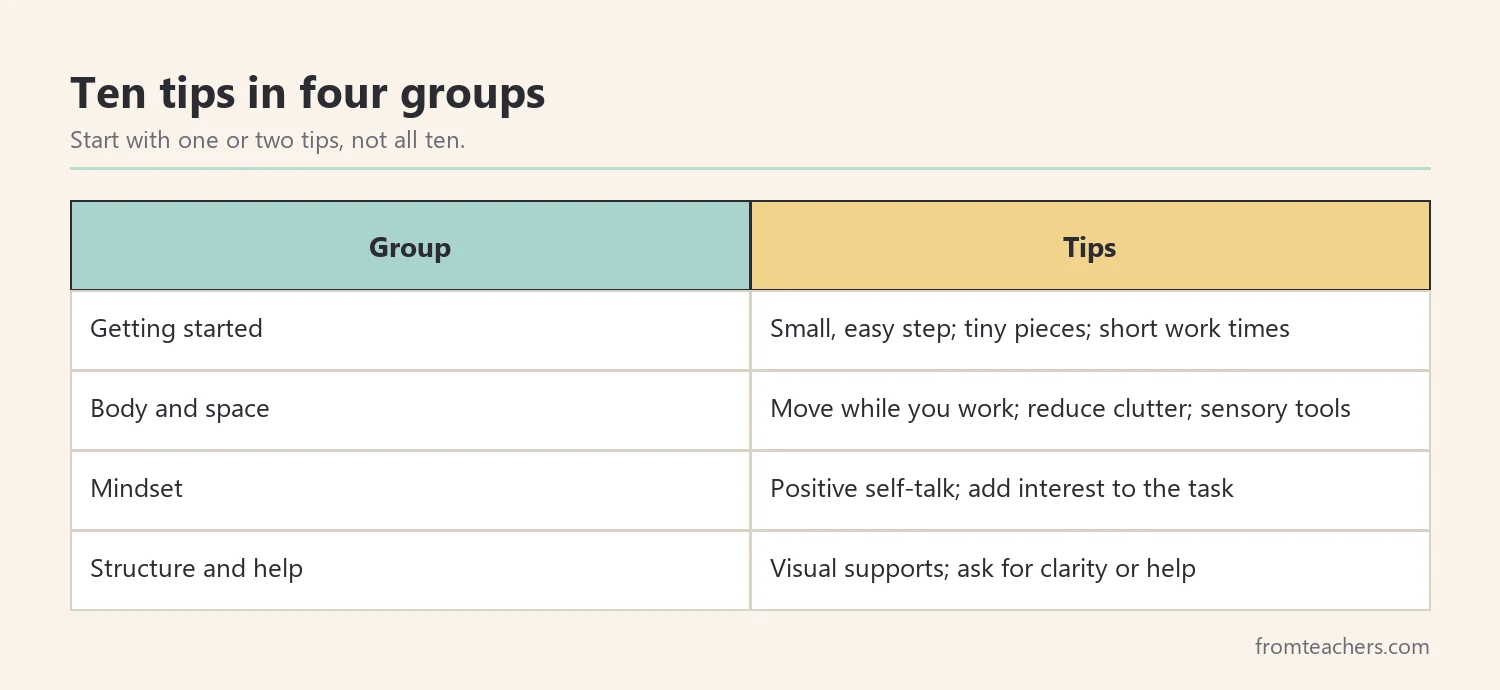
Involve the student
In addition, involve the student. Ask, “When is it easiest for you to focus? When is it hardest?” Students often know more about their own attention than adults expect. Their answers make the plan more likely to work.
Then, check existing plans. If the student has an IEP or a 504 plan, the accommodations already agreed by the team come first. ADHD focusing tips in daily routines should support those plans, not replace them.
Finally, choose a starting point. Pick one or two ADHD focusing tips that match the pattern you observed, try them for two weeks, and only then add more. Changing everything at once makes it hard to know what helped.
Worked example. Jayden is a fictional grade 6 student with ADHD. His teacher, Mr. Kim, observes for one week and notices that Jayden rarely starts independent work within the first five minutes. Once he starts, he often finishes. So, the first goal is getting started.
2. Make starting easier with ADHD focusing tips
Next, shrink the first step. Getting started is often the hardest part. Ask the student to do the quickest part first, such as writing their name and the first answer. A small win builds momentum, and momentum makes the next step easier.
Also, break tasks into tiny pieces. A full page of math problems can feel overwhelming. Folding the page, covering part of it, or numbering chunks turns one large task into several small ones. Students can check off each piece when finished, then move to the next.
In addition, use short work times. Many students focus better in bursts of a few minutes followed by a brief movement or sensory break. Then the cycle repeats. Short bursts often match a student’s natural attention rhythm better than one long stretch.
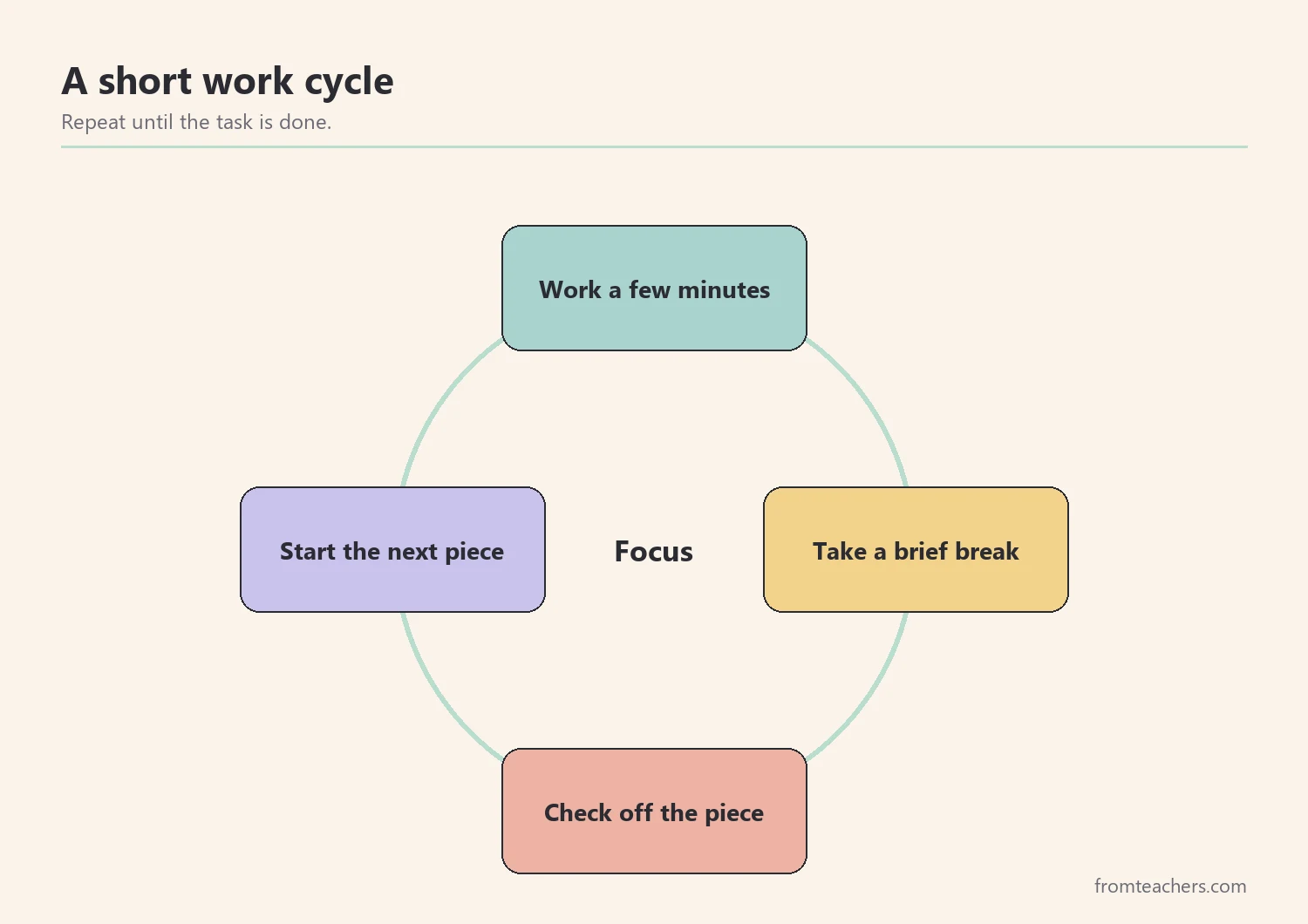
Celebrate the start
Meanwhile, celebrate the start. A quiet thumbs up or a short note such as “Great start” tells the student that starting matters. Praise for effort is especially helpful for students who have heard many corrections.
For a ready-made visual, the ADHD focusing tips poster shares ten strategies, each with a short “why it helps” note, including starting with a small step, breaking tasks into tiny pieces, and using short work times. Posting it near a work area gives students a reminder they can use on their own.
Worked example. Mr. Kim asks Jayden to answer just the first problem, then show him. After that, Jayden works in short bursts with a quick stretch in between. He checks off each chunk on his folded page. On the first day, he starts within two minutes.
3. Use ADHD focusing tips for the body and workspace
Next, let the body help. Many students with ADHD focus better when they can move a little. Options include sitting on a wobble cushion, standing at a desk, using a fidget quietly, or stretching between tasks. Movement can support regulation and focus for many students.
Also, reduce visual clutter. A crowded desk competes for attention. Ask the student to clear the desk, use folders or bins, and keep only the tools needed for the current task. A clean workspace lowers distraction and supports organization.
In addition, offer sensory tools if they help. Headphones, a weighted lap pad, chew tools, or fidgets can reduce restlessness for some students. Introduce them as tools, set clear expectations for use, and check whether they actually help focus.
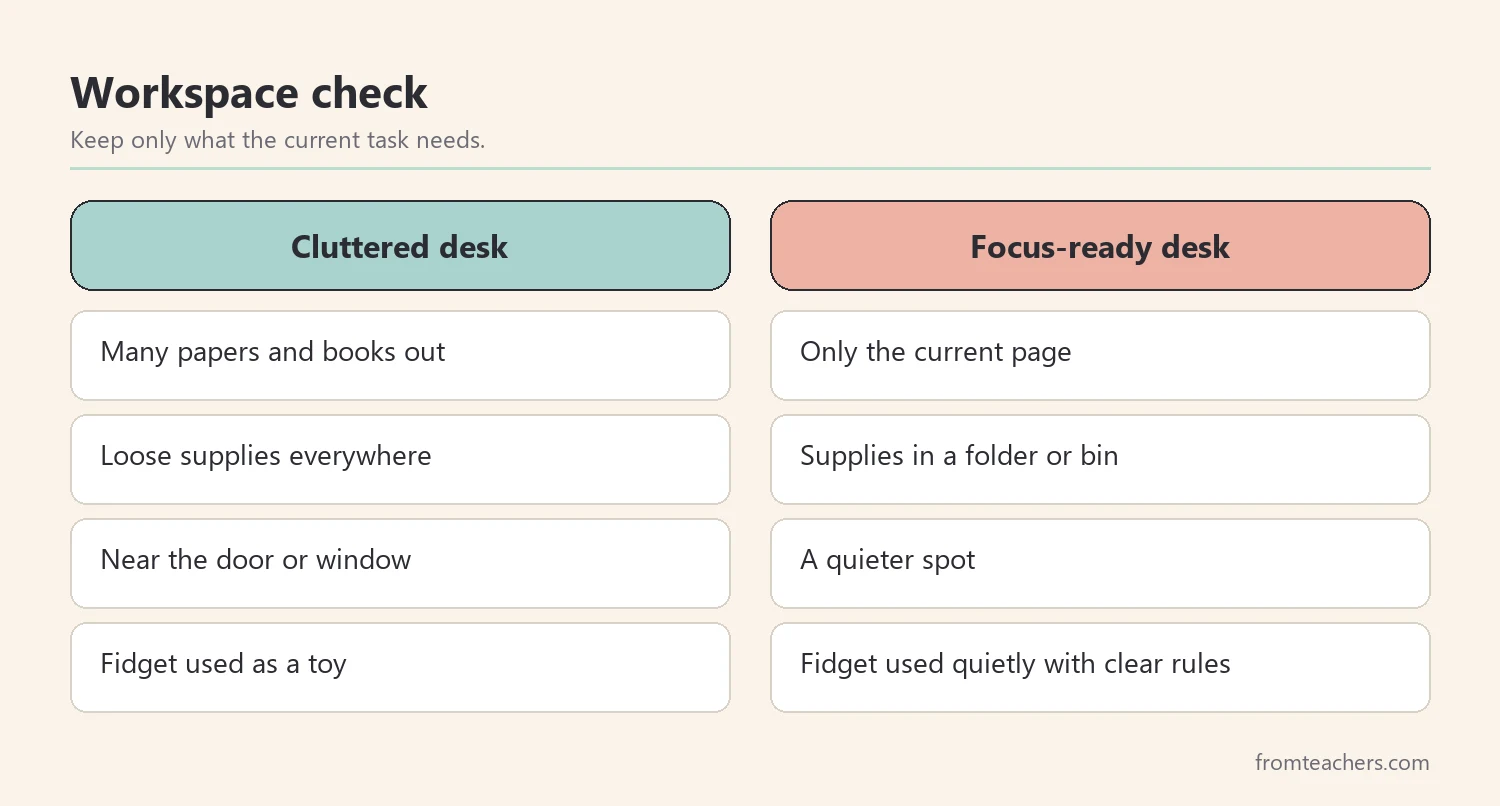
Meanwhile, think about seating. A spot away from doors, windows, and high-traffic areas can help. Some students do well near the teacher, while others prefer a quieter corner. Ask the student and try options for a week each.
Then, teach the tools before using them. Show how to use a wobble cushion or fidget without distracting others. Clear expectations keep these ADHD focusing tips helpful for the student and fair for classmates.
Worked example. Mr. Kim offers Jayden a standing spot at the back counter for independent work and a small bin for supplies. Jayden keeps only his pencil, eraser, and the current page out. He says standing “helps my legs stop bouncing.”
4. Build motivation and positive self-talk
Before changing the task itself, think about how the student feels about it. Many ADHD focusing tips fail because a student already expects to fail. A little encouragement and a sense of control can change that expectation.
Next, add interest to the task. Students with ADHD often focus more easily when a task feels interesting. Simple changes help: set a friendly challenge such as “finish before the timer,” use color or highlighters, or turn practice into a short game.
Also, teach positive self-talk. Phrases like “I can do one step,” “I don’t have to finish everything now,” and “Trying is enough” can reduce frustration. Encouraging thoughts help students keep going when a task feels long.
In addition, make asking for help easy. Many students stop working because they are unsure, not because they are distracted. Teach simple phrases: “Can you explain this again?” “What is the first step?” “I need help getting started.” Support removes barriers and can prevent shutdown.
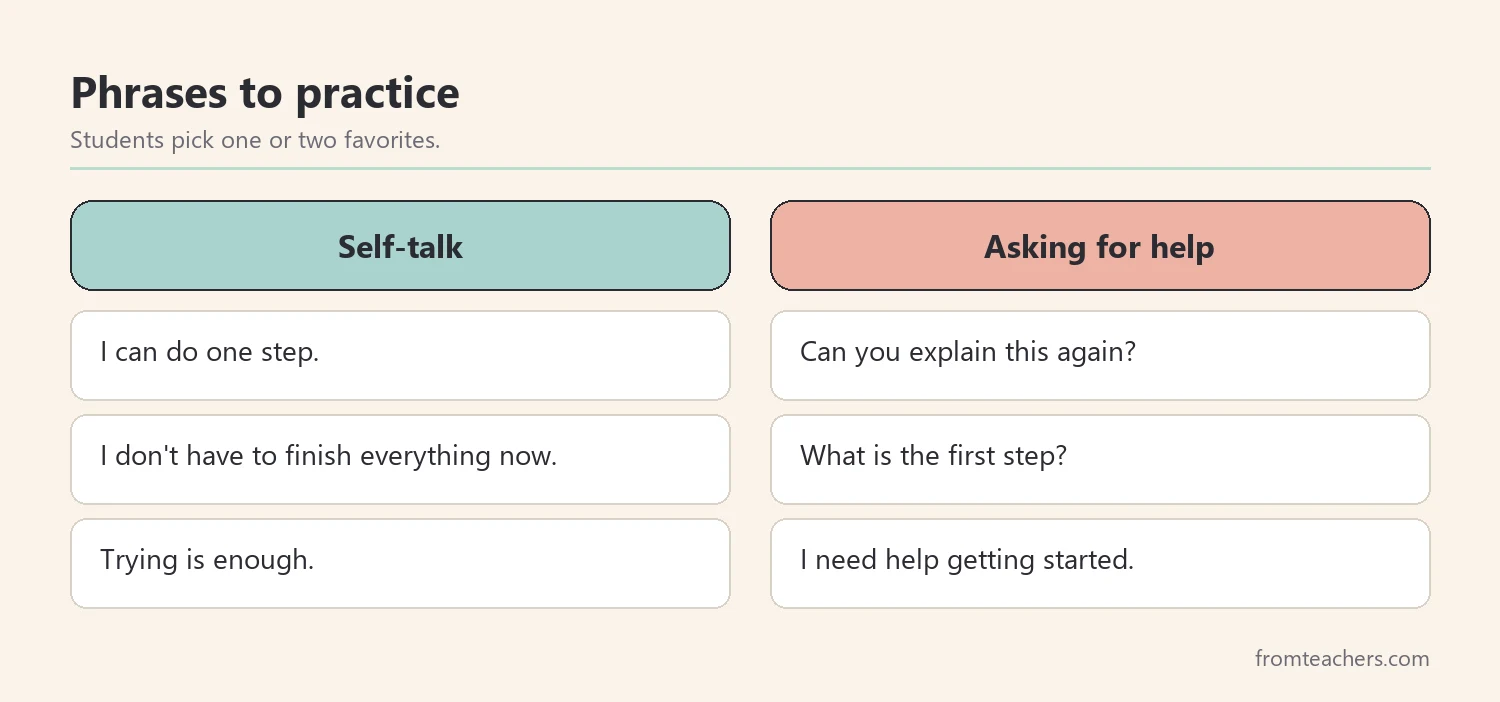
Meanwhile, model the phrases yourself. Say, “I’m going to do one step first,” when you start a task in front of the class. Students learn self-talk faster when they hear adults use it naturally.
Then, offer a private signal. Some students do not want to ask for help in front of peers. A card on the desk or a small hand signal lets them ask quietly.
Worked example. Jayden picks “I can do one step” as his self-talk phrase and writes it on a sticky note. Mr. Kim adds a small “help” card to his desk. In the second week, Jayden flips the card twice instead of leaving his seat.
5. Add visual supports and track progress
Finally, give the brain an external structure. Visual supports such as checklists, first-then boards, step-by-step directions, and timers help students stay on track without constant adult reminders. External structure can do some of the work that attention finds hard.
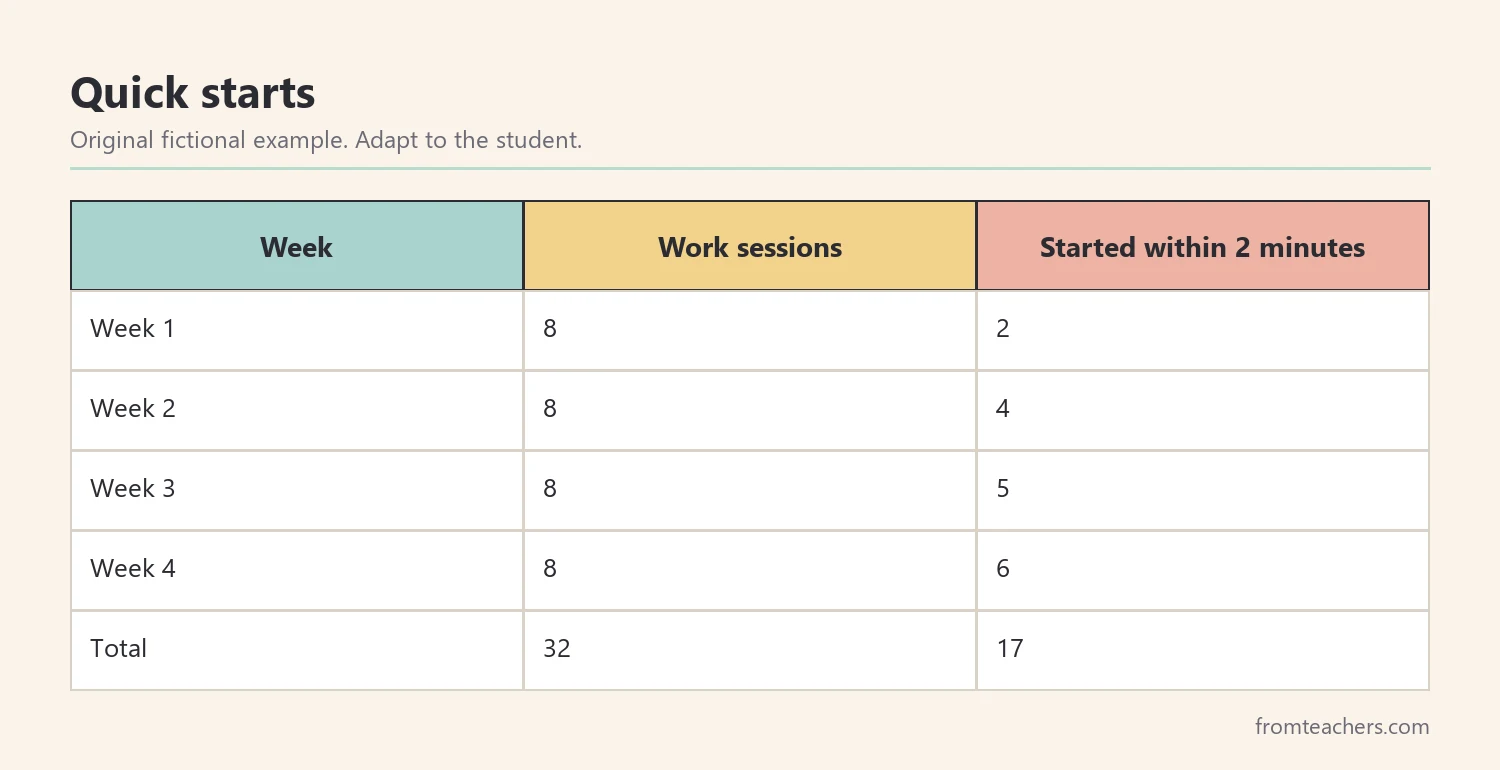
Also, keep tracking simple. Choose one or two measures that match your goal, such as how quickly the student starts or how many chunks they complete. Record them for a few weeks to see whether the ADHD focusing tips are working.
Meanwhile, keep visual supports simple. A checklist with three to five items is easier to follow than a long one. A first-then board, such as “first two problems, then a stretch,” gives a clear goal and a clear reward. Timers work best when the student can see time passing.
Next, review with the student. Share the numbers and ask, “What helped most? What should we change?” Students who see their own progress often feel more motivated.
In addition, share progress with families and the team. A short note such as “Jayden started on his own in most sessions this week” builds confidence and helps families use similar strategies at home.
Then, adjust over time. Some strategies will work well, and others will not. Keep what helps, drop what does not, and add new ADHD focusing tips as the student’s needs change.
Worked example. Mr. Kim tracks Jayden’s independent work sessions for four weeks and counts the ones he started within two minutes. In week 1, 2 of 8 sessions. By week 2, 4 of 8. In week 3, 5 of 8. In week 4, 6 of 8. Over the month, that is 17 quick starts in 32 sessions.
Using focusing tips at home
Families can use the same ideas for homework. Start with the quickest part, work in short bursts, keep the table clear, and use a timer. Consistency between home and school helps students build habits.
In addition, let the child help choose. Ask which ADHD focusing tips from school feel most useful at home, and post those two or three near the homework space. A short, shared list keeps everyone using the same words, and it reminds the child that the tools travel with them.
Also, avoid long homework sessions without breaks. Short, regular pauses usually lead to more work done with less frustration.
Common mistakes and how to avoid them
- Saying “just focus.” It gives no strategy. Fix: offer one concrete tip, such as doing the quickest part first.
- Long tasks with no breaks. Attention fades. Fix: use short work times with brief breaks.
- Removing movement. Restlessness grows. Fix: offer planned, quiet movement options.
- Introducing tools without rules. Fidgets become toys. Fix: teach clear expectations first.
- Trying ten strategies at once. Nothing sticks. Fix: start with one or two and track them.
- Skipping the student’s view. Plans miss the real problem. Fix: ask what helps and what is hard.
Questions teachers and parents ask about ADHD focusing tips
Do these tips work for students without ADHD?
Many ADHD focusing tips help other students too. Small first steps, clear workspaces, short work periods, and visual supports help many learners. They are especially important for students with ADHD, but they can benefit a whole class.
Are fidgets distracting for other students?
They can be if expectations are unclear. Teach how to use the tool quietly, choose low-noise options, and check whether it actually helps the student focus.
How long should short work times be?
It depends on the student and the task. Some start with a few minutes and build up gradually. Observe, ask the student, and adjust.
Should these strategies be in an IEP or 504 plan?
Some may already be listed as accommodations. If a strategy is essential for a student’s access to learning, discuss it with the team so it can be considered formally.
Can these tips replace medical or professional care?
No. These are classroom and home strategies. Diagnosis and treatment decisions belong to families and qualified professionals.
Related reading: Effective ADHD Classroom Strategies to Support Student Success, ADHD in Children: A Guide to Effective Classroom and Home Support, and 5 Practical Teaching Tips to Boost Classroom Focus and Learning.
A companion resource for ADHD focusing tips:
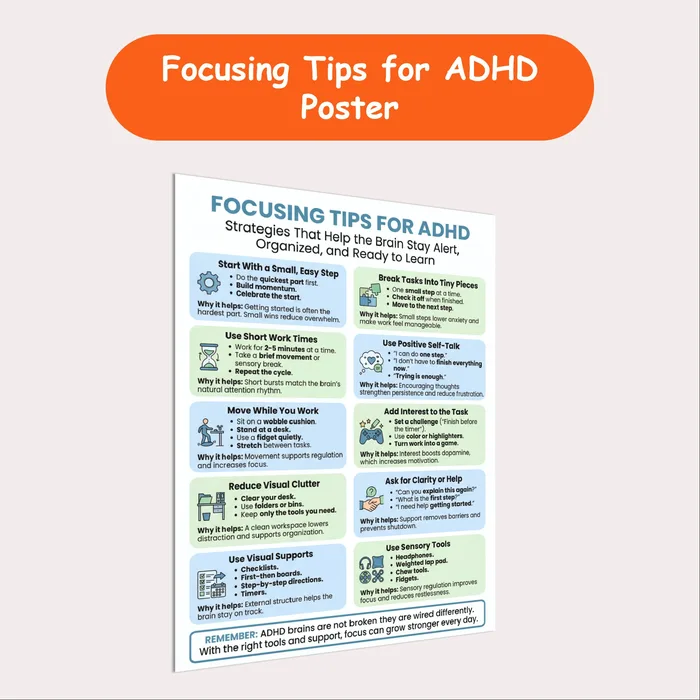
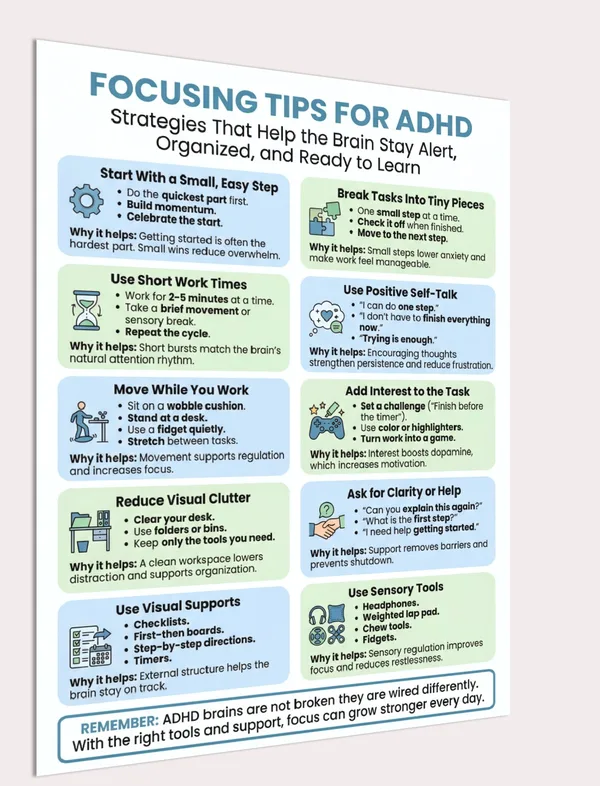
ADHD Focusing Tips Poster: ten strategies that help the brain stay alert, organized, and ready to learn, each with a “why it helps” note, for ADHD classrooms and special education.
Sources and scope
- Centers for Disease Control and Prevention (CDC): general information on ADHD in children.
- CHADD: a national organization offering information on ADHD for families and educators.
- Understood.org: family-friendly information on learning and thinking differences, including ADHD.
- IDEA, U.S. Department of Education: information on special education and related services.
This guide covers everyday classroom and home strategies that support focus. It does not replace medical care, diagnosis, IEP or 504 decisions, or the advice of qualified professionals.
Key takeaways
- ADHD focusing tips work by making the brain’s job easier.
- Make the first step tiny and break tasks into pieces.
- Allow planned movement, clear the desk, and teach tool use.
- Build motivation with interest, self-talk, and easy help-seeking.
- Use visual supports and track one or two simple measures.










Leave a Comment