

AAC strategies for the classroom decide whether a student’s device stays in a backpack or becomes a real voice during the school day. Picture a grade 2 morning meeting. Maya, who uses a speech-generating device, sits with her tablet on her lap while classmates share weekend news. Nobody models on the device, nobody waits, and the meeting ends before she says a word.
This list ranks seven AAC strategies by how easy they are to start tomorrow in a busy classroom. By the end, you will know what to put in place first, how each strategy looks during real lessons, and how to check whether communication is growing.
Examples are fictional. Adapt to the student’s goals and agreed supports, and follow the guidance of the speech-language pathologist. This is guidance, not a diagnosis.
At a glance
- Start with one shared written plan so every adult models the same targets.
- Model on the device while you talk, without demanding imitation.
- Keep the device or a backup board within reach all day.
- Wait, then respond to every attempt as real communication.
- Track a few simple numbers and review them with the SLP.
How we ranked these AAC strategies
This is not a popularity contest. Instead, we ordered the strategies by two plain criteria. First, how quickly a classroom teacher or paraprofessional can start using it without new materials or training. Second, how often it creates a chance for the student to communicate during an ordinary day.
Therefore, the list opens with a shared written plan, because every other strategy works better when the team agrees on targets. Then it moves through daily teaching habits. Your speech-language pathologist (SLP) may suggest a different order for your student, and that advice comes first.
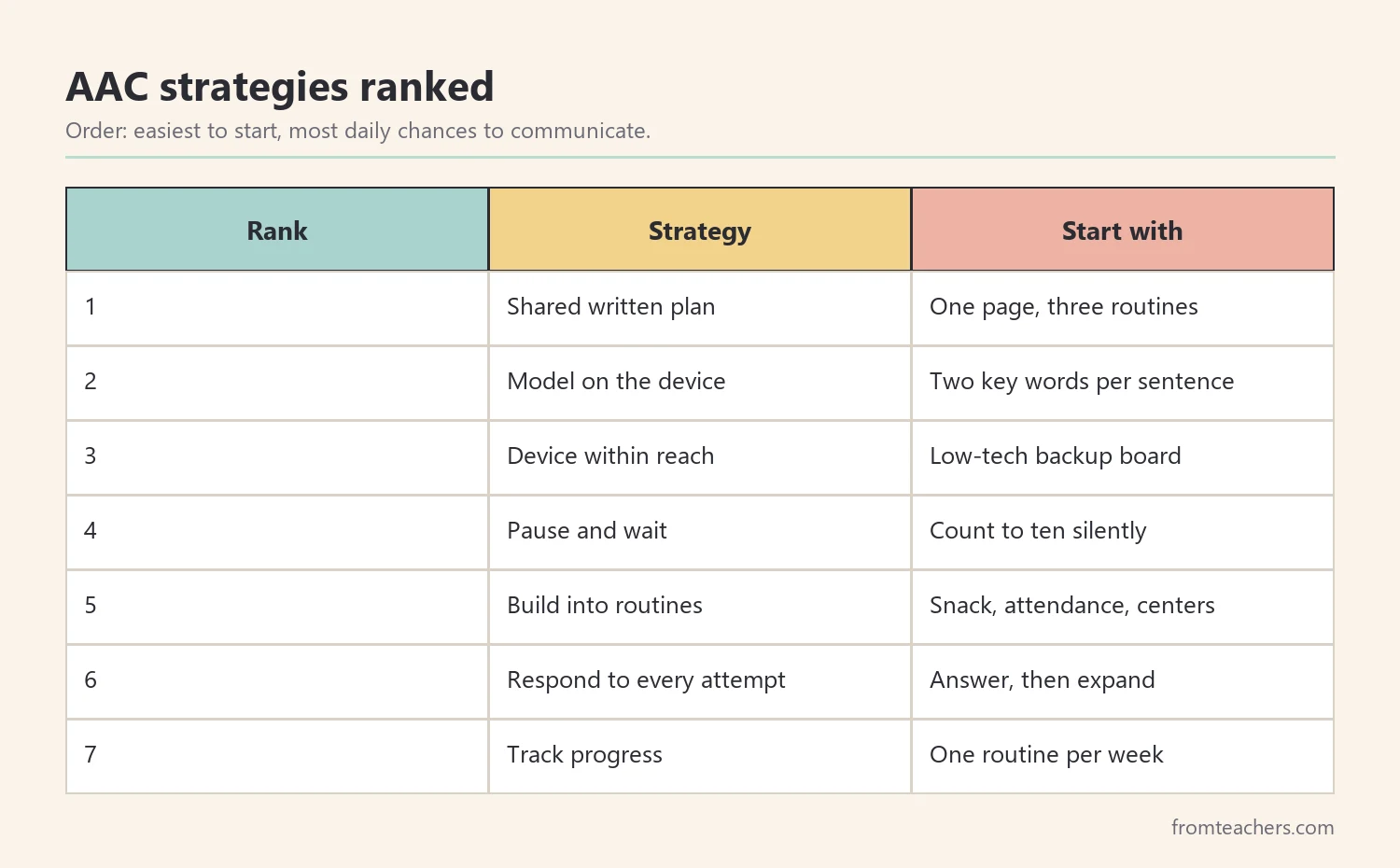
1. Write a shared communication plan (best first step)
Many AAC users spend the day with several adults: the classroom teacher, a paraprofessional, the SLP, specialists, and family. When each adult has a different idea of the goals, the student gets mixed messages. A short written plan fixes that.
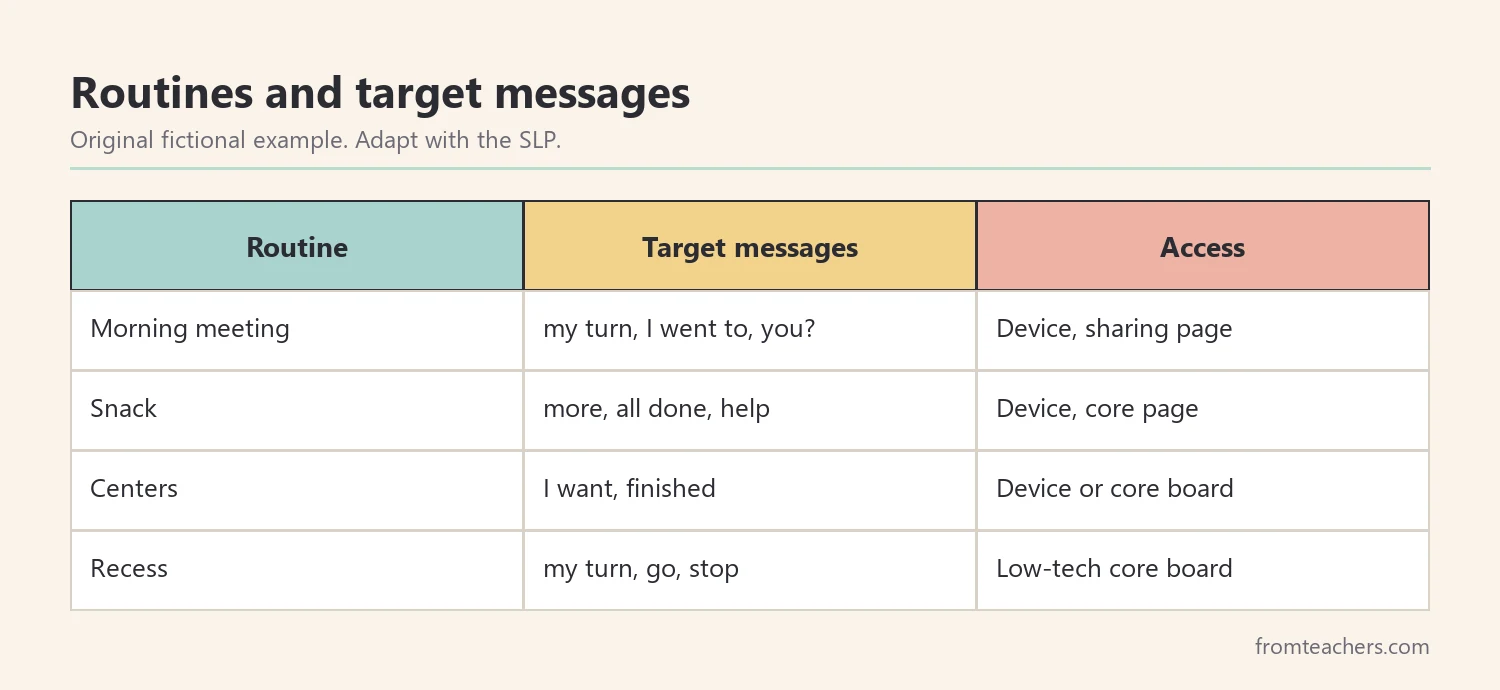
A good plan names the overall objectives, lists daily activities where communication will be practiced, and sets target words or messages for each activity. It also notes how the student will access each message, for example by touching a symbol, using a page on the device, or pointing to a board.
The individual student communication plan for AAC users is built for exactly this. It has sections for objectives, a communication activities overview with activity, timing, frequency, objective, and method, AAC targets for scheduled activities, a progress section with comfort ratings from 1 to 4, and an evaluation and reflection area.
Example: Maya’s team wrote three activities into her plan: morning meeting, snack, and centers. For morning meeting, the target messages were “my turn,” “I went to,” and “you?” Every adult now knew what to model and when.
2. Model on the device as you talk
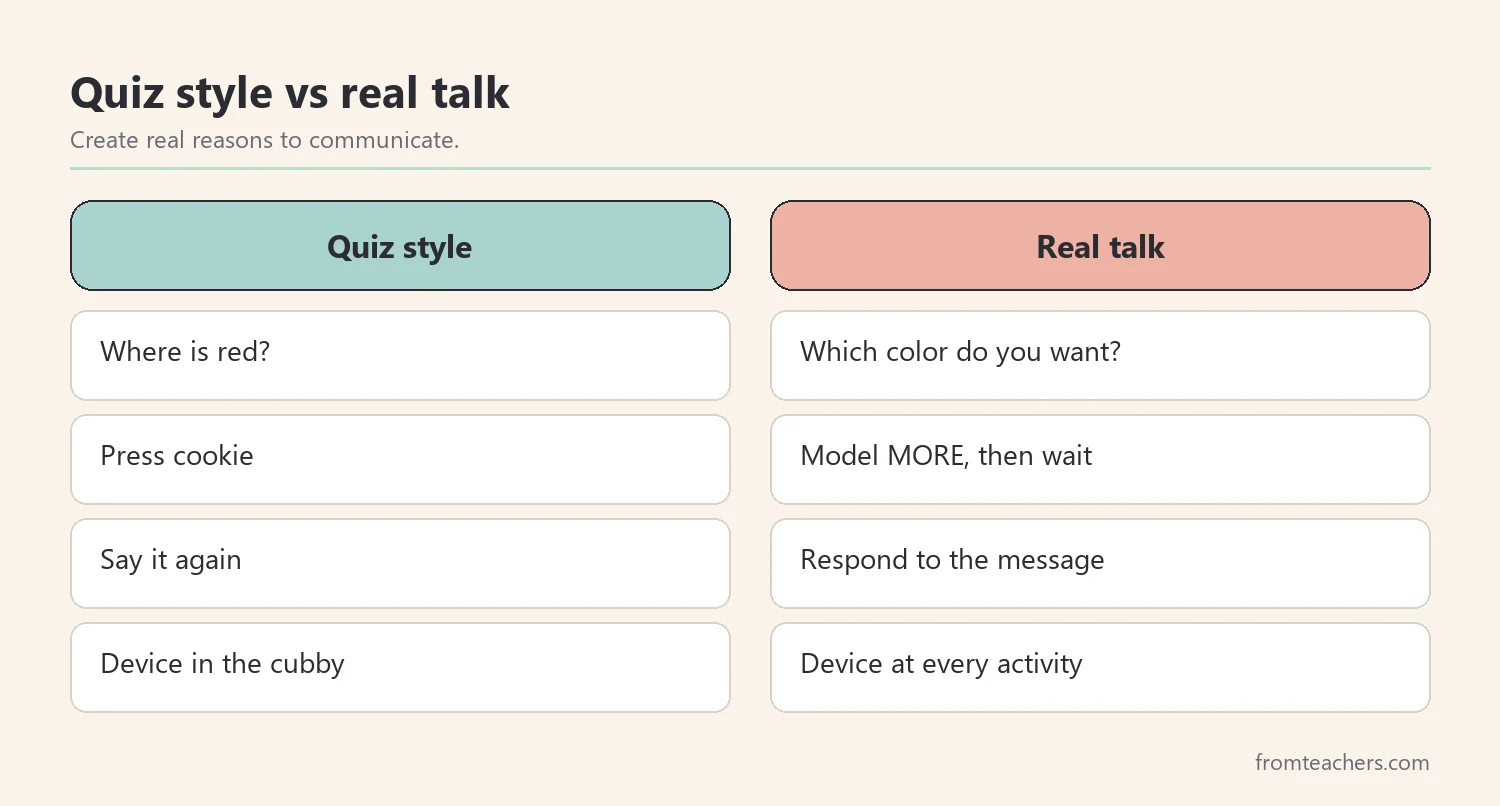
Students learn spoken language by hearing it thousands of times. AAC users need the same exposure in their own system. Modeling means the adult touches the symbols on the student’s device or a matching board while speaking, without requiring the student to copy.
Why it works: it shows where words live and how they combine. AAC specialists widely recommend this approach, often called aided language modeling.
How to use it: model one or two key words in your sentence, not every word. For example, say “Let’s GO OUTSIDE” while touching “go” and “outside.”
Example: During snack, the paraprofessional modeled “MORE” and “ALL DONE” each time she spoke to Maya. Within a few weeks, Maya began using “more” without a prompt.
3. Keep the device within reach all day
A voice that lives in a cubby is not a voice. Therefore, the device or a backup board should travel with the student to every setting: carpet, lunch, recess, specials, and the bus line.
Why it works: communication happens at unplanned moments. If the device is out of reach, those moments pass.
How to use it: agree on a place for the device in each setting, and prepare a low-tech board for times when the tablet cannot be used, such as water play or a dead battery.
Example: Maya’s team added a simple laminated core board to her recess bag. On the first day, she used it to tell a classmate “my turn” on the swing.
4. Pause and wait longer than feels natural
Composing a message on AAC takes time. Many adults fill silence too quickly, answer for the student, or move on. A deliberate pause gives the student room to respond.
Why it works: it signals that you expect a message and that you will wait for it.
How to use it: after a question, count silently to ten while looking at the student with an expectant face. Then, if needed, model a possible answer.
Example: Ms. Lee asked Maya, “What did you do this weekend?” and waited. After about eight seconds, Maya pressed “I went to” and “park.” Classmates clapped, and Maya smiled.
5. Build communication into routines
Routines repeat every day, so they are perfect for practice. Snack, attendance, choosing a center, and passing out materials all create natural reasons to communicate.
Why it works: repetition plus a real purpose helps messages stick.
How to use it: look at your daily schedule and mark two or three routines where the student can give a message. Then add those messages to the communication plan.
Example: Maya became the attendance helper on Mondays. She pressed “here” or “not here” for each classmate, which gave her many turns in a few minutes.
6. Respond to every attempt
When a student presses a button, treat it as communication, even if the message is unexpected. Respond to what was said, then model a fuller message if it helps.
Why it works: students learn that their device has power when adults respond. Ignored attempts teach the opposite.
How to use it: if a student presses “funny” during math, respond with “Something is funny? Tell me.” You may discover a real comment or a new interest.
Example: Maya pressed “dog” during reading. Ms. Lee said, “Dog? Yes, there is a DOG in the picture,” while modeling. Maya then pressed “big,” and a short conversation followed.
7. Track progress with simple notes
Finally, AAC strategies for the classroom work best when the team can see change. Short notes on how often the student communicated, which messages were used, and whether a prompt was needed show what is working.
Why it works: data helps the team decide when to add new vocabulary or new activities.
How to use it: once a week, count messages during one routine. Note whether each was spontaneous or prompted. Share the summary with the SLP.
Example: Here is how Maya’s morning meeting messages changed over five weeks.
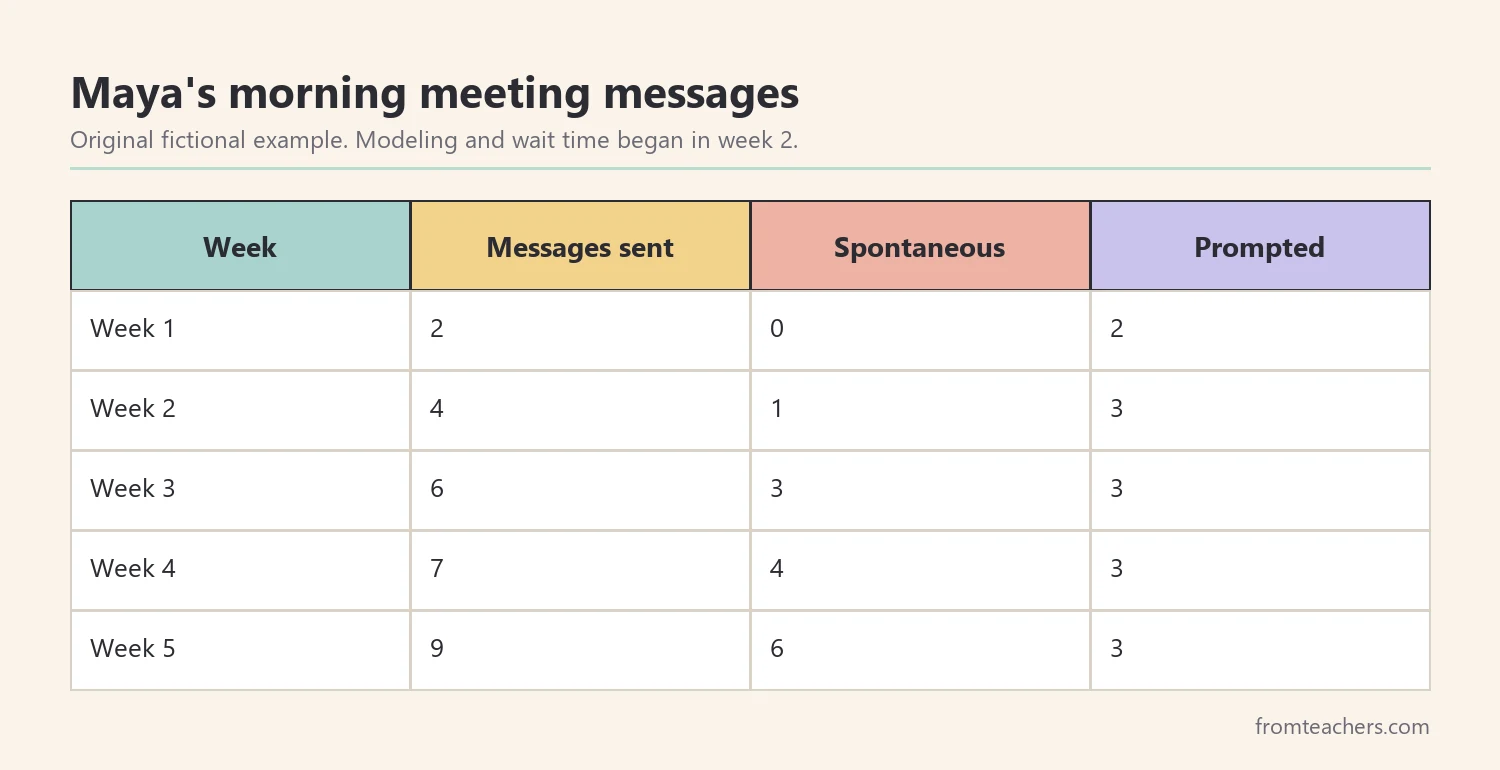
The pattern was clear. As modeling and wait time became habits, Maya sent more messages, and more of them were spontaneous. As a result, the team added two new target messages to the plan.
What a strong AAC day looks like
It helps to picture the goal. On a strong day, the student arrives, and the device is unpacked and placed on the desk before the first activity. During morning meeting, an adult sits nearby and models two or three key words. When the teacher asks a question, the room waits.
Next, during reading, the adult models words about the story, such as “look,” “funny,” or “again.” At snack, the student requests and comments. At recess, a low-tech board hangs from a lanyard or sits in a bag. Before going home, an adult notes three things: which routine went best, which new word appeared, and one thing to try tomorrow.
None of this requires a perfect setup. Instead, it requires shared habits. That is why the plan, modeling, and waiting sit at the top of the list. Once adults practice them in one routine, the others follow more easily.
Also, remember the student’s own preferences. Some students like a quiet corner for longer messages, while others enjoy sharing in front of the class. Asking the student, the family, and the SLP about these preferences makes every strategy more effective.
Putting AAC strategies for the classroom together
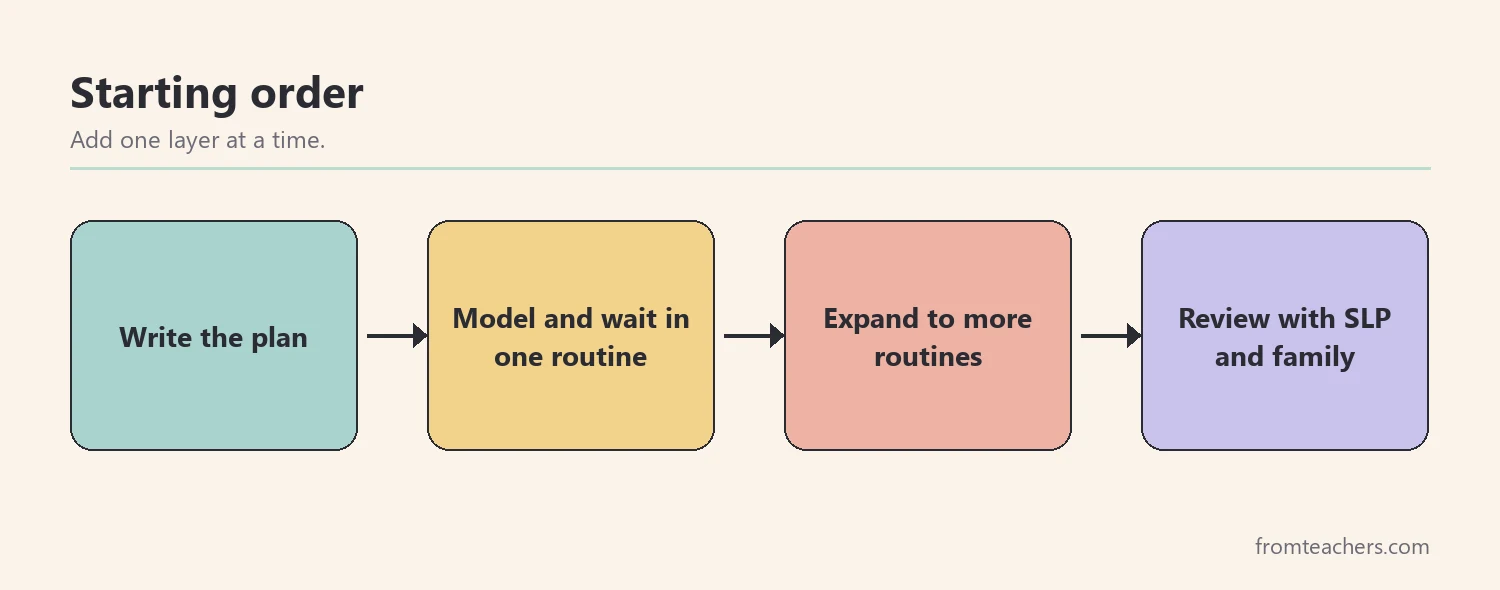
You do not need to start all seven at once. A practical order is: write the plan, then add modeling and wait time in one routine, then expand. Review every few weeks with the SLP and family.
Common mistakes and how to avoid them
- Testing instead of talking. Asking “Where is red?” over and over feels like a quiz. Fix: model and create real reasons to communicate.
- Keeping the device charged but out of reach. Fix: agree on its place in every setting and prepare a low-tech backup.
- Answering for the student. Fix: pause, wait, then model if needed.
- Changing vocabulary locations often. Students learn where words are. Fix: ask the SLP before moving buttons.
- Each adult using different targets. Fix: share one written plan.
Questions teachers and parents ask about AAC strategies for the classroom
Will AAC stop my child from talking?
Families often worry about this. Professional organizations such as ASHA describe AAC as a support for communication and language development, and many children who use AAC also continue to develop speech. Discuss your child’s situation with the SLP.
Do I need training to model on a device?
A short demonstration from the SLP helps a lot. However, you can start today by modeling one or two core words during a routine.
What if the student presses buttons randomly?
Exploring is a normal part of learning a system. Respond to the words, model meaningful messages, and watch for patterns over time.
How many target words should we pick?
Start small, often two or three messages per routine. Add more when the student uses them with less support.
How can families help at home?
Families can model during meals, play, and bedtime routines, and share new interests so the team can add vocabulary. Consistent targets at home and school help messages generalize.
Related reading: Best Assistive Technology for Special Education Classrooms, Autism Social Skills Development, and How Parents and Teachers Can Team Up for Special Education Success.
You may also need: Classroom Observation Form for Special Education (SEN): 12 Daily Checklists.
A companion resource for AAC strategies for the classroom:
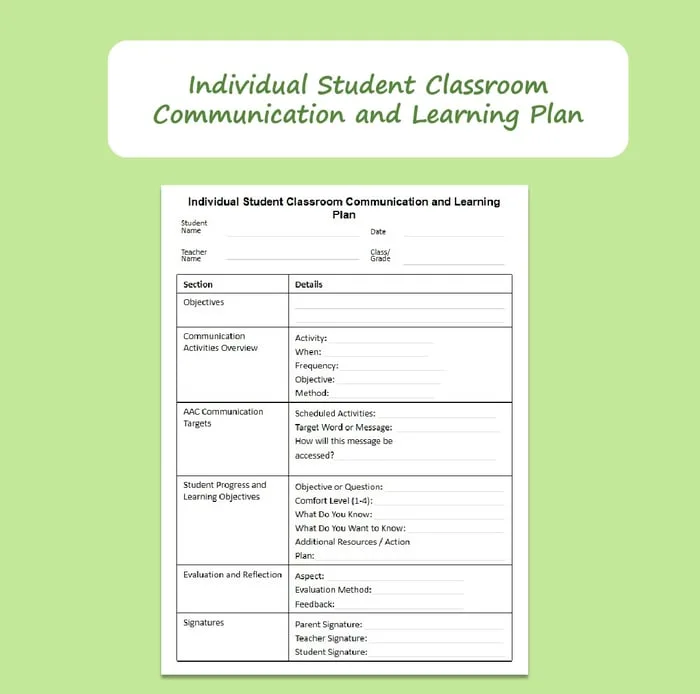
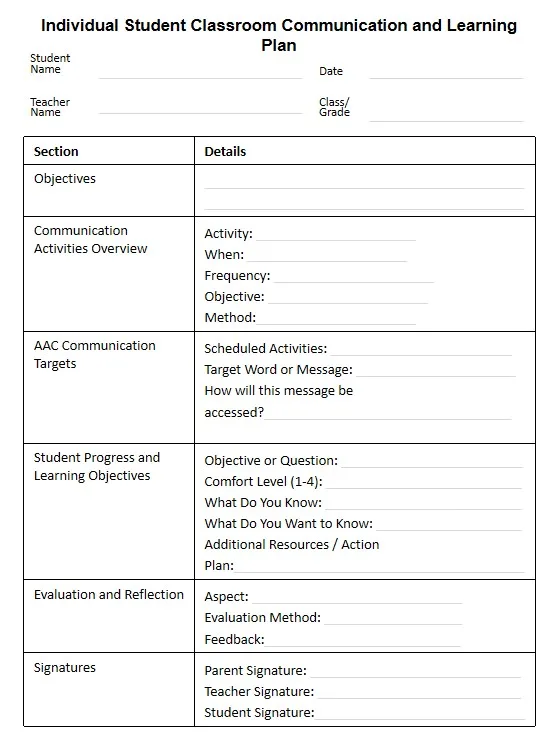
Individual Student Communication Plan AAC Learning Plan for Classrooms: a one-page plan with student and class fields, objectives, a communication activities overview, AAC targets for scheduled activities, progress and comfort ratings from 1 to 4, and an evaluation and reflection section.
Sources and scope
- ASHA Practice Portal: Augmentative and Alternative Communication: professional guidance on AAC assessment and intervention.
- International Society for Augmentative and Alternative Communication (ISAAC): an international organization for people who use AAC and those who support them.
- AFIRM Modules: free learning modules on evidence-based practices for autistic learners.
- IRIS Center, Vanderbilt University: free training modules for educators on supporting students with disabilities.
This list covers everyday classroom strategies that support students who use AAC. It does not cover device selection, vocabulary system design, or formal assessment, which belong to the SLP and the AAC team.
Key takeaways
- Start AAC strategies for the classroom with one shared written plan.
- Model on the device while you speak, without demanding imitation.
- Keep the device or a backup board within reach in every setting.
- Wait, respond to every attempt, and build messages into routines.
- Track a few simple numbers and review them with the SLP.







Leave a Comment