

Good 50 states activities turn a long list of names into a year of real discovery. Picture a fourth grade class in October: students can sing the states song, yet nobody can say where Ohio is or why Florida grows oranges. The facts are there, but they are not connected to anything.
This guide shows you how to plan a full year of U.S. geography in six steps: pace the year, set a weekly routine, teach symbols and landmarks, review with quick games, build a small project, and track what sticks. By the end, you will have a calm, repeatable plan instead of fifty separate mini-units.
Examples are fictional. Adapt the pacing and activities to your students, grade level, and schedule.
At a glance
- Two states a week for 25 weeks covers all 50 and leaves room for review.
- The same five-day routine every week lowers planning time and student stress.
- Symbols and landmarks stick better when students connect them to a reason.
- Short, frequent games beat one big test at the end.
- A simple quiz record shows which states need another look.
1. Pace the year of 50 states activities
First, do the math before you plan a single lesson. Fifty states is a lot, and 50 states activities fall apart when the pacing is vague. A clear calendar keeps you from rushing through the last ten states in May.
A typical school year has about 36 weeks. If you teach two states per week, you need 25 weeks to cover all 50. That leaves about 11 weeks for review, assessments, holidays, and a final showcase. Many teachers like this balance because it never feels rushed.
Next, group the states so patterns are easier to see. Teaching by region, such as the Northeast, Southeast, Midwest, Southwest, and West, helps students notice shared climate, landforms, and history. Starting with your own state is a good way to model the routine, because students already know some of the answers.
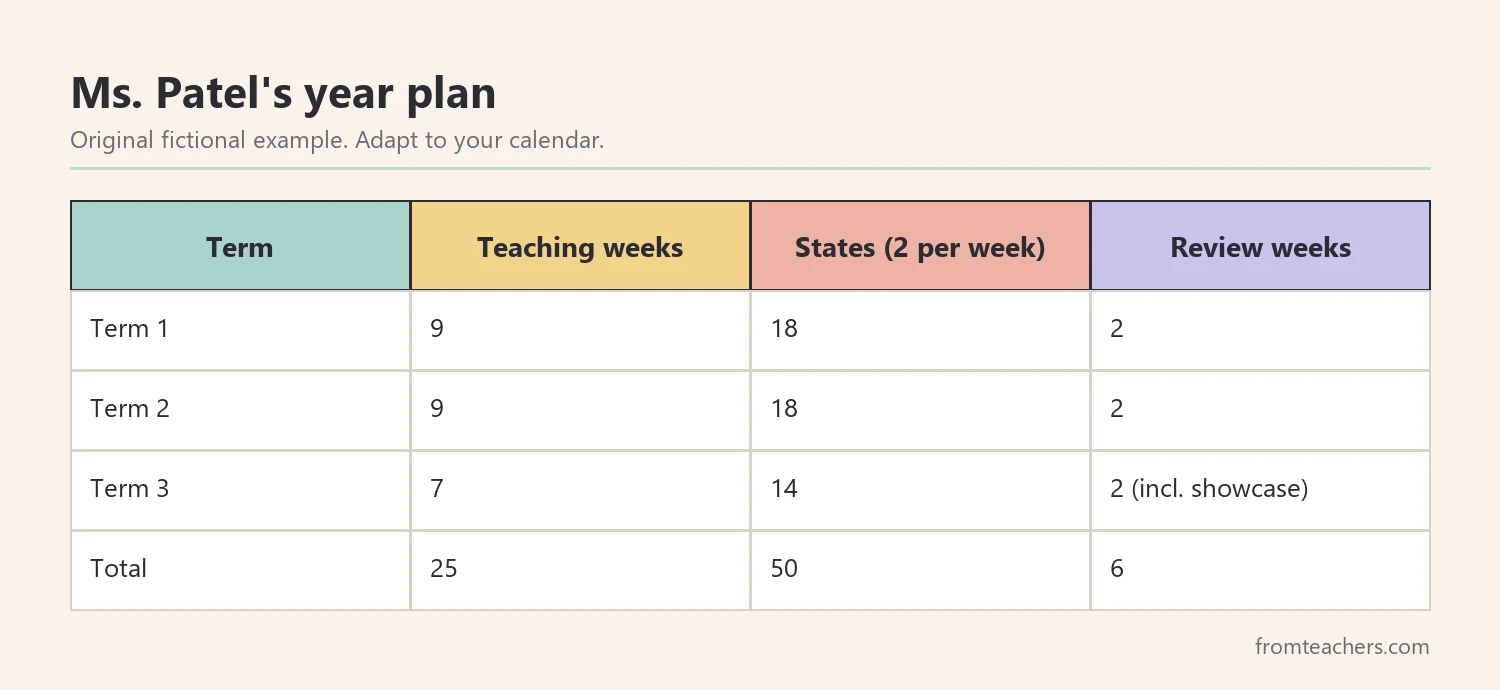
Meet Ms. Patel, a fictional grade 4 teacher. Here is how she split her 25 teaching weeks across three terms:
| Term | Teaching weeks | States (2 per week) |
|---|---|---|
| Term 1 | 9 | 18 |
| Term 2 | 9 | 18 |
| Term 3 | 7 | 14 |
| Total | 25 | 50 |
Then, decide how deep each state will go. Strong 50 states activities do not try to cover every fact. Instead, pick five or six things students should know for every state, such as location, capital, one symbol, one landmark, and one fact about the economy. Everything else is a bonus.
Finally, add review weeks at the end of each region instead of only at the end of the year. Ms. Patel adds a review week after every region, plus a showcase week in late spring. As a result, students revisit earlier states several times.
2. Set a weekly routine for 50 states activities
Next, choose a weekly rhythm and keep it. When 50 states activities follow the same structure every week, students know what to expect and you spend less time planning. Predictability also helps students who find change stressful.
A simple routine has five short blocks, one per day, about 15 to 20 minutes each. It fits easily into a social studies block or a morning meeting.
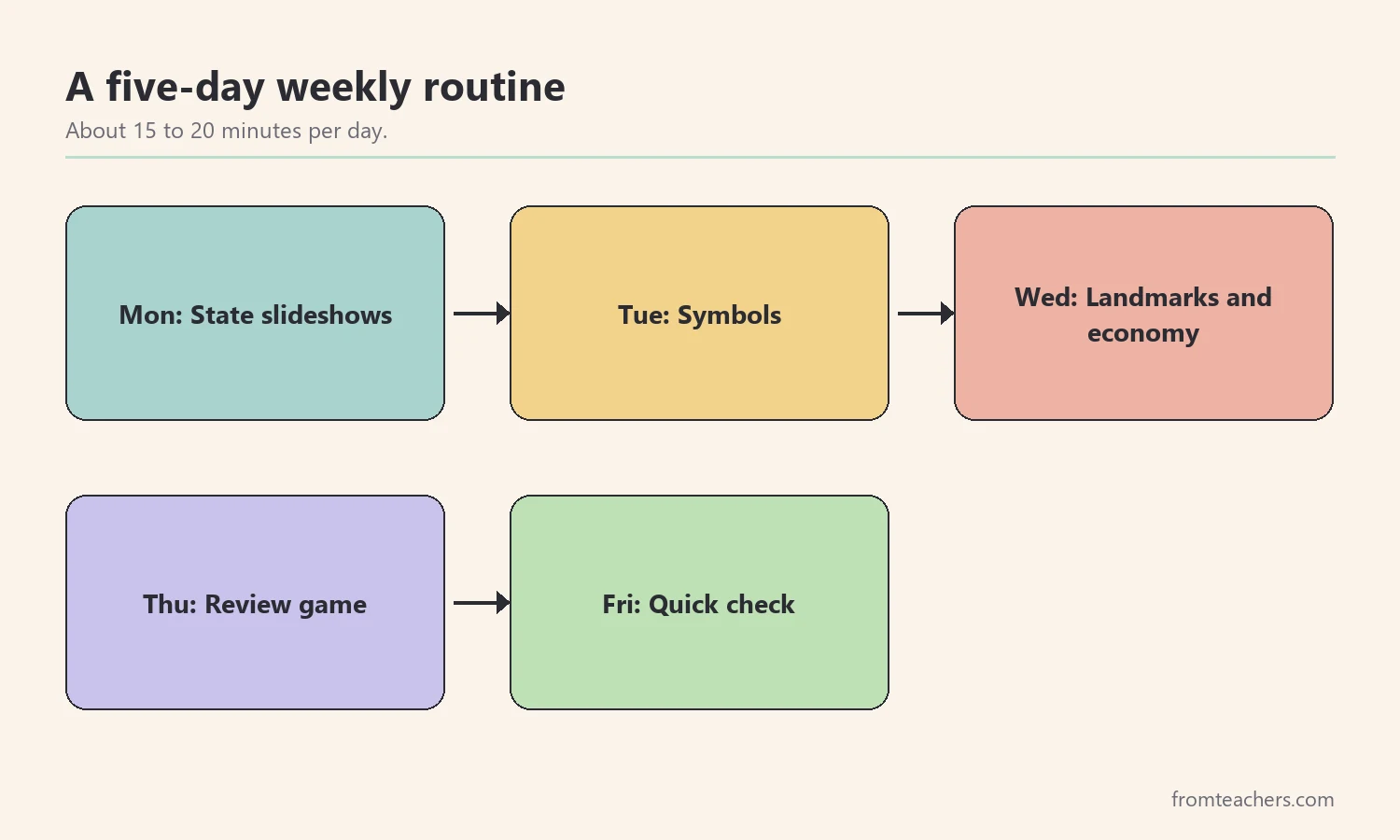
On Monday, open with a short slideshow for each state: location, capital, a few fun facts, and major cities. Tuesday is for state symbols such as the flag, bird, flower, and tree. On Wednesday, explore one or two landmarks and the economy. Then, Thursday is game day, and Friday is a five-minute quick check.
For example, during a week on Texas and Alaska, Ms. Patel’s class compares the bluebonnet and the forget-me-not, the state flowers of Texas and Alaska. Students then predict which state has colder winters and explain how they know.
Also, post the routine on the wall so students can see the week at a glance. When the plan is visible, transitions are faster and students start asking for their favorite day. Visible routines make 50 states activities easier for substitutes to run as well.
Keep each block short. Above all, end every block with one question students answer in their own words. That small habit turns watching into thinking.
3. Teach symbols and landmarks with a reason
Symbols and landmarks are the fun part of the unit, but they only stick when students know why they matter. A state bird on its own is trivia. A state bird linked to the land, the climate, or the people becomes a story.
Try asking “why” after every fact. Why might a desert state choose a cactus flower? What draws so many visitors to the Grand Canyon in Arizona? Why is the Statue of Liberty in New York Harbor? Students do not need perfect answers. The point is to connect a fact to a reason.
Next, use a ready-made presentation to save prep time. The All 50 States Study Bundle of state slideshows includes a slideshow for every state, covering fun facts, symbols, major cities, state trees, economies, and landmarks, so your Monday and Tuesday blocks are ready from Alabama to Wyoming.
Then, build a class “symbol wall.” After each week, students add a small card for each state with one symbol and one landmark. By spring, the wall becomes a visual review tool that students walk past every day.
For instance, one of Ms. Patel’s students noticed that the Northern cardinal appears on the wall for several states. That observation led to a short class discussion about why states sometimes share symbols. Questions like that are worth more than any worksheet.
Moreover, symbols are a natural bridge to other subjects. Students can write a short paragraph about a state bird for writing class, or compare the area of two states during math. Cross-subject links like these make 50 states activities feel less like an add-on and more like part of the whole day.
Finally, include your own community. If your state has a local landmark or a famous product, invite students to bring a photo or a story from home. Personal connections make the rest of the map feel closer.
4. Review with quick 50 states activities and games
Review is where learning becomes long-term memory. Quick 50 states activities that ask students to recall facts work better than rereading notes. Short, frequent practice also feels more like play than study.
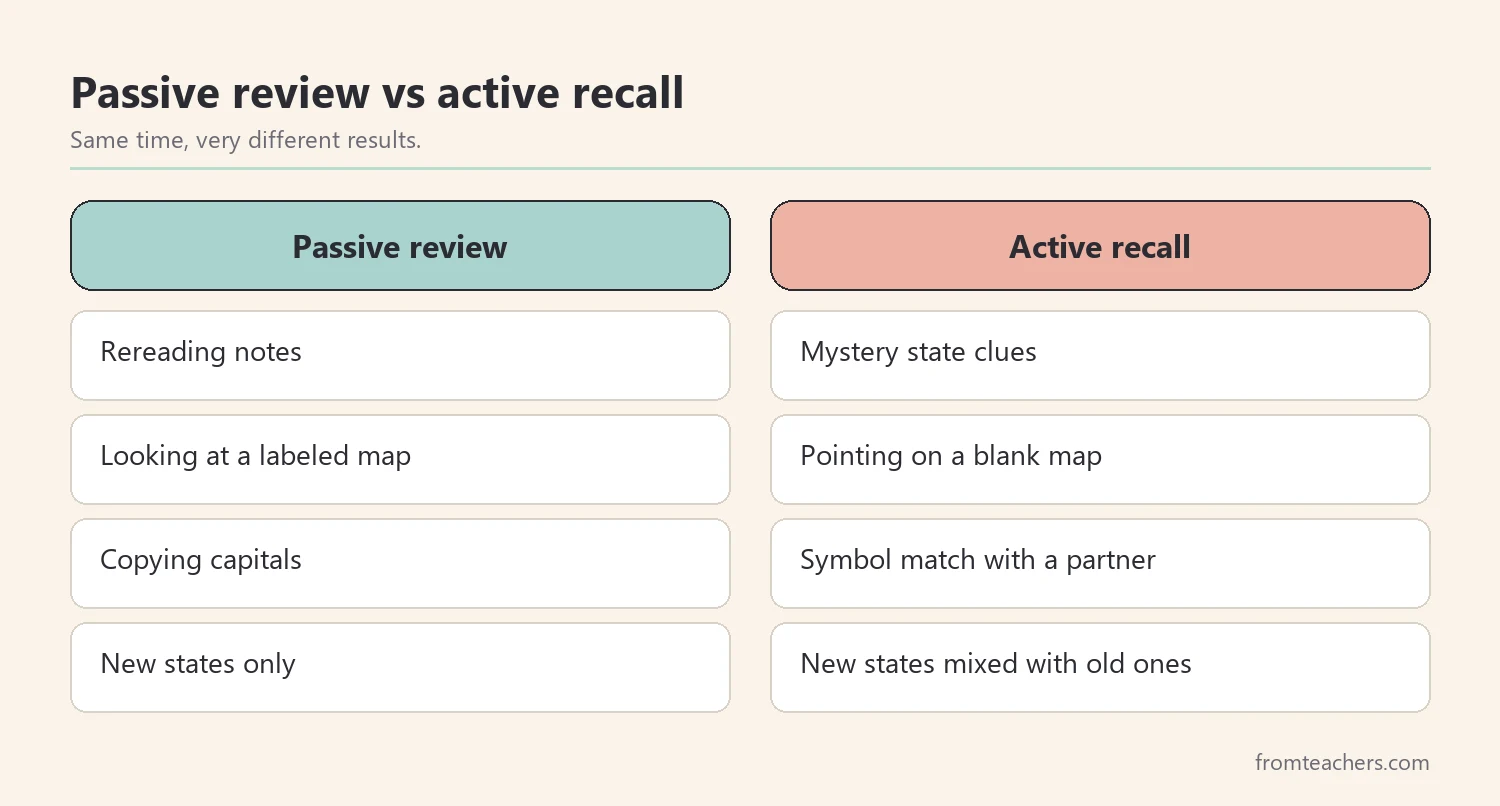
Here are a few games that take five to ten minutes:
- Symbol match: pairs match state name cards to symbol cards, such as Texas to the bluebonnet.
- Mystery state: you read three clues, and teams guess the state.
- Map dash: students point to a state on a blank map before a short timer ends.
- Road trip: teams plan a route through three neighboring states and name one landmark in each.
Mix new states with old ones in every game. For example, a Thursday game in week 12 might include the two new states and four states from earlier weeks. That spacing helps students hold on to earlier learning.
In addition, let students design their own games once they know the routine. A group might write mystery state clues for the class or build a symbol match deck for a region. Student-made 50 states activities often become class favorites, and writing good clues is itself strong review.
Also, keep the games low stakes. Points are fine, but the goal is practice, not ranking. Students who feel safe guessing will try more answers and learn more.
5. Build a small project students keep
Next, give students something to build across the year. A passport journal is a simple option. After each state, students add a stamp or sketch, the capital, one symbol, one landmark, and one fact that surprised them.
The passport works as both a project and a study guide. Because every page follows the same pattern, students learn to organize facts. At the end of the year, the finished passport is something many children are proud to take home.
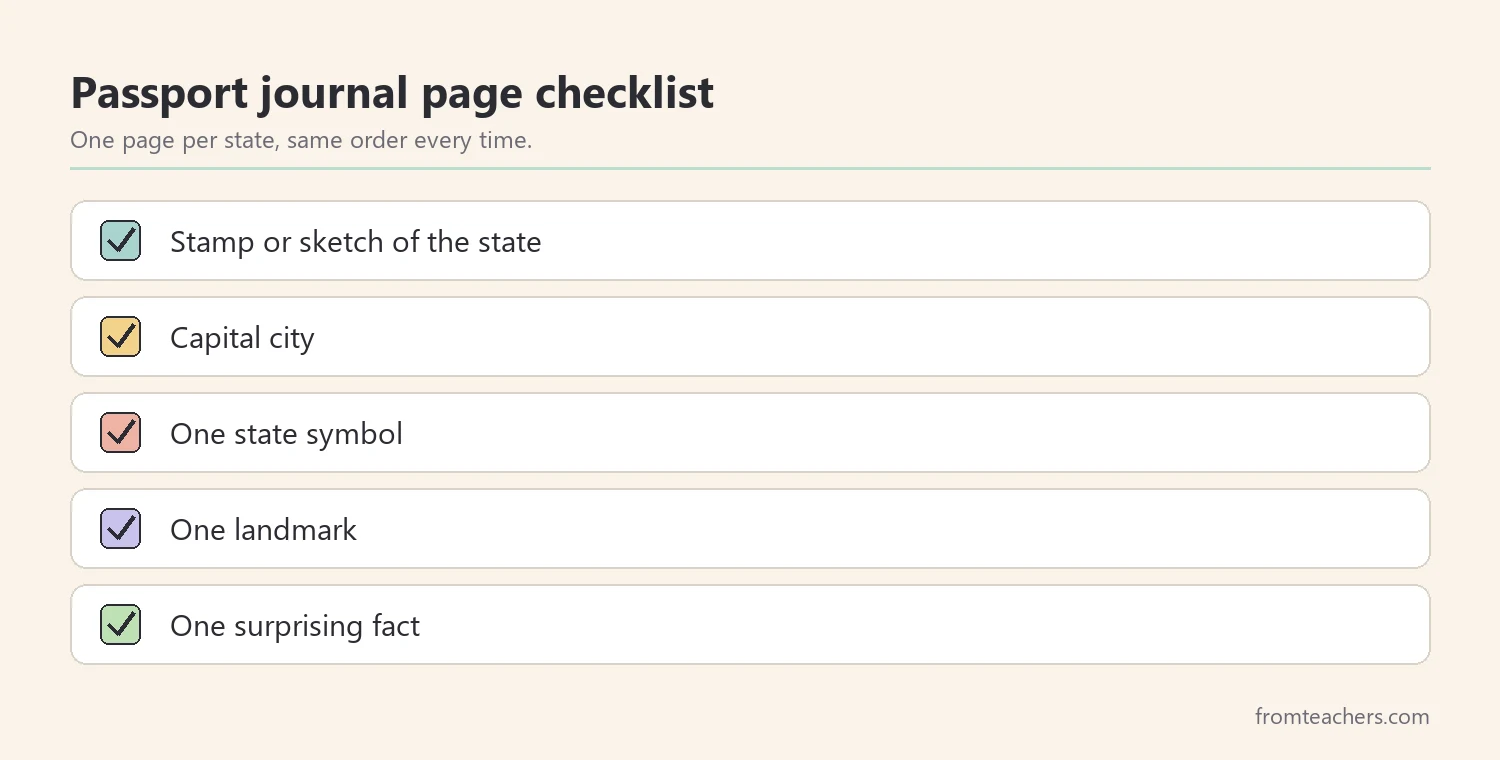
For example, Ms. Patel gives students ten minutes on Friday after the quick check to finish their two passport pages for the week. Students who finish early add a small drawing of a landmark.
Then, plan a showcase near the end of the year. Each student picks a favorite state and presents it in two minutes to families or another class. Presenting gives students a reason to go deeper into one state, while the passport keeps their knowledge of all 50 broad.
Because the project grows week by week, it also shows progress to families. Parents can flip through the passport at conferences and see exactly which 50 states activities their child has completed.
Finally, support every learner. Some students may need sentence starters, a word bank, or partner work. Others may want to research a bonus fact. The same template works for both.
6. Track what sticks in your 50 states activities
Finally, check learning in a light way. A five-question quick check each Friday gives you useful information without turning the unit into a test marathon. Then, a ten-question review quiz after each region shows what students remember over time.
Record the class average, not just individual scores. If the class average dips on one region, plan an extra game round on those states before moving on.
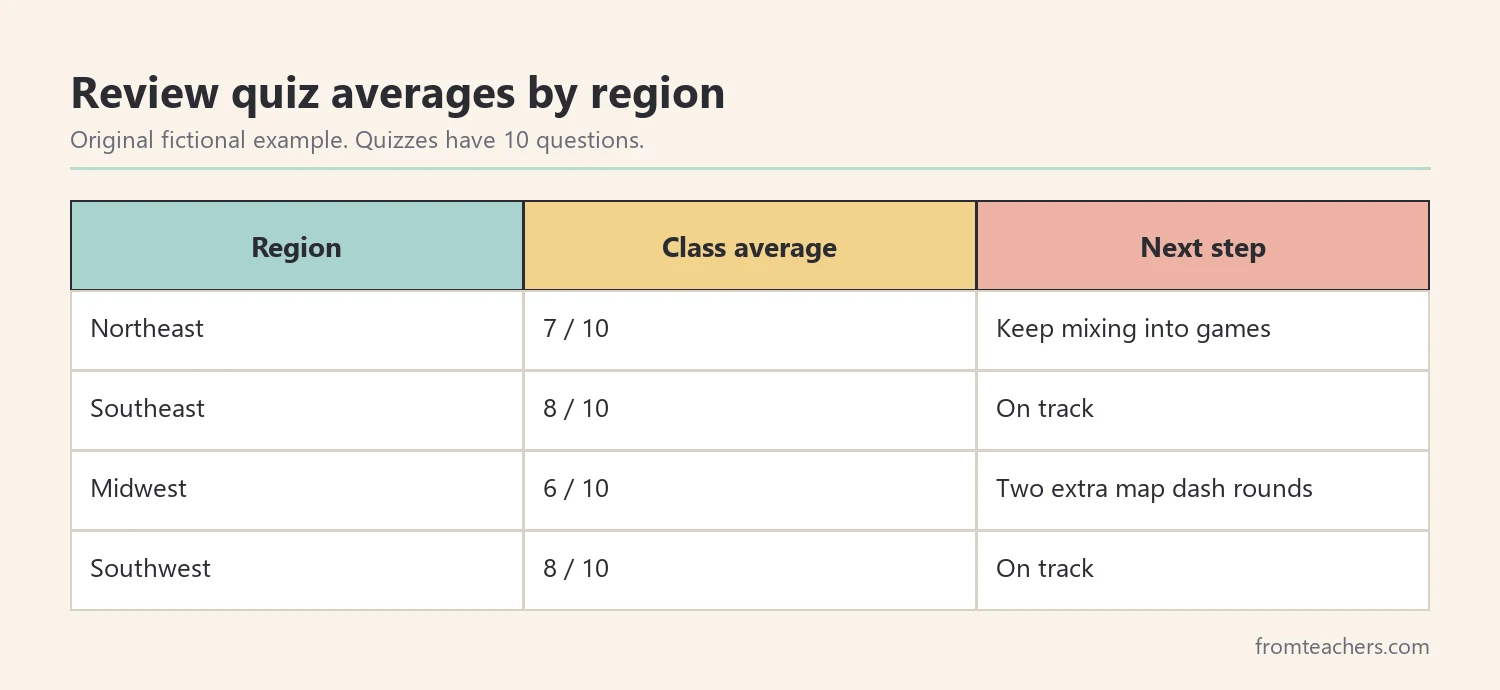
In Ms. Patel’s fictional record, the class averaged 7 out of 10 on the Northeast review, 8 on the Southeast, 6 on the Midwest, and 8 on the Southwest. The Midwest dip told her that students mixed up neighboring states, so she added two map dash rounds before the next region.
Also, ask students what helped them remember. Their answers often point to the games or connections that work best for your group, and you can lean on those in your 50 states activities next year.
Common mistakes and how to avoid them
- Vague pacing. Fix: count your teaching weeks and assign two states per week before the year starts.
- Memorizing capitals only. Fix: connect each state to symbols, landmarks, and a reason behind the facts.
- One big test at the end. Fix: use short Friday checks and a review quiz after each region.
- Never revisiting old states. Fix: mix earlier states into every weekly game.
- Too many activity types. Fix: 50 states activities work best with less variety than you think, so keep one weekly routine and rotate only the games.
Questions teachers and parents ask about 50 states activities
What grade level are 50 states activities best for?
Many schools study U.S. states around grades 3 to 5, and most 50 states activities are written for that range, but the routine works for older students too. Adjust the depth of the facts and the length of the project to fit your group.
Can I teach the 50 states in less than a year?
Yes. You can cover several states per week in a shorter unit. However, students usually remember more when they revisit states over time, so build in review even in a short plan.
How do 50 states activities work for homeschool families?
The weekly routine fits homeschool well. A parent can run one short block per day and use the passport journal as a portfolio. Family trips and local landmarks make great extra lessons.
What is the best order to teach the states?
Starting with your home state, then moving region by region, works well for most classes. Neighboring states share climate and history, which helps students see patterns.
How can I support students who struggle to remember facts?
Offer word banks, picture cues, and partner games. Focus on a few key facts per state rather than every detail. Frequent short practice helps more than long study sessions.
Related reading: 5 Practical Teaching Tips to Boost Classroom Focus and Learning, Learning Styles Student Success Guide, and Homeschooling vs. Public Schooling: Which Educational Path Is Right for Your Child?.
A companion resource for 50 states activities:
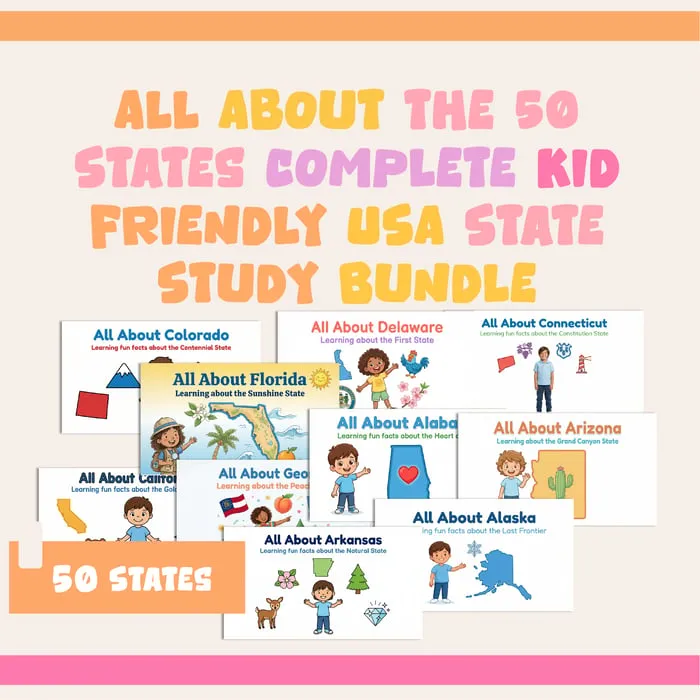
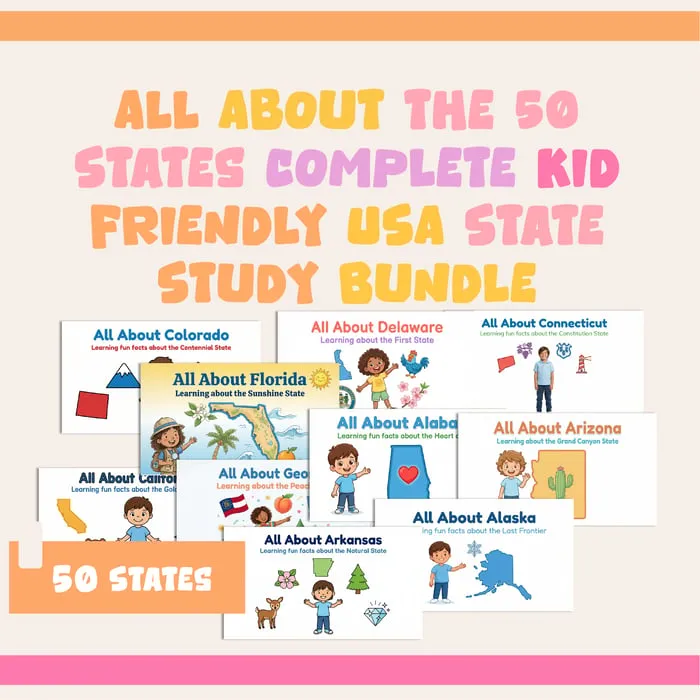
All 50 States Study Bundle: a slideshow for every state from Alabama to Wyoming, covering fun facts, symbols, major cities, state trees, economies, and landmarks, ready for a full-year states unit or geography course.
Sources and scope
- National Council for the Social Studies (NCSS): a professional organization for social studies teaching, including geography.
- National Geographic Education: free maps, activities, and geography resources for classrooms.
- National Park Service: official information on national parks and landmarks across the states.
- Library of Congress: historical maps, photos, and primary sources about U.S. places.
This guide covers planning, routines, and review for a classroom or homeschool states unit. It does not replace your state’s social studies standards or detailed fact-checking for each state’s symbols.
Key takeaways
- Plan 50 states activities with clear math: two states a week for 25 weeks covers all 50.
- Keep one five-day routine and rotate only the games.
- Connect every symbol and landmark to a reason.
- Mix old states into new games so learning lasts.
- Track class averages by region and reteach where the numbers dip.








Leave a Comment