

A student observation form helps most when you are not sure what is really going on. Picture a second grader who seems fine in morning meeting, drifts during math, and comes back from recess upset. Each adult who works with him sees a different slice of the day, and no one has the whole picture. A careful observation can bring those slices together.
This guide gives you a five-step process: set a clear question, prepare the form and the sitting, record what you see objectively, summarize patterns across areas, and share the results with the family and team. By the end, you will be able to run one focused observation and turn it into useful next steps.
Examples are fictional. Adapt to the student’s goals and agreed supports. This is guidance, not a diagnosis.
At a glance
- Start every observation with one clear question.
- Plan when, where, and how long you will observe before you start.
- Write what you see and hear, not what you think it means.
- Look across several areas of development to find patterns.
- Share a short summary and agree on one next step with the team.
1. Set a clear question for the student observation form
First, decide what you want to learn. A student observation form works best when it answers a question, not when it simply collects everything. For example, “How does Sam engage during independent math compared with group work?” is far more useful than “How is Sam doing?”
Next, gather what is already known. Talk briefly with other adults who work with the student, check recent work samples, and note any concerns the family has shared. In addition, check the student’s current goals if they have an IEP or 504 plan. This background helps you choose where to look. It also stops your student observation form from repeating what the team already knows.
Then, write your question at the top of the page. Keep it short and specific. A good question names the student, the setting, and the skill or behavior you want to understand.
| Vague question | Clear question |
|---|---|
| Is he focused? | How long does he work alone during math? |
| How are his social skills? | How does he join games at recess? |
| Is she struggling? | Where does she stop during writing tasks? |
| Why is he upset? | What happens right before he gets upset? |
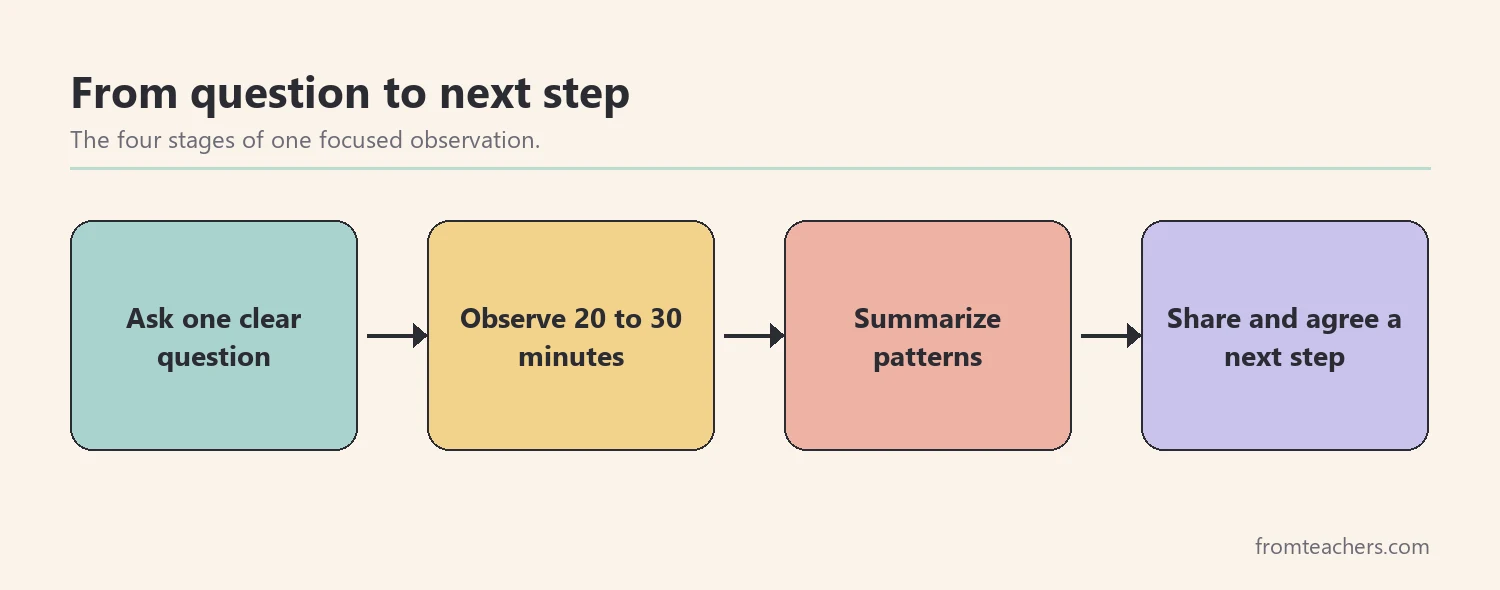
Worked example. Sam is a fictional student in grade 2. His teacher notices he finishes group tasks but often leaves math pages incomplete. His family mentions he seems tired after school. The team agrees on one question: “How do Sam’s attention and engagement change between group work and independent math?”
In short, the question keeps the observation focused. As a result, your student observation form will point toward real next steps.
2. Prepare the form and plan the sitting
Once you have a question, plan the observation itself. Choose the time, the place, and the length. A single sitting of 20 to 30 minutes often gives enough to see patterns, especially if it includes a change of activity.
Next, prepare your student observation form before the lesson starts. Fill in the student’s name, the date, the setting, and your question. Then, review the areas on the form so you know what to watch for. A broad form that covers several areas, such as engagement, attention, emotional well-being, and motor skills, helps you avoid missing something important.
Before you observe
- Write the question at the top of the form.
- Pick a time that includes the activity you want to see.
- Choose a seat where you can see without hovering.
- Tell the classroom teacher what you will do, if it is not your room.
- Have a watch or timer to note times.
- Plan a second sitting on another day, if possible.
Also, think about how to stay low-key. Students often act differently when they know they are being watched. Sit to the side, look around the room now and then, and avoid making notes right in front of the student.
Then, decide what you will do if the day changes. A fire drill, an assembly, or a substitute can make the sitting unusual. If that happens, note it at the top of the form and plan another sitting, rather than drawing conclusions from an untypical day.
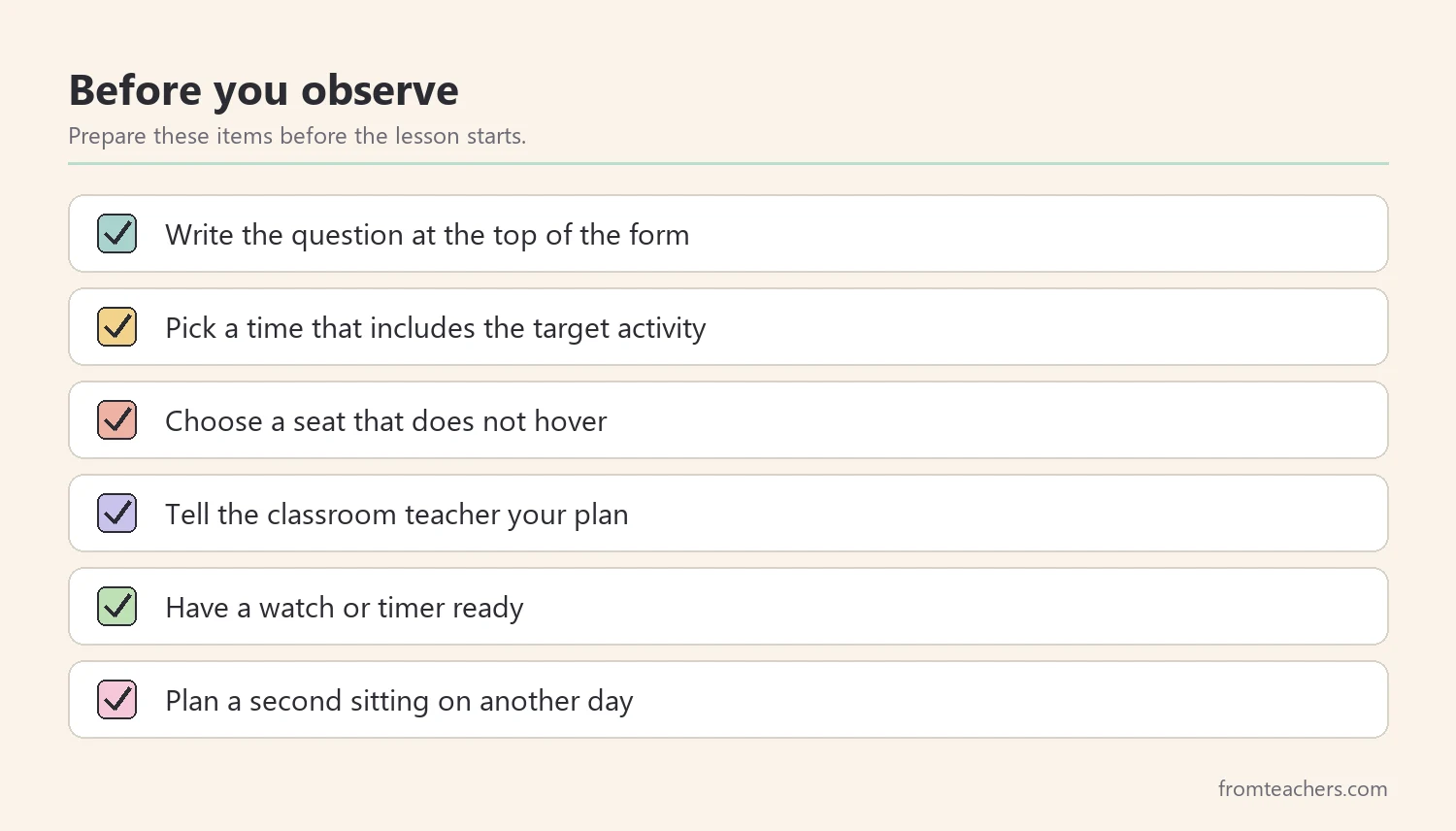
Worked example. Sam’s resource teacher plans a 30-minute observation on Tuesday. It covers the last 15 minutes of group work and the first 15 minutes of independent math. She fills in the form header ahead of time and sits at a side table near the reading corner.
Finally, plan a second short sitting for later in the week. Two observations give a more reliable picture than one. In addition, use the same student observation form both times, so the results are easy to compare side by side.
3. Record what you see objectively on the student observation form
During the sitting, your job is to describe, not to judge. Objective notes say what the student did and said, in words anyone could check. Subjective notes guess at feelings or reasons. Both have a place, but the student observation form should lead with what you saw.
For example, “Sam put his head on the desk for about two minutes after the math page was handed out” is objective. “Sam was lazy during math” is a judgment. The first note helps the team. The second can hurt the student and does not explain anything.
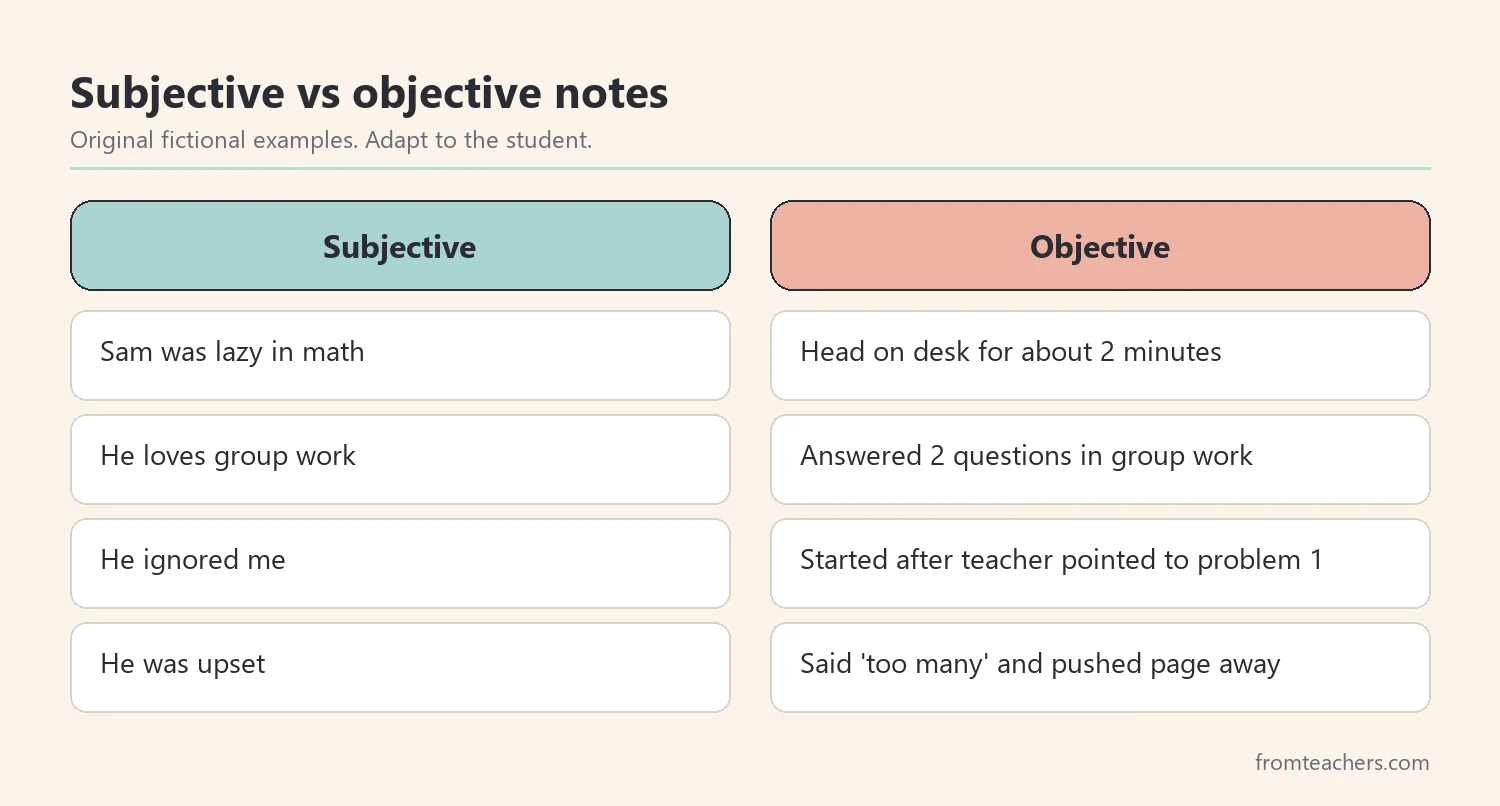
Next, note times. Even rough times, such as “10:05” and “10:12,” show how long a behavior lasted and what came before it. In addition, record what the adults and peers did, because their actions are part of the picture.
Then, mark the checklist areas on your form as you go, and add short notes beside anything surprising. A form with clear checkboxes saves time, so you can keep your eyes on the student. The large fillable classroom observation form uses simple checkboxes across twelve areas, which makes this quick to do in one sitting.
Worked example. During group work, Sam’s resource teacher writes, “10:00, Sam answers two questions and passes materials.” During math, she writes, “10:15, page handed out. 10:16, head on desk. 10:18, teacher points to first problem. 10:19, Sam starts problem one.” She also checks the attention and engagement areas on the form.
In other words, short timed notes tell a story without guessing at the ending.
Also, resist the urge to step in unless safety requires it. If you help the student during the sitting, write that down, because your help changes what you see. A student observation form is most honest when it shows the support that was actually given, not the support you planned.
4. Summarize patterns across areas on the student observation form
After the sitting, take ten minutes to read your notes while they are fresh. Look for patterns across the areas on your student observation form. A pattern might be a time of day, a type of task, or a kind of support that seems to help.
Start by listing what went well. Strengths matter, because they show what supports already work. Next, list the two or three areas that raised questions. Then, connect each one back to your original question.
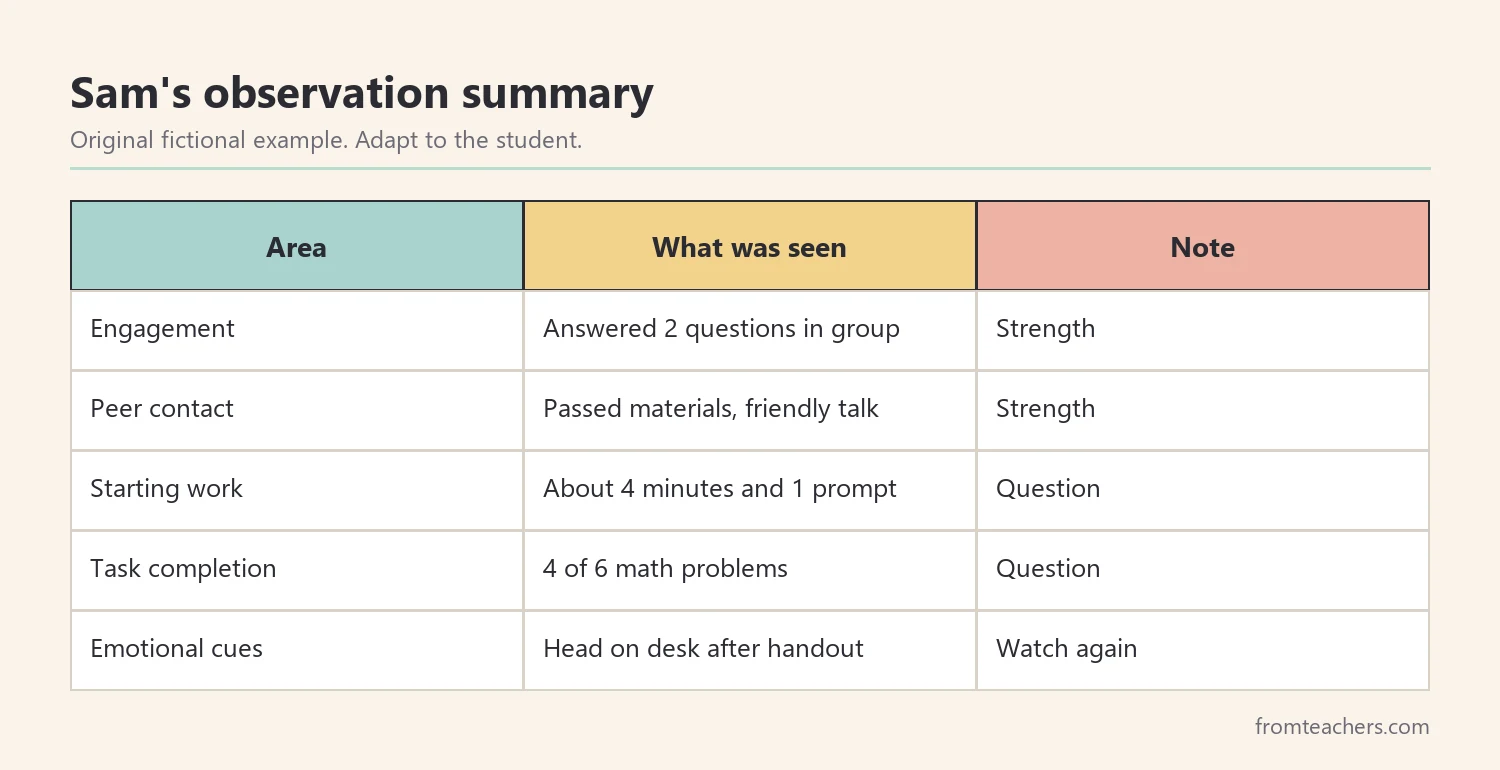
Also, compare the observation with other information. Do work samples, family reports, and other adults’ notes agree? If they do not, that is worth noting too. One observation is a snapshot, and it is most useful alongside other evidence. For this reason, many teams treat the student observation form as a starting point for discussion rather than a final answer.
| Look for | Example question to ask |
|---|---|
| Time patterns | Is it harder after lunch? |
| Task patterns | Is it harder with written work? |
| Support patterns | Does a prompt help him start? |
| Strengths | Where is he most engaged? |
Worked example. Sam’s summary shows strong engagement and friendly peer contact during group work. During independent math, he needed about four minutes and one adult prompt to start. Once started, he finished four of six problems. His teacher notes that a clear first step may help more than extra time.
5. Share student observation form results and plan the next step
A student observation form only helps if the results reach the people who can act on them. Therefore, share a short summary with the classroom teacher, the family, and, when relevant, the student’s IEP team. Keep it to one page and lead with strengths.
Next, agree on one next step. For example, try a written first step on math pages, then observe again in two weeks. A single change is easier to test than a long list of ideas.
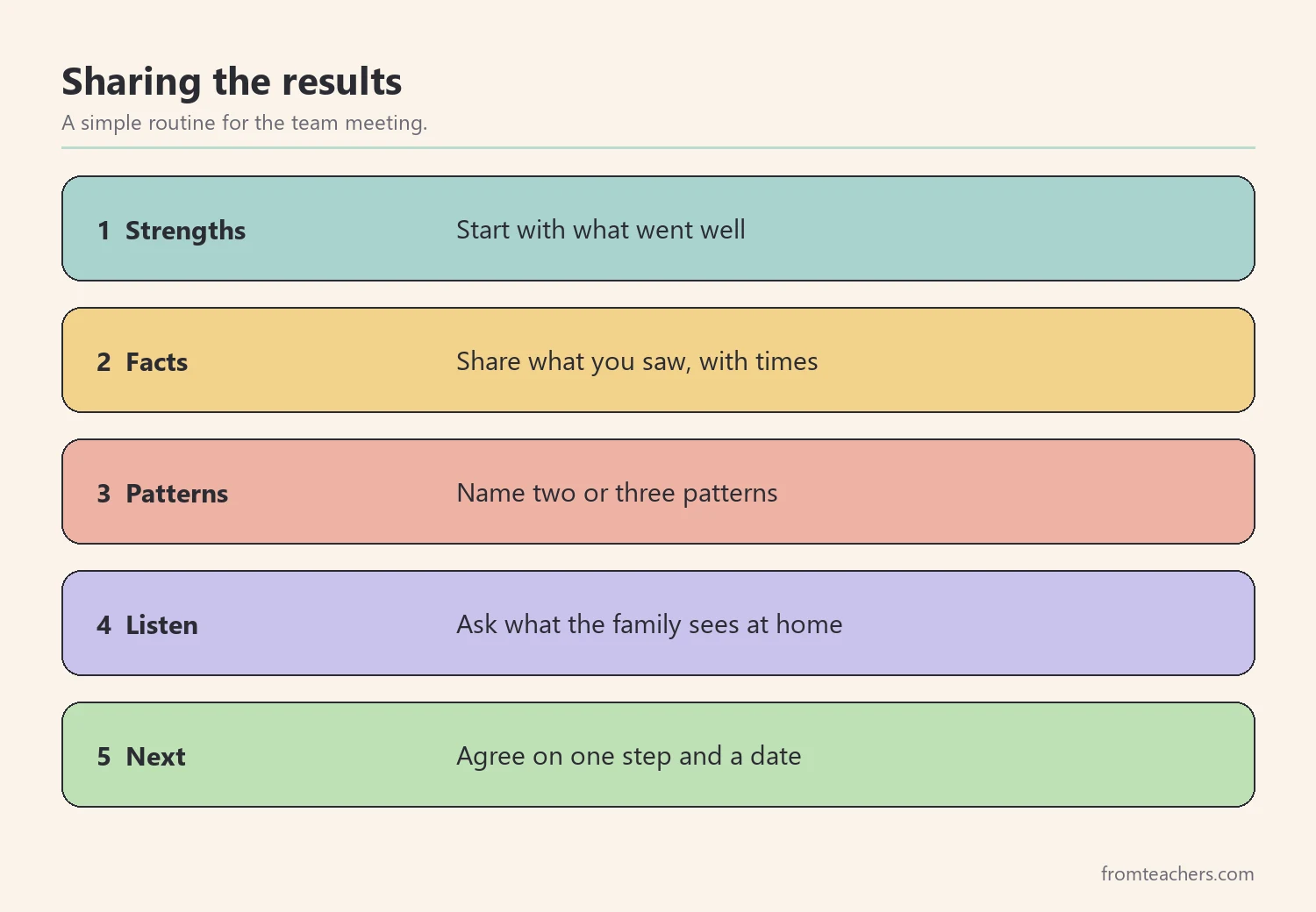
Also, use clear, respectful language with families. Avoid labels and avoid guessing at diagnoses. Describe what you saw, what seemed to help, and what you plan to try. Then, invite the family to share what they notice at home.
Finally, store the form with the date so you can compare later observations. Over time, a set of dated forms shows growth in a way memory cannot. For example, a second student observation form completed after a new support can show whether starting work became quicker or engagement improved.
Worked example. Sam’s resource teacher shares a one-page summary at a short team meeting. His parents mention he also stalls at the start of homework. The team agrees to add a written first step to math pages at school and homework at home. They plan a second observation in two weeks.
Common mistakes and how to avoid them
- Observing without a question. Notes become a long list with no direction. Fix: write one clear question at the top of the form.
- Writing judgments instead of actions. Words like “lazy” or “rude” do not help the team. Fix: describe what the student did and said.
- Relying on one sitting. A single day may not be typical. Fix: plan at least two short observations on different days.
- Skipping strengths. The summary feels negative and misses useful clues. Fix: list what went well first.
- Filing the form and moving on. Nothing changes for the student. Fix: agree on one next step and a date to observe again.
Questions teachers and parents ask about a student observation form
How long should an observation last?
Many teachers find 20 to 30 minutes enough for one sitting, especially if it includes a change of activity. Longer is not always better. Two short observations on different days usually give a clearer picture than one long one.
Who should complete a student observation form?
Classroom teachers, special educators, and support staff can all complete one. It often helps when someone other than the lead teacher observes, so the teacher can keep teaching. Follow your school’s guidance on who observes and how notes are stored.
Should parents see the completed form?
Sharing a summary with families builds trust and invites their view. Follow your school’s policies on records and privacy. Lead with strengths and describe what you saw in plain language.
Can a student observation form be used for an IEP?
Observation notes can be one useful source of information for an IEP team. However, they are one piece of evidence alongside assessments, work samples, and family input. The team decides how the information is used.
How often should I observe the same student?
It depends on the question. For a new concern, two observations a week apart are a good start. After trying a support, observe again in a few weeks to see whether anything has changed.
Related reading: The Power of Data Tracking in Special Education, How Teachers Communicate With Parents in Special Education, and Special Education Accommodation and Modification Tracker.
A companion resource for a student observation form:
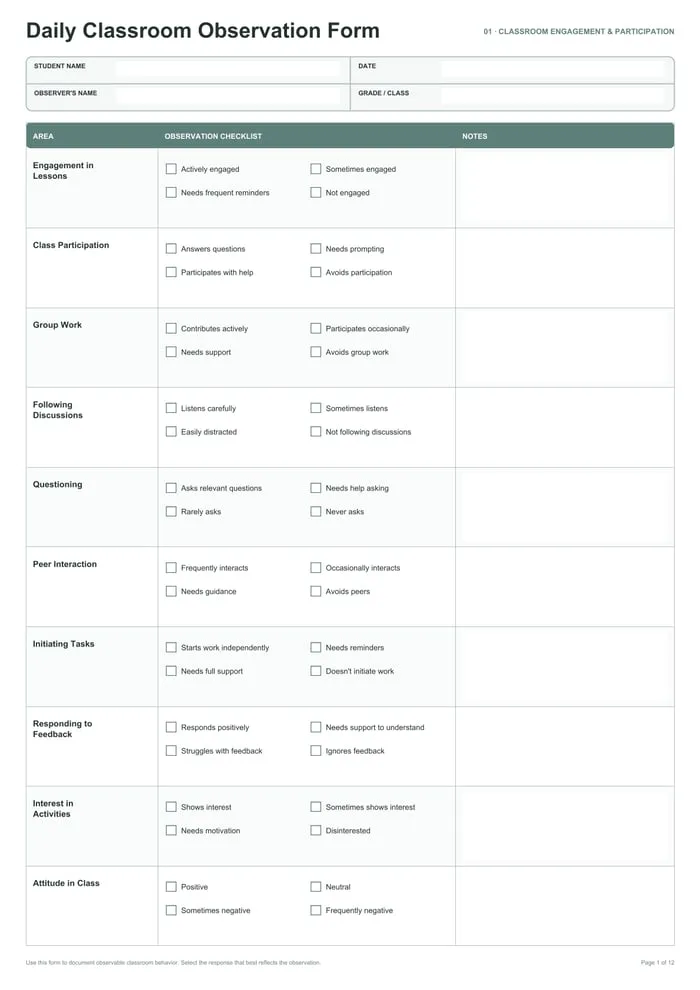
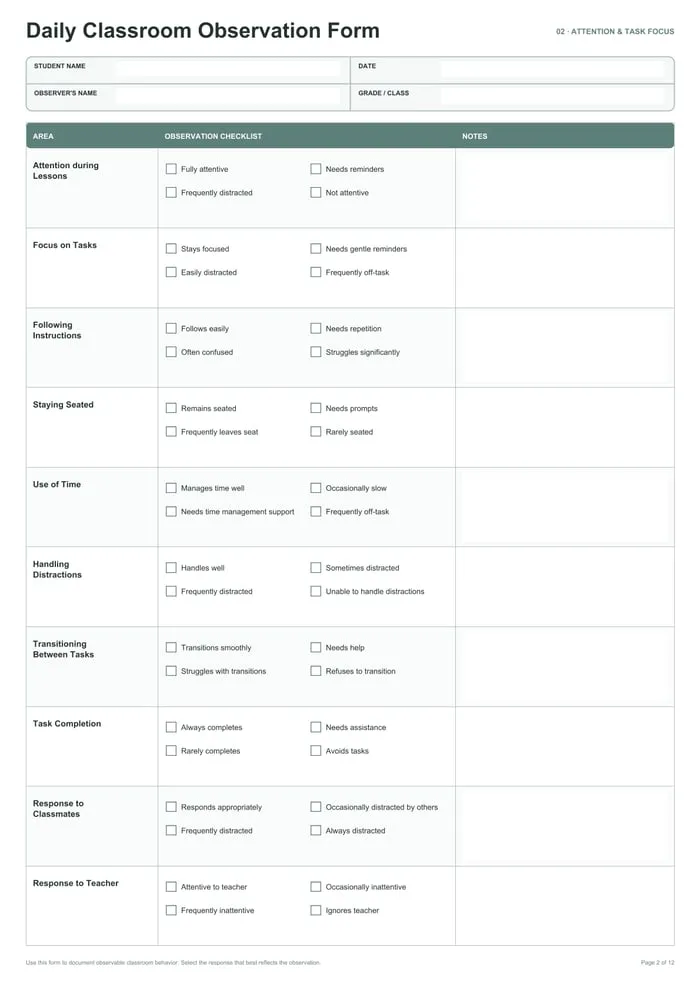
Daily Classroom Observation Form (Large Fillable): a large, easy-to-read form that walks through twelve key areas of development, including engagement, attention, emotional well-being, motor skills, and thinking skills, with simple checkboxes for a full snapshot in one sitting.
Sources and scope
- IRIS Center, Vanderbilt University: free modules on assessment, data collection, and classroom practice.
- National Association for the Education of Young Children: guidance for educators on observing and supporting young children.
- Council for Exceptional Children: a professional association for special educators.
- IDEA, U.S. Department of Education: the law behind special education evaluations, services, and IEPs.
This guide covers informal classroom observation for planning and team communication. It does not cover formal evaluations, diagnosis, or legal record requirements, which belong to qualified professionals and your school’s policies.
Key takeaways
- A student observation form works best when it answers one clear question.
- Plan the time, place, and length of the sitting in advance.
- Record actions, words, and times instead of judgments.
- Summarize strengths and patterns across several areas.
- Share a short summary, agree on one next step, and observe again.










Leave a Comment