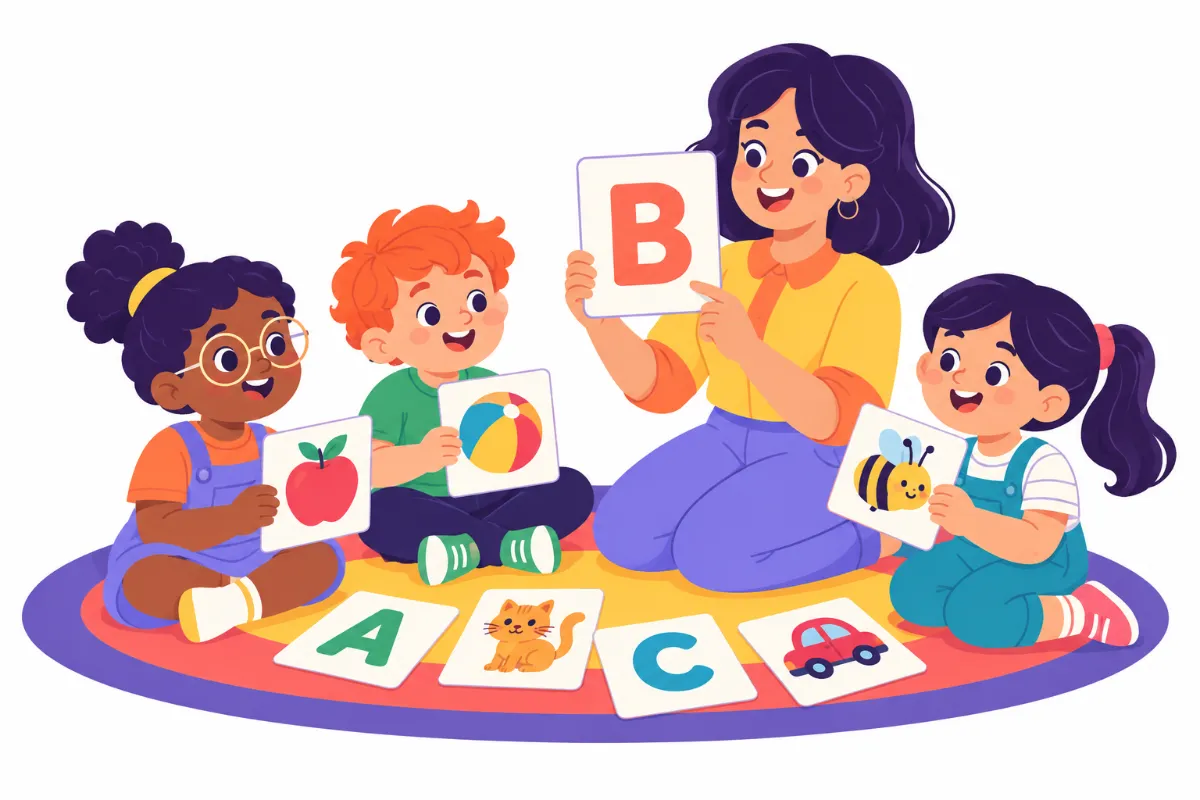

Preschool alphabet activities work best when letters feel like a game, not a chore. Picture a four-year-old who spots the letter M on a cereal box and shouts, “That’s in my name!” That moment of discovery is exactly what good alphabet teaching tries to create every day.
This guide gives you a simple, step-by-step way to teach letter names, shapes, and sounds through play. By the end, you will know which letters to start with, how to introduce each one, which games build practice, and how to track progress without testing young children all day.
Examples are fictional. Adapt to the student’s goals and agreed supports. This is guidance, not a diagnosis.
At a glance
- Start with letters that matter to the child, like the letters in their name.
- Introduce each letter with the same short routine: see, say, sound, build, find.
- Use play, songs, movement, and hands-on materials more than worksheets.
- Connect letters to the real world: signs, books, and food packages.
- Check a few letters at a time and celebrate growth.
1. Choose letters for your first preschool alphabet activities
There is no single required order for teaching the alphabet. However, starting with meaningful letters gives children an instant reason to care.
Begin with the first letter of each child’s name. Then, add the other letters in their name, along with letters in family names, pets, or favorite things. These letters show up in the child’s life often, so practice happens naturally.
Next, mix in letters with clear, easy sounds, such as m, s, t, and a. Keep visually similar letters, like b and d, apart at first so children do not confuse them.
Also, focus on a small set at a time. Two or three new letters a week, with plenty of review, is often more effective than racing through one letter per day without returning to earlier ones.
Consider Nora, a fictional four-year-old in a preschool class. Her teacher, Ms. Patel, starts with N, O, R, and A, the letters in Nora’s name. For the whole class, she adds M and S because they have sounds children can stretch out easily.
Because each child has a different name, Ms. Patel keeps a small name card for every child at the writing table. During preschool alphabet activities, children compare cards and notice shared letters. Nora is delighted to learn that her friend Ana also has an A and an N.
| Letter group | Why start here | Example |
|---|---|---|
| Name letters | Personal and motivating | N, O, R, A for Nora |
| Easy sounds | Sounds can be stretched | m, s, f |
| Frequent letters | Seen often in print | a, t, e |
2. Introduce each letter with the same preschool alphabet activities routine
Preschoolers feel safe with predictable routines. When every new letter follows the same short pattern, children know what to expect and can focus on the letter itself.
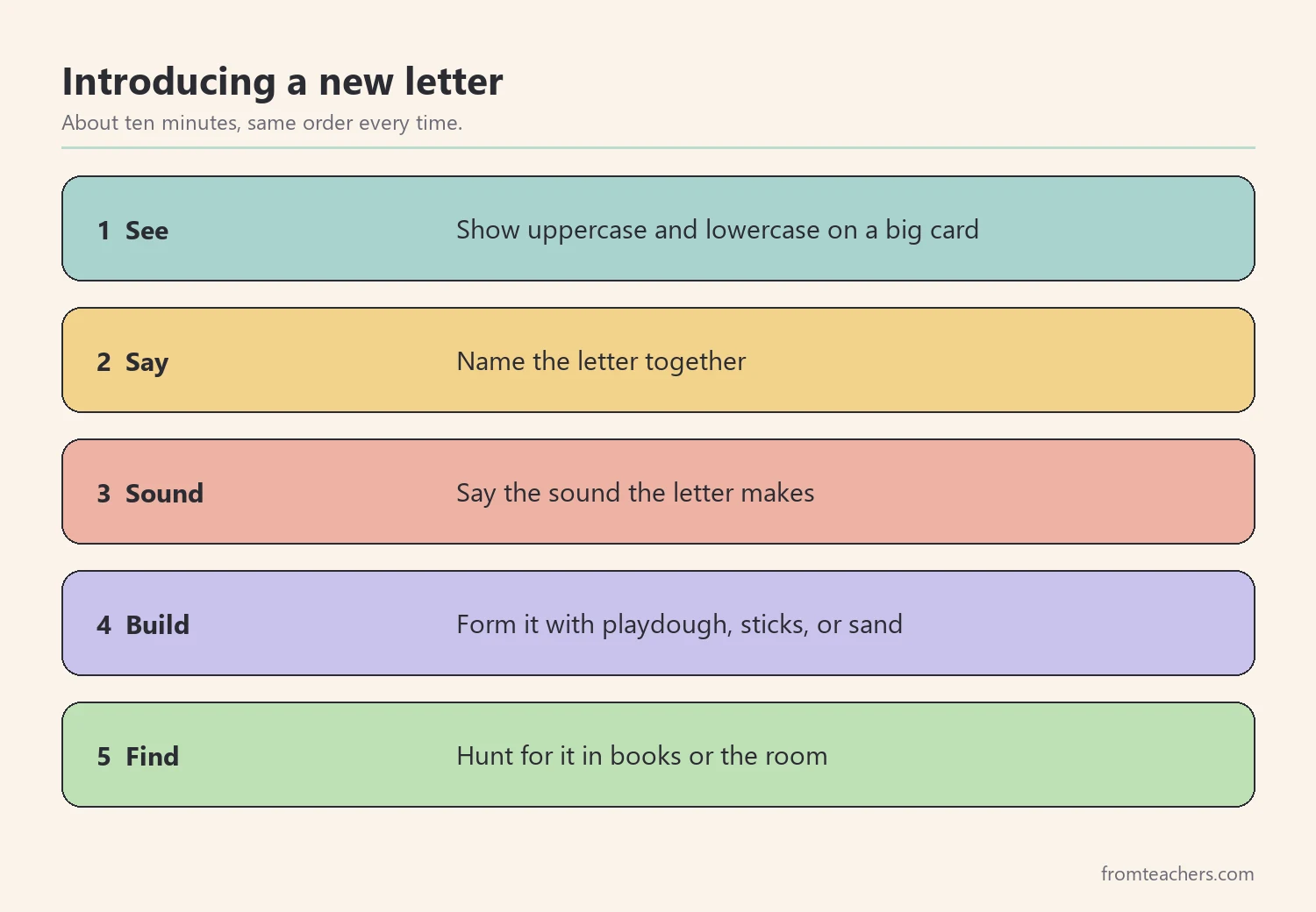
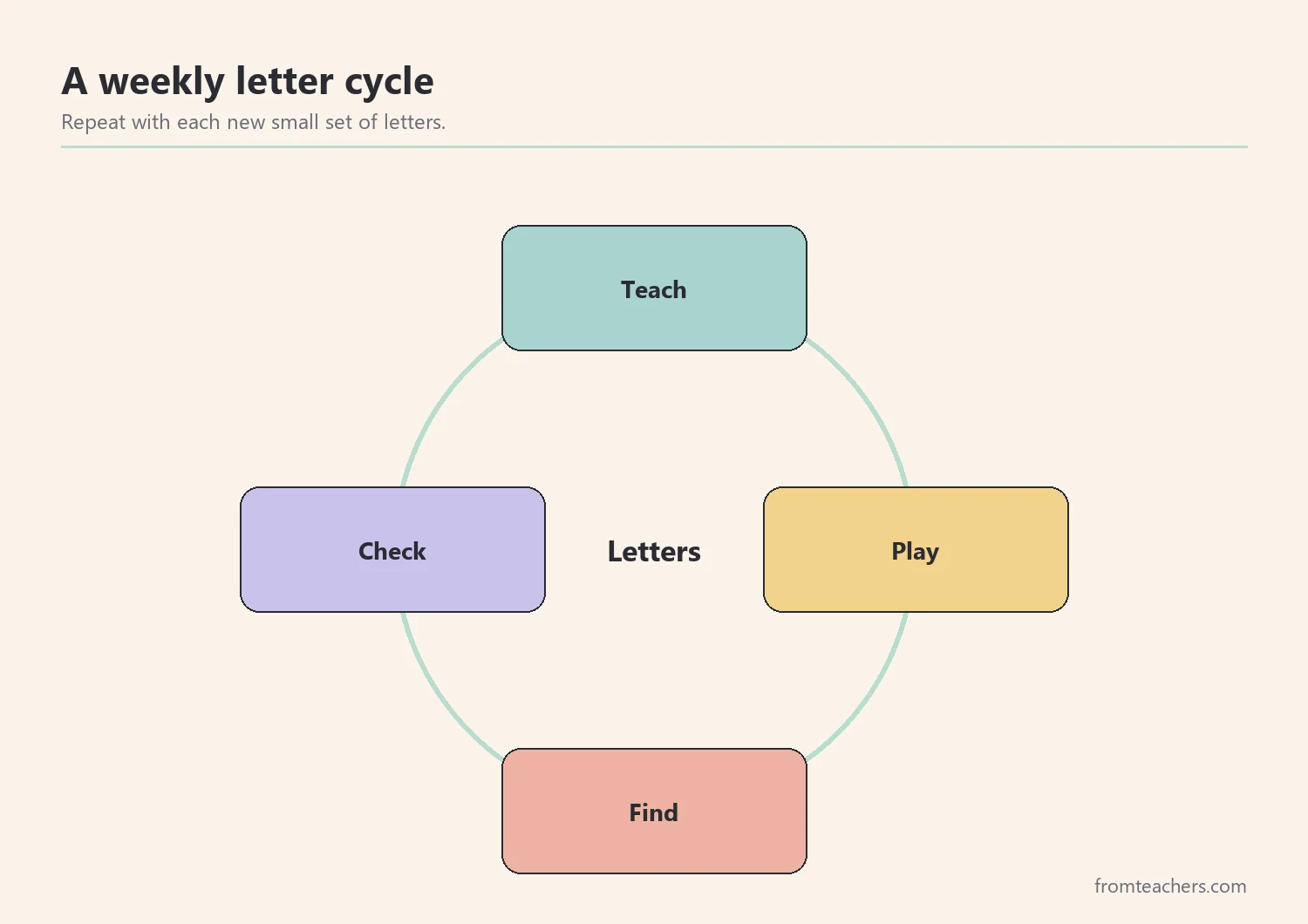
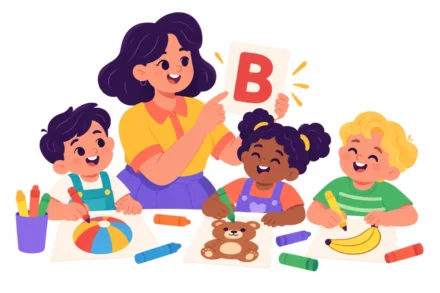
Use five quick moves. First, see it: show the uppercase and lowercase letter on a big card. Second, say it: name the letter together. Third, sound it: say the sound the letter makes. Fourth, build it: form the letter with playdough, sticks, or a finger in sand. Fifth, find it: hunt for the letter in a book or around the room.
Keep the whole routine to about ten minutes. Short, joyful practice that happens often beats long lessons that test attention.
Moreover, show uppercase and lowercase together from the start. Children see both forms in books and on signs, so linking them early helps them read real print.
When Ms. Patel introduces M, children see the card, say “M,” and hum the /m/ sound like eating something yummy. Then they build M with craft sticks and hunt for it on the class library shelf. Nora finds three M’s on book covers and proudly counts them.
Afterward, Ms. Patel adds the M card to the class letter wall at children’s eye level. Over the weeks, the wall fills up, and children use it during play to copy letters for signs and labels. In this way, the routine connects directly to the rest of the day’s preschool alphabet activities.
3. Build preschool alphabet activities around play
Young children learn through their hands, bodies, and imaginations. That is why the strongest preschool alphabet activities often look like play to an outsider.
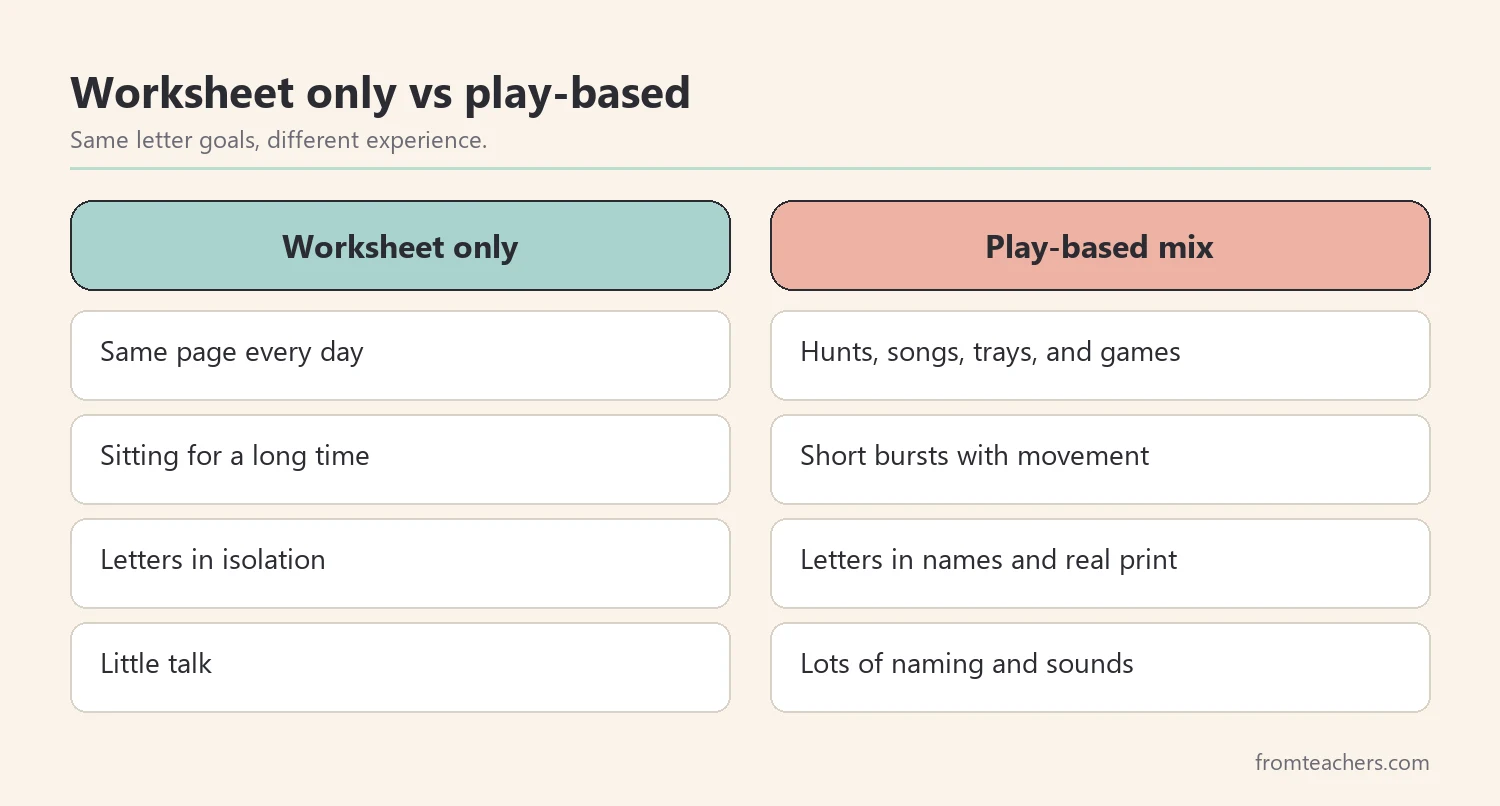
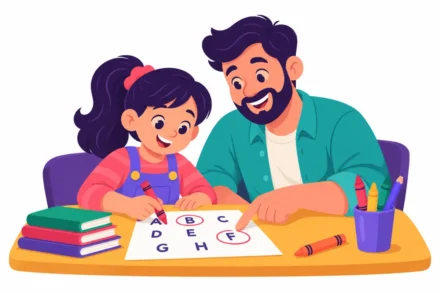
Try a mix of activities across the week. Letter hunts, sensory trays, letter puzzles, alphabet songs, and movement games all build letter knowledge from different angles. Tracing and simple coloring pages can help too, especially for letter shapes, as long as they are short.
Rotate activities so interest stays high, but keep the target letters the same for several days. Repetition through variety is the goal.
Think about different kinds of learners too. Some children love to move, so jumping on floor letters suits them. Others prefer quiet tables with playdough or magnetic letters. Offering several preschool alphabet activities for the same letters lets every child find a way in, and it gives children who need extra practice more chances without boredom.
A ready-made visual guide saves planning time here. The Learning Letters alphabet and phonics guide for preschool includes a section on letter games, tracing, and letter hunts, alongside uppercase and lowercase letters and letter sounds.
| Activity | What it builds | Time |
|---|---|---|
| Letter hunt | Recognition in print | 5 to 10 min |
| Sensory tray writing | Letter shape | 5 min |
| Alphabet song with cards | Letter names and order | 3 min |
| Jump on the letter | Recognition and movement | 5 min |
4. Connect letters to their sounds
Knowing letter names is a great start, but reading needs sounds too. Preschool alphabet activities should gently link each letter to the sound it usually makes.
Start with continuous sounds you can stretch, like /mmm/, /sss/, and /fff/. Children can hear them clearly. Then, add quick sounds like /t/ and /p/, keeping them short and crisp without an extra “uh.”
Use pictures and objects. A small basket with a toy snake, a sock, and a spoon makes the /s/ sound concrete. Children pull out an item, say its name, and listen for the first sound.
In addition, play listening games without any letters at all. “I spy something that starts with /m/” builds the sound awareness children need to connect sounds to print later.
Nora pulls a toy monkey from the M basket and says, “Mmm-monkey!” Ms. Patel points to the M card and says, “Yes, monkey starts with M.” Nora then finds a mitten and a map in the basket without help.
Similarly, songs and rhymes make sound practice feel natural. Changing the first sound in a familiar song, such as singing a verse where every word starts with /m/, makes children giggle while they listen closely. These playful preschool alphabet activities build the ear for sounds that later supports blending and reading.
- Stretch continuous sounds first: m, s, f, l.
- Keep quick sounds short and clean.
- Use object baskets for each sound.
- Play “I spy” with first sounds every day.
5. Find letters everywhere
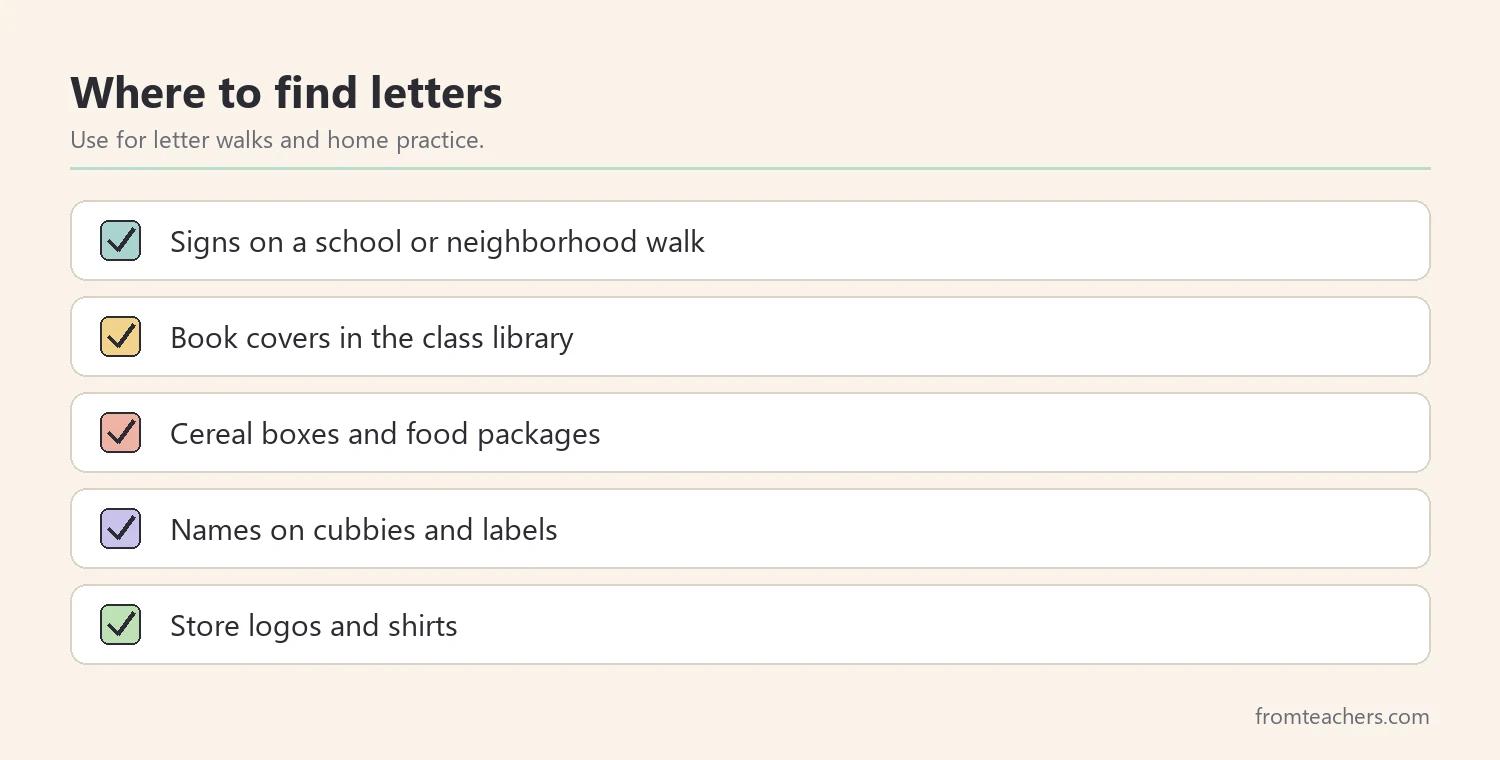
Letters are not only on worksheets. They are on cereal boxes, stop signs, store logos, book covers, and shirts. When children notice this, alphabet learning spreads into the whole day.
Take a letter walk around the school or neighborhood. Bring a clipboard with the target letters and let children tally what they find. Indoors, collect clean food packages and let children circle letters they know.
Also, invite families to join. Ask parents to point out one target letter during a grocery trip or on a walk. A short note home with the week’s letters makes this easy.
These real-world preschool alphabet activities show children that reading is useful, not just a classroom task. That sense of purpose is a strong motivator.
Bring the outside world in, too. A class “letter museum” of clean labels, menus, and junk mail lets children sort print by letter. Preschool alphabet activities like this cost almost nothing and grow every time a family sends something new.
On a letter walk, Nora’s group looks for A and S. They find A on a parking sign and S on a stop sign and a bus. Back in class, Nora draws the stop sign and labels the S herself.
6. Track and review preschool alphabet activities
A light record helps you see who needs more practice without turning preschool into a test. Check a few letters at a time during play or a quick one-on-one moment.
Hold up a letter card and ask, “What letter is this?” and “What sound does it make?” Mark names and sounds separately, since children often learn one before the other. Keep checks to a minute or two.
Then, review the record every few weeks. If a child knows the names but not the sounds, add more sound games. If a letter keeps getting mixed up, give it extra hands-on practice and keep it apart from look-alike letters.
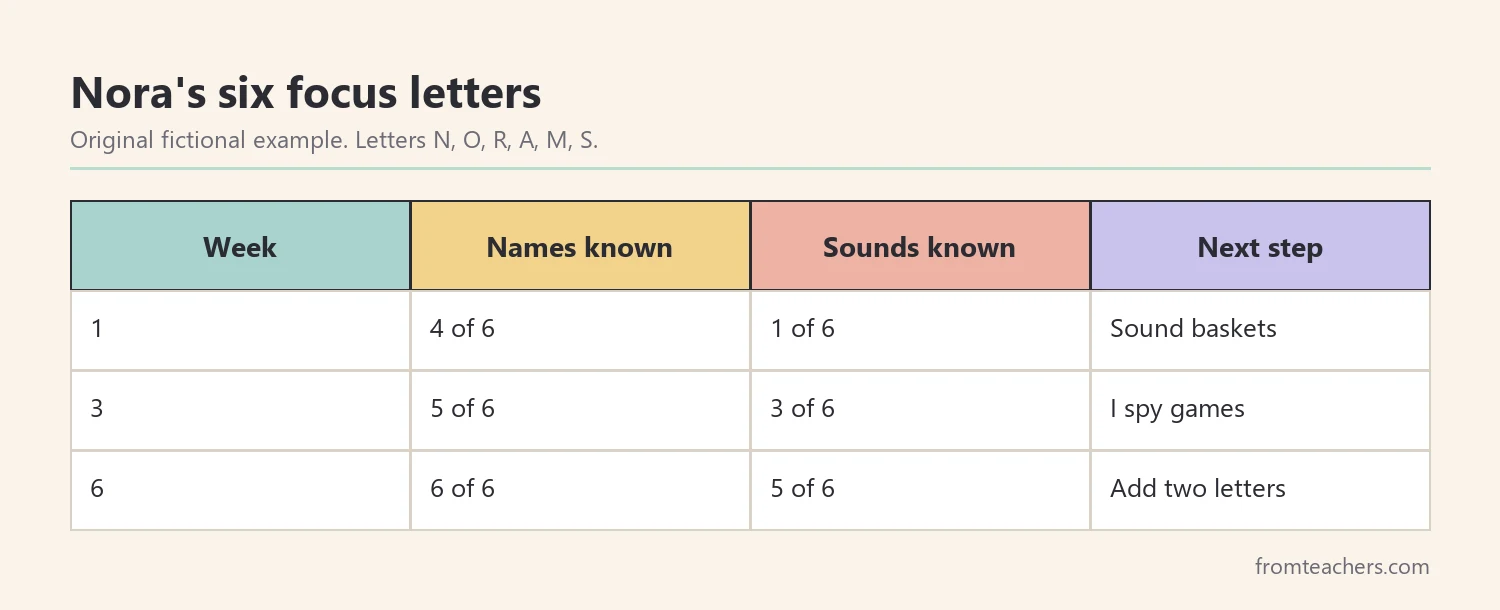
Ms. Patel checks Nora on six focus letters: N, O, R, A, M, and S. In week 1, Nora knows 4 of 6 names and 1 of 6 sounds. By week 6, she knows all 6 names and 5 of 6 sounds. Ms. Patel shares this with Nora’s family and adds two new letters.
Share records with families in a friendly way. A short note such as “Nora now knows every letter in her name and most of their sounds” gives parents something specific to celebrate and practice at home. Families then know which preschool alphabet activities to repeat during the week.
Above all, celebrate effort. A child who proudly finds one letter on a sign is building the confidence that will carry them into reading.
Common mistakes and how to avoid them
- Racing through one letter a day. Fix: teach a few letters at a time and review often.
- Relying only on worksheets. Fix: mix songs, movement, sensory play, and hunts with short tracing practice.
- Teaching names but not sounds. Fix: pair every letter with its sound and daily listening games.
- Adding “uh” to sounds. Fix: practice clean sounds yourself, like /m/ instead of “muh.”
- Introducing look-alike letters together. Fix: separate letters like b and d by a few weeks.
- Testing too much. Fix: check a few letters during play and keep it brief.
Questions teachers and parents ask about preschool alphabet activities
At what age should children start preschool alphabet activities?
Many children enjoy simple letter play around ages three and four, especially with letters in their own name. Follow the child’s interest and keep it playful. Every child moves at their own pace.
Should I teach uppercase or lowercase letters first?
Many teachers show both together, since children see both in real print. Uppercase letters are often easier to form, so children may write them first. Pointing out matching pairs helps link the two forms.
How long should preschool alphabet activities last?
Short is best for preschoolers: about five to ten minutes. Several short sessions across the day work better than one long lesson.
How can parents support preschool alphabet activities at home?
Read together, point out letters on signs and packages, and sing alphabet songs. Play “I spy” with first sounds during car rides or meals. A few minutes a day adds up.
What if a child is not interested in letters yet?
Start with the child’s interests, such as letters in favorite characters, foods, or toys. Keep it light and playful, and avoid pressure. If you have concerns about language development, talk with the child’s family and a qualified professional.
Related reading: Learning Styles Student Success Guide, 5 Practical Teaching Tips to Boost Classroom Focus and Learning, and Dyslexia in Education: Understanding, Innovating, and Empowering.
A companion resource for preschool alphabet activities:
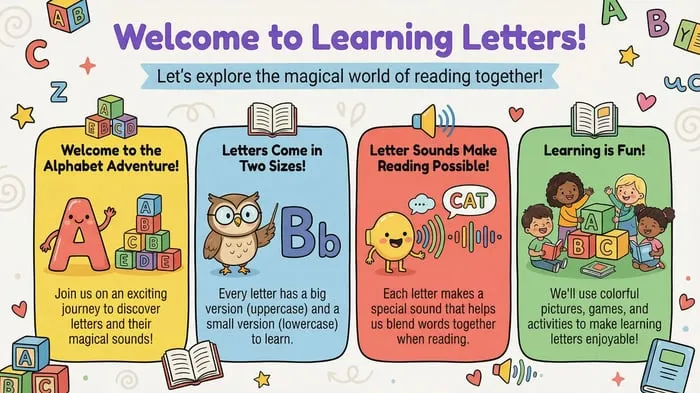
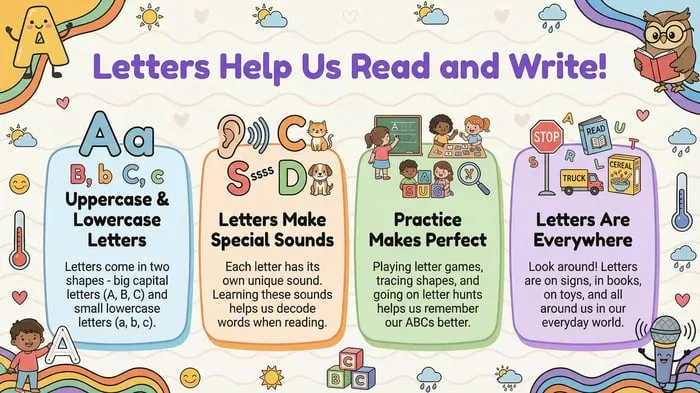
Learning Letters: Alphabet and Phonics for Preschool: a 30-page printable visual guide covering uppercase and lowercase letters, letter sounds, letter games, tracing, letter hunts, and spotting letters in everyday life.
Sources and scope
- National Association for the Education of Young Children (NAEYC): guidance on play-based, developmentally appropriate early learning.
- Reading Rockets: free articles on alphabet knowledge, phonological awareness, and early literacy.
- ZERO TO THREE: resources for families and educators on early development and learning.
- International Literacy Association: a professional organization with resources on literacy instruction.
This guide covers playful, everyday alphabet teaching for preschool and early kindergarten. It does not cover formal reading assessment, speech or language evaluation, or a full phonics curriculum.
Key takeaways
- Start preschool alphabet activities with letters that matter to the child.
- Introduce every letter with the same see, say, sound, build, find routine.
- Use play, songs, and movement more than worksheets.
- Link letters to sounds and to print in the real world.
- Check names and sounds separately, briefly, and celebrate growth.
Leave a Comment