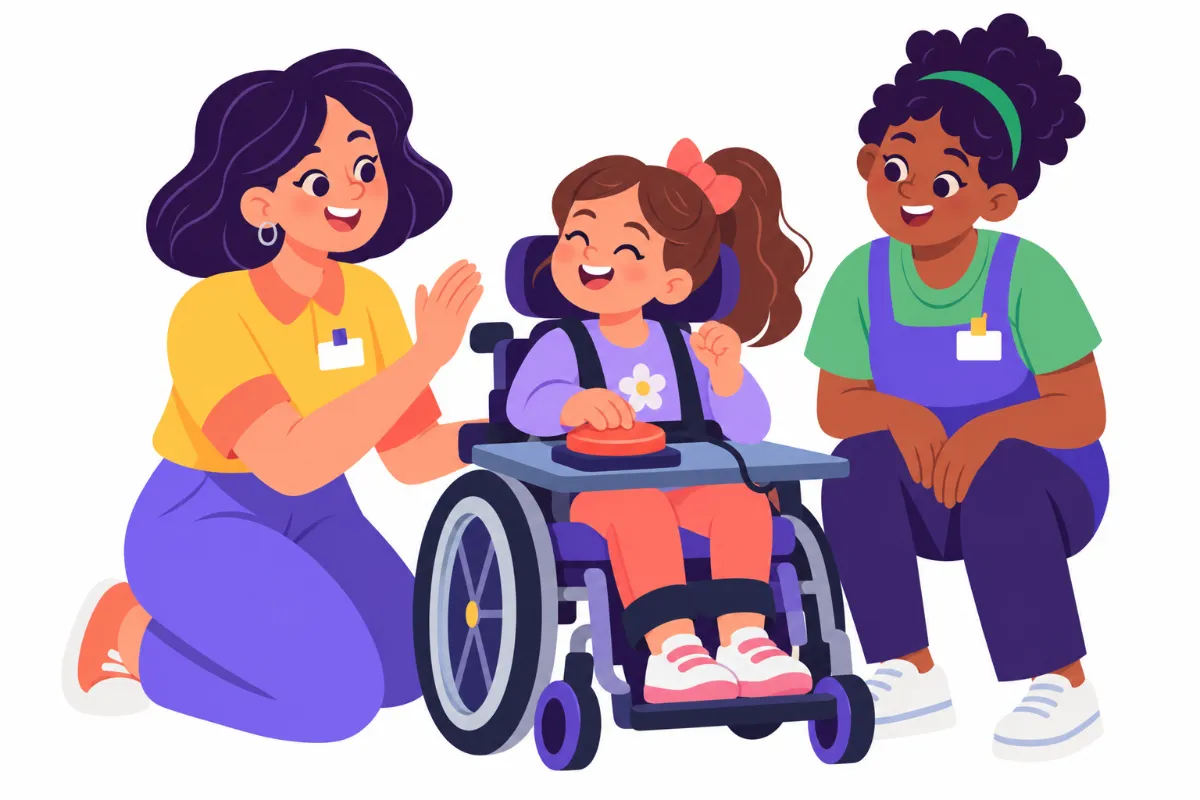

A multiple disabilities classroom asks a teacher to support communication, movement, sensory needs, health routines, and learning all at the same time. Picture a Monday morning: one student needs repositioning, another is reaching for a switch to say hello, and a paraprofessional is asking where the new schedule is. Without a shared plan, the day runs the team instead of the team running the day.
This guide walks you through six practical steps. By the end, you will be able to map each student’s needs, build a daily plan, keep communication available all day, plan seating and sensory supports, organize team roles, and track what is working so you can adjust with confidence.
Examples are fictional. Adapt to the student’s goals and agreed supports. This is guidance, not a diagnosis.
At a glance
- Start with a one-page profile for each student: communication, movement, sensory, health, and learning.
- Build one predictable daily plan that shows who does what and when.
- Keep the student’s communication system within reach in every activity, all day.
- Plan seating, positioning changes, and sensory supports as part of the schedule, not as extras.
- Give every adult a clear role, collect simple data, and review it weekly with the team.
1. Map each student’s needs in your multiple disabilities classroom
First, get a clear picture of each learner. In a multiple disabilities classroom, students often have needs in several areas at once, and each need affects the others. For example, a student who is uncomfortable in their chair may not be ready to communicate or learn, even with a great lesson in front of them.
Therefore, create a one-page profile for every student. Use the IEP, notes from related service providers, and conversations with the family. Keep the language plain, so a substitute or a new paraprofessional can read it in two minutes and know how to help.
| Area | Questions to answer |
|---|---|
| Communication | How does the student say yes, no, more, and stop? |
| Movement | Which positions are approved, and how often do they change? |
| Sensory | What sounds, lights, or textures help or upset them? |
| Health | Which routines are in the health plan, and who is trained? |
Also, add a short “what works” line at the bottom. This is often the most useful part of the page, because it captures the small details that families and experienced staff already know.
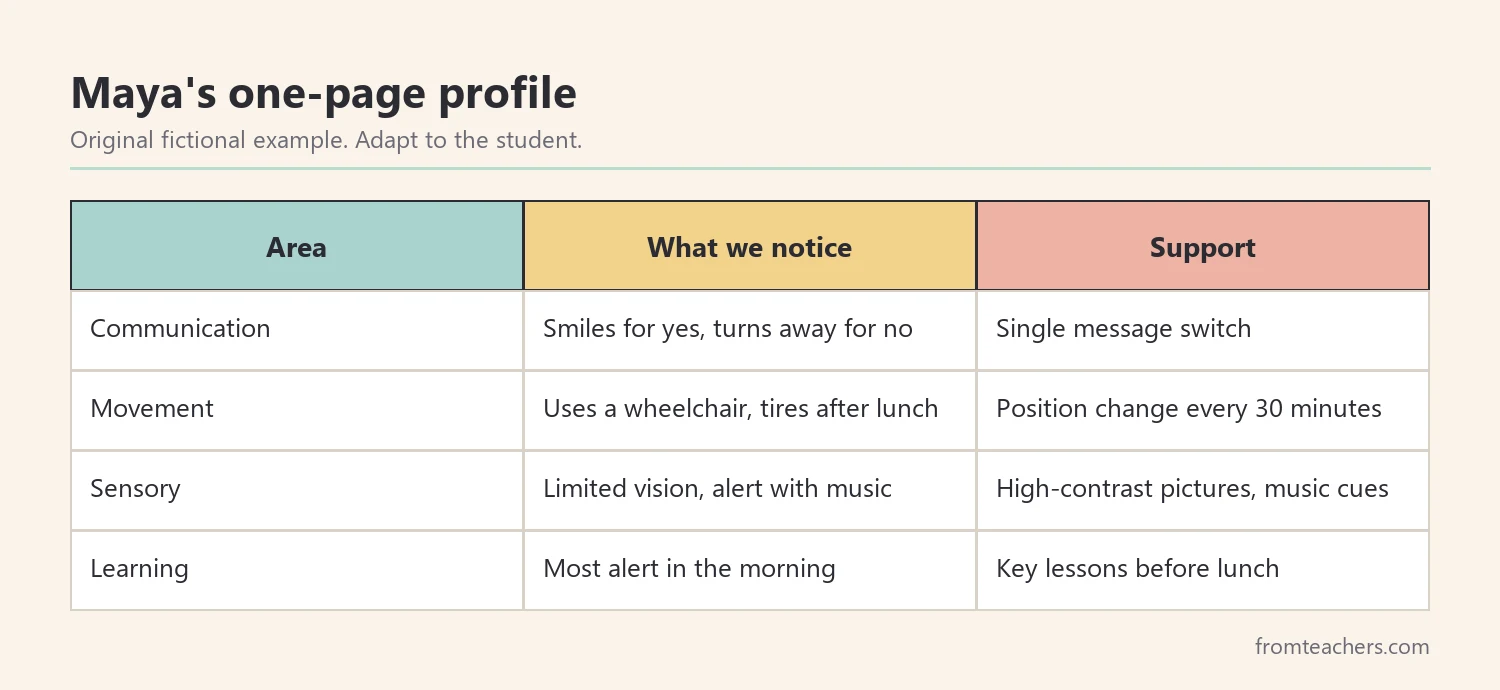
Worked example. Maya is a fictional nine-year-old who uses a wheelchair, has limited vision, and communicates with a single message switch and facial expressions. Her profile notes that she smiles for yes, turns her head away for no, and becomes alert when music plays. It also notes that she tires after lunch and does best with key activities in the morning.
2. Build a daily plan for the multiple disabilities classroom
Next, turn the profiles into one daily plan. A predictable day lowers stress for students and adults, and it makes transitions smoother. Moreover, a written plan means the routine still works when someone is absent.
Start with fixed points: arrival, meals, health routines, and dismissal. Then, place learning blocks around them. Keep each block short, and build in time for repositioning and breaks. In a multiple disabilities classroom, transitions take real time, so schedule them instead of hoping they fit.
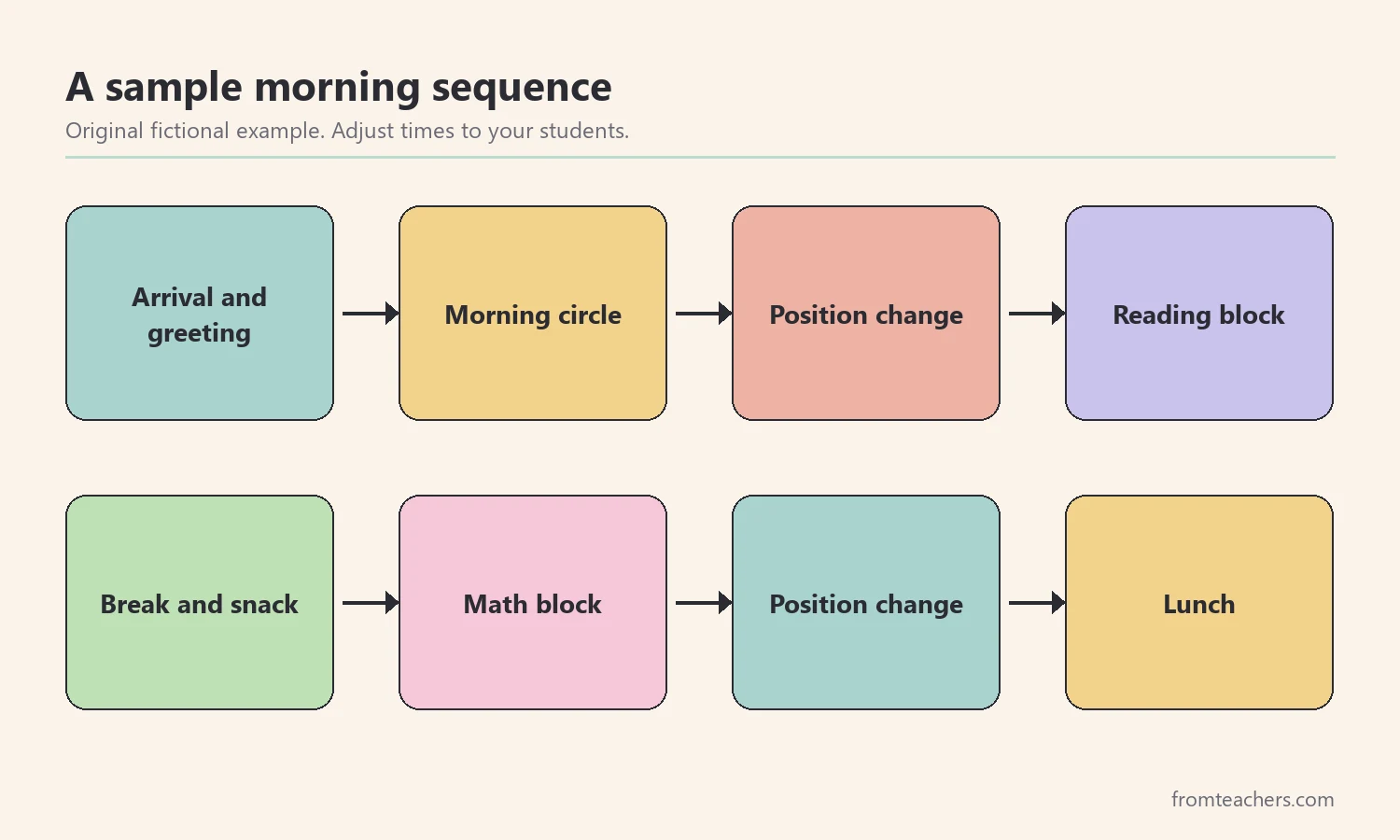
For each block, write three things: the activity, the adult responsible, and the support each student needs. For instance, “Morning circle: teacher leads, para supports Maya’s switch, Sam uses picture cards.” This turns the plan into a shared script for the whole multiple disabilities classroom.
Daily plan checklist
- Fixed times for meals, health care, and dismissal.
- Short learning blocks with a clear start and finish signal.
- Scheduled position changes and rest breaks.
- One named adult for every student in every block.
- A visual or tactile schedule for each student.
If you want a ready starting point, the multiple disabilities toolkit with a one-page daily plan template includes routines, team tools, and printable trackers you can adapt to your room.
Worked example. Maya’s team places reading and math in the morning, when she is most alert. A music cue signals each transition. Her schedule uses real objects: a spoon for lunch and a small book for reading time.
3. Keep communication available all day
Then, make communication part of every activity in the multiple disabilities classroom. Many of your students may use augmentative and alternative communication (AAC), such as switches, picture boards, speech-generating devices, or gestures. However, a device that sits in a backpack cannot help anyone.
Keep the system within reach from arrival to dismissal. In addition, model it: when you talk, point to or press the same symbols the student uses. This shows the student how the system works, without demanding a response every time.
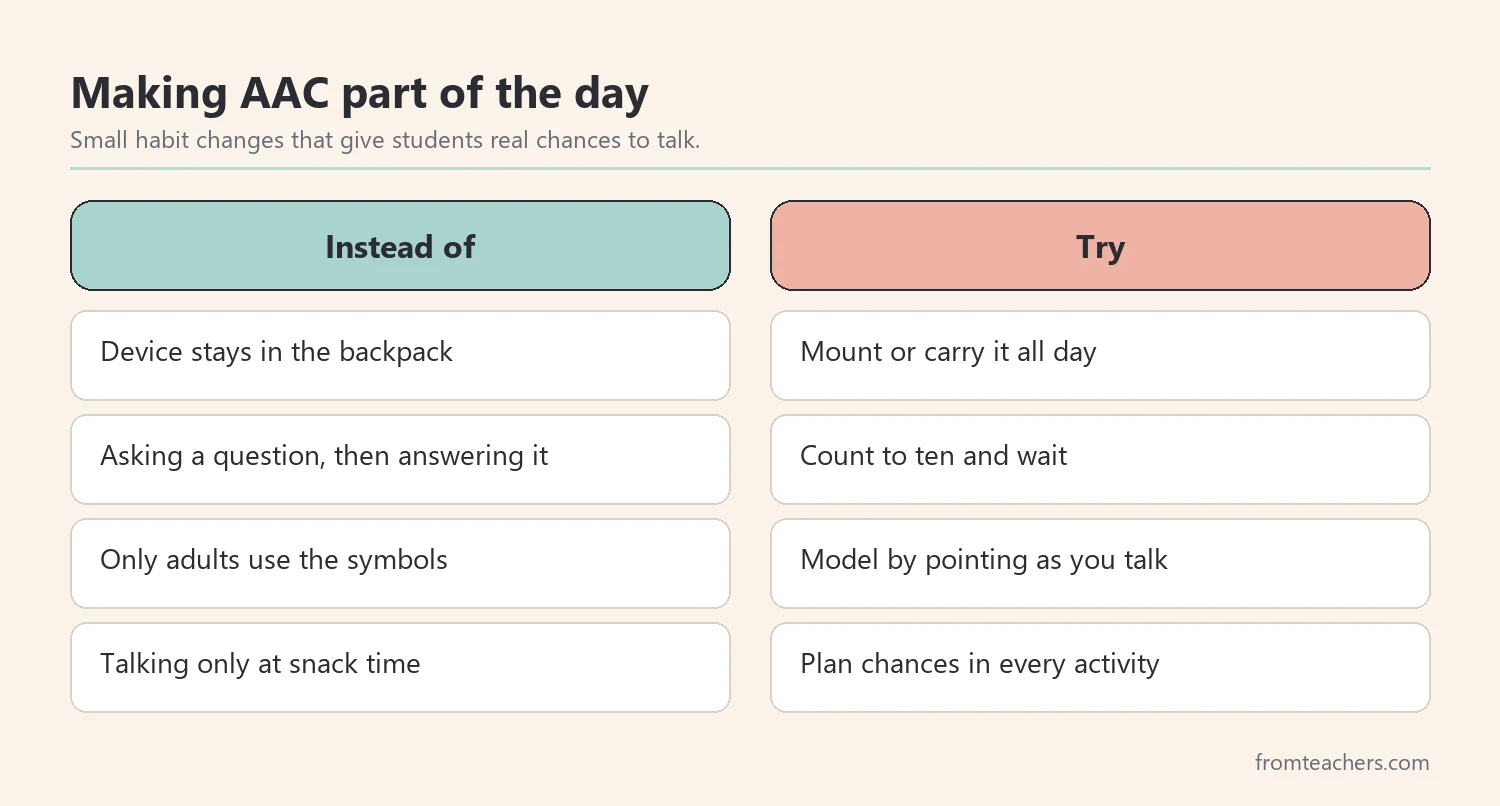
Next, plan real reasons to communicate. Offer choices, pause during favorite activities, and wait. For example, stop a song halfway and give the student time to request “more.” Count silently to ten before you help, because many students need extra processing and movement time.
| Activity | Communication chance |
|---|---|
| Arrival | Greet a friend with a switch message |
| Snack | Choose between two items |
| Music | Request “more” or “stop” |
| Story time | Turn the page or say a repeated line |
Also, ask the speech-language pathologist to train every adult on each student’s system. Consistent responses help students learn that their messages work.
Worked example. Maya’s switch is mounted on her wheelchair tray so it travels with her. The para records “more” before music and “hello” at arrival. When Maya presses the switch, adults respond right away, every time.
4. Plan seating, positioning, and sensory supports
Also, treat seating and positioning as part of instruction. A student who is stable and comfortable can use their hands, eyes, and voice more easily. Follow the positioning plan from the physical therapist or occupational therapist, and never change equipment settings without their guidance.
Write position changes into the daily plan. For example, a student might move from wheelchair to stander to floor mat across the morning. Similarly, check that each position still gives access to the communication system, the lesson materials, and peers.
Then, look at the sensory environment of your multiple disabilities classroom. Lighting, noise, and visual clutter affect how much energy a student has left for learning. Simple changes often help: reduce background noise, use high-contrast materials for students with low vision, and keep a calm corner available.
Sensory and access check
- Can the student see or feel the materials from this position?
- Is the switch or device within easy reach?
- Is the room quiet enough for the student to hear cues?
- Is there a calm space for breaks?
- Has the therapist approved this position for this activity?
In a multiple disabilities classroom, comfort and access come before content. Therefore, if a student seems unsettled, check position, pain signs, and sensory load before assuming the task is too hard. Report any health concerns to the nurse and family promptly.
Worked example. Maya’s occupational therapist recommends a switch position near her right hand. During reading, she sits by the window with a soft lamp and high-contrast pictures. A position change is scheduled after 30 minutes.
5. Organize team roles in the multiple disabilities classroom
Next, make teamwork clear. A multiple disabilities classroom usually includes a teacher, paraprofessionals, related service providers, a nurse, and families. Without clear roles, adults may overlap in some areas while other needs are missed.
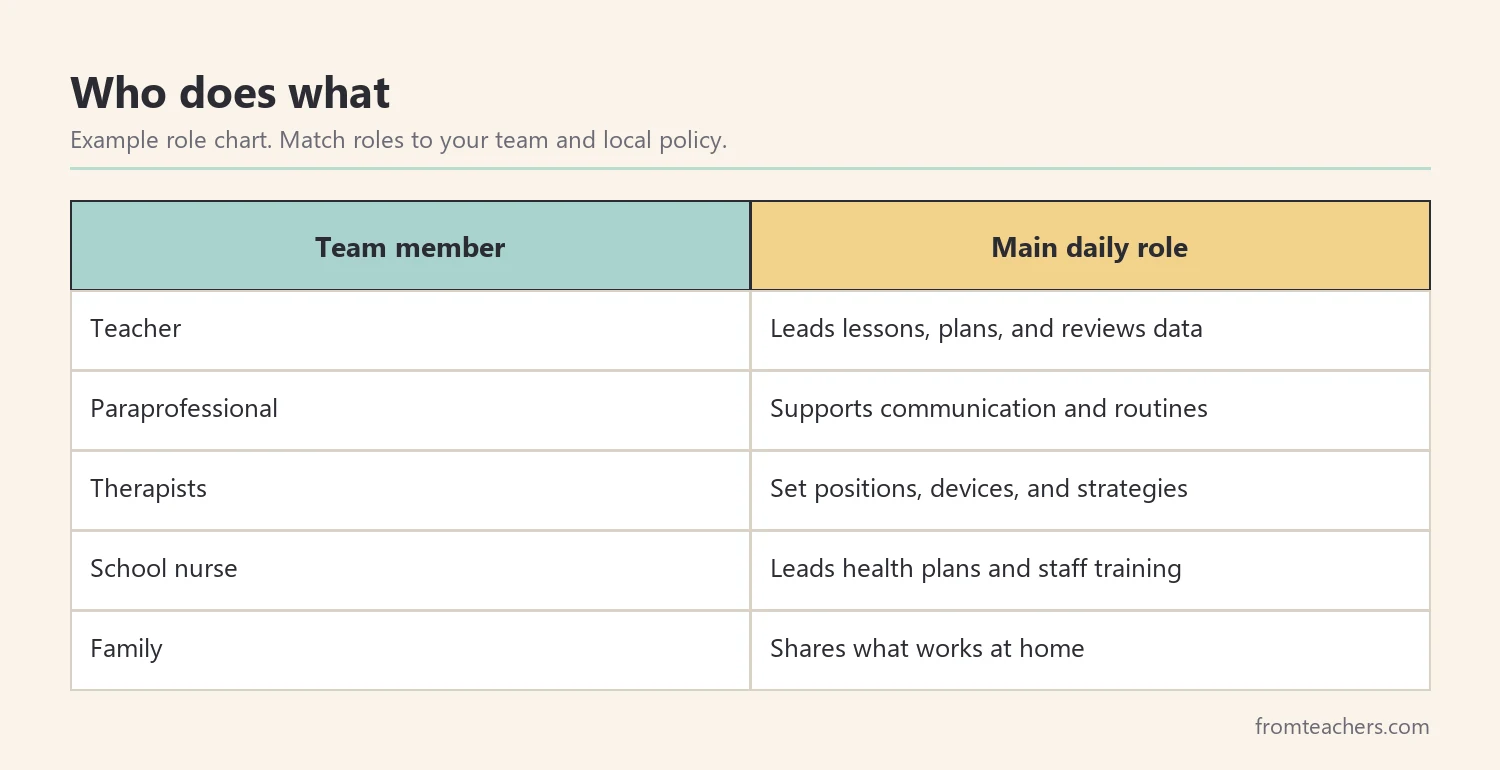
Hold a short team huddle at the start of each day in the multiple disabilities classroom, even for five minutes. Review changes, absences, and any health notes. Furthermore, post a simple role chart where every adult can see it.
Families are key partners. They know what comforts their child, how they communicate at home, and what has worked before. Use a short daily note or a shared notebook to report one success and one thing to watch. In addition, invite families to share new words, signs, or routines from home.
Also, plan for inclusion beyond the multiple disabilities classroom. Identify one or two times each day when students join peers in general education settings, such as music, art, lunch, or morning meeting. Teach peers simple ways to interact, like waiting for a switch response or offering a choice.
Worked example. Maya’s para supports her communication during circle, while the teacher leads the lesson. The physical therapist visits twice a week to check positioning. Maya joins a general education music class on Fridays, where a peer offers her two instrument choices.
6. Track, adjust, and plan for safety
Finally, collect simple data so the team can see what is working in the multiple disabilities classroom. Choose one or two goals per student and track them in a quick format. For example, count how many times a student used AAC out of a set number of planned chances.
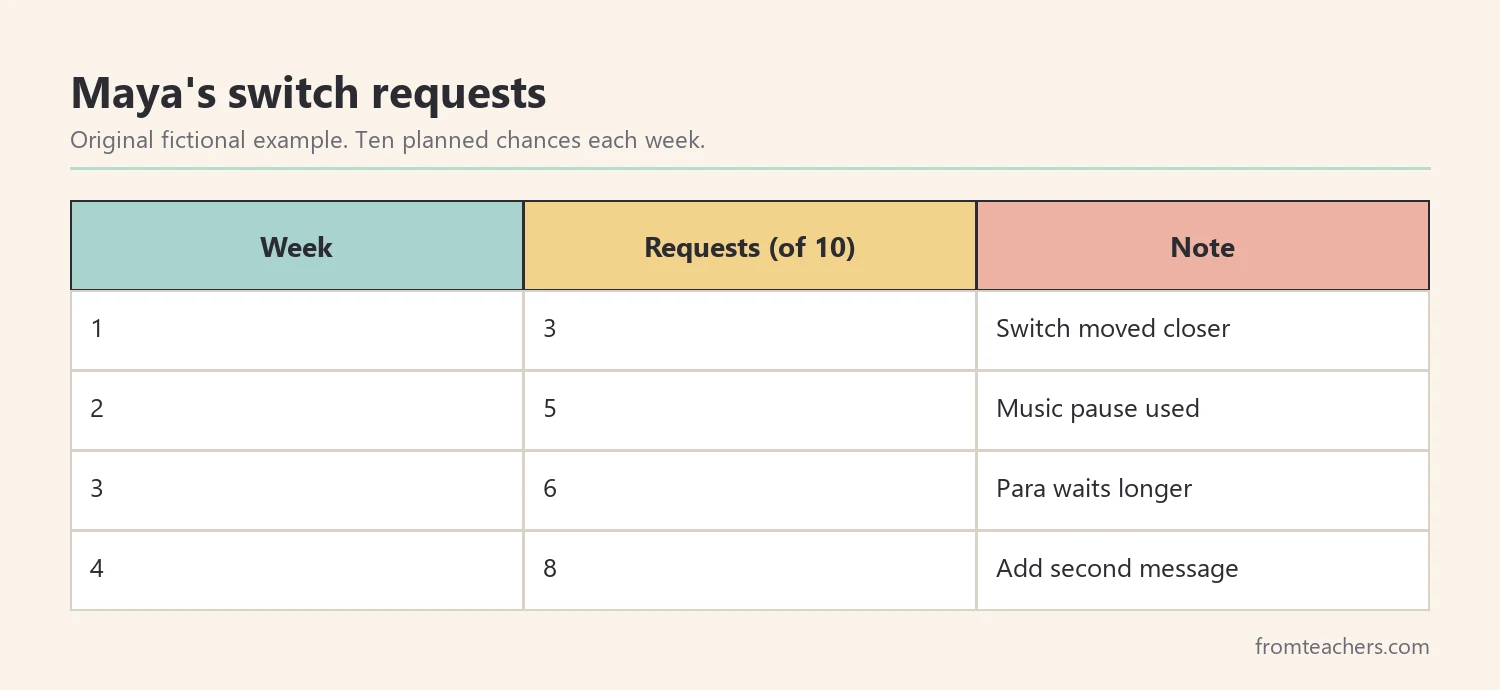
Review the data with the team every week. If a support is working, keep it. If progress stalls, change one thing at a time, such as switch placement, the time of day, or the type of prompt. As a result, you will know which change made the difference.
Safety planning for a multiple disabilities classroom belongs in this step too. Make sure every adult knows each student’s health plan, emergency procedures, and evacuation route. Check that lifting, feeding, and medical routines are done only by trained staff, following the school nurse and the student’s plan.
| Review question | Action |
|---|---|
| Is the goal moving? | Keep the support or change one thing |
| Is the student comfortable? | Check position and sensory load |
| Is every adult trained? | Schedule a short refresher |
Worked example. Maya’s team planned 10 chances each week for her to request “more” with her switch. She used it 3 times in week 1, 5 in week 2, 6 in week 3, and 8 in week 4. Because she is succeeding, the team adds a second message: “stop.”
Common mistakes and how to avoid them
Even a well-planned multiple disabilities classroom runs into a few common problems. Here is how to fix them.
- Keeping AAC in a bag. Fix: mount or carry the system so it is within reach all day.
- Planning lessons without transition time. Fix: schedule repositioning, breaks, and travel time.
- Unclear adult roles. Fix: post a role chart and hold a short daily huddle.
- Changing several supports at once. Fix: adjust one thing at a time and check the data.
- Leaving families out. Fix: share one success and one note each day, and ask what works at home.
Questions teachers and parents ask about a multiple disabilities classroom
What does “multiple disabilities” mean in school?
Under IDEA, multiple disabilities refers to a combination of impairments that together cause such severe educational needs that a program for only one of them would not meet the student’s needs. The exact eligibility decision is made by the IEP team. This guide focuses on daily practice, not eligibility.
How do I start if a student has no communication system yet?
Ask for a referral to the speech-language pathologist for an AAC evaluation. Meanwhile, notice how the student already communicates, such as smiles, sounds, or looking, and respond consistently. Every message should get a response.
How much data should I collect?
In a multiple disabilities classroom, keep it small and steady. One or two goals per student, counted during planned chances, is often enough to show progress. Data that is easy to collect is data that actually gets collected.
How can students with multiple disabilities be included with peers?
Look for shared activities such as music, art, lunch, or morning meeting. Prepare peers with simple ways to interact, and bring the student’s communication system along. Small, regular moments of inclusion build real relationships.
Who decides how a student should be positioned?
The physical therapist or occupational therapist, working with the family and medical team, recommends positions and equipment settings. Classroom staff follow that plan and report any discomfort or changes they notice.
Related reading: Best Assistive Technology for Special Education Classrooms, How Teachers Communicate With Parents in Special Education, and The Power of Data Tracking in Special Education.
A companion resource for planning a multiple disabilities classroom:
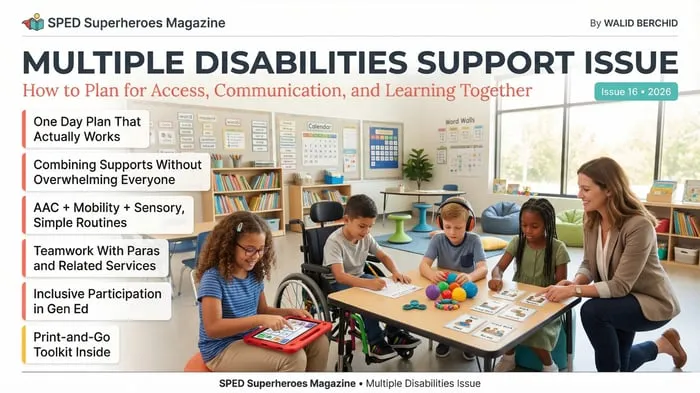
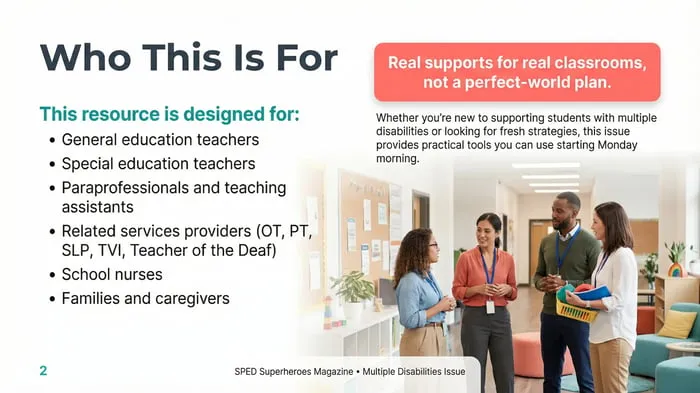
Multiple Disabilities Toolkit: AAC, Access and Daily Plans: a magazine-style guide with a one-page daily plan template, AAC, mobility, and sensory strategies, seating and positioning ideas, team and family tools, and printable trackers.
Sources and scope
- IDEA, U.S. Department of Education: the federal law and regulations on special education, including disability categories.
- IRIS Center, Vanderbilt University: free modules on instruction and supports for students with disabilities.
- American Speech-Language-Hearing Association: information on augmentative and alternative communication.
- American Occupational Therapy Association: information on positioning, daily living, and sensory needs.
This guide covers daily planning, communication access, and teamwork in a multiple disabilities classroom. It does not replace the IEP, the student’s health plan, or advice from therapists, nurses, and doctors.
Key takeaways
- A one-page profile for each student keeps every adult in a multiple disabilities classroom on the same page.
- A predictable daily plan with scheduled transitions lowers stress for everyone.
- Communication systems belong within reach in every activity.
- Positioning and sensory supports come before content.
- Clear roles, family partnership, and simple weekly data guide every adjustment.









Leave a Comment