

Minimally speaking students have plenty to say, and the real question in any classroom is whether they have a reliable way to say it. Picture a morning meeting where every child answers “How are you today?” out loud, while one boy at the end of the circle watches, rocks gently, and waits for the turn to pass him by. Nobody meant to leave him out. Still, the routine was built for speech, so he had no way in.
This guide walks you through five practical steps to change that. By the end, you will be able to notice how a student already communicates, build access into the room, offer real choices, teach and model a communication system, and use simple data to keep improving. Each step follows the same fictional student, so you can see how the pieces fit together.
Examples are fictional. Adapt to the student’s goals and agreed supports. This is guidance, not a diagnosis.
At a glance
- For minimally speaking students, speech is one way to communicate, not the only one. Gestures, pictures, devices, and actions all count.
- Start by presuming competence: assume the student understands more than they can show.
- Build access into routines so communication is possible all day, not only during therapy.
- Offer real choices, wait long enough, and honor what the student picks.
- Track choices and responses weekly so the team can see growth and adjust supports.
1. Notice how minimally speaking students already communicate
First, take an honest look at what the student already does. Minimally speaking students often communicate through eye gaze, reaching, pointing, vocal sounds, facial expressions, signs, pictures, a speech generating device, or by leading an adult by the hand. Each of these is communication, even when it does not look like a sentence.
Next, spend a few days writing down what you see. Note the behavior, the situation, and what you think it meant. For example, pushing a worksheet away might mean “I am done,” “This is too hard,” or “I need a break.” Over time, patterns appear, and those patterns tell you what the student is already trying to say.
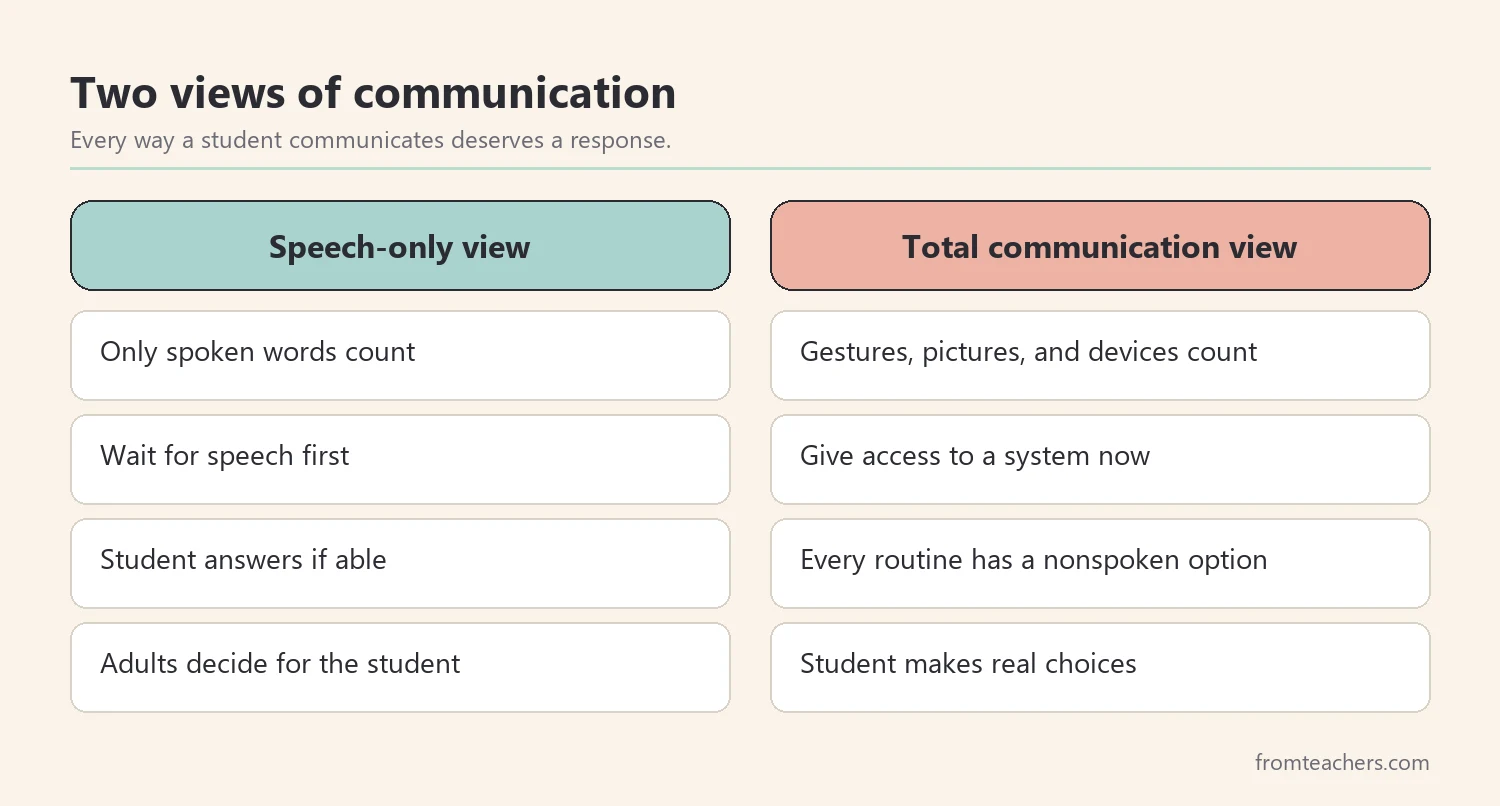
Also, talk with the people who know the student best. Families, speech-language pathologists, and paraprofessionals often recognize signals that a new teacher would miss. A short shared list of “what this looks like and what it usually means” helps every adult respond the same way.
| What you see | Possible message | How to respond |
|---|---|---|
| Looks at the door | I want to leave or go out | Model “go out?” on the board or device |
| Hands an adult a cup | I want a drink | Model “drink” and give it |
| Covers ears | It is too loud | Model “too loud” and lower noise |
Worked example. Noah is a fictional student in grade 3. He uses a few vocal sounds, points to objects he wants, and taps the table when he is finished. His teacher writes down his signals for one week and shares the list with his family and his speech-language pathologist.
2. Build communication access into the classroom
Once you know how the student communicates, make sure the room supports it. Minimally speaking students lose many chances to talk each day when their system sits out of reach. Access means the student can reach a way to communicate at any moment, not only when an adult remembers to hand it over. A device in a backpack or a picture board on a shelf does not give access.
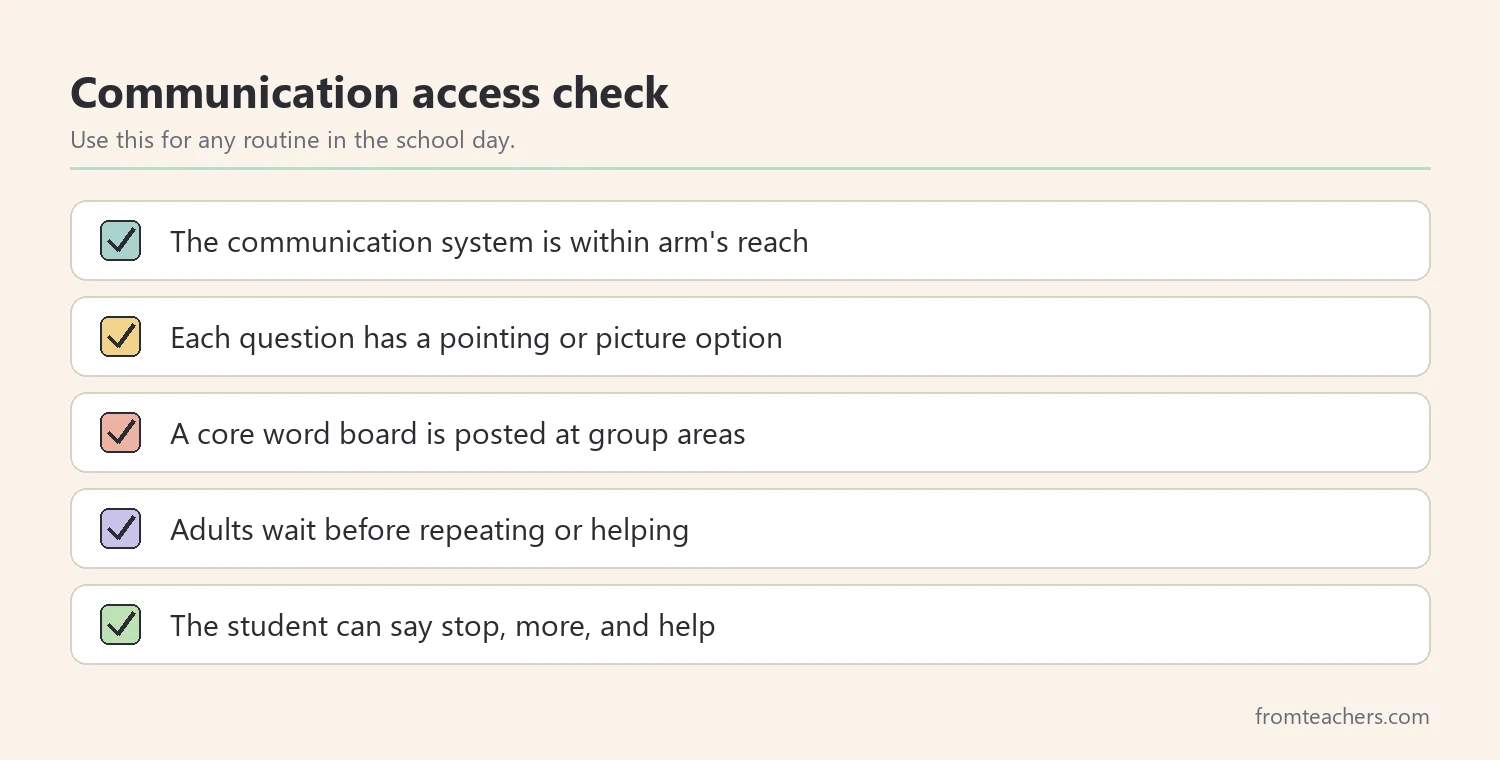
Then, look at each routine and ask a simple question: how could a student answer this without speaking? Morning greetings, read alouds, math talks, and lunch orders can all include a nonspoken way to join. For instance, a core word board on each table lets students point to “more,” “stop,” “help,” or “finished” during any lesson.
In addition, think about the whole class, not only minimally speaking students. When every student sometimes answers by pointing, holding up a card, or using a board, the minimally speaking student is no longer the only one doing something different. As a result, communication becomes part of how the class works, rather than a special activity for one child.
Simple access changes
- Keep the student’s communication system within arm’s reach all day.
- Post a core word board at group areas and on the lunch table.
- Give every question a pointing, picture, or yes and no option.
- Use visual schedules so the student can see what comes next.
- Seat the student where they can see faces and the board clearly.
Worked example. Noah’s teacher adds a core word board to the morning circle. During the greeting, Noah points to “happy” or “tired” while classmates answer out loud. For the first time, he takes a turn like everyone else.
3. Offer minimally speaking students real choices
Choices are one of the fastest ways to give minimally speaking students control and voice. For minimally speaking students, a real choice is one where both options are acceptable, the student can understand them, and the adult truly follows through on what the student picks. A choice between “work now” and “work now in a different chair” is a start, but students notice when choices are only for show.
Start small and concrete. Hold up two real objects, two photos, or two symbols, name each one, and wait. Waiting is the hardest part for many adults. Count silently to ten before you repeat or help, because many students need extra time to plan a movement or find a symbol.
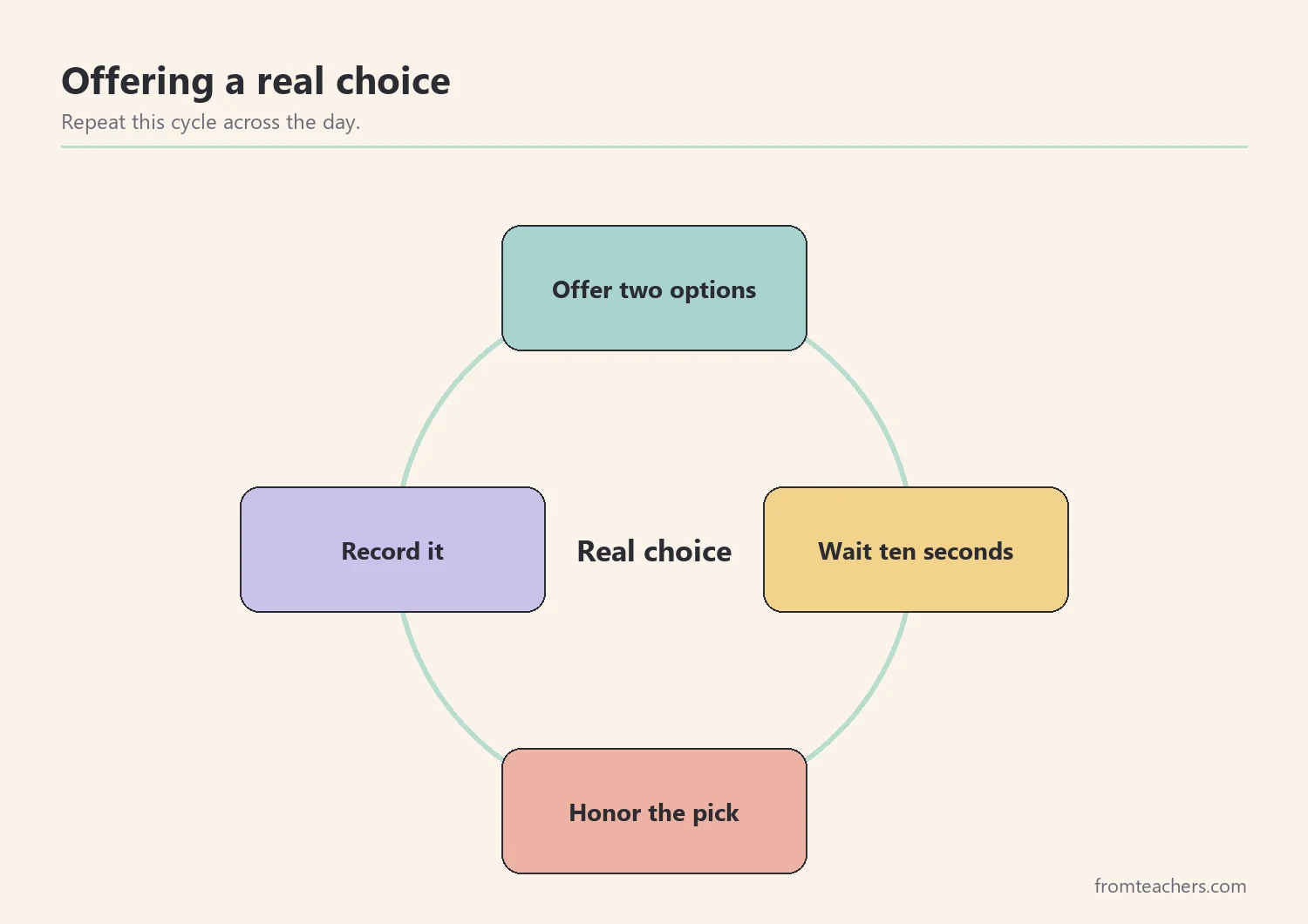
Then, honor the answer, even if it was not what you expected. If the student picks the blue marker, hand over the blue marker. If you are unsure what the student meant, offer the same choice again in a different position. Over time, move from two options to three, and from objects to pictures or words.
Ready-made materials can help a team build this habit. The nonverbal and minimally speaking support magazine includes reflective pieces and classroom scenarios on student choice, data, and inclusive learning environments, which can be a useful starting point for team discussion.
Worked example. Noah’s teacher offers two choices during each work block: which book to read and where to sit. She waits ten seconds after each offer. Noah begins pointing faster by the end of the second week.
4. Model and teach the communication system
Next, teach the communication system the way children learn spoken language: by seeing it used around them. This is often called modeling or aided language input. While you talk, point to the same words on the student’s board or device. For example, say “Let’s go outside” while touching “go” and “out.”
Many minimally speaking students learn best when they see the same symbols used many times a day by different adults.
Model without demanding. In other words, you are showing, not testing. Asking the student to “show me go” again and again can turn the system into a chore. Instead, use it naturally in fun routines, and let the student explore buttons or pages freely.
In addition, plan for vocabulary that does more than request. Minimally speaking students need words to comment, protest, ask questions, share feelings, and joke. A board with only “eat,” “drink,” and “bathroom” limits what a child can say. Core words such as “like,” “not,” “more,” “different,” and “why” open up much more.
| Purpose | Example words | Routine to model in |
|---|---|---|
| Request | more, want, help | Snack, art supplies |
| Protest | stop, not, all done | Work tasks, games |
| Comment | like, funny, big | Read aloud, recess |
| Feelings | happy, mad, tired | Morning circle |
Plan ahead for each lesson, too. Before a science unit, add a few topic words such as “plant,” “grow,” and “water” to a page or board, so minimally speaking students can join the discussion instead of only listening. Keep the core words in the same places, because consistent locations make finding words faster over time.
Also, work closely with the speech-language pathologist. They can help choose vocabulary, set up the device, and suggest how to model during lessons. If the student does not yet have a system, the IEP team can discuss an assistive technology evaluation.
Worked example. Noah’s teacher models two core words, “more” and “stop,” during a tickle game and a bubble activity. She touches the words while saying them and never asks Noah to repeat. After a week, Noah taps “stop” on his own during a loud song.
5. Use data to guide supports for minimally speaking students
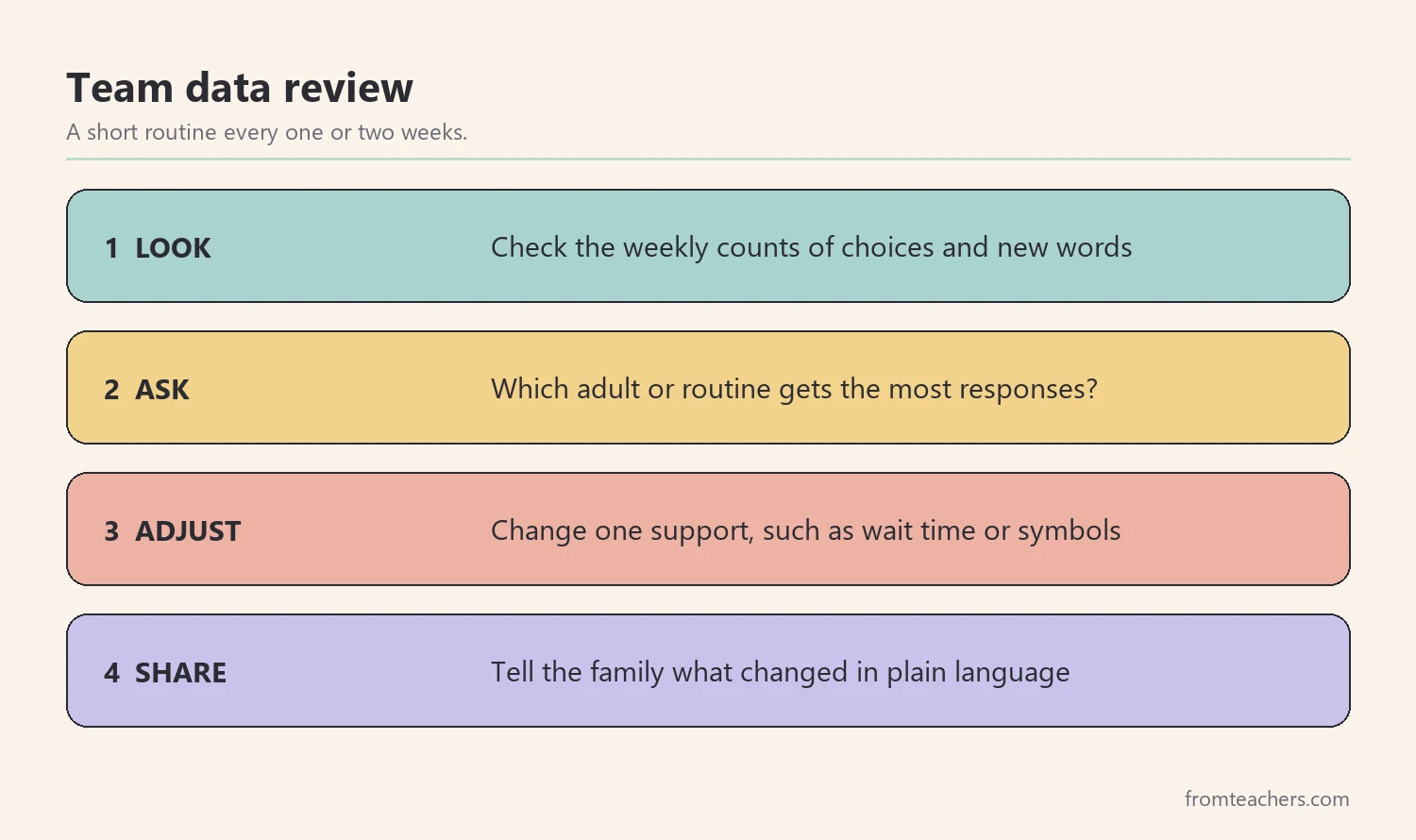
Finally, keep simple records so the team can see what is working. Data does not need to be complicated. A short weekly count of choices offered, choices made without help, and new words used is often enough to show growth and spot problems early.
Data also protects minimally speaking students from low expectations. When the numbers show steady growth, it becomes easier to argue for richer vocabulary and harder tasks.
Look at the record every week or two with the team. For instance, if the student makes choices with objects but not pictures, keep objects for now and pair them with pictures. Similarly, if one adult gets more responses than others, find out what that adult does differently, such as waiting longer.
Then, share progress with the family in plain language. Families of minimally speaking students often hear about problems first, so good news matters. “Noah chose his book and his seat on his own almost every time this week” means more to most families than a percentage. Ask the family what they see at home, because new signals often appear there first.
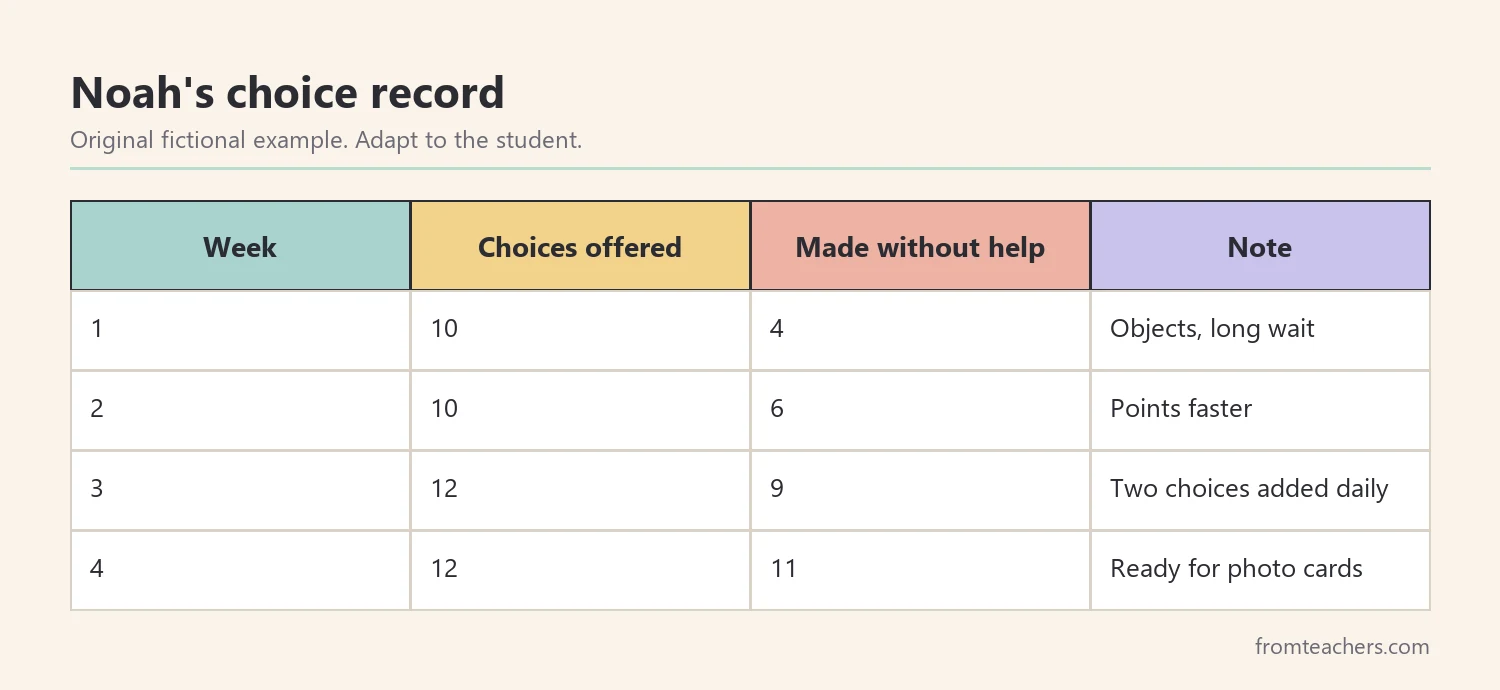
Worked example. In week 1, Noah makes 4 of 10 offered choices without help. In week 2, he makes 6 of 10. The team then adds two choices a day, and he makes 9 of 12 in week 3 and 11 of 12 in week 4. They decide to move from objects to photo cards.
Common mistakes and how to avoid them
- Waiting for speech before offering a system. Fix: give access to a communication system now. Using one does not stop speech from developing.
- Keeping the system out of reach. Fix: place the board or device with the student in every room and routine.
- Offering choices without following through. Fix: only offer options you are ready to honor.
- Testing instead of modeling. Fix: use the system yourself while you talk, without demanding answers.
- Teaching only requests. Fix: add words for comments, feelings, protest, and questions.
- Talking about the student in front of them. Fix: presume competence and speak to the student directly.
Questions teachers and parents ask about minimally speaking students
What does “minimally speaking” mean?
It usually describes a person who uses few or no spoken words to communicate, or whose speech is not reliable across situations. Some people prefer this term over “nonverbal,” because many minimally speaking students use some sounds or words. Follow the student’s and family’s preference.
Will using a device or picture board stop my child from talking?
This is a common worry. Speech-language professionals generally do not see communication systems as a barrier to speech. Talk with your child’s speech-language pathologist about your child’s specific goals.
How long should I wait after offering a choice?
Many students need more time than adults expect. Try counting silently to ten before repeating or helping. Watch the student closely, because a small movement toward one option may be the answer.
How can minimally speaking students take part in class discussions?
Prepare a few relevant words or pictures before the lesson, such as answer choices or opinion words. Also, give the whole class a nonspoken way to respond sometimes, so the student is not singled out.
Who should be on the team?
For minimally speaking students, the team usually includes the classroom teacher, the speech-language pathologist, the family, and paraprofessionals. Depending on the student, an occupational therapist or assistive technology specialist may also help with access and positioning.
Related reading: Best Assistive Technology for Special Education Classrooms, Autism Social Skills Development: Practical Strategies for Growth, and The Power of Data Tracking in Special Education.
A companion resource for supporting minimally speaking students:

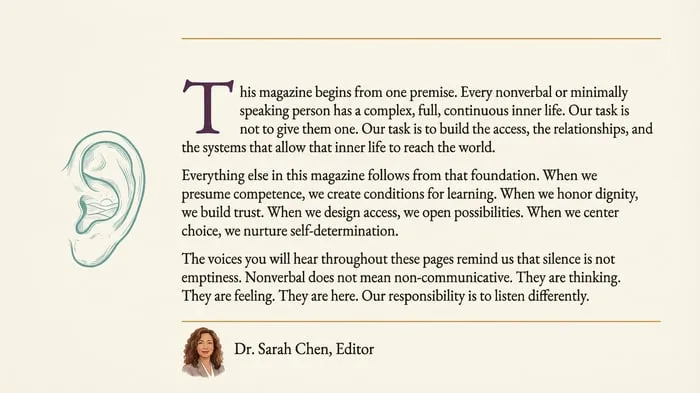
Nonverbal and Minimally Speaking Support Magazine: a magazine style resource on rethinking communication beyond speech, creating inclusive learning environments, and using data to honor student choices, with real classroom scenarios.
Sources and scope
- American Speech-Language-Hearing Association (ASHA): information on augmentative and alternative communication and the role of speech-language pathologists.
- IRIS Center, Vanderbilt University: free modules on evidence-based practices for students with disabilities.
- Individuals with Disabilities Education Act (IDEA): federal information on special education, including assistive technology in the IEP.
- CAST: resources on Universal Design for Learning and multiple means of expression.
This guide covers everyday classroom practices for communication access and choice. It does not replace an individual assessment by a speech-language pathologist or the decisions of the student’s IEP team.
Key takeaways
- Minimally speaking students communicate in many ways, and every way deserves a response.
- Access means minimally speaking students have their communication system with them all day.
- Real choices need clear options, enough wait time, and honest follow-through.
- Model the system while you talk, and teach words for more than requests.
- Simple weekly data helps the team adjust supports and share progress.








Leave a Comment