

Every new special education teacher has a moment when the doubt gets loud. Maybe it is the drive home after an IEP meeting, replaying every word. Maybe it is a Tuesday afternoon when a lesson falls apart and a voice says, “Everyone else knows what they are doing, and you do not.”
This guide gives you six practical steps to build steady, real confidence. By the end, you will be able to name your doubts, collect evidence of small wins, check your professional decisions, notice student breakthroughs, lean on a support network, and review your growth each month.
Examples are fictional. Adapt to your own setting, students, and school policies. This is guidance, not a diagnosis or a substitute for professional mental health support.
At a glance
- Self-doubt is common in the first years, and it does not mean you are in the wrong job.
- Confidence grows from evidence, so write down small wins and student progress.
- A simple check can help you trust, or adjust, your daily decisions.
- Mentors and colleagues turn hard problems into shared problems.
- A short monthly review shows how far you have come.
1. Name the doubt as a new special education teacher
First, notice when the doubt shows up. As a new special education teacher, you juggle instruction, paperwork, behavior support, team meetings, and family communication. It makes sense that some moments feel heavy. However, a vague feeling of “I am not good at this” is hard to fix.
So, make the doubt specific. When it appears, write down three things: the situation, the thought, and a more balanced thought. For example, “IEP meeting, I sounded unsure, a parent asked a question I could not answer.” A balanced version might be, “I said I would find out, and I followed up the next day.”
| Situation | Doubt | Balanced thought |
|---|---|---|
| Lesson ran short | “I cannot plan.” | “I need a backup activity.” |
| Behavior incident | “I lost control.” | “I kept everyone safe and asked for help.” |
| Paperwork late | “I am failing.” | “I need a weekly paperwork block.” |
Also, look for patterns. Many new teachers notice that doubt peaks at certain times, such as Sunday evenings, before meetings, or after a hard behavior day. Knowing the trigger helps you prepare for it.
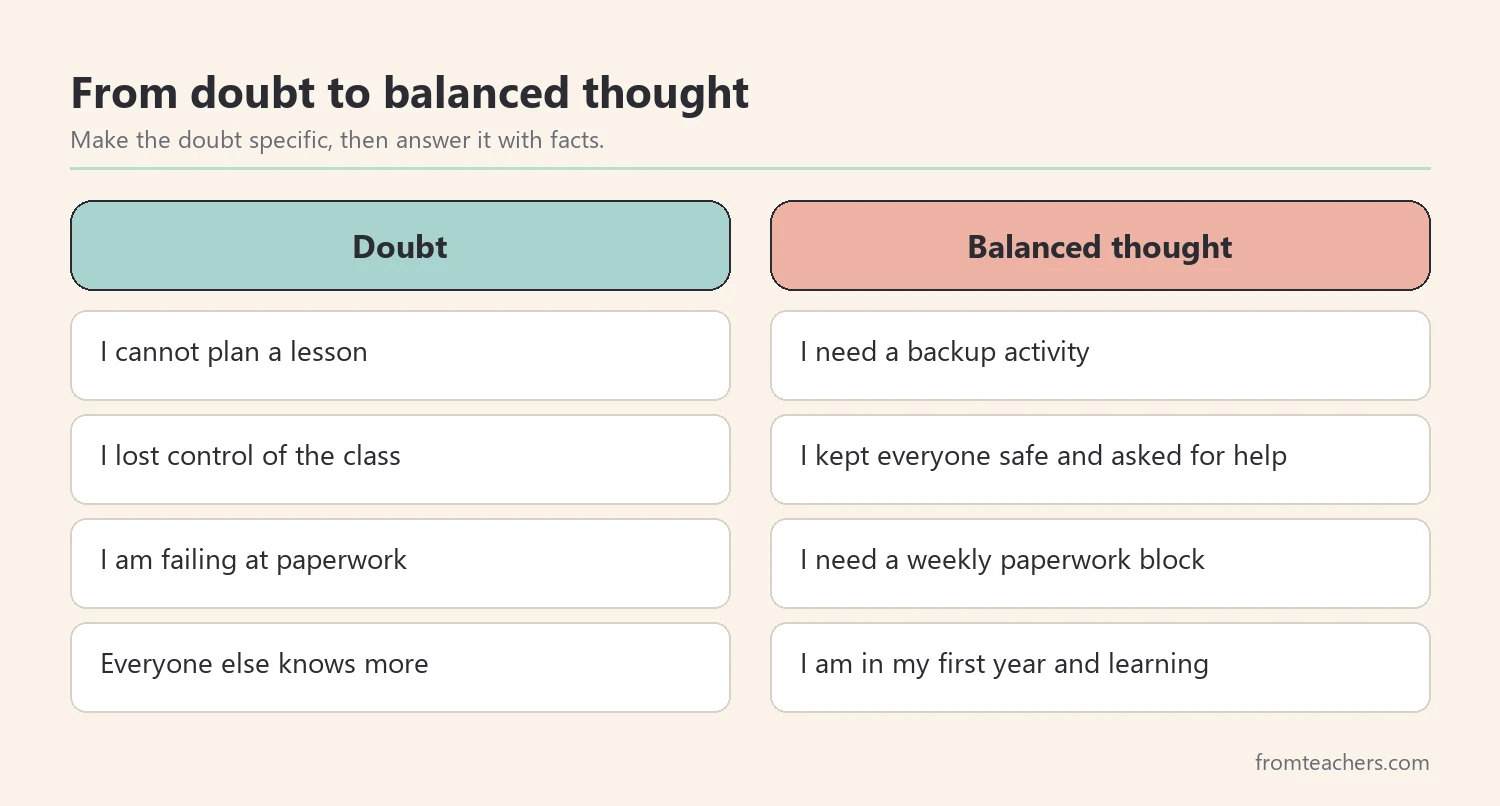
Worked example. Ms. Rivera is a fictional first-year resource room teacher. She notices that her doubt is strongest on Sunday nights. She starts writing one doubt and one balanced thought each Sunday, and she plans Monday’s first lesson before she closes her laptop.
2. Collect evidence of small wins
Next, start collecting proof. Confidence for a new special education teacher rarely comes from a single big success. Instead, it builds from many small ones: a student who started work without a prompt, a parent who said thank you, a transition that went smoothly.
Keep a “small win” log on your desk or phone. This habit is one of the simplest tools a new special education teacher can use. At the end of each day, write one or two wins. Keep it short, specific, and honest. For example, “Jordan read three sentences aloud today” is better than “Good day.”
What counts as a small win?
- A student tried something new or used a strategy you taught.
- A routine ran smoothly without reminders.
- You handled a hard conversation calmly.
- A colleague asked for your idea.
- You finished a task you had been putting off.
Then, reread the log on hard days. When the doubt says nothing is working, your own notes can show a different story. If you would like ready-made pages for this, the self-confidence trackers for new special education teachers include a small win and progress celebration log, along with trackers for self-doubt, decisions, and growth.
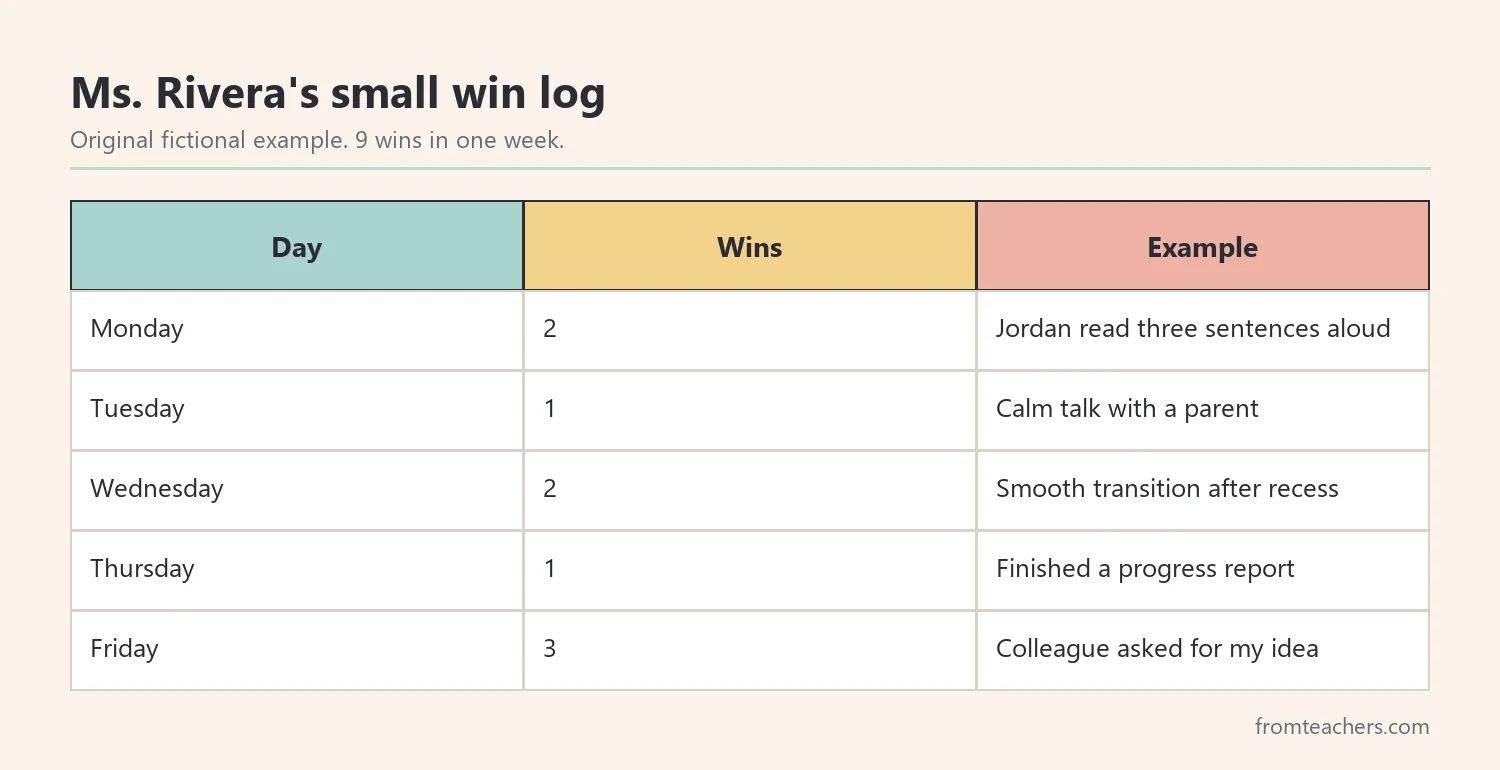
Worked example. In her first week of logging, Ms. Rivera writes 2 wins on Monday, 1 on Tuesday, 2 on Wednesday, 1 on Thursday, and 3 on Friday. That is 9 wins in five days, on a week she had called “a disaster” on Tuesday night.
3. Check and trust your professional decisions
Then, look at the decisions you make all day. A new special education teacher makes dozens of judgment calls: when to give a break, how to adjust a task, whether to call a parent. Second-guessing every one of them is exhausting.
Instead, use a short decision check. Ask yourself a few questions, and if the answers are mostly yes, trust the call and move on. If not, adjust next time. This turns worry into reflection.
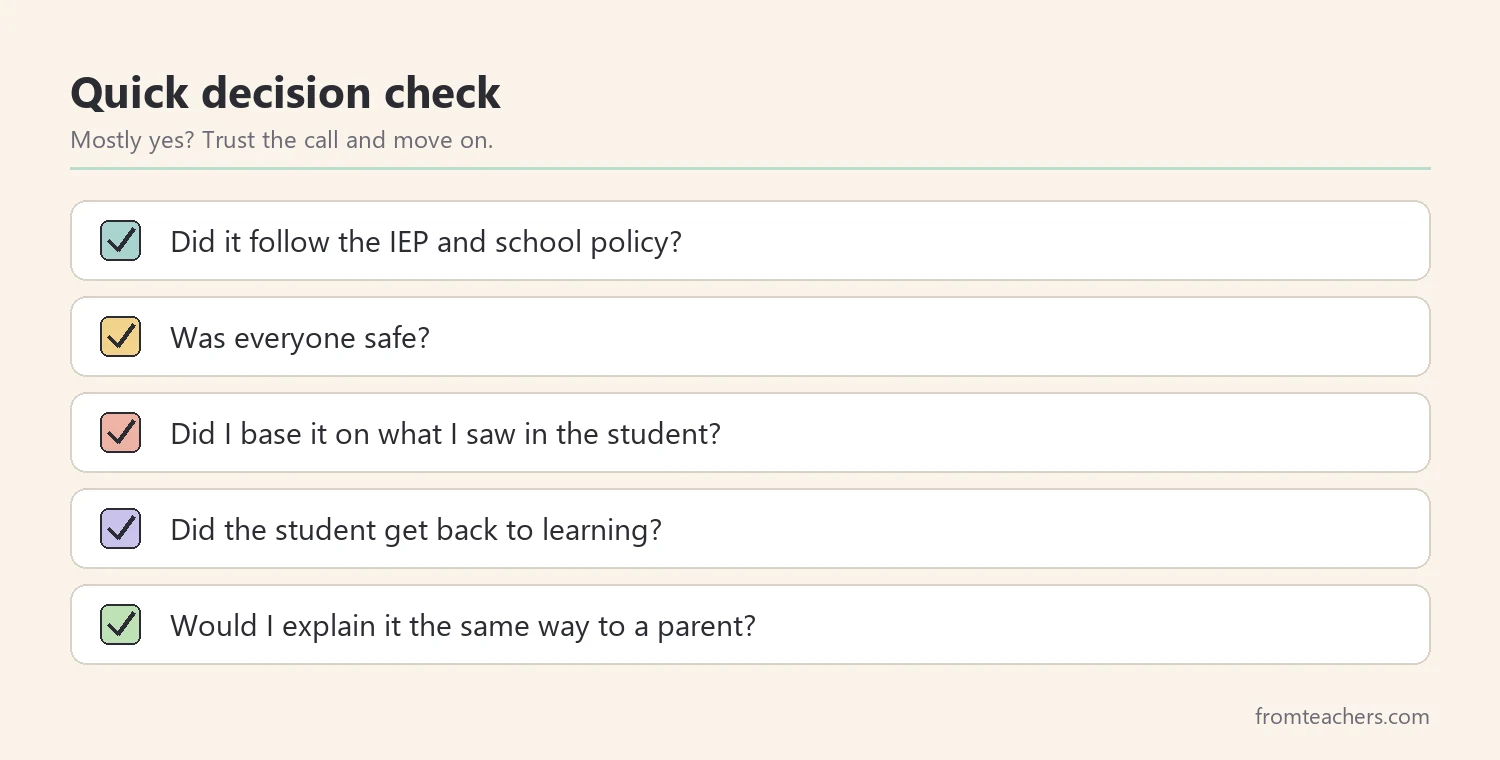
Also, remember that the IEP is your guide. If a decision follows the student’s IEP, the accommodations, and school policy, you are on solid ground. When you are unsure, ask your case manager, mentor, or administrator. Asking is a professional skill, not a weakness.
Of course, some decisions will not work. That is normal for any teacher, new or experienced. When a call goes badly, ask what you would change, write one sentence about it, and try the adjustment next time. A new special education teacher who reflects this way is building judgment, not proving a lack of it.
Moreover, notice the decisions that worked. When a student calmed down after the break you offered, write it down. Over time, these notes show that your professional instincts are growing, and that your judgment is based on what you see in your students.
Worked example. During math, a student named Jordan puts his head down. Ms. Rivera offers a two-minute break, as listed in his IEP. Jordan returns and finishes four problems. She runs through her decision check that evening, answers yes to every question, and writes the call in her log instead of replaying it.
4. Notice student breakthroughs and connections
Next, record moments of impact with students. Progress in special education can be slow and uneven, so it is easy to miss. Yet these moments are the clearest evidence that your work matters.
Keep a simple observer page for breakthroughs and connections. Write the date, the student’s initials, and what happened. For example, “J.T. asked for help with words instead of leaving his seat.” These notes also help you write progress reports and talk with families.
| Type | Example |
|---|---|
| Skill | Read a new sight word list |
| Behavior | Used a calm-down strategy alone |
| Connection | Shared a story from home |
| Independence | Followed a visual schedule |
In addition, share some of these moments. Tell the student. Then tell the family. Tell the general education teacher. Celebrating progress builds trust with everyone, and it reminds you why you chose this work.
For a new special education teacher, these notes do double duty. First, they lift your mood on hard days. Second, they give you real examples to share in team meetings, so you can say “Here is what I saw” instead of “I think it is going fine.” Over a semester, the page fills up, and the pattern of progress becomes hard to argue with.
Also, keep the notes factual and private. Store them as your school requires, and avoid full names in personal logs.
Worked example. Ms. Rivera writes, “J.T. used his break card instead of putting his head down.” She sends a short, positive note home that day. His mother replies that he told her about it at dinner.
5. Build a support and mentorship network
Also, do not carry everything alone. Every new special education teacher needs people to ask, people to learn from, and people to vent to safely. Building that network early is one of the strongest things you can do for your confidence.
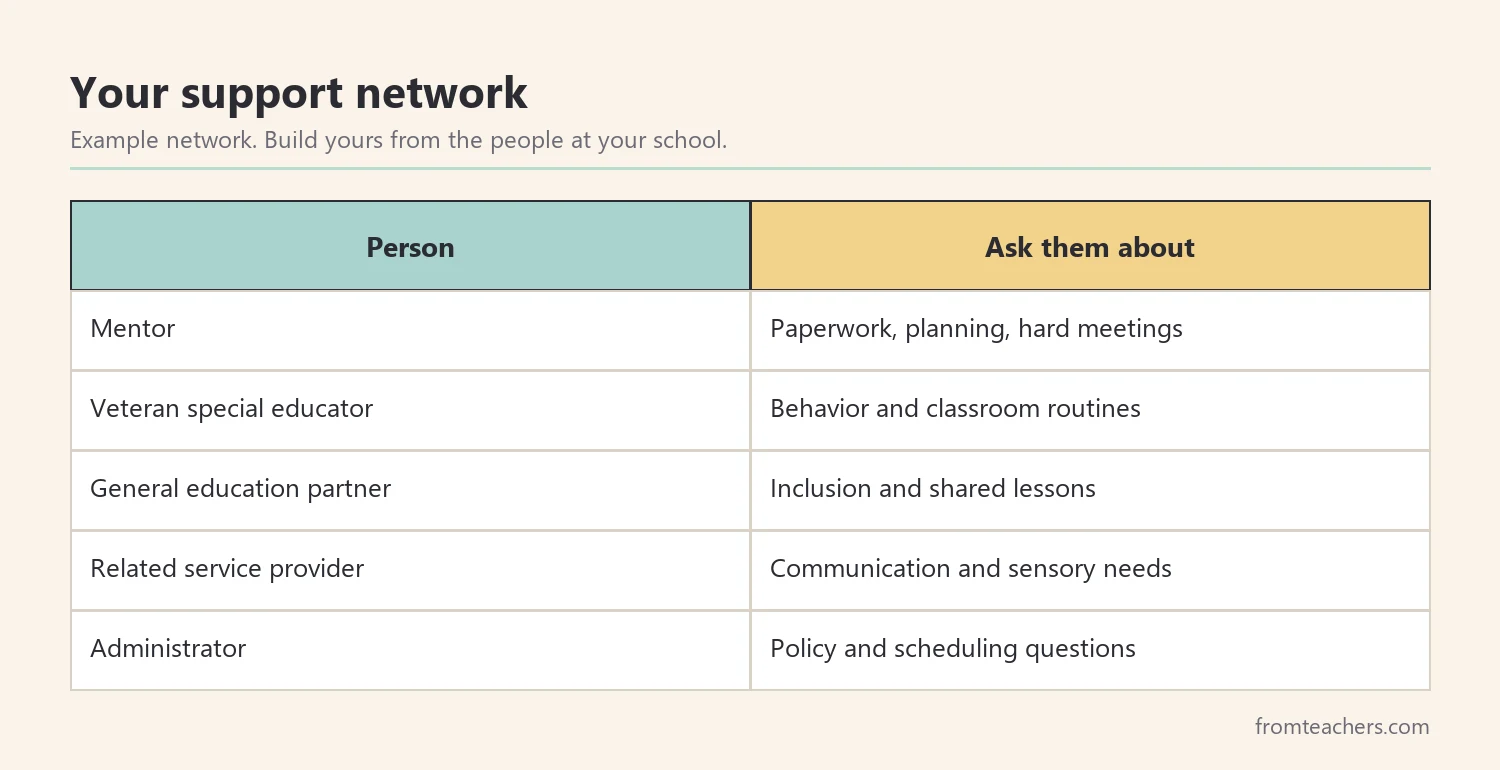
Start with your assigned mentor, if you have one. Then, add a few colleagues who remember being a new special education teacher themselves: a veteran special education teacher, a general education partner, and a related service provider such as the speech-language pathologist. Furthermore, consider a professional organization or an online community for special educators.
Keep a short log of questions and answers. Write the problem, who you asked, and what you tried. As a result, you build your own reference guide, and you can see how often your team helped you solve things together.
Questions to bring to a mentor
- How do you organize IEP paperwork across the year?
- What do you do when a lesson clearly is not working?
- How do you prepare for a hard parent meeting?
- How do you protect time for planning?
Worked example. Ms. Rivera meets her mentor every other Thursday. She brings two questions each time. After one meeting, she copies her mentor’s weekly paperwork block, and her Sunday doubt about late paperwork starts to fade.
6. Review your growth as a new special education teacher each month
Finally, step back once a month. Daily logs show small moments, but a monthly review shows the bigger picture. Set aside twenty minutes on the last Friday of the month.
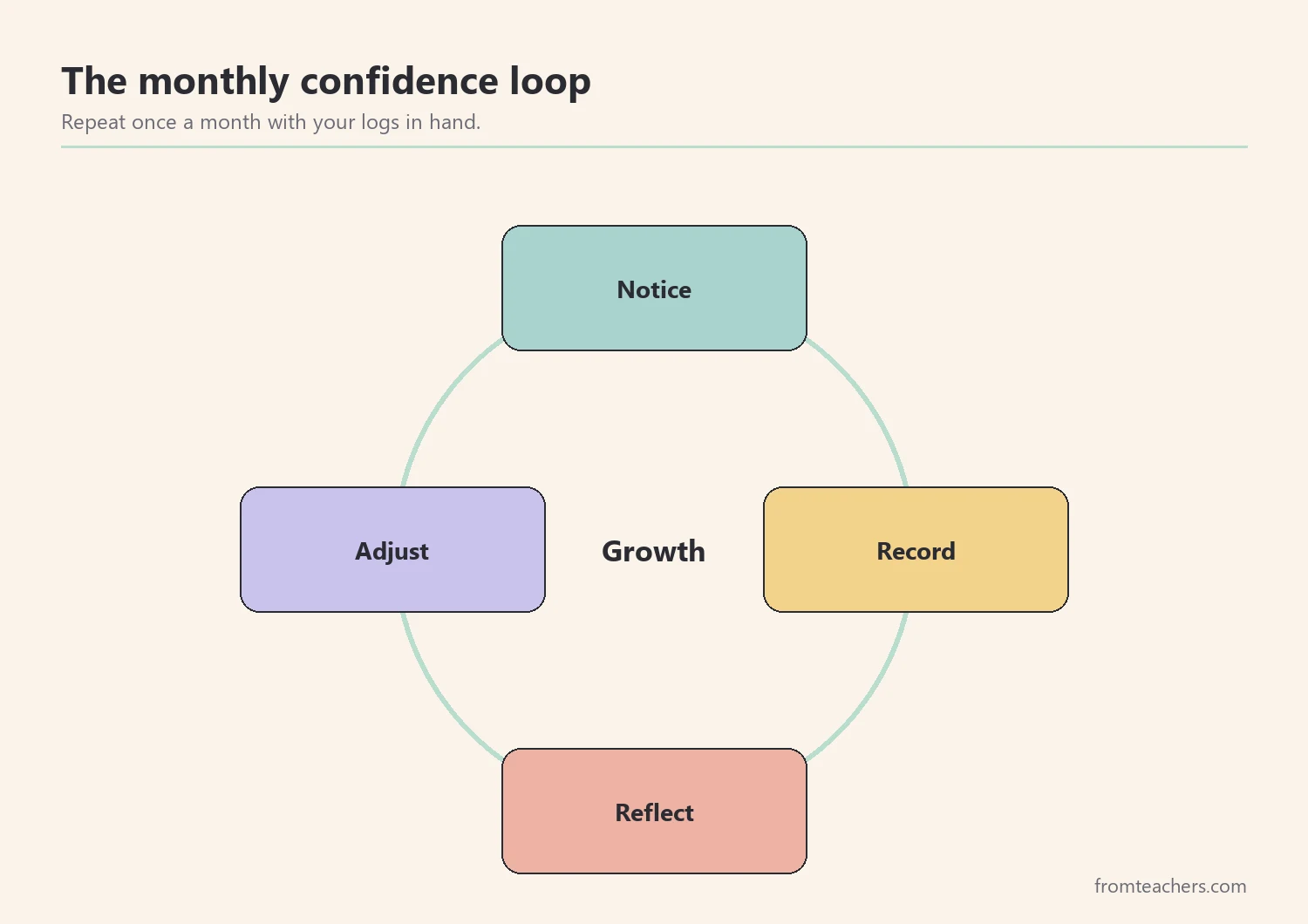
During the review, reread your small win log, your breakthrough notes, and your doubt reframes. Then, answer three questions: What am I doing better than last month? What still feels hard? What is one thing I will try next month?
Moreover, rate a few skills from “just starting” to “growing” to “steady.” Skills might include lesson planning, behavior support, IEP writing, data collection, and family communication. Seeing a skill move up one level is real, concrete progress for a new special education teacher.
However, if doubt or stress becomes constant, affects your sleep, or makes it hard to function, reach out. Talk with your doctor, your school’s employee assistance program, or a mental health professional. Taking care of yourself is part of taking care of your students, and no new special education teacher should feel they must push through alone.
Worked example. In October, Ms. Rivera rates IEP writing as “just starting.” By December, after mentor help and two finished IEPs, she rates it as “growing.” She picks family communication as her focus for January.
Common mistakes and how to avoid them
Even a thoughtful new special education teacher can fall into a few traps. Here is how to step around them.
- Comparing yourself to veteran teachers. Fix: compare yourself to last month, not to someone with twenty years of practice.
- Only remembering the hard moments. Fix: log one or two small wins every day.
- Waiting until you are overwhelmed to ask for help. Fix: schedule regular mentor time and bring questions.
- Replaying every decision. Fix: use a short decision check, then let it go.
- Skipping rest. Fix: protect at least one evening a week with no school work.
Questions teachers ask about being a new special education teacher
Is it normal for a new special education teacher to feel like an imposter?
Many new teachers describe feeling unsure or out of place in their first years. The role is complex, and skill grows with experience. Tracking evidence of progress can help balance those feelings.
How long does it take to feel confident?
There is no fixed timeline. Confidence often grows unevenly, with some skills feeling steady early and others taking longer. A monthly review helps you see the progress you might otherwise miss.
What if I do not have an assigned mentor?
Ask your administrator or department lead whether a mentor can be assigned. Meanwhile, reach out to an experienced colleague for a short monthly chat. Professional organizations for special educators can also offer community and resources.
How much time does a confidence log take?
Two to five minutes a day is usually enough. Short entries are easier to keep up, and consistency matters more than detail.
Should I share my doubts with my mentor?
Yes, if you feel safe doing so. Mentors often had the same doubts in their early years and can offer perspective. Bring a specific situation so the conversation leads to a practical next step.
Related reading: Special Education Strategies: 10 Powerful Ways Teachers Can Succeed, How Teachers Communicate With Parents in Special Education, and Addressing Challenges in Special Education: Practical Strategies for Educators.
A companion resource for building confidence in your first years:
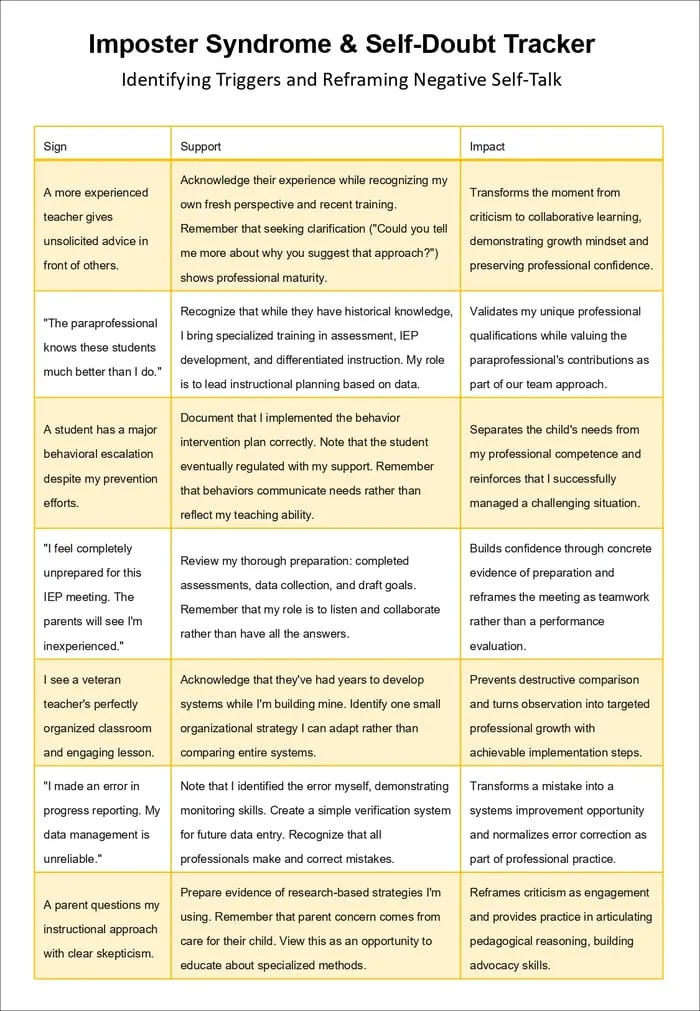
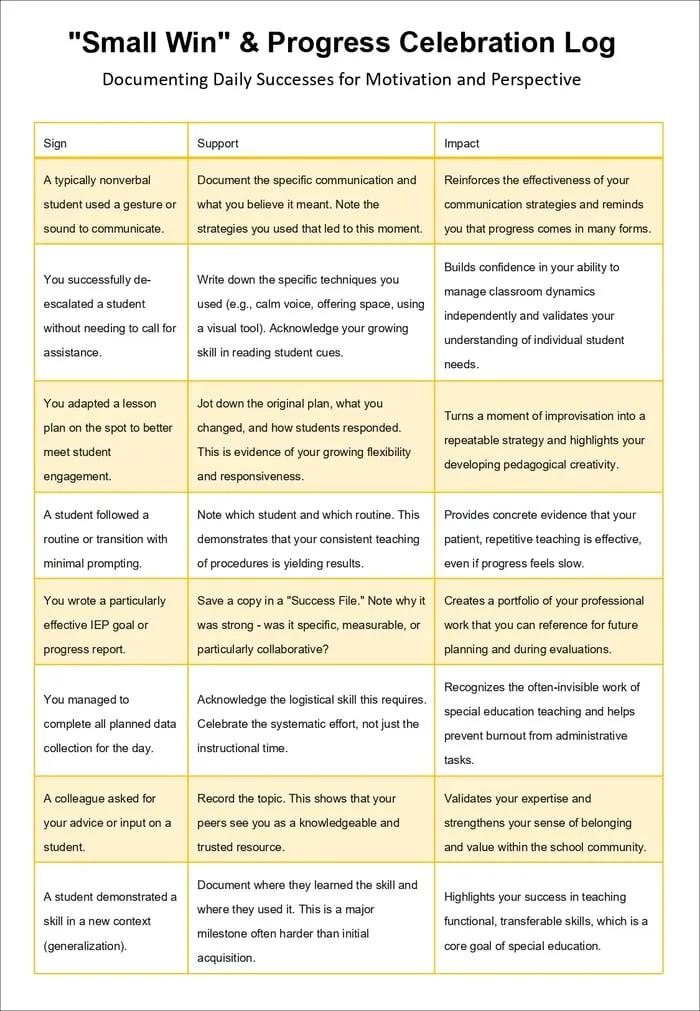
Self-Confidence as a New Special Education Teacher: a 12-page printable collection of trackers, including a self-doubt tracker, a decision trust checklist, a student breakthrough observer, a growth tracker, a mentorship log, and a small win log.
Sources and scope
- Council for Exceptional Children: a professional organization for special educators, with standards, resources, and community.
- IRIS Center, Vanderbilt University: free modules on instruction, behavior, and IEP practice for educators.
- IDEA, U.S. Department of Education: the federal law and regulations that shape special education services.
- American Psychological Association: general information on stress and wellbeing.
This guide covers practical habits for building professional confidence in the first years of special education teaching. It does not replace mentoring, school guidance, or professional mental health care.
Key takeaways
- Doubt is common for a new special education teacher, and naming it makes it easier to manage.
- Small wins, written down daily, become real evidence of growth.
- A short decision check helps you trust your judgment.
- Mentors and colleagues make hard problems lighter.
- A monthly review shows progress you might otherwise miss.










Leave a Comment