

Documenting parent contacts can feel like one more task at the end of a long day, until a parent asks in March what you said back in October. Picture a teacher at a conference table, trying to recall whether she emailed or called, and what was agreed. She knows she reached out. However, without a record, it is her memory against someone else’s.
This guide walks you through five steps to set up a simple log, record each call, email, and meeting the same day, write clear notes, keep records private, and use the log to plan your next conversation. By the end, you will have a routine that takes a few minutes per contact and saves hours later in the year.
Examples are fictional. Adapt to your school’s policies and your students’ needs. This is general guidance, not legal advice.
At a glance
- Keep one log per student in one place, not scattered across email and sticky notes.
- Record every contact the same day, including attempts that got no answer.
- Write short, factual notes: who, when, how, what was discussed, and next steps.
- Store the log securely and follow your school’s privacy rules.
- Review the log before conferences and balance concern calls with positive news.
1. Set up one log for documenting parent contacts
First, decide where every record will live. Many teachers keep notes in email folders, planner margins, and phone call history. As a result, nothing is complete when they need it. One log per student for documenting parent contacts, kept in one binder or one digital folder, solves that problem.
Next, choose your fields before the school year starts. Documenting parent contacts goes faster when every entry has the same layout. At a minimum, include these:
| Field | Why it matters |
|---|---|
| Date and time | Shows when contact happened |
| Person | Who you spoke with |
| Means of contact | Phone, email, in person, or other |
| Topic | Behavior, academic, routines, or other |
| Notes and next steps | What was said and agreed |
Then, add a top section with the student’s name, grade, and family contact details. List each adult who may be contacted, with the phone numbers and email the family has shared. Also, check your school records for any notes about who may receive information.
In our fictional example, Ms. Rivera teaches grade 3. Her student, Leo, has a mother who works evenings and a grandfather who handles school pickup. At the start of the year, Ms. Rivera set up one page for Leo with both contacts, their preferred times, and the best way to reach each person. That small step meant she never had to search for a number again.
Also, decide how you will handle siblings and shared families. Some teachers keep one page per child, even when two siblings are in the same class. That way, documenting parent contacts stays clear when a conversation is about only one student. If a call covers both children, write a short note on each page.
Finally, keep the format simple enough to use daily. A log that takes ten minutes per entry will not last past October. If you want a ready-made format, the fillable Parent Communication Log for teachers includes contact fields, date and person columns, checkboxes for the means of contact and topic, and lined space for notes.
2. Record every contact the same day
Memory fades fast, especially on busy days, and documenting parent contacts later almost always means losing details. Therefore, make a rule: every contact is logged before you leave school that day. That includes calls, emails, quick talks at pickup, notes home, and meetings.
Also, log attempts. If you called and nobody answered, write it down with the time and whether you left a message. Documenting parent contacts that did not connect shows that you reached out, and it helps you notice when a family is hard to reach by one method.
Here is a short look at Leo’s first entries in September:
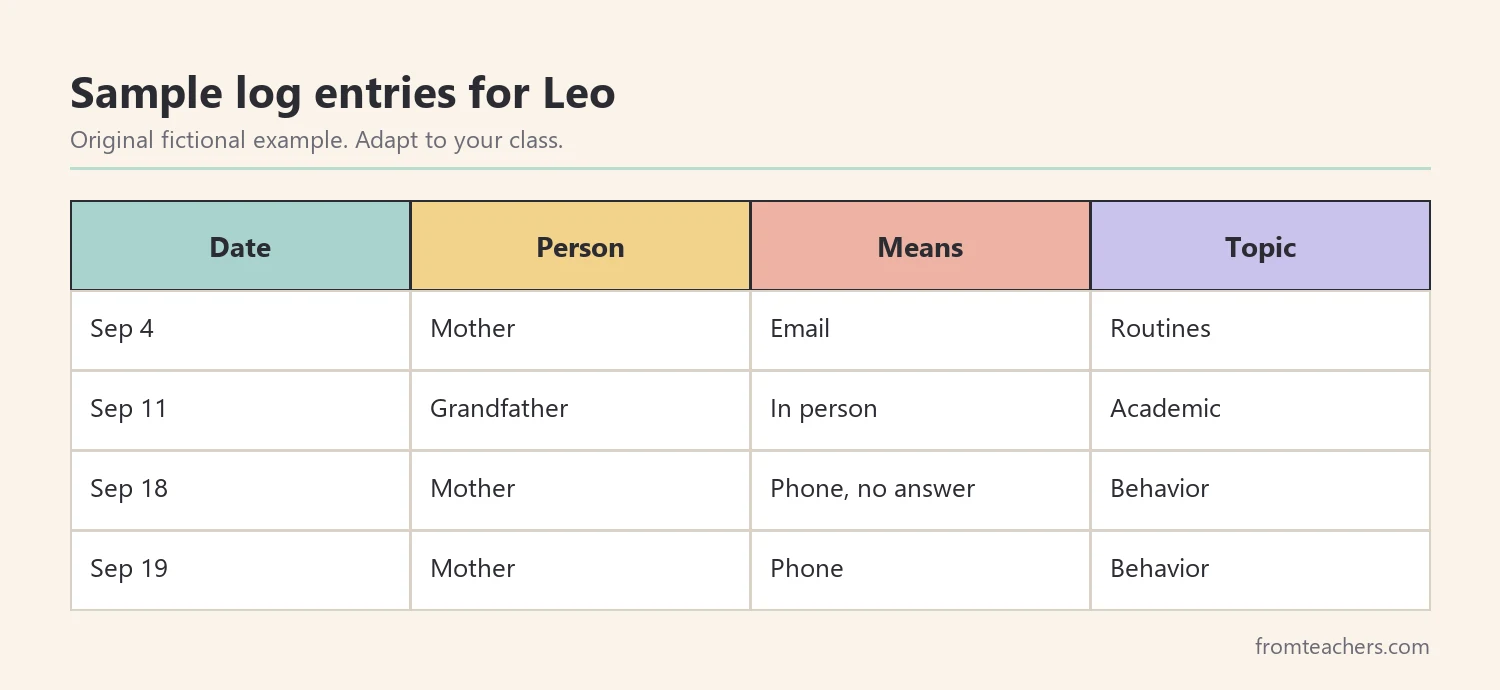
Next, build the habit into a routine you already have. Some teachers log contacts right after dismissal, before checking email. Others keep the log open during their planning period. Either way, attach the habit to a fixed moment so it happens without extra thought.
When documenting parent contacts by email, you may not need to retype the whole message. Instead, write the date, the person, a one-line summary, and where the full email is saved. That keeps the log short while still pointing to the full record.
In addition, keep informal contacts in the log. A two-minute chat at the door about a missing library book may seem minor. Later, however, a pattern of small conversations can tell an important story about a student’s week.
3. Write clear, factual notes when documenting parent contacts
A log is only useful if the notes make sense months later, to you and to anyone else who may need to read them. Because of that, write what happened, not what you think about the family.
When documenting parent contacts, stick to facts. Write what was said, what was asked, and what was agreed. Avoid labels, guesses about motives, and emotional words. If a parent was upset, describe what they said, not how you felt about it.
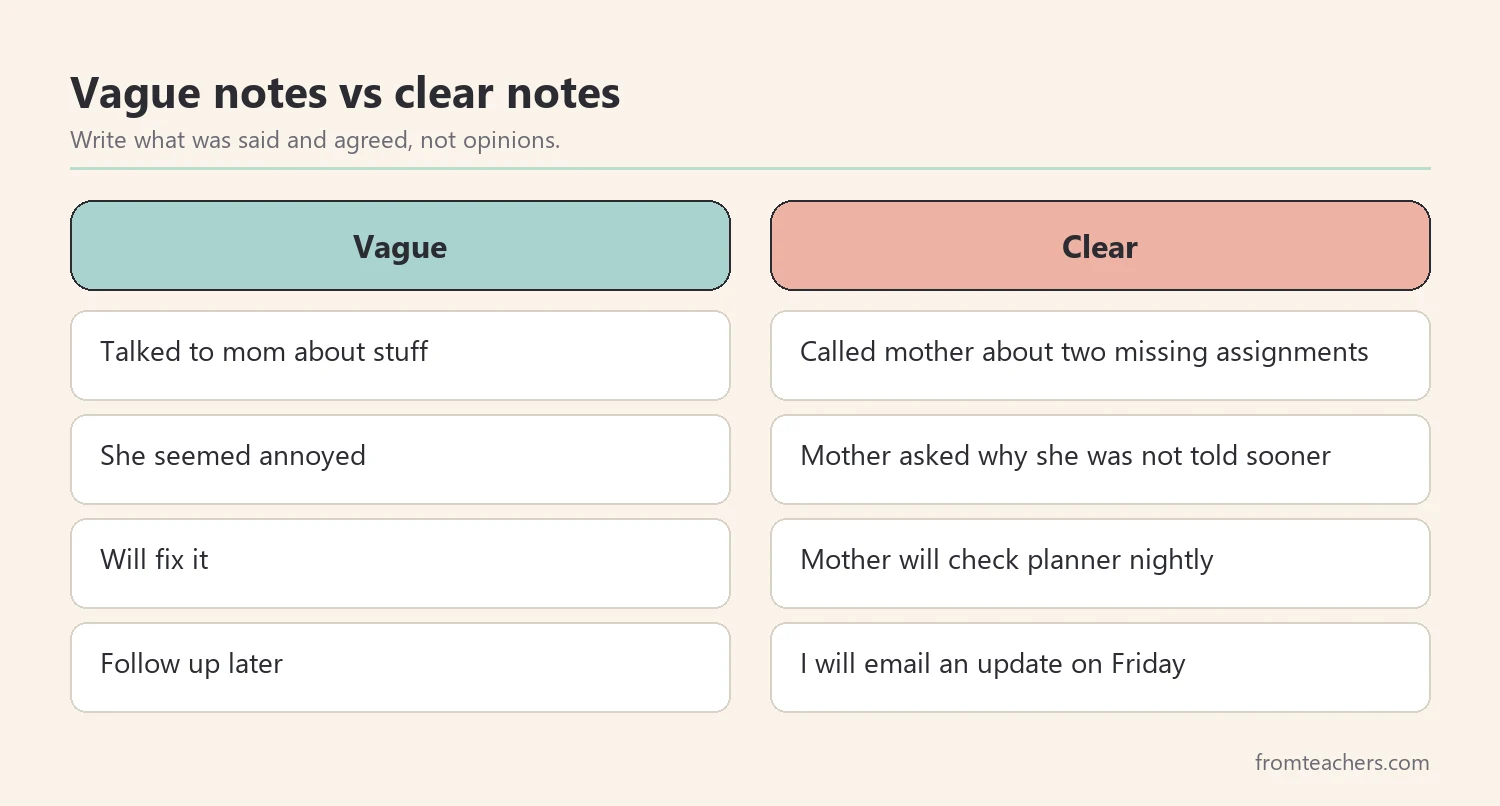
Next, always end with a next step. Who will do what, and by when? For example, after a call about homework, Ms. Rivera wrote: “Mother will check the planner each evening. I will email a progress update on Friday.” That one line made follow-up easy.
Also, use the same short phrases each time. Consistent wording makes documenting parent contacts faster and makes the log easier to scan. For instance, start each note with the purpose: “Called to share,” “Called about,” or “Parent asked about.”
Finally, read the note once before you close the log. Ask yourself: would this make sense to the family if they read it? Would it make sense to a colleague? If the answer is yes to both, the note is ready.
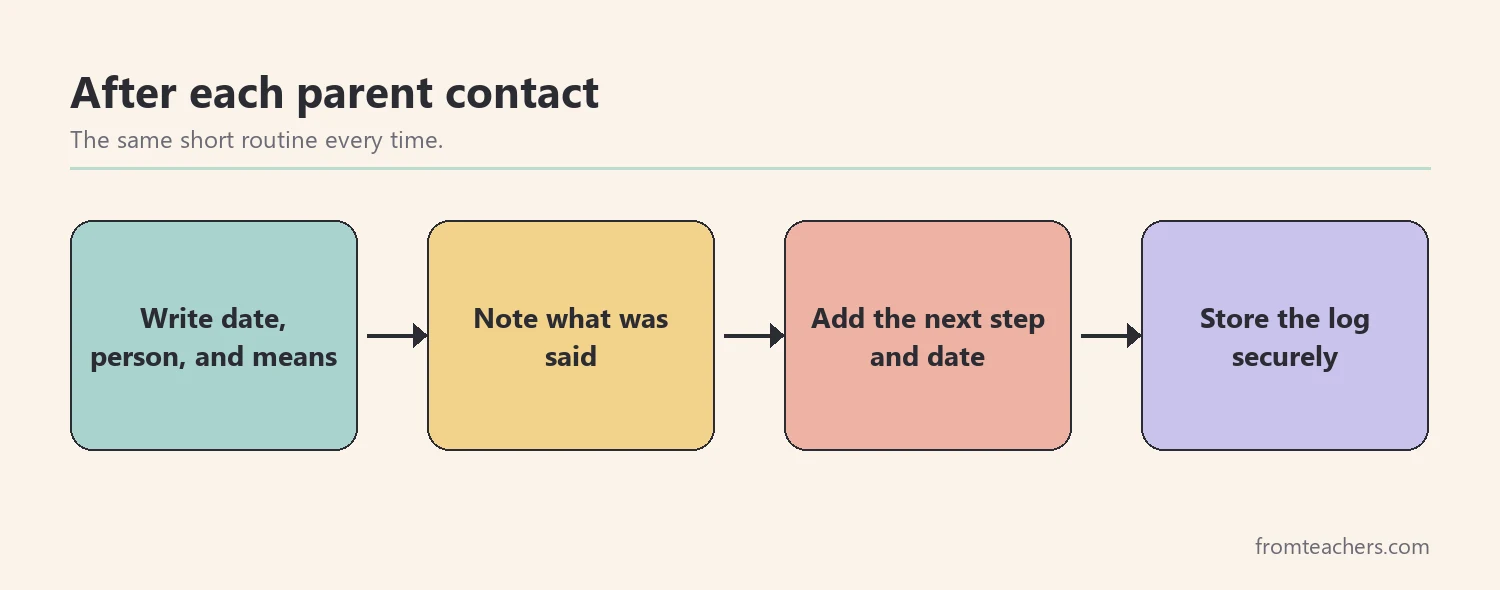
- Write who, when, and how first.
- Describe what was said in plain words.
- Leave out opinions and labels.
- End with a clear next step and a date.
4. Keep contact records private and organized
Parent contact logs contain personal information about students and families. For that reason, treat documenting parent contacts with the same care as grades and other school records.
First, store the log securely. A paper binder belongs in a locked drawer or cabinet, not on a desk where students or visitors can see it. A digital log belongs in a school-approved system or drive, not on a personal device or app. Ask your administrator what your school expects.
Next, learn your school and district policies. In the United States, the Family Educational Rights and Privacy Act (FERPA) sets general rules about student education records. Your district may also have its own rules about what to record and who may see it. When in doubt, ask before you share.
Then, organize logs so you can find any entry fast. Many teachers use one tab per student, in alphabetical order. Others keep a digital folder per student with the log and saved emails together. Choose one method and keep it for the whole year.
Also, be careful with shared spaces. Do not leave a log open on a projected screen or a shared computer. Similarly, do not discuss one family’s notes with another family, even in passing. Documenting parent contacts builds trust only when families know their information is safe.
Finally, know what happens at the end of the year. Some schools want logs handed in, while others want them stored or destroyed after a set time. Check your district’s guidance so you follow it correctly.
5. Review the log and use it to plan ahead
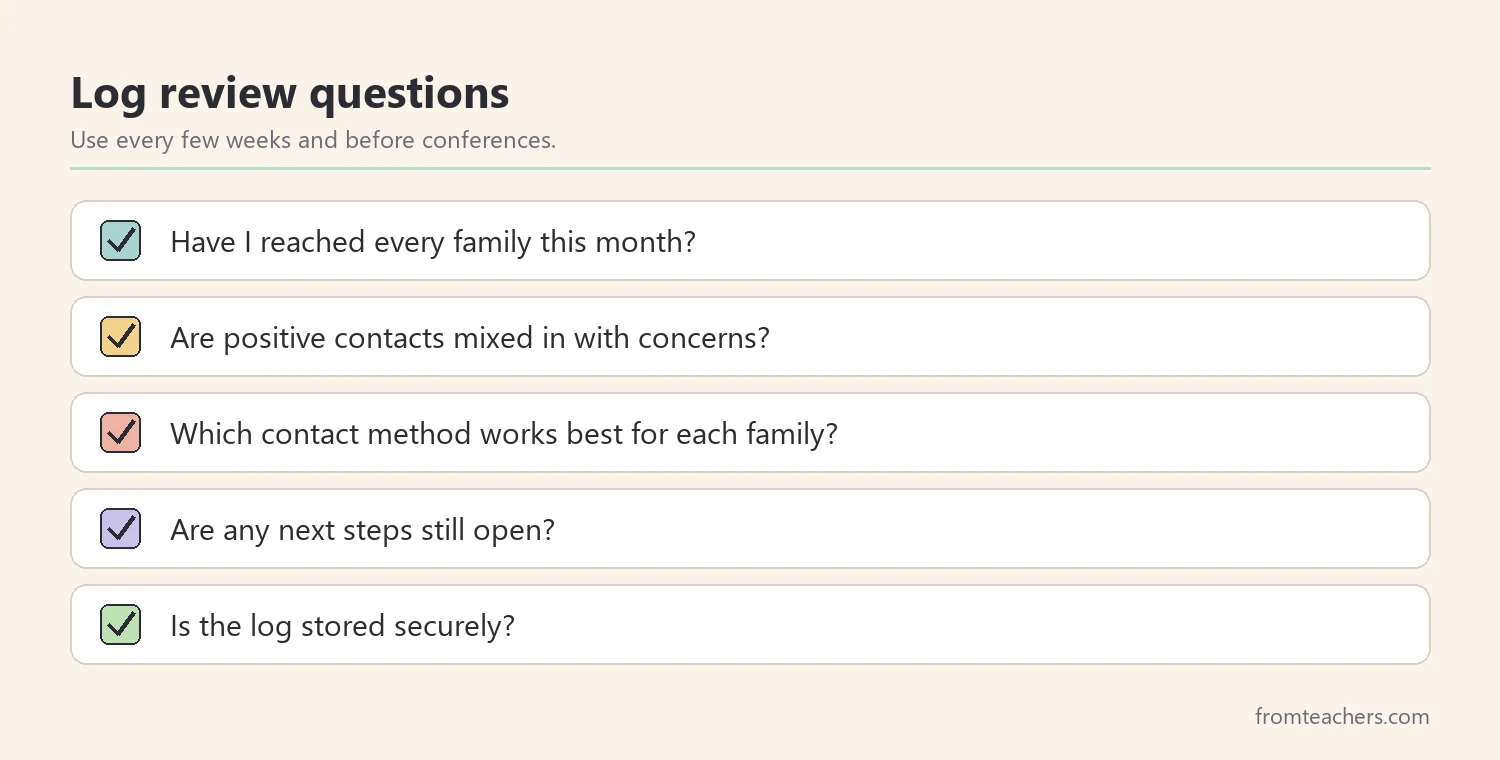
Documenting parent contacts is not only about keeping a record. It is also a planning tool. Therefore, schedule a short review every few weeks and before every conference or team meeting.
Start by counting. How many contacts did you have with each family? What was the method? What were the topics? These simple counts show patterns you might miss day to day.
For Leo, Ms. Rivera reviewed her log at the end of November. Here is what it showed:
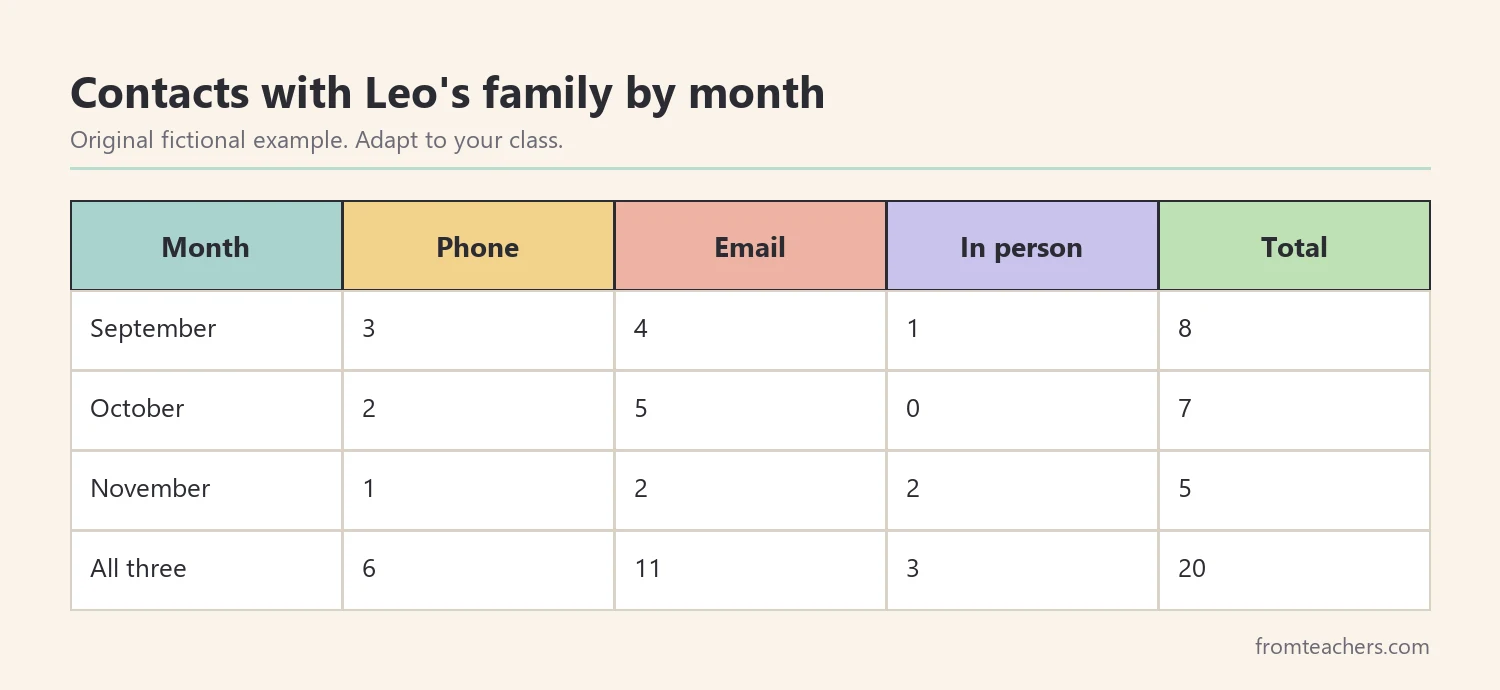
Over three months, she had 20 contacts with Leo’s family: 8 in September, 7 in October, and 5 in November. Email was the most common method, with 11 of the 20 contacts. Phone calls dropped from 3 in September to 1 in November, mostly because evening calls were hard for Leo’s mother. So, Ms. Rivera moved updates to email and saved calls for urgent topics.
Next, check the balance. Documenting parent contacts over time makes it easy to see whether most calls carry bad news. If most entries are about problems, add planned positive contacts. A short note about something the student did well builds goodwill, and it makes harder conversations easier later.
Finally, use the log before meetings. Documenting parent contacts all year means you can walk into a conference with dates, topics, and agreed next steps in front of you. Instead of relying on memory, you can say, “On October 12, we agreed to try the planner check. Here is how it has gone.”
Common mistakes and how to avoid them
- Logging only problems. Documenting parent contacts only when something goes wrong tells half the story. Plan positive contacts and record them too.
- Waiting until the end of the week. Details blur within days. Log each contact the same day, even if the note is short.
- Writing opinions instead of facts. Labels like “difficult” or “uncooperative” can cause harm if read later. Describe what was said and done.
- Skipping failed attempts. Unanswered calls show that you tried. Record the date, time, and whether you left a message.
- Keeping notes in many places. Email, sticky notes, and a planner each hold part of the picture. Keep one log per student and point to saved emails from it.
- Leaving the log in the open. Student information needs protection. Store the log securely and follow school policy.
Questions teachers and parents ask about documenting parent contacts
How detailed should my notes be?
Detailed enough that someone else could understand what happened. A good note names who, when, how, the main topic, and the next step. Most entries need only two to four sentences.
Should I log quick conversations at pickup?
Yes, especially if anything was asked or agreed. A short line is enough. Over time, these small entries can show patterns that matter.
Is documenting parent contacts on paper or digital better?
Both can work. Paper is quick and easy to bring to a meeting, while digital logs are easy to search and back up. Choose the format your school allows and that you will use every day. The best tool for documenting parent contacts is the one you open without thinking.
Can parents see what I write?
In many cases, families may have rights to review education records. Rules vary, so check your school and district policies. Either way, write every note as if the family might read it.
How often should I review the log?
A quick review every few weeks works well, plus a closer look before conferences or team meetings. Count contacts by method and topic, and check that positive news appears alongside concerns.
Related reading: How Teachers Communicate With Parents in Special Education: Building a Strong Partnership, How Parents and Teachers Can Team Up for Special Education Success, and The Power of Data Tracking in Special Education.
A companion resource for documenting parent contacts:
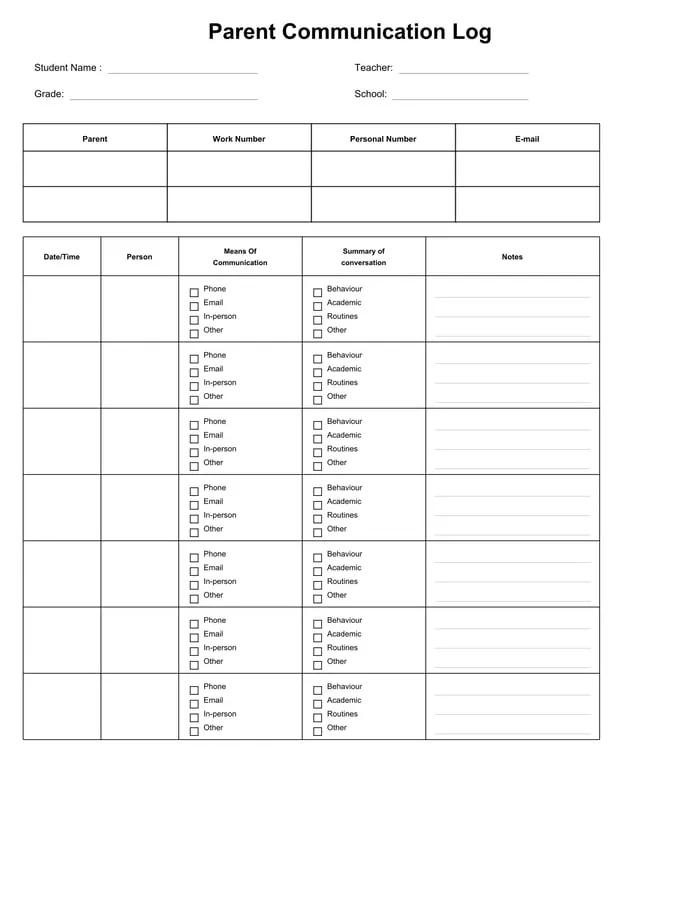
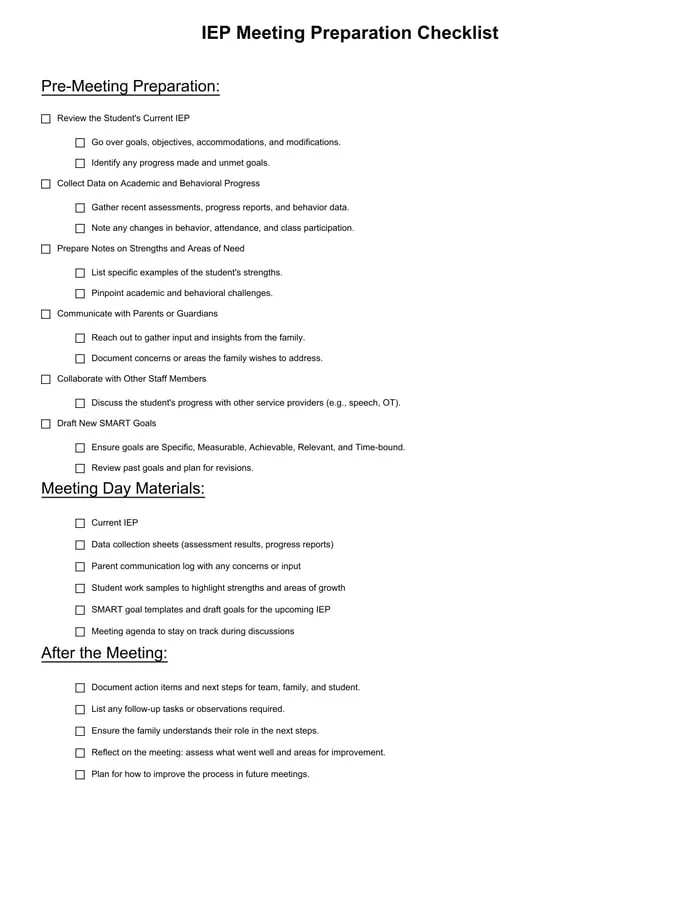
Parent Communication Log for Teachers: a fillable PDF you can complete digitally or print, with student and school fields, a parent contact table, date and person columns, checkboxes for phone, email, in-person, or other contact, topic checkboxes for behavior, academic, routines, or other, and lined space for notes.
Sources and scope
- Protecting Student Privacy, U.S. Department of Education: official guidance on FERPA and student education records.
- National PTA: resources on family engagement and partnerships between families and schools.
- Center for Parent Information and Resources: information for families and the professionals who work with them.
- IDEA, U.S. Department of Education: the law behind special education services, including parent participation.
This guide covers a practical routine for recording and reviewing communication with families. It does not replace your school’s policies or legal advice about records, which should come from your administration or district.
Key takeaways
- Documenting parent contacts works best with one log per student in one place.
- Log every contact the same day, including attempts with no answer.
- Write factual notes that end with a clear next step.
- Store logs securely and follow your school’s privacy rules.
- Review the log regularly to spot patterns and plan positive contacts.









Leave a Comment