

Student organization skills decide whether a finished worksheet actually reaches the teacher. Picture the end of the day: the bell rings, a fifth grader stuffs loose papers into a backpack that already holds a crushed snack bag, two library books, and last week’s permission slip. The next morning, the homework he finished is nowhere to be found.
This guide walks you through a short, repeatable course for teaching student organization skills at school and at home. By the end, you will be able to define the target habits, build simple backpack, desk, and paper routines, teach them step by step, track progress in a few minutes a week, and fade your support. Examples are fictional. Adapt to the student’s goals and agreed supports. This is guidance, not a diagnosis.
At a glance
- Student organization skills are a set of teachable habits, not a personality trait.
- Start with two or three observable routines, such as a daily backpack check.
- Teach each routine with modeling, guided practice, and a visual checklist.
- Record a few quick checks per week so you can see real change.
- Fade adult prompts slowly once the student succeeds on most days.
1. Define the student organization skills you want to see
First, turn “be more organized” into behaviors you can actually watch. Vague goals lead to vague feedback, and students rarely know what “clean up your desk” really means. Instead, name the exact actions, the time they happen, and what “done” looks like.
For most classrooms, student organization skills fall into three areas. The backpack covers what travels between home and school. The desk or cubby covers materials used during the day. Paper management covers handouts, homework, and notes that need a clear home.
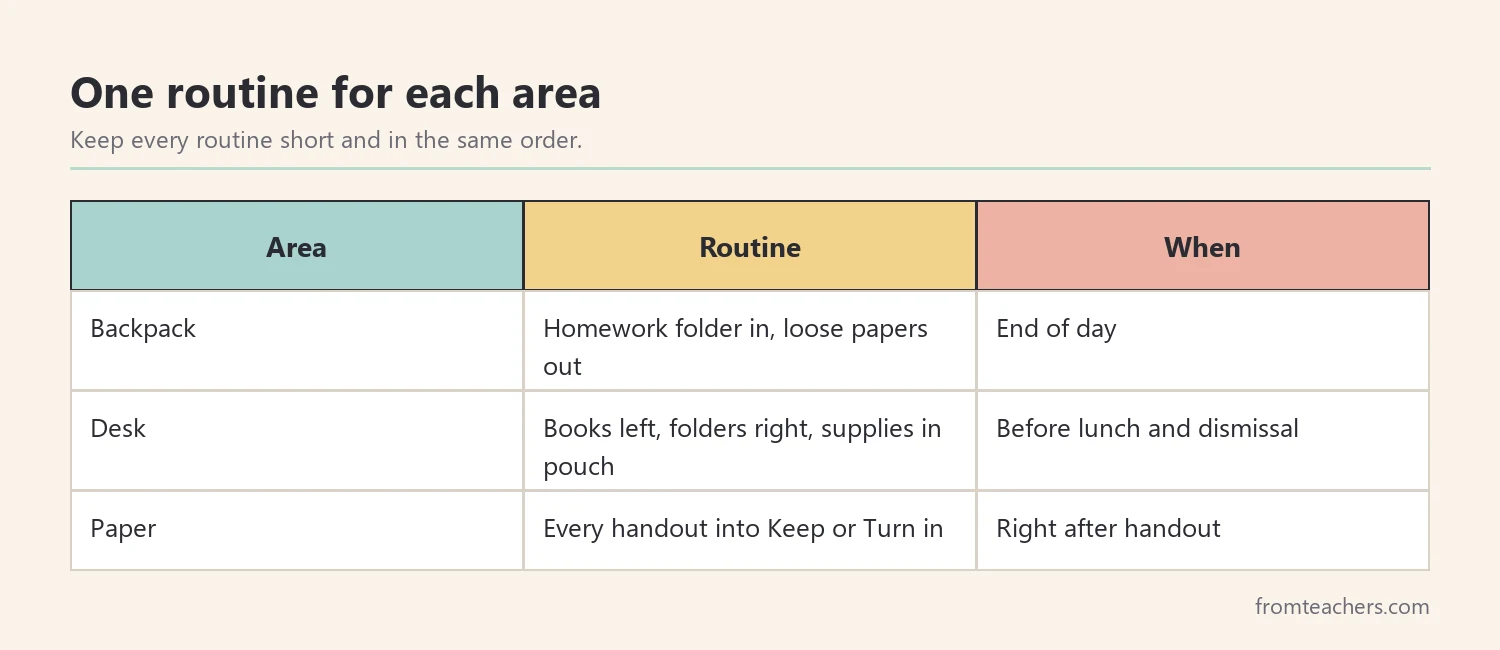
| Area | Observable habit | When it happens |
|---|---|---|
| Backpack | Homework folder goes in, loose papers come out | End of day |
| Desk | Books on the left, folders on the right, supplies in a pouch | Before lunch and dismissal |
| Paper | Every handout goes into “Keep” or “Turn in” | Right after it is handed out |
Next, pick only two or three student organization skills to start. Choosing everything at once overwhelms the student and the adults who support him. Meanwhile, the habits you leave for later will still be there when the first ones are solid.
Worked example. Leo is a fictional fifth grader who finishes most homework but turns in about half of it. His teacher, Ms. Rivera, watches him for one week. She notices that papers go straight into the backpack’s main pocket, and his desk holds loose sheets from several subjects. So she chooses two target habits: “Leo puts every handout into his two-pocket folder before he sits down,” and “Leo completes a two-minute backpack check before dismissal.”
Finally, write each habit as a sentence a substitute could read and understand. If another adult can tell whether it happened, the habit is clear enough to teach.
2. Build simple routines for backpack, desk, and paper
Once you know the target habits, build the system that makes them easy. Strong student organization skills rest on routines with very few steps, the same order every time, and materials that are always in the same place. In other words, you remove decisions so the student only has to follow the path.
For the backpack, one two-pocket folder works well. Label one side “Keep at home” and the other “Return to school.” Then, add a small tag on the zipper that lists what must be inside each day. For the desk, mark zones with tape or labels so every item has a home. For paper, give the student one place for anything unfinished and one place for anything ready to turn in.
In addition, keep each routine short, because student organization skills grow through daily repetition. Two minutes at the end of the day is realistic, while a ten-minute clean-out often gets skipped. Therefore, save the bigger cleaning job for a weekly reset, for example every Friday afternoon.
Worked example. Ms. Rivera gives Leo a bright two-pocket folder and tapes a small card to his desk. The card shows three steps: “Handout in folder, folder in backpack, zip the bag.” Next, his family agrees to check the “Return to school” pocket each evening and sign his planner when the homework is inside.
Put this step into practice
Also, think about who will use the routine besides the student. A paraprofessional, a specialist, or a parent should prompt the same steps with the same words. When every adult says the same thing, the routine becomes predictable and the student learns it faster.
Finally, avoid buying a lot of new supplies at this stage. Most student organization skills grow from consistent steps, not from fancy bins. A single folder used daily beats a full set of color-coded binders that nobody maintains.
3. Teach student organization skills step by step
Next, teach student organization skills the way you would teach any other skill. Telling a student to “get organized” rarely works, because it assumes he already knows how. Instead, use a short cycle: explain why, model it, practice it together, then let the student try it alone.
In addition, start with buy-in. Ask students how it feels to lose something important, and what they could do with the time they spend searching. Keep the tone warm. A messy backpack is not a character flaw, so frame organization as a tool that makes school easier.
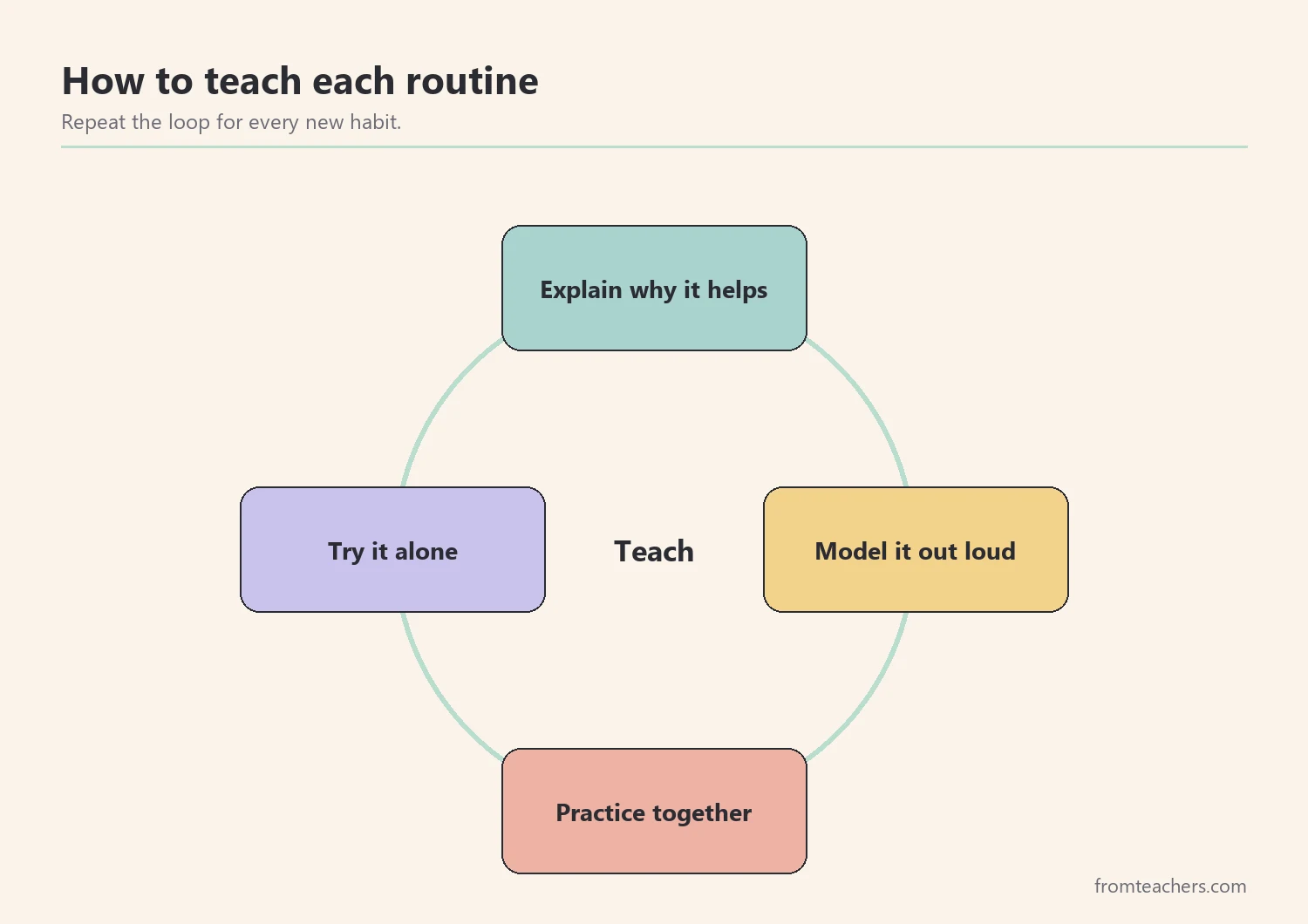
Then model the routine out loud. For example, hold up a handout and say, “This is a math page I still need to finish, so it goes in the Keep side.” Next, practice together several times while the student talks through each step. After that, let him try it alone while you watch and give quick, specific feedback.
For example, a structured resource can carry much of this teaching for you. The Desk and Backpack Organization Skills for Students Workbook moves from a “Why Organize?” introduction through separate backpack, desk, and paper sections, so you can teach one area per lesson in a fun, comic-style format.
Worked example. Ms. Rivera teaches Leo’s backpack check during the last ten minutes of three days in a row. On the first day, she models the steps while Leo watches. Next, they do it together. On the third, Leo leads, and she only points to the card when he pauses.
Moreover, students with attention or executive function challenges often build student organization skills more slowly and need more practice rounds than their peers. That is normal. Short, frequent practice usually works better than one long lesson, so plan for a few minutes daily rather than a single big session.
Lastly, praise the process, not the tidy result. “You put the handout in the folder right away” teaches more than “Your desk looks nice.”
4. Add visual supports and adjust for each learner
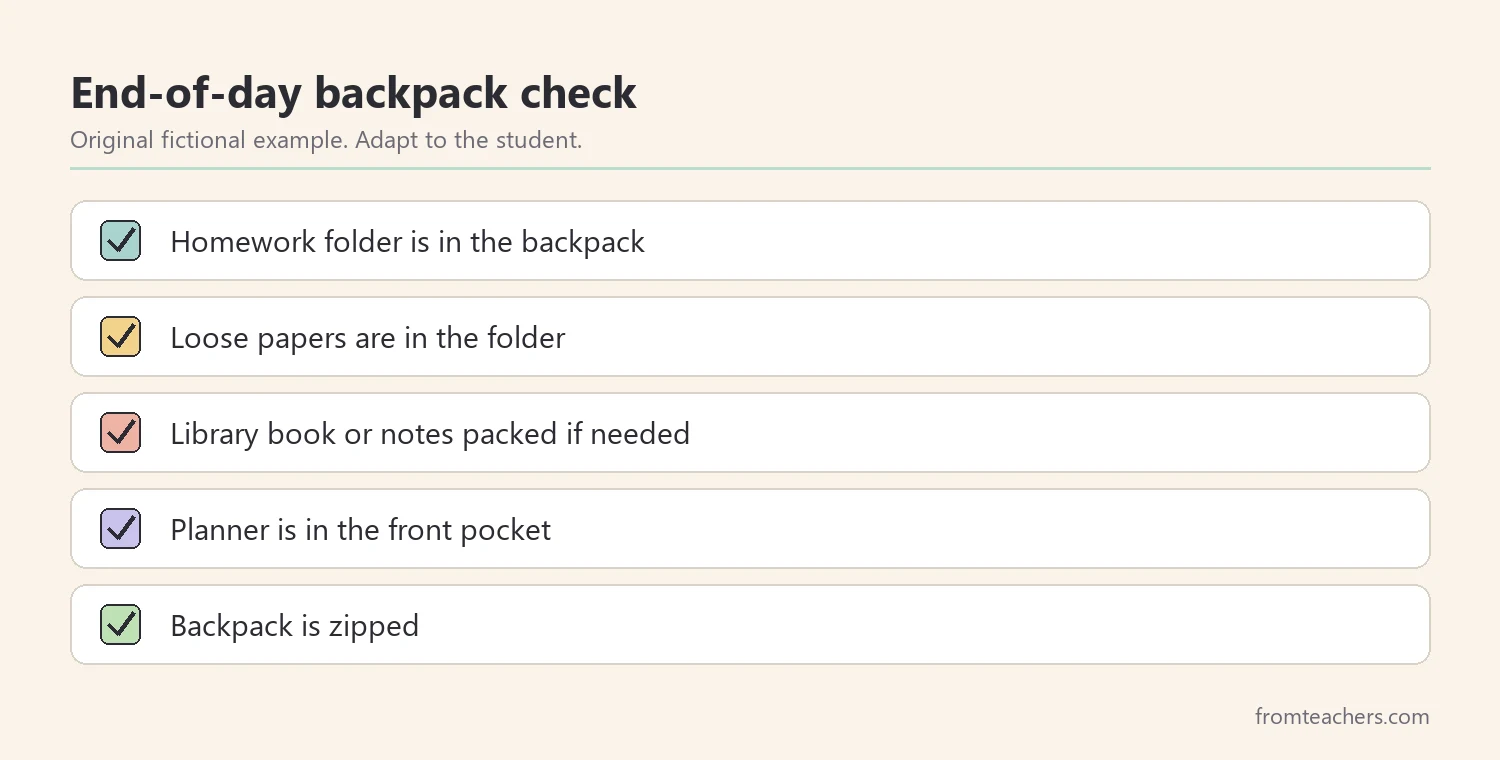
Visual supports keep student organization skills going when the adult is not standing nearby. A checklist on the desk, a tag on the backpack, or a labeled photo of a “ready” desk lets the student check his own work. As a result, he relies less on reminders and more on the system.
Next, keep visuals short and concrete. Three to five steps is plenty, and pictures help younger students or emerging readers. In addition, place each visual exactly where the routine happens, so the student does not have to remember where to look.
However, not every student needs the same support to build student organization skills. Some do well with a single desk card. Others benefit from a timer, a peer buddy who runs the check at the same time, or extra time before dismissal. For students with ADHD, frequent short check-ins and fewer items in the desk often help, and any formal supports should follow what the student’s team has agreed.
A quick classroom example
Here are a few adjustments worth trying:
- Reduce clutter by storing extra supplies in a shared class bin.
- Use one folder for all subjects instead of one per subject.
- Give a two-minute warning before the end-of-day check.
- Pair the student with a buddy for the backpack routine.
- Take a photo of the “ready” desk and tape it inside the lid.
Worked example. Leo often forgets the card once he is busy talking with friends. So Ms. Rivera adds a two-minute warning and pairs him with a classmate who also does the check. Within a week, the reminder becomes part of the class rhythm, and Leo rarely needs an extra prompt.
Ultimately, the right support is the smallest one that still works. If a student succeeds with only a card, there is no need to add a buddy or a timer.
5. Record progress on student organization skills
Without a record, it is hard to tell whether a routine is working. Fortunately, tracking student organization skills can take less than a minute a day. A simple yes or no for each target habit is enough to show a pattern over a few weeks.
Also, use a weekly sheet with one row per day and one column per habit. Then, total the checks on Friday. Because the numbers are small and concrete, the student can help fill in the sheet, which also builds self-awareness.
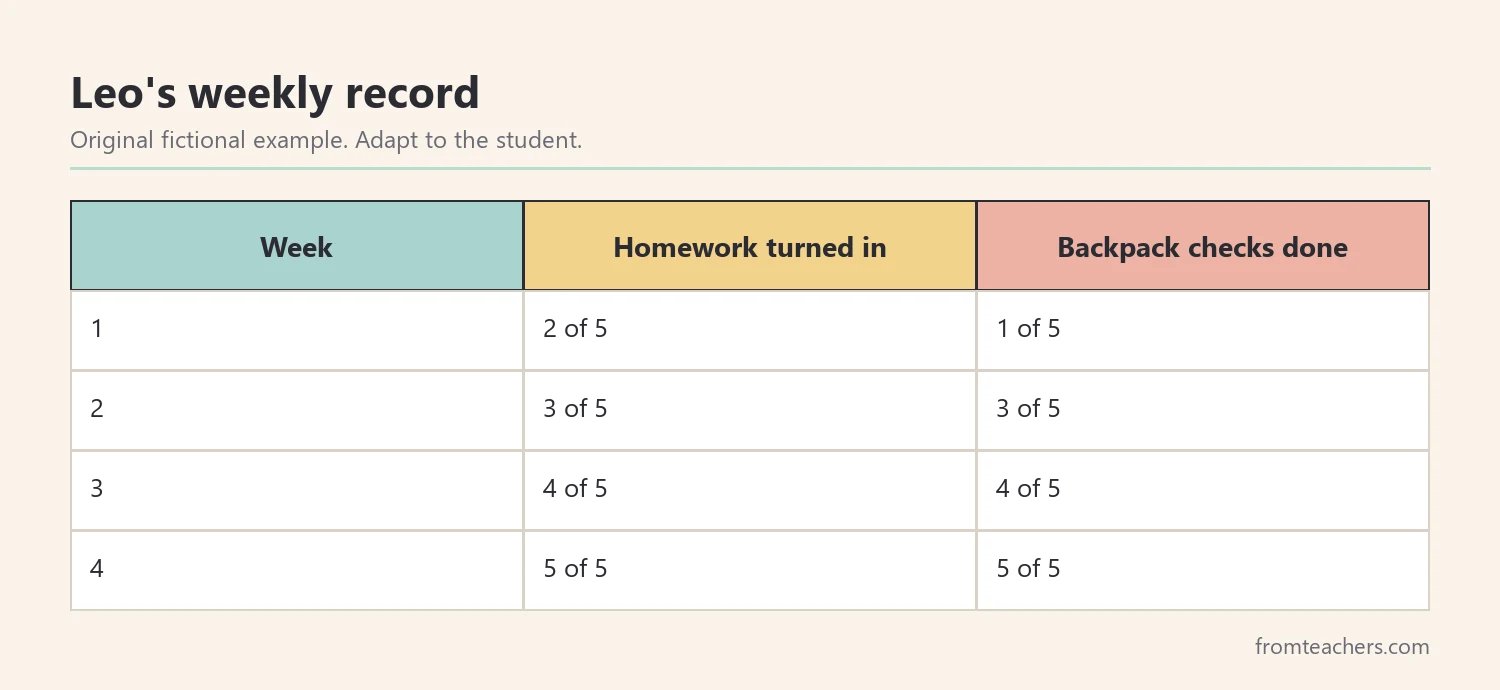
Worked example. Ms. Rivera tracks two things for Leo: how many of five homework assignments he turns in each week, and how many of five backpack checks he completes. In week 1, he turns in 2 of 5 assignments and completes 1 of 5 checks. By week 4, he turns in 5 of 5 and completes 5 of 5.
| Week | Homework turned in | Backpack checks done |
|---|---|---|
| 1 | 2 of 5 | 1 of 5 |
| 2 | 3 of 5 | 3 of 5 |
| 3 | 4 of 5 | 4 of 5 |
| 4 | 5 of 5 | 5 of 5 |
In this fictional example, Leo’s student organization skills improve on both measures together. That pattern suggests the backpack check is helping homework reach school. Still, one good month is a starting point, not a finish line, so keep recording while you begin to fade support.
Also, share the data with the family. A short note such as “Leo turned in all five assignments this week” gives parents a reason to keep the home routine going.
6. Review, fade support, and keep the habits going
Once student organization skills hold on most days, start fading your support. Fading means removing prompts in small steps while the habit stays in place. For example, move from saying the steps, to pointing at the card, to simply waiting quietly.
Then schedule a regular review, perhaps every two or three weeks. Ask what is working, what still breaks down, and which habit to add next. In addition, plan a mid-year reset, because desks and backpacks often pile up again after long breaks.
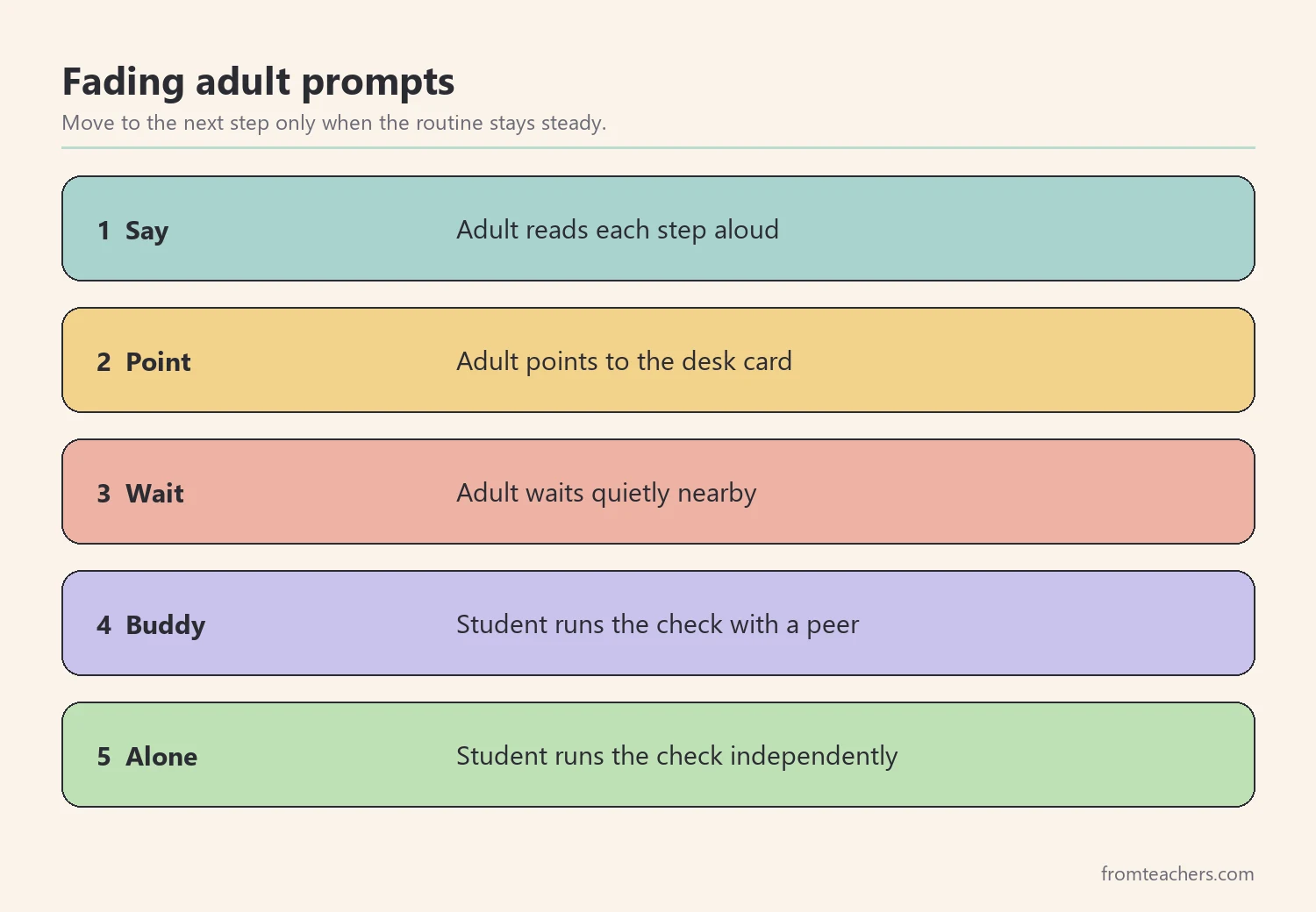
Worked example. After four strong weeks, Ms. Rivera stops reading the steps aloud and only taps the desk card. Two weeks later, she stops tapping, and Leo runs the check with his buddy. Next, they add a new habit: a Friday desk reset using the same teach, practice, and track cycle.
Finally, celebrate the growth with the student. Showing him his own chart from week 1 to week 4 makes the progress visible and gives him a reason to keep going.
Common mistakes and how to avoid them
- Teaching everything at once. Fix: start with two or three habits and add more only when those are steady.
- Using shame or public comparisons. Fix: treat organization as a skill to learn and praise the process privately.
- Buying complex systems. Fix: use one folder and clear desk zones before adding binders or bins.
- Different adults, different instructions. Fix: give every adult the same short script and visual card.
- Removing support too soon. Fix: fade prompts in small steps and keep recording while you do.
- Skipping the reset. Fix: plan a weekly clean-out and a mid-year refresh on the calendar.
Questions teachers and parents ask about student organization skills
At what age should I start teaching student organization skills?
You can start in the early elementary grades with very simple routines, such as putting a folder in a backpack. As students grow, the routines can include more steps and more independence. Many middle schoolers still benefit from direct teaching.
How long does it take for a routine to stick?
It varies widely from student to student. Some children follow a routine reliably after a week or two, while others need many weeks of practice and prompts. Your weekly record will tell you more than any general timeline.
Do students with ADHD need a different approach?
The same teaching steps work, but students with ADHD often need shorter routines, more visual cues, and more practice. Follow any supports the student’s team has agreed on, and adjust based on what your data shows.
How can parents support organization at home?
Parents can check the homework folder at the same time each evening and use the same words the teacher uses. A small home spot for the backpack also helps, so it is packed and ready by the door.
What if the student keeps losing the folder itself?
Student organization skills depend on tools the child can find. Make the folder easy to spot with a bright color and the student’s name on the front. Then add “folder in backpack” as the very first step on the checklist, and practice it until it becomes automatic.
Related reading: Effective ADHD Classroom Strategies to Support Student Success, 5 Practical Teaching Tips to Boost Classroom Focus and Learning, and Learning Styles Student Success Guide.
A companion resource for student organization skills:
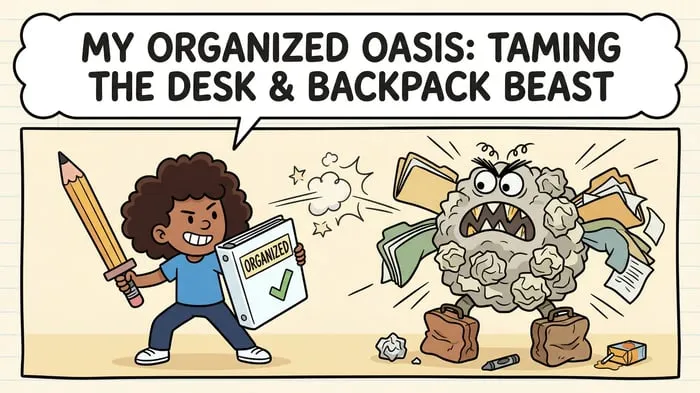
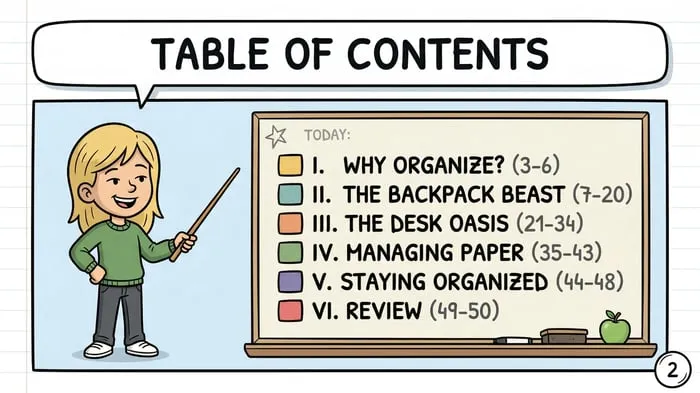
Desk and Backpack Organization Skills for Students Workbook: a 50-page printable, comic-style workbook with sections on why organization matters, backpack routines, desk routines, managing paper, staying organized, and a review. It suits elementary and middle school students, small groups, and special education settings.
Sources and scope
- CHADD: a national nonprofit with information for families and educators on ADHD, including school organization and executive function.
- Understood.org: practical articles for parents and teachers on executive function and learning differences.
- IRIS Center at Vanderbilt University: free modules on classroom routines, behavior supports, and evidence-based practices.
- CAST UDL Guidelines: a framework for designing lessons, including supports for planning and managing materials.
- Child Mind Institute: family-friendly guidance on attention, executive function, and school success.
This guide covers everyday classroom and home routines for backpacks, desks, and papers; it does not replace an evaluation or the supports written in a student’s plan.
Key takeaways
- Define two or three observable student organization skills before you start teaching.
- Keep each routine short, consistent, and supported by a visual card.
- Teach with a cycle of explain, model, practice, and independent tries.
- Record simple yes or no checks to see whether the routine works.
- Fade prompts slowly and plan regular resets to keep habits strong.




Leave a Comment