

Student burnout prevention starts with a moment many teachers know well: it is the third week of school, and a bright student who started strong now puts her head down during first period and says, quietly, that she cannot do this anymore. For neurodivergent learners, that moment rarely comes out of nowhere. Instead, it builds from weeks of masking, sensory strain, and schedules that leave no room to recover.
After reading this guide, you will be able to spot early signs of overwhelm, lighten an overloaded week, teach a simple self-advocacy script, and review progress with the student and family. Examples are fictional. Adapt to the student’s goals and agreed supports. This is guidance, not a diagnosis.
At a glance
- Burnout builds slowly, so watch for small changes in energy, attendance, and skills.
- Look at the whole week, including after-school commitments, not only class time.
- Protect real recovery time the same way you protect instruction time.
- Teach students a short script to ask for a break or an adjustment.
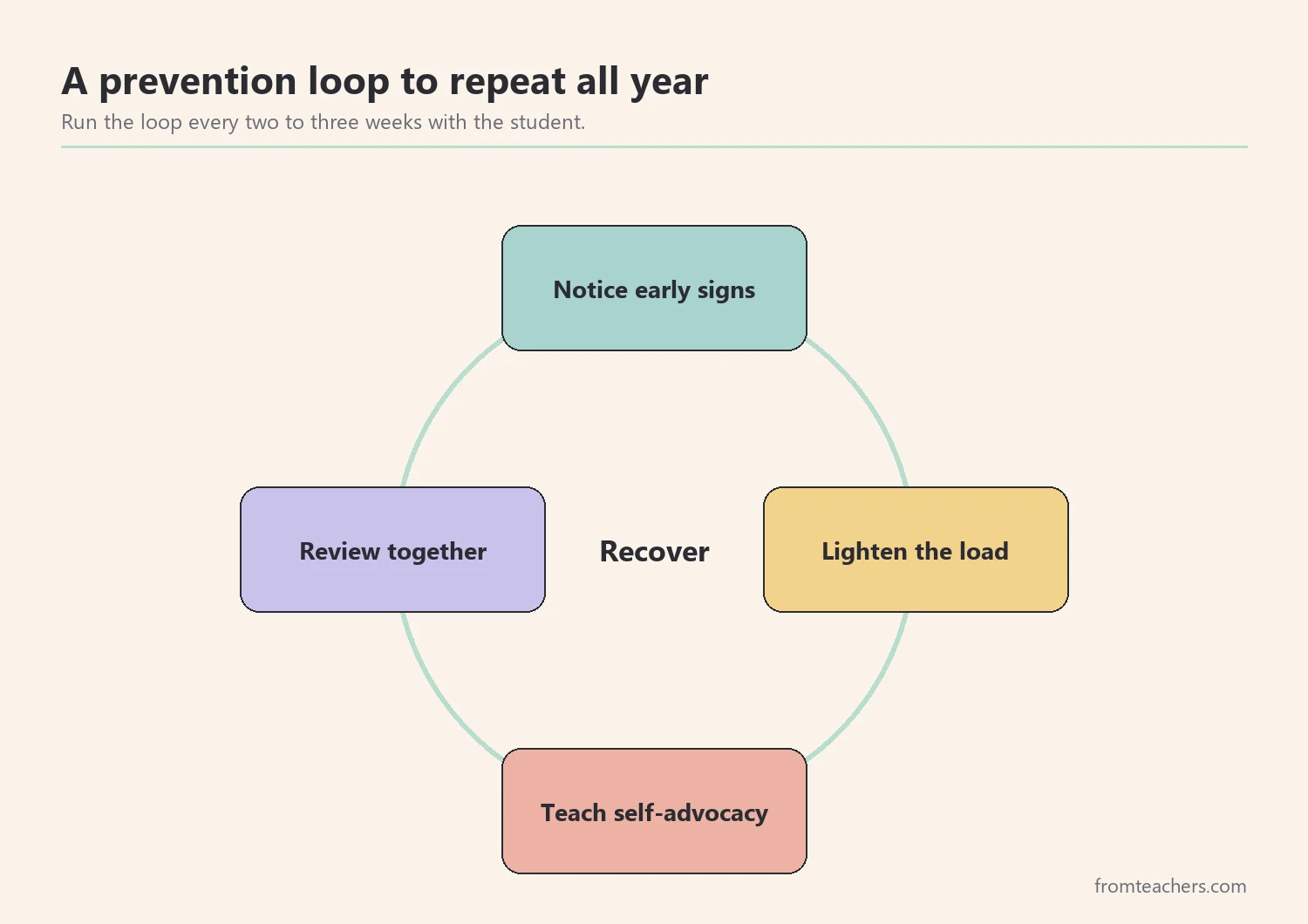
- Review together every two to three weeks and change one thing at a time.
1. Define what student burnout prevention looks like for this learner
First, agree on what you are trying to prevent. In school, burnout usually shows up as a long drop in energy, motivation, and skills that the student could handle before. Many autistic people describe this kind of exhaustion in their own words, and families often notice it first at home.
Next, describe what “doing well” looks like for this specific student. A clear picture of a good week gives everyone something concrete to protect. Without it, student burnout prevention turns into vague advice like “take it easy,” which nobody can act on.
Consider Maya, a fictional autistic student in grade 8. In September, Maya joined robotics club, kept her piano lessons, and started math tutoring. By week four, she was arriving late, skipping lunch in the cafeteria, and forgetting homework she used to finish easily.
Her teacher, her mother, and Maya met for fifteen minutes. Together they wrote three short statements about a good week for Maya:
- She arrives on time at least four days out of five.
- She eats lunch somewhere she can actually eat, even if that is the library.
- She has at least one evening with no planned activity.
Notice that these statements are observable. Anyone on the team can check them without guessing what Maya feels inside. Also, Maya helped write them, so they reflect her priorities and not only the adults’ worries.
Finally, keep the definition short. Three or four statements are enough to guide decisions for the next month.
Good student burnout prevention also means agreeing on who watches for what. For instance, Maya’s teacher tracked mornings and class work, while her mother tracked evenings and sleep.
2. Notice early signs before the crash
Early signs are often quiet. Because they look like ordinary tiredness, adults may miss them or treat them as a motivation problem. However, a pattern of small changes over a few weeks is worth a closer look.
Start by watching for changes compared with the student’s own usual pattern, not compared with classmates. For example, one student may always be quiet, while for another, quiet is a warning sign.
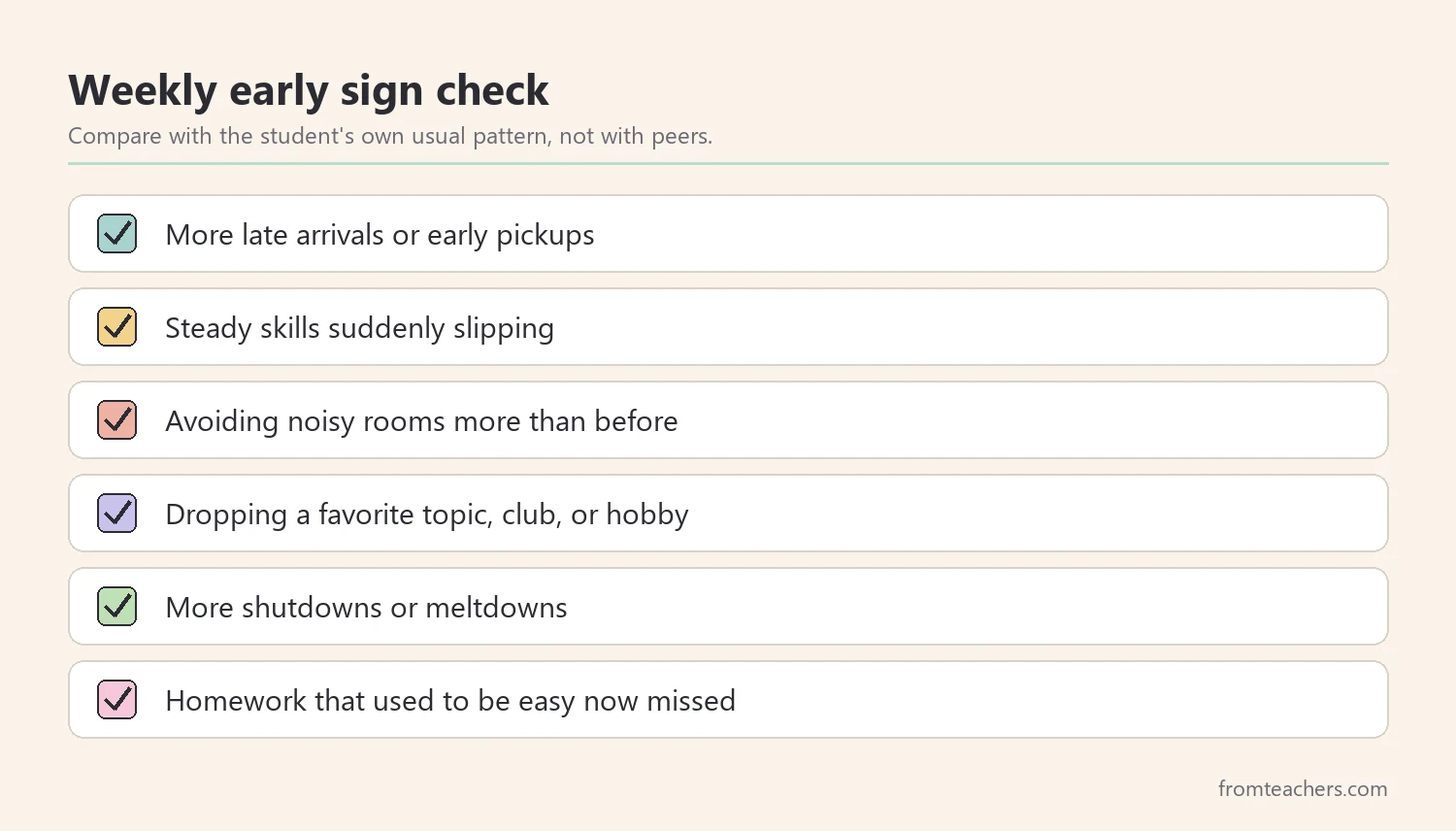
| Area | Possible early sign | What to check |
|---|---|---|
| Attendance | More late arrivals or early pickups | Mornings and transitions |
| Skills | Steady skills suddenly slipping | Workload and sleep |
| Sensory | Avoiding noisy rooms more than before | Cafeteria, halls, assemblies |
| Interests | Dropping a favorite topic or club | Total weekly demands |
| Regulation | More shutdowns or meltdowns | Recovery time after school |
The table is a starting point for student burnout prevention, not a diagnostic tool. Use it to decide what to discuss, not to label the student.
In Maya’s case, her teacher kept a simple tally for two weeks. Maya was late on 3 of 10 school days and missed 4 homework assignments that she would normally complete. Meanwhile, her mother noticed that Maya stopped drawing in the evenings, which was usually how she relaxed.
Then, share what you notice in neutral language. “I noticed you have been late three times this week. How are mornings going?” invites a conversation. In contrast, “You need to try harder” closes it.
A quick sign check works well as a weekly habit. Therefore, the team does not wait for a crisis to start talking about student burnout prevention.
3. Lighten an overloaded schedule
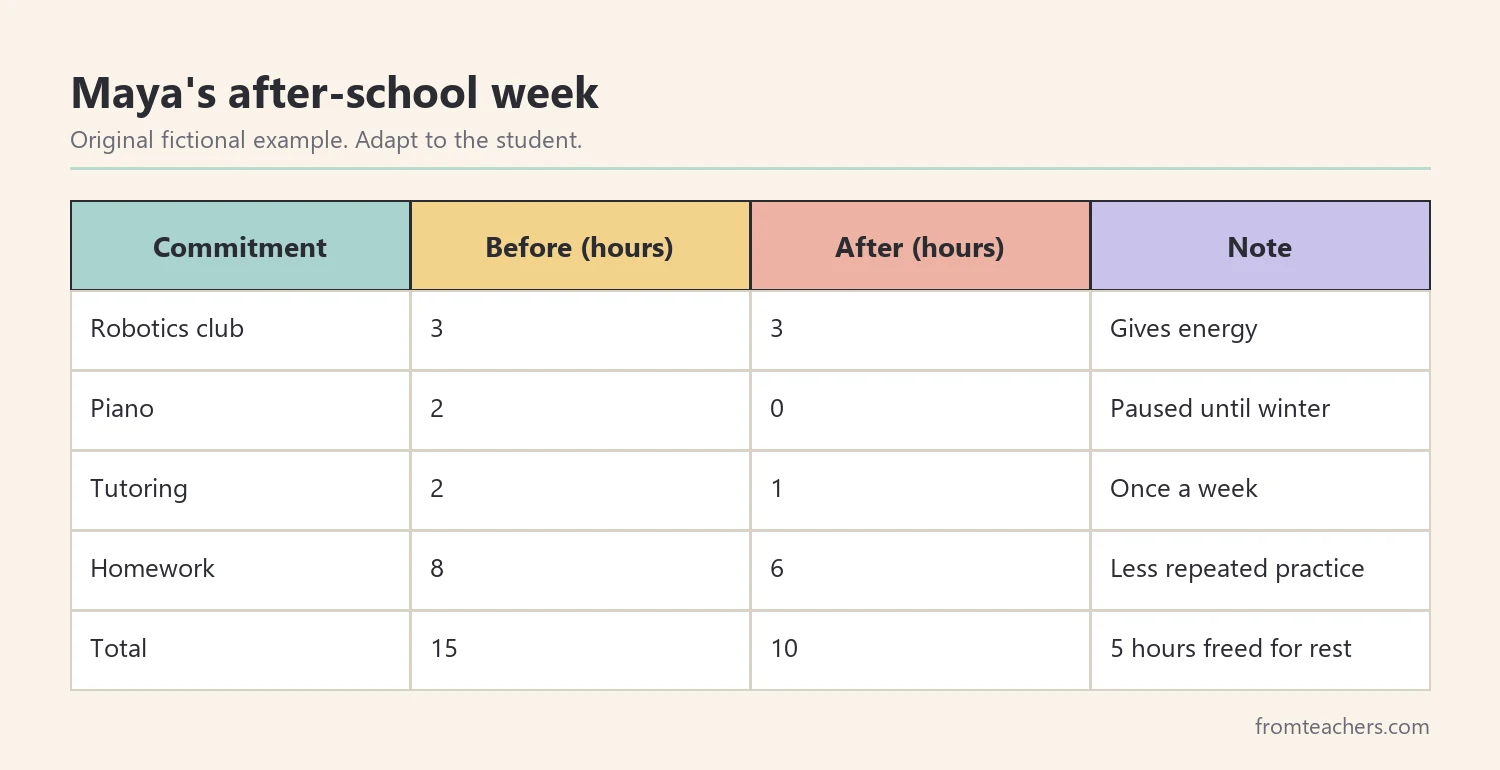
Many neurodivergent students carry too much at once: demanding classes, therapies, clubs, tutoring, and homework. So look at the whole week, not only school hours. Student burnout prevention often depends more on what happens after 3 p.m. than on any single classroom strategy.
First, list every commitment and how long it takes. Next, ask the student which activities give energy and which drain it. Then, choose one or two changes the family can actually make.
For Maya, the team listed her after-school hours for a typical week. Robotics club took 3 hours, piano took 2 hours, tutoring took 2 hours, and homework took about 8 hours, for a total of 15 hours. Maya said robotics gave her energy, while piano had started to feel like another test.
Together, they agreed on three changes. Maya paused piano until winter break, tutoring moved to one hour a week, and her teachers trimmed homework to about 6 hours by reducing repeated practice items. Her new total was 10 hours, which freed 5 hours each week for rest.
Also, define what rest means for the student. Rest is not laziness; it is how the brain recovers. For Maya, rest meant drawing, walking the dog, and quiet time with headphones. Another student might recharge with a bike ride or a favorite video game. In short, student burnout prevention makes room in the week before the student has to ask for it.
If you want a ready-made structure for these conversations, the burnout prevention strategy tables for neurodivergent learners include a page on correcting an overloaded schedule, with clear steps you can walk through with a student.
4. Teach self-advocacy as part of student burnout prevention
Adults cannot catch every warning sign. That is why the student needs a simple, practiced way to say, “I need something to change.” Self-advocacy is one of the most durable tools in student burnout prevention because it travels with the student into every class.
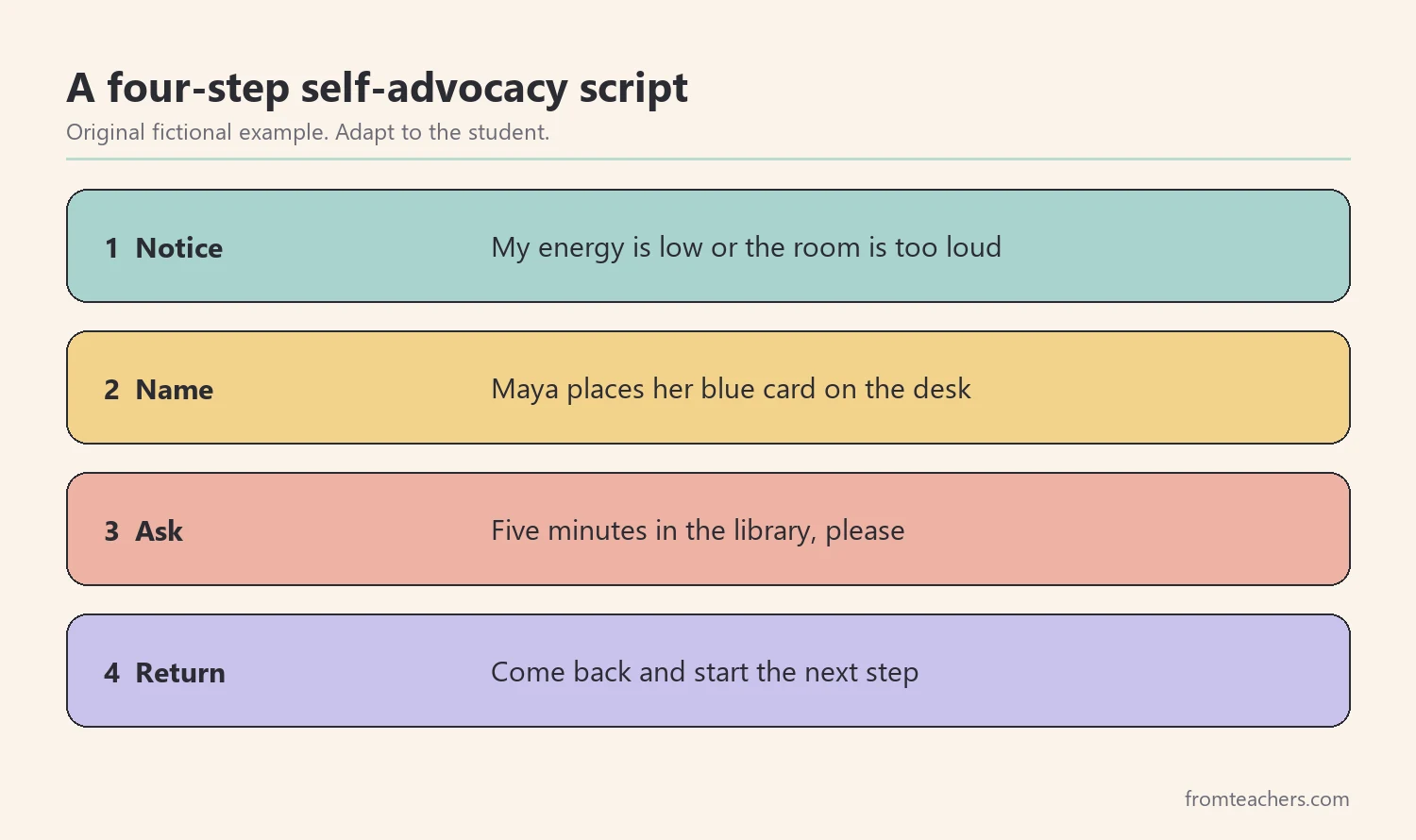
Start with a short script. Keep it to three or four steps, and practice it when the student is calm, not in the middle of overload.
- Notice: “My energy is low,” or “The room is too loud.”
- Name: Tell a trusted adult in words, on a card, or with a signal.
- Ask: Request one specific support, like a break or a quieter seat.
- Return: Come back to the task with a clear next step.
Maya practiced her script with her teacher twice during homeroom. She chose a small blue card to place on her desk when she needed five minutes in the library. In the first week, she used the card twice and returned to class both times within ten minutes.
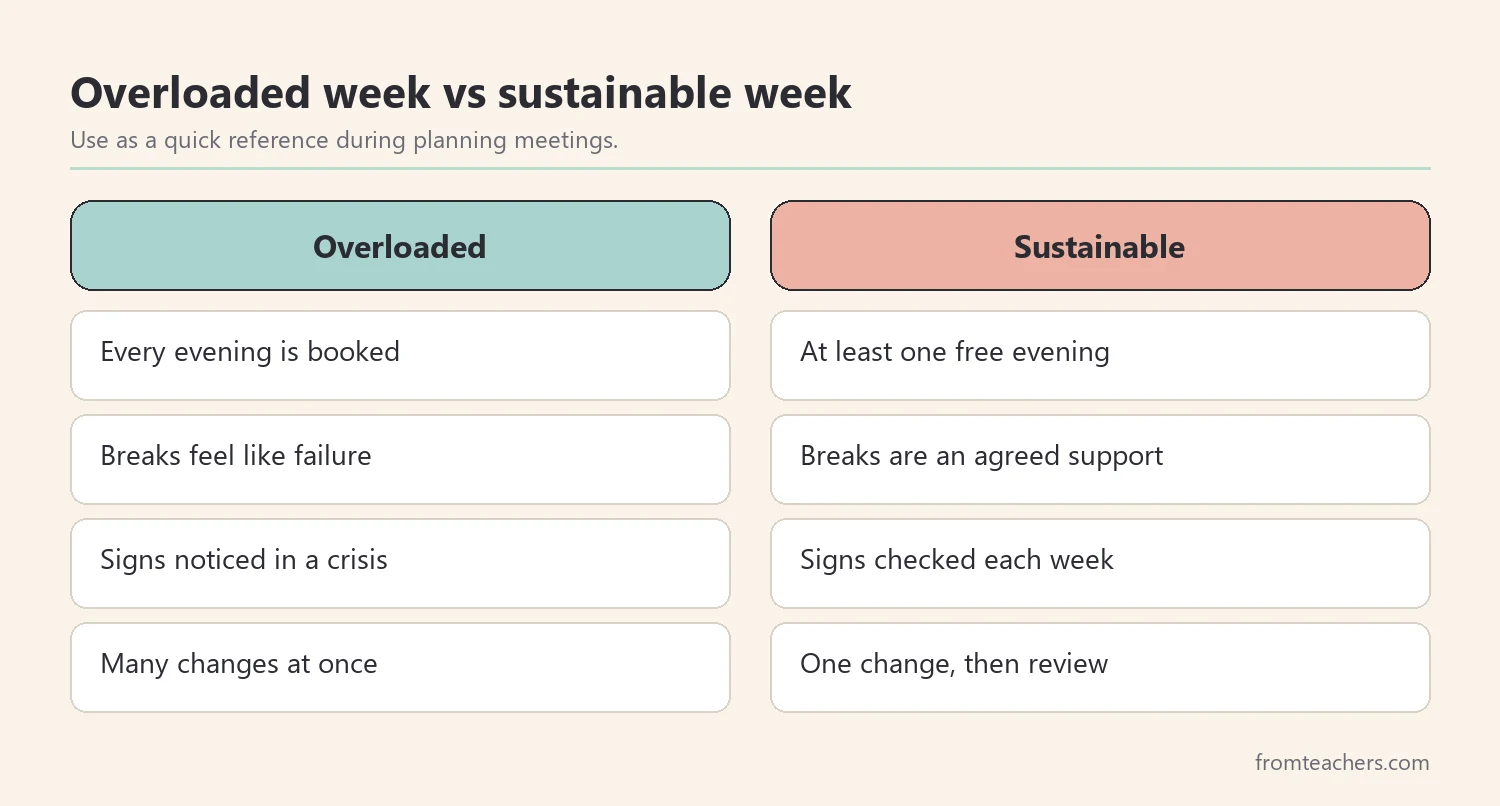
Also, address the fear of judgment directly. Many students worry that taking a break makes them look lazy or different. Therefore, explain that the break is an agreed support, and make sure every adult who teaches the student honors it the same way.
Finally, celebrate the ask, not only the return. When a student uses the script, they are doing exactly what you taught them to do. With practice, the script turns student burnout prevention into something the student can start on their own.
5. Add sensory and executive function supports
Sensory overload and executive function fatigue are two large energy drains. When you reduce them, students have more energy left for learning and friendships.
Practical student burnout prevention also looks at the environment itself, because the room, the noise, and the daily routine can drain energy as much as the workload does.
For sensory needs, offer simple options: headphones, a quieter work space, permission to leave a noisy area a few minutes early, and a calm place to eat lunch. Similarly, give advance notice before fire drills or assemblies whenever possible.
For executive function, cut down on the invisible work. For example, post the day’s agenda in the same place every day, break long assignments into parts with separate check-ins, and keep one folder for everything that goes home.
Maya’s team added two supports. First, she ate lunch in the library three days a week with one friend. Second, her science teacher split a two-week project into four short checkpoints, so Maya always knew the next step.
Keep supports small and consistent. A few changes used every day work better than many changes used now and then. In addition, write them down so substitutes and new staff can follow them.
6. Review progress with student burnout prevention in mind
Every two to three weeks, look back at the statements you wrote in step 1. Are they happening more often? What changed, and what still feels hard?
Keep the review short and include the student. A ten-minute check-in with three questions is usually enough:
- What helped your energy most in the last few weeks?
- What still drains you?
- What is one thing we could try next?
After three weeks, Maya was on time 14 of 15 school days, compared with 7 of 10 days earlier, and she had missed only one homework assignment. She was drawing again most evenings. As a result, the team kept the lighter schedule and planned to revisit piano after winter break.
Also, celebrate a successful school week out loud. Naming what went well helps the student remember that recovery is possible. Over time, student burnout prevention becomes a routine the student owns, not a rescue the adults run.
Common mistakes and how to avoid them
Even careful teams slip into habits that undercut student burnout prevention. Here are the most common ones, with a simple fix for each.
- Mistake: waiting for a crisis. Fix: run a quick weekly sign check so small changes get noticed early.
- Mistake: looking only at school hours. Fix: list every after-school commitment and its time.
- Mistake: treating rest as a reward. Fix: schedule rest as a basic need, not something earned.
- Mistake: changing everything at once. Fix: make one or two changes, then review before adding more.
- Mistake: uneven break rules. Fix: write the agreed break support down and share it with every adult.
Questions teachers and parents ask about student burnout prevention
How is burnout different from a bad week?
A bad week usually improves after a weekend or a short rest. Burnout lasts longer, and skills the student had before may slip. If tiredness and withdrawal continue for several weeks, talk with the family and the student’s team. Student burnout prevention works best when you act on that pattern early.
Can student burnout prevention start mid-year?
Yes. You can start at any point. Begin with a short sign check and a look at the whole week, then choose one change to try right away.
What if the family cannot drop any activities?
Then look for smaller adjustments inside the school day, such as reduced repeated practice, a calm lunch space, or fewer transitions. Even protecting one quiet evening can help.
Should the student be part of every meeting?
Include the student whenever it is appropriate for their age and comfort. Their view of what drains and restores them is often the most useful information the team has. Shorter meetings with clear questions make participation easier.
Who should we contact if things get worse?
If you notice signs of serious distress, contact the school counselor, school psychologist, or the family’s health provider right away. Student burnout prevention supports wellbeing, but it does not replace professional care.
Related reading: Understanding Autistic Burnout and School Exhaustion: Prevention and Support Strategies, Managing Sensory Overload: Practical Strategies for Autism and ADHD, and Understanding Demand Avoidance and School Refusal: Strategies for PDA-Style Profiles.
A companion resource for student burnout prevention:
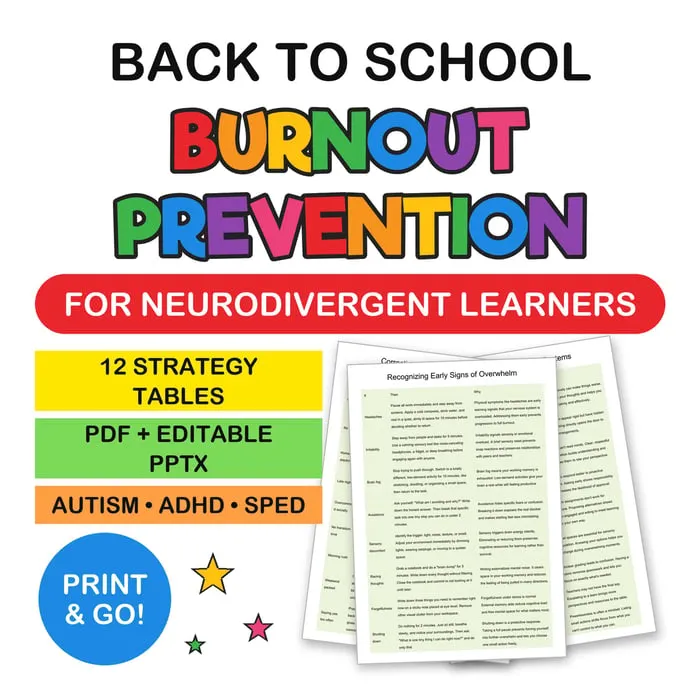
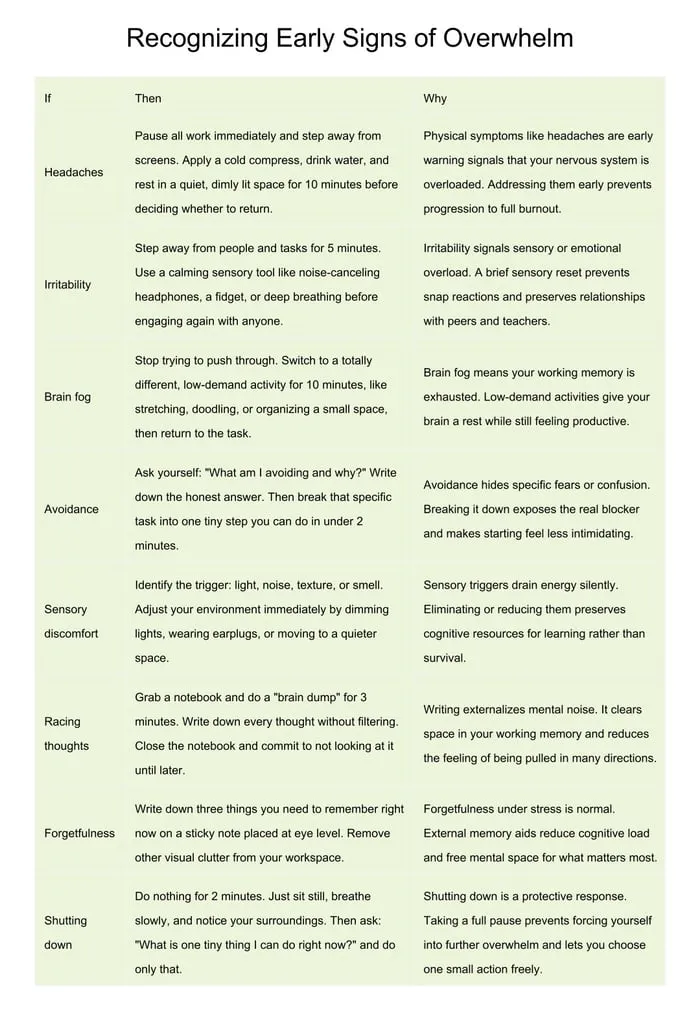
Back to School Burnout Prevention for Neurodivergent Learners: Strategy Tables: 12 one-page strategy tables for students, teachers, and families, covering early signs of overwhelm, sensory overload, overloaded schedules, executive function fatigue, self-advocacy, and fear of judgment for taking breaks. Includes a PDF and an editable PowerPoint.
Sources and scope
- IRIS Center, Vanderbilt University: free modules on classroom supports, behavior, and evidence-based practices.
- Understood.org: practical articles for families and teachers on learning and thinking differences.
- CDC autism information: general background on autism spectrum disorder.
- IDEA, U.S. Department of Education: the law behind special education services, IEPs, and accommodations.
This guide covers everyday school and home strategies for protecting energy and preventing overwhelm. It does not cover diagnosis, mental health treatment, or crisis response, which belong to qualified professionals and the student’s team.
Key takeaways
- Define a good week in a few observable statements, written with the student.
- Compare signs with the student’s own usual pattern, week by week.
- Count all commitments, and free real time for rest.
- Practice a short self-advocacy script when the student is calm.
- Review every two to three weeks and change one thing at a time.










Leave a Comment