

Demand avoidance in school often shows up in a small, ordinary moment. You hand out a writing page, and one student pushes it away, slides under the desk, or starts talking about something else entirely. From the front of the room, demand avoidance in school can look like defiance. Often, though, the student is not choosing to refuse. The request has simply landed as a threat.
This guide walks you through a five-step process to tell “can’t right now” apart from “won’t,” reduce the pressure that sets off avoidance, and keep learning moving. By the end, you will have a short observation plan, a set of lower-pressure ways to phrase requests, and a simple record you can review with the family and the team.
Examples are fictional. Adapt to the student’s goals and agreed supports. This is guidance, not a diagnosis.
At a glance
- Avoidance is often a stress response, not a plan to break rules.
- Look for the hidden demands: transitions, wording, uncertainty, and being watched.
- Lower the pressure in how you ask, not the learning goal itself.
- Build predictability and real choice into the day.
- Record a few simple measures and review them together every few weeks.
1. Understand what demand avoidance in school looks like
First, it helps to name what you are seeing. Demand avoidance in school describes a pattern where a student resists or escapes everyday requests, even ones they can do and sometimes even ones they enjoy. The resistance can be loud, like refusing or leaving, or quiet, like stalling, joking, or suddenly needing the bathroom.
Next, think about the nervous system. When a person feels safe, they can think, plan, and follow directions. When a person feels under threat, the body shifts toward fight, flight, or freeze. Those responses are automatic. A student in that state is not weighing a choice in the way adults often assume.
In addition, demand avoidance can appear in students with very different profiles. Some autistic students show it strongly, and some families and clinicians describe a PDA-style profile. Students with ADHD may avoid tasks that feel long or unclear. Students who have lived through trauma may react to anything that feels like losing control. The label matters less in the classroom than the pattern you can see, because demand avoidance in school looks similar across these profiles.
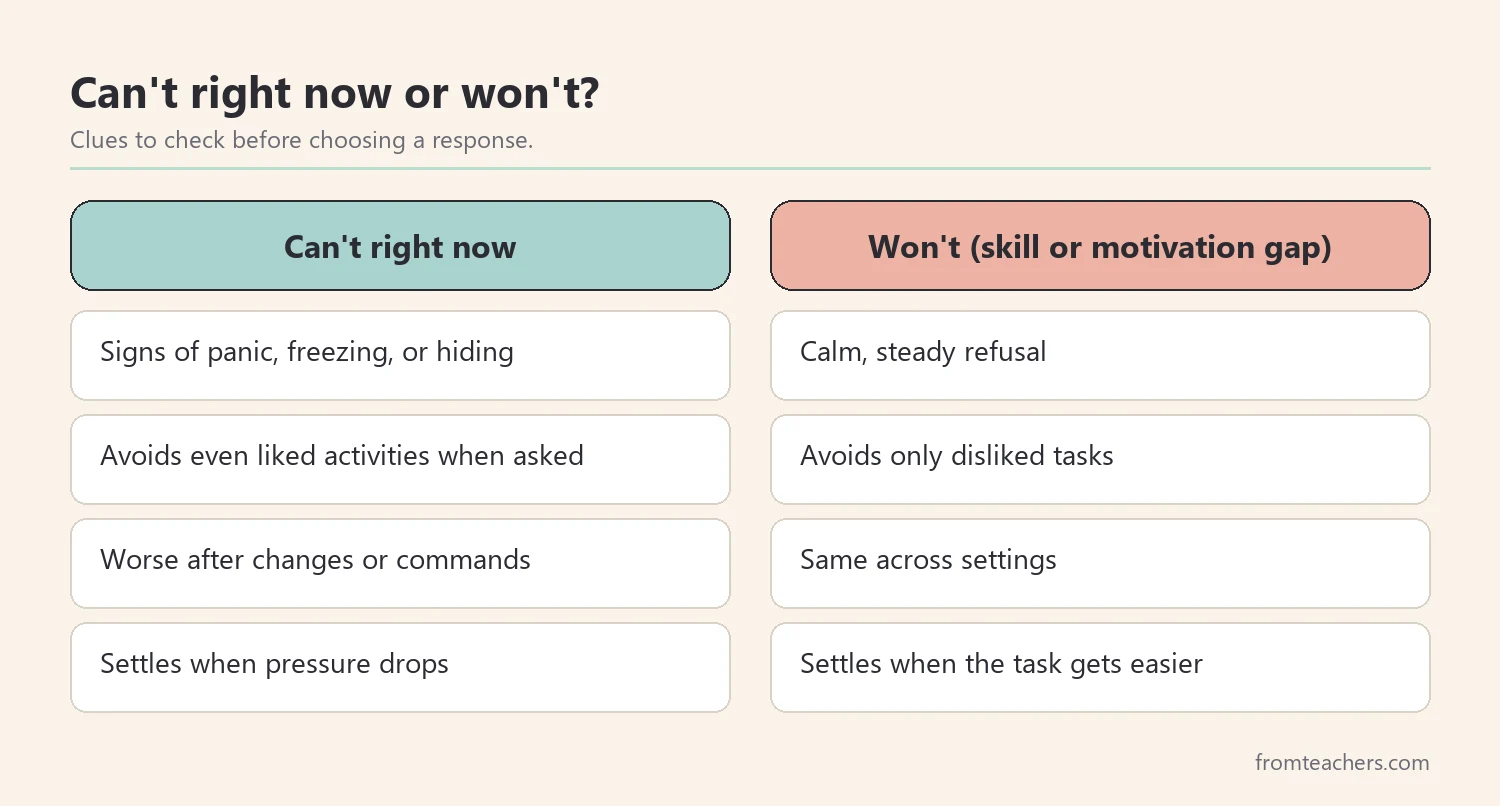
Worked example. Lina is a fictional student in grade 3. She reads well and loves drawing. However, when her teacher says, “Everyone take out your journals and write three sentences,” Lina often hides her face, says the task is stupid, or walks to the book corner. On days with free drawing time, she starts instantly. Her teacher begins to wonder whether the problem is writing, or the way writing is asked for.
So, before you change anything, hold one question in mind: what about this moment feels unsafe or out of control for this student? That question leads to better plans than “how do I make her comply?”
2. Observe the hidden demands
Many demands are not obvious, and that is why demand avoidance in school can seem to come out of nowhere. A direct instruction is a demand, but so is a transition, a change in schedule, a question asked in front of peers, a timer, or even praise that raises expectations. Therefore, the second step is to spend a few days noticing which demands come right before avoidance.
Keep the method simple. Use a sticky note or a short log, and for each episode write the time, the activity, what was said or asked, and what the student did. Then, look for repeats. Often, demand avoidance in school clusters around a few types of moments rather than spreading evenly across the day.
| Hidden demand | How it can feel | Possible adjustment |
|---|---|---|
| Sudden transition | Loss of control | Advance warning and a visual |
| Direct command | Pressure, no way out | Indirect or shared wording |
| Open-ended task | Uncertain, endless | Clear start and finish |
| Being watched | Fear of failing in public | Private check-in |
| Unexpected change | Threat to predictability | Preview changes early |
Worked example. Over four days, Lina’s teacher logs seven episodes. Five happen when a whole-class command starts a writing task. One happens when an assembly replaces art without notice. Only one happens during a quiet, self-chosen activity. The pattern points to direct commands and surprise changes, not to a dislike of school.
In short, a few days of notes turn demand avoidance in school from a mystery into a short list of triggers you can work with. As a result, your plan targets the moments that matter most.
3. Lower the pressure without lowering the goal
Once you know the triggers, change how the demand is delivered. The learning goal can stay the same. What changes is the wording, the timing, and how much control the student feels. This is the heart of responding well to demand avoidance in school.
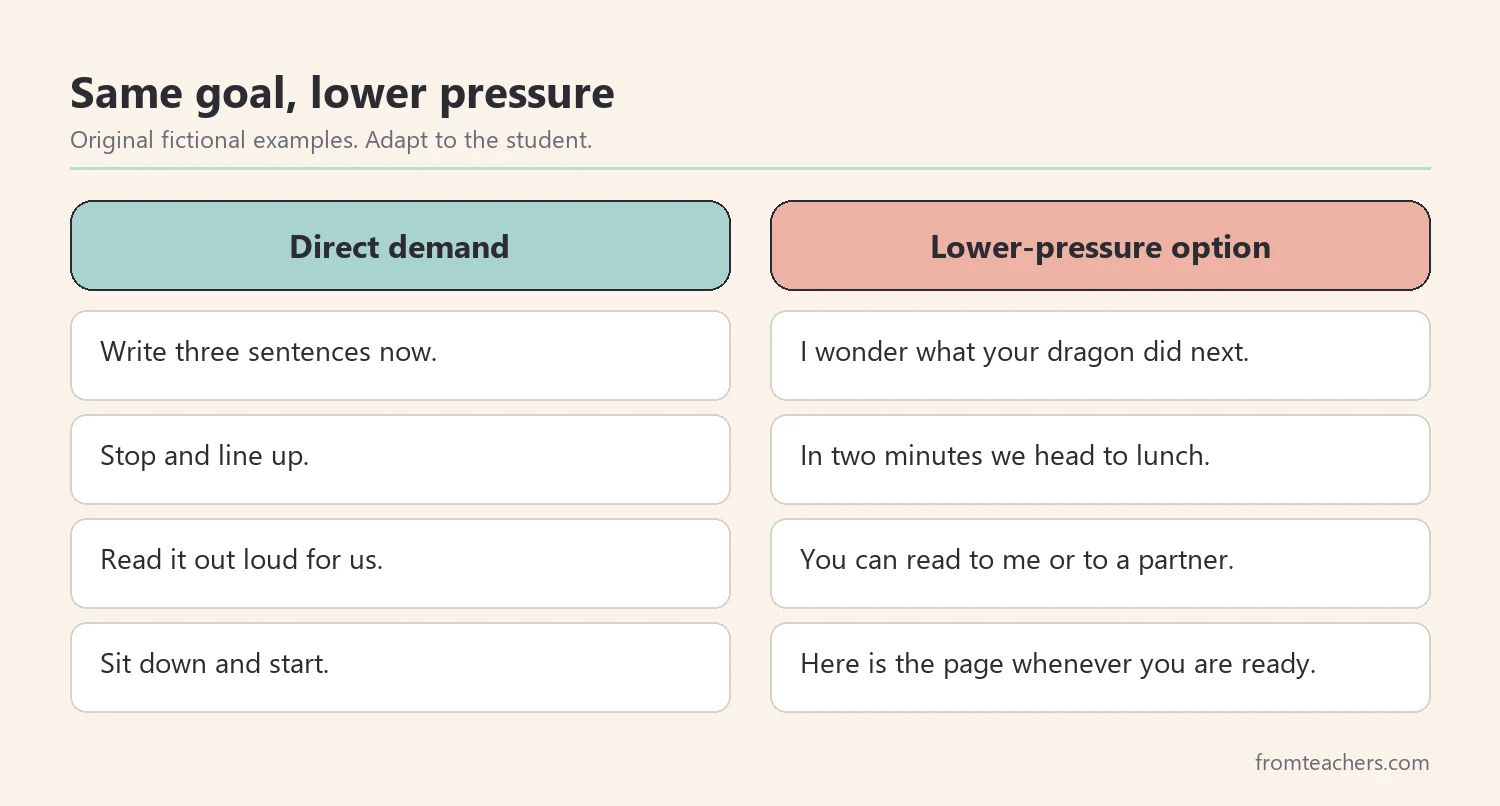
Start with language. Direct commands such as “Do this now” can be swapped for indirect or shared phrasing. For example, “I wonder how this story starts,” “Let’s see what the first line could be,” or “Here is the page for whenever you are ready.” In addition, try placing the task nearby rather than handing it over, and give a little processing time before expecting a start.
Next, offer real choices. A choice of pen or pencil, journal or laptop, first sentence or last sentence first, gives back a sense of control. Keep the choices small and genuine. If both options lead to the same goal, you lose nothing and the student gains a way in.
Also, notice your own body language, since adult posture can quietly feed demand avoidance in school. Standing over a desk, repeating the request, or raising your voice all add pressure. Sitting at eye level, speaking softly, and stepping back after making the offer usually help more.
If you want a deeper reference for staff training, the Demand Sensitivity Across Autism, ADHD, and Trauma Profiles slides cover direct versus indirect demands, language and transitions as hidden demands, and reflection prompts for team discussion.
Worked example. Instead of “Write three sentences,” Lina’s teacher places the journal on her desk and says, “I’m curious what your dragon did next. You can draw it first or write it first.” Lina draws for four minutes, then adds two sentences under her picture.
4. Build predictability to reduce demand avoidance in school
Predictability lowers threat. When a student knows what is coming, how long it lasts, and what happens after, there is less to defend against. So, the fourth step is to make the structure of the day visible and steady.
A visual schedule is a good starting point. Show the order of activities, mark changes as early as possible, and let the student check or move items themselves. In addition, warn before transitions with a quiet signal or a short countdown, rather than a sudden call to stop.
Then, plan a safe place and a safe exit. Many students settle faster when they know there is an agreed spot where they can calm down without it being a punishment. Agree on how they will signal the need and how they will return. However, keep the return gentle, without a lecture.
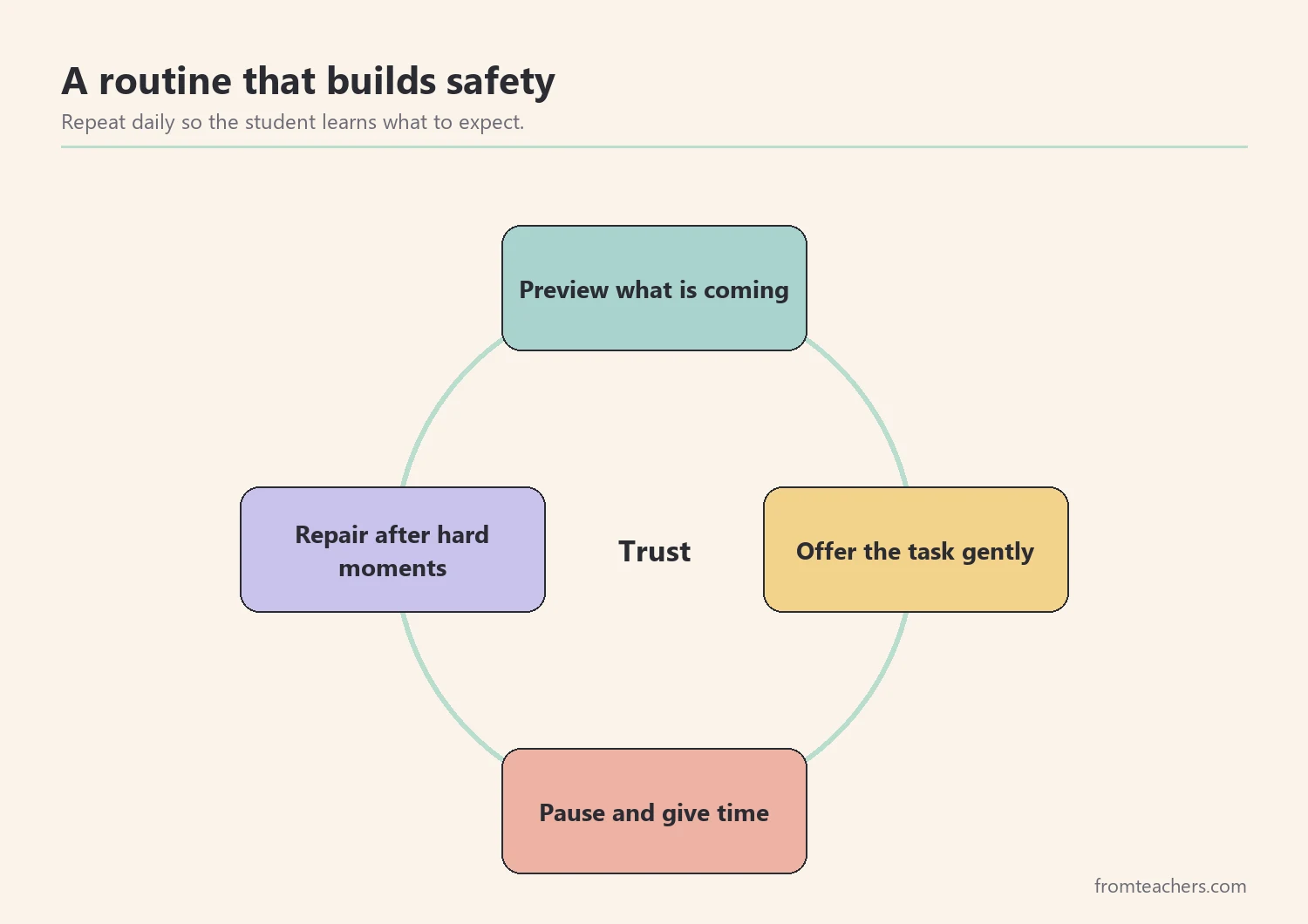
Finally, protect the relationship. Students who avoid demands often need to feel that an adult is on their side before they can take risks with work. Brief, low-pressure moments of connection, such as noticing something they like, can matter as much as any strategy aimed at demand avoidance in school.
Predictability checklist
- A visual schedule the student can see and handle.
- Advance notice of changes, ideally the day before.
- A quiet transition signal instead of a sudden stop.
- An agreed calm spot with a clear way back.
- One or two moments of connection each day with no demand attached.
Worked example. Lina’s teacher adds a small picture schedule to her desk and moves the Friday assembly card into place on Thursday afternoon. Before journal time, she gives a two-minute heads-up. Lina also has a beanbag in the reading corner she can use for five minutes, then return when the sand timer runs out.
5. Record and review demand avoidance in school with the team
Without a record, it is easy to forget the good days and remember only the hard ones. Therefore, choose two or three simple measures and track them on the same days each week. Tracking demand avoidance in school does not need a complex system.
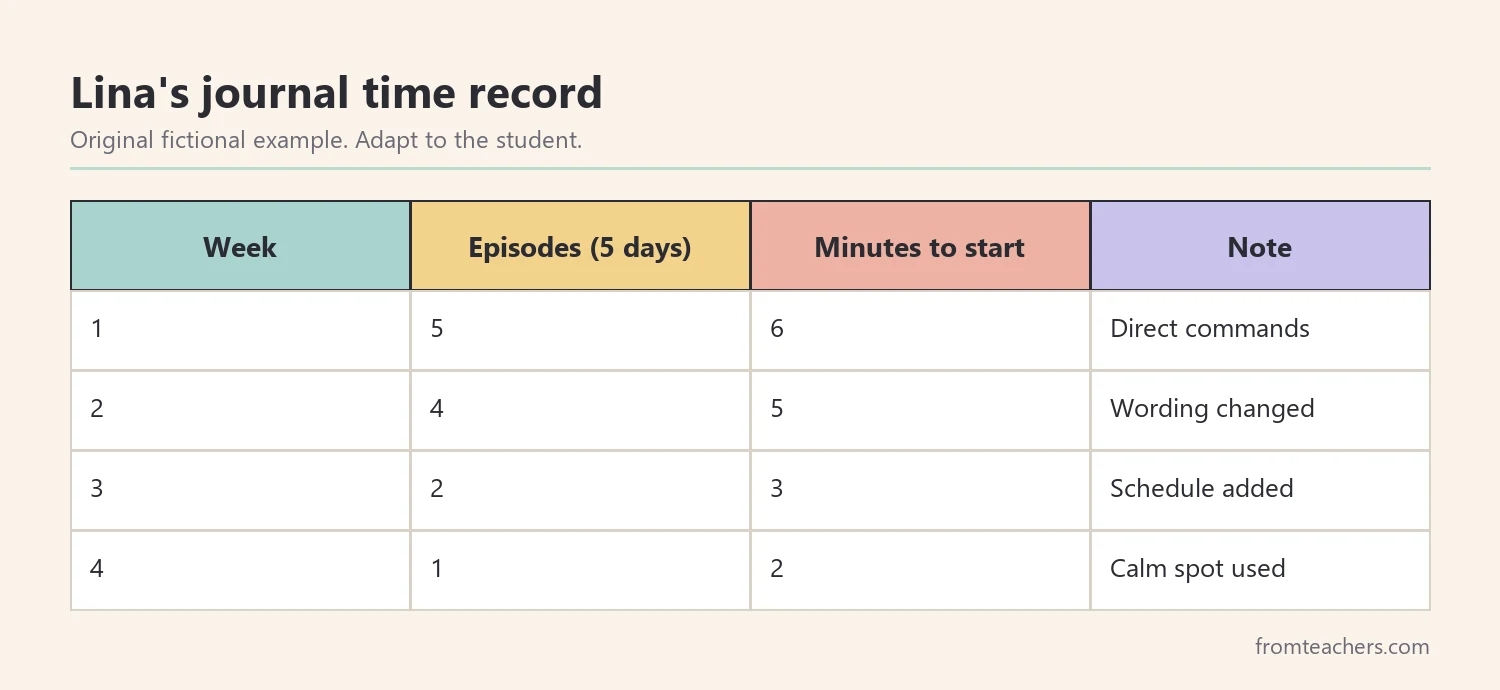
Useful measures of demand avoidance in school include the number of avoidance episodes during a target activity, the minutes until the student starts, and whether the student returned on their own after a break. In addition, add a short note when something unusual happens, such as a substitute teacher, a fire drill, or a poor night of sleep reported by the family.
Then, review every three to four weeks with the family and, where relevant, the IEP or 504 team. Families often know which approaches to demand avoidance in school match what works at home and which phrases set off resistance. Share one success and one next step. Keep any change small, so you can tell what made the difference.
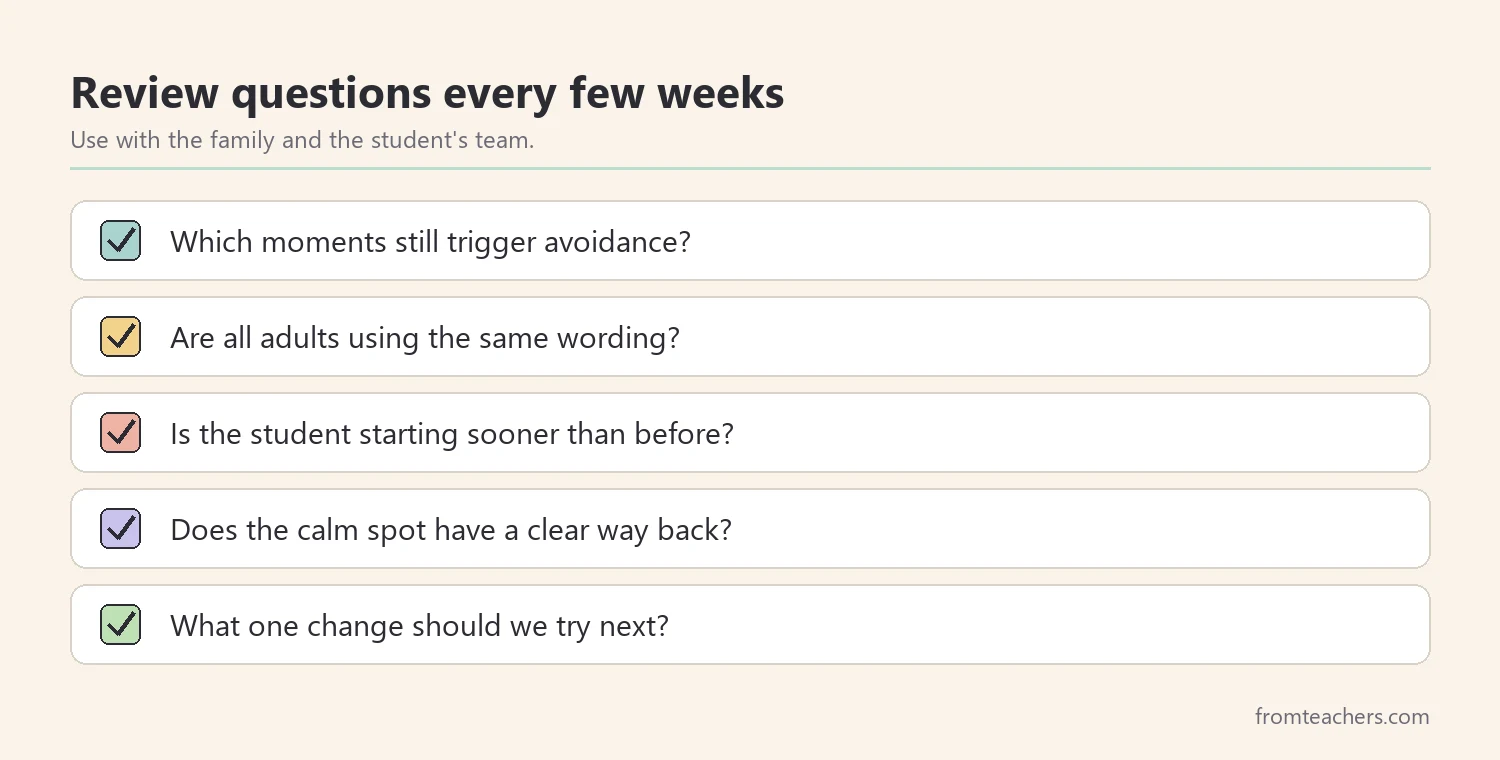
Worked example. Lina’s teacher tracks journal time on five days a week. In week 1, Lina has 5 episodes across the 5 days and takes about 6 minutes to start. By week 4, she has 1 episode and starts within 2 minutes on most days. At the review, her parents mention that “I wonder” phrasing also works at bedtime, so everyone agrees to use it consistently.
Common mistakes and how to avoid them
- Treating every refusal as defiance. This raises pressure and often makes avoidance worse. Fix: ask what made the moment feel unsafe before deciding on a response.
- Repeating the demand louder. Repetition adds threat. Fix: make the offer once, calmly, then give time and space.
- Removing the goal entirely. Avoiding all demands can leave gaps in learning. Fix: keep the goal and change the delivery, timing, and choices.
- Using fake choices. “You can do it now or lose recess” is not a choice. Fix: offer two options that both lead to the learning goal.
- Surprise changes. Unexpected shifts are a common trigger. Fix: preview changes as early as you can, visually and in words.
- Changing too much at once. You will not know what helped. Fix: try one change, record it, then add the next.
Questions teachers and parents ask about demand avoidance in school
Is demand avoidance in school the same as PDA?
Not exactly. Demand avoidance is a behavior pattern that can appear in many students. PDA is a term some families and professionals use for a specific profile, often discussed alongside autism. Any formal identification belongs to qualified professionals, while this guide focuses on classroom responses.
Won’t lowering pressure teach the student to avoid more?
The aim is to lower threat, not expectations. When a student feels safer, they are usually more able to engage, and you can slowly increase challenge. Your data will show whether engagement is growing.
How do I handle this with a whole class watching?
Keep responses private and low-key. Use a quiet word, a written note, or a gesture, and avoid public countdowns or consequences. Many lower-pressure approaches, such as choices and visual schedules, also help other students.
What if the student avoids even things they enjoy?
That can happen when the activity starts to feel expected or watched. Try reducing attention on the activity, letting the student start on their own, and praising quietly or later. Enjoyment often returns when the pressure drops.
When should we involve the wider team?
If avoidance is frequent, getting more intense, or affecting attendance, bring your notes to the family and the school team. They can look at evaluation, supports, and whether a behavior plan or IEP changes are needed.
Related reading: Understanding Demand Avoidance and School Refusal: Strategies for PDA-Style Profiles, Essential Trauma-Informed Teaching Strategies for Modern Classrooms, and Meltdowns vs Tantrums: A Guide to Understanding and Responding.
A companion resource for demand avoidance in school:
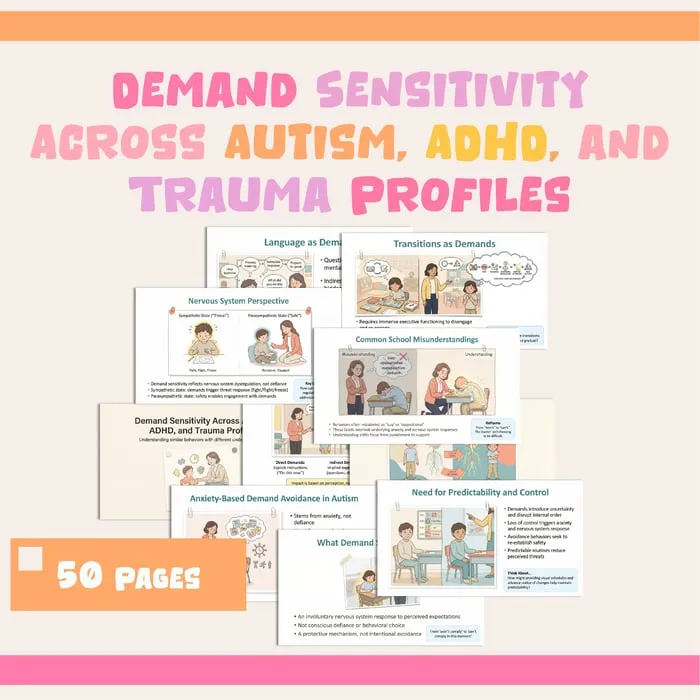
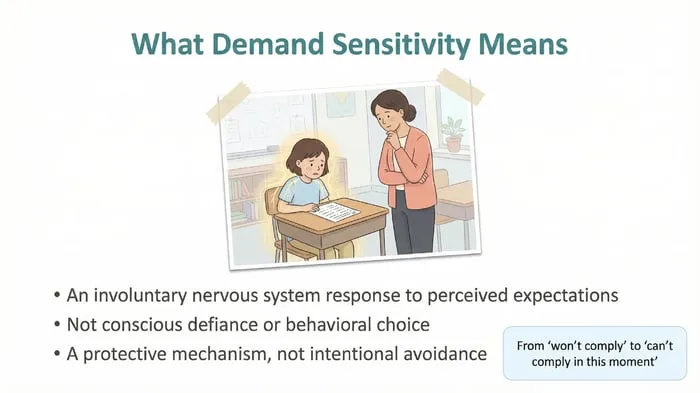
Demand Sensitivity Across Autism, ADHD, and Trauma Profiles: a 50-slide professional development resource on fight, flight, and freeze responses, language and transitions as hidden demands, direct versus indirect demands, predictability and control, and reflection prompts for staff.
Sources and scope
- PDA Society: information and guidance for families and educators on PDA-style profiles.
- National Child Traumatic Stress Network: resources on trauma and its effects on children, including in schools.
- IRIS Center, Vanderbilt University: free modules on classroom behavior and evidence-based practices.
- CDC autism information: general background on autism spectrum disorder.
- IDEA, U.S. Department of Education: the law behind special education services and IEPs.
This guide covers everyday classroom responses to avoidance of demands. It does not cover diagnosis, therapy, or crisis intervention, which belong to qualified professionals and the student’s team.
Key takeaways
- Demand avoidance in school is often a stress response, so start by asking what feels unsafe.
- Track the hidden demands behind demand avoidance in school, such as transitions, commands, and surprise changes.
- Keep the goal, but soften the wording and offer real choices.
- Make the day predictable and agree on a calm spot with a clear way back.
- Record a few measures and review them with the family every few weeks.










Leave a Comment