

Special education classroom management often breaks down in the same small moments: the shift from reading to math, the minute after lunch, or the wait while you help one student and four others drift. You know the students, you know the goals, and still the room feels like it runs you instead of the other way around.
This guide works like a short course. By the end, you will be able to set up a calm room, write and teach routines, plan transitions, respond to behavior in a steady way, and review what is working each week. Examples are fictional. Adapt to the student’s goals and agreed supports. This is guidance, not a diagnosis.
At a glance
- Strong special education classroom management is planned before students arrive, not invented in the moment.
- Routines are skills: write them down, model them, practice them, and praise them.
- Transitions need their own plan, with a visual cue, a warning, and a clear first step.
- Respond to behavior with a short, calm, predictable script.
- Track one simple measure and adjust every week or two.
1. Set up the room for special education classroom management
First, look at your space through a student’s eyes. Where do they enter, where do they put their things, and where do they go when they feel overwhelmed? Clear answers to those questions prevent many problems before they start.
Next, give every area a single job. A small group table is for teaching. A quiet corner is for resetting. An independent work area is for practice. When an area has one purpose, students learn what to do there without many words from you.
Also, make the day visible. A picture or word schedule at student eye level answers “what comes next?” before anyone has to ask. For some students, a personal schedule strip on the desk works better than a large wall chart.
Consider our fictional student, Leo, grade 3. Leo often wanders during independent work because he is unsure where finished papers go. His teacher adds a labeled “Done” tray next to his desk and a small check box on his schedule strip. Within a few days, Leo walks to the tray, drops his page, and checks the box without prompting.
| Area | One job | Visual cue |
|---|---|---|
| Entry | Unpack and check schedule | Picture steps by the door |
| Teacher table | Small group lessons | Group name card |
| Work area | Independent practice | Task box and Done tray |
| Calm corner | Short reset | Timer and choice board |
Finally, walk the room once after school. Notice crowded paths, supplies that are hard to reach, and noisy spots. Moving one shelf can remove a daily trigger. Good special education classroom management starts with the physical space because the space quietly teaches all day.
2. Write routines as clear, short steps
In special education classroom management, many problems are routine problems. Students are not refusing; they are guessing. Therefore, the most useful planning time you can spend is writing your key routines as three to five short steps each.
Start with the routines that cause the most trouble. For most rooms, that list includes arrival, getting help, independent work, and cleaning up. Write each step as an action the student can see, such as “put your folder in the blue bin,” rather than a value, such as “be responsible.”
Then, turn each routine into a visual. Photos of your actual students’ materials work well, and simple icons are fine too. Post the routine where it happens, not on a wall across the room.
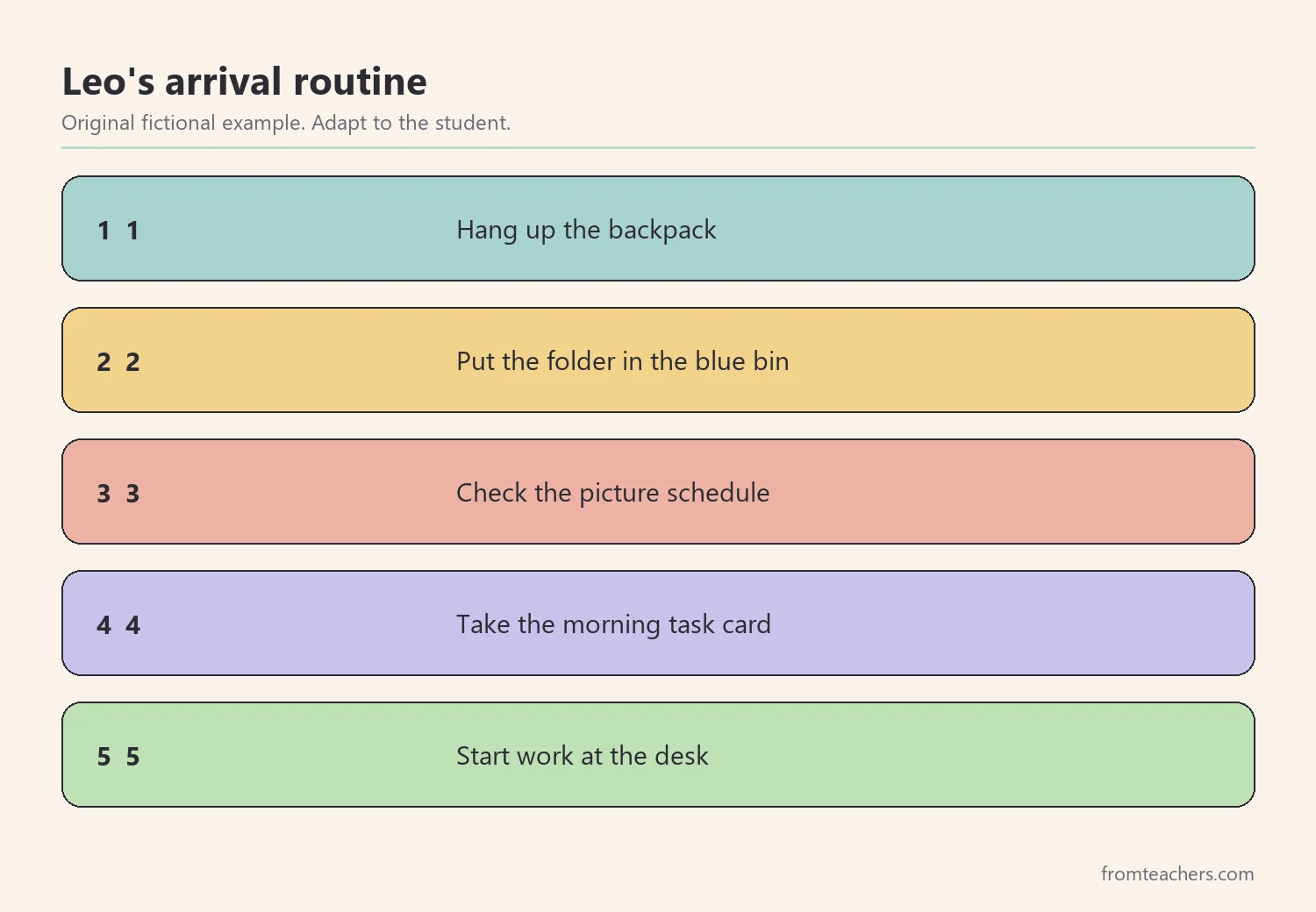
For Leo, the arrival routine had been a single instruction: “get ready.” His teacher rewrote it as five steps: hang up the backpack, put the folder in the bin, check the schedule, take the morning task, and start at the desk. Because each step is concrete, Leo and the paraprofessional can both point to the same picture instead of repeating directions.
In addition, keep the wording identical across adults. When the teacher says “check your schedule” and an aide says “see what’s next,” some students hear two different tasks. Consistent language is a quiet but powerful part of special education classroom management.
If you want ready-made examples to compare with your own routines, the comic-style classroom management dos and don’ts guide shows common habits next to more effective alternatives for engagement, behavior, and transitions.
3. Teach and practice routines like any other skill
In special education classroom management, writing a routine is only half the work. Next, you teach it with the same care you give a reading or math skill: model, practice, give feedback, and practice again.
Begin by modeling the routine yourself while you narrate each step. Then invite one student to model it while others watch. After that, the whole group practices, and you give specific praise for each correct step: “You put your folder in the bin right away.”
Also, practice before you need it. The first two weeks of school, the week after a break, and the day before a substitute arrives are all good times for short practice runs. A two-minute rehearsal costs far less than a twenty-minute recovery.
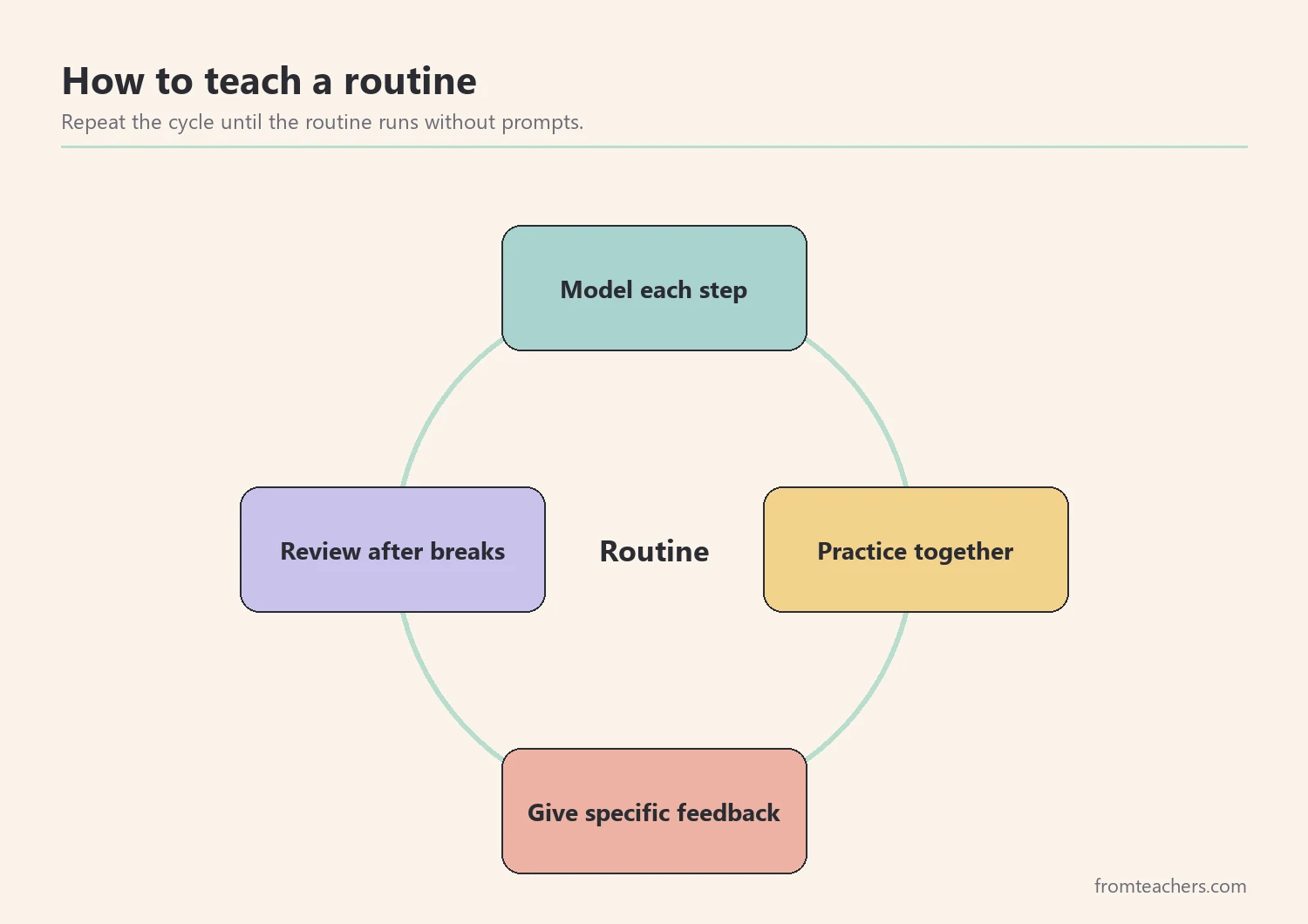
Meanwhile, plan prompts that fade. For Leo, the teacher first points to each picture on the arrival chart. After a week, she points only to the first picture. By the third week, she simply stands near the chart. Each step gives Leo a little more independence.
Finally, celebrate the routine, not just the student. Saying “Our arrival routine was smooth today, everyone was working in four minutes” builds a group identity around calm habits. That shared pride is a real strength of steady special education classroom management.
4. Plan transitions in special education classroom management
Transitions are where special education classroom management is tested most, and where many rooms lose their calm. Students move, materials change, and adult attention is split. As a result, a transition deserves its own small plan, just like a lesson.
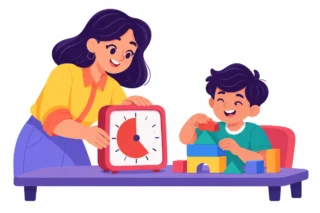
A reliable transition plan has four parts. First, a warning: “Two more minutes of reading.” Second, a visual cue, such as a timer or a chime. Third, a clear ending step: “Put your book in the basket.” Fourth, a clear first step for the next activity: “Sit at the math table and take your whiteboard.”
Moreover, give the students who find change hardest a little extra structure. A personal transition card, a job during the change (such as carrying the pencil cup), or going first can make a large difference.
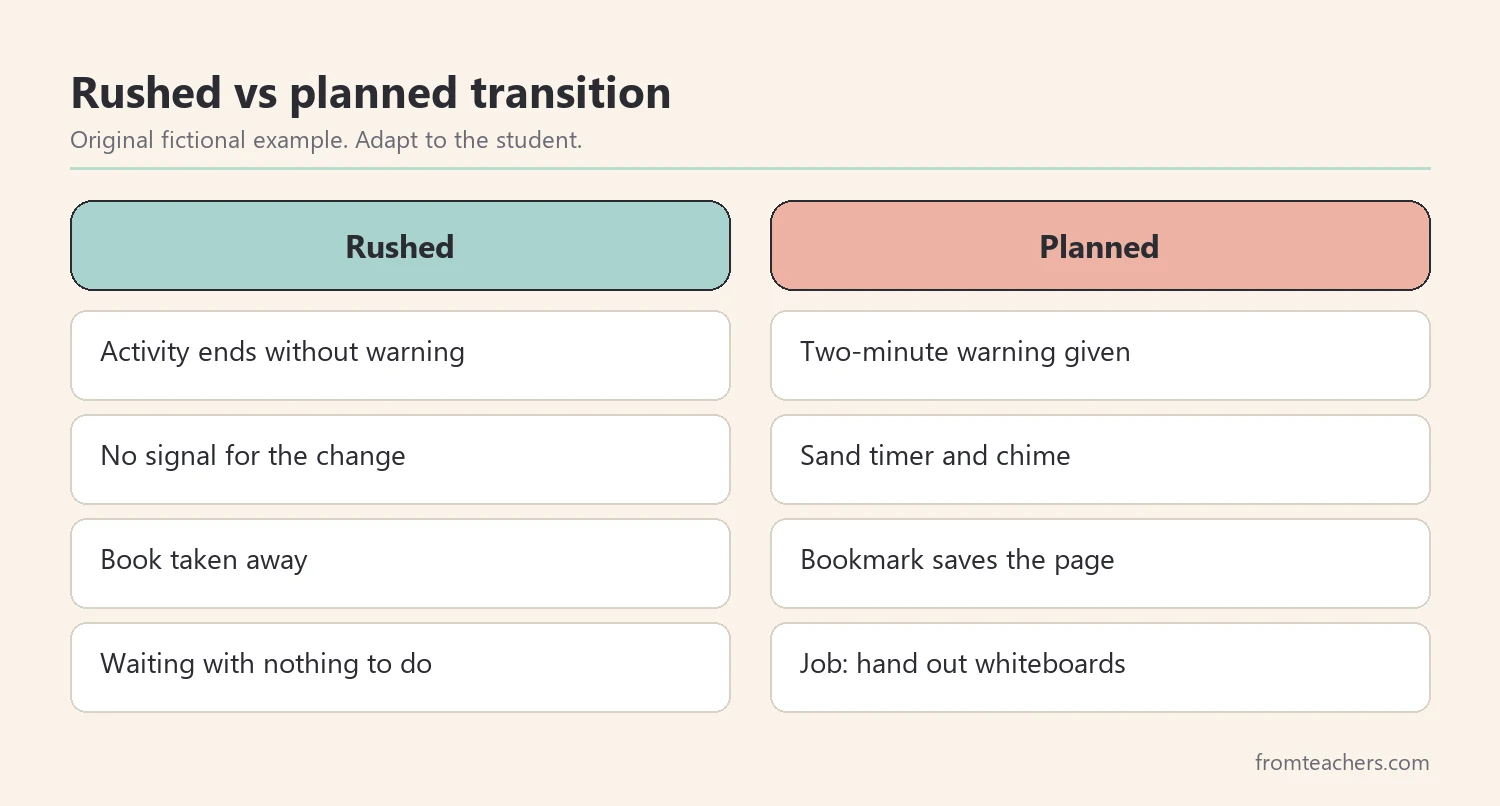
For example, Leo struggled when reading ended. He kept reading and became upset when the book was taken. His teacher added a two-minute warning, a sand timer on his desk, and a bookmark so he could save his page. Then she gave him the job of handing out whiteboards. The transition became something he did, not something done to him.
Also, keep transitions short. If students regularly wait with nothing to do, problems fill the gap. Have the next materials ready before you give the signal. Strong special education classroom management treats every minute of waiting as a design problem you can solve.
5. Respond to behavior with a calm, predictable script
Even with good routines, hard moments will happen, and special education classroom management includes planning for them. What matters is that your response is calm, brief, and predictable, so students know exactly what comes next.
Start with the lowest-key response that works. Proximity, a quiet look, a pointed gesture to the routine card, or a whispered reminder often settles a situation without stopping the lesson. Save longer conversations for later, when everyone is calm.
Next, use a short script for common situations. For example: “I see you are upset. You can take a break or ask for help.” Then wait. Offering two acceptable choices gives control back to the student without a power struggle.
Furthermore, separate the behavior from the person. “Throwing materials is not safe. Let’s pick them up together” focuses on the action. Avoid public charts or comments that shame a student, because they tend to damage trust and rarely change the behavior.
In Leo’s case, when frustration rose during writing, the plan was simple. The teacher pointed to the break card, Leo chose the calm corner, and a three-minute timer started. When the timer ended, she met him with a short re-entry step: “Write one sentence, then we check it together.” In this fictional example, the pattern became familiar, and over the following weeks Leo began asking for the break before frustration turned into a larger moment.
Finally, follow your school’s behavior procedures and the student’s IEP or behavior plan. Effective special education classroom management supports those plans; it never replaces them.
6. Record and review what is working
Without a record, it is hard to tell whether a change in your special education classroom management helped. Therefore, choose one simple measure for the routine you are working on and track it for two to four weeks.
Keep the measure small and quick to record, such as minutes until the class is working after arrival, or the number of prompts a student needs during a transition. A tally on a clipboard is enough.
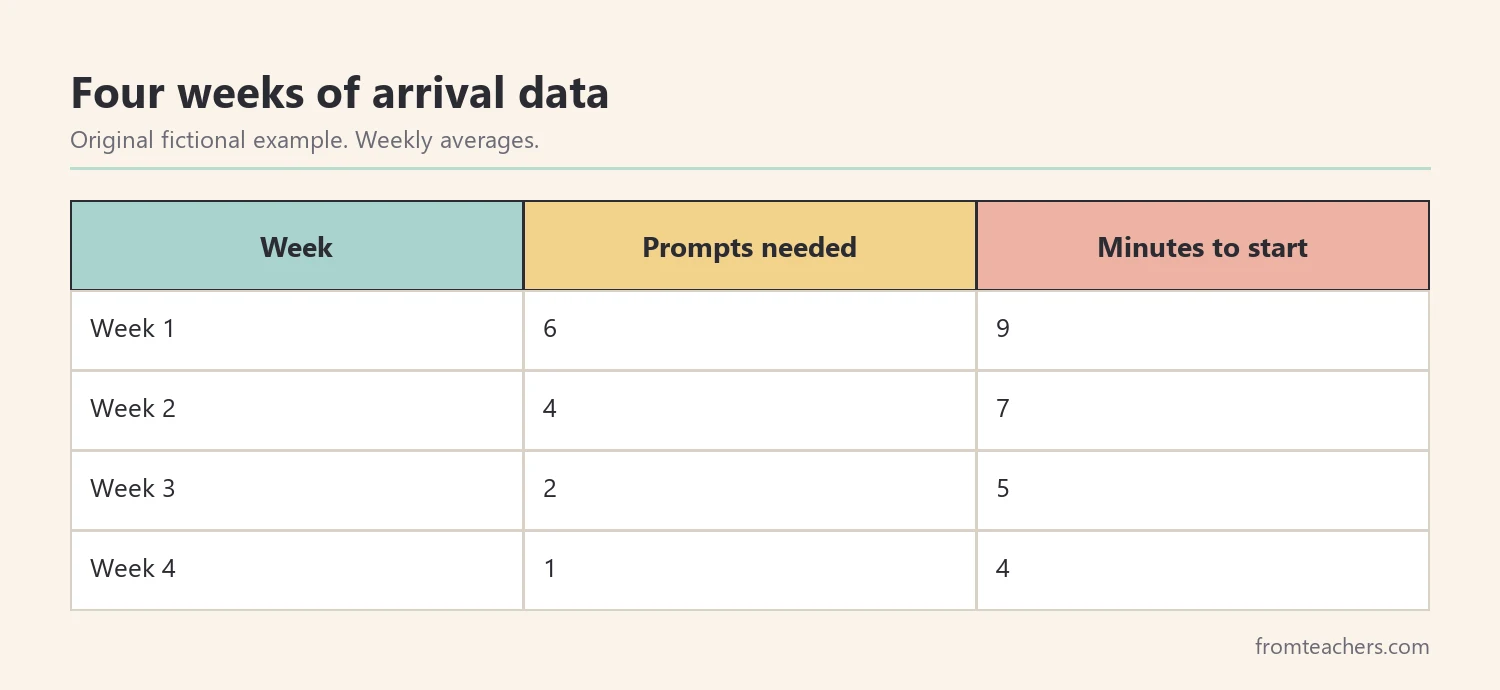
For Leo, the teacher recorded two numbers each morning and wrote the weekly average. In week 1, he needed about 6 prompts and took 9 minutes to start. By week 4, he needed about 1 prompt and started within 4 minutes. That trend told the team the routine was working and that prompts could keep fading.
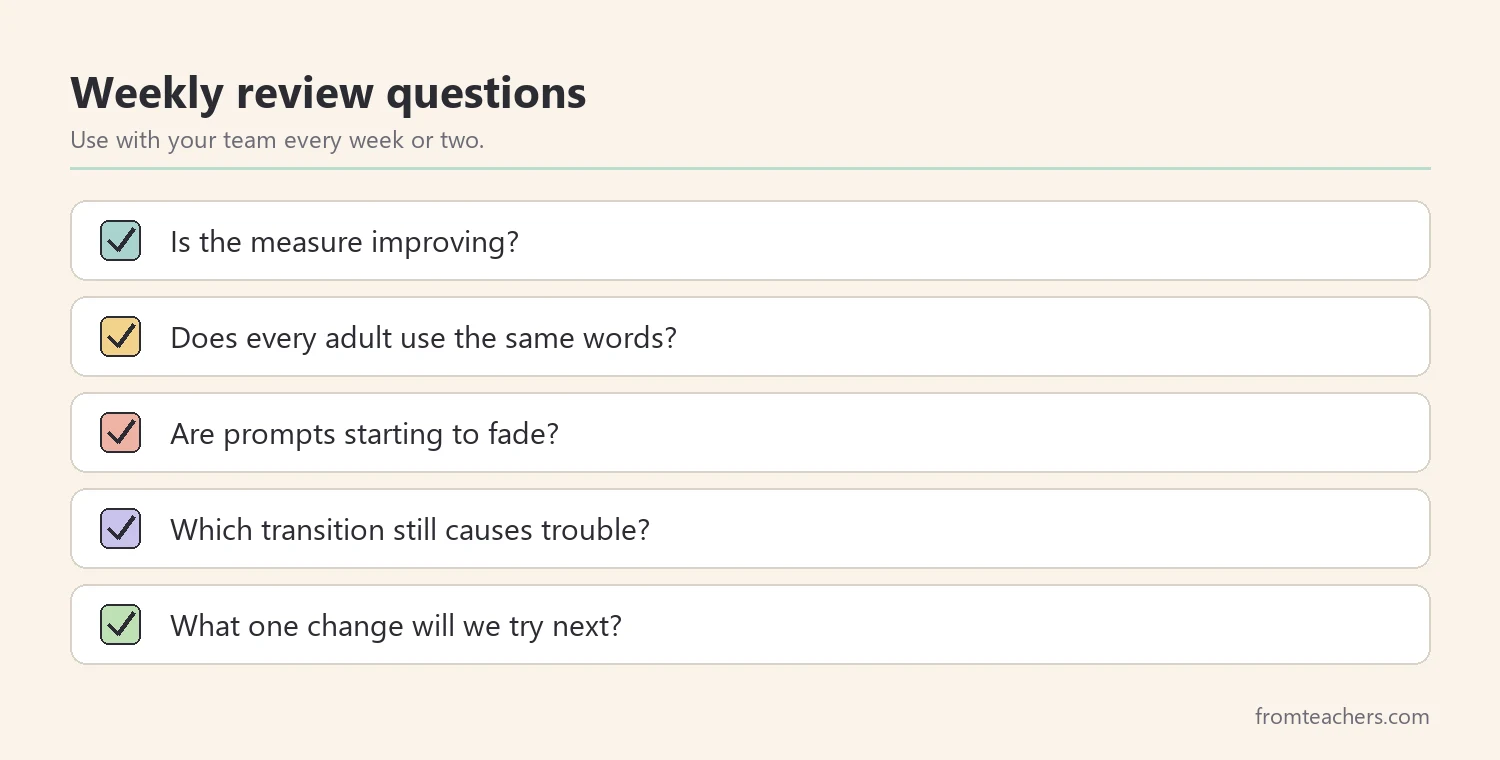
Then, review the data with your team every week or two. Ask three questions: Is the measure improving? Is the plan being used the same way by every adult? What one change would we try next? Short, regular reviews keep special education classroom management responsive instead of rigid.
Also, share progress with families. A quick note such as “Leo is starting morning work in about four minutes now” builds partnership and lets families use the same language at home.
Common mistakes and how to avoid them
- Mistake: Posting rules but never teaching them. Fix: model, practice, and praise each routine, especially in the first weeks and after breaks.
- Mistake: Using different words for the same routine. Fix: agree on one script with every adult in the room and post it.
- Mistake: Starting transitions without a warning. Fix: give a time warning, a visual cue, and a clear first step for the next activity.
- Mistake: Long lectures during a hard moment. Fix: use a short, calm script with two acceptable choices, and talk more later.
- Mistake: Changing the whole system every week. Fix: change one thing at a time and track one simple measure.
- Mistake: Public behavior charts. Fix: give private, specific feedback and celebrate group routines instead.
Questions teachers and parents ask about special education classroom management
What is the most important part of special education classroom management?
Predictable routines combined with warm relationships make the biggest difference. Students feel safer when they know what comes next and trust the adults around them. Everything else builds on that base.
How long does it take for a new special education classroom management routine to stick?
It varies by student and routine. Many teachers plan for daily practice over at least two to three weeks, then lighter reviews after breaks. Your own tracking will tell you when prompts can fade.
Do these strategies work in general education classrooms?
Yes. Visual schedules, taught routines, and planned transitions help most learners. They are especially helpful for students with IEPs who are included in general education settings.
How do I get paraprofessionals on the same page?
Share the written routines and the exact scripts you use. Model them, then watch each other and give quick feedback. A short weekly check-in keeps everyone consistent.
How can parents support classroom routines at home?
Ask the teacher for the words and visuals used for special education classroom management in class. Using the same language for routines like getting ready in the morning helps children carry skills from school to home.
Related reading: Moving Beyond Shame and Behavior Charts: Positive Alternatives for Effective Classroom Management, Special Education Strategies: 10 Powerful Ways Teachers Can Succeed, and Meltdowns vs Tantrums: A Guide to Understanding and Responding.
A companion resource for special education classroom management:
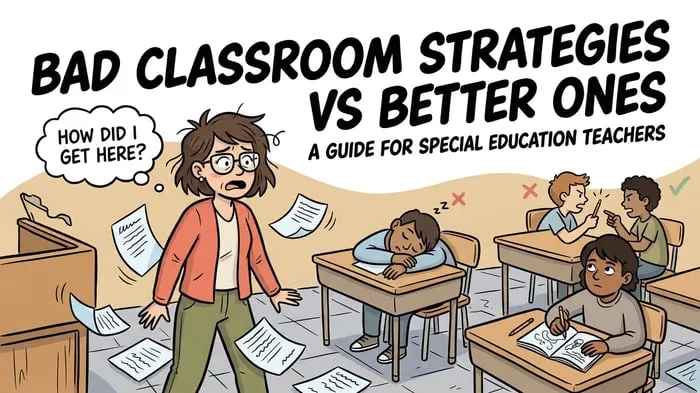
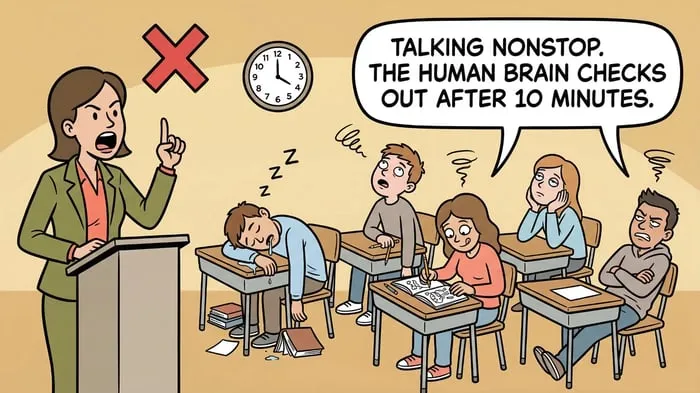
Classroom Management Strategies: Dos and Don’ts for SPED Teachers: a 51-page comic-style guide that pairs common classroom habits with more effective alternatives, covering engagement, behavior, transitions, differentiation, and communication.
Sources and scope
- IRIS Center, Vanderbilt University: free modules on classroom behavior management, routines, and evidence-based practices.
- Center on PBIS: guidance on positive behavioral interventions and supports in schools.
- IDEA, U.S. Department of Education: the law behind special education services and IEPs.
- What Works Clearinghouse: reviews of education research, including practice guides on classroom behavior.
This guide covers everyday classroom routines, transitions, and calm responses to behavior. It does not cover formal behavior assessments, crisis procedures, or individual behavior plans, which belong to the student’s team and your school’s policies.
Key takeaways
- Special education classroom management starts with a room where every area has one clear job.
- Write routines as short, visible steps and use the same words across adults.
- Teach routines with modeling, practice, and feedback, then fade prompts.
- Plan transitions with a warning, a cue, and a clear first step.
- Track one simple measure and review it with your team every week or two.








Leave a Comment