

ODD parenting strategies matter most at 7:45 on a school morning, when a simple “shoes on, please” turns into a shouting match and everyone leaves the house upset. Teachers see the same pattern at 9:00, when a direction to put away a tablet becomes a standoff in front of the class.
This guide to ODD parenting strategies turns those moments into a plan. After reading, you will be able to strengthen your connection with the child, prevent many power struggles, give directions that are easier to follow, stay calm during defiance, and solve recurring problems together with the child and the school.
Examples are fictional. Adapt to the student’s goals and agreed supports. This is guidance, not a diagnosis.
At a glance
- Defiance often signals a lagging skill, such as flexibility or frustration tolerance.
- Daily positive time builds the relationship that makes limits easier to accept.
- Clear, calm directions and real choices prevent many power struggles.
- Predictable, proportionate consequences work better than bigger punishments.
- Solving recurring problems together, at a calm time, reduces repeat conflicts.
Oppositional defiant disorder (ODD) is diagnosed by a qualified professional. However, the ODD parenting strategies below are useful for any child with frequent arguing and refusal, with or without a formal diagnosis.
1. Start ODD parenting strategies by reading the defiance
Effective ODD parenting strategies start with a shift in thinking. Children with this pattern are not usually trying to ruin the day. More often, they struggle with skills many of us take for granted: shifting from one activity to another, handling frustration, or tolerating being told no.
So begin by looking for patterns instead of reacting to each incident. For one week, jot down when the conflicts happen, what was asked, and what happened right before. You will often see that most blowups cluster around a few predictable moments.
Meet Leo, a fictional eight-year-old in third grade. At home, his mother notices that most arguments happen during three moments: getting ready in the morning, stopping screen time, and starting homework. At school, his teacher sees the same thing at transitions, especially when Leo must stop a preferred task.
| Moment | What was asked | Likely lagging skill |
|---|---|---|
| Morning routine | Get dressed now | Shifting between tasks |
| Screen time ends | Turn off the tablet | Stopping a preferred activity |
| Homework | Start math | Frustration tolerance |
This simple record changes the question from “Why won’t he listen?” to “Which skill is hard here, and how can we help?” That shift lowers adult frustration, which matters, because calm adults are the foundation of every strategy that follows.
2. Build connection with daily positive time
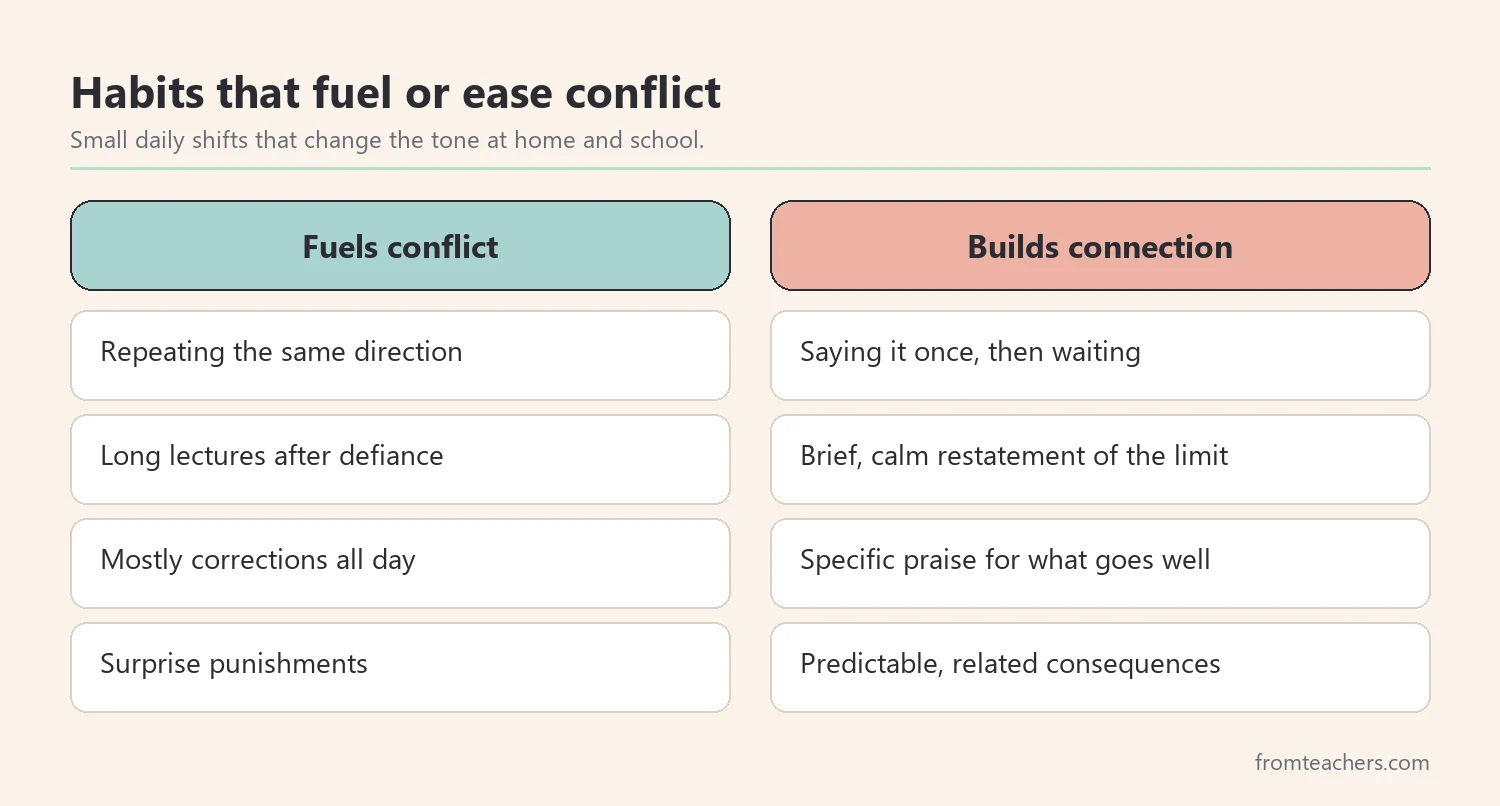
Children who argue a lot often hear many corrections each day. Over time, the relationship can start to feel like one long negotiation. Therefore, one of the most important ODD parenting strategies is to protect a short, daily window of positive time that has nothing to do with rules.
Set aside 10 to 15 minutes. Let the child choose the activity, within reason. During this time, avoid questions, commands, and teaching. Instead, describe what the child is doing, praise specific positive behavior, and simply enjoy being together.
For Leo, his father sets up 15 minutes of Lego building after dinner. He says things like “You’re adding a second tower” and “You stayed patient when that piece didn’t fit.” He does not correct the build. After two weeks, Leo starts asking for “Lego time” and is a little quicker to accept the bedtime routine afterward.
Also, look for chances to catch the child being good throughout the day. Specific praise sounds like “You turned off the TV the first time I asked. Thank you.” Many family guides suggest aiming for far more positive comments than corrections. You do not need a perfect ratio; you need the child to hear clearly what is going well.
Teachers can do a classroom version. A two-minute check-in at the door each morning, a job that gives the student responsibility, or a quick note home about something positive all strengthen the relationship.
3. ODD parenting strategies for clear directions and choices
How adults ask matters, and clear requests sit at the heart of ODD parenting strategies. Vague, repeated, or question-style directions invite debate. “Can you maybe get ready?” sounds optional. In contrast, a clear direction is short, specific, and stated once in a calm voice.
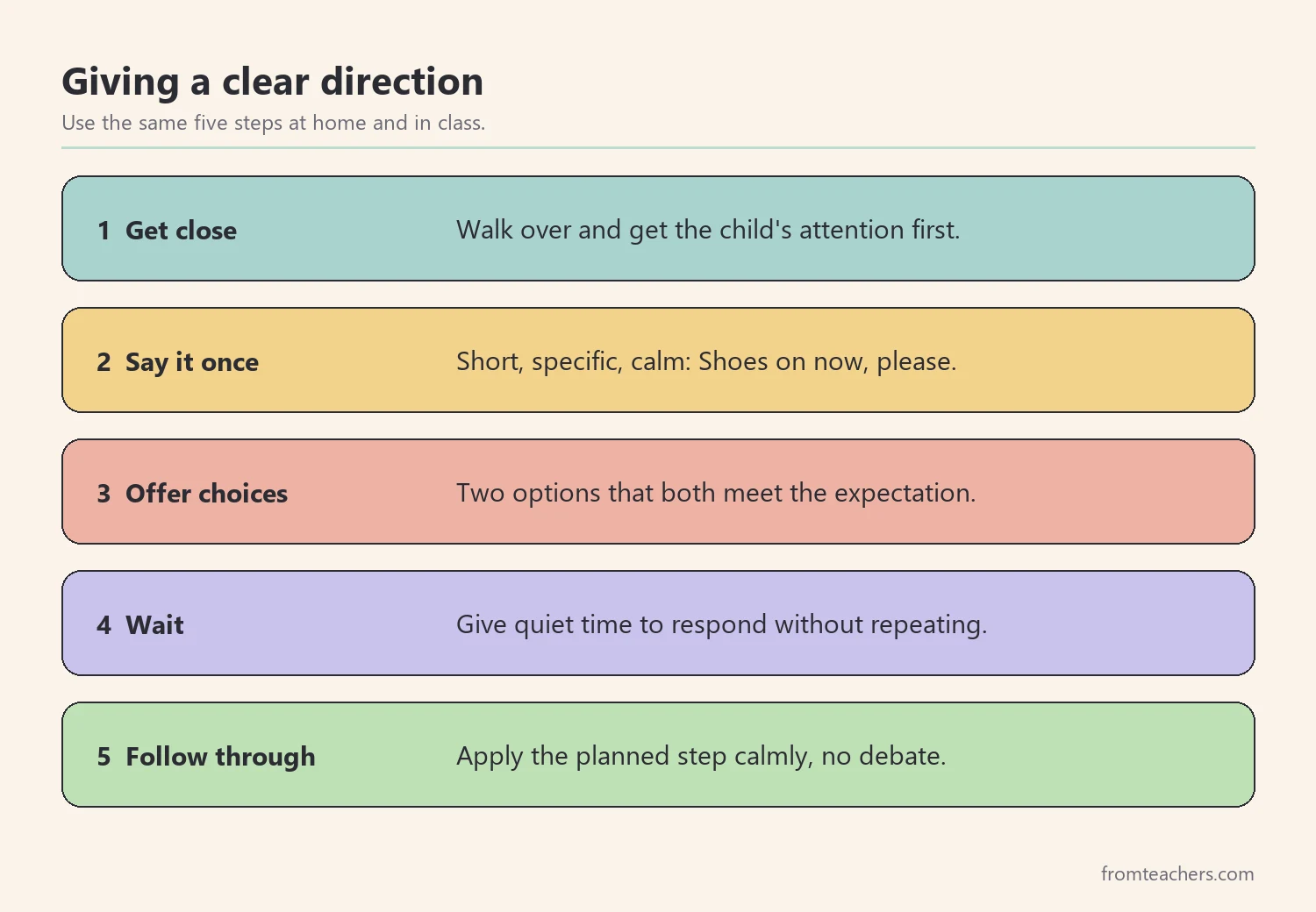
- Get close: walk over and get the child’s attention instead of calling from another room.
- Say it once: “Shoes on now, please.” Then wait quietly.
- Offer two choices: “Sneakers or boots?” Both choices still meet the expectation.
- Give a warning before transitions: “Five minutes left, then tablet off.”
- Follow through calmly: if the child does not respond, apply the planned consequence without arguing.
Choices are powerful because they give the child some control without giving up the limit. Leo’s mother stops saying “Get dressed” five times. Instead, she says once, “Clothes on before breakfast. Blue shirt or green shirt?” Leo still grumbles, but he picks a shirt most mornings.
For ready-made language for home and school, a guide such as the ODD strategies guide for parents and teachers organizes approaches like offering choices, consistent consequences, and classroom reinforcement into separate sections for each adult. That way, everyone uses the same playbook.
4. Use ODD parenting strategies to stay calm during defiance
Even with good prevention, defiance will happen. In these moments, the adult’s reaction often decides whether the conflict lasts two minutes or forty. Arguing, lecturing, and raising your voice tend to add fuel. Staying calm and brief tends to lower it.
Like all ODD parenting strategies, this works best when you plan your response in advance, so you are not inventing it in the heat of the moment. A simple script helps: name the feeling, restate the limit, and step back. For example: “You’re mad that screen time is over. The tablet goes in the basket. I’ll be in the kitchen.”
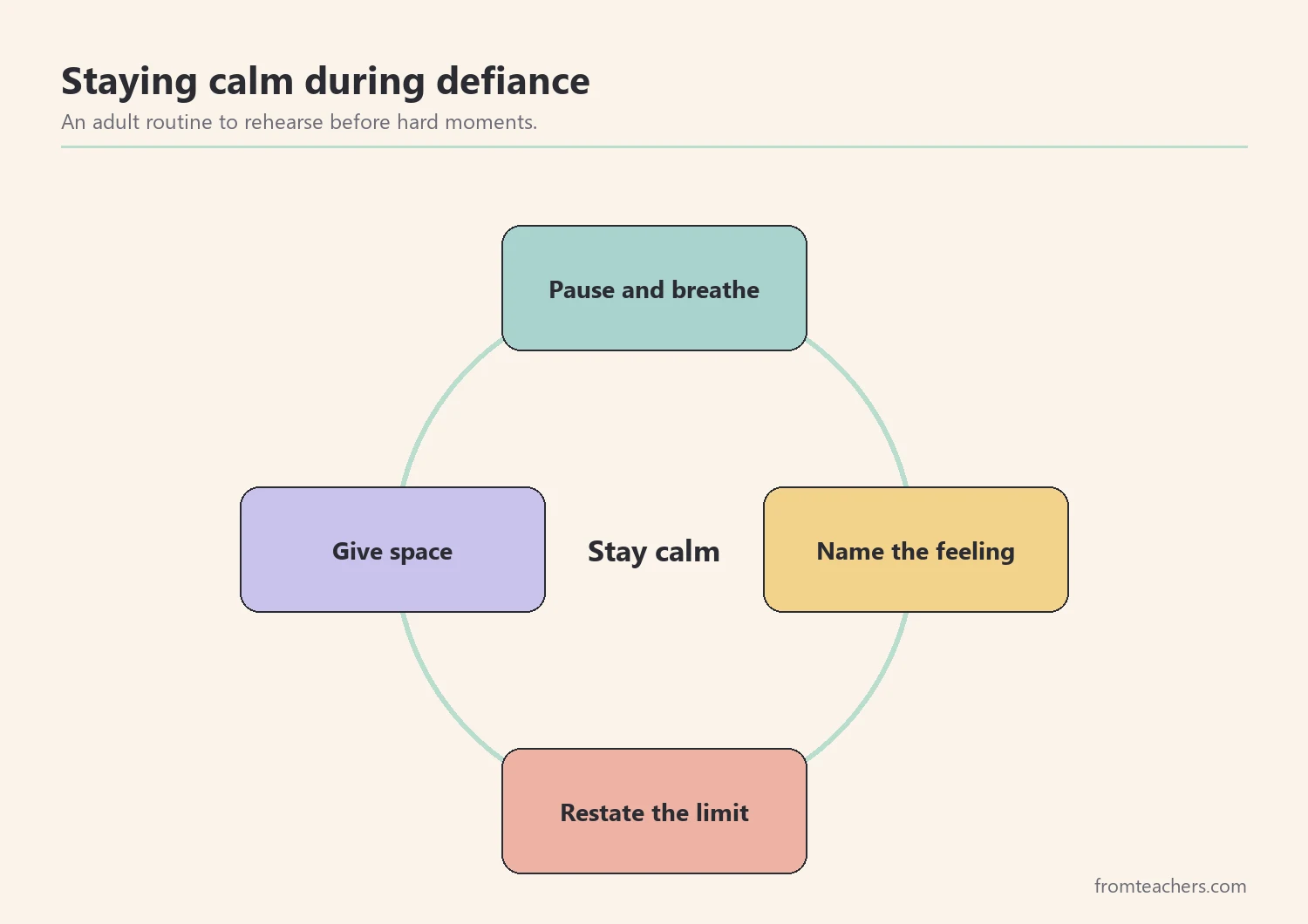
Next, use consequences that are predictable and proportionate. Bigger punishments rarely work better. Instead, choose small, related consequences announced ahead of time, such as losing the next screen session if the tablet is not handed over. Then follow through every time, calmly and without extra commentary.
When Leo refuses to hand over the tablet, his father takes a breath, says the script once, and walks away. Leo yells for a minute, then puts the tablet in the basket. His father says, “Thanks for putting it away,” and moves on. The planned consequence would have applied if Leo had not followed through, but praise for the eventual choice keeps the relationship intact.
Also, teach the child a calm-down plan for themselves. At school, a cool-down space with a timer and a short return routine gives the student a respectful way to reset. At home, a quiet corner with a few calming items can serve the same purpose. Practice using it when everyone is calm, so it feels like a tool, not a punishment.
5. Solve recurring problems together
Some conflicts repeat every day. For these, the most useful ODD parenting strategies happen away from the heat of the moment. Collaborative problem solving means sitting down with the child at a calm time and working out a plan together.
Use three steps. First, gather the child’s concern: “I’ve noticed homework has been hard. What’s up?” Then share your concern: “My concern is that the work gets done before bedtime.” Finally, invite solutions: “I wonder if there’s a way we could both get what we need.”
For Leo, this conversation reveals that math feels overwhelming when he sees a whole worksheet. Together they agree that his mother will fold the page so he sees five problems at a time, and Leo will take a short movement break after each section. Homework still takes effort, but the nightly battle eases.
| Step | Adult says | Goal |
|---|---|---|
| Empathy | “What’s hard about homework?” | Understand the child’s concern |
| Define the problem | “My concern is…” | Share the adult concern |
| Invitation | “Let’s think of ideas.” | Find a plan that works for both |
Plans will not always work the first time. That is fine. Agree to try the plan for a few days, then check in and adjust. The process itself teaches flexibility and problem solving, which are the very skills the child is building.
6. Coordinate ODD parenting strategies between home and school
Children do best when the adults around them use similar language and expectations. When home uses choices and calm limits while school uses lectures and removals, or the reverse, the child gets mixed signals. Therefore, consistency across settings is worth the effort.
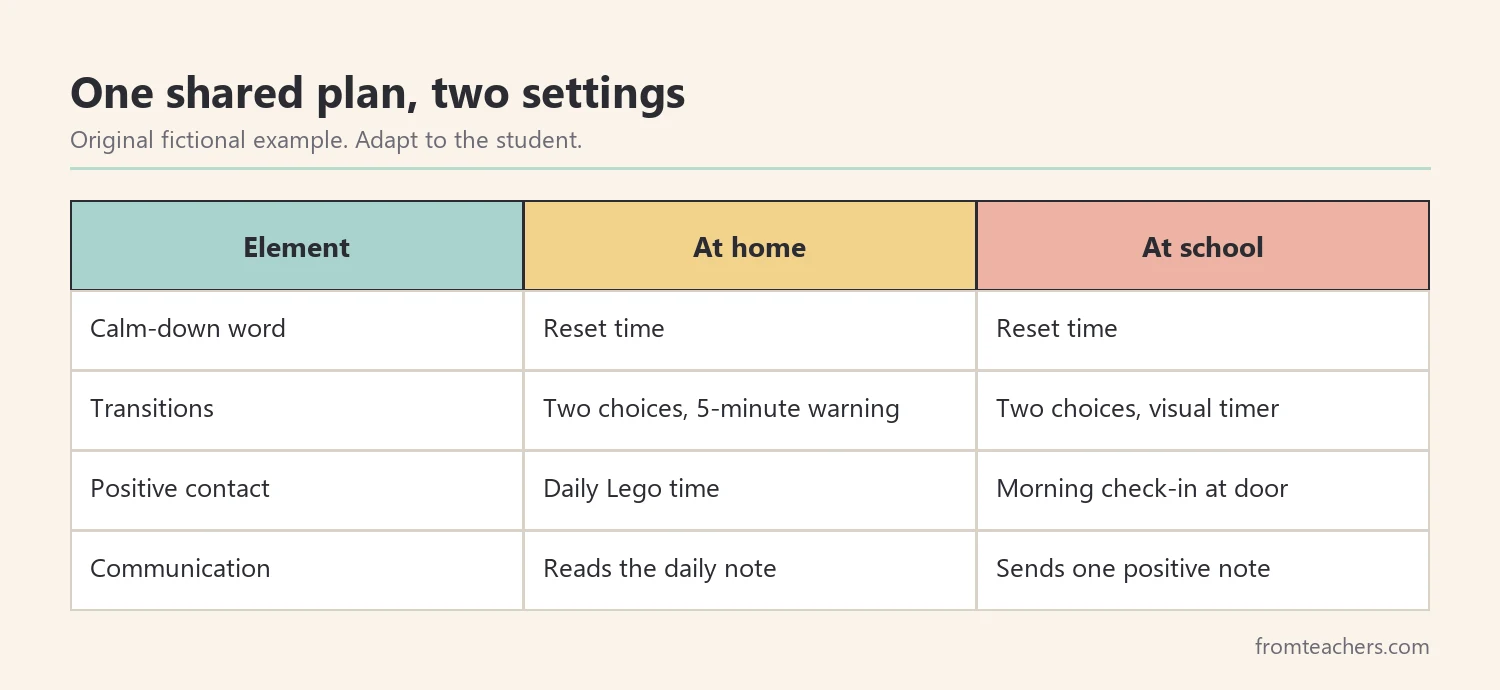
Start with a short meeting or call about which ODD parenting strategies to share. Share what works at home, ask what works at school, and agree on two or three shared elements: the same calm-down word, the same choice format, and one daily positive note. If the school is completing a functional behavior assessment, share your patterns notebook, because home observations can help the team understand triggers.
Leo’s parents and teacher agree to use the phrase “reset time” for calm-down breaks, to offer two choices for transitions, and to send one positive note home each day. Within a few weeks, both settings report shorter conflicts. Results like these are fictional, but the approach of shared language is widely recommended.
Finally, take care of the adults. Using ODD parenting strategies every day with a child who argues often is tiring. Trade off hard moments with another caregiver when possible, and talk with the child’s pediatrician or a mental health professional if conflicts are frequent, intense, or affecting safety. Evidence-based programs such as Parent Management Training and Parent-Child Interaction Therapy are delivered by trained clinicians and can be a strong next step.
Common mistakes and how to avoid them
Even well-meant ODD parenting strategies can backfire. Watch for these common traps.
- Arguing back: Long debates reward defiance with attention. State the limit once and step away.
- Escalating punishments: Bigger consequences often increase resentment. Use small, predictable, related consequences instead.
- Inconsistent follow-through: If a consequence applies only sometimes, the child learns to test it. Pick consequences you can apply every time.
- Skipping positive time: Limits land better inside a warm relationship. Protect daily connection even on hard days.
- Problem solving in the moment: Upset children cannot think flexibly. Save collaborative talks for calm times.
- Working alone: Coordinate with school and seek professional help when needed.
Questions teachers and parents ask about ODD parenting strategies
Are ODD parenting strategies different from regular parenting?
Most use the same building blocks: warmth, clear expectations, and consistency. The difference is intensity and planning. Adults working with a defiant child need to be more deliberate about positive time, calm responses, and predictable follow-through.
Does giving choices mean the child is in charge?
No. You set the limit, and the child chooses how to meet it. “Brush teeth before or after pajamas?” still ends with brushed teeth. Choices reduce power struggles because the child gets some control within your boundaries.
How long before ODD parenting strategies make a difference?
It varies by child and family. Sometimes behavior gets a little worse at first as the child tests new limits. Consistency over several weeks matters more than any single technique, so track patterns to notice gradual change.
What should teachers do differently in the classroom?
Teachers can use clear routines, private redirections instead of public ones, positive reinforcement systems, and a cool-down space. Group approaches like the Good Behavior Game can also help. Coordinating language with families makes these supports stronger.
When should we seek professional help?
Reach out to a pediatrician, school psychologist, or mental health professional if defiance is frequent, intense, affects safety, or does not improve with consistent support. A professional can evaluate the child and recommend evidence-based treatment.
Related reading: positive alternatives to shame and behavior charts, how parents and teachers can team up, and meltdowns vs tantrums explained.
A companion resource for parents and teachers of children with ODD:
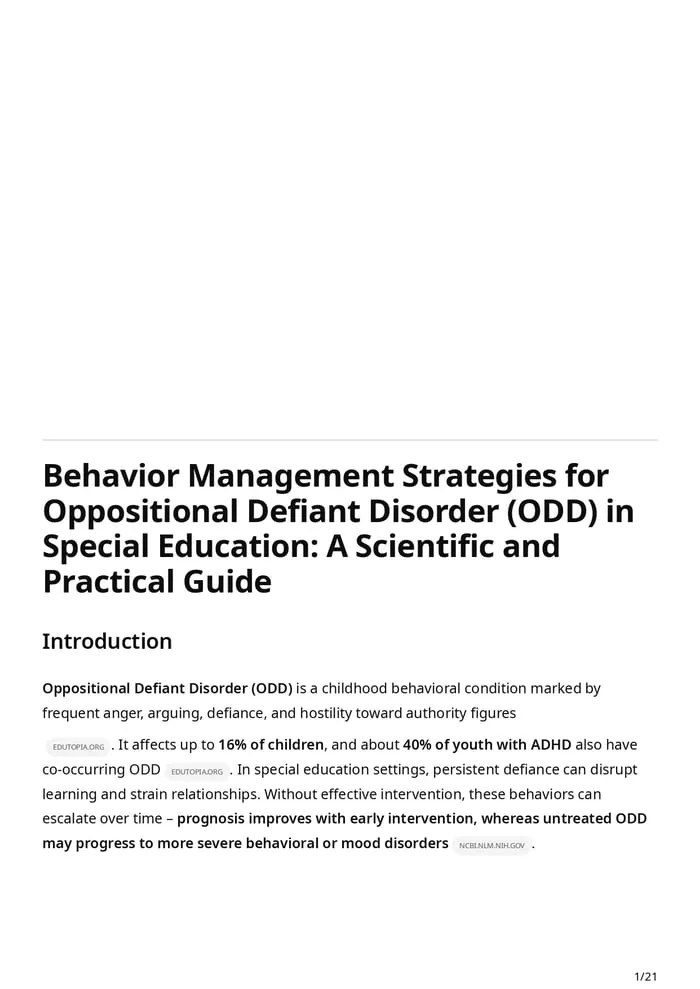
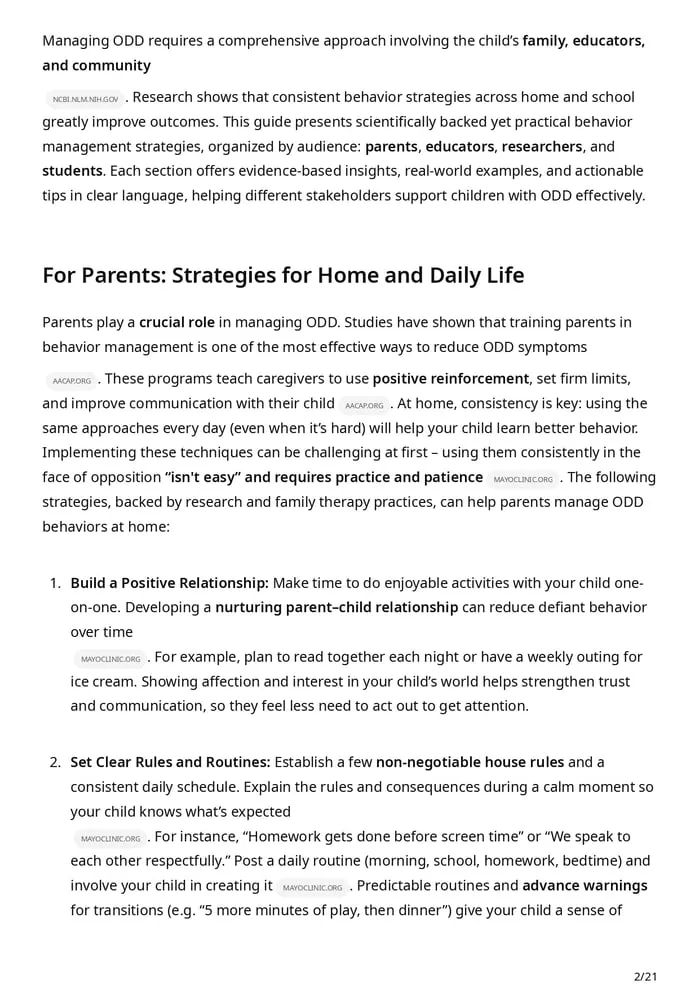
Oppositional Defiant Disorder (ODD) Guide: Strategies for Parents & Teachers: a 21-page guide with separate sections for parents, educators, researchers, and students, covering home strategies, classroom supports, evidence-based interventions, and kid-friendly coping steps.
Sources and scope
- American Academy of Child and Adolescent Psychiatry (AACAP) publishes family resources on oppositional defiant disorder and other childhood conditions.
- HealthyChildren.org from the American Academy of Pediatrics offers parent guidance on discipline and behavior.
- PCIT International describes Parent-Child Interaction Therapy and how to find trained therapists.
- Lives in the Balance explains the Collaborative and Proactive Solutions approach to solving problems with children.
- Child Mind Institute provides family-friendly articles on behavior challenges and treatment options.
This guide covers practical home and classroom strategies for frequent defiance. These ODD parenting strategies are not a diagnosis, and this guide does not diagnose ODD or replace evaluation and treatment by a qualified professional.
Key takeaways
- Good ODD parenting strategies begin by tracking when conflicts happen to find the lagging skill.
- Among ODD parenting strategies, protect daily positive time to strengthen the relationship.
- Give one clear direction with two real choices, then follow through calmly.
- Solve recurring problems together at a calm time.
- Share language and plans with school, and seek professional help when needed.




Leave a Comment