

Energy logs for school counselors can turn a vague complaint like “I’m always tired” into a pattern a student can actually see and change. Picture Ms. Okafor, a fictional middle and high school counselor. A ninth grader named Jonah keeps visiting her office after lunch, saying he cannot focus. He is not sure why, and neither is she. A week of simple energy notes could give them both something concrete to talk about.
This list ranks eight ways counselors can use energy logs with students, from the quickest to set up to the most involved. For each one you will find what it is, why it can help, how to run it in a counseling setting and a short example with Jonah. You will also find a comparison of energy logs and mood logs, a review checklist and a sample week of notes.
Examples are fictional. Adapt to the student’s needs and your school’s procedures. This is guidance, not a diagnosis or medical advice.
At a glance
- An energy log helps students notice when they feel alert or drained during the day.
- Counselors can use logs to start conversations, not to judge habits.
- Start small: one week, a few times a day, short notes.
- Look for patterns with the student, then try one small change.
- Refer ongoing tiredness or health concerns to families and medical professionals.
How we ranked these approaches
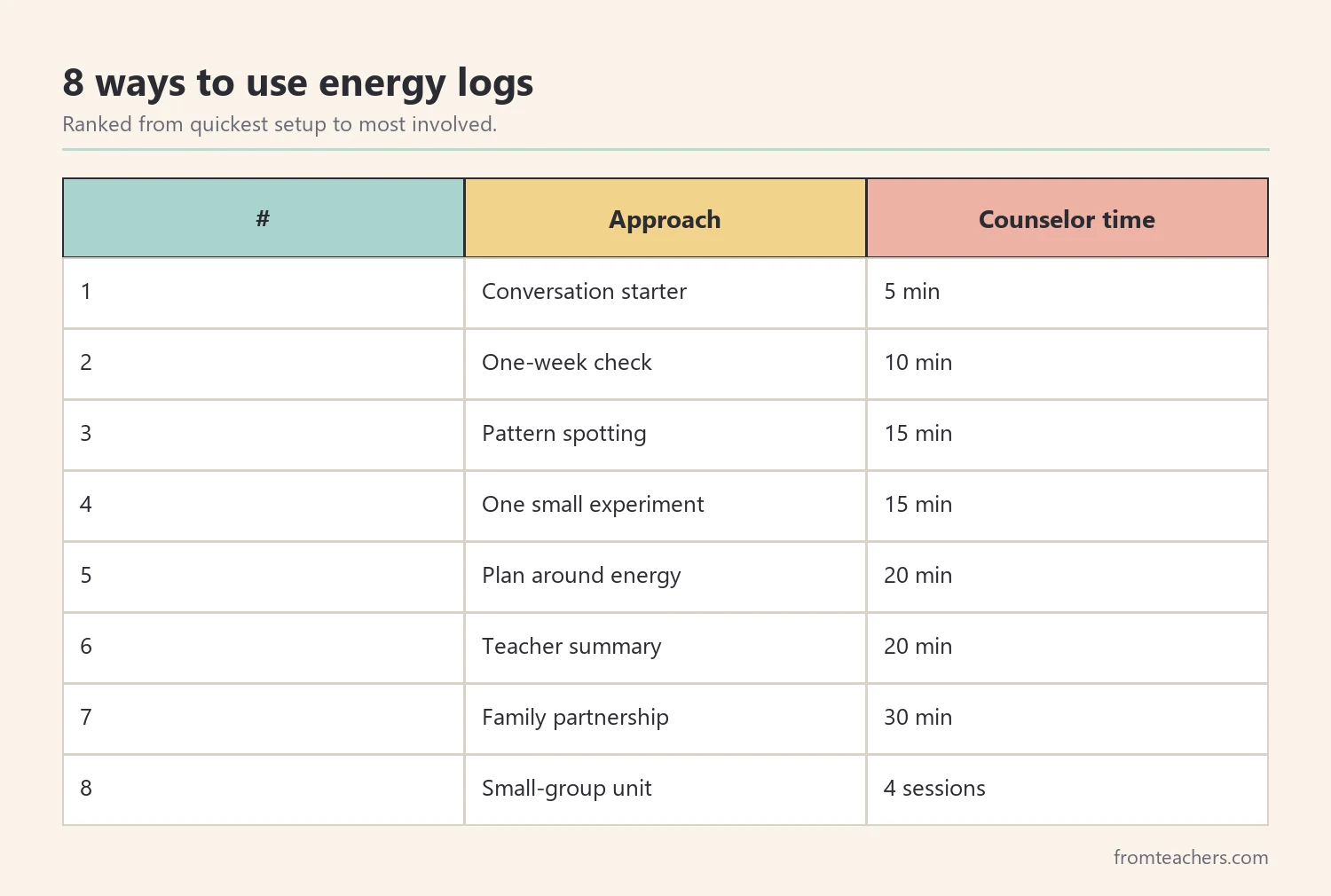
We ranked the eight approaches by the time they ask from a busy counselor, starting with a five-minute conversation starter and ending with a small-group program. Counselors often carry large caseloads, so the first items on the list fit into a single short meeting. Later items take more planning but can reach several students at once.
None of these approaches is a screening tool. Instead, each one uses a simple log to help a student reflect on sleep, meals, activity, mood and energy. When a pattern suggests something more serious, the counselor’s role is to connect the family with the right professional. Figure 1 shows the ranking.
1. A five-minute conversation starter
What it is: you hand the student a blank energy log during a first meeting and fill in only today together.
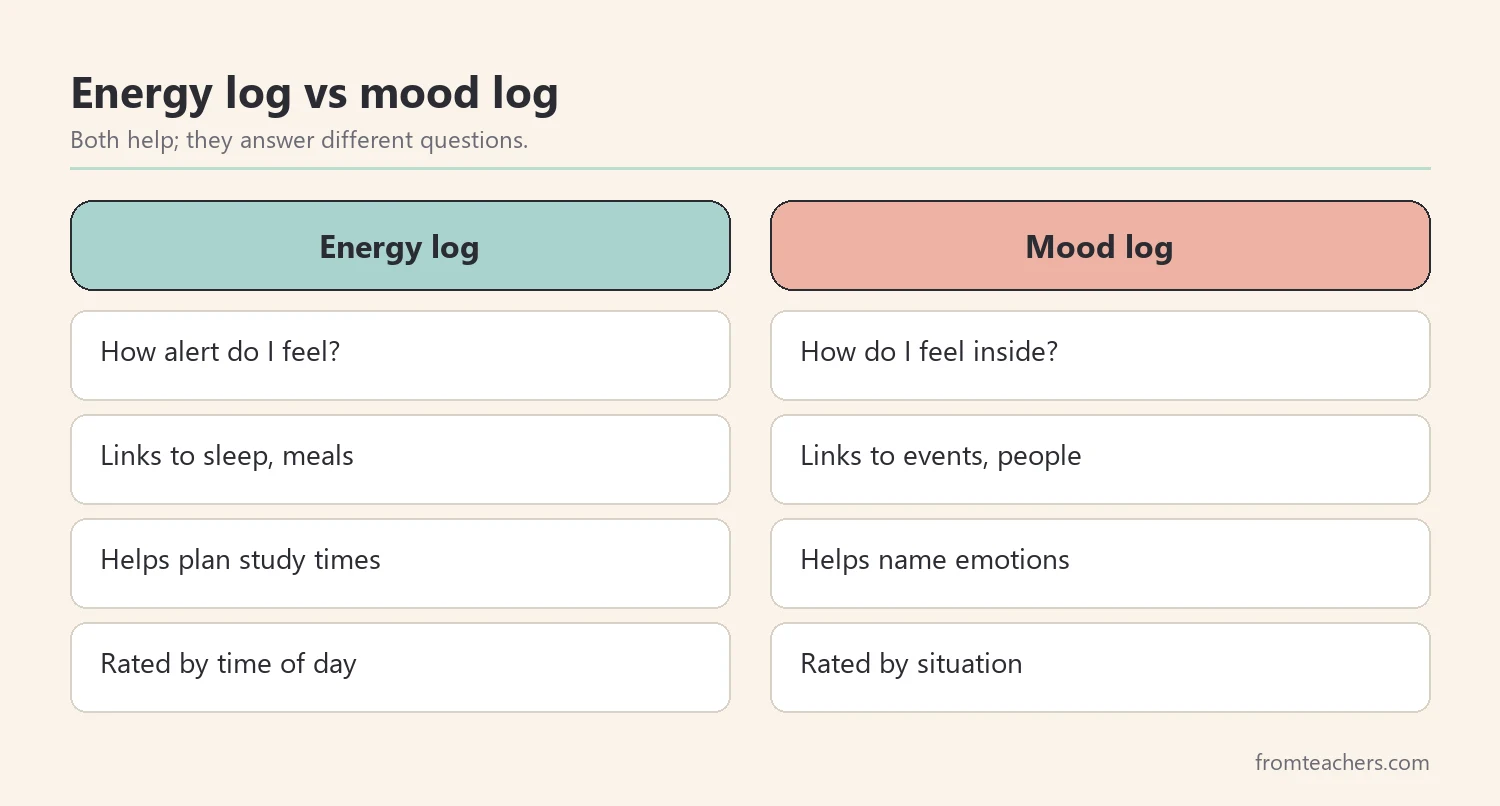
Why it helps: many students find it easier to talk about a sheet of paper than about themselves. Rating energy from one to five feels low risk, and it opens the door to questions about sleep, breakfast and stress.
How to use it: ask the student to rate energy for the morning so far, then ask one follow-up question about each rating. Keep it light and curious. Do not try to solve anything in this first meeting.
Example: Jonah rated his morning energy as a 2. When Ms. Okafor asked what time he woke up, he said he slept late but felt tired anyway. That small detail became the starting point for later sessions.
2. Energy logs for school counselors as a one-week check
What it is: the student fills in a short energy log every day for one school week, then brings it back.
Why it helps: one day can mislead. A week shows patterns, such as a dip every afternoon or low energy after late nights. It also gives the student ownership of the data.
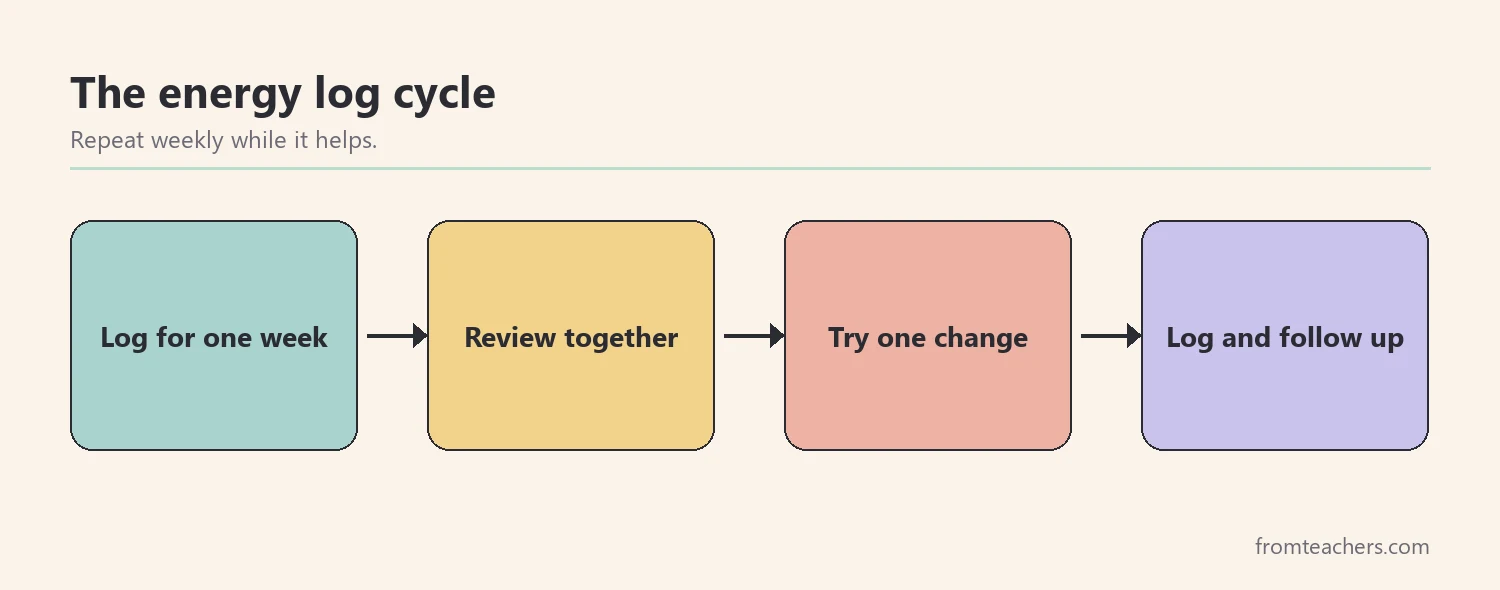
How to use it: agree on three times to rate energy each day, for example before school, after lunch and after school. Keep notes short. Schedule a ten-minute review at the end of the week.
A ready-made sheet like the Daily Energy Level Tracker with sleep, mood and habit reflection already includes a morning check-in, time-of-day ratings and a reflection section, so the student does not need to design anything.
Example: Jonah’s week showed energy of 3 or 4 in the morning and 1 or 2 right after lunch on four days out of five. He had not noticed this himself.
3. Pattern spotting together
What it is: you and the student read the completed log side by side and look for highs, lows and repeated links.
Why it helps: students are more likely to try a change when they discover the pattern themselves. Your job is to ask good questions, not to deliver conclusions.
How to use it: ask three questions: when was your energy highest, when was it lowest and what was happening at those times? Write the student’s own words in the margin.
Example: Jonah noticed that his lowest points came on days he skipped breakfast and ate a large lunch quickly. Ms. Okafor did not give nutrition advice. She simply asked what he wanted to try.
4. One small experiment
What it is: the student chooses one small change and logs another week to see what happens.
Why it helps: it turns reflection into action without overwhelming the student. A single change is also easier to judge than several at once.
How to use it: help the student pick something realistic and within their control, such as drinking water at lunch, a short walk between classes or a set time to put the phone away. Avoid anything that sounds like a diet or a medical plan.
Example: Jonah chose to take a short walk around the field during the last ten minutes of lunch. His after-lunch ratings rose from mostly 1s and 2s to mostly 3s over the following week.
5. Planning hard tasks around energy
What it is: the student uses log data to plan homework and study for times when energy is usually higher.
Why it helps: many students sit down to study at the worst possible time. Knowing their own pattern helps them protect their best hours for the hardest work.
How to use it: look at after-school and evening ratings. Ask the student to choose one homework block for the time with the highest typical energy, and to save easier tasks for low points.
Example: Jonah’s log showed a second energy rise around 7 p.m. He moved math homework from right after school to the early evening and used the after-school slot for lighter reading.
6. Sharing a summary with teachers
What it is: with the student’s agreement, you share a short, positive summary with teachers so they understand the pattern.
Why it helps: teachers often read low energy as low effort. A brief note can change how they respond and open space for small classroom adjustments.
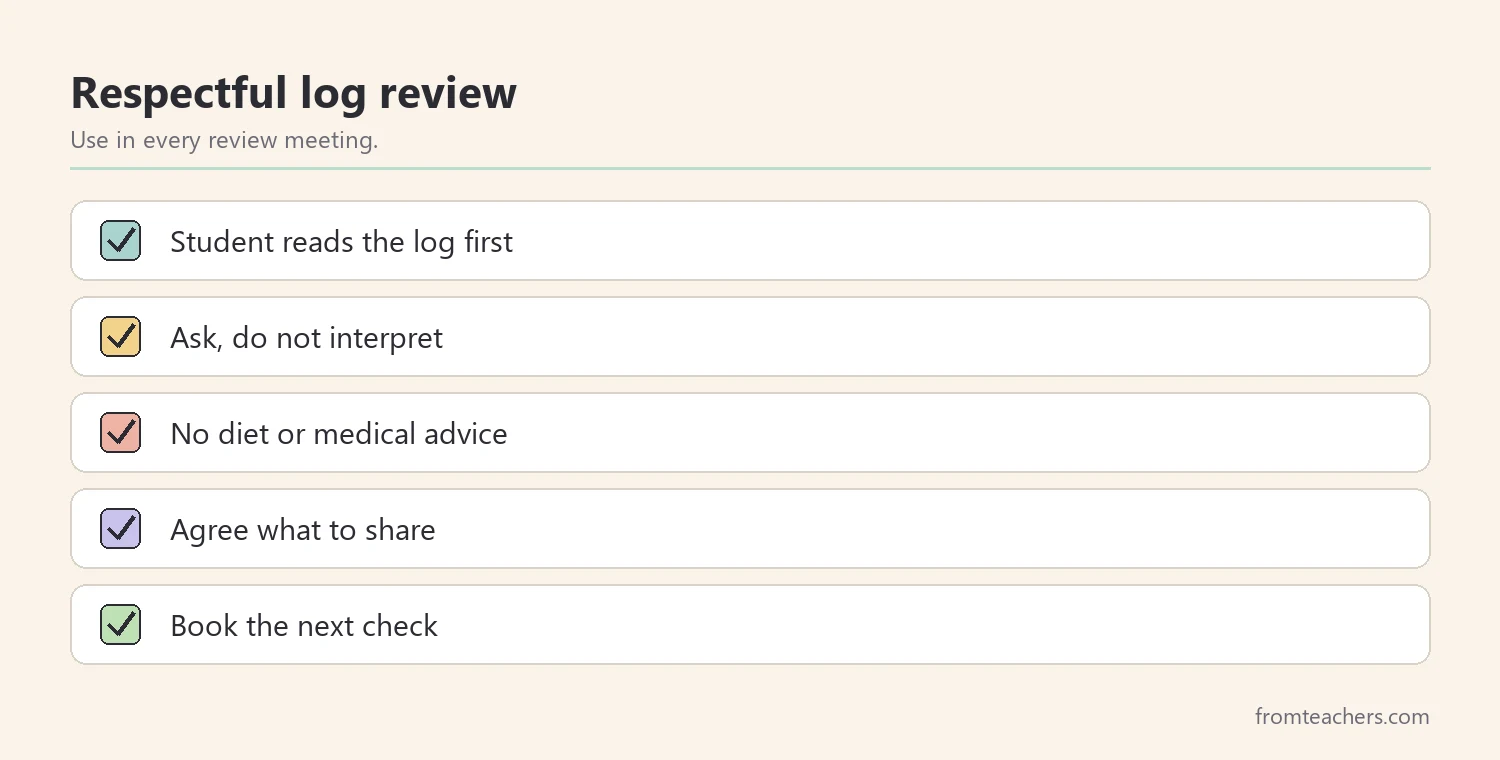
How to use it: keep the summary to two or three sentences. Share only what the student agrees to share, and follow your school’s privacy rules. Focus on what helps, not on personal details.
Example: Jonah agreed to a note for his fifth-period teacher saying that a quick movement break or standing task after lunch helps him focus. The teacher started offering him the job of handing out materials.
7. Family partnership
What it is: you invite the family to look at the log and talk about home routines that may affect energy, such as sleep times and mornings.
Why it helps: many energy patterns start at home. Families can support small changes and notice concerns that need a doctor’s input.
How to use it: share the log in a calm, non-blaming way. Ask what the family has noticed. If tiredness is persistent or severe, encourage them to speak with the student’s doctor rather than offering explanations yourself.
Example: Jonah’s parent said he often played games late on weeknights. Together, they agreed on a screen-off time on school nights and planned to check in after two weeks.
8. A small-group energy unit
What it is: a short small-group program, for example four sessions, where several students track energy and share what they learn.
Why it helps: peers normalize the experience of feeling tired or scattered. Group discussion also helps students try strategies that worked for others.
How to use it: in session one, introduce the log. In sessions two and three, review patterns and choose experiments. In session four, share results and set a personal plan. Keep personal details private and focus on habits.
Example: Ms. Okafor ran a four-week group with five ninth graders. Jonah shared his lunch walk idea, and two classmates tried it the following week.
A sample week of energy notes
Here is Jonah’s fictional log for the week of his experiment. It shows the kind of simple data that makes a review meeting productive. Ratings are from one (very low) to five (very high).
| Day | Before school | After lunch | Note |
|---|---|---|---|
| Monday | 3 | 3 | Walked at lunch |
| Tuesday | 2 | 2 | Late night, skipped walk |
| Wednesday | 3 | 3 | Walked, ate breakfast |
| Thursday | 4 | 3 | Slept earlier |
| Friday | 3 | 4 | Walked with a friend |
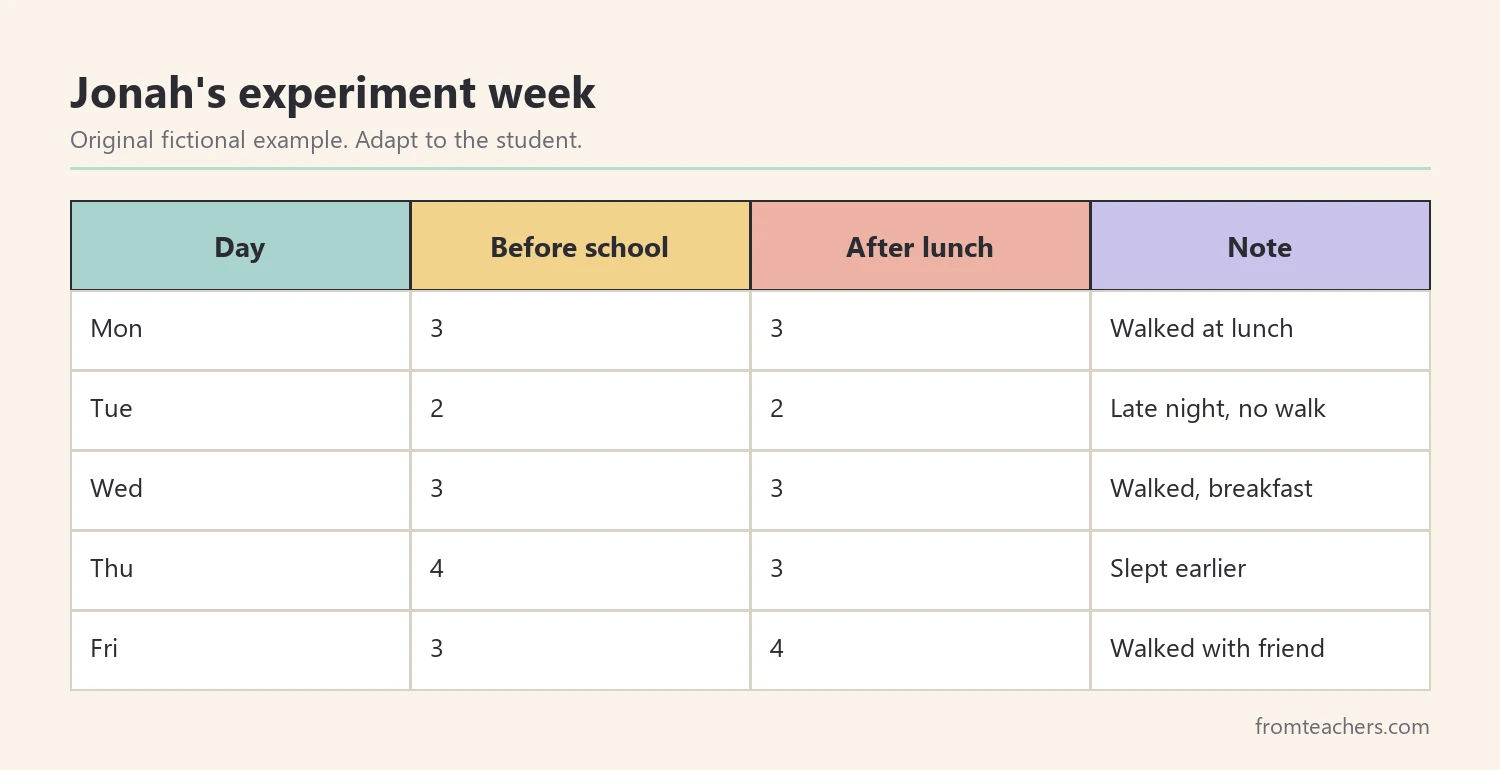
Notice how the note column does the most work. It connects each rating to something the student did, which helps the student see cause and effect without the counselor lecturing.
When to refer
An energy log is a reflection tool. It cannot explain medical causes of tiredness, and counselors should not try to. If a student reports exhaustion that lasts for weeks, sleeps far more or less than usual, shows signs of low mood or hopelessness, or has energy changes alongside other worrying signs, talk with the family and follow your school’s referral procedures.
Similarly, if a student shares anything about safety or harm, follow your school’s safety protocol right away. The log is never a reason to delay that response.
Common mistakes and how to avoid them
- Turning the log into homework the student dreads. Fix: keep it short, three ratings a day and a few words.
- Interpreting the data for the student. Fix: ask questions and let the student name the pattern.
- Giving diet or medical advice. Fix: stay with simple habits and refer health concerns.
- Changing too much at once. Fix: test one small experiment per week.
- Sharing details without consent. Fix: agree with the student on what teachers and families will see.
- Forgetting to follow up. Fix: book the review meeting when you hand out the log.
Questions counselors ask about energy logs for school counselors
What age is right for energy logs?
Most students from about grade 5 upward can complete a simple log. Younger students may need fewer time slots and picture-based ratings, and families can help fill it in.
How long should a student keep an energy log?
One week is usually enough to see a first pattern. A second week helps check whether a small change made a difference.
What if the student forgets to fill it in?
That is common. Missing days are still information. Ask what got in the way and simplify the log, for example by keeping only two ratings a day.
Can energy logs help students with ADHD or anxiety?
Many students find logs useful for self-awareness, but they do not replace support from the IEP or 504 team, therapists or doctors. Use the log as one source of information alongside the student’s existing plan.
Should I keep copies of the logs?
Follow your school’s record-keeping rules. Many counselors keep only a short summary and let the student keep the original log.
Related reading: Building Stronger School Counseling Programs, Understanding Autistic Burnout and School Exhaustion, and School Counseling Strategies for Student Success.
You may also need: Sleep and Learning: What Every Teacher Should Know.
A companion resource for counselors using energy logs:
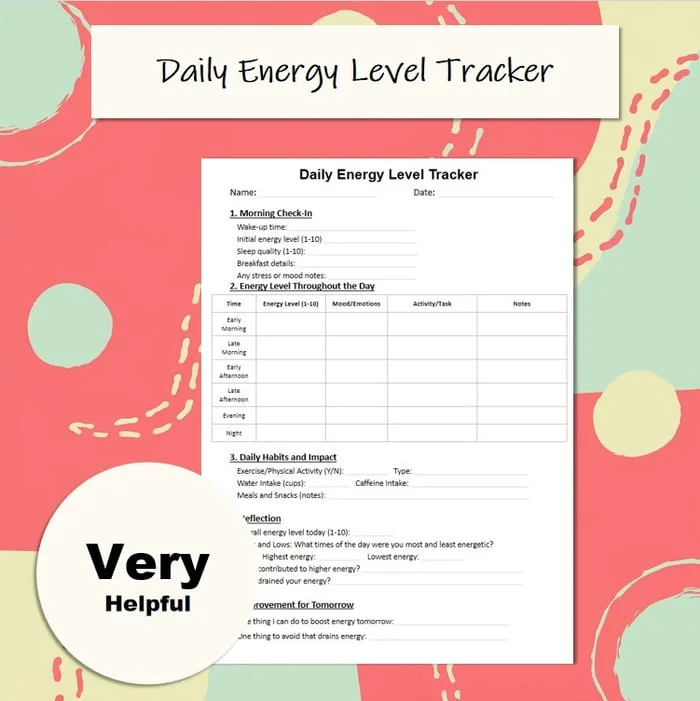
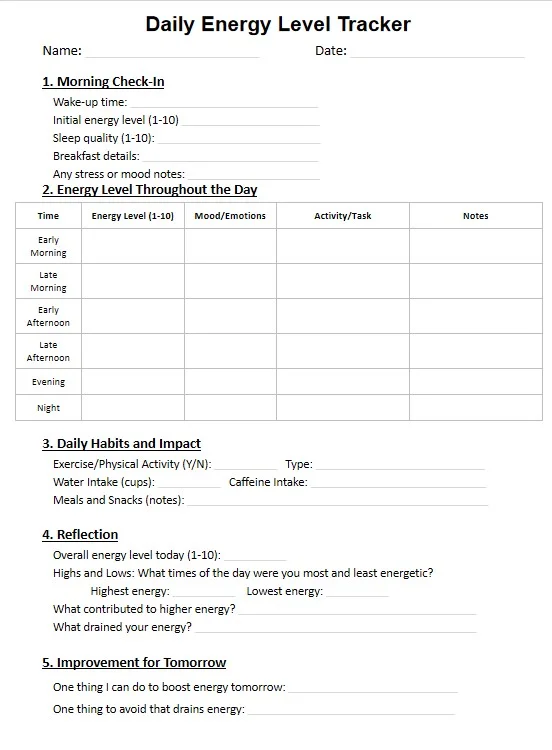
Daily Energy Level Tracker: Sleep, Mood and Habit Reflection Worksheet: a one-page tracker with a morning check-in for wake-up time, sleep quality and breakfast, an energy and mood table from early morning to night, daily habits such as exercise, water and meals, and a reflection on the day’s highest and lowest energy points.
Sources and scope
- National Association of School Psychologists: resources on student wellbeing and school-based mental health support.
- CASEL: frameworks for social and emotional learning, including self-awareness and self-management.
- Child Mind Institute: articles for families and educators on children’s wellbeing, sleep and attention.
- HealthyChildren.org: the American Academy of Pediatrics site for parents, including sleep and healthy habits.
This guide describes reflective ways counselors can use energy logs with students. It does not cover medical causes of fatigue or replace clinical assessment. Refer persistent or serious concerns to families and qualified professionals.
Key takeaways
- Energy logs for school counselors turn vague tiredness into visible patterns.
- Start with a five-minute conversation, then a one-week log.
- Let students spot their own patterns and test one small change.
- Share summaries only with the student’s consent.
- Refer persistent tiredness or wellbeing concerns promptly.










Leave a Comment