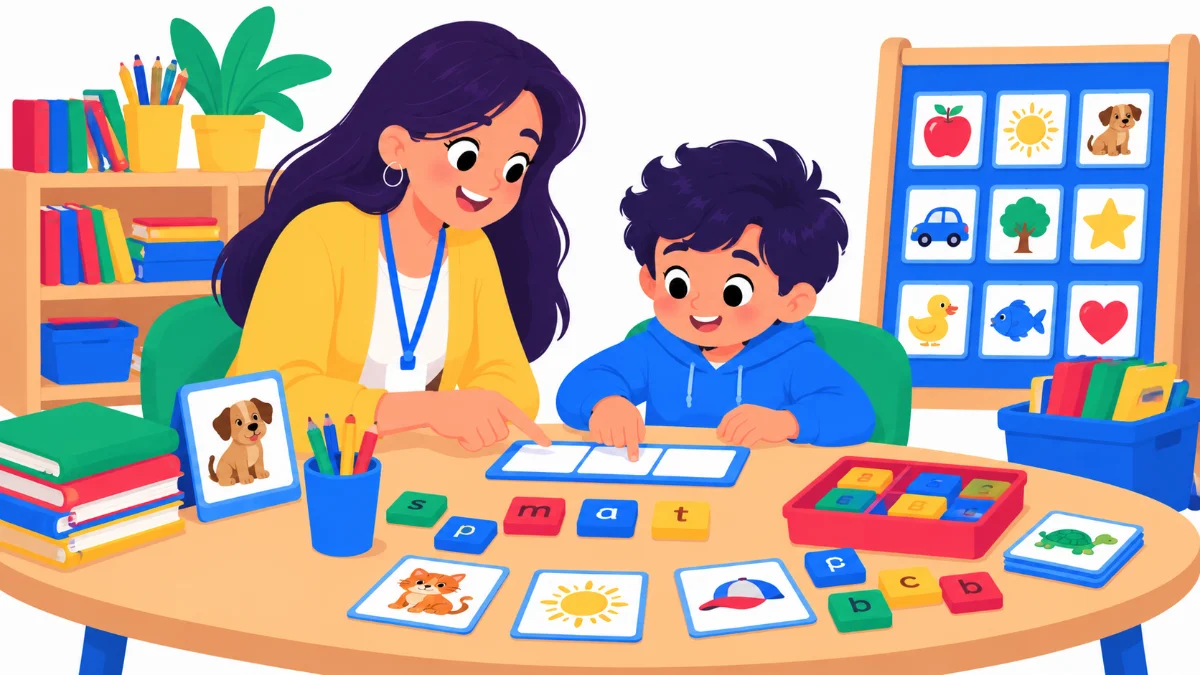

Signs of phonics difficulty often show up quietly in kindergarten and first grade, long before a child is labeled a struggling reader. Picture Ben, a first grader who loves stories and knows many words by sight. Yet when he meets a new short word like “pit,” he guesses “pot” or looks at the picture. In October, it looks like a small slip. By March, it can become a real gap.
This list is for kindergarten and first grade teachers who want to notice patterns early and respond with good teaching. It describes eight signs of phonics difficulty in the order skills are usually taught, from letter sounds to vowel teams. For each sign, you will find what it looks like, what to record and a simple next step.
Examples are fictional. Adapt to the student’s goals and agreed supports. This is guidance, not a diagnosis.
At a glance
- Early phonics gaps are easier to close than late ones.
- One mistake means little; a repeated pattern means a lot.
- Record what the child reads, not only whether it was right.
- Explicit, systematic phonics teaching helps most young readers.
- Share patterns with the family and your reading or support team early.
How this list is ordered
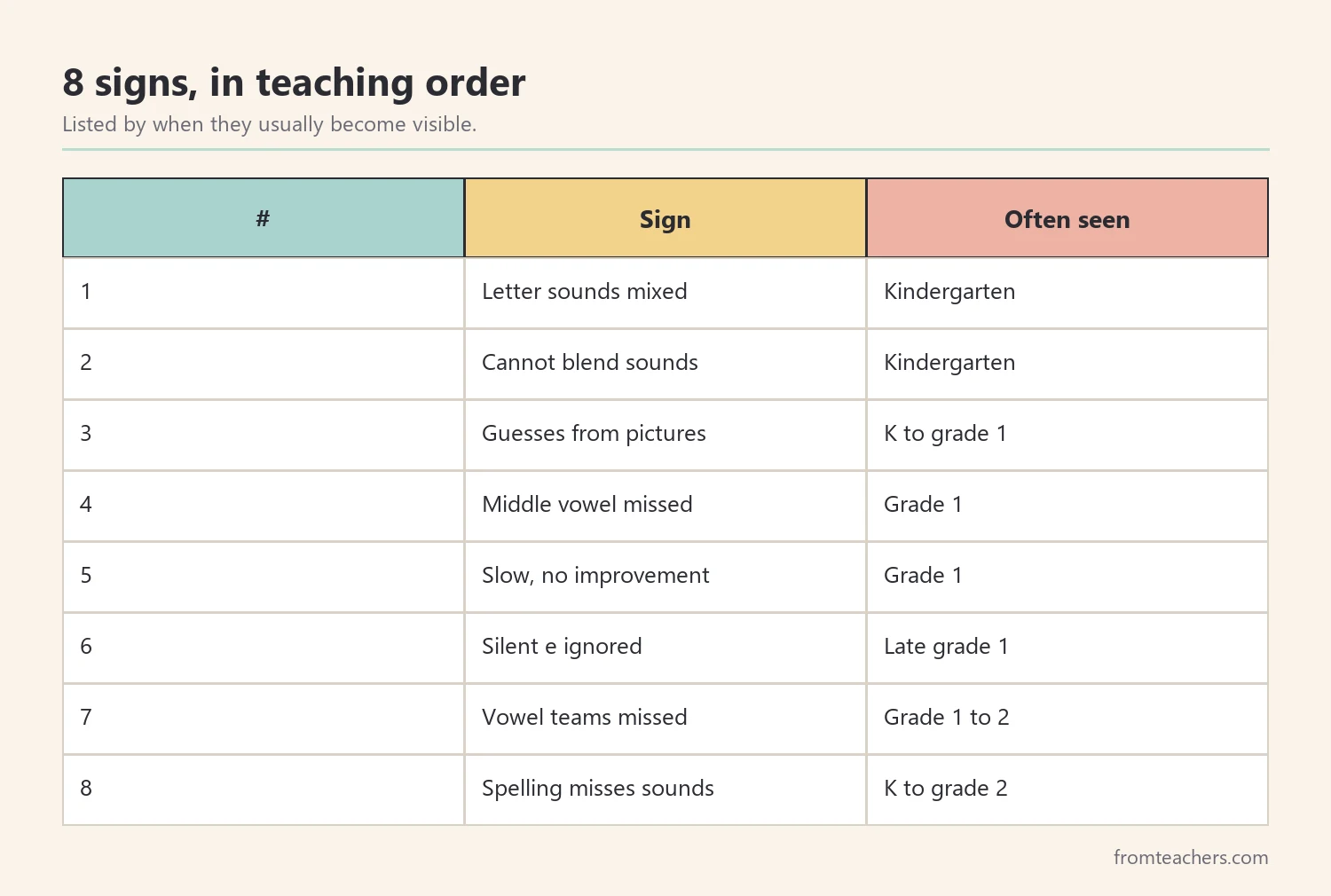
We ordered these eight signs of phonics difficulty by when they usually become visible, following a common teaching sequence: letter sounds, blending, CVC words, Magic E and vowel teams. Your curriculum may teach patterns in a slightly different order, so adjust the list to your scope and sequence.
Also, a sign is not a diagnosis. Many children show one or two of these for a short time and then catch up with good teaching. What matters is persistence: a pattern that continues after clear, repeated instruction. Figure 1 shows the eight signs and when they tend to appear.
1. Mixing up letter sounds that look or sound alike
First, watch letter-sound knowledge. Confusing b and d is common in young children. However, a child who still mixes many sounds, such as short e and short i, after weeks of practice may need more focused teaching.
What to record: which sounds are confused, in reading and in spelling.
Next step: practice confused pairs with mouth position, a keyword picture and short daily review.
2. Trouble blending sounds into a word
Next, notice blending. A child says /c/ /a/ /t/ clearly but cannot put them together, or says “cat” only after many tries. This is one of the earliest signs of phonics difficulty and is easy to check in one minute.
What to record: how many three-sound words the child blends correctly out of ten.
Next step: use continuous sounds first (m, s, f) and model smooth blending with your finger under the word.
3. Guessing from the first letter or the picture
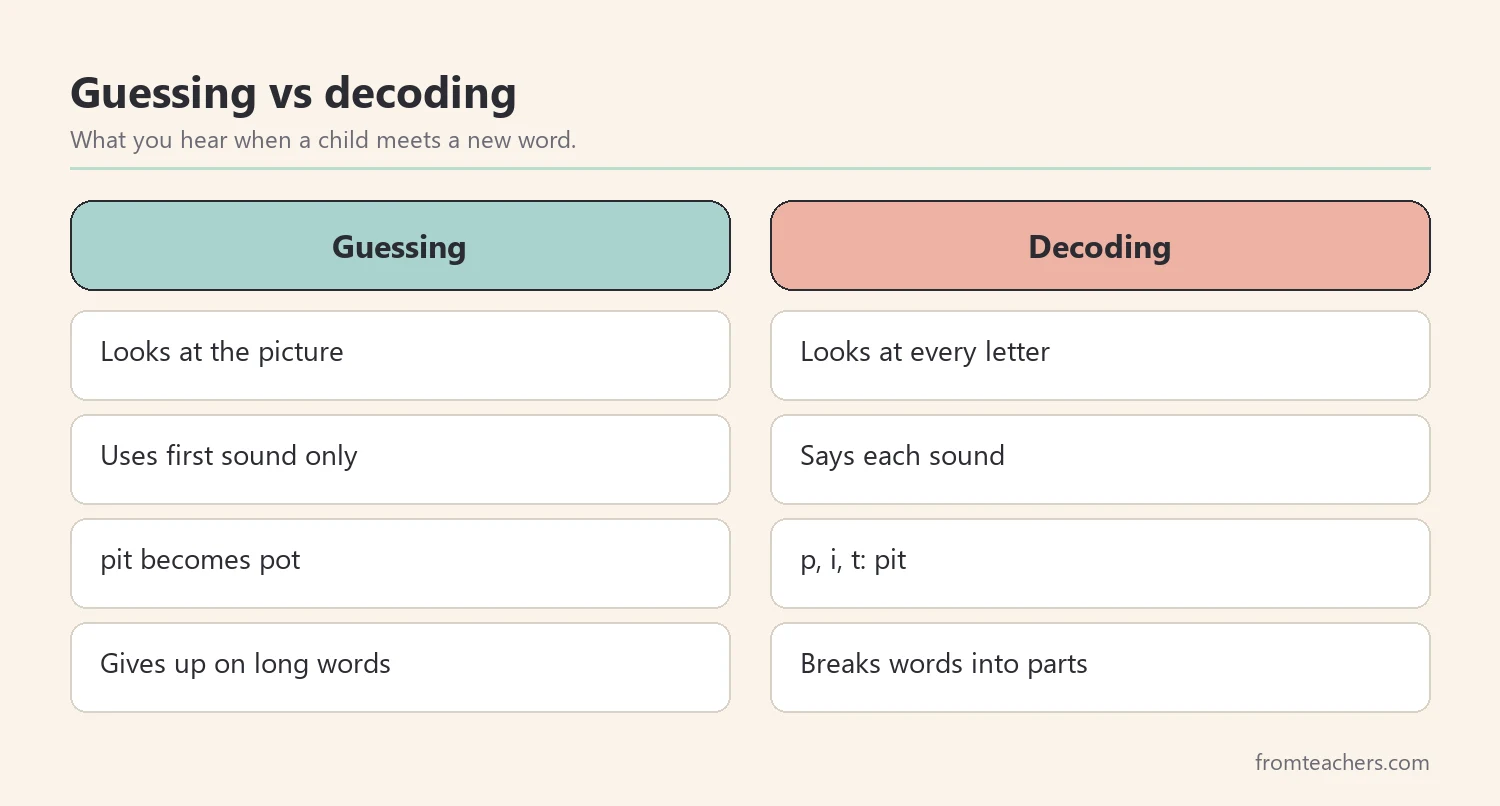
Then listen to how the child reads new words. Ben looks at the first letter and guesses a word he knows: “pit” becomes “pot,” “hen” becomes “horse.” Guessing from pictures and first letters is one of the signs of phonics difficulty that sight word success can hide.
What to record: write down the actual words the child says, not just a check or an X.
Example: Ben’s teacher, Ms. Patel, wrote “pit: pot, hen: horse, mug: mom.” The pattern was clear: he used only the first sound.
4. Skipping or changing the middle vowel
Similarly, many young readers get the first and last sounds right but miss the vowel in the middle. “Sit” becomes “sat,” “bed” becomes “bad.” Vowel errors in CVC words are among the most common signs of phonics difficulty in first grade.
What to record: which vowels the child confuses most.
Next step: use Elkonin sound boxes and color the vowel box. The child says each sound while pushing a token into its box.
5. Reading slowly, sound by sound, without improvement
Next, some children decode accurately but stay very slow, sounding out the same CVC words again and again for weeks. Accurate but laborious reading can mean the child needs more practice to make words automatic.
What to record: words read correctly in one minute on a short CVC list, once every two weeks.
To plan that extra practice, the CVC, Magic E and vowel teams guidebook for dyslexia intervention includes step-by-step teaching sequences, progress monitoring guidance and a phonics tracking chart.
6. Ignoring the silent e
Then, when Magic E is taught, watch for children who read “cape” as “cap” and “hope” as “hop.” Missing the effect of a final e after the lesson has been taught many times is one of the clearer signs of phonics difficulty in late first grade.
What to record: pairs read correctly, such as cap and cape, out of ten pairs.
Next step: use word pairs side by side and a simple rule card: “e at the end, the vowel says its name.”
| Word pair | Ben in January | Ben in March |
|---|---|---|
| cap / cape | cap / cap | cap / cape |
| hop / hope | hop / hop | hop / hope |
| kit / kite | kit / kit | kit / kite |
7. Struggling with vowel teams
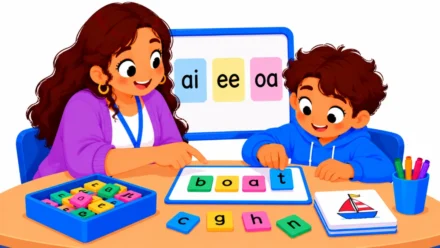
Next, vowel teams like ai, ee and oa are often taught late in first grade or in second grade. A child who reads “rain” as “ran” or “boat” as “bot” may still be reading only the first vowel.
What to record: which teams are read correctly in single words and in short sentences.
Next step: teach one team at a time, sort words by team and read short decodable texts with that pattern.
8. Spelling that does not match the sounds
Finally, look at writing. Spelling errors are normal in young children. However, spellings that miss sounds entirely, such as “bd” for “bed,” after months of instruction can be signs of phonics difficulty that reading alone does not show.
What to record: a short dictation of five words every two weeks. Count sounds represented, not only whole words correct.
How to respond to signs of phonics difficulty
First, teach explicitly. Children who show signs of phonics difficulty usually benefit from direct, systematic phonics instruction: clear modeling, guided practice and lots of reading with the target pattern. Practice guides from the What Works Clearinghouse describe this kind of foundational skills teaching.
Next, add small-group time. Ten to fifteen focused minutes several days a week, with the same routine each time, often helps more than longer but irregular sessions.
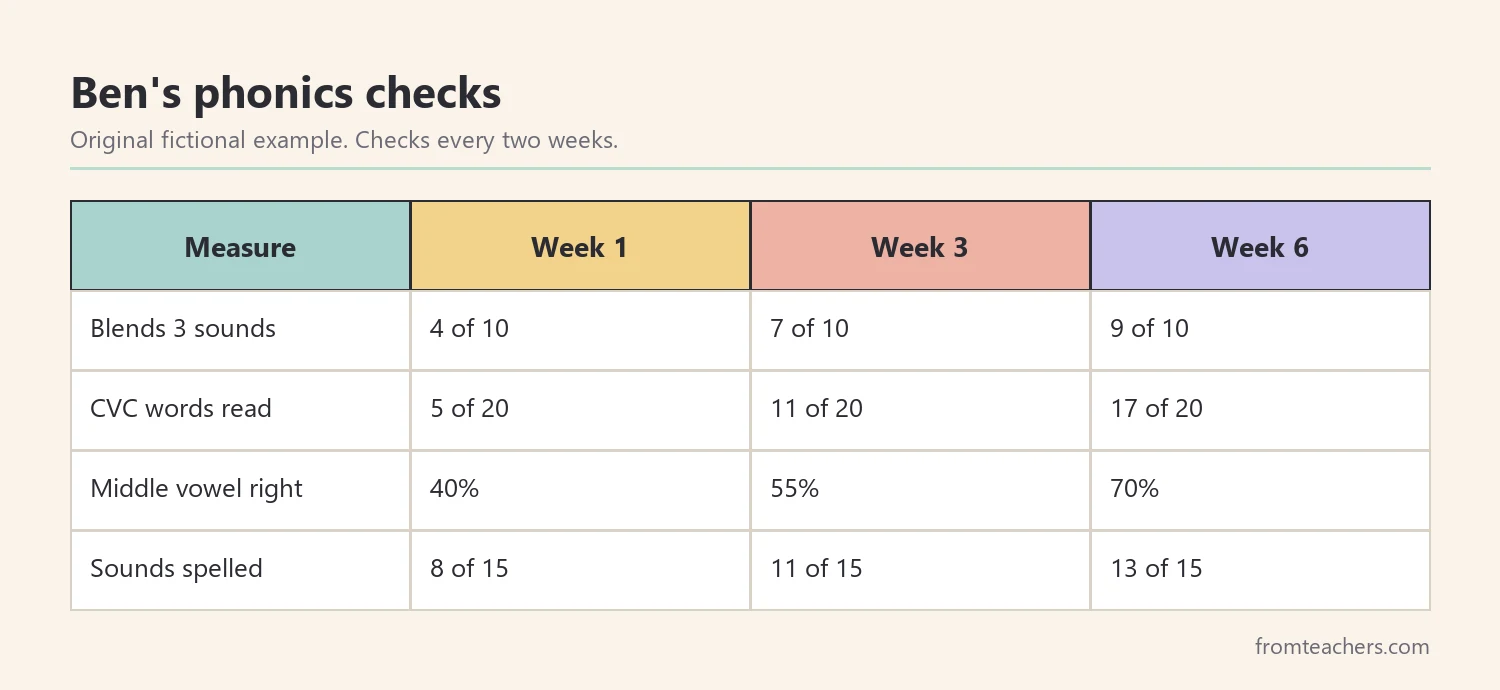
Then monitor progress. Use the same short check every two weeks so you can compare. For example, Ms. Patel tracked Ben’s blending and CVC reading for six weeks. Figure 3 shows steady growth in CVC words, while vowel accuracy took longer.
Also, use multisensory practice where it helps: saying sounds while writing letters, tapping sounds on fingers or building words with tiles. Many structured literacy programs include these techniques.
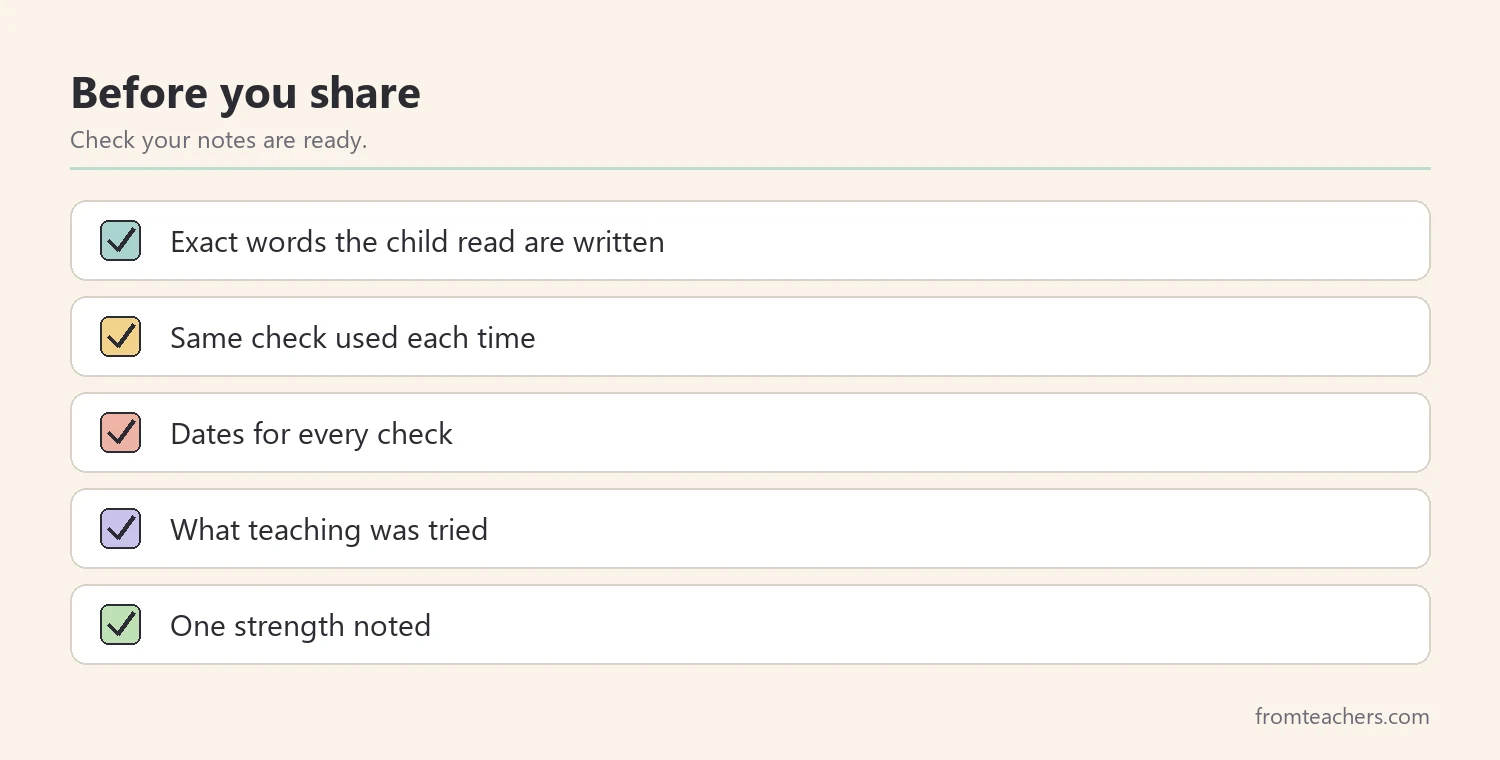
When to share signs of phonics difficulty with others
Share early. Families can support practice at home, and they may know about speech, hearing or vision history that matters. Your reading specialist or support team can suggest more intensive help.
In addition, follow your school’s process, such as MTSS or a student support team. If a child keeps struggling despite good, regular intervention, the team may discuss whether an evaluation is appropriate. Teachers notice and record; qualified professionals evaluate.
For Ben, the team added a small phonics group four days a week and sent home short decodable books. After eight weeks, he read most CVC words accurately and had started on Magic E. Figure 5 shows the simple cycle his teachers followed.
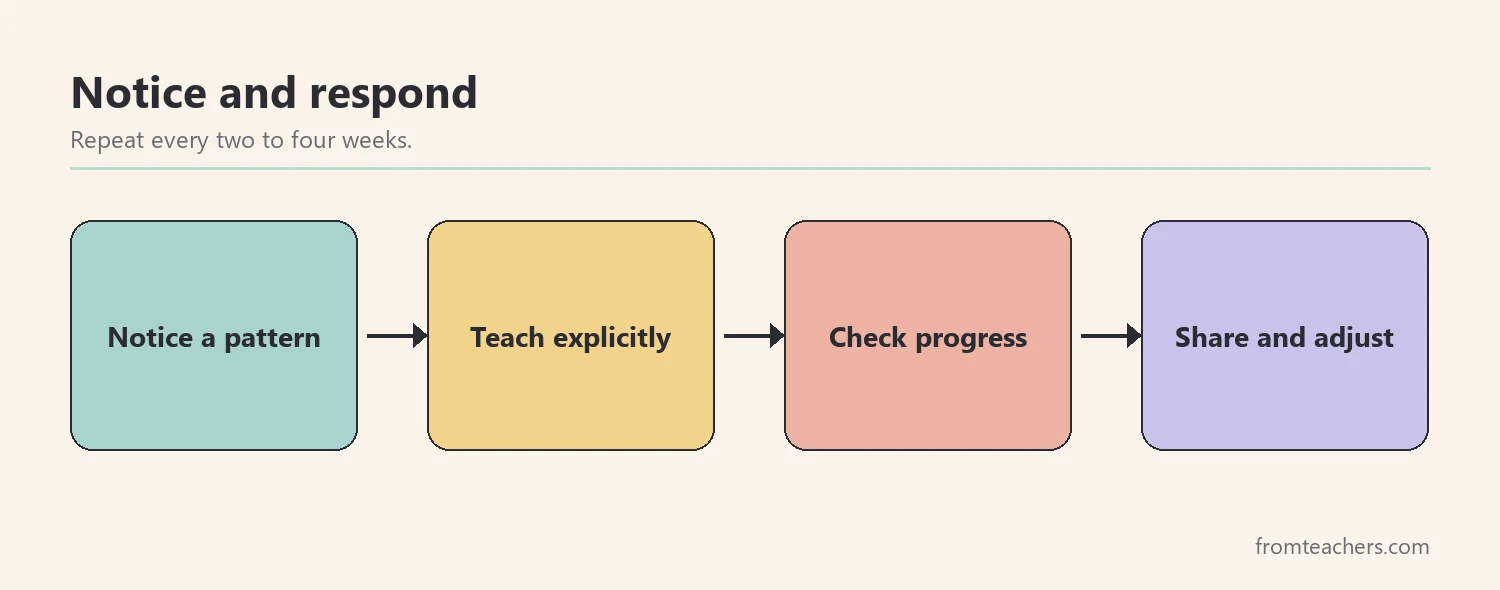
Signs of phonics difficulty in kindergarten versus first grade
In kindergarten, signs of phonics difficulty usually involve the basics: learning letter names and sounds, hearing rhymes and the first sound in a word, and blending two or three sounds. Children develop at different rates, so watch for a pattern across several months rather than a single check.
In first grade, expectations grow quickly. Children move from CVC words to Magic E and often to vowel teams. As a result, gaps that were small in kindergarten can widen, especially when a child relies on guessing.
Therefore, kindergarten and first grade teachers benefit from sharing notes. A short handoff in June, listing which sounds and patterns a child found hard, saves weeks of rediscovery in September.
Partnering with families at home
Families want to help, but they often do not know how phonics is taught today. Therefore, send home one simple activity at a time, with a short model. For example, a list of ten CVC words with the vowel in color, and a note: “Ask your child to say each sound, then read the word.”
Next, explain what to do with mistakes. Encourage parents to point to the letter the child missed and ask, “What sound does this make?” instead of saying the word for them. That small habit supports decoding instead of guessing.
In addition, invite families to read aloud every day for fun. Listening to rich stories builds vocabulary and background knowledge, which children need when their decoding catches up. For Ben, his grandfather read dinosaur books at bedtime while Ben read three short decodable pages first.
Finally, keep the tone hopeful. Many young readers who receive clear, early support make real progress, and families who feel included tend to stay involved.
Common mistakes and how to avoid them
- Waiting to see if the child grows out of it. Fix: start extra practice while you keep watching.
- Counting only words right or wrong. Fix: write down what the child actually said.
- Teaching more sight words to cover the gap. Fix: teach the sound patterns directly.
- Changing the check every time. Fix: use the same short probe every two weeks.
- Telling families it is dyslexia. Fix: share patterns and let qualified professionals evaluate.
Questions teachers ask about signs of phonics difficulty
Are b and d reversals a sign of dyslexia?
Reversals are common in young children and are not a diagnosis on their own. Watch whether they continue along with other patterns after clear teaching.
How early can I notice signs of phonics difficulty?
Many patterns, such as trouble with letter sounds or blending, can be noticed in kindergarten. Early support is usually easier than late support.
Should I stop teaching sight words?
No. High-frequency words still matter. However, make sure the child also learns to decode new words instead of guessing.
How often should I check progress?
Every two weeks is common for students receiving extra help. Use the same short task each time.
What should I tell parents?
Describe what you see, what you are doing and how they can help at home. Invite them to share what they notice too.
Related reading: Dyslexia Solutions in the Classroom: Evidence-Based Strategies, Dyslexia in Education: Understanding, Innovating, and Empowering, and The Power of Data Tracking in Special Education.
You may also need: Classroom Accommodations and Tools for Supporting Dyslexia.
A companion resource for signs of phonics difficulty:
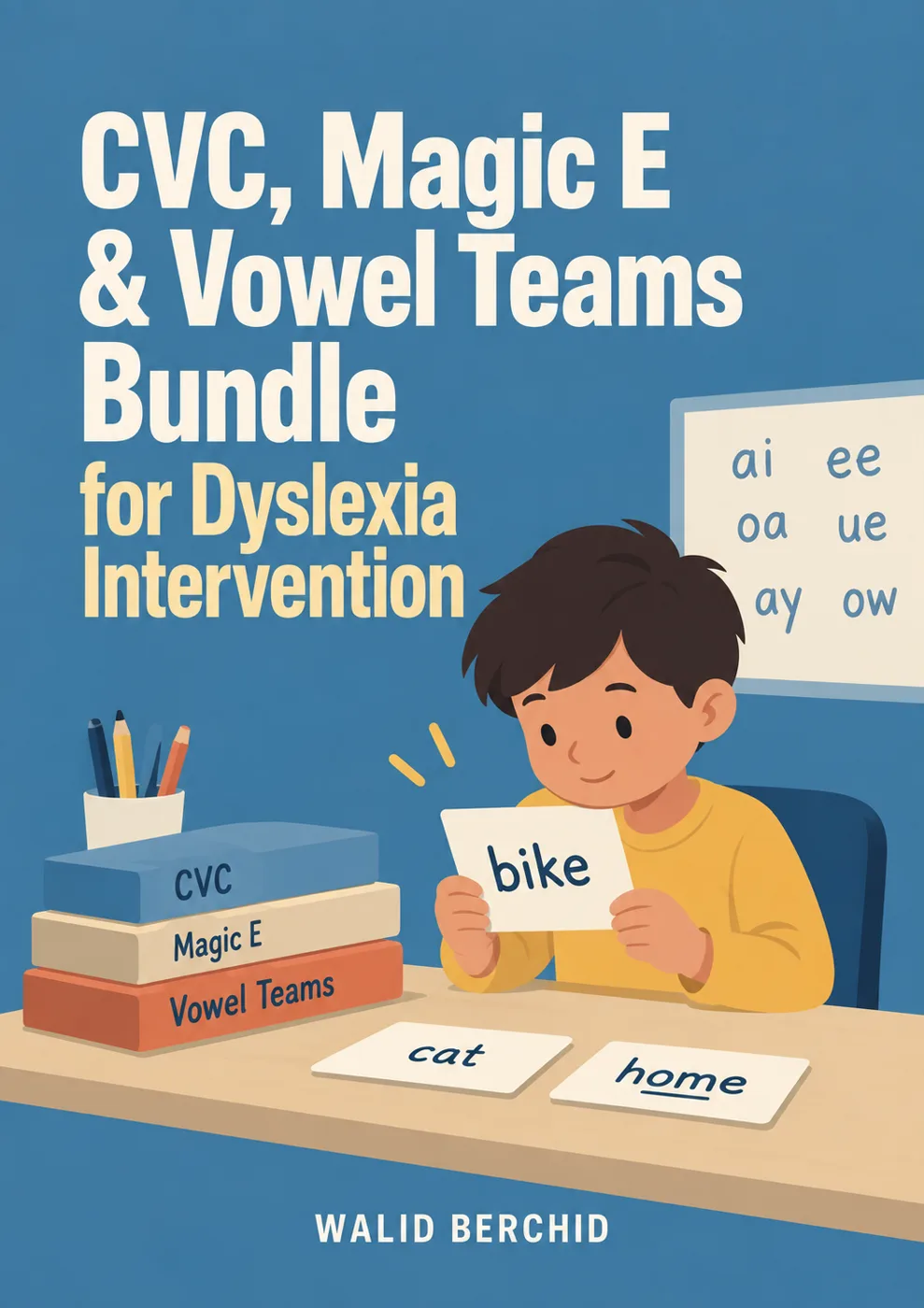
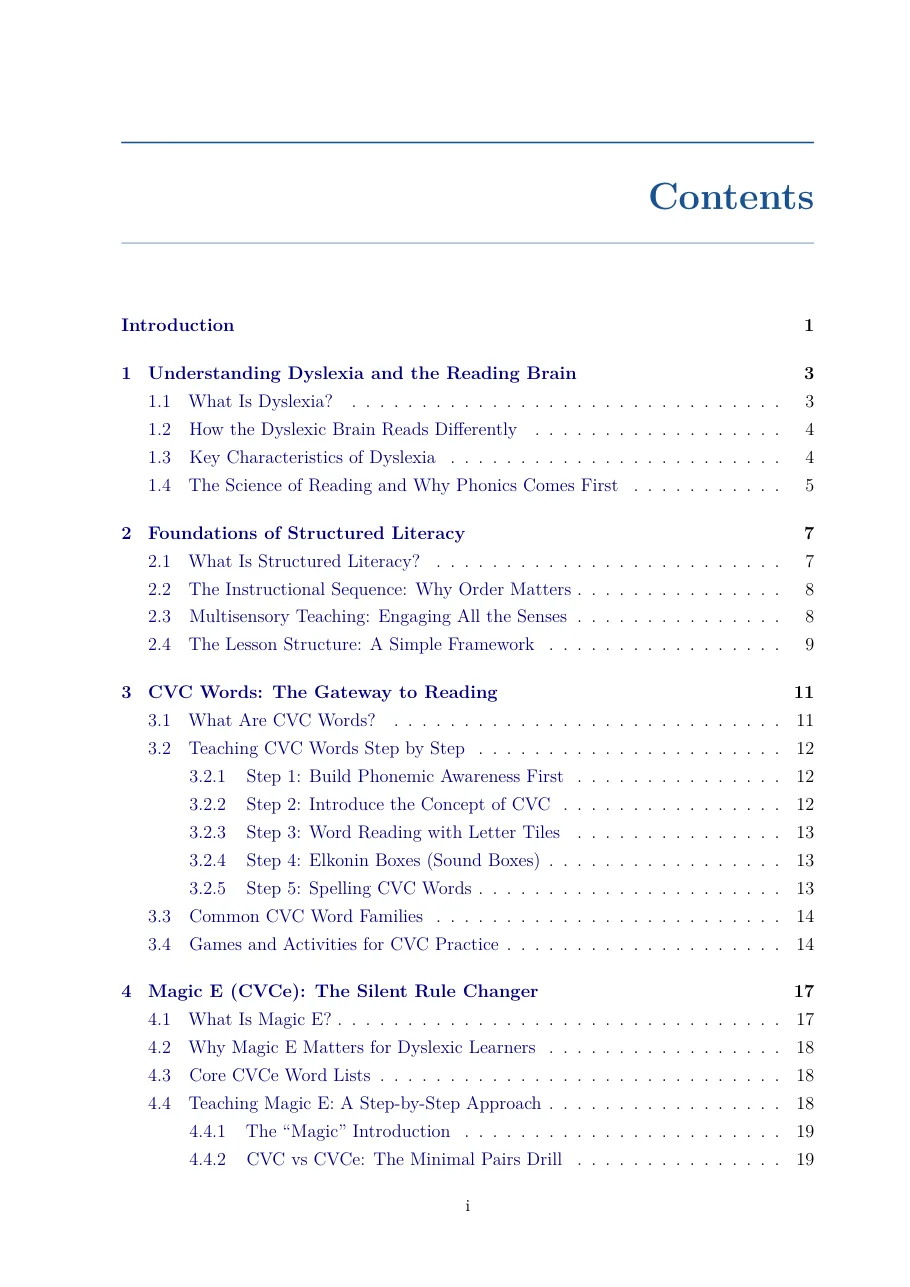
CVC, Magic E and Vowel Teams Bundle for Dyslexia Intervention: a 55-page guidebook with structured literacy foundations, step-by-step teaching sequences for CVC words, Magic E and vowel teams, assessment and progress monitoring guidance, a sample twelve-week plan and seven printable templates, including Elkonin boxes and a phonics tracking chart.
Sources and scope
- International Dyslexia Association: fact sheets on dyslexia and structured literacy.
- What Works Clearinghouse: practice guides on foundational reading skills from the Institute of Education Sciences.
- IRIS Center at Vanderbilt University: free modules on early reading and progress monitoring.
- Understood: plain-language articles for teachers and families on reading difficulties.
This list helps K-1 teachers notice and record phonics patterns and try classroom support. It does not diagnose dyslexia or any learning disability; that requires a qualified evaluation.
Key takeaways
- Signs of phonics difficulty are repeated patterns after clear teaching, not single mistakes.
- Write down the words a child actually reads.
- Respond with explicit, systematic phonics and small-group practice.
- Monitor progress every two weeks with the same short check.
- Share early with families and your support team; leave diagnosis to qualified evaluators.


Leave a Comment