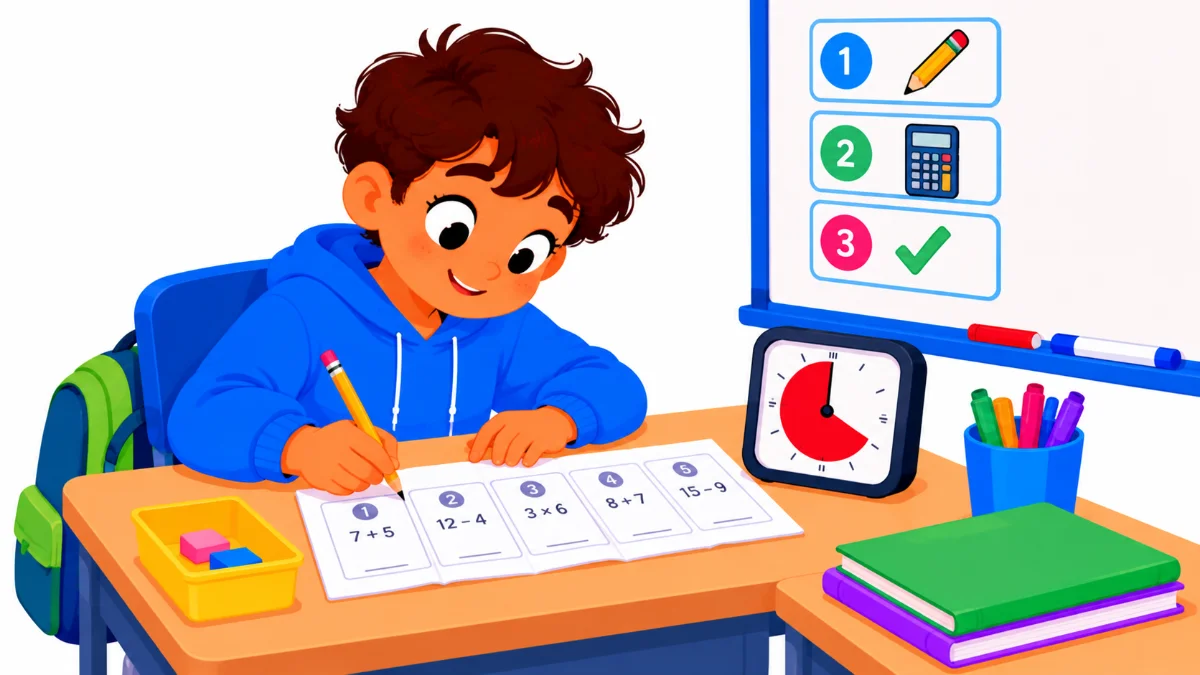

The right ADHD classroom accommodations can turn a day of constant reminders into a day where a student starts work, stays with it, and finishes. Picture a grade 5 classroom during math. Liam, who has ADHD, hears a five-step set of directions, starts on step one, gets distracted by a pencil sharpener, and is still on step two when the timer rings.
This list ranks ten common accommodations by how easy they are to put in place without extra staff or materials. By the end, you will know what each accommodation is, when it fits, how to introduce it smoothly, and how to check whether it helps.
Examples are fictional. Accommodations for a specific student are decided by the IEP or 504 team. This is guidance, not a diagnosis or medical advice.
At a glance
- Start with supports that need no extra staff, like written directions.
- Chunk tasks and use short check-ins to catch drifting early.
- Plan movement and make time visible with timers.
- Add one or two supports at a time and track simple measures.
- Introduce supports privately and keep them consistent.
How we ranked these accommodations
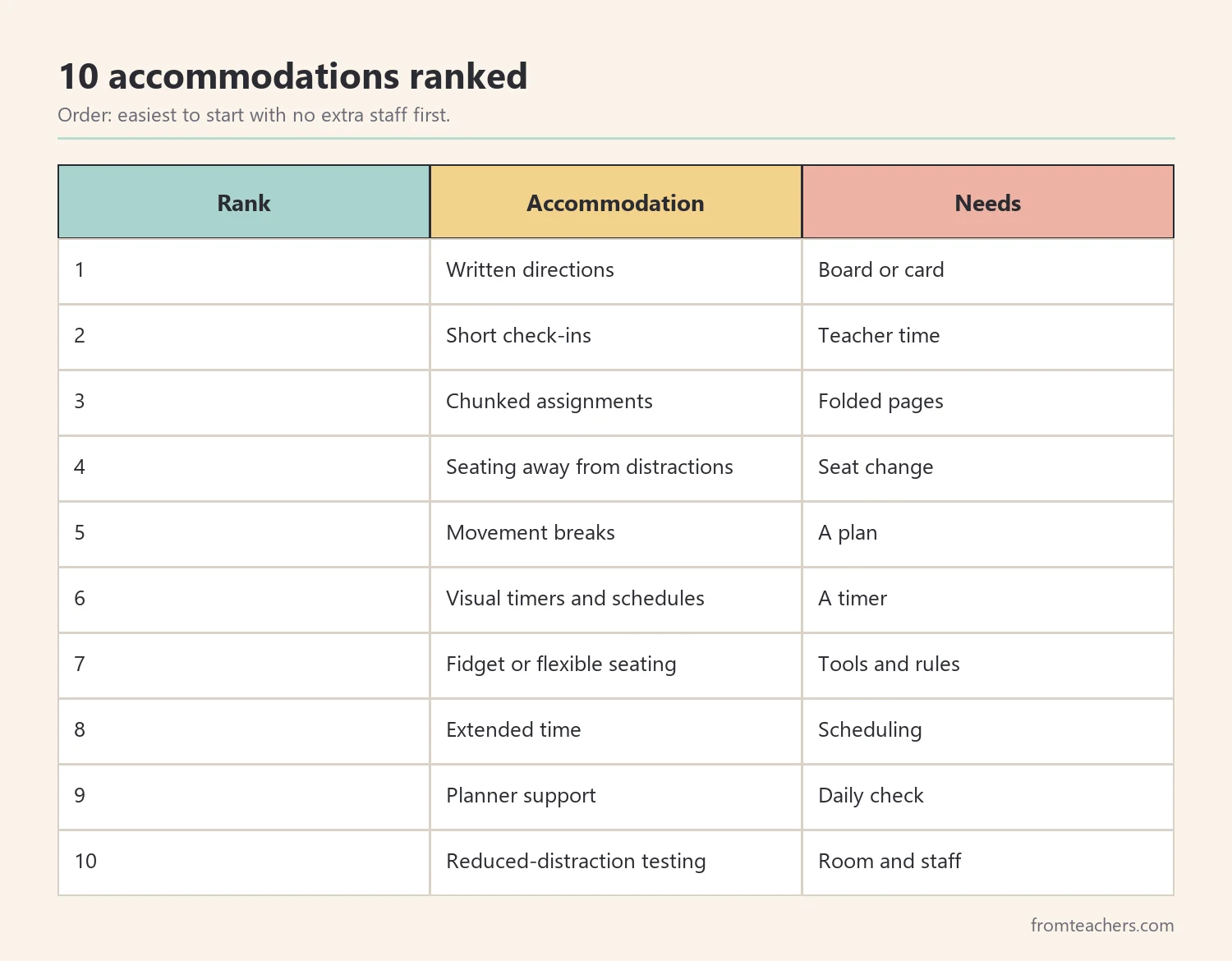
We did not rank accommodations by effectiveness, because what works depends on the student. Instead, the order follows one practical criterion: how easily a classroom teacher can start it with no additional staff and little or no cost. Accommodations near the top, like giving directions in writing, can start tomorrow. Those lower down, like a separate testing setting, need scheduling and coordination.
Many of these supports are commonly discussed by IEP and 504 teams for students with ADHD. They target attention, impulse control, and executive function, which are areas where many students with ADHD need support.
The ready-made option: an ADHD support toolkit for classroom and home
If you want a complete set of systems and scripts, the ADHD support toolkit with classroom and home strategies is a 49-page guide. It explains ADHD in plain language, covers the “Big 5” classroom supports plus routines for transitions, directions, and movement breaks, and adds executive function help, regulation strategies, and scripts for hard moments.
It also includes a home section with parent partnership scripts and a homework plan, plus a printable toolkit with data trackers and classroom scenarios.
1. Directions in writing as well as spoken
What it is: key directions posted on the board or on a card, in addition to saying them.
Why it helps: the student can look back instead of holding every step in memory.
How to start: number the steps and keep them visible during the whole task.
Example: Ms. Chen wrote three numbered steps on the board. When Liam lost track, he glanced up instead of asking a neighbor.
2. Short check-ins
What it is: brief teacher visits to the student’s desk at planned points.
Why it helps: it catches drifting early and gives quick feedback.
How to start: plan a check-in a few minutes after work begins, then halfway through.
Example: Ms. Chen checked Liam’s work three minutes in. A quick nod and “Good start, now step two” kept him moving.
3. Chunked assignments
What it is: breaking a long task into smaller parts, sometimes on separate pages.
Why it helps: a short task feels manageable, and finishing each part gives a sense of progress.
How to start: fold a worksheet in half or cover part of it. Give the next part when the first is done.
Example: Liam’s 20-problem sheet became four sets of five. He finished more problems than before.
4. Seating away from distractions
What it is: a seat away from doors, windows, pencil sharpeners, and busy pathways, often near the teacher.
Why it helps: fewer things compete for attention.
How to start: try a seat for a week and ask the student how it feels.
Example: Liam moved from beside the sharpener to a quieter spot near the board. His off-task moments dropped.
5. Planned movement breaks
What it is: short, scheduled chances to move, such as delivering a note, stretching, or a quick walk.
Why it helps: many students with ADHD find it easier to focus after movement than after being asked to sit still longer.
How to start: schedule breaks between tasks, and teach how to return to work.
Example: Liam became the class messenger twice a morning. He returned ready to work, and Ms. Chen noticed fewer fidgety moments in the half hour after each trip.
6. Visual timers and schedules
What it is: a timer that shows time passing and a visible schedule of the day or lesson.
Why it helps: it makes time concrete and reduces surprises at transitions.
How to start: use a timer for work blocks and give warnings before transitions.
Example: A two-minute warning before cleanup helped Liam finish instead of being pulled away mid-task.
7. Tools for fidgeting or flexible seating
What it is: quiet fidget tools, a wobble cushion, or a standing option.
Why it helps: some students focus better when allowed small, quiet movement.
How to start: set clear rules: the tool stays quiet, stays at the desk, and is not a toy.
Example: Liam used a quiet fidget during read-alouds. He listened better and stopped tapping his pencil.
8. Extended time
What it is: more time to complete tests or assignments.
Why it helps: students who lose focus or need breaks can still show what they know.
How to start: agree on how much extra time, where, and how the student will be reminded.
Example: With extra time on quizzes, Liam finished all questions instead of leaving the last third blank.
9. Homework and planner support
What it is: a planner check at the end of the day and, if needed, a short note between home and school.
Why it helps: it reduces forgotten assignments and missing materials.
How to start: check the planner for one minute before dismissal, and keep a homework folder with “to do” and “done” sides.
Example: With a daily planner check, Liam’s missing homework dropped sharply.
10. Reduced-distraction testing setting
What it is: taking tests in a quieter room or a small group.
Why it helps: fewer distractions can make it easier to concentrate on demanding tasks.
How to start: coordinate space and staff with the team, and practice in the new setting before big tests.
Example: Liam took unit tests in the library with a small group. He said it felt “calmer,” and his scores became a more accurate picture of what he knew.
Checking whether ADHD classroom accommodations are working
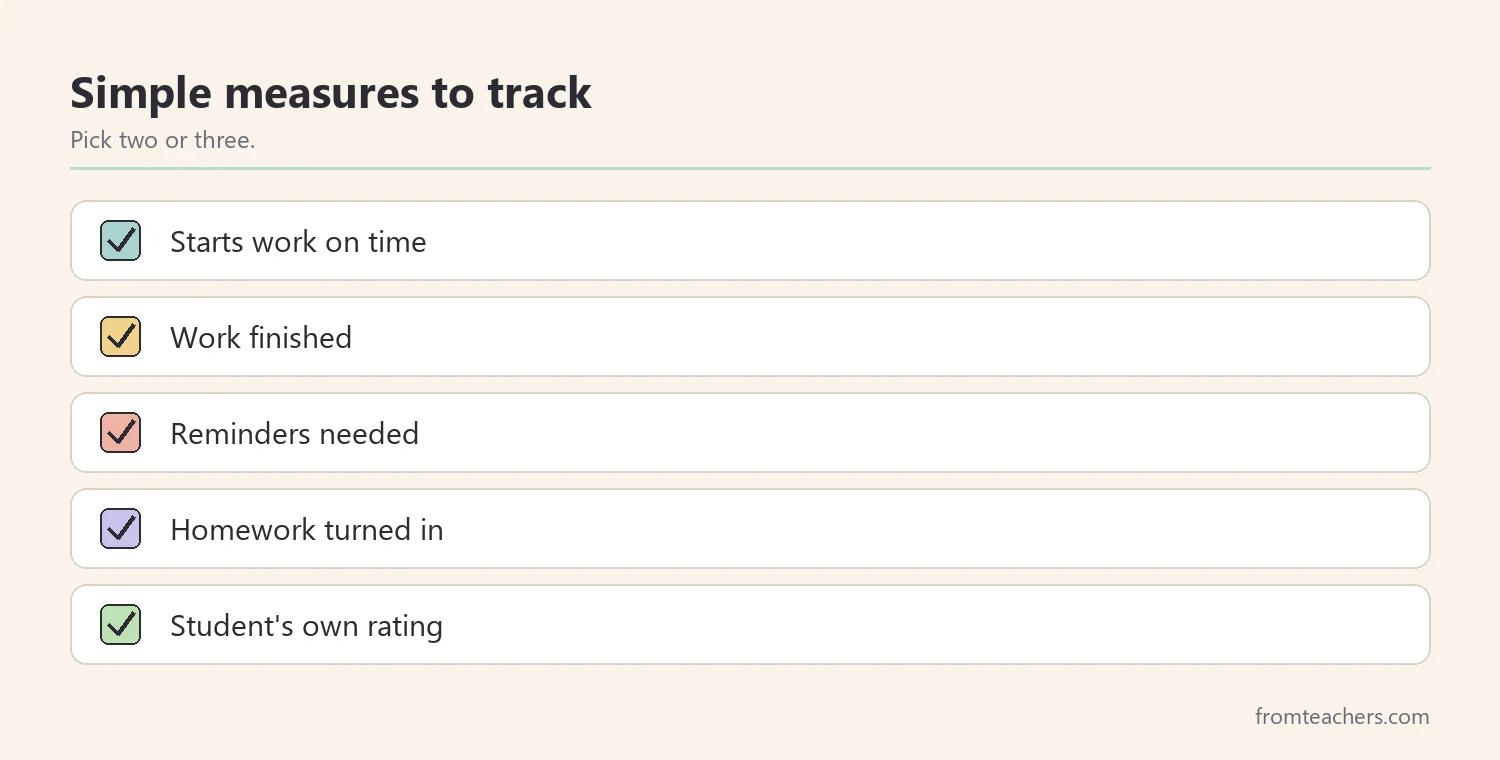
Accommodations should change something you can see. Choose two or three simple measures linked to the student’s goals, such as how often the student starts work on time, how much work is finished, and how many reminders are needed.
Here is how Ms. Chen tracked Liam’s first five weeks as accommodations were added.
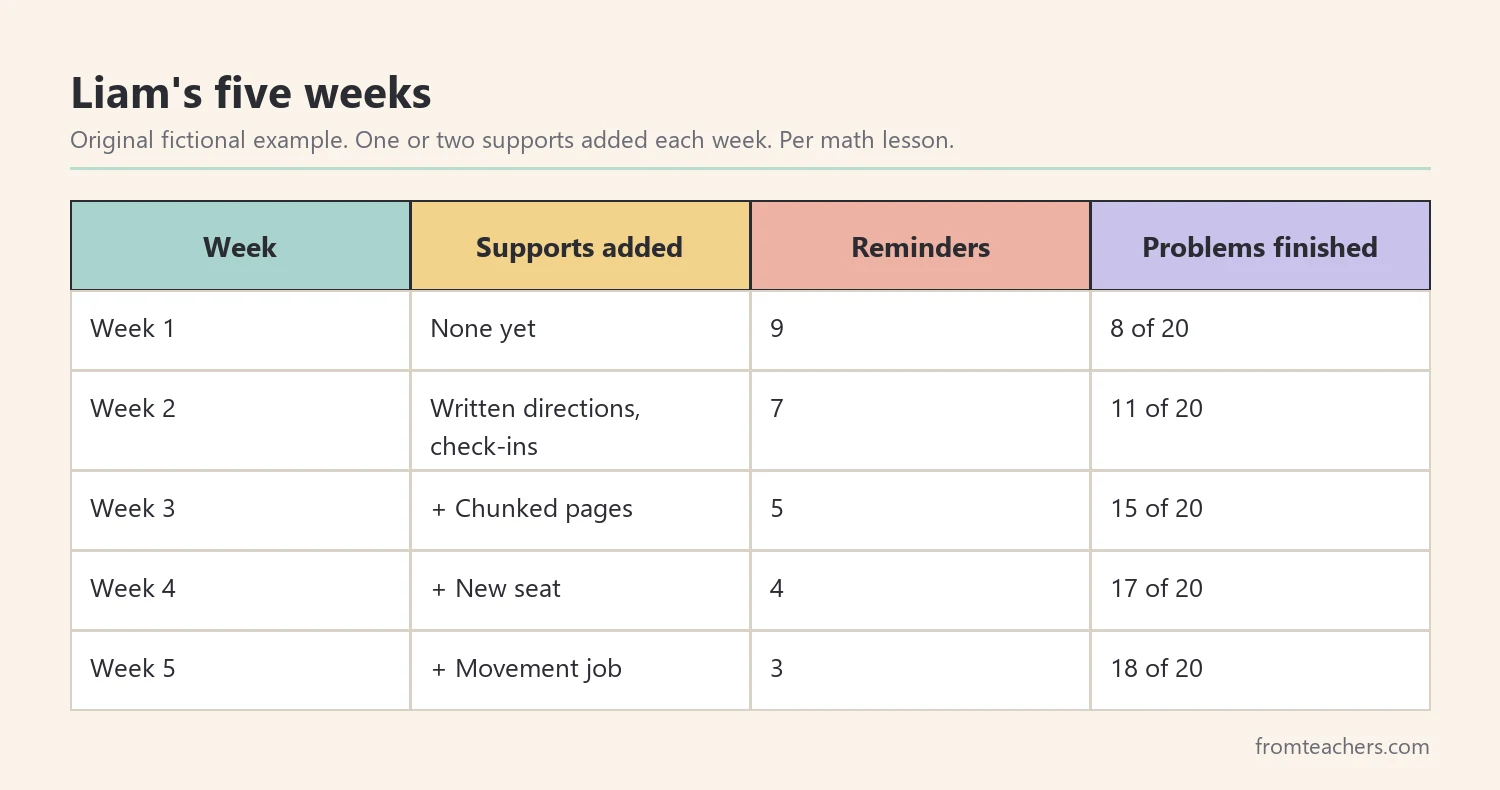
The pattern was encouraging. Each added support brought fewer reminders and more finished work. As a result, the team kept the accommodations and planned to review them in eight weeks.
Matching supports to the barrier
The most useful ADHD classroom accommodations target the specific barrier a student faces. Before choosing, watch closely for a few days and ask: where exactly does the student get stuck?
If the student struggles to start, try written directions, a check-in at minute three, and a start ritual. If the student starts well but drifts, try chunked tasks, a visual timer, and planned movement. When work is finished but never reaches the teacher, focus on planner checks and a homework folder. If tests go badly despite good classwork, look at extended time and a quieter setting.
This matching step prevents a common problem: piling on supports that do not address the real difficulty. It also makes team conversations clearer, because each support has a stated purpose that can be checked.
Introducing accommodations smoothly
How you introduce an accommodation matters as much as the accommodation itself. Students, especially older ones, may feel singled out.
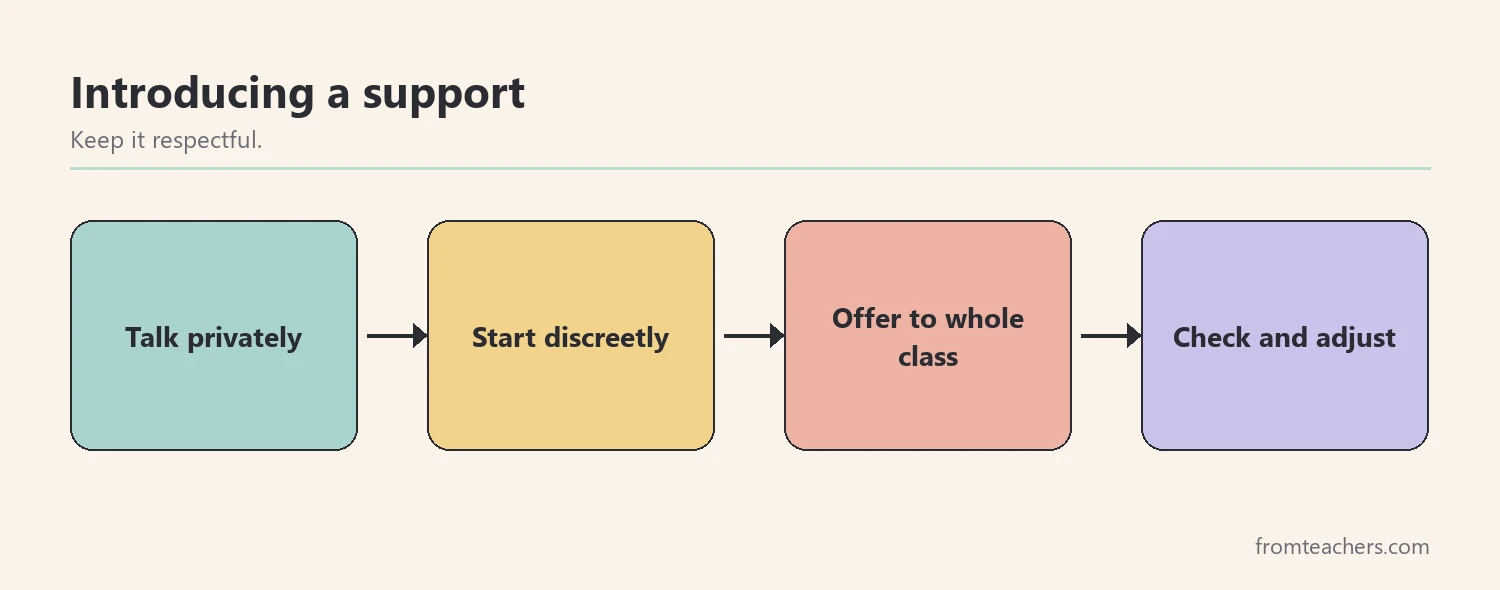
First, talk privately with the student. Explain what the support is and why it might help. Next, make supports discreet when possible, such as a direction card on the desk rather than a public reminder. Then, offer some supports, like written directions and timers, to the whole class. Many students benefit, and no one stands out.
In addition, work with the family. Sharing what helps at school, and hearing what helps at home, makes supports more consistent. A short weekly note can be enough.
Moreover, revisit supports as the student grows. A visual timer that helps a grade 5 student may be replaced by a phone timer or planner app in middle school. The goal is gradually more independence.
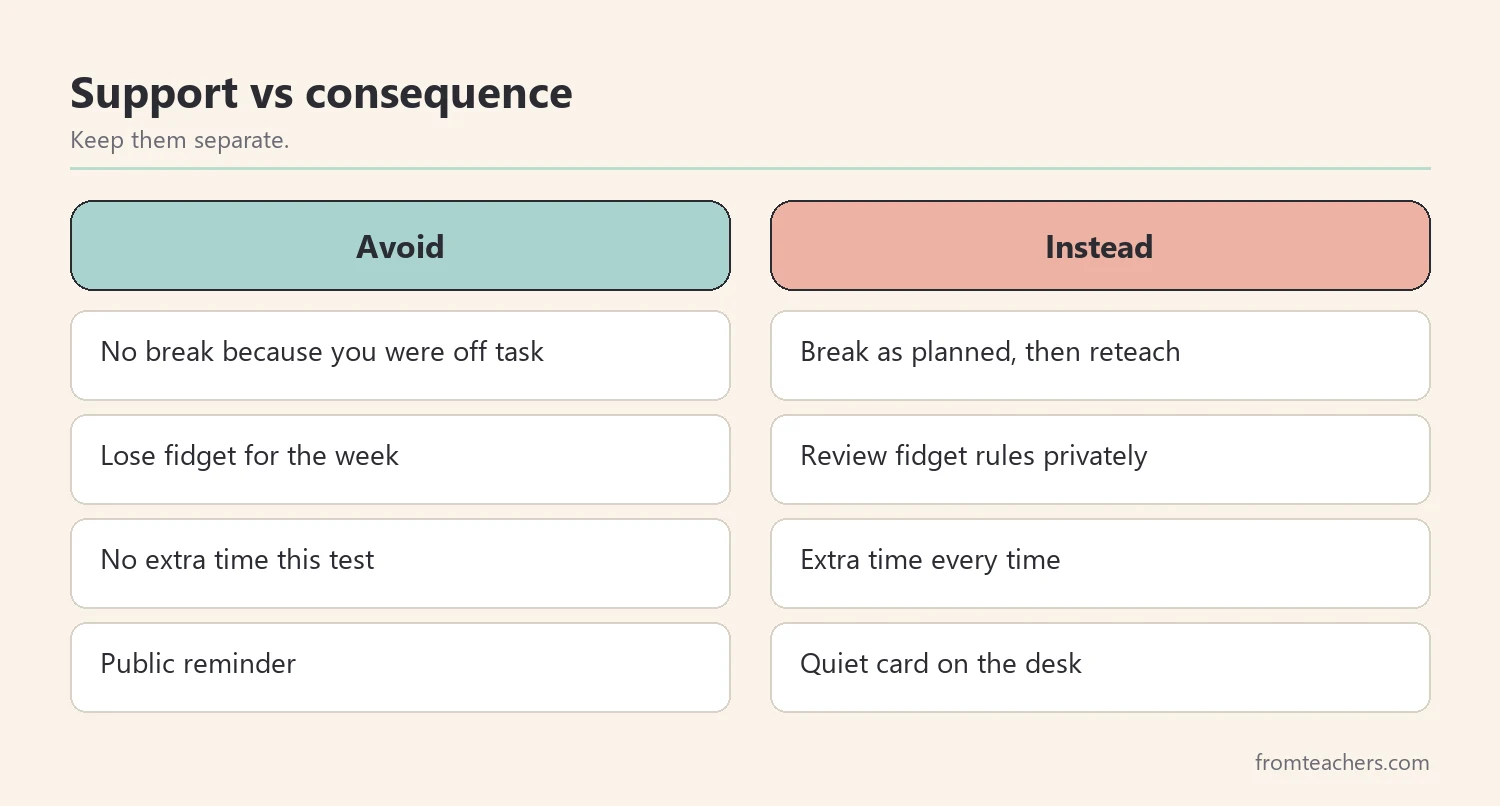
Finally, remember that accommodations are not a reward or a punishment. They are tools that give the student fair access to learning, and they work best when they are provided consistently every day.
Common mistakes and how to avoid them
- Adding too many supports at once. Fix: add one or two, then check data.
- Inconsistent use. Fix: share a one-page summary with all staff.
- Making the student stand out. Fix: offer universal supports to the class when possible.
- Removing supports as punishment. Fix: keep accommodations separate from consequences.
- Never reviewing. Fix: check simple measures and review with the team.
Questions teachers and parents ask about ADHD classroom accommodations
Does a student need a diagnosis to get accommodations?
Formal accommodations usually come through an IEP or 504 plan, which involves an evaluation process. However, teachers can often use universal supports, like written directions, with any student.
What is the difference between a 504 plan and an IEP?
Broadly, a 504 plan provides accommodations for access, while an IEP provides specially designed instruction and related services under IDEA. Your school team can explain which applies.
Are fidget tools always helpful?
Not always. They help some students and distract others. Try them with clear rules and watch the results.
How often should accommodations be reviewed?
Formally, at least at the annual review. Informally, check simple data every few weeks, especially when supports are new.
Can these accommodations be used at home?
Many can. Written steps, timers, chunked homework, and movement breaks often help at home too.
Related reading: Effective ADHD Classroom Strategies, Accommodations vs Modifications in Special Education, and ADHD in Children: A Guide to Effective Classroom and Home Support.
You may also need: Homework Help for ADHD: Focused, Simple, and Supportive Study Strategies.
A companion resource for ADHD classroom accommodations:
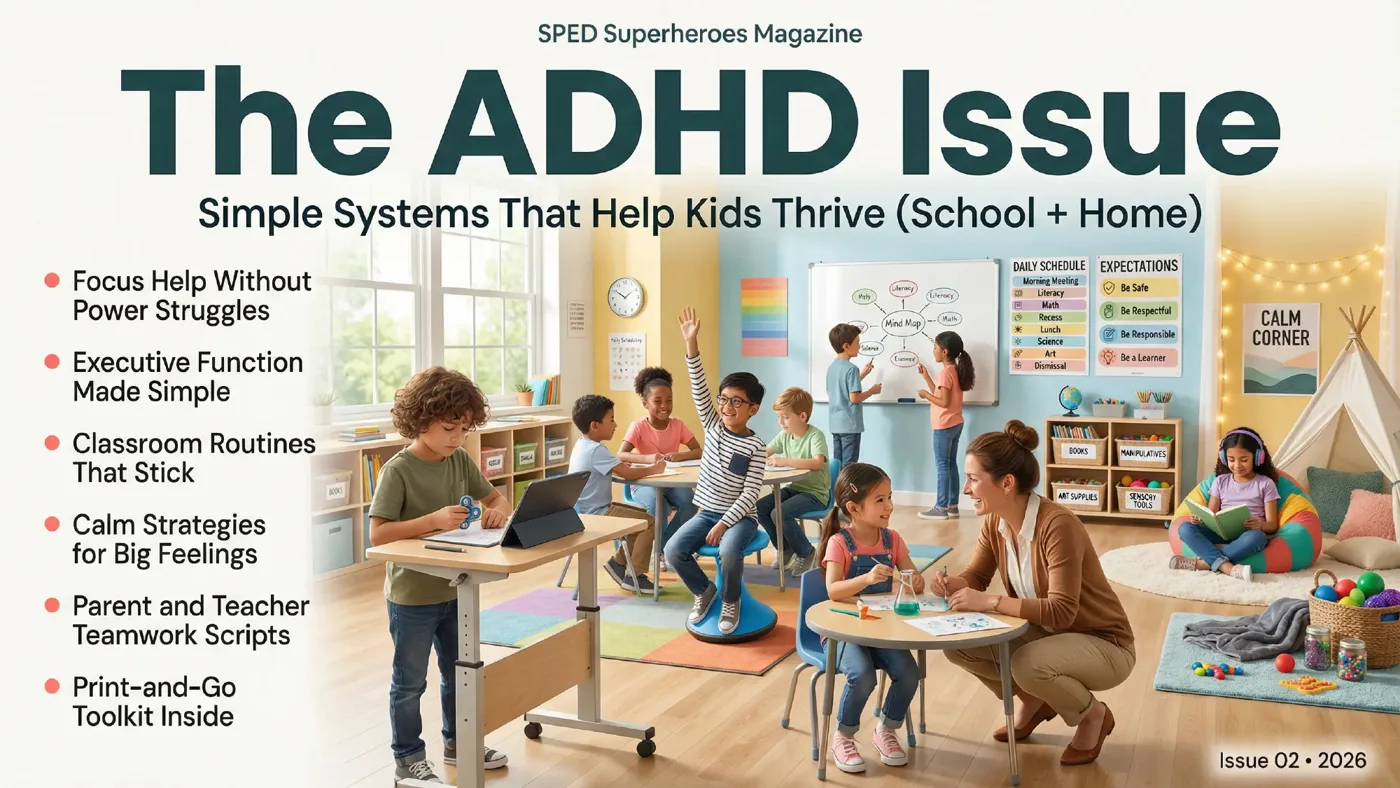
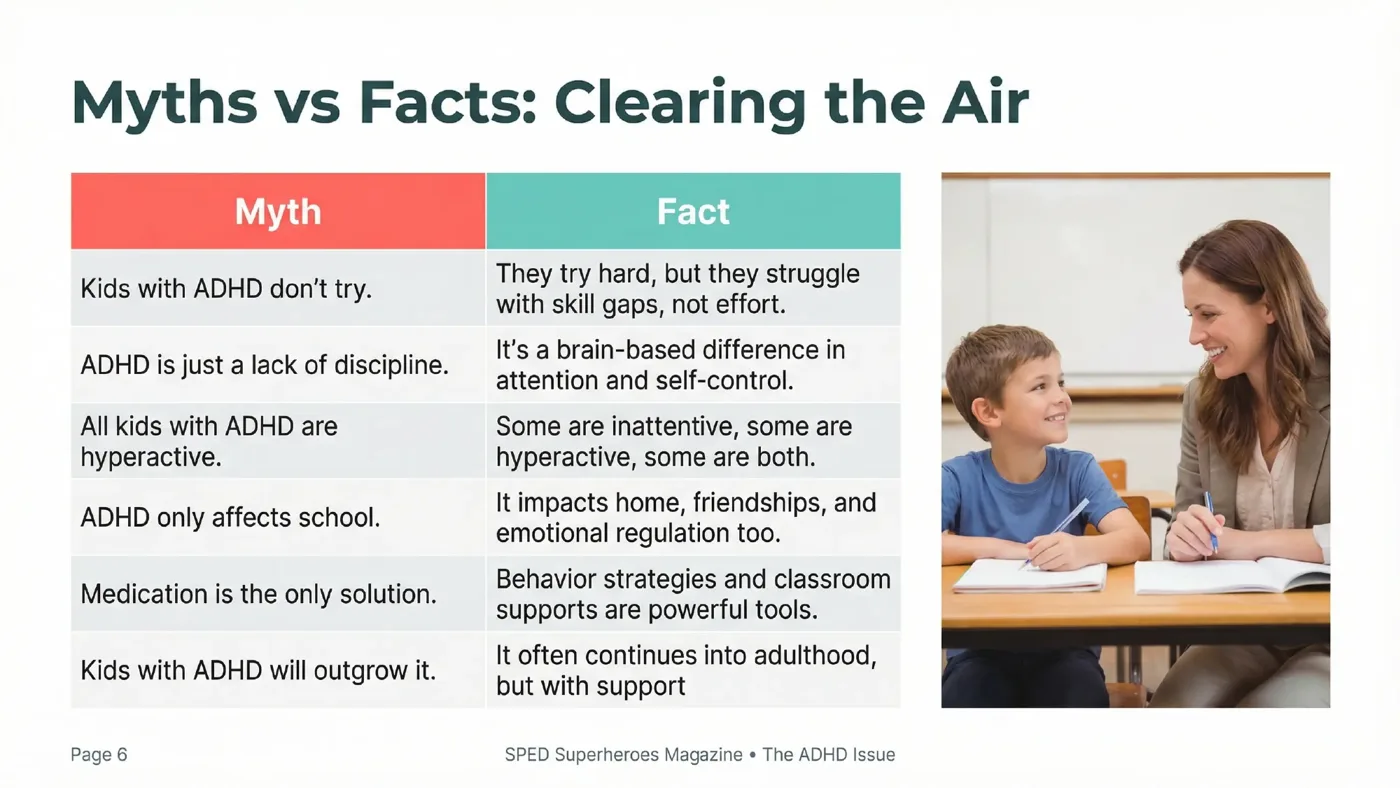
ADHD Support Toolkit: Classroom And Home Strategies: a 49-page guide with a plain-language explanation of ADHD, the Big 5 classroom supports, routines for transitions, directions and movement breaks, executive function and regulation strategies, a home section with a homework plan, and a printable toolkit with data trackers.
Sources and scope
- CHADD: information on ADHD for families and educators, including school supports.
- Understood.org: practical guidance on ADHD accommodations at school.
- Center for Parent Information and Resources: information on IEPs, 504 plans and accommodations.
- National Institute of Mental Health: general information about ADHD.
This list covers common classroom accommodations for students with ADHD. It does not cover diagnosis or medical treatment, and accommodations for a specific student are decided by the IEP or 504 team.
Key takeaways
- Start with ADHD classroom accommodations that need no extra staff, like written directions.
- Add supports one or two at a time and track simple measures.
- Introduce supports privately and offer universal ones to the whole class.
- Keep accommodations consistent and separate from consequences.
- Review with the team and family, and adjust as the student grows.










Leave a Comment