

Common classroom accommodations can sound like a confusing list of jargon when you first see them in your child’s IEP or 504 plan. Picture a parent at a grade 5 504 meeting. Lily’s mom hears “preferential seating, chunked assignments, extended time, and read-aloud for tests.” Everyone nods. She nods too, but later, at home, she wonders what each one actually looks like and how she will know if any of them work.
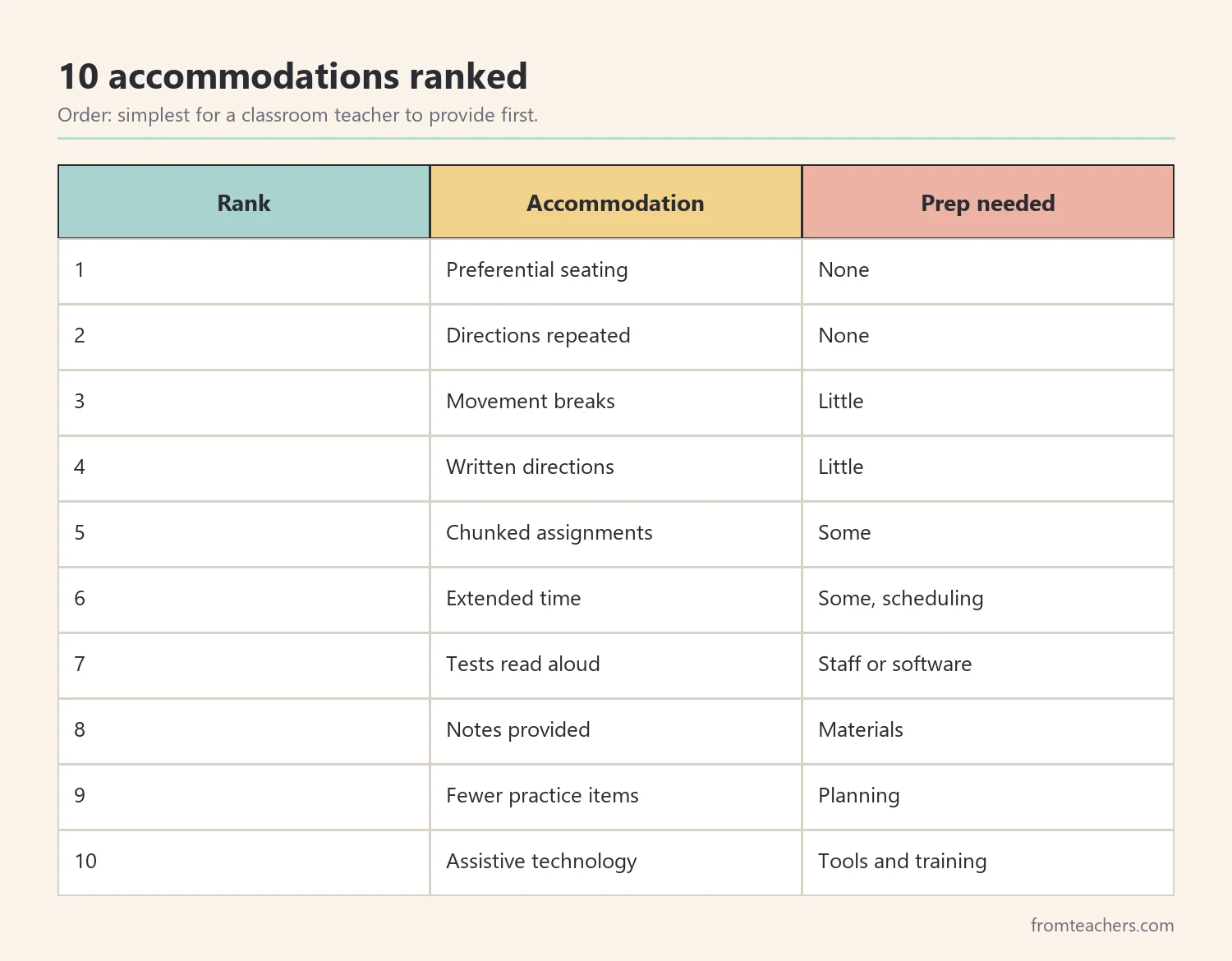
This list is written for parents. It explains ten accommodations you are likely to hear about, ranked from the simplest for a classroom teacher to provide to the ones that need more planning. For each one, you will learn what it is, who it often helps, what it looks like in class, and the questions to ask to find out whether it is working. By the end, you will be ready for a more confident conversation with your child’s team.
Examples are fictional. Adapt to the student’s goals and agreed supports. Accommodations are decided by the IEP or 504 team based on the student’s needs. This is guidance, not legal advice.
At a glance
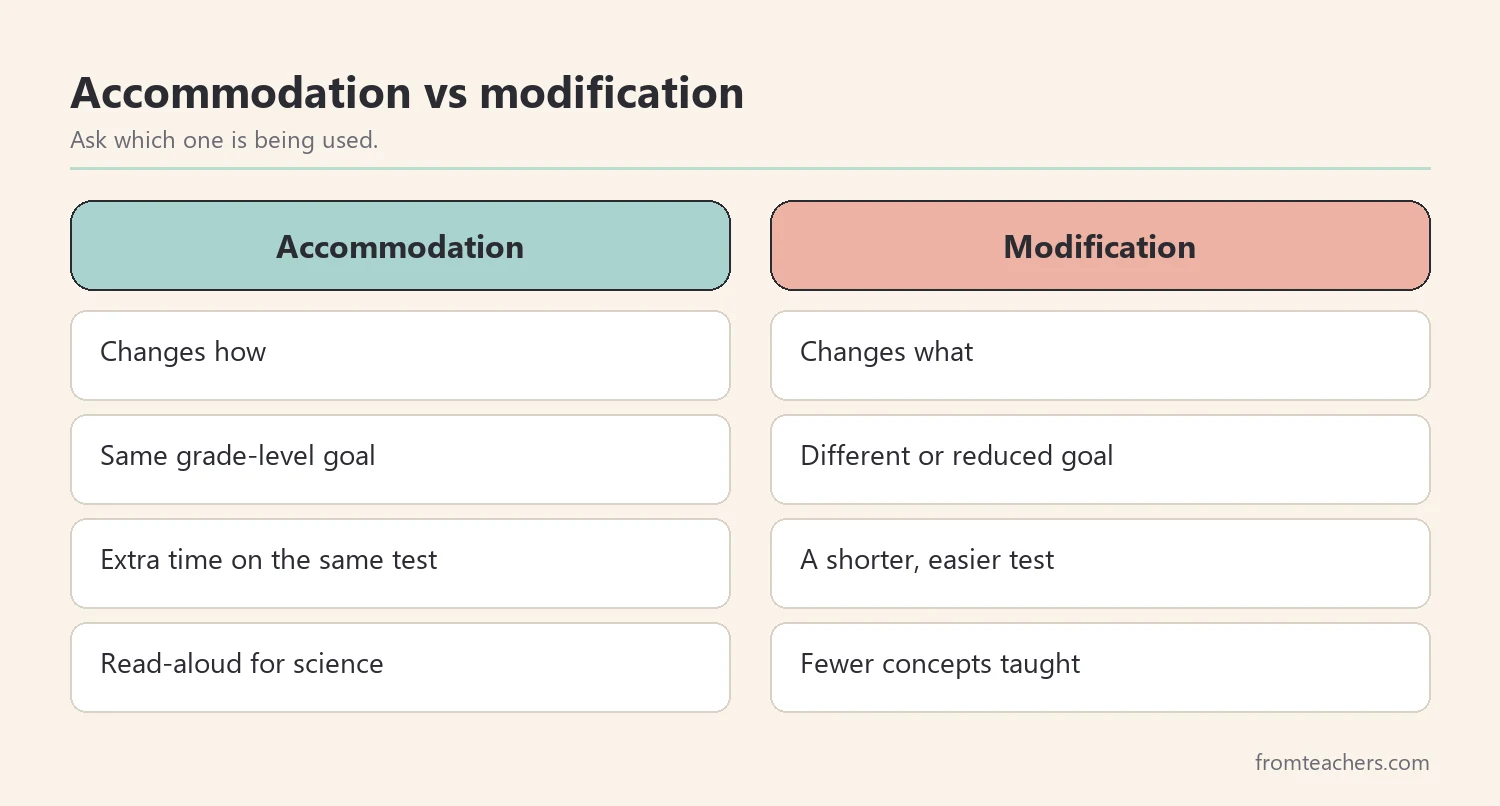
- Accommodations change how a child learns, not what they learn.
- Seating, repeated directions and breaks are the simplest to provide.
- Extended time, read-aloud tests and assistive technology need more planning.
- Check three things: provided, used and helpful.
- Bring specific questions and home observations to the team.
How we ranked these accommodations
We did not rank by “best,” because the right accommodation depends on the individual student. Instead, we used one clear rule: how easy each accommodation is for a typical general education teacher to provide during a normal day. The first ones need almost no preparation. The later ones need materials, technology, or coordination with other staff.
Also, remember the key difference: an accommodation changes how a student learns or shows learning, not what they are expected to learn. A modification changes the expectation itself.
The ready-made option: a form that asks “Is it working?”
Parents often hear “It’s going fine” without details. The classroom accommodation feedback form for IEP and 504 effectiveness gives teachers a one-page way to report which accommodations were implemented, rate effectiveness from Very Effective to Not Effective or Did Not Use, describe behavior, engagement, and focus, note academic impact and challenges, and suggest additional accommodations.
As a result, parents and case managers get real feedback, and you can ask the team to use a form like this before review meetings.
1. Preferential seating
What it is: the student sits in a spot that supports learning, often near the teacher, away from doors or windows, or near the board.
Who it often helps: students with attention difficulties, hearing or vision needs, or those who are easily distracted.
What it looks like: Lily sits in the second row, near the teacher’s usual teaching spot and away from the pencil sharpener.
Ask: “Does the seat help her focus, or does she still get distracted there?”
2. Directions repeated or clarified
What it is: the teacher repeats directions, checks understanding, or gives them in smaller steps.
Who it often helps: students with attention, language processing, or memory difficulties.
What it looks like: after giving directions to the class, the teacher quietly asks Lily to repeat the first step.
Ask: “Does she start tasks on time after directions are repeated?”
3. Movement or short breaks
What it is: planned opportunities to move or take a short break.
Who it often helps: students with ADHD, sensory needs, or anxiety.
What it looks like: Lily delivers a note to the office once each morning or uses a break card for two minutes.
Ask: “Does she return to work more focused after a break?”
Example: Lily’s teacher noticed that a two-minute break after recess helped more than one during math, so they moved it.
4. Written or visual copies of directions
What it is: instructions given in writing or with visuals, in addition to spoken directions.
Who it often helps: students with memory, attention, or hearing needs, and English learners.
What it looks like: the steps for a science lab are printed on a card at Lily’s desk.
Ask: “Does she check the card on her own, or does she still need reminders?”
Example: at first, Lily ignored the card. After her teacher pointed to it twice and praised her for using it, she began checking it before raising her hand.
5. Chunked assignments
What it is: large assignments broken into smaller parts, often with separate check-ins.
Who it often helps: students who feel overwhelmed by long tasks or struggle with planning.
What it looks like: Lily’s book report is split into three parts with three due dates.
Ask: “Does she complete each part on time, and is the quality improving?”
6. Extended time
Extended time is one of the most common classroom accommodations parents hear about.
What it is: extra time for tests or assignments, often time and a half.
Who it often helps: students who read, write, or process information more slowly.
What it looks like: Lily finishes math tests in the resource room after class.
Ask: “Does she use the extra time? Do her scores reflect what she knows?”
Example: Lily’s teacher noticed she rarely used her extra time in the classroom, because she did not want classmates to see. Moving it to the resource room changed that.
7. Tests read aloud
What it is: test questions are read to the student by an adult or with text-to-speech, when reading is not the skill being tested.
Who it often helps: students with reading disabilities such as dyslexia.
What it looks like: Lily hears science test questions through headphones.
Ask: “Do her science scores better match what she knows in class discussions?”
8. Notes or study guides provided
What it is: the student receives a copy of class notes or a partially completed note sheet.
Who it often helps: students with writing difficulties, slow handwriting, or attention needs.
What it looks like: Lily receives a guided notes page with blanks to fill in during the lesson.
Ask: “Is she listening and filling in key words, or just waiting for the notes?”
Example: Lily’s guided notes had about ten blanks per lesson. Because she no longer copied everything from the board, she could listen and answer questions, and her quiz scores rose.
9. Reduced number of practice items
What it is: the student completes fewer practice problems that still cover every skill.
Who it often helps: students who need more time or tire quickly, as long as the same skills are practiced.
What it looks like: Lily does the odd-numbered math problems, which include every problem type.
Ask: “Is she still practicing every skill, and is she mastering them?”
10. Assistive technology
What it is: tools such as speech-to-text, text-to-speech, audiobooks, or graphic organizer apps.
Who it often helps: students with reading, writing, or organizational challenges.
What it looks like: Lily uses speech-to-text for writing first drafts.
Ask: “Has she been taught how to use the tool, and does she use it on her own?”
How to tell if common classroom accommodations are working
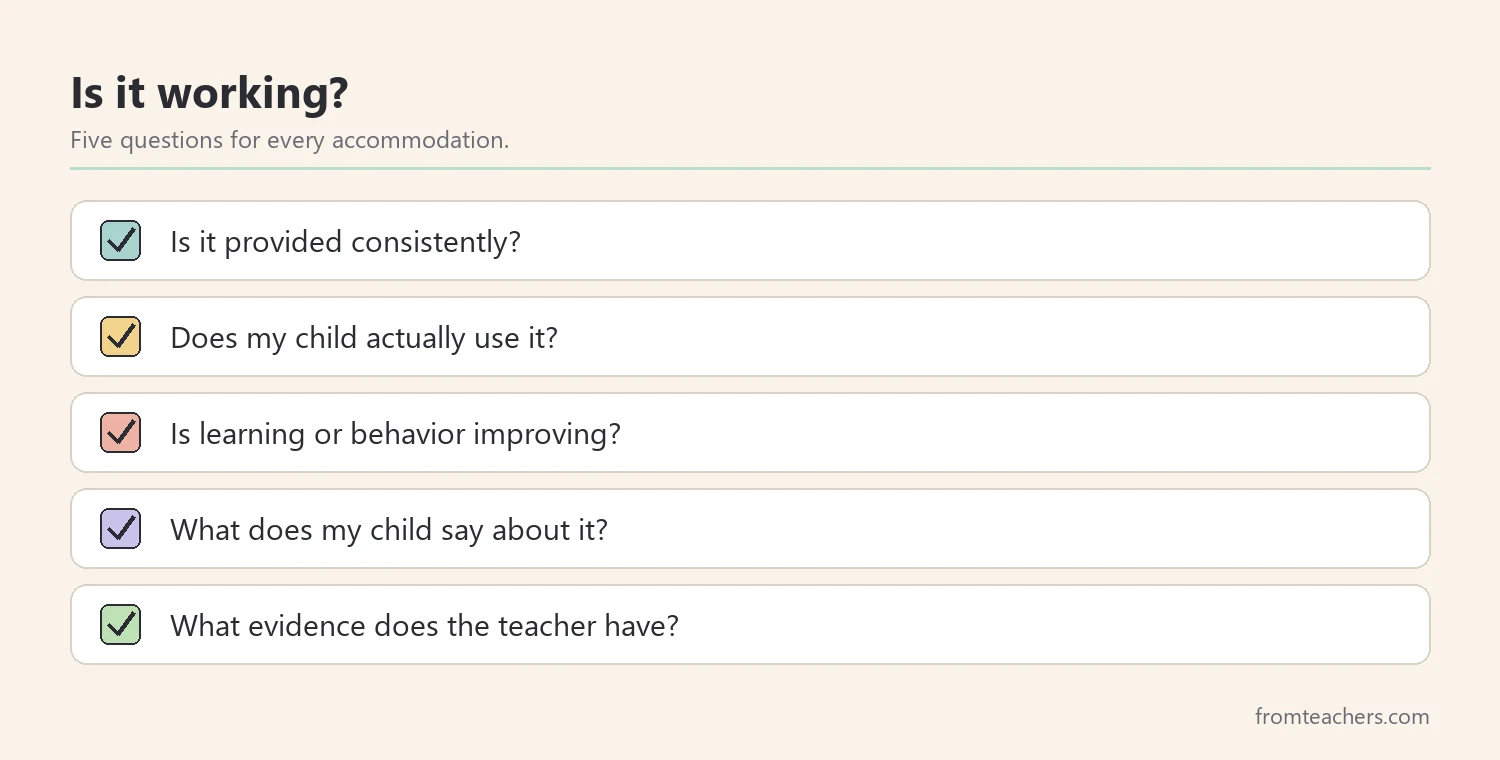
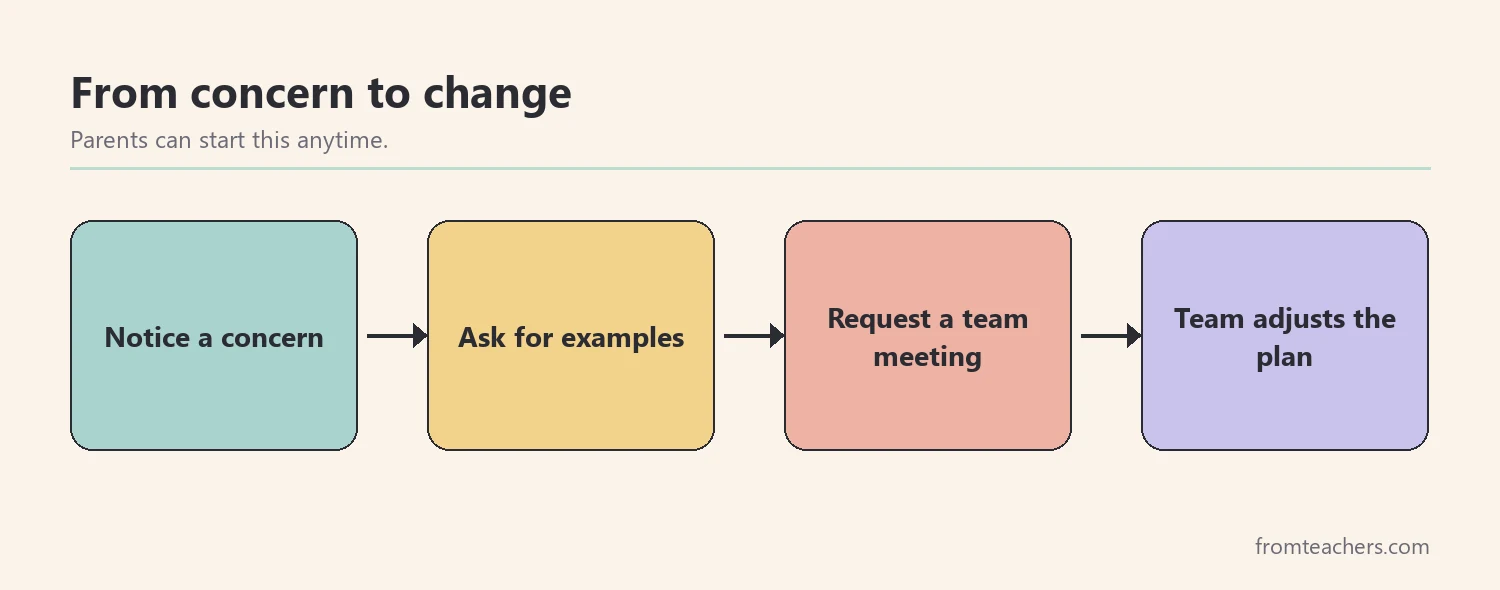
An accommodation can be written in the plan and still not help. To find out, look at three things: whether it is provided consistently, whether your child actually uses it, and whether learning or behavior improves.
First, ask the teacher for specific examples, not just “fine.” Next, ask your child: “When you have extra time, do you use it? Does it help?” Then look at work samples over several weeks. Finally, ask whether the team can use a short feedback form before review meetings.
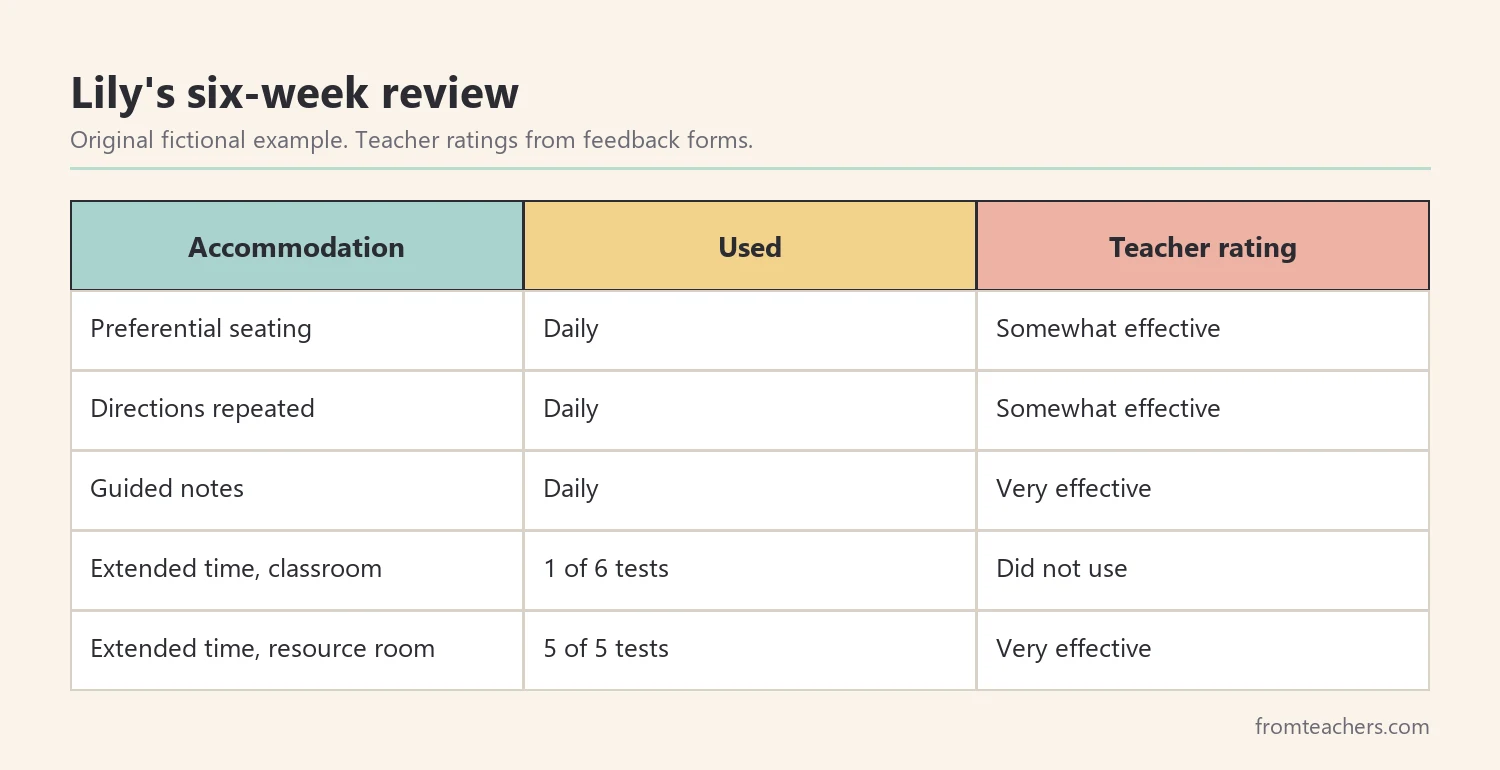
Lily’s team tracked her accommodations for six weeks. The results are shown in Figure 4. Extended time in the resource room and guided notes helped most, while preferential seating alone made little difference.
Questions to bring to the next meeting
Parents are equal members of the IEP team, and 504 teams also benefit from parent input. These questions help keep the conversation specific.
| Question | Why ask it |
|---|---|
| Which accommodations does my child use most? | Shows real use |
| Which ones are not used, and why? | Finds barriers |
| What evidence shows progress? | Moves past “fine” |
| Is anything new needed? | Keeps the plan current |
In addition, share what you see at home. If homework takes three hours, that is useful information for the team.
Talking with your child about accommodations
Many children feel embarrassed to use supports in front of classmates. A short, calm conversation can help. Explain that accommodations are like glasses: they do not make the work easier, they make it fair, so the student can show what they know.
Also, ask your child which supports feel helpful and which feel awkward. Children often give honest answers at home that they would not share at school. Lily told her mom she disliked leaving class for extra time, which led the team to adjust the setting.
As children grow, encourage them to name their accommodations and ask for them. That skill, called self-advocacy, becomes very important in middle school, high school, and beyond.
Common mistakes and how to avoid them
- Assuming “in the plan” means “happening”: ask for examples and evidence.
- Too many accommodations at once: focus on the ones that address the biggest needs.
- Confusing accommodations and modifications: ask whether expectations are changing.
- Not asking your child: their view often explains why a support is not used.
- Waiting for the annual review: you can request a meeting anytime concerns arise.
Questions parents ask about common classroom accommodations
What is the difference between an IEP and a 504 plan?
An IEP is a plan under IDEA for students who need specially designed instruction. A 504 plan, under Section 504, provides accommodations for students with disabilities who may not need special education. Both can include accommodations.
Can I ask for a specific accommodation?
Yes. Parents can suggest accommodations, ideally with examples of the need. The team decides together.
Will accommodations follow my child to state tests?
Some may, depending on state testing rules. Ask the team which accommodations are allowed on state assessments.
How often should accommodations be reviewed?
At least at the annual review, but you can ask for a meeting anytime you have concerns.
Do accommodations lower expectations?
No. Accommodations change how a student learns or shows learning, not what they are expected to learn.
Related reading: accommodations vs modifications explained, how teachers and parents communicate in special education.
A companion resource for common classroom accommodations:
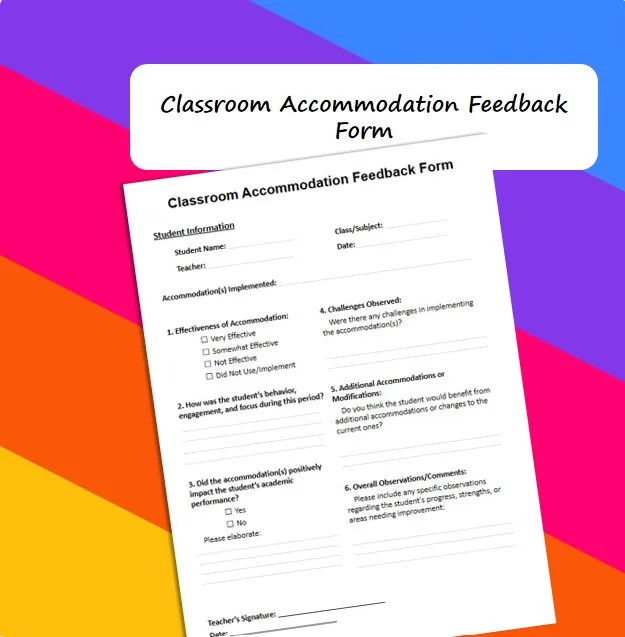
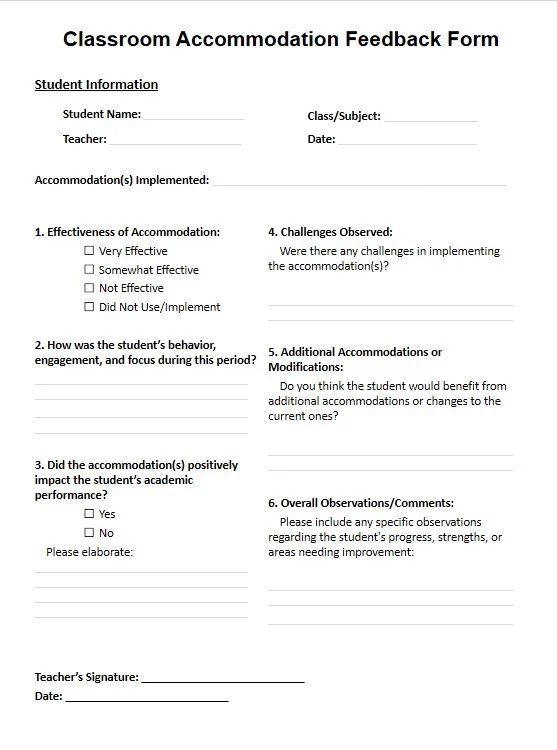
Classroom Accommodation Feedback Form IEP 504 Effectiveness Tracker: a one-page form with student, teacher, date and class fields, accommodations implemented, an effectiveness rating from Very Effective to Not Effective or Did Not Use, questions on engagement and academic impact, challenges observed, suggested additional accommodations and teacher signature.
You may also need: Accommodations & Modifications Tracker Editable Special Education IEP Forms.
Sources and scope
- Center for Parent Information and Resources: plain-language information for families on IEPs, 504 plans and accommodations.
- Understood.org: articles for parents on classroom accommodations.
- Wrightslaw: information on IDEA, Section 504 and parent rights.
- National Center for Learning Disabilities: resources on accommodations for students with learning disabilities.
This list explains common accommodations for parents in general terms. It does not provide legal advice; accommodations are decided by the IEP or 504 team for each student.
Key takeaways
- Common classroom accommodations change how a child learns, not what they learn.
- Simple supports like seating and repeated directions are easy to provide.
- Extended time, read-aloud tests, and assistive technology need more planning.
- Ask whether each accommodation is provided, used, and helpful.
- Bring specific questions and home observations to the team.





Leave a Comment