

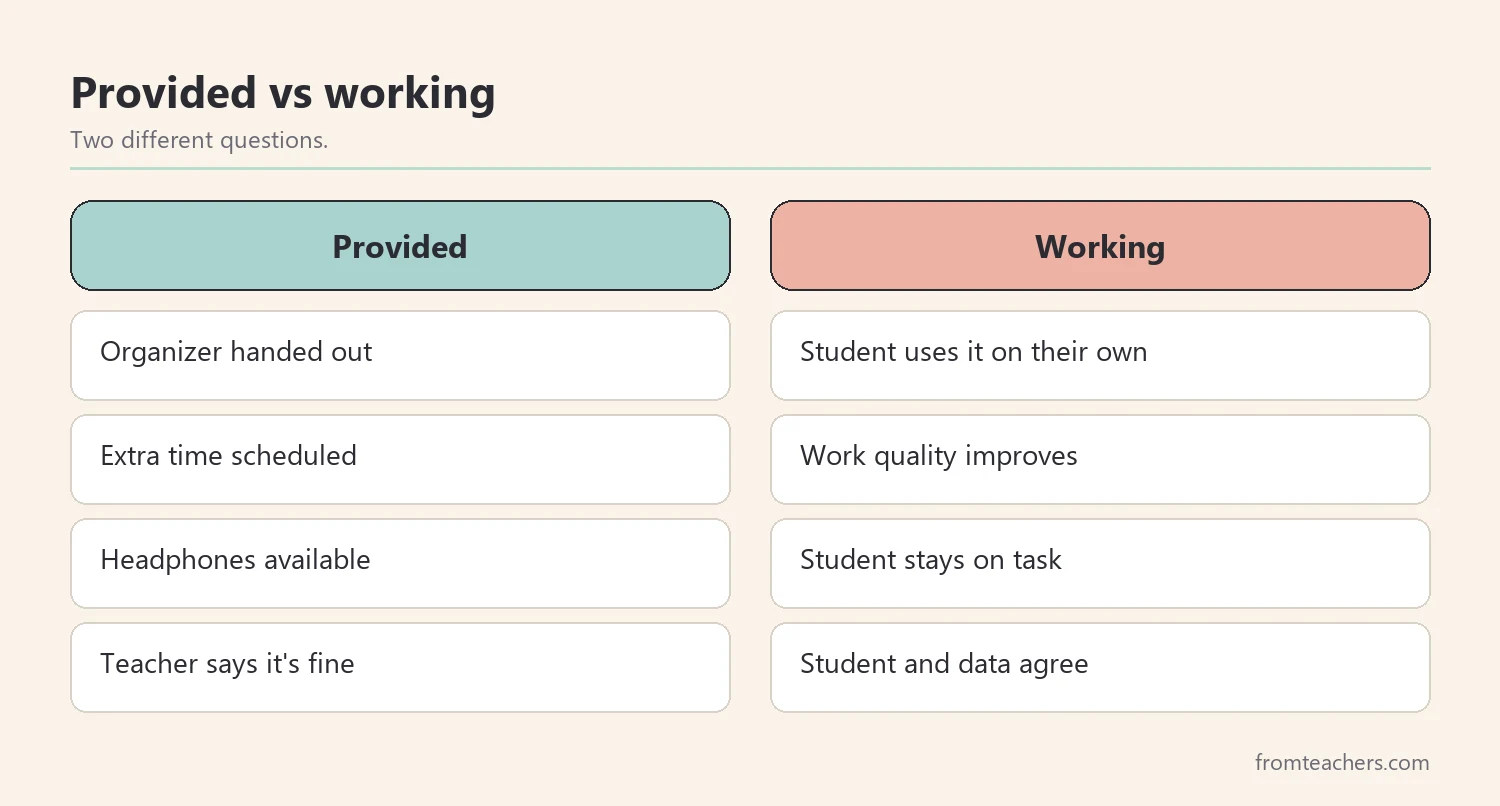
Spotting the signs an accommodation is not working early can save a student months of struggling with a support that only exists on paper. Picture a grade 6 social studies class. Marcus has extended time and a graphic organizer in his IEP. He gets both, yet his unit test grades keep dropping, and when asked, his teacher says, “It’s fine, he uses them.”
This list covers seven signs, ranked from the easiest to notice during a normal class to the ones that only show up over several weeks. By the end, you will know what each sign looks like, what might be behind it, how to collect quick feedback, and how to bring it to the IEP or 504 team.
Examples are fictional. Adapt to the student’s goals and agreed supports. Changes to an IEP or 504 plan are made by the team, not by one teacher. This is guidance, not legal advice.
At a glance
- Provided does not mean working: check use and impact.
- Watch for non-use, inconsistency and getting stuck in daily class.
- Look for flat grades or growing dependence over several weeks.
- Collect short, structured feedback from teachers, student and family.
- Bring evidence to the team, which decides any plan changes.
How we ranked these signs
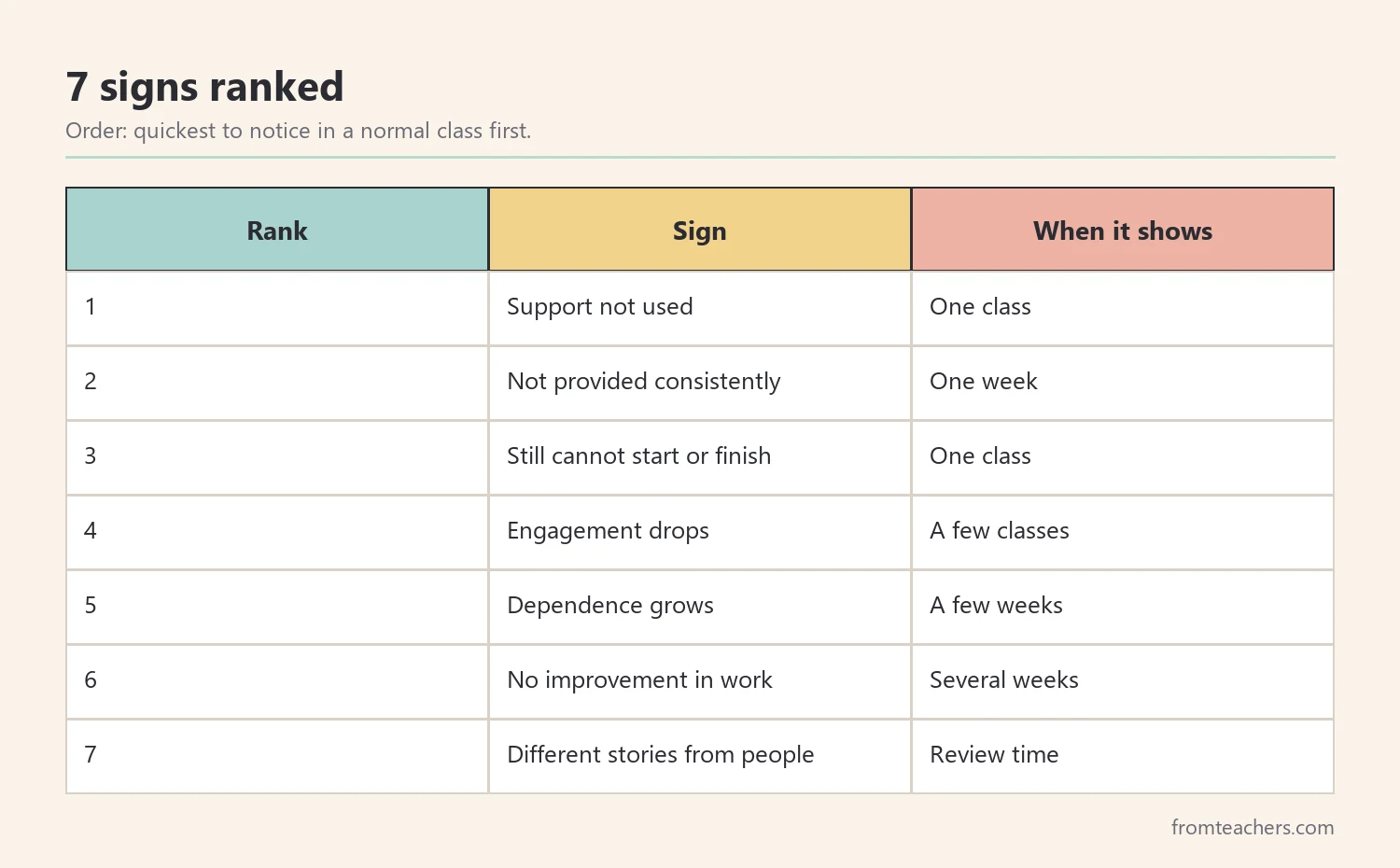
There is no official ranking of warning signs, so we used one simple, stated rule: how quickly a classroom teacher can notice the sign during ordinary lessons. Signs at the top can be seen in a single class period. Signs lower down need a few weeks of notes or grades to appear.
Therefore, the list also suggests a monitoring rhythm: watch for the first signs daily, and check the later signs every few weeks with simple data.
The ready-made option: a one-page accommodation feedback form
Teachers are often asked “Is it working?” with no structured way to answer. The classroom accommodation feedback form for IEP and 504 effectiveness solves that. It has fields for the student, teacher, date, and class, a space to note which accommodations were implemented, an effectiveness rating from Very Effective to Not Effective or Did Not Use, a question on behavior, engagement, and focus, a question on academic impact, and space for challenges observed.
Because every teacher answers the same questions, the case manager gets usable feedback instead of “it’s fine.”
1. The student does not use the accommodation
What it looks like: the graphic organizer stays blank, the student refuses extended time, or the noise-reducing headphones stay in the bag.
Possible reason: the student may feel embarrassed, may not understand how to use the tool, or may find it unhelpful for that task.
Next step: ask privately, “What makes this hard to use?” Then teach or adjust how it is offered.
Example: Marcus admitted he did not like leaving class to finish tests, because classmates asked why. The team arranged extended time at the start of lunch in the same room instead.
2. The accommodation is not provided consistently
What it looks like: it happens in one class but not another, or only when the case manager reminds staff.
Possible reason: staff may not know the details, or the accommodation may be hard to provide in that setting.
Next step: share a short accommodations summary with every teacher, and ask each to record when it is used.
Example: Marcus had his organizer in English but rarely in social studies. A shared one-page summary fixed the gap.
3. The student still cannot start or finish the task
What it looks like: even with the support, the student sits without starting, or stops halfway.
Possible reason: the accommodation may target the wrong barrier. For example, extra time does not help if the student cannot read the questions.
Next step: watch closely at the moment the student gets stuck. That moment often reveals the real barrier.
Example: Marcus’s teacher noticed he got stuck on long reading passages, not on writing. That pointed to a reading support rather than more time.
4. Engagement or behavior gets worse during the supported task
What it looks like: more off-task behavior, frustration, or avoidance during tasks where the accommodation is used.
Possible reason: the support may be awkward, too visible, or make the task longer without making it easier.
Next step: note what happens before and during the task, and ask the student how it feels.
Example: Marcus became restless when the organizer had too many boxes. A simpler three-box version reduced frustration.
5. The student depends on the support more, not less
What it looks like: the student needs adult prompting every time, even after weeks of practice.
Possible reason: the accommodation may have been introduced without teaching the student to use it independently.
Next step: teach the tool explicitly, then gradually reduce prompts while tracking independence.
Example: At first, Marcus needed a reminder to open his organizer. After a short lesson and a checklist, he began using it on his own.
6. Grades or work quality do not improve over time
What it looks like: several weeks pass with no improvement in assignments or tests.
Possible reason: the accommodation may be the wrong one, or the student may need additional instruction, not just access.
Next step: compare a few assignments before and after the accommodation started, and share them with the team.
Example: Marcus’s test scores stayed flat for four weeks with extended time alone. When a read-aloud option was added, they began to rise.
7. The student, family, or teachers report different stories
What it looks like: the teacher says it works, the student says it does not, and the family sees stress at home.
Possible reason: each person sees a different part of the picture.
Next step: collect short, structured feedback from each person and compare it side by side.
Example: Marcus said tests were “still impossible,” while his teacher rated extended time as somewhat effective. That mismatch led to a useful team meeting.
Collecting quick feedback on the signs an accommodation is not working
A short, structured form beats a hallway conversation. Ask each teacher to rate effectiveness, note engagement, describe academic impact, and list challenges. Ask the student too, in simple words.
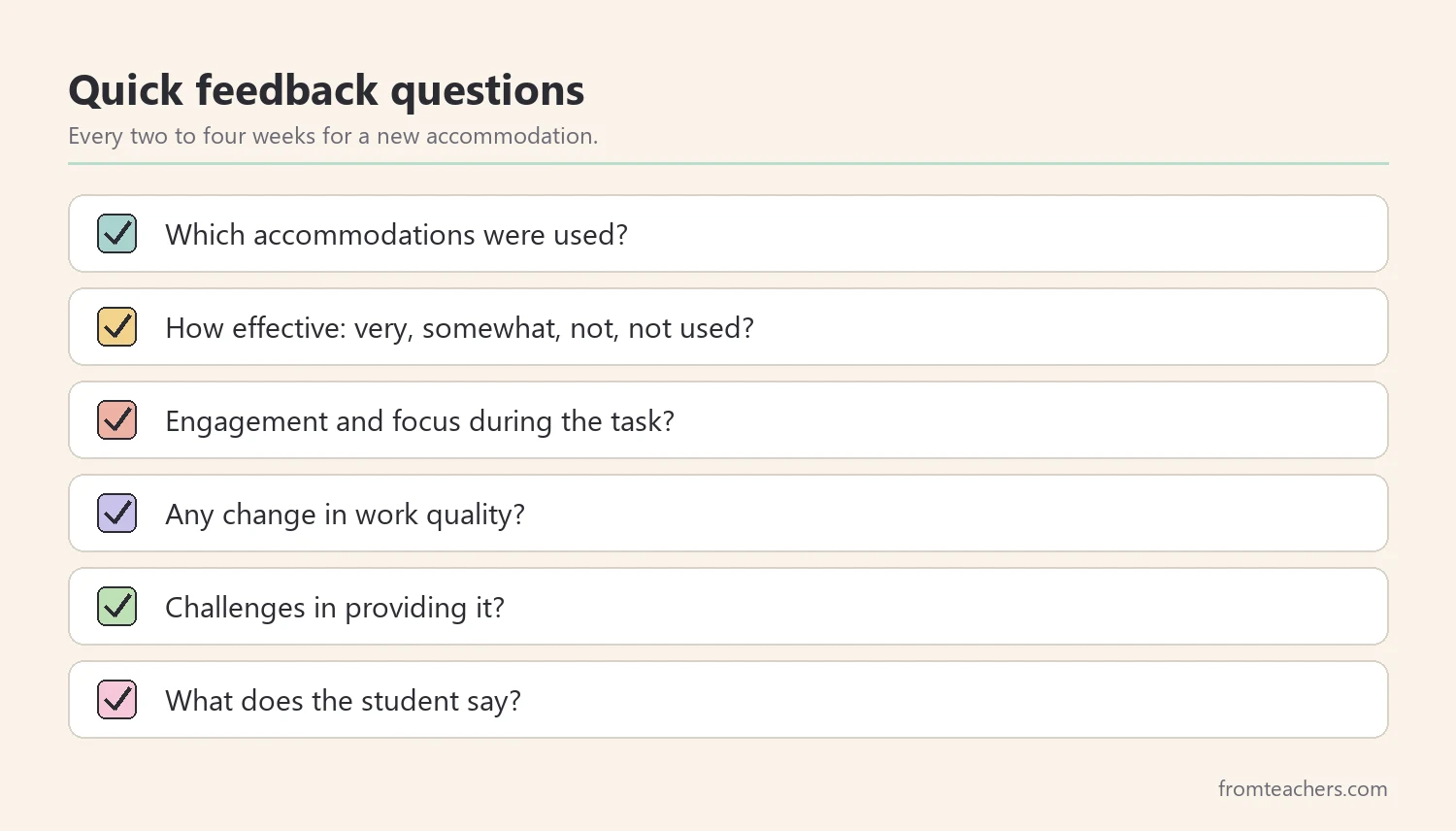
In addition, keep the cycle short. A form every two to four weeks for a new accommodation is often enough, then less often once things are stable.
Here is how Marcus’s team tracked his accommodations over six weeks.
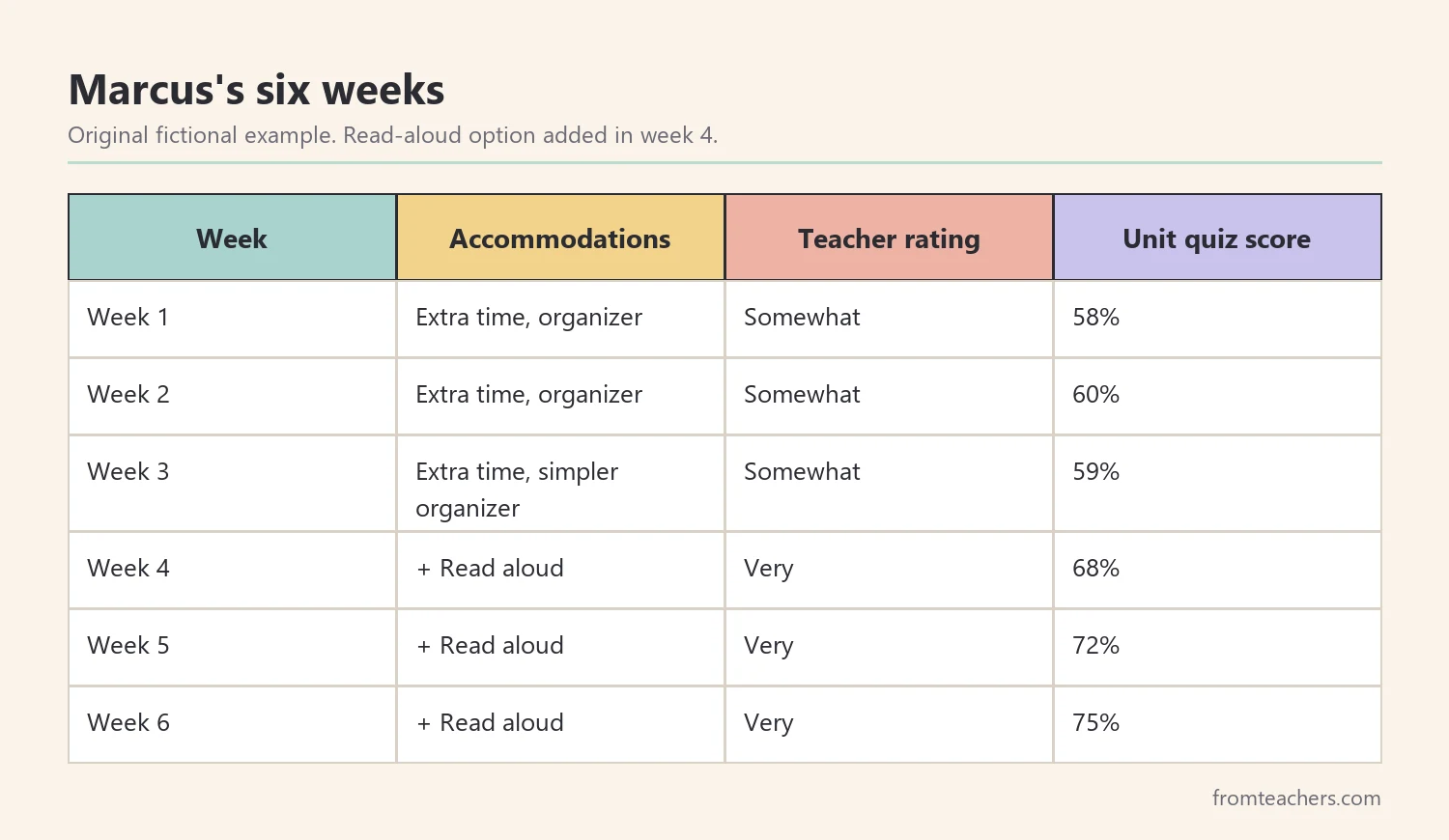
The data told a clear story. Extended time alone was rated somewhat effective but did not change scores. Once the reading barrier was addressed with a read-aloud option, ratings and scores rose together. As a result, the team updated the plan at the next review.
Asking the student without making it awkward
Students are often the best source of information about their supports, yet they may not volunteer it. A short, private check-in works better than a question in front of the class.
First, keep questions concrete. “When you used the organizer today, which part helped?” is easier to answer than “Is your accommodation working?” Next, offer choices for students who find open questions hard, such as a thumbs up, sideways, or down for each support. Then, listen without defending the plan. The goal is to learn, not to convince.
In addition, ask at the right moment. Right after a task, while the experience is fresh, usually gives the most accurate answer. For students who prefer writing, a two-question exit slip can replace the conversation.
Bringing concerns to the IEP or 504 team
When you notice these warning signs, bring evidence, not just impressions. A few completed feedback forms, one or two work samples, and the student’s view give the team something concrete to discuss.
Also, frame the conversation around the student’s needs, not blame. “Here is what we see, and here is what we wonder” keeps everyone working together.
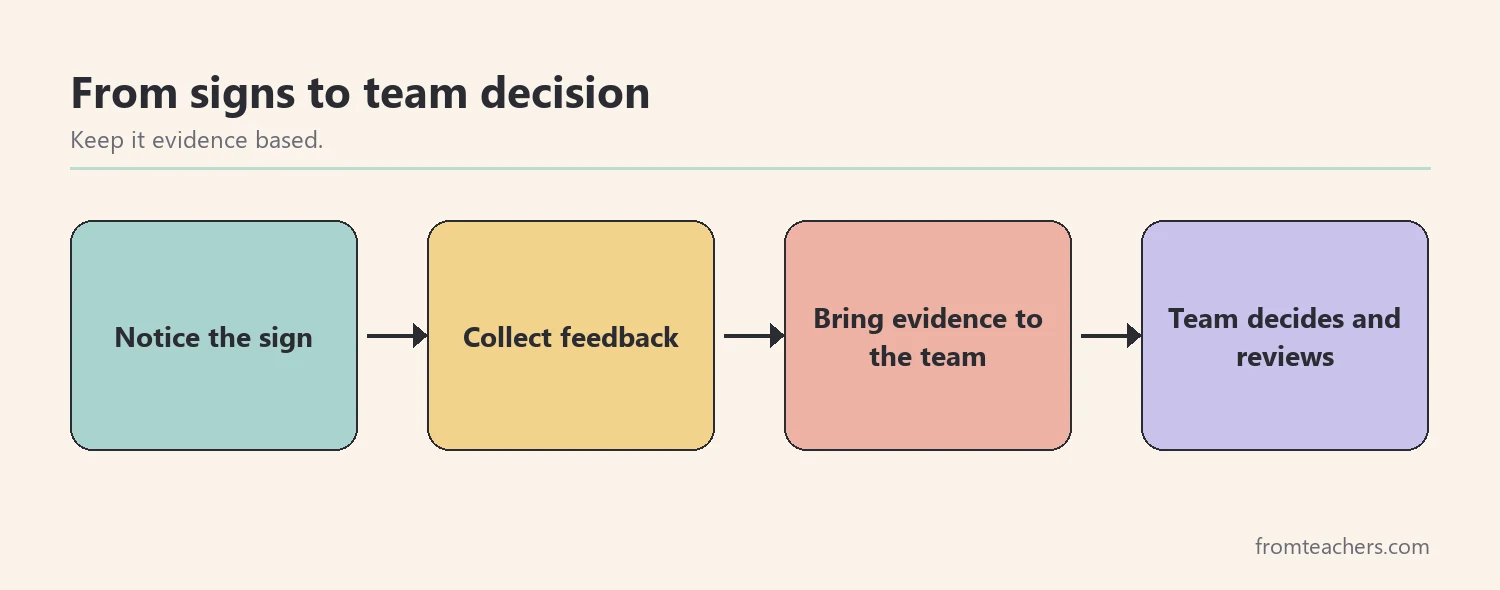
Remember that only the team can change the written plan. However, teachers can often adjust how an accommodation is delivered, such as where extended time happens, while the plan stays the same.
Moreover, involve the student as much as possible. Older students can explain which supports help, which feel awkward, and what they would change. Their input often points to the simplest fix. In Marcus’s case, his own comment about leaving the room was the key to making extended time work.
Finally, follow up. After a change, collect another round of feedback within a few weeks. If the new approach works, record it clearly so next year’s teachers start with the right support from day one.
Common mistakes and how to avoid them
- Assuming “provided” means “working.” Fix: check use and impact, not just delivery.
- Waiting for the annual review. Fix: collect feedback every few weeks for new accommodations.
- Asking only adults. Fix: include the student’s view in simple words.
- Adding more accommodations instead of fixing one. Fix: find the real barrier first.
- Changing the plan informally. Fix: bring evidence to the team and let the team decide.
Questions teachers and parents ask about signs an accommodation is not working
How long should we try an accommodation before judging it?
It depends on the support and the student. Many teams gather feedback for several weeks, as long as the accommodation is being provided and taught consistently.
Can a teacher stop an accommodation that is not working?
No. Accommodations in an IEP or 504 plan must be provided as written until the team changes them. Bring your concerns to the case manager.
What if the student refuses the accommodation?
Ask why, privately. Refusal often signals embarrassment or a poor fit. The team can then discuss ways to make the support more discreet or more useful.
Who should fill in the feedback form?
Each teacher who provides the accommodation, plus input from the student and family when possible. Different views make the picture clearer.
What is the difference between an accommodation and a modification?
An accommodation changes how a student learns or shows learning, such as extra time. A modification changes what the student is expected to learn. The distinction matters when reviewing effectiveness.
Related reading: Accommodations vs Modifications in Special Education, Special Education Accommodation and Modification Tracker, and How Parents and Teachers Can Team Up for Special Education Success.
You may also need: Classroom Observation Form for Special Education (SEN): 12 Daily Checklists.
A companion resource for signs an accommodation is not working:
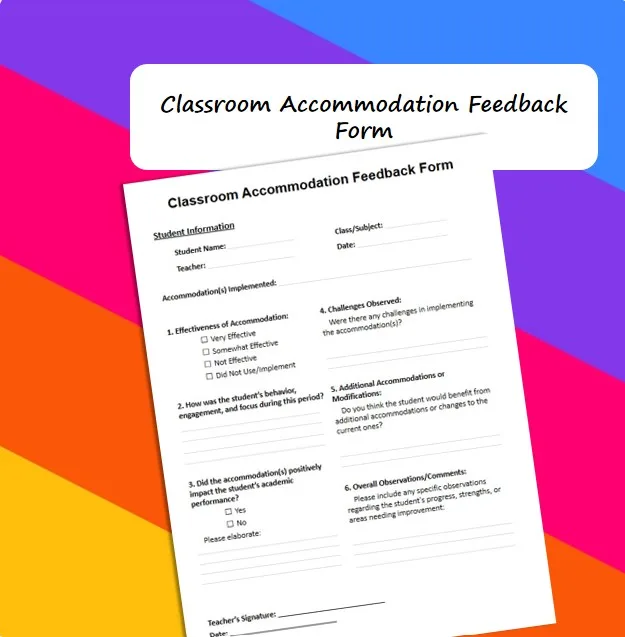
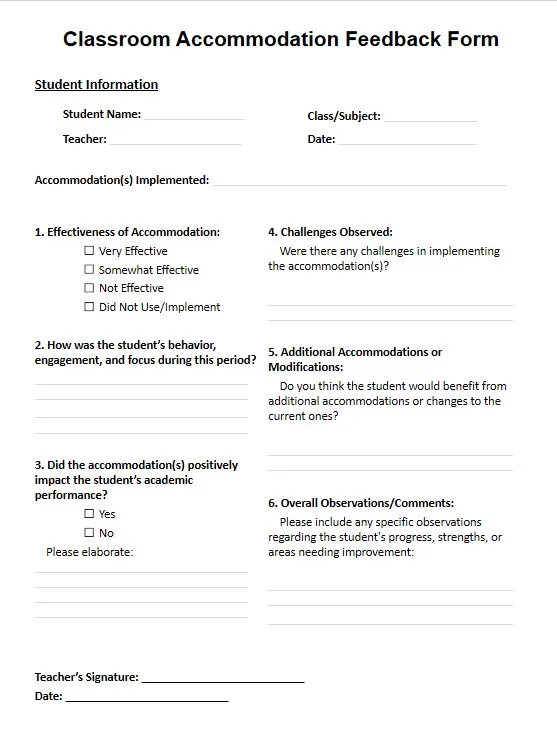
Classroom Accommodation Feedback Form IEP 504 Effectiveness Tracker: a one-page form with student, teacher, date and class fields, accommodations implemented, an effectiveness rating from Very Effective to Not Effective or Did Not Use, questions on engagement and academic impact, and space for challenges observed.
Sources and scope
- Center for Parent Information and Resources: plain-language information on IEPs, accommodations and reviews.
- Understood.org: articles for families and teachers on accommodations and 504 plans.
- Wrightslaw: information on special education law, IEPs and Section 504.
- CAST UDL Guidelines: a framework for designing flexible, accessible learning.
This list covers classroom signs and feedback routines for reviewing accommodations. It does not provide legal advice; changes to IEP or 504 plans follow your team and district procedures.
Key takeaways
- The signs an accommodation is not working often appear in daily class first.
- Check whether the student uses the support and whether it removes the real barrier.
- Collect short, structured feedback every few weeks.
- Include the student and family, not just teachers.
- Bring evidence to the team, which decides any changes to the plan.









Leave a Comment