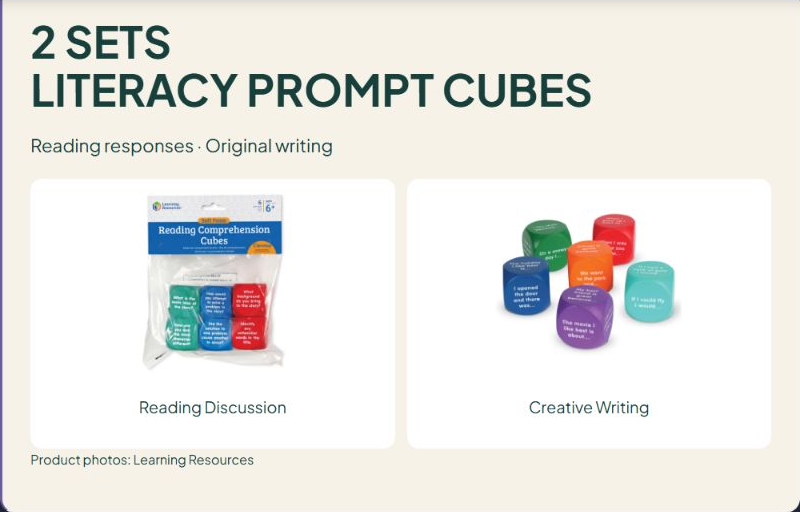

2 SETS
LITERACY PROMPT CUBES
Reading responses · Original writing

Reading Discussion

Creative Writing
Product photos: Learning Resources
Affiliate disclosure: As an Amazon Associate I earn from qualifying purchases. Purchases through our links may earn a commission at no additional cost to you.
Literacy prompt cubes give students a question or starting idea, but the right set depends on what happens next. Discussing a book, composing an original story and retelling something already read are different tasks. Choose the prompt format around that task rather than assuming every set of colorful cubes does the same job.
This guide compares Learning Resources Reading Comprehension Cubes LER7022 and Writing Prompt Cubes LER7232. We have not tested their classroom performance or measured changes in reading or writing. The planning examples are original suggestions, not evidence that buying a particular set improves achievement.
Quick comparison of literacy prompt cubes
| Detail | Reading Comprehension LER7022 | Writing Prompt LER7232 |
|---|---|---|
| Set contents | Six foam cubes | Six foam cubes |
| Main task | Respond before, during and after reading | Start an original piece of writing |
| Manufacturer organization | Two red before, two blue during, two green after | 36 writing prompts |
| Activity guide | Included | Included |
| Manufacturer age guidance | 6+ | 6+ |
Check the actual prompts against the students' language, reading and response needs. An age label does not establish that every question is accessible independently. An adult may need to read a prompt aloud, explain vocabulary or choose a different response format.
1. Reading Comprehension Cubes: questions across the reading process
LER7022 contains six foam cubes. The manufacturer's activity guide divides them into two red before-reading cubes, two blue during-reading cubes and two green after-reading cubes. This organization gives you a way to choose a prompt for the current stage of a shared text rather than drawing from an undifferentiated writing topic bank.
Why consider it: The stage labels can help an adult prepare discussion around a book already being used. Students can respond orally or in writing, depending on the selected question and the lesson goal.
Limitation: A random roll may produce a question that does not fit the current page, text type or student's knowledge. Preview the question and select another when needed. These cubes do not supply the book, a sequence of decoding lessons or an independently validated assessment system.
Choose it when: The task is to discuss and explain a particular text before, during or after reading.
2. Writing Prompt Cubes: a starting point for composition
LER7232 supplies six soft foam cubes with thirty-six writing prompts and an activity guide. Learning Resources describes using them for individual or collaborative writing. The guide offers ways to use a rolled prompt for story writing, partner work and journals.
Why consider it: A shared starting prompt lets students compare the different directions their own writing takes. One student might plan a short oral story first, while another creates a paragraph or longer draft. The prompt supplies a starting point; the teacher still sets the writing expectation.
Limitation: A topic does not teach spelling, sentence construction, planning or revision by itself. A student who struggles to begin may need a model, word choices, a sketch or a conversation before writing. Preview journal prompts and avoid requiring students to share private experiences with a group.
Choose it when: You need a starting idea for an original composition and already have a plan for the writing instruction that follows.
Two original ways to plan the response
Reading discussion: connect the answer to the text
Choose an appropriate before-, during- or after-reading cube. After a student answers, ask them to identify a relevant detail from the shared text when the question calls for evidence. Another student can explain whether that detail supports the answer. This follow-up is an original teaching suggestion, not a claim that the printed cubes include those exact words.
Writing: use one starting idea, then compare choices
An adult can select an appropriate writing prompt for two students. Give them time to plan independently before composing. During a voluntary comparison, discuss the different characters, events or explanations each writer chose. Set a narrow writing goal, such as a clear sequence of events, so the activity involves more than simply filling a page.
Buying and classroom setup advice
Count groups rather than assuming six cubes mean six complete sets
Each offer contains six cubes, but one student using one cube does not necessarily have the full range of prompts. For example, the comprehension set distributes its reading stages across different colors. Plan which cubes each group needs and how they will rotate before deciding how many sets to buy.
Preview language and response demands
Check whether students can read the prompt, understand it and produce the kind of answer requested. These are separate demands. An oral response, drawing with an explanation or adult-supported reading may suit a particular lesson, but select the support around the learner and task rather than assuming the product's age label resolves that decision.
Make the physical routine simple
Choose a clear surface and establish who rolls, who reads and who responds. Have a plan for prompts that are unsuitable or repeated. A deliberate adult choice can be more useful than preserving randomness when the question does not fit the lesson.
Decide what evidence to keep
If the goal is to understand a student's thinking, decide what to record: a written answer, an observation or another appropriate response. Buying a cube set does not provide an assessment rubric. Keep the learning goal visible and evaluate the response using the criteria you have chosen.
Questions before buying
Do I need both sets?
Start with the task you actually need to support. Reading discussion and original writing can overlap, but they are not interchangeable. Inspect the available prompt examples and existing classroom materials before adding another set.
Do these replace books or writing instruction?
No. The cubes supply prompts. You still need suitable texts, explicit directions, modeling and feedback for the activity. This comparison does not establish that the sets replace a reading program or address a particular learning difficulty.
Are customer ratings or testing results included?
No authorized customer excerpts have been verified for these exact offers. We do not invent ratings, classroom trials or achievement results. The comparison is based on identifiable set contents, manufacturer guidance and original planning advice.
For displaying written discussion reminders, compare our classroom pocket charts. Check the card sizes and layout before pairing supplies.
Leave a Comment