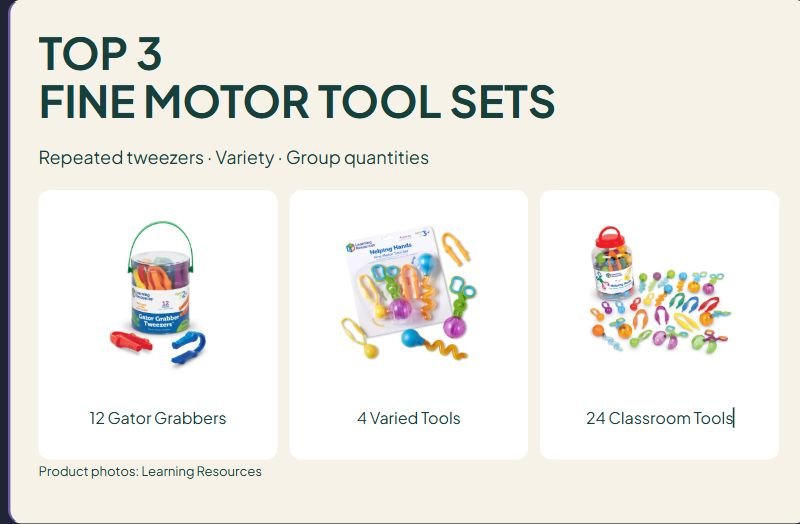

TOP 3
FINE MOTOR TOOL SETS
Repeated tweezers · Variety · Group quantities

12 Gator Grabbers

4 Varied Tools

24 Classroom Tools
Product photos: Learning Resources
Affiliate disclosure: As an Amazon Associate I earn from qualifying purchases. Purchases through our links may earn a commission at no additional cost to you.
Classroom fine motor tools come in packs that solve different supply problems. Twelve matching tweezers let several children try the same handling action. A four-tool variety pack offers different actions to explore. A 24-tool classroom pack adds repeated tools, but its contents are not simply six identical copies of the smaller pack.
This comparison covers three Learning Resources options using manufacturer specifications and verified U.S. Amazon listings. We have not tested the tools or verified customer review excerpts. The activity ideas are editorial suggestions, not evidence of improved handwriting or treatment outcomes.
Quick comparison of classroom fine motor tools
| Set | Verified contents | Useful reason to choose it | Main limitation |
|---|---|---|---|
| Gator Grabber Tweezers, LER2963 | 12 Gator Grabbers in six colors; storage bucket | Repeated tweezer tools for a shared sorting activity | One tool format rather than a variety of handling actions |
| Helping Hands, LER5558 | One each: Gator Grabber Tweezers, Handy Scoopers, Twisty Droppers and Squeezy Tweezers | Four different tools to explore before buying multiples | Only one of each tool |
| Helping Hands Classroom Set, LER5551 | Six each: Squeezy Tweezers, Twisty Droppers, Handy Scoopers and Jumbo Tweezers; storage bucket | Repeated tools for group activities | Includes Jumbo Tweezers, not Gator Grabbers |
The Gator Grabber pack is labeled ages 2+. Both Helping Hands sets are labeled ages 3+. These are labels for the tools, not blanket approval of every material you might place in a sorting tray. Choose age-appropriate activity materials for the actual children and follow the product instructions and supervision guidance.
1. Gator Grabber Tweezers: repeated tools for one activity
The Gator Grabber set includes 12 tweezers in six colors: red, blue, green, yellow, orange and purple. The manufacturer lists a reusable storage bucket. These are repeated examples of one tool format, which can be more useful than variety when a group needs to try the same task.
Why consider it: If the lesson asks children to transfer or sort appropriate objects with tweezers, a matching set makes it easier to distribute the same type of tool across working places. The different colors can help an adult organize materials or assign tools, although the colors do not change the basic activity.
Limitations: Twelve tweezers do not include twelve trays or a supply of sorting materials. You still need enough work space and appropriate objects for each planned position. Nor does the pack provide droppers or scooping tools. Buy it for repeated tweezer use rather than expecting a mixed collection.
An activity to try: Prepare a small, age-appropriate selection of objects and two destination areas. Ask the learner to transfer objects according to one visible feature, then explain the sorting rule. If managing the tool prevents the child from showing the rule, allow another way to respond before changing the academic task.
Choose it when: You need multiple versions of the same tweezer tool and already have a specific sorting or transfer activity in mind.
2. Helping Hands four-tool set: variety before quantity
The LER5558 set includes Gator Grabber Tweezers, Handy Scoopers, Twisty Droppers and Squeezy Tweezers. These are four different tools, rather than four copies of a single design. The manufacturer identifies the set for ages 3+.
Why consider it: A small variety pack lets an adult introduce different handling actions and observe what works for the intended activity. The dropper serves a different task from a tweezer. A scooper also changes how an object is collected and released. That variety can help you decide what to buy in larger quantities later.
Limitations: There is only one of each tool. Four children may hold four tools at once, but they cannot all try the same tool simultaneously without taking turns. If you want to compare tools on the same task, think about whether each tool is actually suited to that material. A dropper is not an interchangeable replacement for tweezers in a dry-object sorting activity.
A planning idea: Introduce one tool at a time and model its intended action using suitable materials. Keep a simple record of whether the learner can collect, move and release the material for that task. Use those observations to adjust the activity, rather than declaring one tool universally best.
Choose it when: You want a small selection of different tools for supervised exploration or a rotating center before committing to a larger pack.
3. Helping Hands Classroom Set: six of each of four tools
The LER5551 Classroom Set includes 24 tools: six Squeezy Tweezers, six Twisty Droppers, six Handy Scoopers and six Jumbo Tweezers. A reusable jumbo storage bucket is listed. Both the manufacturer and verified Amazon description specify that combination.
Why consider it: Repeated tools can make it easier for several children to try the same format during a group activity. If six working positions need a dropper, the listed inventory supplies six droppers. That is a more useful planning fact than the headline total of 24 alone.
A key difference: This set has Jumbo Tweezers where the smaller LER5558 variety pack has Gator Grabber Tweezers. It is therefore inaccurate to call it six identical copies of the four-tool pack. Check the tool names, not just the family branding or total count.
Limitations: Twenty-four tools do not automatically create 24 complete activity stations. Materials, trays, space and adult support still need planning. There are six of each format, so an activity requiring the same tool for more than six children at once needs a different distribution plan or more supplies.
An activity to plan: Organize a small group around one appropriate tool-and-material combination. Rotate roles or tools only when that change serves the task. Keep a count of the six tools used before returning them to the shared bucket.
Choose it when: You already know which of its four tool formats you will use and need repeated examples for a group.
How to choose and use a tool pack
Count the tool you need, not just the total
For a twelve-position tweezer activity, twelve Gator Grabbers and a mixed 24-tool pack are different purchases. The classroom pack has six of each listed format. Start with the task, write down the required tool type and number, then check the selected package against that list.
Keep the learning goal visible
Sorting by a feature and operating a tool are separate demands. A child may understand the sorting rule while finding the grip or release difficult. Offer a way to show the idea, and adapt the handling activity to the individual rather than treating every dropped object as a misunderstanding.
Plan setup and cleanup as part of the purchase
Decide where each child will work and how materials will be contained. Count distributed tools before and after the activity. Follow the manufacturer's care instructions; do not assume that a plastic tool is dishwasher-safe or suitable for a particular cleaning method without checking.
Questions before buying
Will these tools improve handwriting?
The manufacturer markets them for fine motor practice, but this comparison has not tested handwriting outcomes. Picking up objects with a tool and forming letters on paper are different tasks. Choose tools for a useful activity rather than a guaranteed developmental result.
Is the classroom pack the same as six small packs?
No. The smaller pack includes Gator Grabber Tweezers, while the classroom pack lists Jumbo Tweezers. Both also include Squeezy Tweezers, Handy Scoopers and Twisty Droppers, but their quantities differ.
Are sorting objects included?
The verified contents compared here describe the tools and, for the twelve- and 24-tool packs, storage buckets. Do not assume that trays, counters or other activity materials are supplied. Check the exact selected package before purchasing extras.
For another supervised hands-on activity with a different handling action, see our lacing bead and alphabet set comparison. Compare the lesson goal and supplied working materials before adding another activity pack.






Leave a Comment