

504 plan eligibility questions often land on a teacher at the worst possible moment. A parent stops you at pickup and asks, “Does my daughter qualify for a 504 or an IEP?” An administrator wants a quick answer before a meeting. You know the two plans are different, but explaining why, in plain words, is harder than it sounds.
This guide walks you through six practical steps: understanding what the law asks, noticing early signs, explaining the difference between a 504 and an IEP, supporting the referral and meeting, putting accommodations into daily practice, and reviewing the plan over time. By the end, you will be able to explain 504 plan eligibility clearly and do your part well, without overstepping your role.
Examples are fictional. Adapt to the student’s goals and agreed supports. This is guidance, not a diagnosis or legal advice.
At a glance
- A 504 plan comes from a civil rights law, Section 504 of the Rehabilitation Act, and focuses on equal access.
- Eligibility is decided by a school team, never by one teacher on the spot.
- An IEP comes from IDEA and adds specially designed instruction, not only access supports.
- Your best contribution is clear, dated classroom notes about what you see.
- Once a plan exists, every adult who works with the student must follow it.
1. Understand what 504 plan eligibility means
First, it helps to know where the 504 plan comes from. Section 504 of the Rehabilitation Act of 1973 is a civil rights law. It says that schools receiving federal funds cannot exclude or discriminate against students because of a disability. A 504 plan is the written way a school describes how it will give a student equal access to learning.
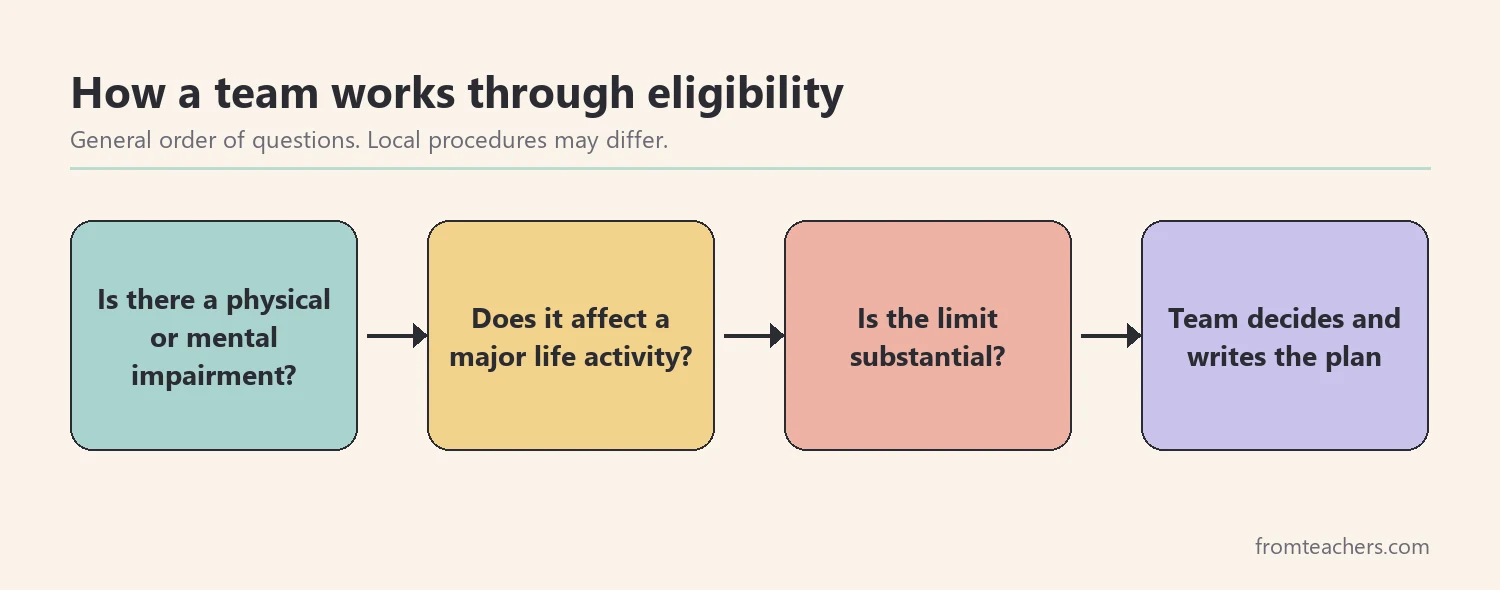
In simple terms, 504 plan eligibility rests on one central question: does the student have a physical or mental impairment that substantially limits one or more major life activities? Major life activities include things like learning, reading, concentrating, thinking, walking, seeing, hearing, breathing, and caring for oneself. The impairment does not need to cause failing grades to count.
Next, remember who decides. A school team that knows the student and looks at several sources of information makes the decision. That team usually includes a coordinator, teachers, and the family. As a classroom teacher, you contribute information, but you do not grant or deny 504 plan eligibility yourself.
Three questions the team considers
| Question | What it means in practice |
|---|---|
| Is there an impairment? | A documented physical or mental condition |
| Does it limit a major life activity? | For example, learning, concentrating, or eating |
| Is the limit substantial? | Compared with most students of the same age |
Worked example. Lena is a fictional sixth grader with type 1 diabetes. Her grades are strong. However, she sometimes needs to check her blood sugar, eat a snack, or visit the nurse during class. Her condition affects major life activities such as eating and caring for herself. Good grades alone do not rule out 504 plan eligibility, so the team still needs to look at her situation.
2. Notice early signs and write them down
Teachers often see a need long before anyone uses the word “plan.” Therefore, your notes matter. Notes are the raw material for any later look at 504 plan eligibility. A good note describes what happened, when, and during what task, without guessing at a cause or a diagnosis.
For example, “Left class for the nurse three times this week during second period” is a useful note. “She probably has a medical problem” is not. Stick to what you saw and heard. In addition, record what you already tried and how the student responded.
Then, share your notes through the right channel. Most schools have a 504 coordinator, a counselor, or a student support team that handles concerns. If a parent asks you directly about 504 plan eligibility, thank them, explain that a team looks at it, and point them to the coordinator. Avoid promising an outcome either way.
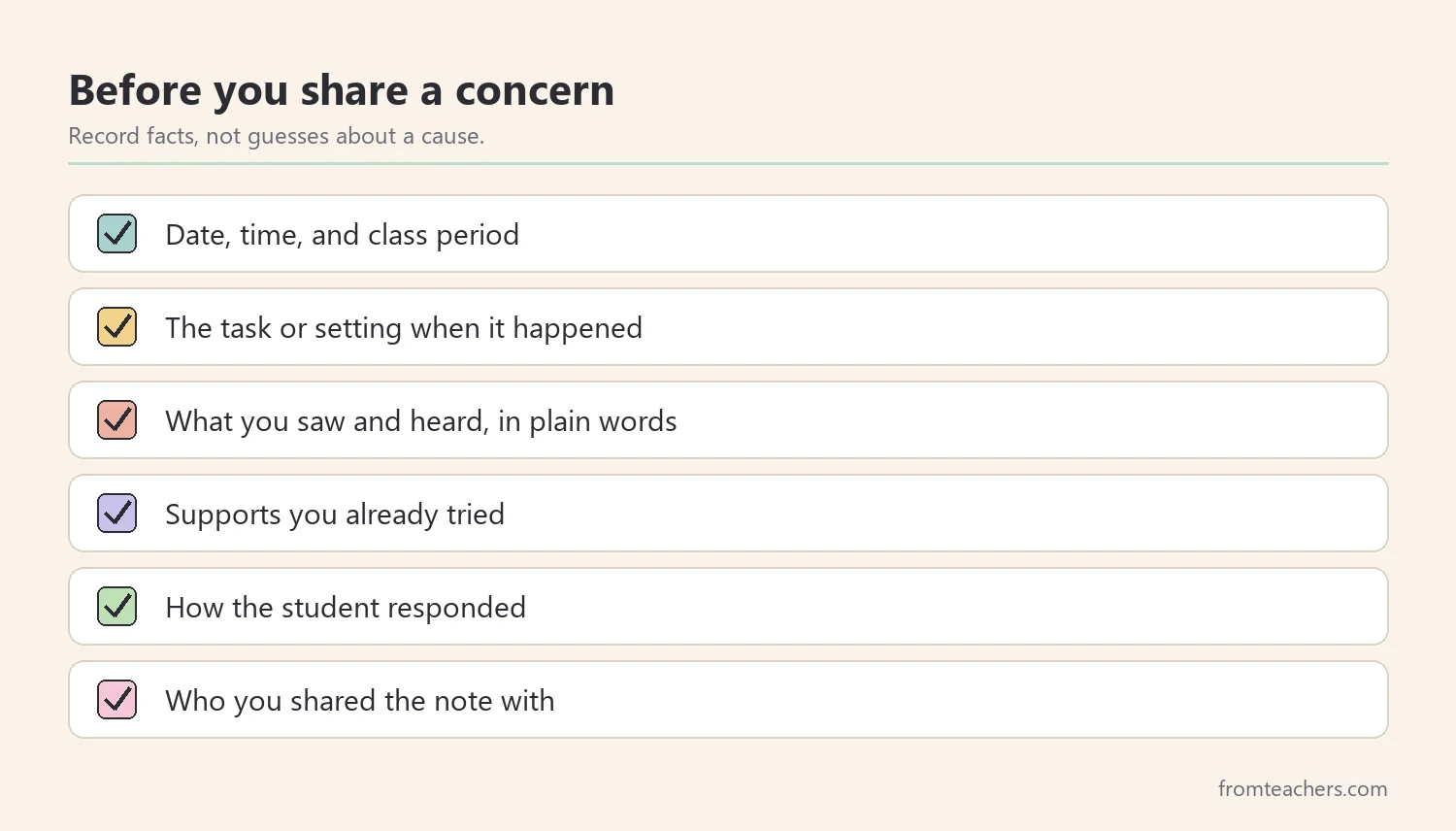
Worked example. Lena’s math teacher notices that she misses parts of two quizzes because she leaves for the nurse. He writes the dates, the class period, and what she missed. He also notes that she finished the work calmly when given extra time the next day. He sends this to the school’s 504 coordinator and copies the counselor.
In short, clear notes help the team make a fair decision. As a result, the conversation starts with facts rather than impressions.
3. Explain the difference between a 504 and an IEP
Parents and colleagues often mix up the two plans, and that is understandable, because questions about 504 plan eligibility and IEP eligibility tend to arrive together. Both describe supports for a student with a disability. However, they come from different laws and serve different purposes.
An IEP comes from the Individuals with Disabilities Education Act (IDEA). To qualify, a student must have a disability in one of the categories IDEA lists and need specially designed instruction because of it. In other words, the student needs teaching that is changed to meet their needs, not only access supports. By contrast, 504 plan eligibility uses a broader definition of disability. A 504 plan usually lists accommodations that remove barriers, such as extra time, seating, breaks, or access to the nurse.
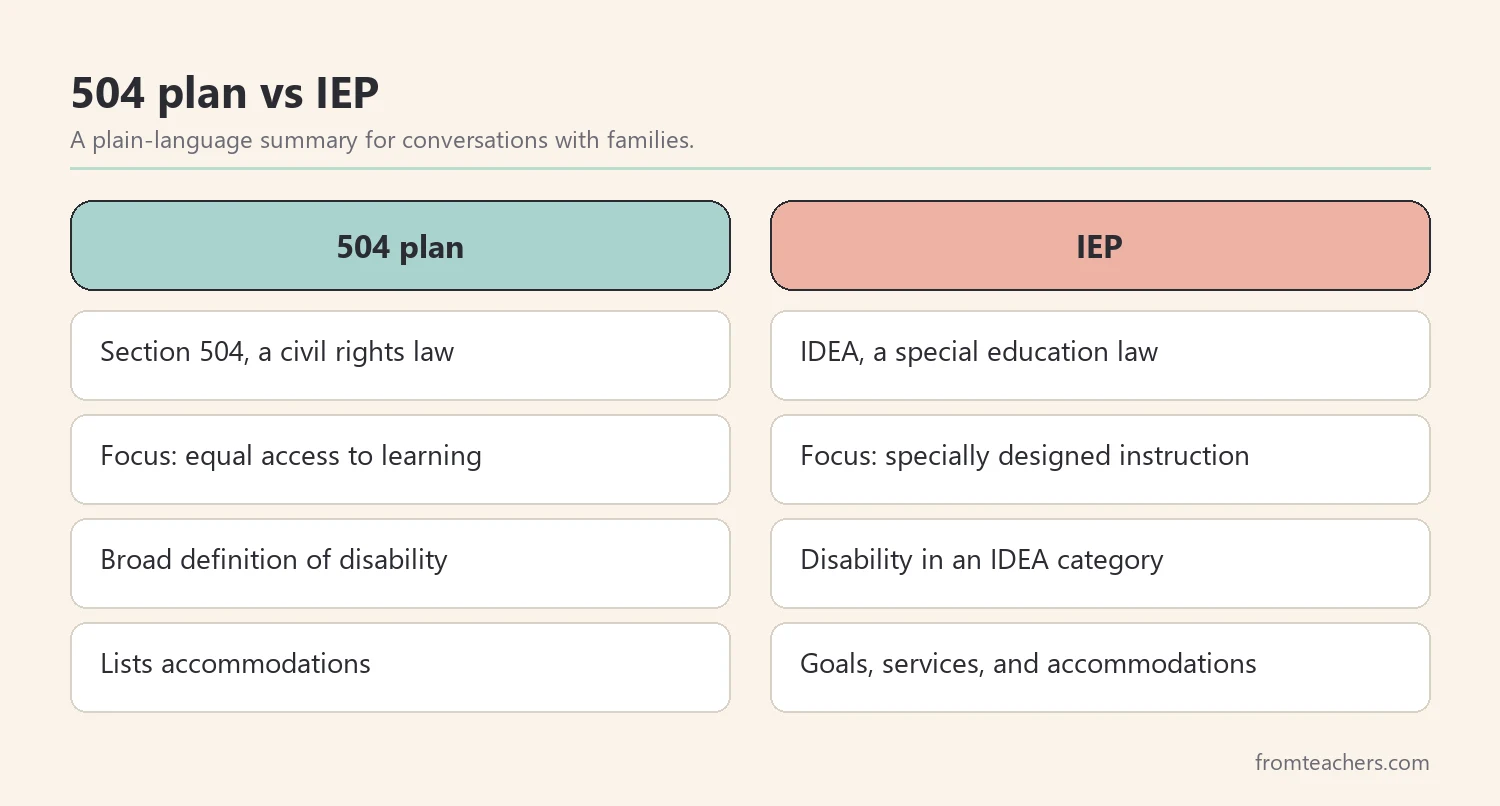
Also, keep one more point in mind. A student who does not qualify for an IEP may still be considered for a 504 plan. So, a “no” under IDEA is not automatically the end of the conversation about support.
When you need words for that moment, a ready-made reference helps. The 504 vs. IEP teacher toolkit includes plain-English tables on plan basics, plan differences, and calm scripts for when a parent or admin asks you to explain on the spot.
A plain-language script
“A 504 plan helps a student access the same learning as everyone else, for example with extra time or breaks. An IEP is for students who also need specially designed teaching. A school team looks at the information and decides which, if either, fits.”
4. Support the referral and the 504 plan eligibility meeting
Once a concern is shared, the school follows its own process. Usually, someone reviews existing information, gathers more if needed, and invites the family to a meeting. Your role is to bring clear classroom information and to listen.
Before the meeting, prepare a one-page summary. Include the dates and patterns from your notes, the supports you already tried, and how the student responded. Keep it short. Teams appreciate a page they can read in two minutes.
During the meeting, describe what you see in class. Let the coordinator lead the discussion of 504 plan eligibility itself. If you are asked for an opinion, frame it as what helps in your room, for example: “When Lena has a snack at her desk, she stays for the whole lesson.”
| Bring to the meeting | Leave out |
|---|---|
| Dated notes of what you saw | Guesses about a diagnosis |
| Supports you tried and results | Comparisons with other students by name |
| Work samples, if relevant | Promises about the outcome |
| Questions about daily logistics | Personal opinions on the family |
Worked example. At Lena’s meeting, the team reviews her doctor’s information, the nurse’s records, and her math teacher’s notes. They agree that she meets 504 plan eligibility. Her plan includes access to snacks and water in class, permission to visit the nurse at any time, and extra time to make up work she misses during those visits.
Afterward, ask for a copy of the plan or the accommodations that apply to your class. You cannot follow what you have not read.
5. Put accommodations into daily practice
A plan only helps if it shows up in the classroom every day. Therefore, turn each accommodation into a simple routine you can follow without thinking. Where will the snack be kept? What will the student do when she leaves, and how will she catch up?
Next, tell any substitute, aide, or co-teacher what the plan says. Many missed accommodations happen on days the regular teacher is away. A short note in your sub plans, kept private and respectful, prevents most of those gaps.
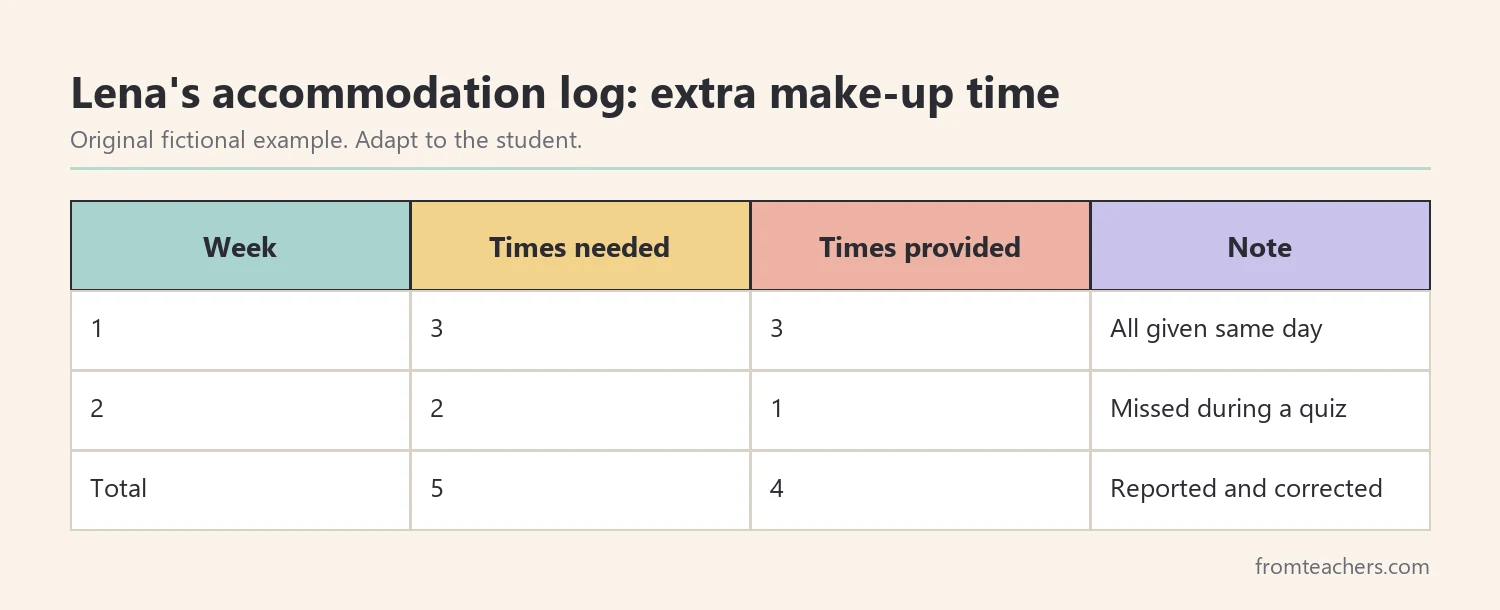
Then, keep a quick log. A weekly tally of when each accommodation was needed and when it was provided shows whether the plan is working. It also protects you, because you can show what you did.
When an accommodation gets missed
Mistakes happen, even with good intentions. If you realize you missed an accommodation, say so quickly and simply. Tell the coordinator, explain what happened, and describe how you will prevent it next time. Then, if the team agrees, talk with the family honestly.
Worked example. In week one, Lena’s math teacher gives extra make-up time all three times she needs it, but forgets it once during a quiz in week two. Over the two weeks, she needs extra time five times and receives it four times. He tells the coordinator the same day, offers Lena the make-up time, and adds a reminder to his quiz routine.
6. Review the plan and keep explaining it clearly
A 504 plan is not a one-time event. Students grow, conditions change, and classes change. Most schools review plans at least once a year and reevaluate students periodically, following their own policies.
So, bring your log to each review. Even after a student meets 504 plan eligibility, the details of the plan should keep pace with the student. Share what works, what is used rarely, and what might be missing. If an accommodation is never needed, the team may adjust it. If a new need appears, the team can look at 504 plan eligibility again or consider whether an evaluation under IDEA makes sense.
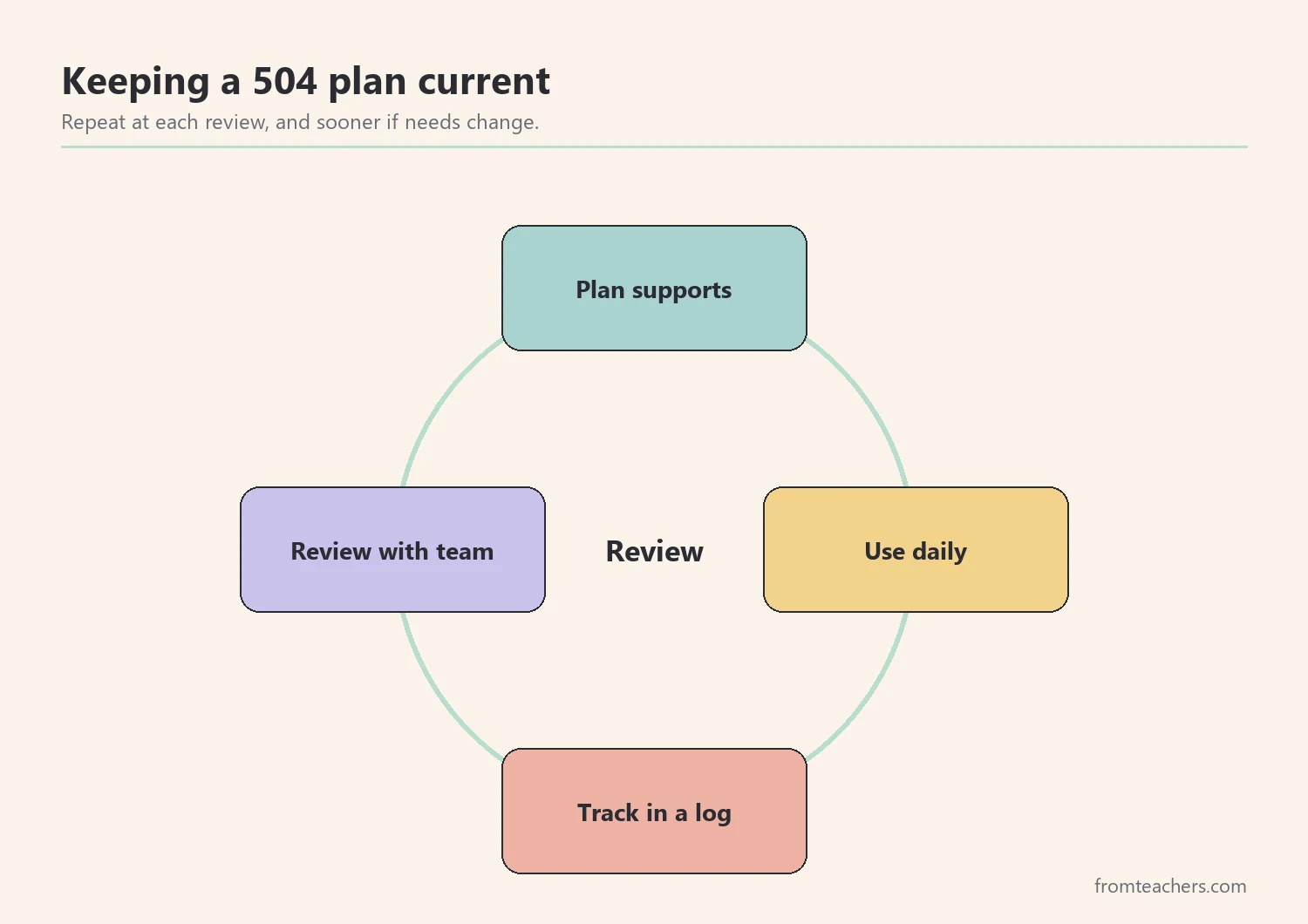
Also, keep the student in the conversation. Older students can often tell you which supports help most and which feel awkward. Their voice makes the plan more useful and builds self-advocacy over time.
Worked example. At Lena’s annual review, her log shows that she rarely needs to leave class now, because she checks her levels at lunch. The team keeps the snack and nurse access, and Lena asks for a private signal instead of raising her hand to leave. Everyone agrees.
Common mistakes and how to avoid them
- Telling a parent the student “won’t qualify.” Only the team decides 504 plan eligibility. Fix: explain the process and refer the family to the coordinator.
- Assuming good grades rule out a plan. A student can do well and still be substantially limited. Fix: look at the full picture, not only report cards.
- Treating a 504 and an IEP as the same thing. This confuses families. Fix: use the plain-language script and the comparison table.
- Forgetting substitutes and specials teachers. Plans break on unusual days. Fix: add a private note to sub plans and share accommodations with every adult involved.
- Hiding a missed accommodation. Silence damages trust. Fix: report it quickly, correct it, and change your routine.
Questions teachers and parents ask about 504 plan eligibility
Does a student need a diagnosis to be considered?
A team looks for a physical or mental impairment, and medical or other documentation often helps. However, schools follow their own procedures, and teachers should not ask families for a diagnosis themselves. Refer questions to the coordinator.
Can a student with high grades have a 504 plan?
Yes, it is possible. 504 plan eligibility depends on whether an impairment substantially limits a major life activity, not on grades alone. The team considers the whole student.
Who writes the 504 plan?
The school team writes it, usually led by a 504 coordinator or counselor, with input from teachers and the family. Teachers then carry out the accommodations that apply to their classes.
Can a student have both a 504 plan and an IEP?
In general, a student with an IEP receives accommodations through the IEP, so a separate 504 plan is usually not needed. If you are unsure in a specific case, ask your coordinator or special education lead.
What should I say if a parent asks about 504 plan eligibility at pickup?
Thank them, keep it short, and avoid predictions. Say that a school team reviews these questions, and give them the name of the coordinator. Then, write down the conversation and share it.
Related reading: Accommodations vs Modifications in Special Education: The Difference Explained, How Teachers Communicate With Parents in Special Education, and Special Education Accommodation and Modification Tracker.
A companion resource for 504 plan eligibility:
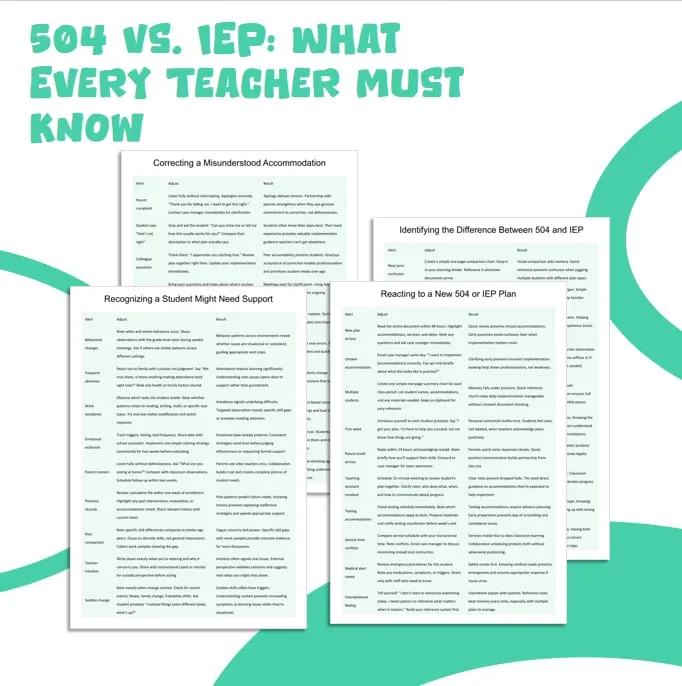
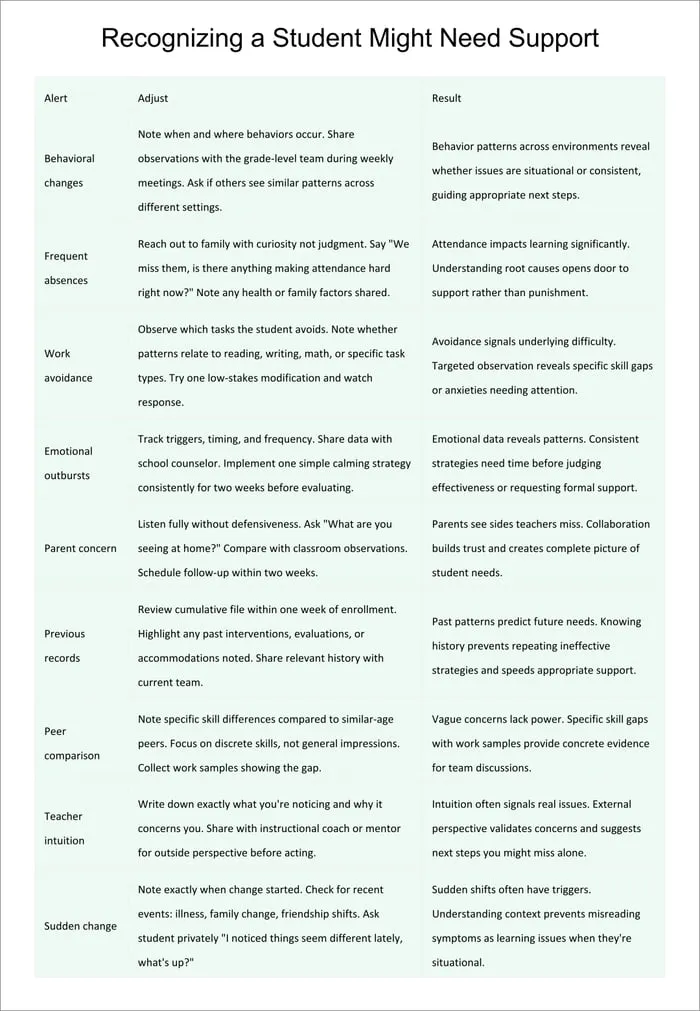
504 vs. IEP: What Every Teacher Must Know: 12 pages of Alert, Adjust, and Result tables on 504 and IEP basics, plan differences, and daily implementation, with guidance on early signs, calm scripts for new plans, and honest language for when a plan gets missed.
Sources and scope
- U.S. Department of Education: home of the Office for Civil Rights, which enforces Section 504 in schools.
- IDEA, U.S. Department of Education: the law behind special education services and IEPs.
- Center for Parent Information and Resources: plain-language resources for families on 504 plans and IEPs.
- Understood.org: practical articles for families and teachers on learning and thinking differences.
- IRIS Center, Vanderbilt University: free modules on accommodations and special education practice.
This guide explains the classroom teacher’s role around 504 plans and IEPs in general terms. It does not give legal advice or replace your district’s procedures, which can differ from state to state.
Key takeaways
- 504 plan eligibility asks whether an impairment substantially limits a major life activity.
- A school team decides, so teachers share facts and avoid predictions.
- An IEP adds specially designed instruction; a 504 plan focuses on access.
- Turn each accommodation into a routine and log it weekly.
- Own any missed accommodation quickly and review the plan with the team.










Leave a Comment