

A classroom behavior checklist turns a busy, noisy lesson into a few clear marks you can trust later. Picture this: a parent meeting is tomorrow, and all you have are vague memories like “he had a rough week.” In contrast, a short daily checklist gives you dated, objective notes that describe what you actually saw.
After reading this guide, you will be able to choose one area to observe, build or adapt a simple checklist, collect quick daily marks without stopping your teaching, and turn those marks into a calm, useful summary for families and the student’s team.
Examples are fictional. Adapt to the student’s goals and agreed supports. This is guidance, not a diagnosis.
At a glance
- Observe one area at a time, such as attention, transitions, or peer interaction.
- Write checklist items as observable actions, not labels or feelings.
- Mark the checklist during a short, fixed window so your notes are comparable.
- Count and summarize weekly, then look for patterns before you change anything.
- Share results with families in plain language, with one next step.
1. Define what your classroom behavior checklist will observe
First, pick one area of the school day. A checklist that tries to cover everything ends up covering nothing well. For example, you might focus on attention during lessons, behavior during transitions, or peer interaction during group work.
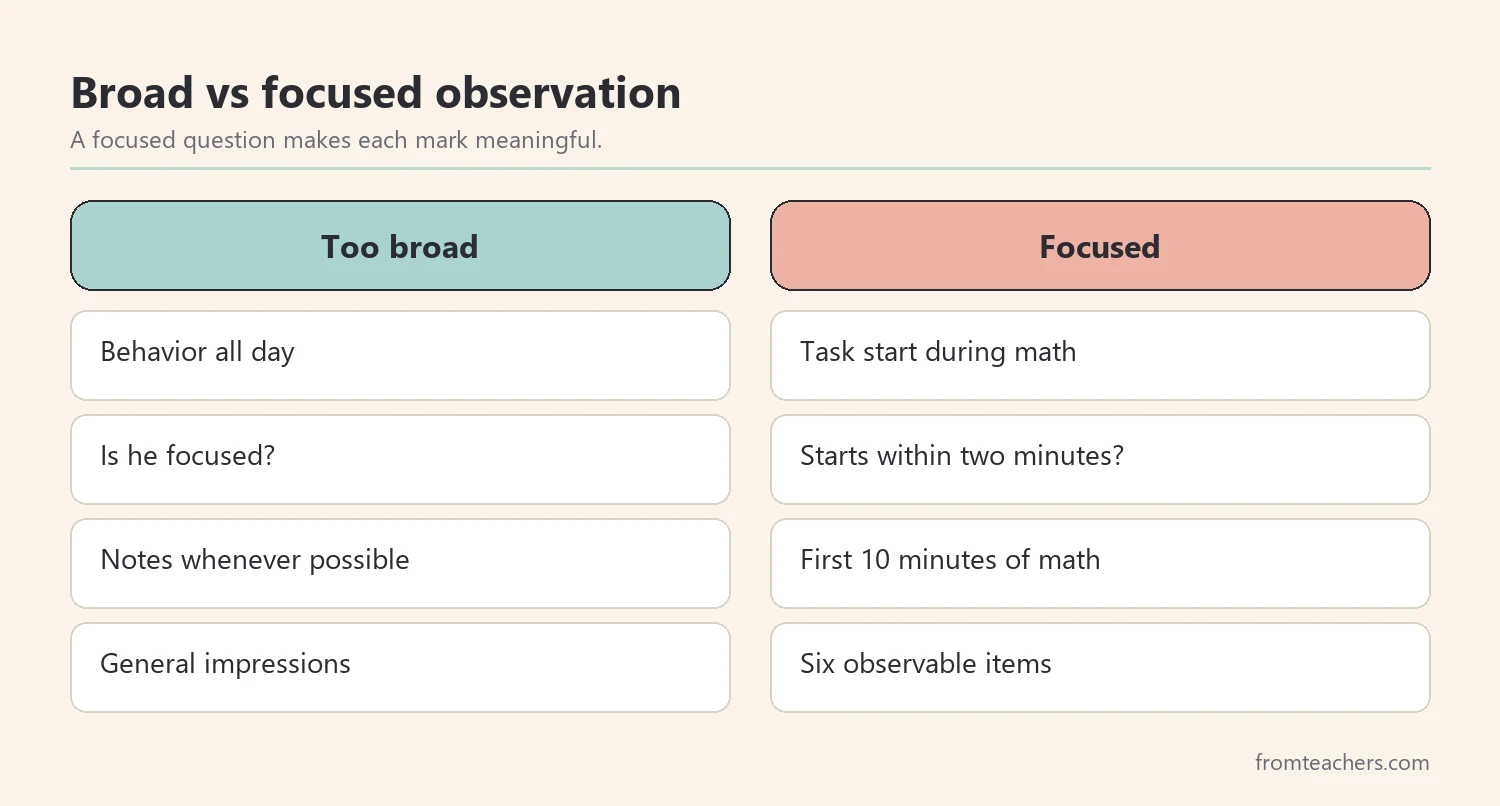
Next, write a one-sentence question you want the data to answer. A good question is specific and time-bound. “Does Amir start independent work within two minutes of directions?” is far more useful than “Is Amir focused?”
Then, decide who needs the answer. A parent meeting, an IEP review, and a quick colleague check-in each need slightly different detail. Knowing your audience keeps the classroom behavior checklist short and purposeful.
It also helps to think about why you are observing now. Maybe a family raised a concern, maybe a new support started, or maybe you simply want a baseline before a review. Write that reason at the top of the sheet. Weeks later, it reminds everyone what the marks were meant to show.
Finally, choose the observation window. A window is a short, repeatable slice of time, such as the first ten minutes of independent math or the walk back from lunch. Because the window stays the same each day, the marks can be compared fairly from one week to the next.
Worked example: Amir, grade 4
Amir’s teacher, Ms. Reyes, notices that independent math work often starts late. Instead of tracking “behavior” in general, she chooses one area: attention and task initiation during math. Her question is: “How often does Amir begin the first problem within two minutes, and what helps?”
| Too broad | Focused |
|---|---|
| Behavior all day | Task start during math |
| Is he focused? | Starts within 2 minutes? |
| Notes whenever possible | First 10 minutes of math |
2. Write observable checklist items
Good checklist items describe what anyone in the room could see or hear. “Opens notebook to the correct page” is observable. “Seems unmotivated” is an interpretation, and two adults may disagree about it.
A useful test is the “two-observer rule.” If a paraprofessional and a teacher watched the same five minutes, would they mark the item the same way? If not, rewrite it until they would.
Also, keep the list short. Five to eight items is usually enough for one observation window. Add a small notes line for context, such as a fire drill, a substitute, or a schedule change.
Watch out for items that hide two behaviors in one line. “Listens and follows directions” is really two separate actions. If a student listens but does not follow through, you will not know which box to tick. Split combined items so each line checks one thing.
Similarly, phrase items in the positive where you can. “Starts the first problem” tells you what success looks like, while “does not waste time” only describes a gap. Positive wording also makes the sheet easier to share with families and with the student.
Choosing a rating style
Most teachers use simple checkbox ratings. A three-point scale works well: “yes,” “partly,” and “not yet.” Alternatively, you can use “observed” and “not observed” when you only need a quick yes or no.
Whichever style you pick, keep it the same for the whole observation period. Switching from a yes or no to a three-point scale midway makes the weeks hard to compare. If you must change, start a fresh sheet and note the date.
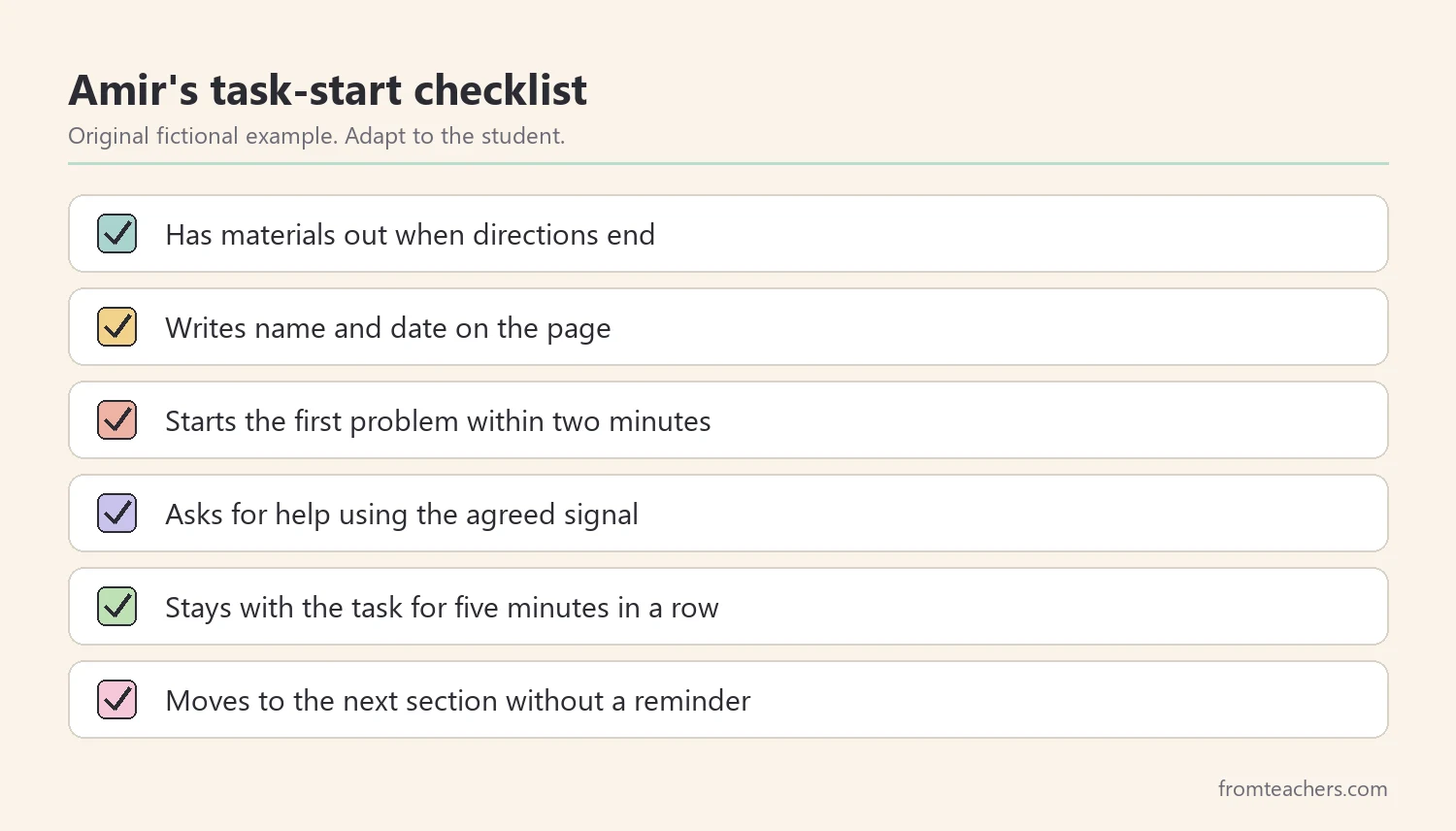
For Amir, Ms. Reyes writes six items:
- Has materials out when directions end.
- Writes his name and the date on the page.
- Starts the first problem within two minutes.
- Asks for help using the agreed signal.
- Stays with the task for five minutes in a row.
- Moves to the next section without a reminder.
Before using the list, test it for two or three days. Ms. Reyes found that “stays with the task for five minutes” was hard to judge while helping other students, so she set a quiet timer on her desk. Small adjustments like this are normal and make the data more reliable.
3. Set up a quick daily classroom behavior checklist routine
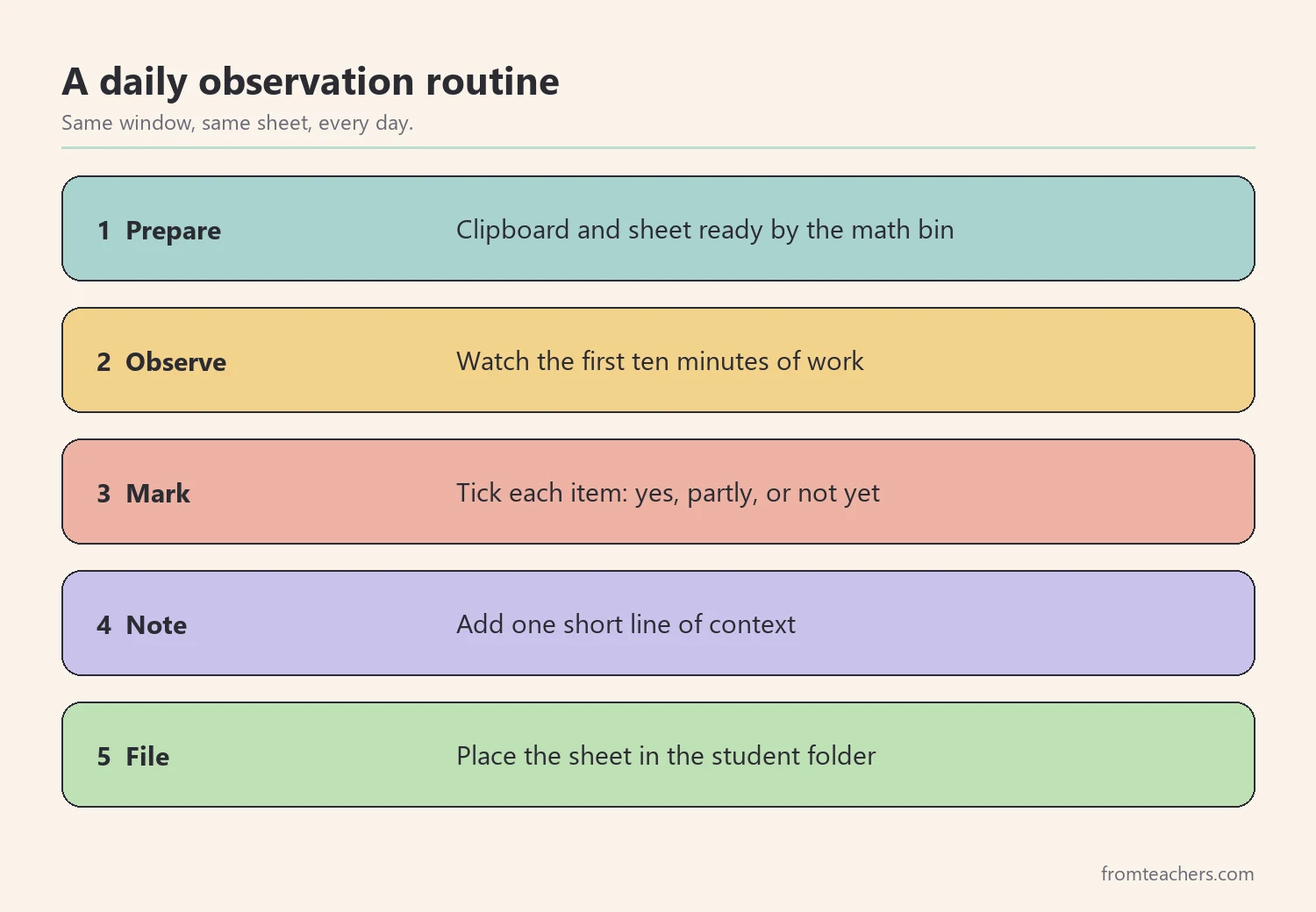
The best checklist is the one you actually use. Therefore, attach it to a fixed time and place. Ms. Reyes keeps Amir’s sheet on a clipboard by the math bin and marks it during the first ten minutes of independent work.
Moreover, make marking fast. Circle or tick, then move on. Writing full sentences during teaching usually means the data stops after a week. Save a single short note for the end of the window.
If you prefer typing, a fillable form on a tablet works just as well. Some teachers like ready-made daily classroom observation forms with a checklist for each area of the day, so they can switch focus from attention to transitions without building a new sheet.
Agree with other adults on who marks the sheet. If a paraprofessional supports math on Tuesdays, show them the items and do one practice window side by side. Afterward, compare your marks. Where you disagree, talk through the item and adjust the wording so it is clearer next time.
Keep the sheets together in one folder per student or per area. A simple order, newest on top, makes the weekly summary quick. Additionally, store the folder where you can grab it before a meeting without searching through piles.
Finally, plan for missed days. A blank day is fine. Just write “not observed” so a gap does not look like a problem.
4. Record and summarize the week
At the end of each week, count the marks. You do not need complex math. For each item, note how many days it was observed out of the days you checked.
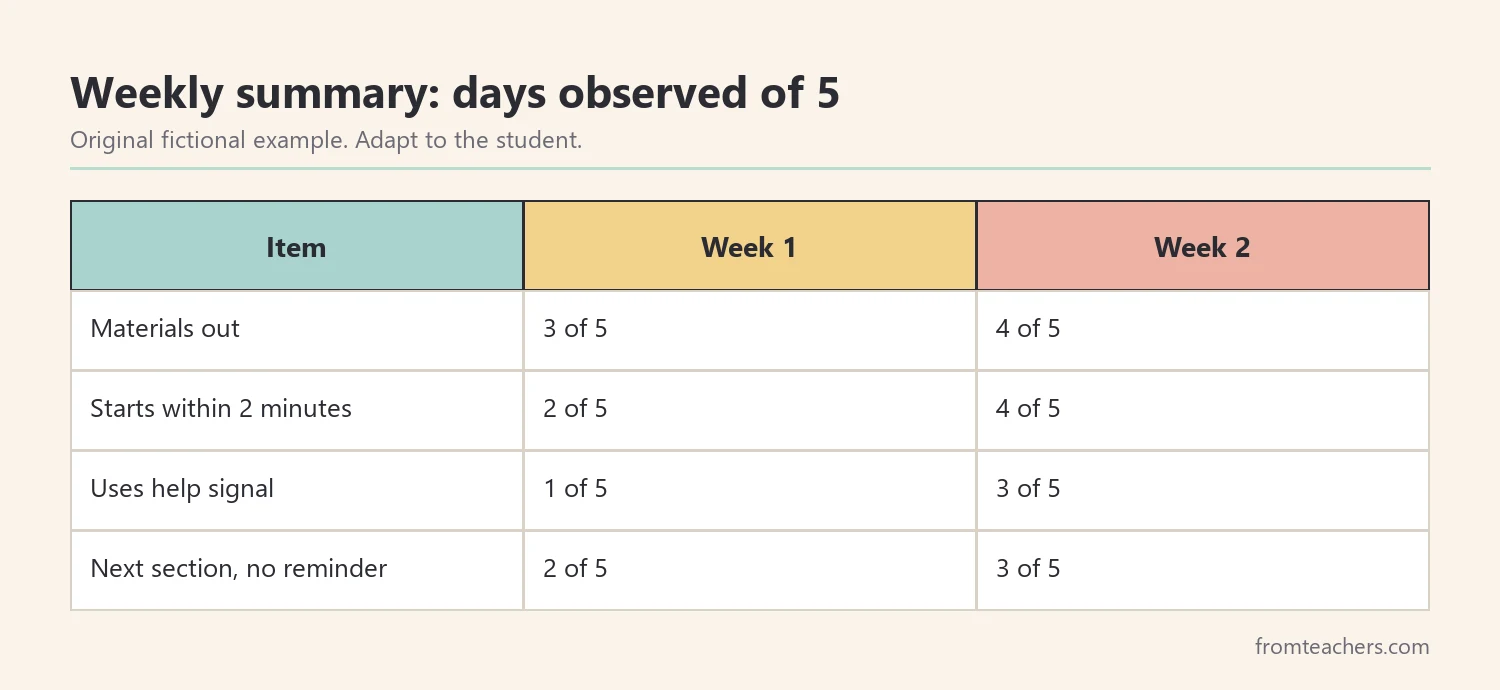
For Amir, Ms. Reyes observed math on five days in week one. He started the first problem within two minutes on two of those five days. In week two, after she added a sticky note with the first step, he started on time on four of five days.
| Item | Week 1 | Week 2 |
|---|---|---|
| Materials out | 3 of 5 | 4 of 5 |
| Starts within 2 min | 2 of 5 | 4 of 5 |
| Uses help signal | 1 of 5 | 3 of 5 |
| Next section, no reminder | 2 of 5 | 3 of 5 |
In addition, read your short notes for patterns. Ms. Reyes saw that the one late start in week two came right after indoor recess. That is a pattern worth discussing, not a conclusion.
Be careful with small numbers. Two weeks of data can point to a pattern, but it cannot prove one. For that reason, describe what you saw in plain terms and keep collecting before drawing firm conclusions. Words like “so far” and “this week” keep the summary honest.
Moreover, keep the summary to one short paragraph plus the table. Ms. Reyes writes: “Week two: on-time starts rose from 2 of 5 to 4 of 5 after the first-step sticky note. The late start followed indoor recess.” That is enough for a colleague or family to understand at a glance.
5. Review your classroom behavior checklist data and share it
Every two to four weeks, step back and ask what the data says. Is the behavior changing? Did a support help? Is there a time of day that stands out? Keep the review short and focused on one next step.
When you share results with a family, lead with strengths. For instance, Ms. Reyes might say: “Amir started math on time on four of five days this week, up from two. The sticky note with the first step seems to help.” Then she can ask what the family notices at home.
For an IEP review or team meeting, bring the weekly table and your notes. A classroom behavior checklist does not replace formal assessment. However, it gives the team concrete, dated observations to discuss.
Invite the student into the review when it fits their age. Amir might look at the weekly table and say what helped. Students often notice details adults miss, such as a noisy table or a confusing worksheet layout. Their input also builds ownership of the next step.
Keep the tone neutral in every conversation. The goal is to understand the pattern and adjust support, not to grade the student. When adults model calm, curious language about data, families tend to respond the same way.
Lastly, decide what happens next. You might keep the same checklist, fade a support, or switch to a new area such as transitions or peer interaction.
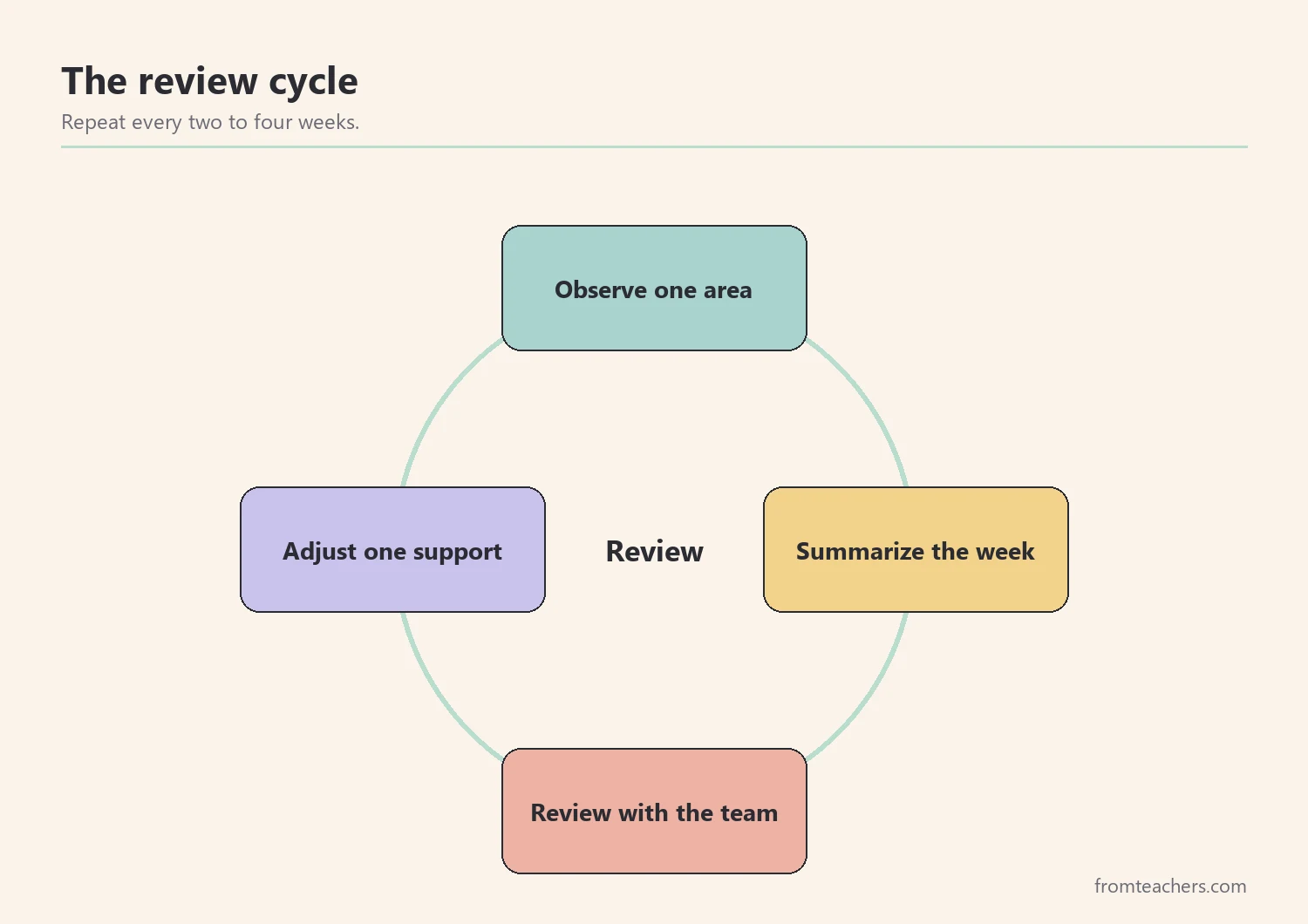
When the area you were watching improves and stays steady, celebrate it with the student and the family. Then, if needed, start a new checklist for a different part of the day. Keep the old sheets on file, because they show growth over the whole year.
Common mistakes and how to avoid them
- Tracking everything at once. Fix: choose one area and one question per checklist.
- Using labels instead of actions. Fix: replace words like “lazy” or “defiant” with what the student did or did not do.
- Marking from memory at the end of the day. Fix: mark during a fixed window, even if it is only ten minutes.
- Changing several supports at once. Fix: change one thing, then watch for two weeks.
- Sharing raw marks without context. Fix: give families a short summary, a strength, and one next step.
Questions teachers and parents ask about a classroom behavior checklist
How long should a classroom behavior checklist be?
Usually five to eight items is enough. A short list is faster to mark and easier to summarize. If you need more items, split them into two checklists for different times of day.
How often should I fill it in?
Daily is ideal for the area you are watching, during the same short window. If daily is not realistic, choose three fixed days a week. Consistency matters more than volume.
Can a paraprofessional fill in the checklist?
Yes, and that often helps. Walk through each item together first and agree on what counts. Then compare a few days of marks to make sure you are seeing the same thing.
What if the data shows no change?
No change is useful information too. First, check that the support was used the same way every day. Then, talk with the team about trying a different support, and keep the same checklist so the comparison stays fair.
Is this the same as a functional behavior assessment?
No. A classroom behavior checklist is an informal observation tool. A functional behavior assessment is a formal process led by the student’s team, although your checklist notes may be useful background for it.
Related reading: The Power of Data Tracking in Special Education, Moving Beyond Shame and Behavior Charts: Positive Alternatives for Effective Classroom Management, and How Teachers Communicate With Parents in Special Education: Building a Strong Partnership.
A companion resource for your classroom behavior checklist:
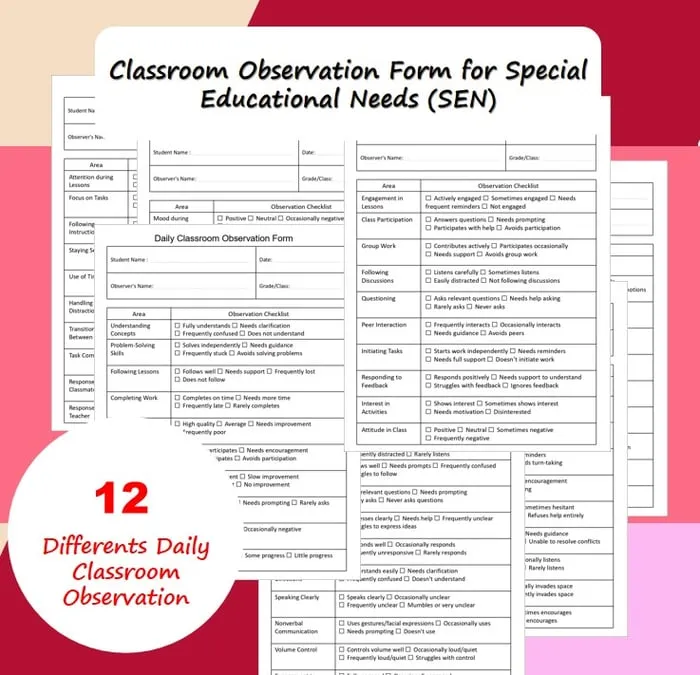
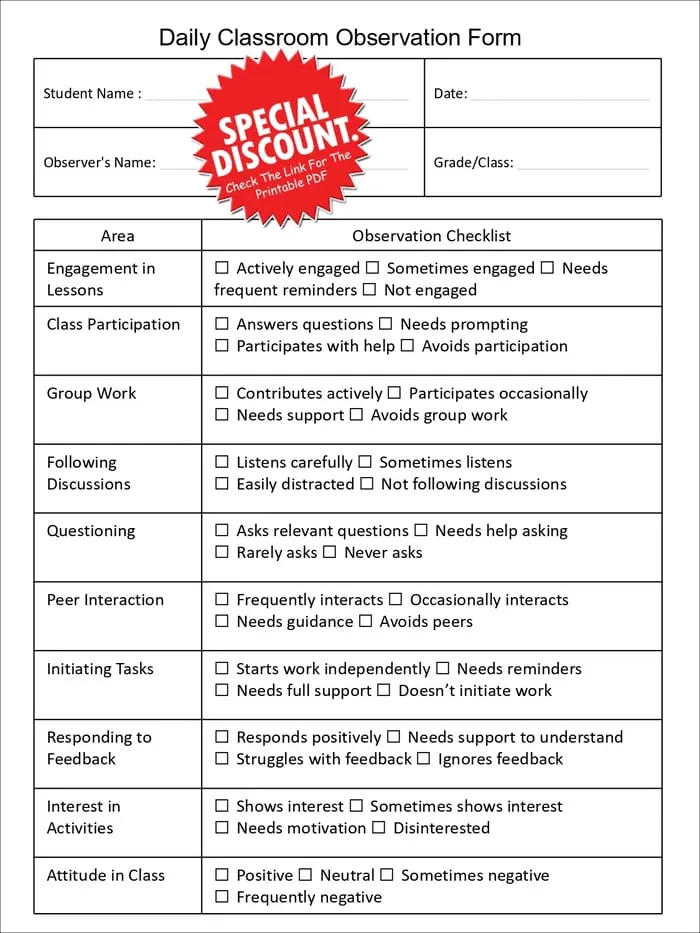
Daily Classroom Observation Forms: Behavior Checklist: 12 fillable forms, each focused on one area of the school day, such as attention, emotional regulation, peer interaction, communication, transitions, and motor skills, with simple checkbox ratings.
Sources and scope
- IRIS Center, Vanderbilt University: free modules on classroom behavior, data collection, and evidence-based practices.
- Center on PBIS: guidance on positive behavioral interventions and supports in schools.
- IDEA, U.S. Department of Education: the law behind special education services and IEPs.
- Understood.org: practical articles for families and teachers on learning and attention differences.
This guide covers informal daily classroom observation. It does not cover formal assessments, functional behavior assessments, or diagnosis, which belong to qualified professionals and the student’s team.
Key takeaways
- A classroom behavior checklist works best when it targets one area and one question.
- Write items as observable actions that two adults would mark the same way.
- Mark during a short, fixed window and note context briefly.
- Summarize weekly as “days observed out of days checked.”
- Share a strength and one next step with families and the team.










Leave a Comment