

Interobserver agreement in ABA answers a simple but important question: would two trained observers record the same thing? Imagine a team reviewing a graph that shows a student’s requests rising every week. Before anyone celebrates, they need to know the data is trustworthy and that the teaching was delivered as planned.
After reading this guide, you will be able to plan an IOA check, calculate common agreement scores, check procedural integrity during sessions, use behavioral skills training (BST) to fix gaps, and review all three together so your team can trust both its data and its teaching.
Examples are fictional. Adapt to the student’s goals and agreed supports. This is guidance, not a diagnosis.
At a glance
- IOA checks whether two observers record the same behavior the same way.
- Procedural integrity checks whether the teaching steps were delivered as written.
- Choose the IOA method that matches how you measure the behavior.
- When agreement or integrity is low, use BST to retrain, then check again.
- Review IOA and integrity regularly, not only when a problem appears.
Throughout the guide, the same fictional team appears: a student, an RBT, and a supervising BCBA. Their numbers are simple on purpose, so you can follow each calculation step by step and then apply it to your own data sheets.
1. Plan your interobserver agreement in ABA checks
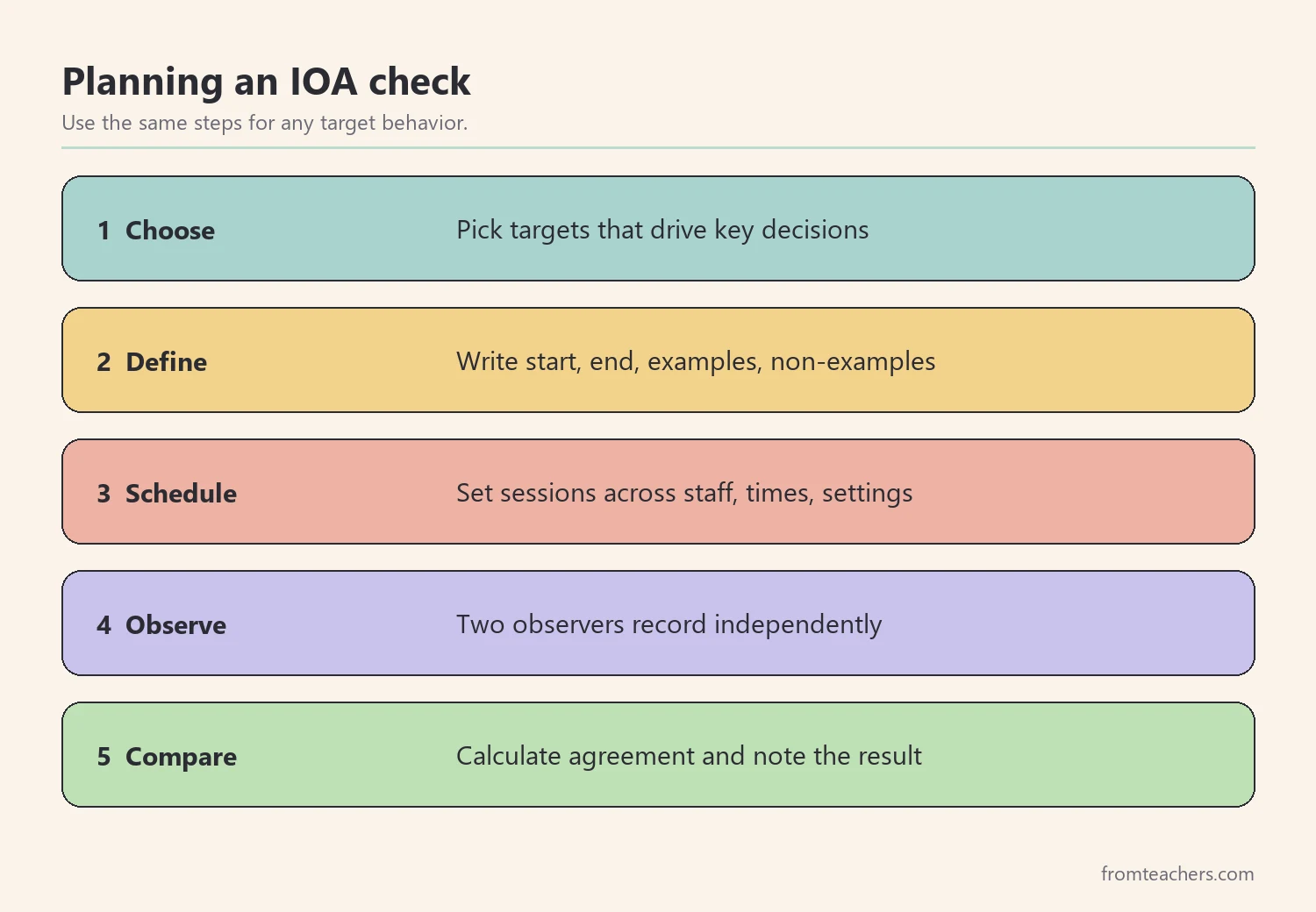
First, decide which programs need IOA. In practice, most teams start with the targets that drive important decisions, such as a behavior reduction goal or a skill that is close to mastery. Those graphs carry the most weight, so they deserve the most reliable data.
Next, define the behavior clearly. IOA can only be as good as the definition. A definition should describe what the behavior looks like, when it starts and ends, and include a few examples and non-examples. If two observers read the same definition and picture different actions, agreement will be low no matter how careful they are.
Then, schedule the checks. A second observer collects data at the same time as the primary observer, but independently, without looking at each other’s sheets. Many teams spread IOA across different sessions, times of day, and staff members so the checks reflect real practice rather than one good day.
Before the first check, both observers should practice together. A short practice round with a video or a role play lets them compare their marks and talk through any disagreements. In addition, agree on where the second observer will sit, so they can see the student clearly without distracting the session.
Finally, decide what you will do with the results. Will a low score trigger retraining, a rewrite of the definition, or both? Writing that plan down ahead of time keeps the response calm and consistent, rather than personal.
Worked example: Theo, age 7
Theo is learning to request items using a short phrase. His RBT, Maya, records each independent request during a 20-minute play session. Jordan, the supervising BCBA, plans to collect IOA once a week by observing the same session and recording separately.
| Decision | Theo’s plan |
|---|---|
| Target | Independent requests |
| Measure | Count and 1-minute intervals |
| Observers | Maya (primary), Jordan (second) |
| Schedule | One session per week |
Keep the completed IOA sheets with the session data. When a graph is reviewed months later, anyone can see when agreement was checked, who checked it, and what the scores were.
2. Calculate interobserver agreement in ABA
There are several ways to calculate IOA. The right one depends on how you measure the behavior. Two of the most common are total count IOA and interval-by-interval IOA.
Total count IOA
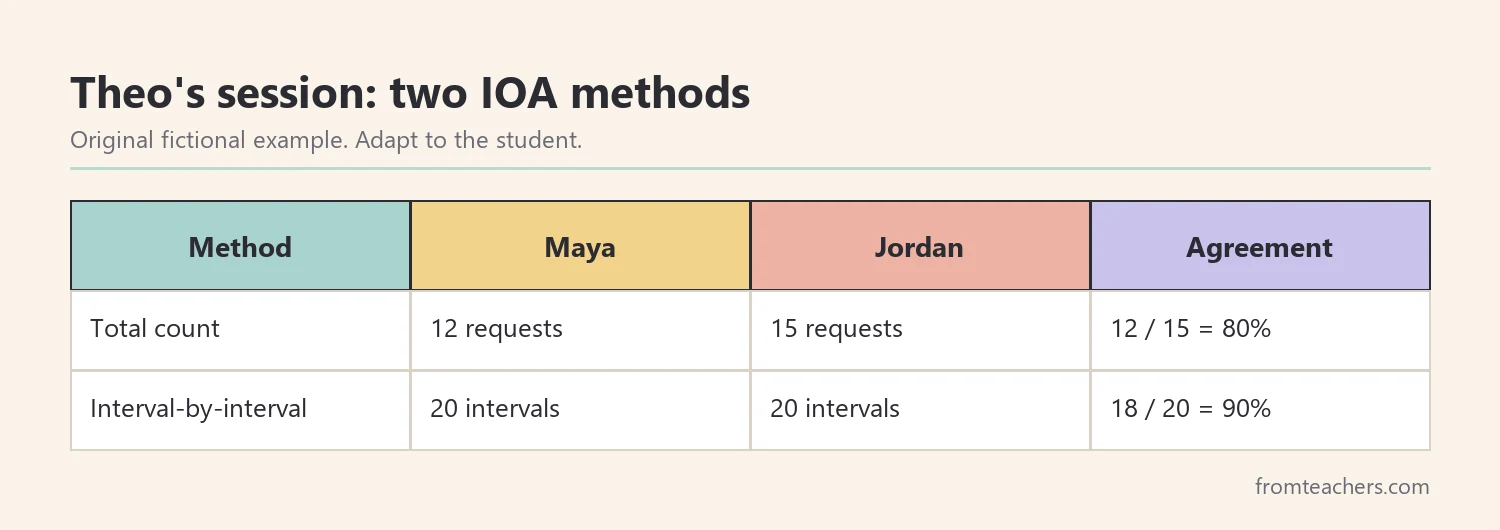
Divide the smaller count by the larger count, then multiply by 100. In Theo’s session, Maya counted 12 requests and Jordan counted 15. So, 12 divided by 15 is 0.8, which is 80 percent agreement.
However, total count IOA has a weakness. Two observers could reach the same total while recording different moments. For that reason, it is a quick check rather than a detailed one.
Interval-by-interval IOA
Here, the session is split into short intervals, and each observer marks whether the behavior occurred in each one. Count the intervals where they agree, divide by the total number of intervals, and multiply by 100.
Theo’s 20-minute session has 20 one-minute intervals. Maya and Jordan agreed on 18 intervals and disagreed on 2. So, 18 divided by 20 is 0.9, which is 90 percent.
| Method | Calculation | Result |
|---|---|---|
| Total count | 12 / 15 x 100 | 80% |
| Interval-by-interval | 18 / 20 x 100 | 90% |
Other methods you may see
Depending on the data, teams may also use trial-by-trial IOA for discrete trials, duration-based IOA for how long a behavior lasts, or exact count-per-interval IOA for stricter checks. Each one follows the same idea: compare two independent records and express agreement as a percentage. Your BCBA can help you choose the method that fits each program.
Whatever the method, write the calculation on the sheet. A short line such as “18 / 20 x 100 = 90%” makes it easy for anyone reviewing the file to check the math later.
Many teams use 80 percent as a commonly cited minimum and look for consistent scores above it. Follow your organization’s standards and your BCBA’s guidance.
3. Check procedural integrity during sessions
Reliable data is only half of the picture. The team also needs to know that the teaching was delivered as written. This is called procedural integrity, or treatment fidelity.
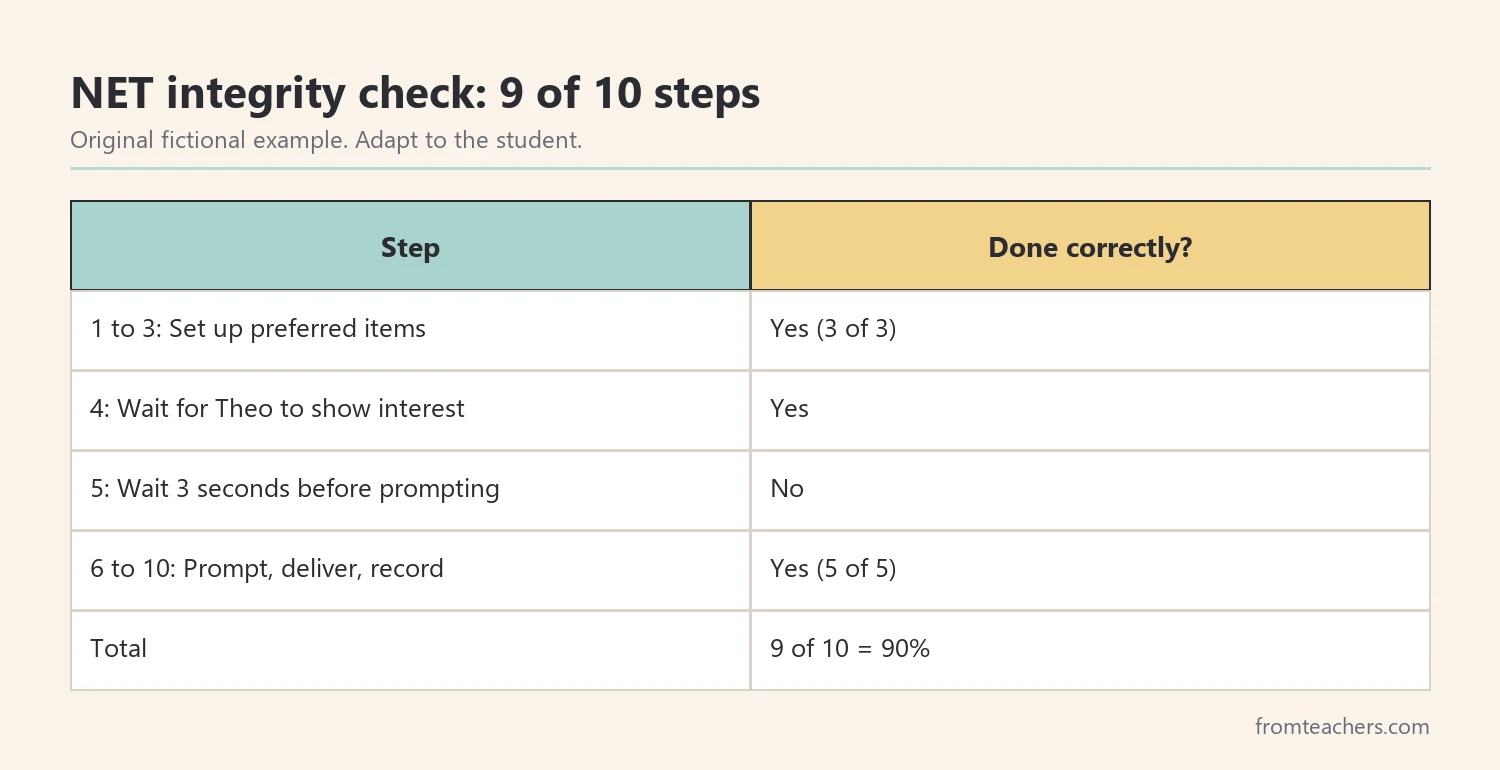
To check it, break the procedure into steps on a checklist. During a session, an observer marks each step as done correctly or not. The integrity score is the number of correct steps divided by the total steps, multiplied by 100.
For Theo’s Natural Environment Teaching (NET) session, Jordan uses a 10-step checklist. Steps include arranging preferred items, waiting for Theo to show interest, giving the right prompt level, and delivering the item right after a request. Maya completes 9 of the 10 steps correctly, so her integrity score is 90 percent.
The step Maya missed was waiting a few seconds before prompting. As a result, some requests were prompted rather than independent.
Integrity checklists exist for other formats too. For a task analysis program taught with forward chaining, backward chaining, or total task presentation, the checklist lists the steps of the chaining procedure itself. As a result, the observer can see whether the correct step was taught and whether prompts were faded as planned.
Printable IOA data sheets and procedural integrity checklists for NET and task analysis programs can make these checks quicker, because every observer uses the same layout.
4. Use BST to close the gaps
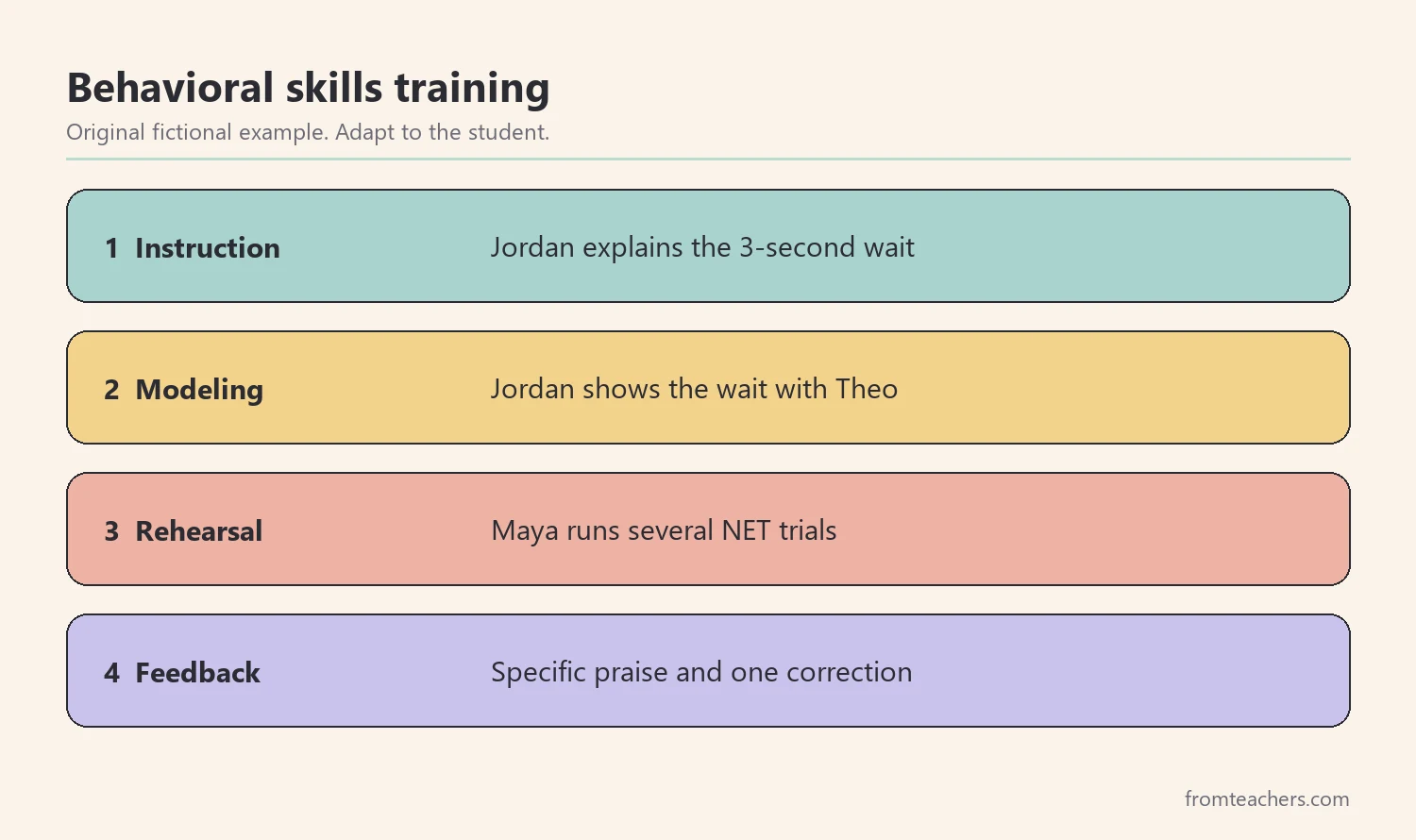
When IOA or integrity is lower than expected, the next step is usually training, not blame. Behavioral skills training is a structured way to teach a skill to staff or caregivers. It has four core parts: instruction, modeling, rehearsal, and feedback.
First, give brief instruction. Jordan explains why the wait matters and shows Maya the written step. Next, model the skill. Jordan runs a short NET trial with Theo, waiting three seconds before prompting. Then, rehearse. Maya runs several trials while Jordan watches. Finally, give feedback. Jordan names what Maya did well and gives one specific correction.
BST continues until the skill is steady. Many teams also plan a maintenance check a few weeks later to make sure the skill holds. Tracking each part on a form helps you see which stage still needs work, and the same approach works when training parents to run a routine at home.
Keep feedback specific and balanced. “You waited three seconds on the last two trials, and Theo requested on his own both times” is far more useful than “good job.” In the same way, one clear correction is easier to act on than a long list.
BST also works for training new staff before they ever run a program alone. Instead of waiting for low integrity scores, a new RBT can go through instruction, modeling, rehearsal, and feedback for each core procedure. That way, the first integrity check measures a skill that has already been practiced, and early sessions run more smoothly for the student.
Theo’s BST record
| Stage | Who | Note |
|---|---|---|
| Instruction | Jordan | Reviewed wait step |
| Modeling | Jordan | Showed 3-second wait |
| Rehearsal | Maya | Ran several trials |
| Feedback | Jordan | Praise and one fix |
5. Review interobserver agreement in ABA with integrity data
IOA and integrity tell you the most when you look at them together. High IOA with low integrity means the data is reliable, but the teaching was not delivered as planned. Low IOA with high integrity often points to a definition or recording problem.
After BST, Jordan checks again the following week. This time, Maya counts 14 requests and Jordan counts 14, so total count IOA is 100 percent. Interval agreement is 19 of 20, or 95 percent, and Maya completes all 10 integrity steps, or 100 percent.
| Week | Count IOA | Interval IOA | Integrity |
|---|---|---|---|
| 1 | 80% | 90% | 90% |
| 2 | 100% | 95% | 100% |
Notice how the numbers connect. Once Maya added the wait, Theo had a clear chance to request on his own, and both observers recorded the same requests. In other words, better teaching and better data often improve together.
Share the results with the whole team, including caregivers when appropriate. A short summary, such as “Our data on Theo’s requests is now reliable, and the NET steps are being followed,” helps everyone trust the graph that guides the next decision.
Keep reviewing on a regular schedule. Add notes when something changes, such as a new staff member or a new setting. Over time, this routine makes interobserver agreement in ABA a normal part of supervision rather than a special event.
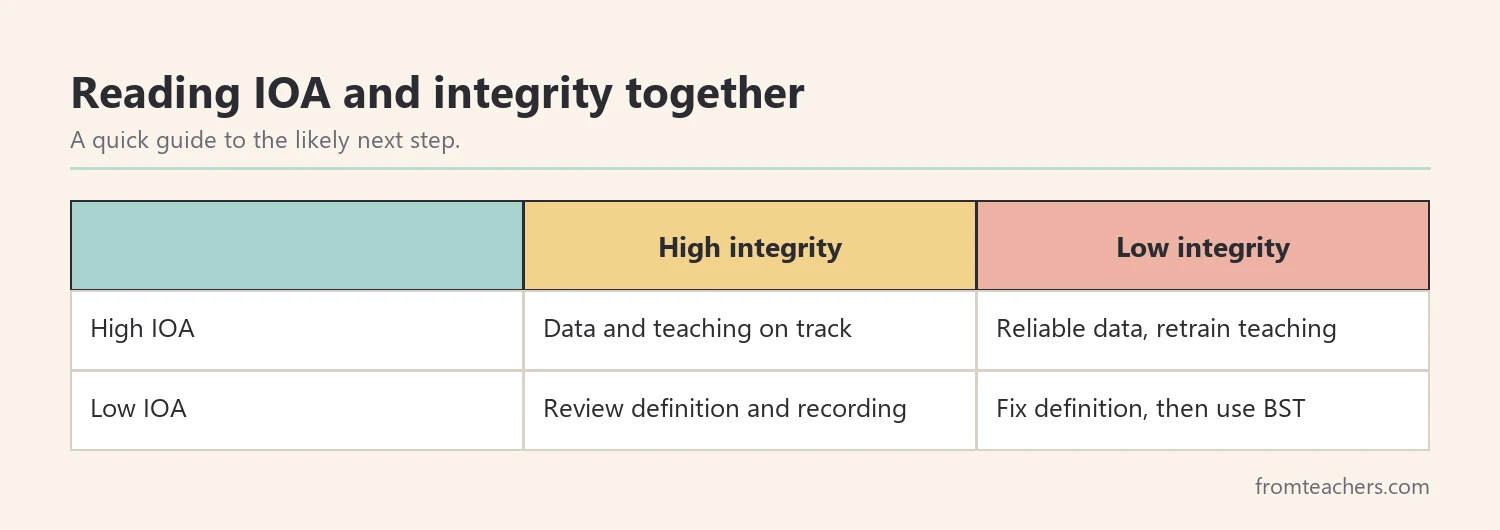
Common mistakes and how to avoid them
- Vague behavior definitions. Fix: add clear start and end points, examples, and non-examples.
- Observers comparing notes during the session. Fix: record independently and compare only afterward.
- Relying only on total count IOA. Fix: use interval or trial-based methods when timing matters.
- Checking IOA only on good days. Fix: spread checks across staff, times, and settings.
- Treating low scores as personal failure. Fix: use BST and check again.
Above all, treat these checks as quality care rather than inspection. When staff know that IOA and integrity checks are routine and supportive, they are more likely to ask for help early. That culture protects the student, because decisions are based on accurate data and consistent teaching.
Questions teachers and parents ask about interobserver agreement in ABA
What is a good IOA score?
Many teams use 80 percent as a commonly cited minimum, with higher scores preferred. Your organization or supervising BCBA may set its own standard. Consistency over time matters as much as any single score.
How often should IOA be collected?
It varies by organization and program. Many teams collect it on a regular share of sessions and spread it across staff and settings. Ask your BCBA what your team’s standard is.
Is procedural integrity the same as IOA?
No. IOA checks whether observers agree on what the student did. Procedural integrity checks whether the adult delivered the teaching steps as written.
Can parents be trained with BST?
Yes. BST works well for caregivers learning a routine at home. The same four parts apply, with practice in the real setting when possible.
What should we do if IOA stays low?
First, reread the behavior definition with both observers and look for vague words. Then, check whether both observers could see the student clearly. If the definition and setting look fine, use BST with both observers and run another check.
Related reading: The Power of Data Tracking in Special Education, Special Education Accommodation and Modification Tracker, and Autism Social Skills Development: Practical Strategies for Growth.
A companion resource for interobserver agreement in ABA:
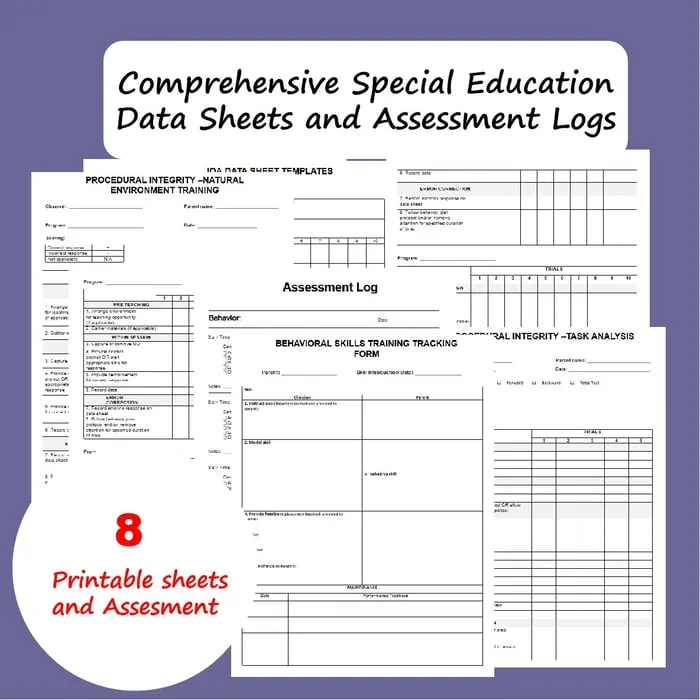
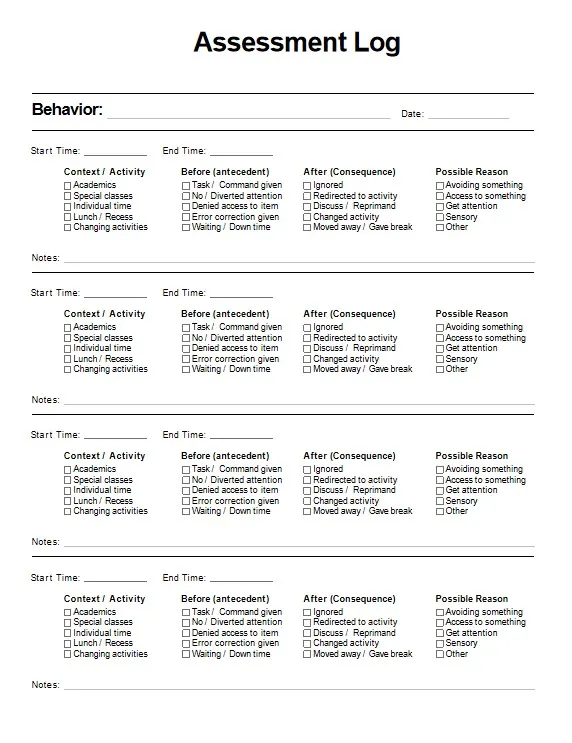
ABA Data Sheets: IOA, Procedural Integrity and BST Forms: 8 printable sheets in PDF and editable PowerPoint, including IOA templates, procedural integrity checklists for NET and chaining programs, a general assessment log, and a BST tracking form with clinician and parent columns.
Sources and scope
- Behavior Analyst Certification Board (BACB): certification standards, ethics code, and supervision requirements for BCBAs and RBTs.
- Association of Professional Behavior Analysts (APBA): a professional organization for practicing behavior analysts.
- IRIS Center, Vanderbilt University: free modules on data collection and evidence-based practices.
- What Works Clearinghouse: reviews of education research, including single-case design standards.
This guide covers practical IOA, procedural integrity, and BST routines for teams. It does not replace supervision, your organization’s policies, or BACB requirements.
Key takeaways
- Interobserver agreement in ABA shows whether your data can be trusted.
- Pick the IOA method that matches how you measure behavior.
- Procedural integrity shows whether teaching was delivered as written.
- Use BST to fix gaps, then check again.
- Review IOA and integrity together on a regular schedule.










Leave a Comment