

Vacation safety skills matter most in the moments nobody plans for. Picture a busy airport gate: the family is checking boarding passes, a ten-year-old spots a bright vending machine across the hall, and in three seconds he is out of sight. Nothing bad happens, but everyone’s heart races, and the child has no idea why the adults are upset.
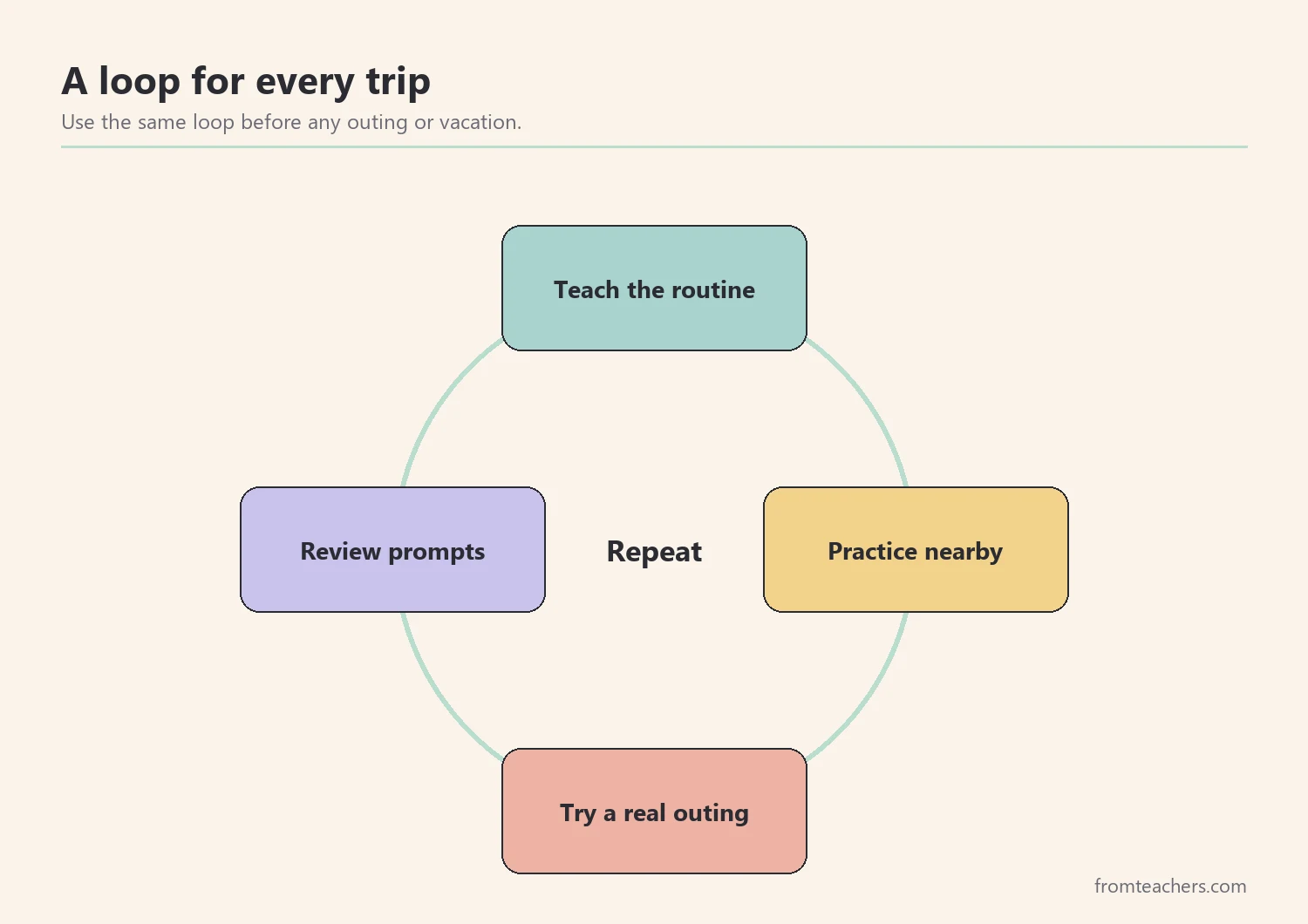
This guide turns that worry into a plan. You will learn how to check what a child can already do, teach a few clear routines, rehearse them in real places, and track progress with simple checklists. By the end, you will have a small, practical set of steps you can use before any trip, outing, or family vacation.
Examples are fictional. Adapt to the student’s goals and agreed supports. This is guidance, not a diagnosis.
At a glance
- Check what the child can already do before the trip, not on the day you leave.
- Teach a small number of routines: stay close, check in, and ask the right helper.
- Practice in real places, starting quiet and moving to busier ones.
- Prepare for the settings that change on vacation: water, hotels, and crowds.
- Record each practice briefly so the team can see what is improving.
1. Check current vacation safety skills before the trip
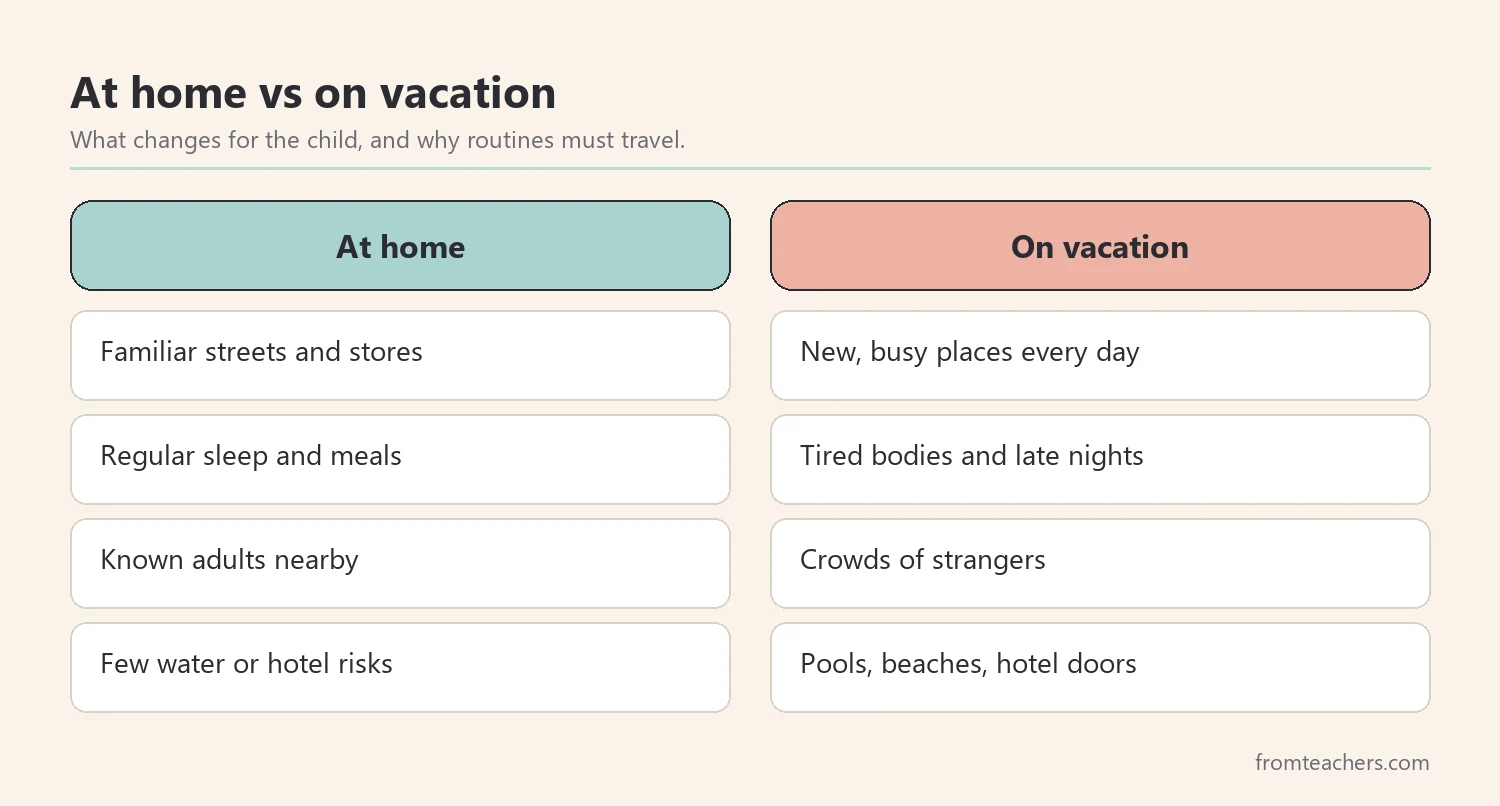
Start with what the child already does well. Many children can stay close in a familiar grocery store but struggle in a loud terminal or a crowded beach. Because vacations mix new places, new routines, and tired bodies, a skill that looks solid at home can disappear on day two of a trip.
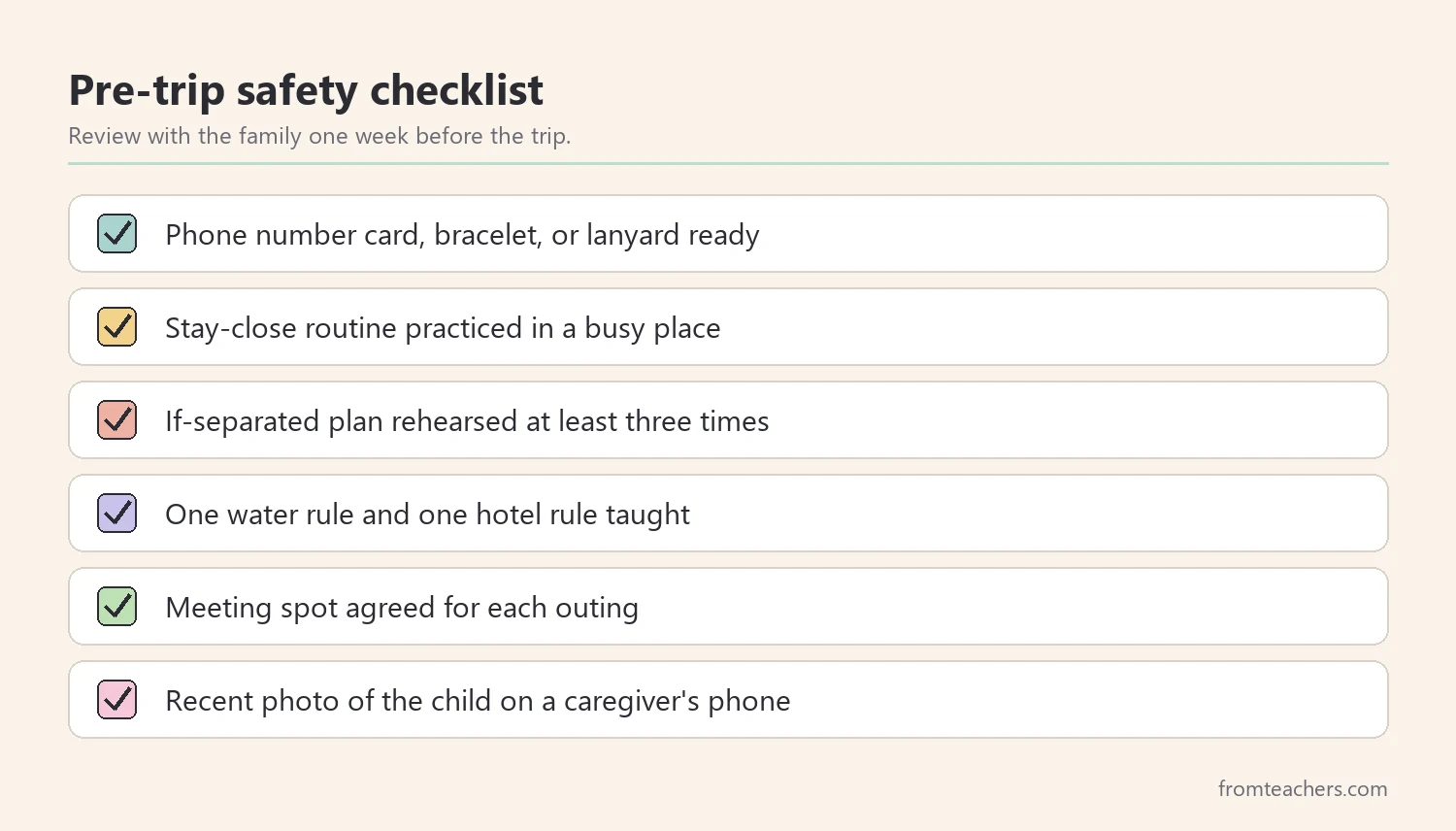
First, list the vacation safety skills you care about most. Keep the list short. For most families and life skills classrooms, five skills cover the biggest risks:
- Staying within an agreed distance of a trusted adult.
- Stopping when called by name.
- Sharing name and a caregiver’s phone number, by speaking, pointing, or showing a card.
- Knowing who a safe helper is in a public place.
- Following one water or pool rule without reminders.
Next, watch the child during two or three ordinary outings. Note how many prompts each skill needs. A prompt is any reminder, gesture, or physical guidance. You are not testing the child; you are finding the starting point.
For example, meet Leo, a fictional fourth grader in a life skills class. His family is planning a trip to visit relatives, with a flight and a hotel stay. During a practice walk to a local mall, his teacher notices that Leo stops when called, but he drifts ahead whenever he sees a screen or a fountain. He can say his name clearly but not his mother’s phone number.
That short observation of Leo’s vacation safety skills already tells the team where to focus. Leo does not need a long safety unit. Instead, he needs a stay-close routine, a phone number card, and practice near the things that pull his attention.
2. Teach a stay-close and check-in routine
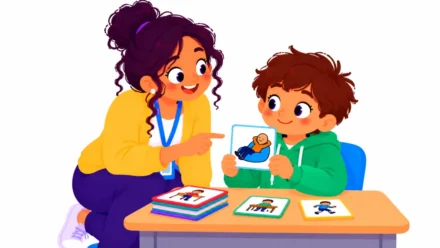
Once you know the starting point, teach one routine at a time. Strong vacation safety skills are built from small routines, not long lectures. Children learn safety routines best when the routine has a name, a simple action, and the same words every time. In addition, a visual card helps children who process spoken language slowly or who freeze under stress.
Leo’s team chose a routine called “Hand or Bag.” In crowded places, Leo either holds an adult’s hand or keeps one hand on a parent’s backpack strap. In quieter places, he may walk freely but must stay within “two big steps.” Every few minutes, the adult says “Check in,” and Leo answers with a thumbs-up or by touching the bag.
Teach the routine in three short stages:
- Show it. Model the routine with a picture card and a quick role play in the classroom or living room.
- Practice it. Walk the school hallway or a quiet park path and use the exact words.
- Stretch it. Move to a busier place, such as a store entrance, while the adult stays calm and close.
Praise the specific behavior right away: “You checked in. That keeps you safe.” As a result, the child links the routine to success instead of to fear.
Also, keep the language positive. “Stay with me” is easier to follow than “Don’t run off.” Children who struggle with language often hear only the last word, and “run off” is the opposite of what you want.
These first vacation safety skills form the base for everything else. If the child can stay close and check in, the next routines become much easier to teach.
3. Practice what to do if separated
Even with good routines, separations can happen. Therefore, every child needs a short, rehearsed plan for the moment they cannot see their adult. The plan should be simple enough to follow while scared.
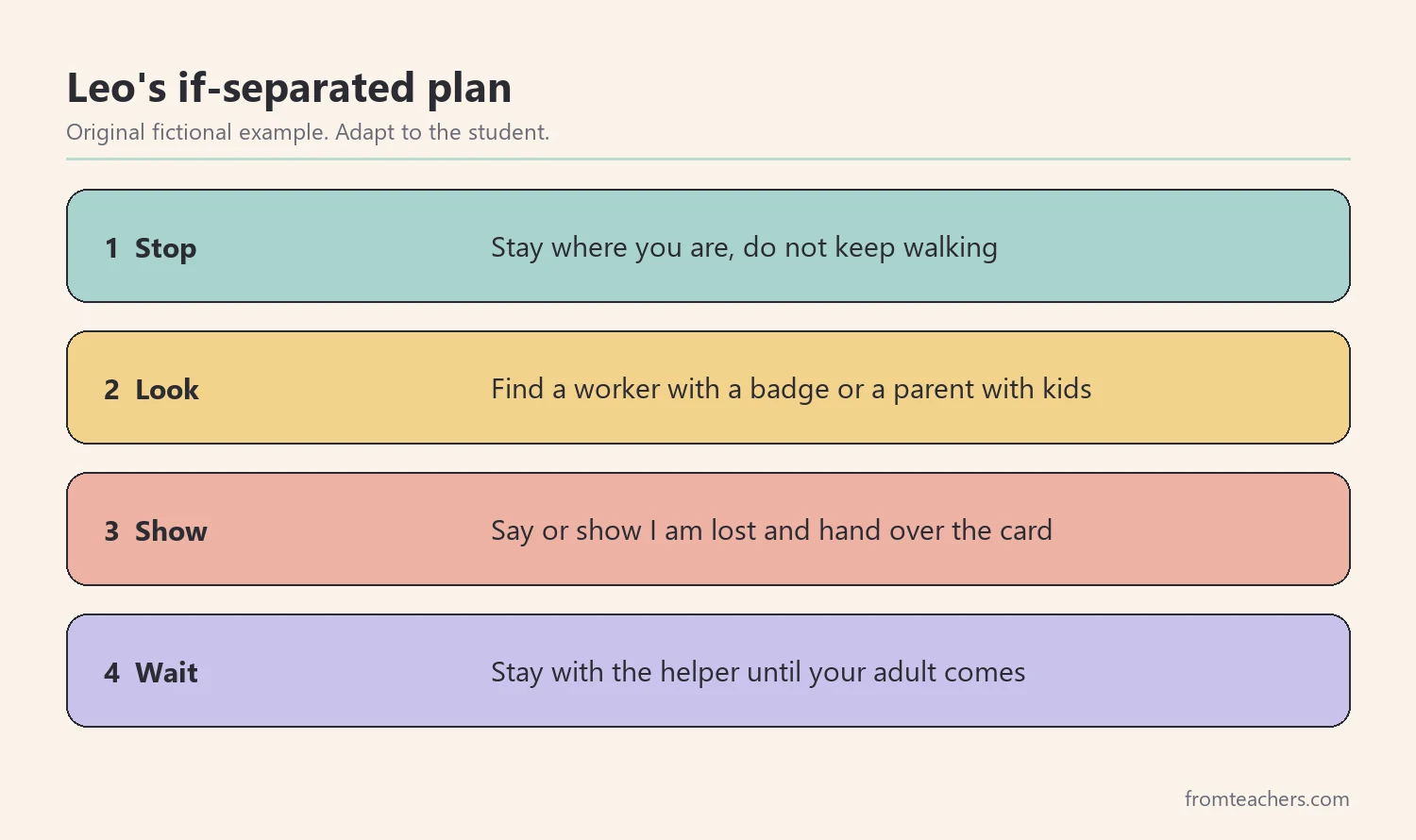
Leo’s team used a four-part plan that fits on one card:
- Stop. Stay where you are. Do not keep walking.
- Look. Find a safe helper: a worker with a uniform or name badge, or a parent with children.
- Show. Say or show “I am lost” and hand over the card with a caregiver’s phone number.
- Wait. Stay with the helper until your adult arrives.
Practice this plan many times before the trip, because it is one of the vacation safety skills a child may need without any adult nearby. Start in the classroom with role play, where a staff member plays the helper. Then practice in a store where an employee has agreed to help. Many families find that a calm practice in a familiar place builds confidence for the real trip.
Notably, the phone number card matters for many children. Some children can recite a number at home but not when upset. A laminated card in a pocket, a bracelet, or a lanyard gives a backup that does not depend on memory. Choose a format the child will actually keep on.
Finally, talk about who is not a helper in kid-friendly words. Rather than teaching fear of all strangers, teach the child to choose the helper. In practice, that keeps the focus on what to do instead of who to avoid. Stranger safety and personal boundaries can then be taught as part of the wider set of vacation safety skills, with role plays that fit the child’s age and understanding.
4. Prepare vacation safety skills for water, hotels, and crowds
Vacations bring settings that most children do not face every week. Because of this, it helps to plan for each one separately. Pick the settings your trip will actually include, and teach one rule for each.
| Setting | One clear rule | How to practice |
|---|---|---|
| Pool or beach | Ask an adult before touching the water | Role play at a local pool with a picture card |
| Hotel | Open the door only with an adult | Practice with a classroom or bedroom door |
| Airport or station | Hand or Bag in lines and crowds | Visit a bus station or busy store entrance |
| Theme park or event | Meet at the agreed spot if separated | Pick a meeting spot on every outing |
Water deserves extra attention. Drowning can happen quickly and quietly, so close adult supervision near water is essential at every age, even for children who can swim. A child’s rule, like “Ask first,” supports supervision but never replaces it.
Similarly, hotel rooms can confuse children. Doors look alike, hallways are long, and elevators feel exciting. Show the child a photo of the room number on arrival, and practice walking from the elevator to the room together once or twice.
For Leo, the team added the pool rule and a hotel door rule. His mother printed a small card with both rules and a photo of the hotel’s pool area from its website. As a result, Leo could see the place before he arrived, which made the rules feel real.
Also, think about the transitions. Many children find it hard to leave the pool or end a fun activity. A visual timer or a “two more minutes, then towel” routine reduces arguments and keeps vacation safety skills in place when energy is low.
5. Record and review vacation safety skills
Practice is only useful if you know whether it is working. Recording vacation safety skills does not need to take long. A brief record after each outing shows what is improving and what needs more teaching. Keep it simple enough to fill in within a minute.
Track the number of prompts each skill needed. Fewer prompts over time means the child is taking over the skill. Leo’s teacher and mother recorded three practice outings over three weeks:
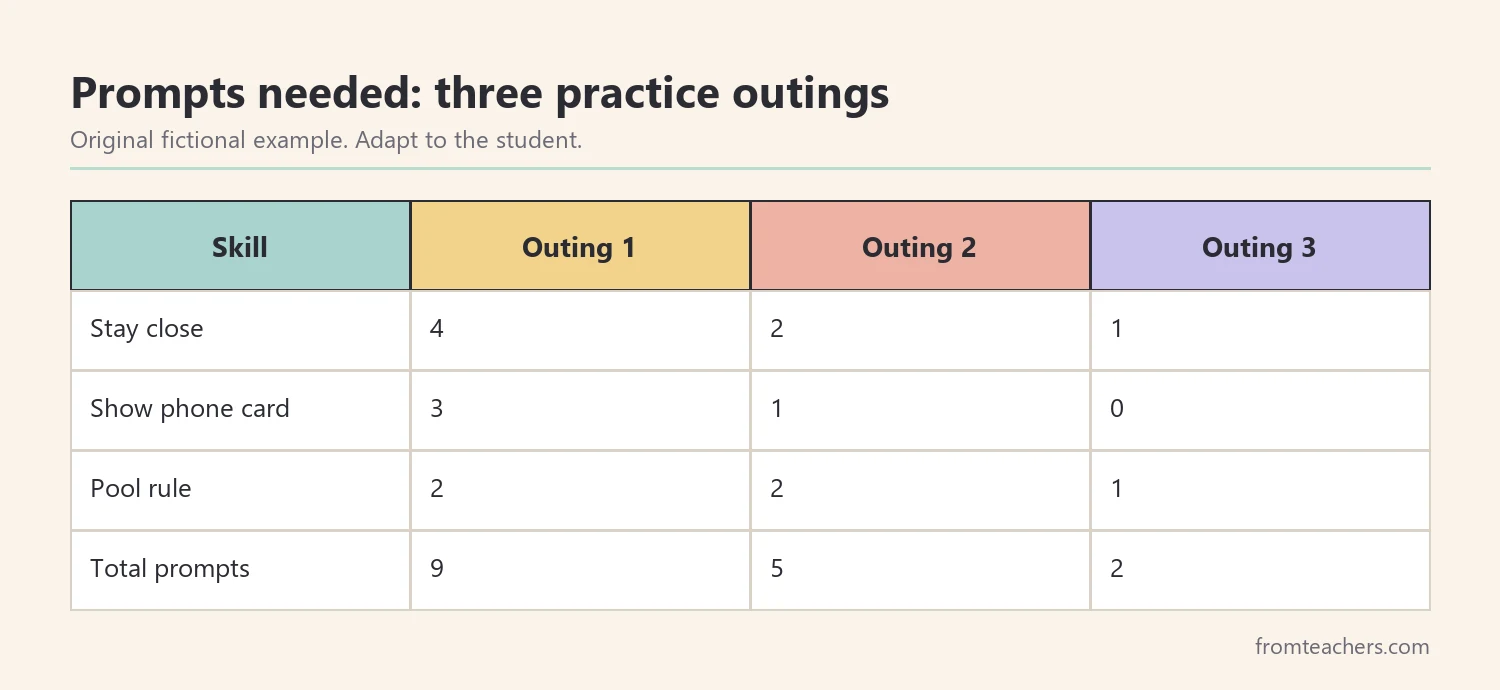
Leo needed 4 prompts to stay close on the first outing, 2 on the second, and 1 on the third. He needed 3 prompts to show his phone card at first, then 1, then none. Across the three outings, his total prompts for the three skills fell from 9 to 5 to 2. That trend told the team the routines were working, and the pool rule needed one more rehearsal before the trip.
A structured checklist makes this kind of tracking much easier. For instance, a set of vacation safety and community safety checklists gives you ready forms for readiness, travel safety, emergency response, and independence, so you can record each outing without designing pages from scratch.
Review the vacation safety skills data with the family before the trip. Then decide together which skills are ready, which need adult support, and which the child should not be expected to handle alone yet. After the trip, ask what happened, what worked, and what to practice next.
Common mistakes and how to avoid them
- Teaching everything at once. Fix: pick two or three routines and practice them until they are reliable.
- Practicing only at school. Fix: move practice into real community places, starting quiet and getting busier.
- Using fear to motivate. Fix: teach what to do and praise it, rather than describing what could go wrong.
- Relying on memory for a phone number. Fix: add a card, bracelet, or lanyard the child will wear.
- Treating a rule as supervision. Fix: keep close adult supervision near water and in crowds, even when the child knows the rule.
- Skipping the review. Fix: spend five minutes after each outing noting prompts and one next step.
Questions teachers and parents ask about vacation safety skills
At what age should children start learning vacation safety skills?
Children can start with simple routines, like holding a hand or stopping when called, as soon as they walk in public places. Older children and teens build on these with phone numbers, helper choices, and more independence. Match the skill to the child’s understanding, not only their age.
What if the child cannot speak or recite a phone number?
Use a card, bracelet, or communication device page with the caregiver’s information. Then practice handing it to a helper in role play. Many children with limited speech learn this routine well when it is short and practiced often.
How long before a trip should we start practicing?
Several weeks of short practice usually works better than one long session the week before. Even two or three outings give you useful information. If the trip is soon, focus on just the stay-close routine and the phone card.
Should we use a tracking device?
Some families choose one, and that is a personal decision. However, a device is a backup, not a skill. The child still needs to know how to stay close and what to do if separated.
How can teachers support vacation safety skills during the school year?
Teachers can build vacation safety skills into community outings, life skills lessons, and IEP goals where appropriate. Sharing checklists with families helps the same words and routines carry over from school to the trip.
Related reading: Navigating the Path to Adulthood: Building Essential Life Skills, Managing Sensory Overload: Practical Strategies for Autism and ADHD, and How Parents and Teachers Can Team Up for Special Education Success.
A companion resource for vacation safety skills:
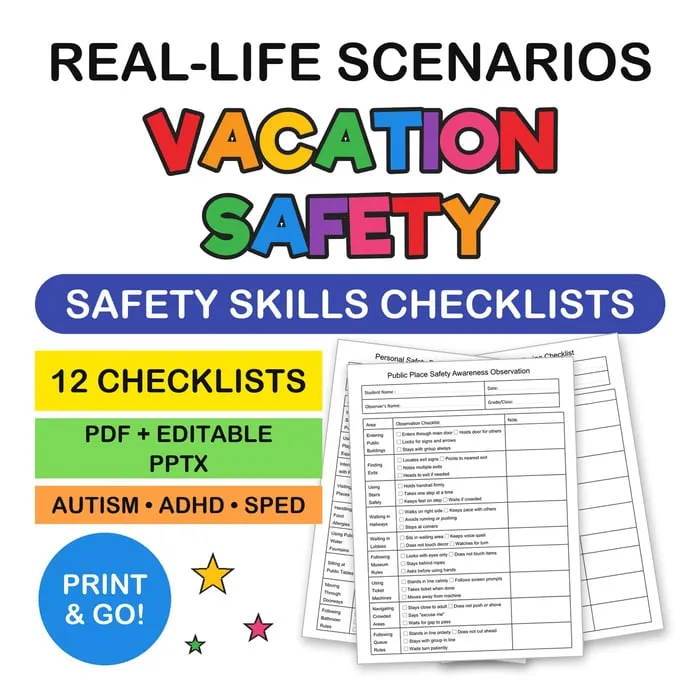
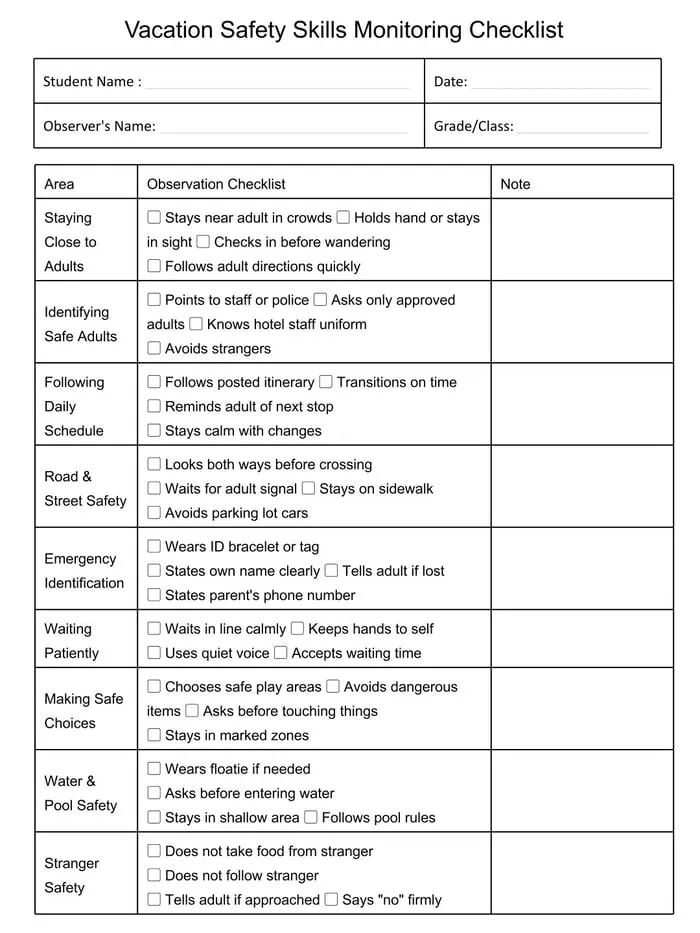
Vacation Safety Skills: Real-Life Scenarios and Checklists for Special Education: a set of 12 checklists and trackers covering vacation readiness, travel and community safety, emergency response, stranger safety and boundaries, routines and transitions, and independence. It comes as a PDF plus an editable PowerPoint file.
Sources and scope
- National Center for Missing & Exploited Children: child safety education and resources for families.
- Safe Kids Worldwide: general injury prevention information for families, including water safety.
- American Red Cross: water safety and preparedness information.
- IRIS Center, Vanderbilt University: free modules on evidence-based teaching practices for students with disabilities.
This guide covers teaching everyday safety routines for trips and outings. It does not replace adult supervision, emergency planning by families, or advice from the child’s medical or therapy team.
Key takeaways
- Observe first so you teach the vacation safety skills the child actually needs.
- Give each routine a name, a simple action, and the same words every time.
- Rehearse the if-separated plan until the child can follow it calmly.
- Plan one rule each for water, hotels, and crowds, and keep supervising closely.
- Record prompts after each outing and review the trend with the family.





Leave a Comment