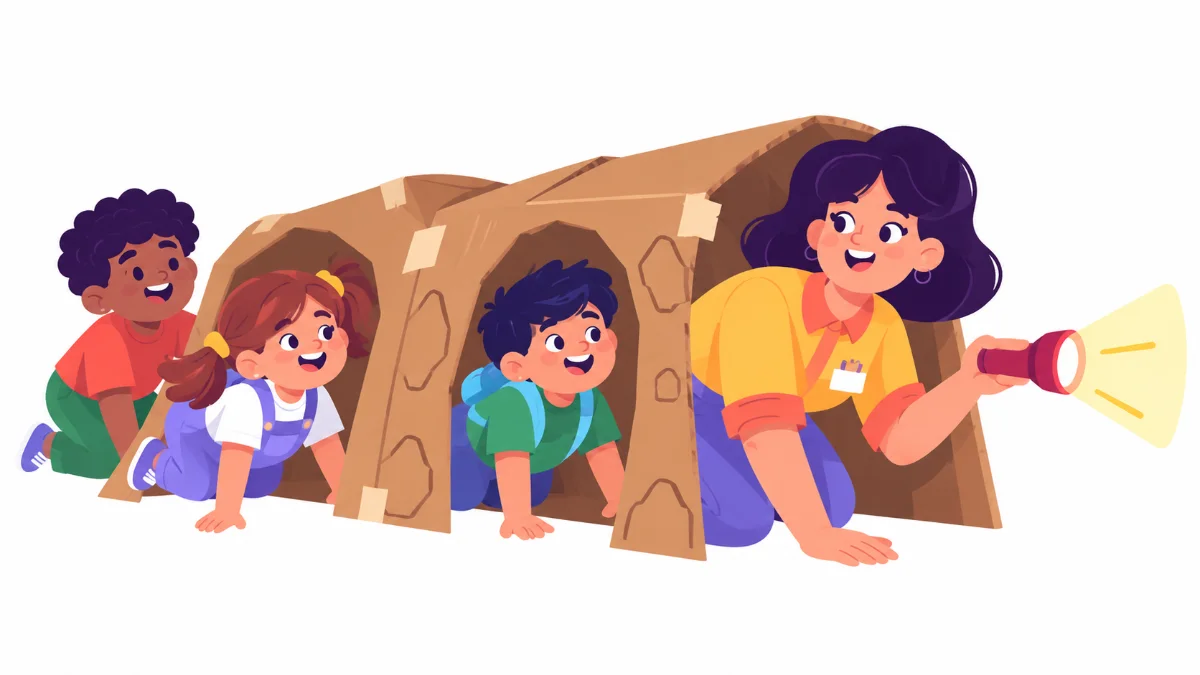

Kentucky facts for kids can turn a quick state study into a lesson students actually remember. Picture a third-grade class that has just finished a list of state capitals. They can say “Frankfort,” but nobody can point to Kentucky on a map, explain the handshake on its flag, or guess what lies under its hills. The facts are there. What is missing is a story that connects them.
This guide gives you a five-step plan for a short Kentucky unit. By the end, you will be able to help students locate the state, read its flag and symbols, explore Mammoth Cave and the land, meet its wildlife and horses, and show what they learned in a simple fact project.
Examples are fictional. Adapt to the student’s goals and agreed supports. This is guidance, not a diagnosis.
At a glance
- Start every state study with the map, so each fact has a place to live.
- Kentucky is called the Bluegrass State, and its capital is Frankfort.
- The flag’s seal shows two men shaking hands, a symbol of unity.
- Mammoth Cave National Park protects the longest known cave system in the world.
- Finish with a short project where students teach facts back to the class.
1. Locate Kentucky before teaching Kentucky facts for kids
First, put the state on the map. Facts stick better when students can picture where they belong. Show a U.S. map and ask students to find Kentucky in the east-central part of the country, south of the Ohio River.
Next, look at its neighbors. Kentucky borders seven states: Ohio, Indiana, and Illinois to the north, West Virginia and Virginia to the east, Tennessee to the south, and Missouri to the west across the Mississippi River. Counting the neighbors together is a quick, hands-on way to read a map.
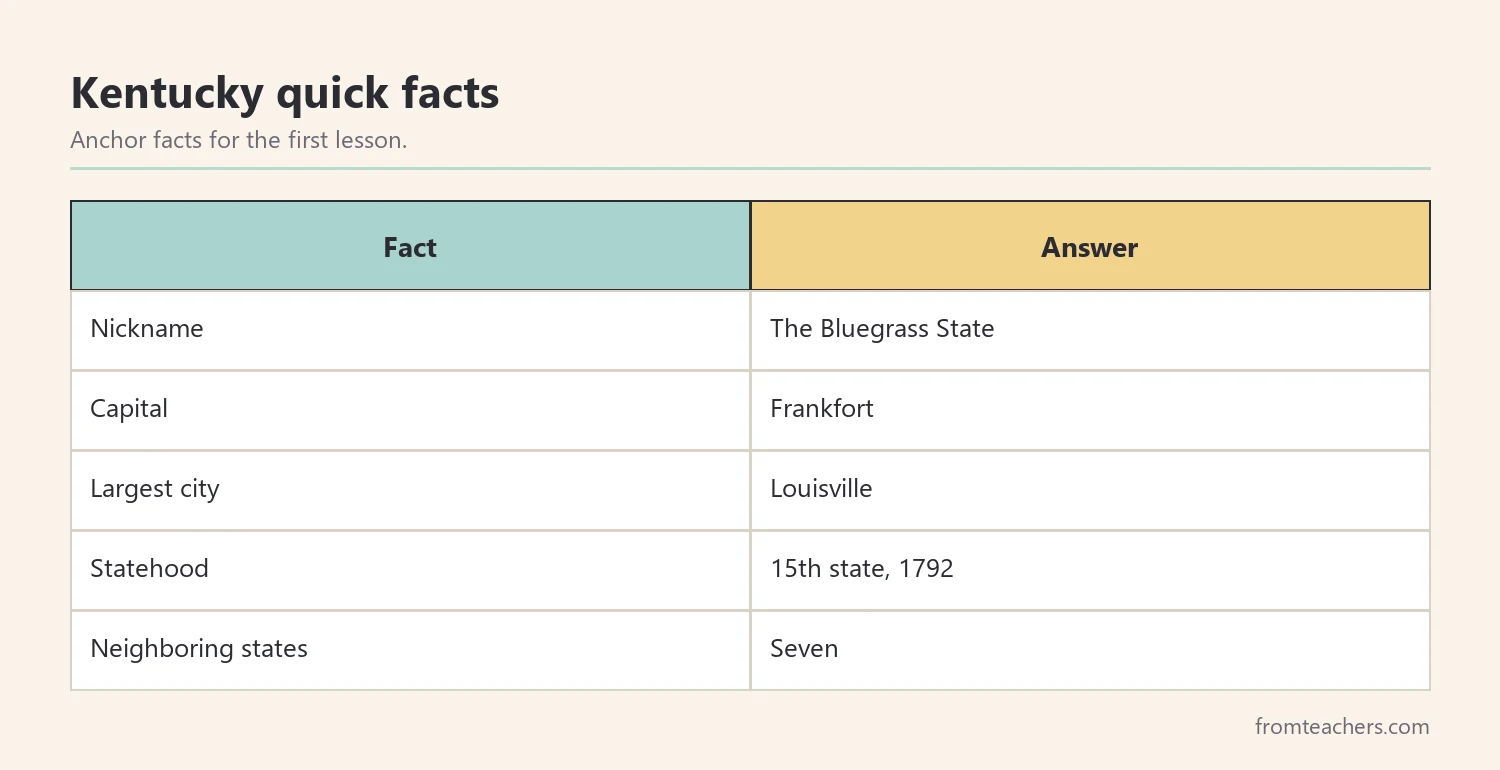
Then, introduce a few anchor Kentucky facts for kids. Kentucky became the 15th state in 1792. Its capital is Frankfort, and its largest city is Louisville. The state is nicknamed the Bluegrass State, after a grass that grows in its central region.
Also, connect rivers to the map. The Ohio River runs along the northern border, and the Mississippi River touches the far western edge. Ask, “Why might towns grow along a big river?” This turns a map label into a small geography lesson.
Map activity checklist
- Color Kentucky on a blank U.S. map.
- Label Frankfort with a star and Louisville with a dot.
- Trace the Ohio River along the northern border.
- Count and name the seven neighboring states.
Worked example. Ava is a fictional third grader in Ms. Lane’s class. On day one, she colors Kentucky, stars Frankfort, and traces the Ohio River in blue. She counts the neighbors twice and proudly announces, “Seven!”
2. Read the flag and symbols in Kentucky facts for kids
Once students know where Kentucky is, move to its symbols. Symbols are some of the most memorable Kentucky facts for kids, because each one has a picture and a reason behind it.
Start with the flag. The Kentucky flag is navy blue with the state seal in the center. The seal shows two men shaking hands, with the state motto, “United We Stand, Divided We Fall,” around them. Ask students what a handshake means to them. Most will say friendship or agreement, which leads straight to the idea of unity.
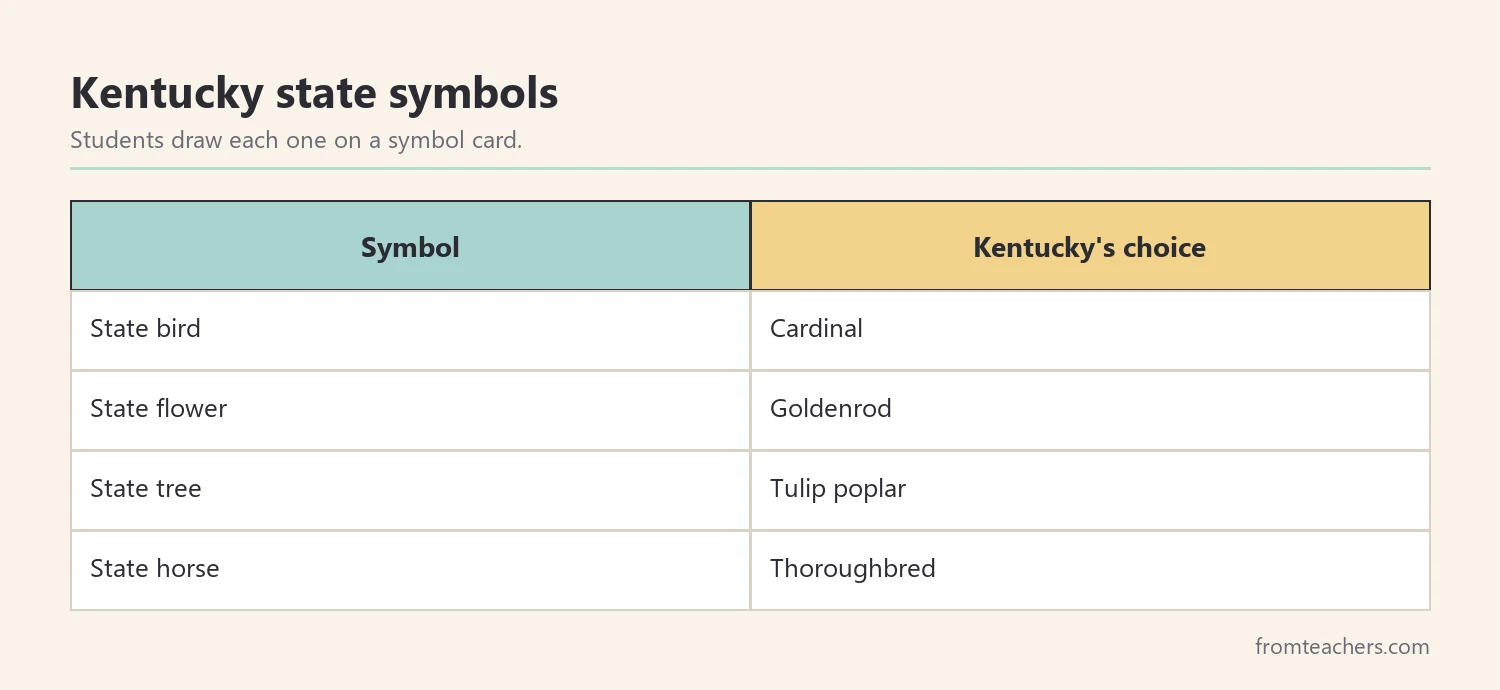
Next, introduce a few more symbols. The state bird is the cardinal, the state flower is goldenrod, the state tree is the tulip poplar, and the state horse is the Thoroughbred. Students can draw each symbol on a small card and write one sentence about it.
For a ready-made visual walk-through, a Kentucky state study slideshow on facts, symbols, and wildlife includes a slide on the flag’s handshake symbol, along with slides on Mammoth Cave and Kentucky wildlife.
Worked example. Ava draws the flag and circles the handshake. Under it she writes, “The handshake means people working together.” Then she makes a symbol card for the cardinal, because she has seen one at her grandmother’s bird feeder.
3. Explore Mammoth Cave and the land with Kentucky facts for kids
Then, take students underground. Mammoth Cave National Park in central Kentucky protects the longest known cave system in the world, with more than 400 miles of passages mapped so far. It became a national park in 1941, and the park covers more than 52,000 acres.
Make the size concrete. For example, ask students to name a place about 400 miles away from school, then explain that the mapped cave passages, laid end to end, would stretch even farther. Comparisons like this turn big numbers into something students can feel.
Also, explain how caves form in simple terms. Over a very long time, water slowly dissolves certain kinds of rock, such as limestone, and leaves tunnels and rooms behind. Students do not need every detail, but the idea that water can shape rock is a strong science link.
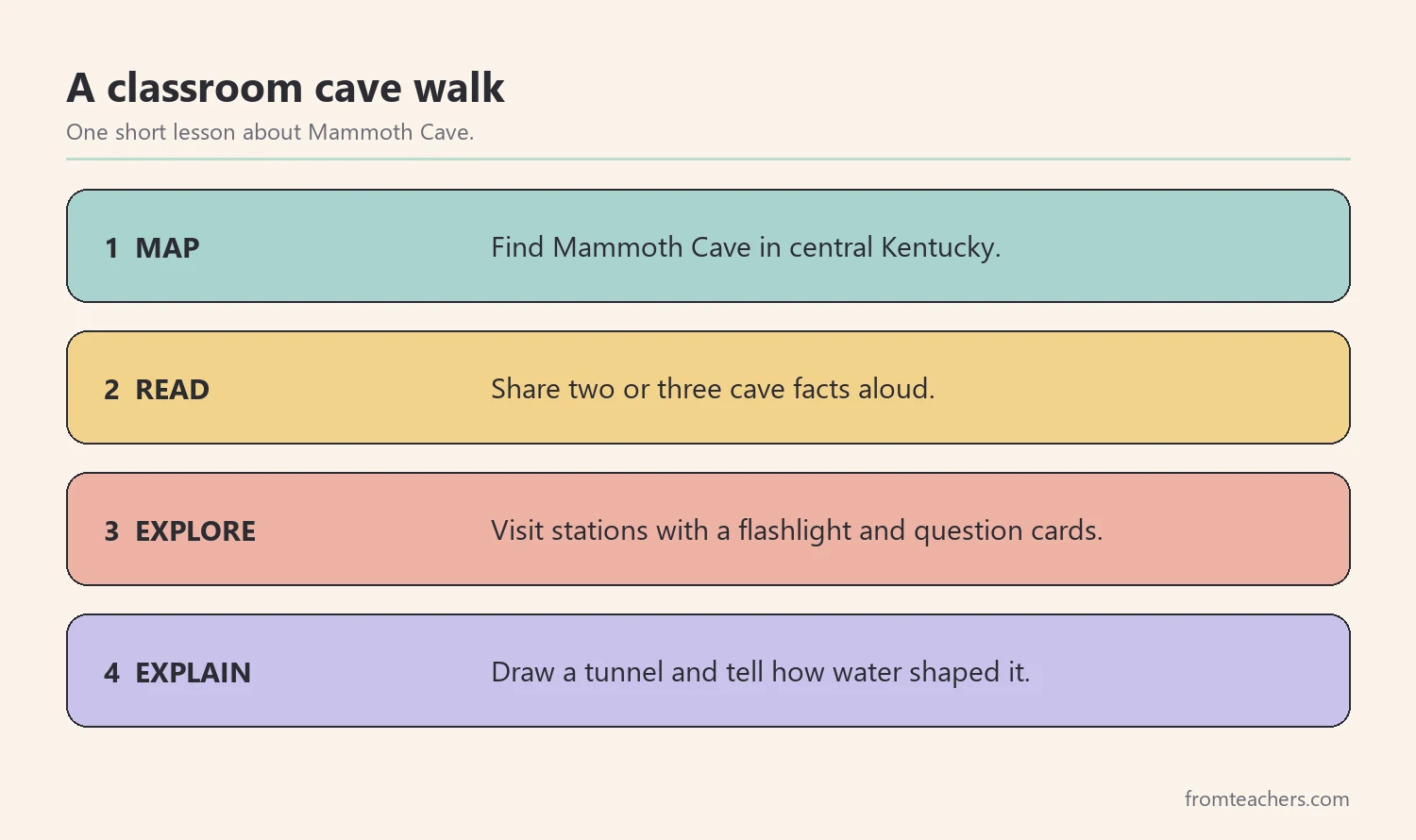
Next, try a short classroom “cave walk.” Dim the lights, use a flashlight, and read a few cave facts aloud as students move between stations. At each station, they answer one question on a card. This makes Kentucky facts for kids feel like an adventure rather than a list.
In addition, describe the land beyond the caves. Eastern Kentucky has the Appalachian Mountains, central Kentucky has the rolling Bluegrass region, and the west has river lowlands. Students can shade these three regions on their maps.
Finally, invite questions students still have about caves, and write them on a chart. Questions such as “Do animals live in the cave?” or “How do people map it?” make a natural bridge to independent reading. Encourage students to look for answers on the National Park Service website with an adult, and to share one new fact with the class the next day.
Worked example. During the cave walk, Ava answers the station card “When did Mammoth Cave become a national park?” with “1941.” At the last station, she draws a tunnel and labels it “water made this.”
4. Meet the wildlife and horses in Kentucky facts for kids
Next, bring in the animals, often the favorite Kentucky facts for kids. Wildlife is often where students light up, and it connects state study to science. Kentucky has white-tailed deer across much of the state, and black bears live mainly in the mountains of eastern Kentucky.
Then, talk about horses. Kentucky is famous for horse farms, especially in the Bluegrass region. The Kentucky Derby, a well-known horse race, is held each year at Churchill Downs in Louisville, usually on the first Saturday in May. It was first run in 1875.
| Animal | Where in Kentucky | Kid-friendly fact |
|---|---|---|
| White-tailed deer | Across much of the state | Raises its white tail when alarmed |
| Black bear | Mainly eastern mountains | Eats many plants, nuts, and berries |
| Cardinal | Across the state | Kentucky’s state bird |
| Thoroughbred horse | Bluegrass region farms | Kentucky’s state horse |
Also, build in a quick sorting activity. Give students cards with animals and places, and ask them to match each animal to where it lives in the state. Afterward, ask, “Why do bears live in the mountains and not in the city?” This adds a simple habitat lesson to Kentucky facts for kids.
Moreover, connect to history if time allows. Abraham Lincoln was born in Kentucky in 1809. A single sentence like this links state study to a name students already know.
Worked example. Ava matches the black bear card to the eastern mountains and explains, “There are more trees and food there.” She adds a horse to her map in the Bluegrass region.
5. Review Kentucky facts for kids with a fact project
Finally, ask students to show which Kentucky facts for kids they learned. A short project helps them organize facts and explain them in their own words. Teaching a fact to someone else is one of the best ways to remember it.
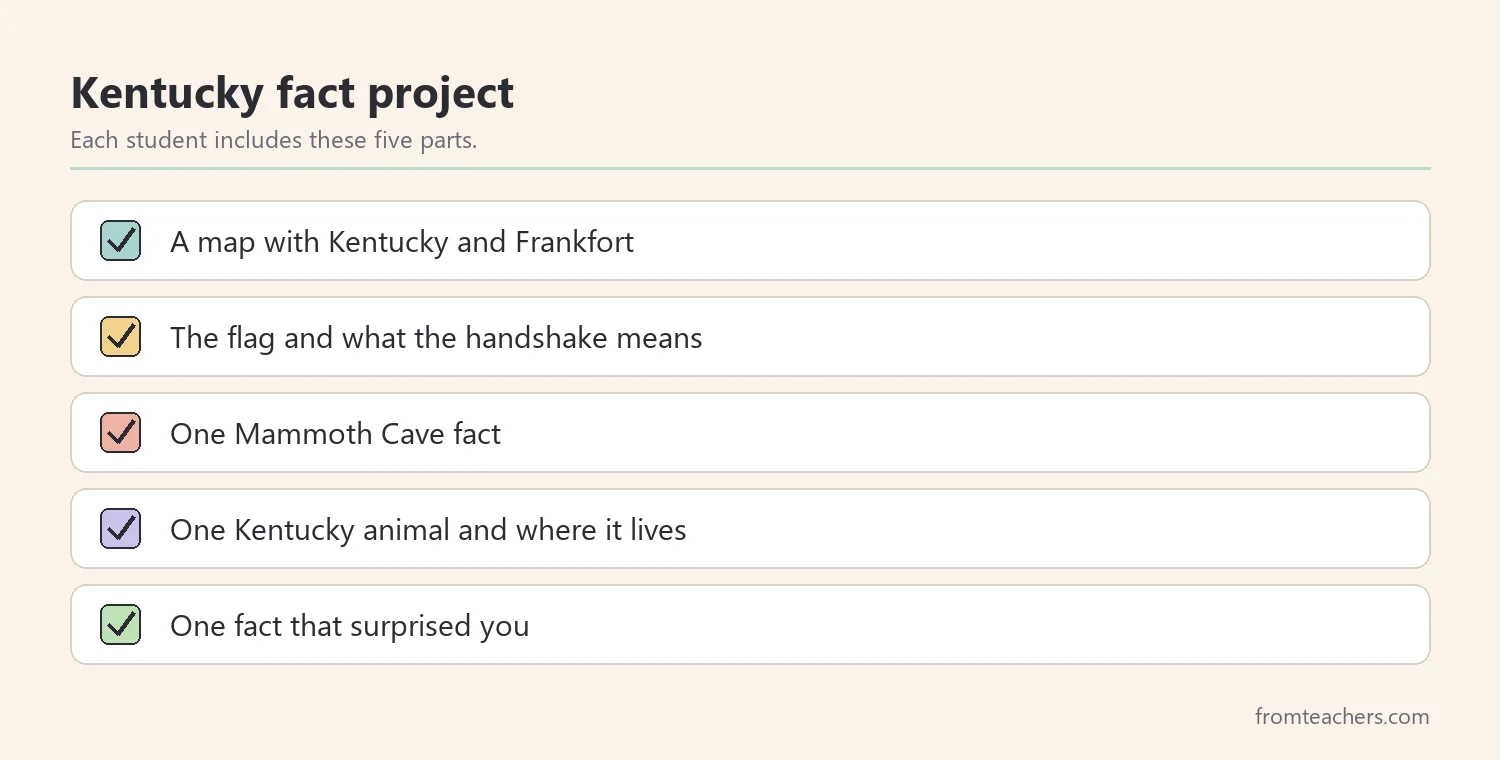
Keep the project simple. A folded fact booklet, a one-page poster, or a short “tour guide” talk all work well. Each student includes the map, the flag, one cave fact, one animal, and one fact they found most surprising.
Then, review with a quick game. For example, play “true or false” with statements like “Kentucky’s capital is Louisville.” Students explain why a false statement is wrong, which reinforces the correct fact. In addition, a short quiz of 10 facts gives you a quick check on what stuck.
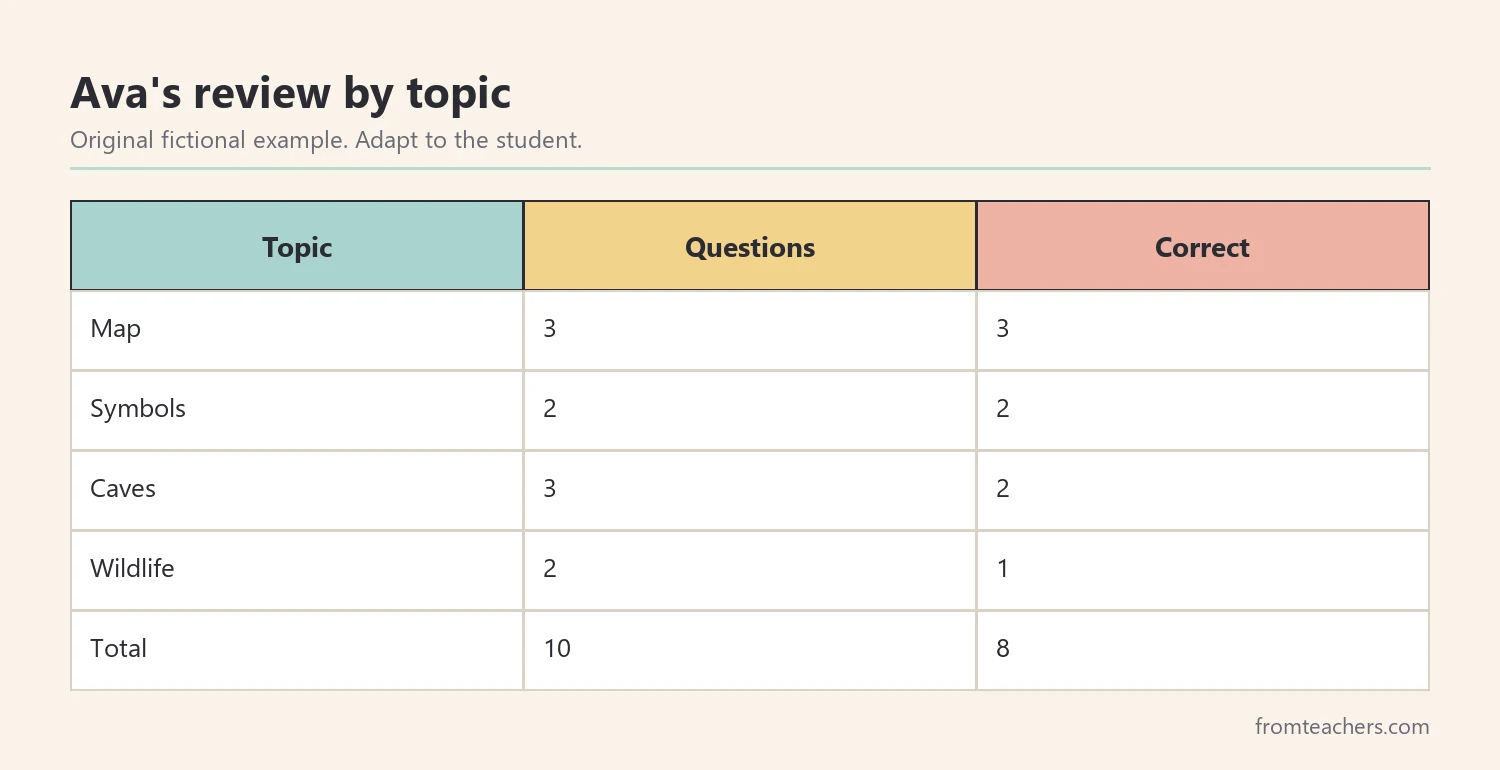
Also, look at the review by topic. If most students miss cave questions, revisit that part before moving on. If one student misses map questions, a short one-on-one map check may be all that is needed.
Worked example. Ava gets 8 of 10 review questions correct: 3 of 3 on the map, 2 of 2 on symbols, 2 of 3 on caves, and 1 of 2 on wildlife. She presents her booklet as a “cave tour guide,” and Ms. Lane notes that she needs one more look at where black bears live.
Adapting Kentucky facts for kids in a mixed class
Not every student needs the same amount of information. For early readers, keep Kentucky facts for kids to short sentences with a picture, such as “The cardinal is the state bird.” For students ready for more, add a research question, such as “Why is it called the Bluegrass State?”
In addition, offer different ways to show learning. Some students write a booklet, some draw a labeled map, and some record a short spoken tour. Each format can still include the same five project parts, so expectations stay clear for everyone.
Also, pair students thoughtfully. A strong reader can read Kentucky facts for kids aloud while a partner who loves drawing illustrates them. Both students learn the facts, and both contribute something real to the project.
Common mistakes and how to avoid them
- Starting with a long list of Kentucky facts for kids. Fix: begin with the map so each fact has a place.
- Using numbers without context. Fix: compare big numbers to distances or places students know.
- Treating symbols as trivia. Fix: ask what each symbol means and why it was chosen.
- Skipping hands-on activities. Fix: add a cave walk, sorting cards, or map coloring.
- Ending without a review. Fix: use a short project and quiz to check understanding.
Questions teachers and parents ask about Kentucky facts for kids
What are the most important Kentucky facts for kids to know?
Start with the capital, Frankfort, the nickname, the Bluegrass State, and where the state sits on the map. Then add the flag, Mammoth Cave, and one or two animals.
What grade level is this unit for?
This plan fits upper elementary grades well, especially during a 50-states or U.S. geography unit. Younger students can focus on the map and symbols, while older students can research more facts.
How long should a Kentucky unit take?
Many teachers spend about a week on one state, with one step per day. You can shorten it by combining the symbols and wildlife lessons.
How can parents explore Kentucky at home?
Look at a map together, find Kentucky, and talk about its neighbors. Watching a short video about caves or horses and asking your child to explain one fact can extend the lesson.
Can this plan work for other states?
Yes. The same five steps work for any state: locate it, read its symbols, explore its land, meet its wildlife, and review with a project.
Related reading: Learning Styles Student Success Guide, 5 Practical Teaching Tips to Boost Classroom Focus and Learning, and Homeschooling vs. Public Schooling: Which Educational Path Is Right for Your Child?
A companion resource for a Kentucky state study:
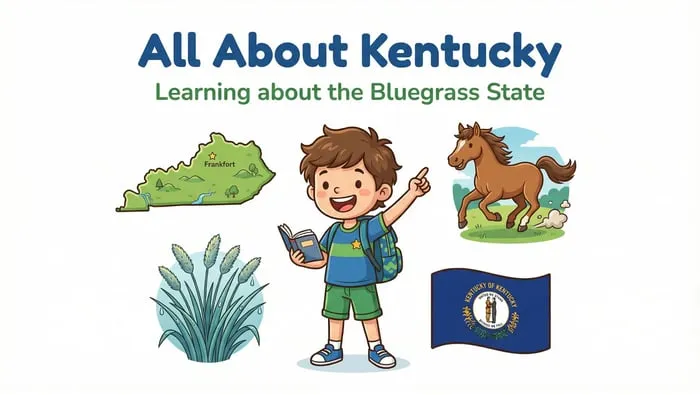
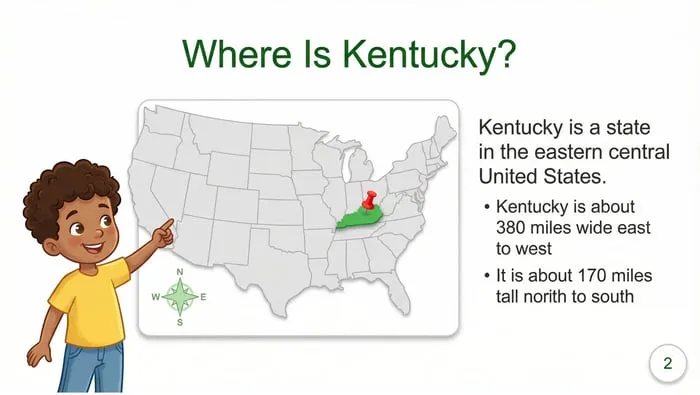
Kentucky State Study: Facts, Symbols, and Wildlife: a 30-slide, hand-illustrated resource that introduces the Bluegrass State, explains the flag’s handshake symbol, covers Mammoth Cave National Park and Kentucky wildlife, and closes with a review of key facts.
Sources and scope
- Mammoth Cave National Park, National Park Service: official information on the park and its cave system.
- Commonwealth of Kentucky: the official state website with general state information.
- Kentucky Department of Fish and Wildlife Resources: information on Kentucky’s native wildlife.
- Kentucky Historical Society: resources on Kentucky history and heritage.
This guide covers a short elementary unit on Kentucky geography, symbols, caves, and wildlife. It is an introduction, not a complete history of the state.
Key takeaways
- Kentucky facts for kids stick best when they start on the map.
- The flag’s handshake stands for unity, and symbols give facts a picture.
- Mammoth Cave turns big numbers into a hands-on adventure.
- Wildlife and horses connect state study to science and daily life.
- A short project and review show what students really learned.




Leave a Comment