

Organizational skills help students arrive prepared, find what they need, and turn in the work they have already done. Picture a seventh grader who finished his science homework last night, yet cannot find it in a backpack full of loose papers. He gets a zero for work he actually completed. The problem is not effort. It is the system around the work.
This guide shows you how to teach organizational skills in six steps: find where things break down, set up the workspace and folders, use schedules and checklists, pack ahead and break big tasks into pieces, use timers and ask for help, and then practice and fade support. By the end, you will have a simple plan that helps students stay prepared and confident.
Examples are fictional. Adapt to the student’s goals and agreed supports. This is guidance, not a diagnosis.
At a glance
- Organization is a skill, not a talent, so it can be taught.
- Simple, consistent systems prevent lost work and confusion.
- Schedules and checklists lower stress and support memory.
- Packing ahead and small task pieces reduce last-minute panic.
- Build systems with the student, then fade adult prompts.
1. Find where organizational skills break down
First, look closely at where things go wrong. Does the student lose papers between class and home? Forget what homework is due? Arrive without materials? Start big projects the night before? Each problem points to a different skill, so a quick look saves a lot of guesswork.
Next, collect a few facts for one or two weeks. Count missing assignments, note forgotten materials, and ask the student where they think things go wrong. Students often know exactly which moment is hard, such as the rush at the end of class.
Also, pick one or two targets to start. Trying to fix everything at once usually fails. A student who builds one strong habit gains confidence for the next one, and that steady growth is how organizational skills develop.
In addition, involve families early. A short message asking what homework time looks like at home can reveal useful details, such as a backpack that never gets opened.
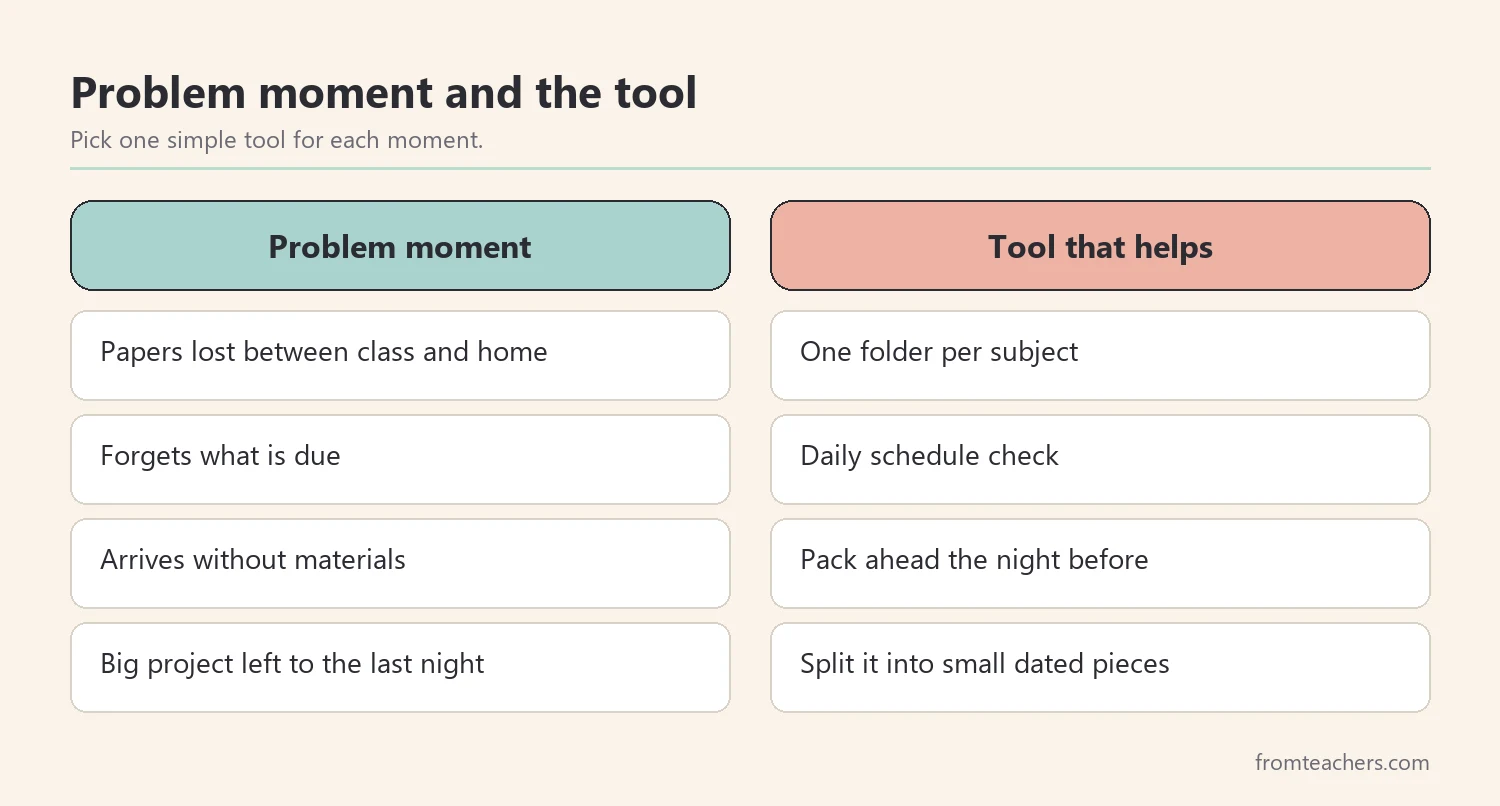
Worked example. Jonah is a fictional student in grade 7. His teacher, Mr. Kim, counts 4 missing assignments out of 12 in one week. Jonah says, “I do the work, but I can’t find it.” Mr. Kim picks two first targets: a folder system and an end-of-day packing routine.
2. Set up a clean workspace, folders, and bins
Next, build the physical system. Teach students to keep the workspace clean: throw away trash, put materials back where they belong, and keep only what they need on the desk. A clear space helps the brain stay focused and reduces distractions.
Then, set up folders and bins. Use one folder per class or subject, color-code materials, and put papers in the right place right away. Consistent systems prevent lost work and confusion, because every paper has a home.
Importantly, build the system with the student. Let them choose the colors and the labels. When students help design it, they understand it and are more likely to use it.
A classroom visual keeps these habits in view. The organizational skills reminders poster with staying-prepared tips lists eight practical tools, and each tip includes a short “why it matters” note.
| Subject | Folder color |
|---|---|
| Math | Blue |
| Science | Green |
| English | Red |
| Homework to turn in | Yellow |
Worked example. Jonah chooses a color for each subject and adds a yellow “turn in” folder. Mr. Kim shows him how to put each paper into the right folder before he leaves class. On the first day, Jonah needs two reminders. By the end of the week, he needs none.
3. Build organizational skills with schedules and checklists
Next, teach students to check their schedule every day. They look at the visual schedule, review deadlines or homework, and prepare for transitions. Predictability lowers stress and improves follow-through.
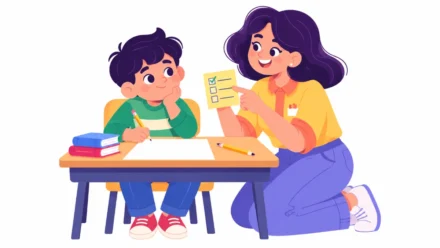
Then, add checklists to guide tasks. Students write down the steps, check them off as they go, and keep the list where they can see it. Checklists support memory, reduce overwhelm, and build independence.
Also, set a fixed time for the schedule check. The start of the day or the start of each class works well. A two-minute routine at the same time each day turns organizational skills into a habit rather than a scramble.
In addition, keep checklists short. Three to five items is usually enough. Long lists feel like more work, and students stop using them. A short list that a student actually uses does more for organizational skills than a perfect list that stays in the binder.
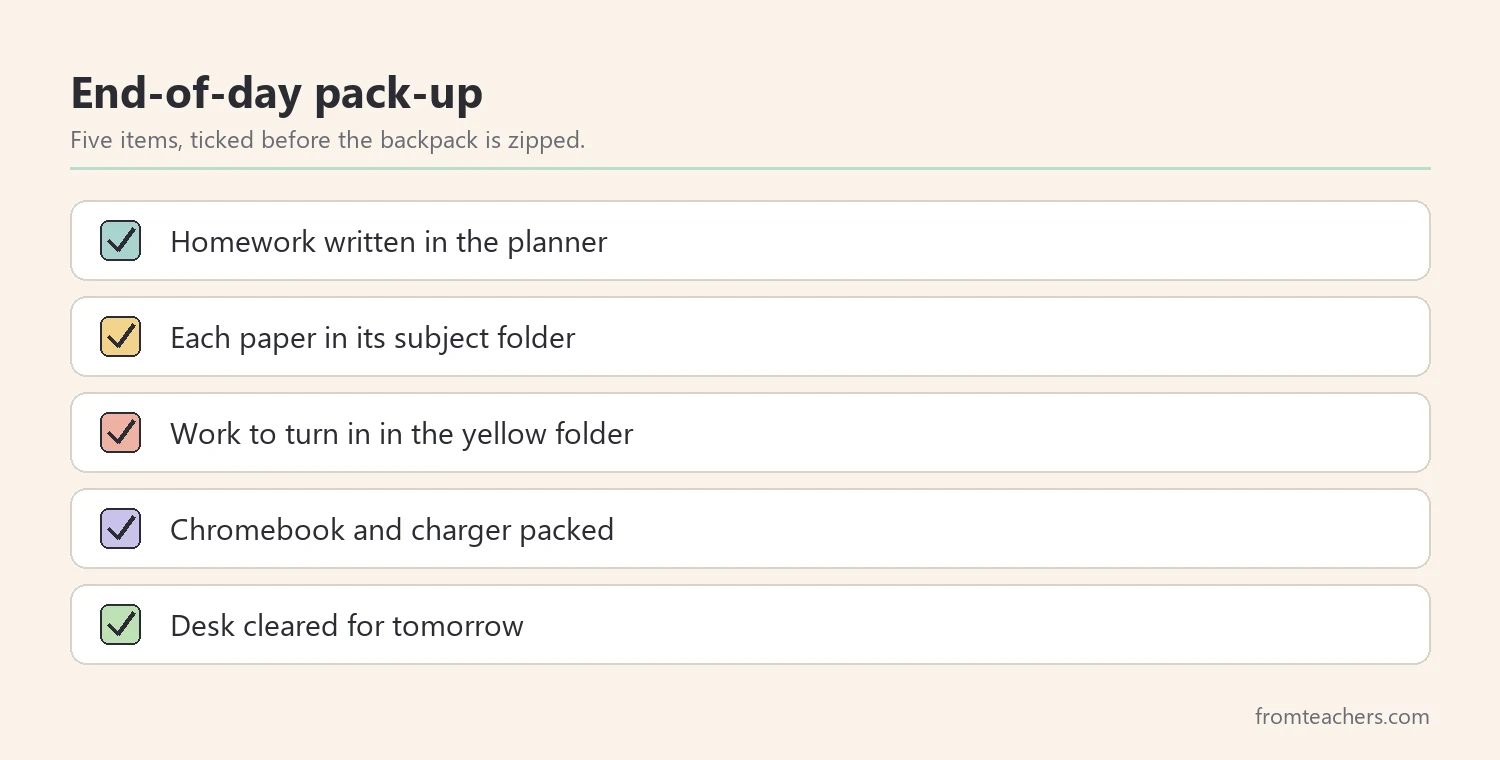
Worked example. Each morning, Jonah checks his planner for two minutes during homeroom. At the end of the day, he uses a five-item checklist taped inside his binder. He ticks each item before he zips his backpack.
4. Pack ahead and break big tasks into small pieces
Next, teach students to pack materials ahead of time. They put items in the backpack before transitions, double-check the binder, folders, or Chromebook, and keep needed tools in a consistent place. Preparation reduces last-minute stress and late work.
Then, teach students to break big tasks into small pieces. They divide the work into steps, set mini-goals, and work a little at a time. Small tasks feel manageable, which makes it easier to stay organized.
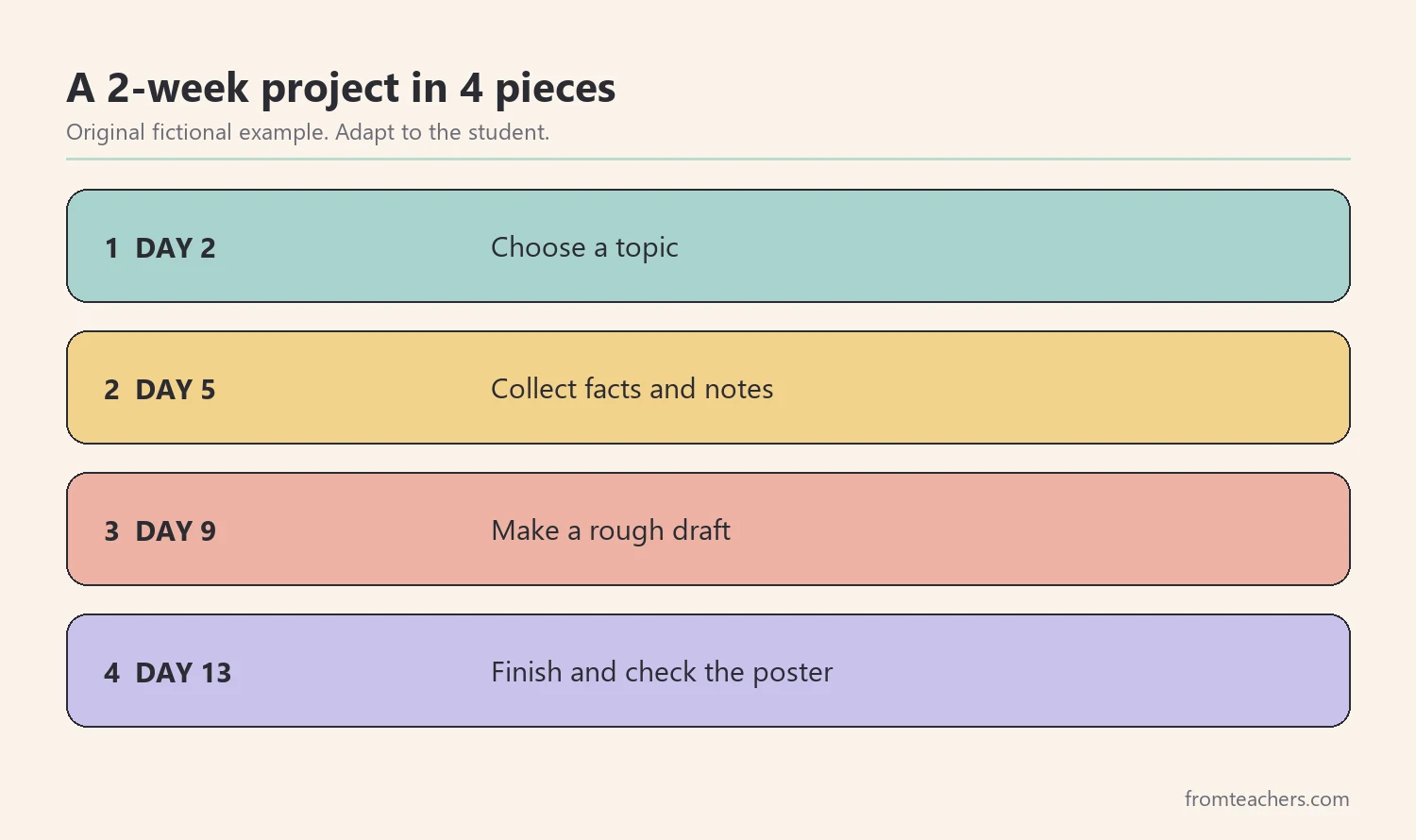
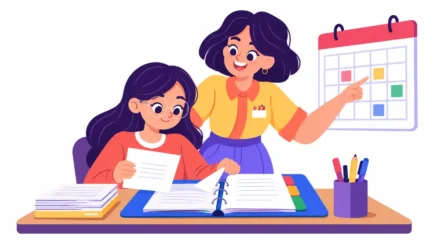
Also, put each piece on the calendar. A project due in two weeks becomes four short tasks with their own dates. This is where organizational skills meet time management, and it prevents the night-before rush.
Meanwhile, check in briefly at each mini-deadline. A quick “Show me your notes” keeps the plan on track and catches problems early, while there is still time to fix them.
Worked example. Jonah has a science poster due in two weeks. With Mr. Kim, he splits it into four pieces: choose a topic, collect facts, make a draft, and finish the poster. Each piece gets a date in his planner, and Mr. Kim checks in briefly at each date.
5. Use timers and alarms, and ask for help
Next, teach students to use timers and alarms. They set reminders for start or stop times, use a phone, tablet, or classroom timer, and stick to the schedule. Timers help with planning, pacing, and switching tasks.
Also, teach students to ask for help when they need it. Give them exact words: “Can you help me organize this?” “Where should this go?” “I need help setting up a system.” Support strengthens organizational habits and prevents overwhelm.
Importantly, make asking feel normal. Some students hide disorganization because they feel embarrassed. A calm, private response tells them that asking for help is part of good organizational skills, not a sign of failure.
In addition, use alarms for the tricky moments you found in step 1. If papers get lost at the end of class, set a two-minute “pack up” alarm before the bell. The reminder arrives exactly when it is needed.
| Moment | Reminder |
|---|---|
| 2 minutes before the bell | “Pack up and file papers” |
| 4:30 p.m. at home | “Start homework” |
| 8:00 p.m. at home | “Pack backpack for tomorrow” |
Worked example. Jonah sets a phone alarm at 8:00 p.m. labeled “Pack for tomorrow.” In class, Mr. Kim sets a two-minute timer before the bell. Once, Jonah cannot find where a worksheet goes and asks, “Where should this go?” Mr. Kim helps him add a new section to his binder.
6. Practice, review, and fade support for organizational skills
Finally, practice and review. Organization is a skill, not a talent. With routines, visuals, and practice, students can learn to stay prepared and confident.
Then, track a few simple numbers for several weeks, such as missing assignments. This shows whether the systems work and which ones need changing.
Also, fade adult prompts step by step. Move from daily checks to a few times a week, then to the student checking on their own. If missing work rises again, return briefly to more support, then fade again.
In addition, hold a short weekly reset. Once a week, the student empties the backpack, sorts loose papers, and throws away what is not needed. Five minutes each week prevents the system from slowly falling apart.
Then, celebrate what the student now does alone. Name the specific habit, such as “You filed every paper this week without a reminder.” Specific praise shows students that organizational skills are something they are building, not something they either have or lack.
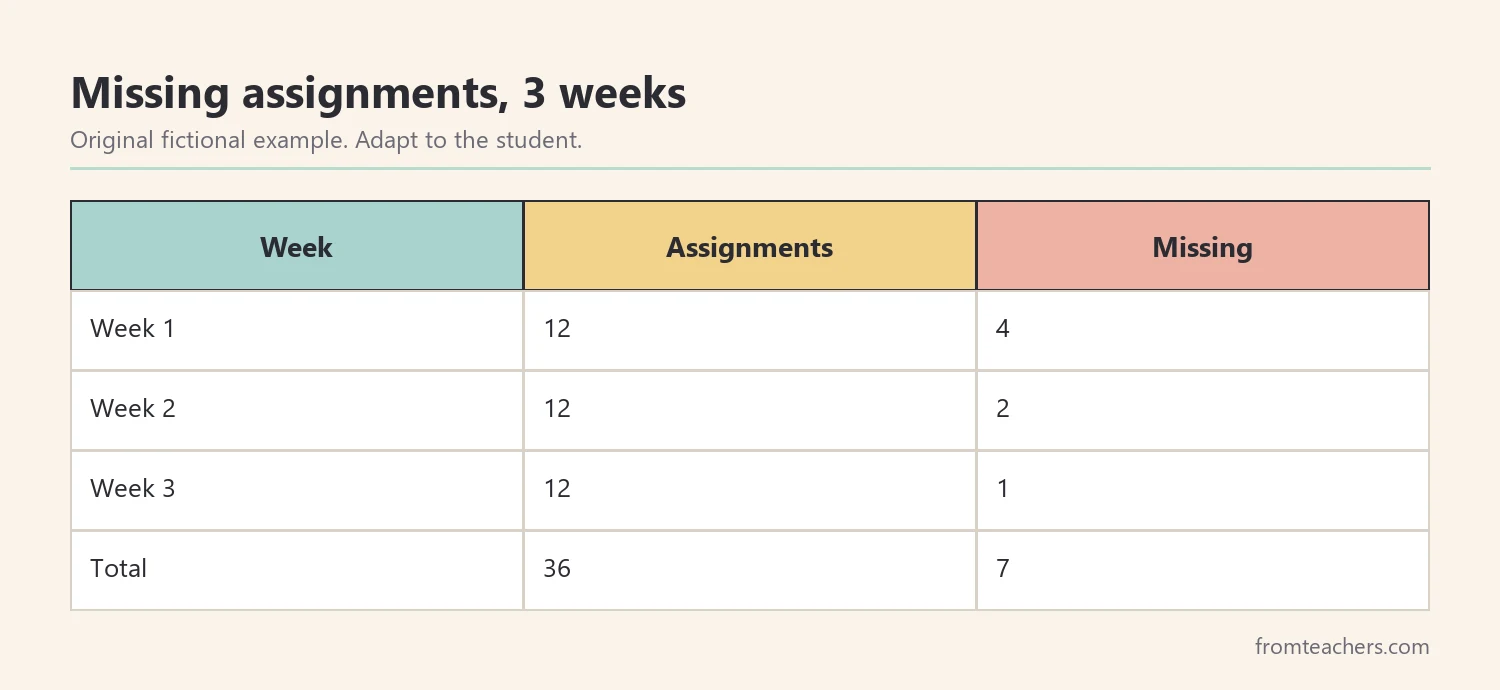
Worked example. Mr. Kim tracks Jonah’s missing assignments for three weeks, with 12 assignments each week. Missing work drops from 4 in week 1 to 2 in week 2 and 1 in week 3. That is 7 missing out of 36 in total, with most of them in the first week. Mr. Kim moves to checking Jonah’s folders twice a week instead of daily.
Supporting organization at home
Homework routines matter as much as classroom routines. Families can set up a homework spot with the supplies the student needs, use the same folder colors, and keep a short evening packing checklist near the door.
Also, encourage families to praise the process. “You packed your bag before bed, nice work” builds the habit more than a reminder about forgotten homework. Shared language between home and school helps organizational skills grow in both places.
Teaching organizational skills to a whole class
Many of these tools work for every student, not only those who struggle. So, consider a whole-class routine. Spend two minutes at the end of each lesson on filing papers and writing down homework, and model it on the board for the first few weeks.
Also, display the steps where students can see them. A poster near the door reminds everyone to pack up before they leave. Students who need extra help can then get a personal checklist or a quick check-in, while the rest of the class uses the same shared routine.
In addition, give the class a reason. Explain that clear organizational skills save time, reduce stress, and help everyone get credit for the work they do. Students are more likely to follow a routine when they understand why it matters.
Common mistakes and how to avoid them
- Adult-built systems. Students do not understand them. Fix: design folders and labels together.
- Too many folders. The system becomes confusing. Fix: keep it simple, one per subject.
- Long checklists. Students stop using them. Fix: three to five items only.
- No weekly reset. Clutter slowly returns. Fix: a five-minute clean-out each week.
- Fading too fast. Old habits come back. Fix: fade prompts gradually and track progress.
Questions teachers and parents ask about organizational skills
Why do some students struggle more with organization?
Organization depends on executive function skills such as planning and working memory, which develop at different rates. Students with ADHD or learning differences often need more structure and practice to build strong organizational skills.
Should I organize the student’s desk for them?
It is better to organize it together. Show the steps, then let the student do more each time. The goal is a system the student can run alone.
Paper or digital planner?
Either can work. Choose the one the student will actually check. Some students use paper for daily tasks and phone alarms for reminders.
How long does it take to build these habits?
It varies. Many students need several weeks of steady practice before a routine becomes automatic. Track simple data so you can see progress along the way.
What if the system stops working?
Ask the student what changed. Then simplify the system or adjust it. A small fix is usually better than starting over.
Related reading: Effective ADHD Classroom Strategies to Support Student Success, Special Education Strategies: 10 Powerful Ways Teachers Can Succeed, and The Power of Data Tracking in Special Education.
A companion resource for organizational skills:
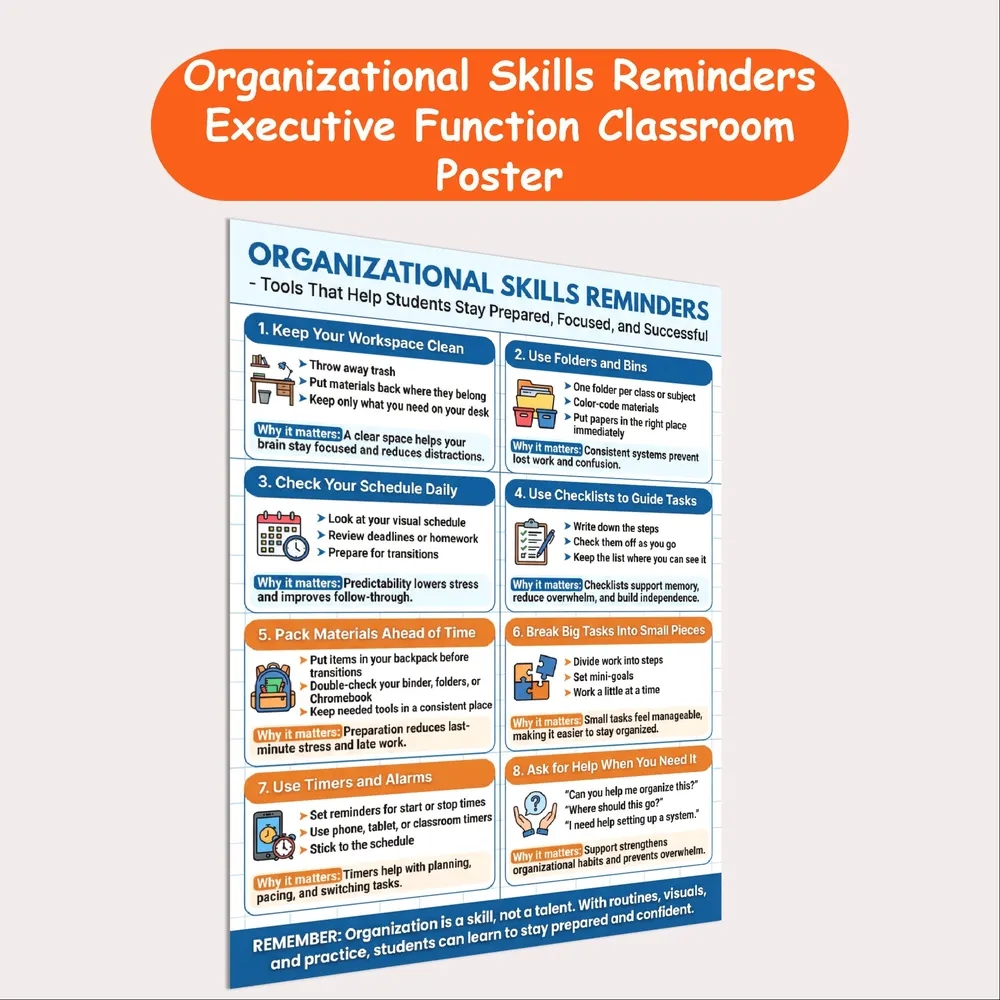
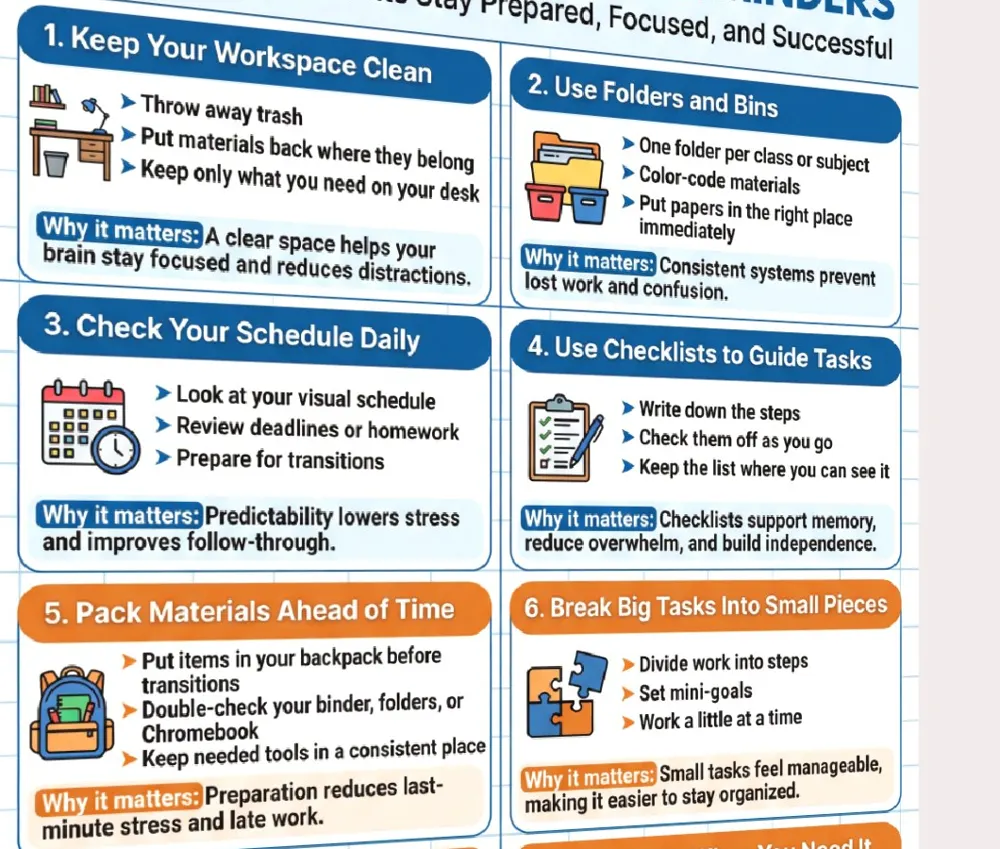
Organizational Skills Reminders Poster: a printable poster with eight practical tools that help students stay prepared, focused, and successful. Each tip includes a “why it matters” note.
Sources and scope
- Center on the Developing Child, Harvard University: research-based explanations of executive function skills.
- Understood.org: family-friendly guidance on organization, executive function, and learning differences.
- CHADD: information on ADHD for families and educators.
- IRIS Center, Vanderbilt University: free modules on evidence-based classroom practices.
This guide covers practical routines for teaching organization at school and home. It does not replace evaluation, diagnosis, or individualized plans set by a student’s support team.
Key takeaways
- Start by finding exactly where organizational skills break down.
- Give every paper a home with simple folders and bins.
- Use daily schedule checks and short checklists.
- Pack ahead, split big tasks, and use alarms for tricky moments.
- Track missing work and fade prompts gradually.




Leave a Comment