

Task initiation difficulties show up in a quiet way. Picture a fifth grader who reads the directions, nods, opens his notebook, and then sits still for ten minutes while the rest of the class gets to work. He is not refusing, and he understands the task. He simply cannot get the first move to happen.
This guide gives you a five-step process for supporting a student who struggles to start. By the end, you will be able to spot the signs, name the likely barrier, shrink the first step, build a start routine, and track whether the support is working.
Examples are fictional. Adapt to the student’s goals and agreed supports. This is guidance, not a diagnosis.
At a glance
- A student who cannot start is not the same as a student who will not start.
- Observe the start of tasks for a few days before choosing a support.
- Match each sign to one specific support, not a general reminder.
- Make the first step so small that starting feels possible.
- Track minutes to start and fade prompts as the student gains independence.
1. Spot the signs of task initiation difficulties
First, look closely at the first few minutes of independent work. Task initiation difficulties are about the gap between knowing what to do and actually beginning. That gap can look like daydreaming, tidying a desk, sharpening a pencil twice, or asking to use the restroom. From the outside, it is easy to read these behaviors as laziness or defiance.
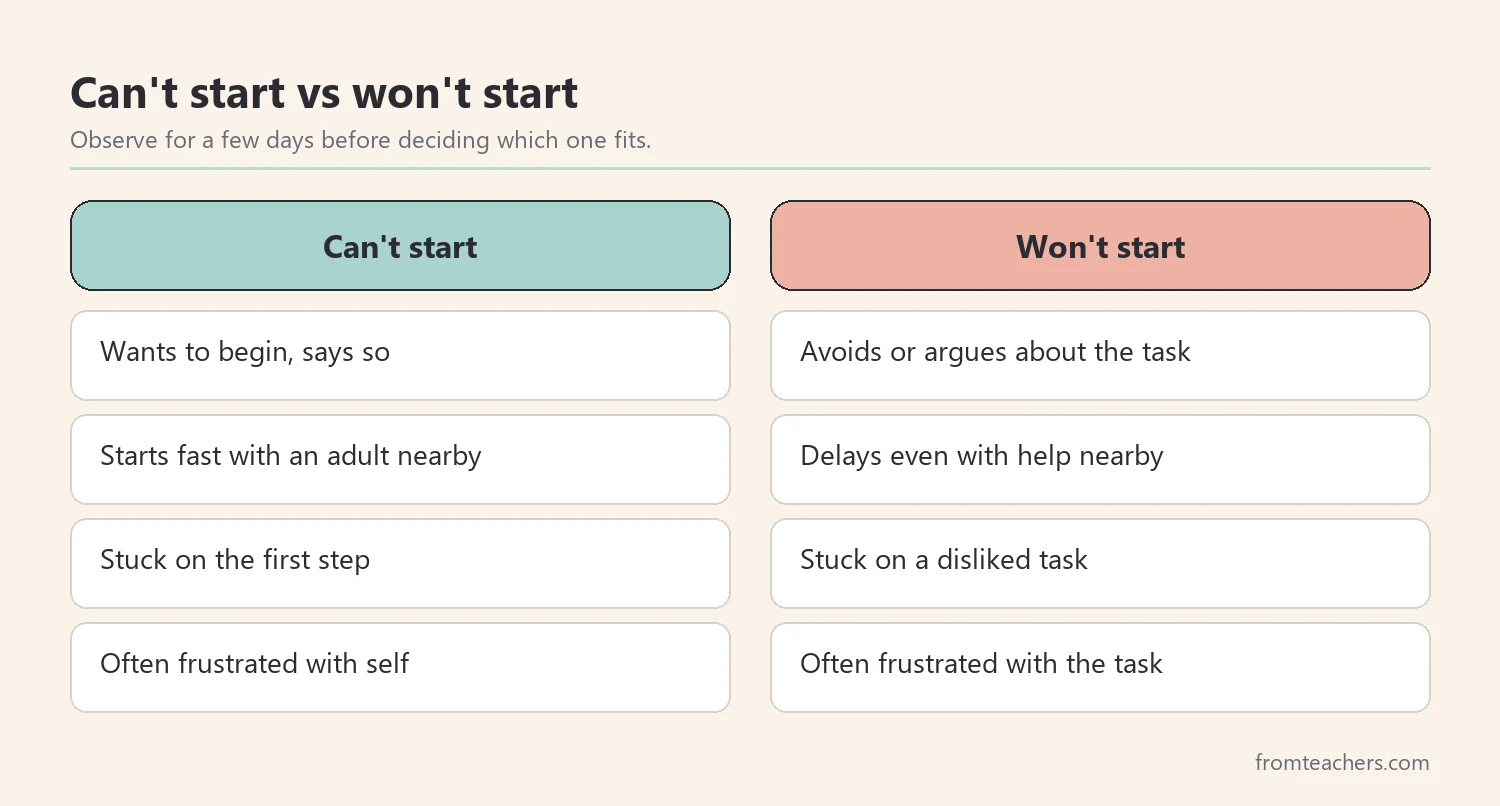
Next, separate “can’t start” from “won’t start.” A student who will not start usually has a reason linked to the task, such as avoiding something hard or something boring. A student who cannot start often wants to begin, may even say so, and still gets stuck. Many students show a mix of both, and the difference matters because the supports are different.
Then, write down what you actually see. Note the task, the setting, how long the student waited before the first visible action, and what finally got the student going. For example, “Math page, 9:40, sat for 8 minutes, started after I pointed to problem one.”
Meet Leo, a fictional fifth grader. His teacher, Ms. Patel, notices that Leo is quick and accurate once he is working. However, on four of five days, he waits more than six minutes before writing anything during independent work. He starts right away when she sits beside him. So the problem is starting, not skill.
Finally, share your notes with the family and the student’s team. Families often see the same pattern with homework or chores. Their view helps you decide whether the struggle is linked to one subject or shows up across the day.
2. Name the barrier behind the stuck moment
Now, ask what makes the first step hard for this student. Starting a task asks the brain to plan, focus, remember the directions, and shift from the previous activity, all at once. If any one of those parts is weak, the start can stall. Naming the barrier keeps you from guessing.
Common barriers include unclear directions, a task that feels too big, not knowing where to begin, trouble shifting from the last activity, and worry about getting it wrong. Some students also struggle to judge time, so “later” always feels like enough. Each of these points to a different support.
| What you see | Possible barrier | Support to try |
|---|---|---|
| Rereads directions, then waits | Unclear first step | Write step one on a sticky note |
| Stares at a full page | Task feels too big | Cover all but the first section |
| Still talking about recess | Trouble shifting | Short transition routine |
| Erases the first word again and again | Fear of mistakes | “Rough start” box to warm up |
For Leo, Ms. Patel tries two quick tests. When she covers most of the page, Leo still waits. When she writes “Do problem 1” on a sticky note and places it on his desk, he starts in under two minutes. So his main barrier is knowing exactly where to begin.
In addition, look at the timing. A student who starts easily in the morning but stalls after lunch may be tired or still settling after a busy transition. A student who stalls only on writing tasks may need a different kind of first step than one who stalls on everything. These details point you toward the right support and save weeks of trial and error.
Also, ask the student. Many students in upper elementary and beyond can describe what feels hard. A simple question such as “What happens in your head when you look at the page?” can reveal more than a week of observation.
3. Shrink the first step to address task initiation difficulties
Next, make the first action so small that it is almost impossible to fail. For a student who gets stuck, the goal is not to finish the whole assignment. The goal is to begin, because starting often brings momentum with it.
A good first step is visible, concrete, and takes under a minute. “Write your name and the date.” “Copy problem one.” “Underline the question.” Avoid vague prompts like “Get started” or “Focus.” Those tell the student what to do in general, but not what to do right now.
Moreover, give the first step in writing. Spoken directions disappear, while a sticky note, a card, or a line on the board stays put. Students who struggle to hold information in mind can look back at it as often as they need.
For Leo, the sticky note becomes a routine. At the start of each independent block, Ms. Patel writes one first step. After two weeks, Leo begins writing his own first step on the note, with her checking it. That shift moves the support from adult to student.
If you want a ready-made set of supports, the initiation deficits strategy tables from berchid.com list common signs of initiation difficulty, a specific support for each, and the impact it has. They can save time when you are choosing what to try first.
4. Build a start routine and teach it
Then, turn the start into a predictable routine. Routines reduce the number of decisions a student has to make. When the steps are always the same, the student uses less energy figuring out how to begin.
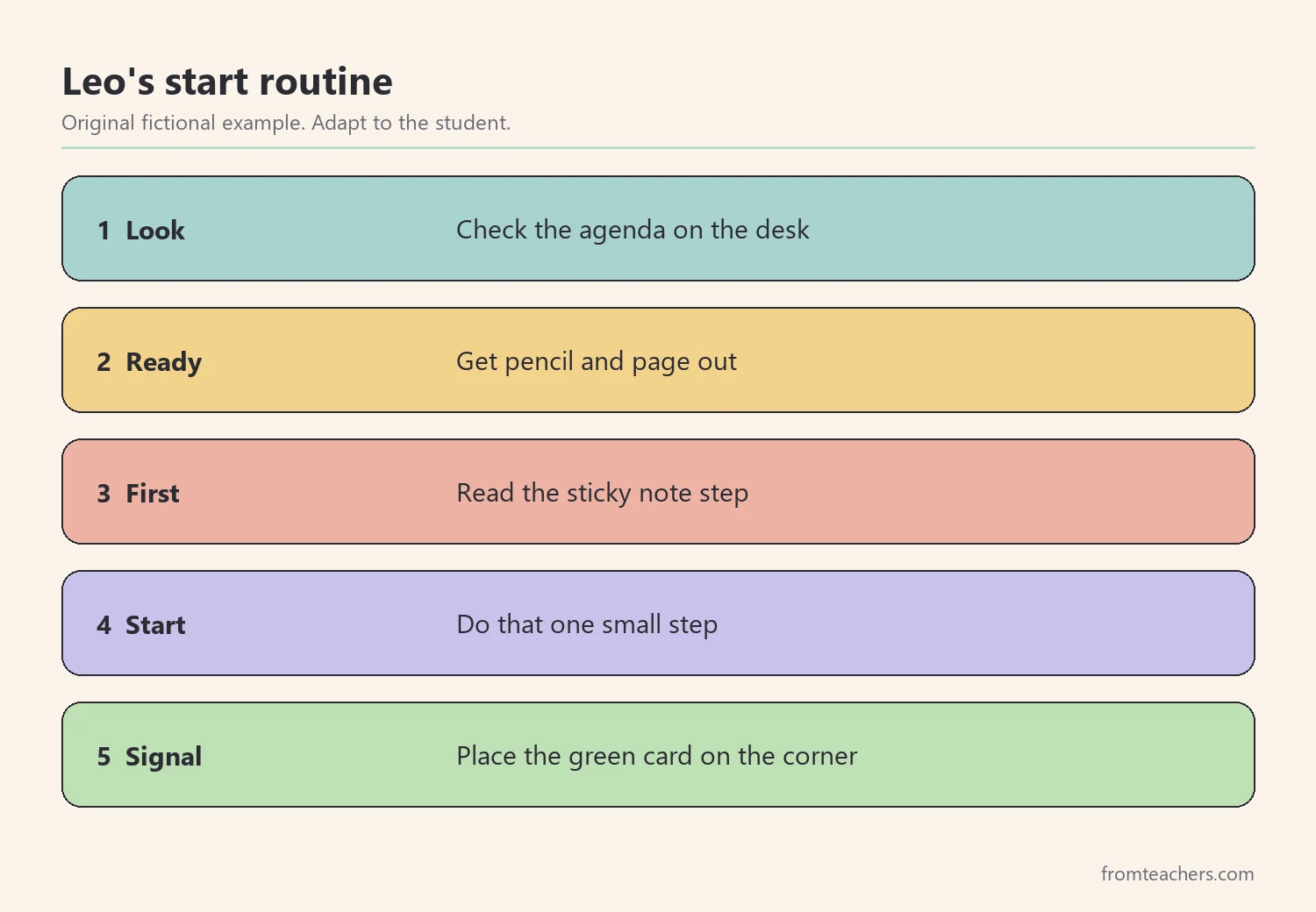
A simple start routine might be: look at the agenda, get materials ready, read the first step, do the first step, then signal that you have started. Keep it to five steps or fewer. Post it on the desk or in a folder, not only on a wall across the room.
Also, teach the routine during a calm moment, not in the middle of a stuck one. Model it, practice it with an easy task, and give specific praise when the student follows it. For instance, “You read the first step and started right away. That is the routine working.”
Next, plan prompts that you can fade. At first, you might point to the routine card. Later, you might only make eye contact and tap the desk. Eventually, the card alone is enough. Fading matters, because the long-term goal is independence, not a student who waits for an adult.
For Leo, the routine includes a green card he places on the desk corner once he has started. It tells Ms. Patel he is on track without calling attention to him. It also gives Leo a small, clear finish line for the start itself.
Meanwhile, keep the language the same every time. If one adult says “get going,” another says “start your work,” and a third says “check your card,” the student has to translate each prompt. Instead, agree on one short phrase and one gesture across the team. Consistent words make the routine easier to learn and easier to use without help.
Finally, check that the routine works in more than one setting. A support that works only in math may need adjustments for writing, science, or homework. Ask the family whether a simple version could work at home, too.
5. Track progress on task initiation difficulties and fade support
Finally, measure what changes. Tracking keeps the plan honest. Without data, it is easy to believe a support is working when it is not, or to give up on one that just needs more time.
Keep the record simple. Two measures are usually enough: minutes from directions to first visible action, and the level of prompt the student needed. Record them a few times a week during the same type of task. That way, you are comparing like with like.
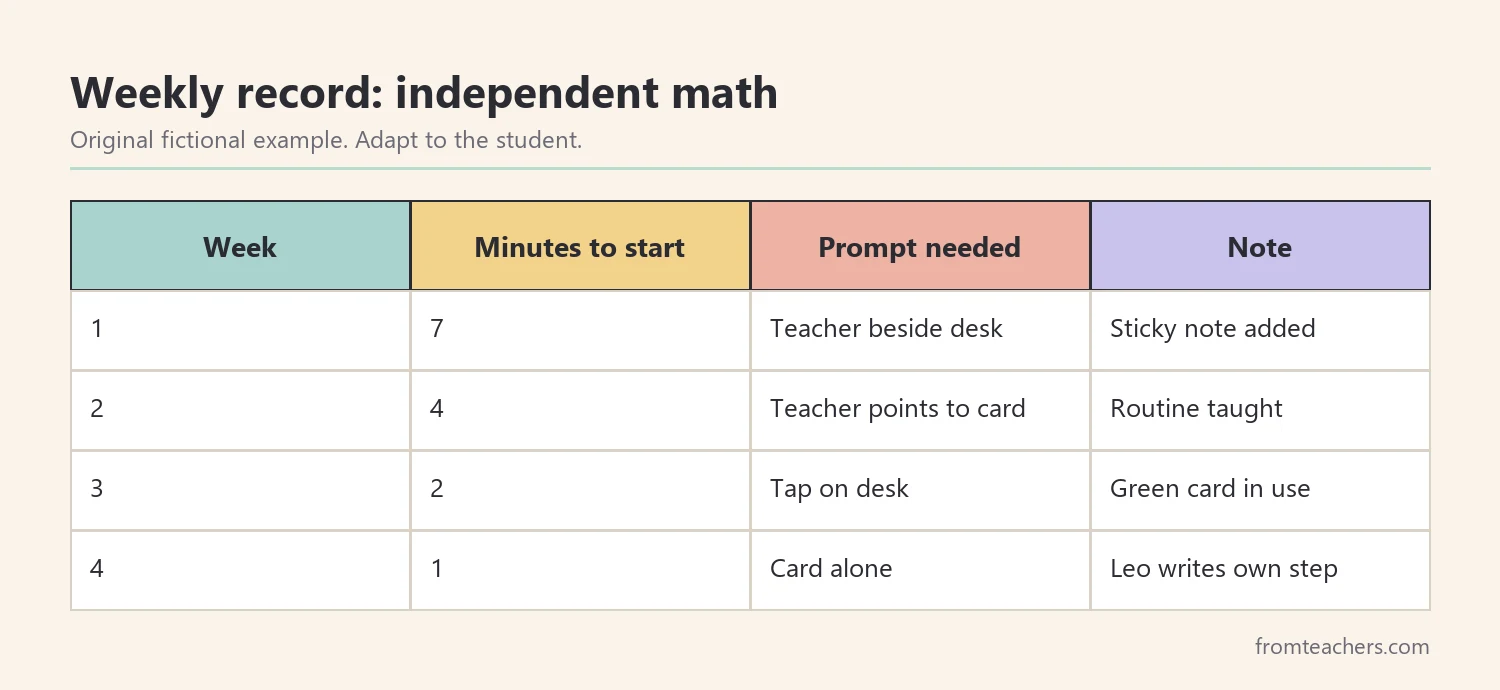
For Leo, minutes to start drop from about seven in week one to about one in week four. At the same time, the prompt level moves from a teacher sitting nearby to the routine card alone. That is the pattern you hope to see: faster starts with less adult help.
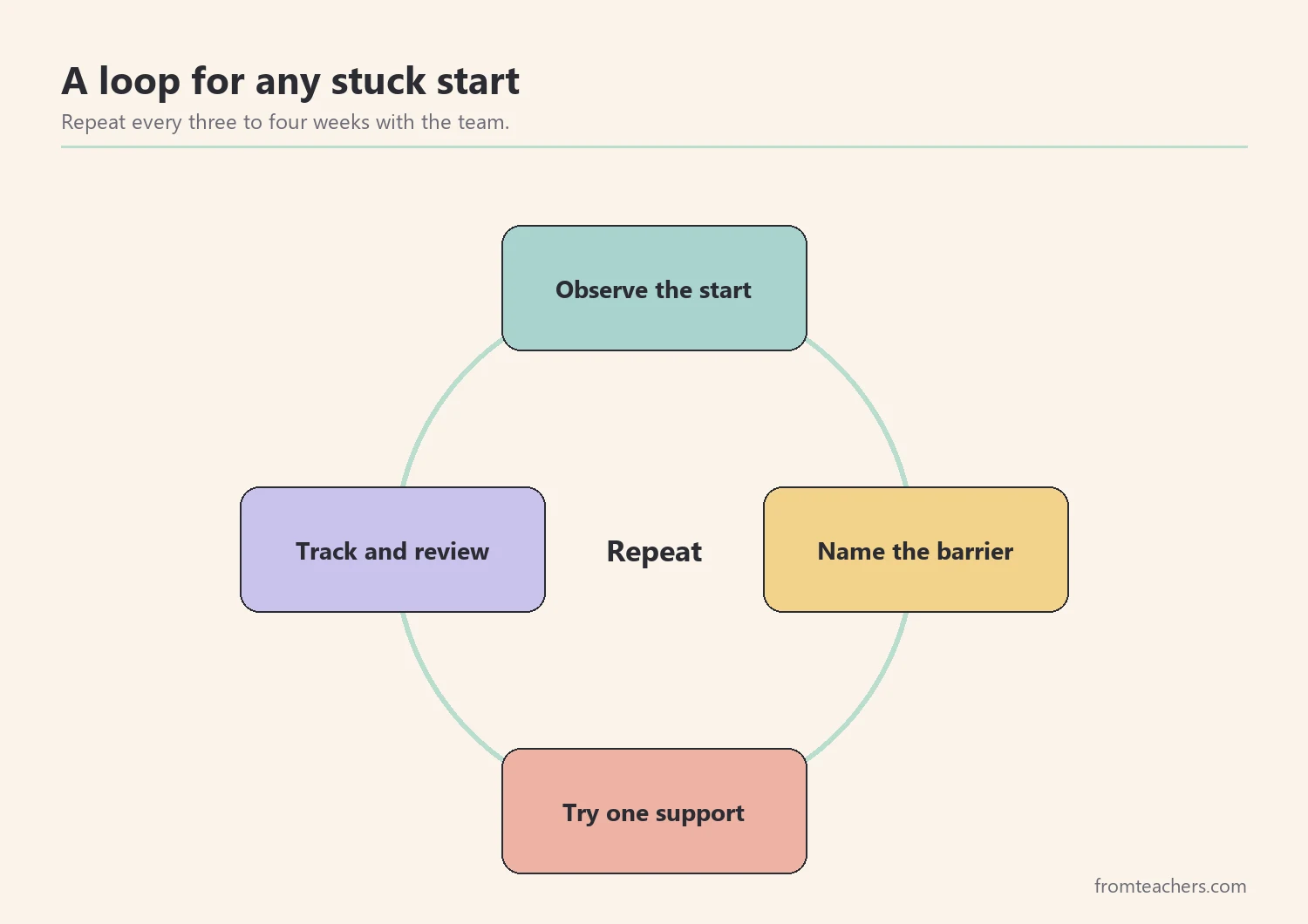
Then, review every three to four weeks with the team and the family. If progress stalls, revisit step two. Perhaps the barrier has changed, or the first step is still too big. If progress is steady, fade one more prompt and keep watching.
In some cases, progress looks uneven. A student may start quickly for three days and then stall again after a long weekend or a schedule change. That is normal. Look at the trend across several weeks rather than any single day, and note events that might explain a dip.
Also, celebrate the start, not only the finish. Students who struggle to begin often hear more about what they did not do than what they did. Noticing the first step out loud builds confidence and makes the next start a little easier.
Common mistakes and how to avoid them
- Treating every delay as defiance. Fix: observe first and separate “can’t start” from “won’t start” before choosing a response.
- Repeating the directions louder. Fix: give the first step in writing and keep it short and concrete.
- Breaking the task into too many pieces at once. Fix: focus on the first step only, then add more structure if needed.
- Keeping an adult beside the student forever. Fix: plan a prompt ladder from the start and fade one level at a time.
- Changing several supports in the same week. Fix: try one change, track it for two weeks, then decide.
Questions teachers and parents ask about task initiation difficulties
Are task initiation difficulties the same as laziness?
No. A student who gets stuck at the start often wants to start and may feel frustrated or embarrassed about getting stuck. Laziness suggests a lack of effort, while initiation struggles are about the gap between intention and action.
Which students struggle most with starting tasks?
Starting can be hard for many students, including those with ADHD, autism, anxiety, or learning disabilities. However, any student can struggle with a task that is unclear or too big. Focus on what you observe rather than on a label.
How long should I wait before stepping in?
Watch the student’s typical pattern first. If a student usually stays stuck past a certain point, plan a light prompt just before that point. Over time, you can wait a little longer as the student gains independence.
Can these strategies work at home?
Yes. A written first step, a short start routine, and a clear signal for “I have started” work for homework and chores, too. Using the same words at school and at home keeps the support consistent.
Should this be part of an IEP or 504 plan?
If task initiation difficulties affect learning in several settings, the team may discuss supports or goals. Bring your data to the meeting so the conversation is based on what you have seen.
Related reading: Effective ADHD Classroom Strategies to Support Student Success, 5 Practical Teaching Tips to Boost Classroom Focus and Learning, and The Power of Data Tracking in Special Education.
A companion resource for task initiation difficulties:


Initiation Deficits: Strategies for Students Who Can’t Start Tasks: 12 strategy tables that describe common signs of initiation difficulty, a specific support for each, and the impact it has.
Sources and scope
- IRIS Center, Vanderbilt University: free modules on classroom supports, behavior, and evidence-based practices.
- Understood.org: plain-language information on executive function, ADHD, and learning differences for families and teachers.
- Center on the Developing Child at Harvard University: background on executive function and how these skills develop.
- IDEA, U.S. Department of Education: the law behind special education services and IEPs.
This guide covers practical classroom and home strategies for students who struggle to start tasks. It does not replace an evaluation or individualized guidance from the student’s team.
Key takeaways
- Observe the start of tasks and separate “can’t start” from “won’t start.”
- Name the specific barrier before choosing a support.
- Make the first step small, concrete, and written down.
- Teach a short start routine and fade prompts over time.
- Track minutes to start and review progress with the team and family.










Leave a Comment