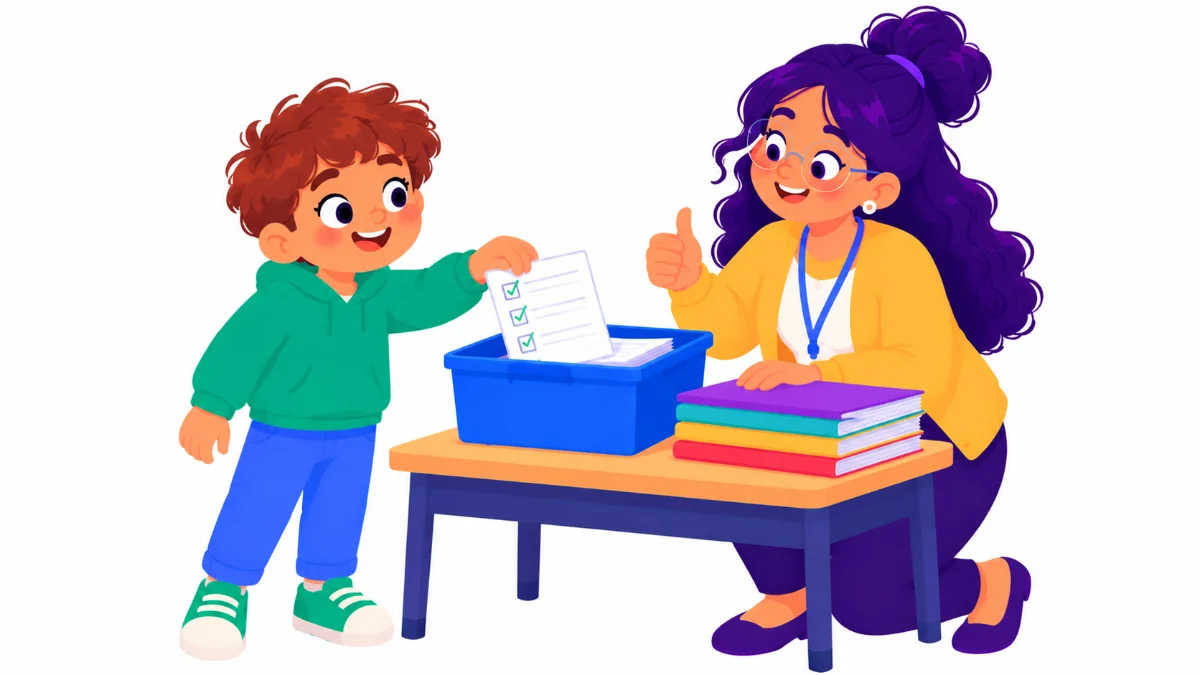

A task completion checklist helps students know when work is truly finished, not just stopped. Picture a fifth grader who hands in a math page with the back side blank, the last word problem skipped, and the paper left in his desk for two days. He did most of the work. He just never had a clear finish line.
This guide walks you through five steps: define what finished means, teach the eight self-check questions, model the checking process, build a turn-in and wrap-up routine, and track progress while you fade support. By the end, you will have a simple system a student can use on any assignment, in class or at home.
Examples are fictional. Adapt to the student’s goals and agreed supports. This is guidance, not a diagnosis.
At a glance
- Many students stop working before the task is complete because “done” is unclear.
- Eight short self-check questions make the finish line visible.
- Teach checking like a skill: model it, practice it together, then hand it over.
- Turning work in and cleaning up are part of finishing, not extras.
- Track complete assignments weekly and fade prompts as the habit grows.
1. Define what finished means before work starts
First, notice the gap between stopping and finishing. A student may stop when they get tired, when the page looks full, or when classmates stand up. None of these mean the task is complete. Without a clear definition, “I’m done” means different things to different people.
Next, make the finish line visible before the student begins. Point out how many parts the task has, where it gets turned in, and what a complete page looks like. A quick look at a finished example can help more than a long explanation.
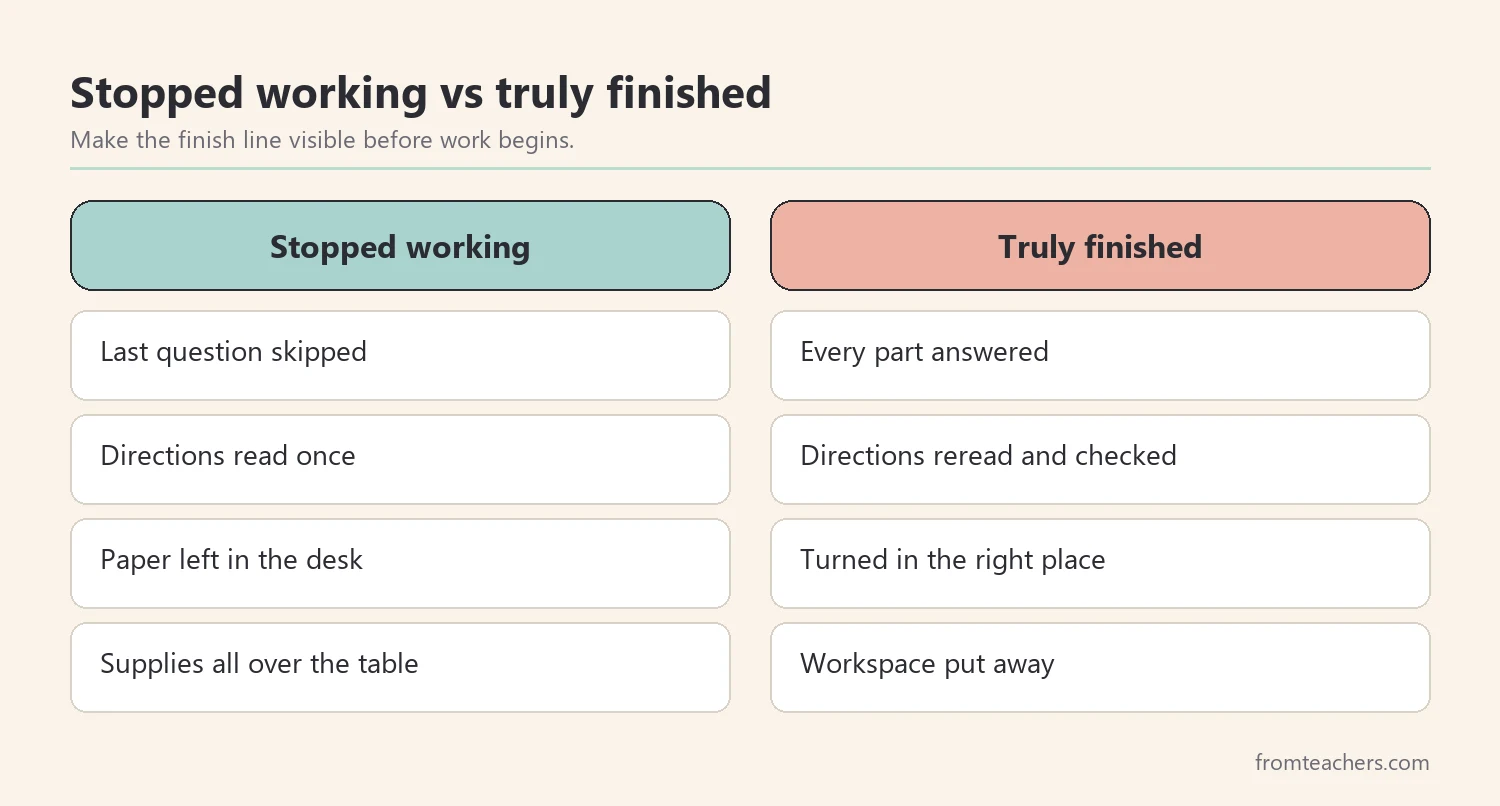
It also helps to agree on a signal for “I think I’m done.” For example, the student places a sticky note on the corner of the desk. That signal becomes the cue to start the self-check instead of jumping straight to the next activity.
Then, observe where finishing breaks down for this student. Some students skip parts. Others rush and make small mistakes. Still others finish the work but never turn it in. Knowing the weak point tells you which questions to teach first.
| What you notice | Where to focus first |
|---|---|
| Blank sections or skipped questions | Complete every part |
| Many small, careless errors | Check work slowly |
| Finished work found in the desk | Turn it in correctly |
| Wrong format or missing steps | Follow all the directions |
In addition, talk with the student about it without blame. Ask, “How do you know when you’re done?” Their answer often shows exactly what is missing. Some students honestly believe a task is finished once they reach the bottom of the page.
Worked example. Sam, a fictional fifth grader, turns in 2 of 5 math assignments complete in a typical week. His teacher notices two patterns: he skips the back of the page and leaves finished work in his desk. Those become the first two targets.
2. Teach the eight questions of a task completion checklist
A good task completion checklist uses questions the student asks themselves. Questions invite checking, while commands can feel like more rules. Eight short questions cover the full path from directions to celebration.
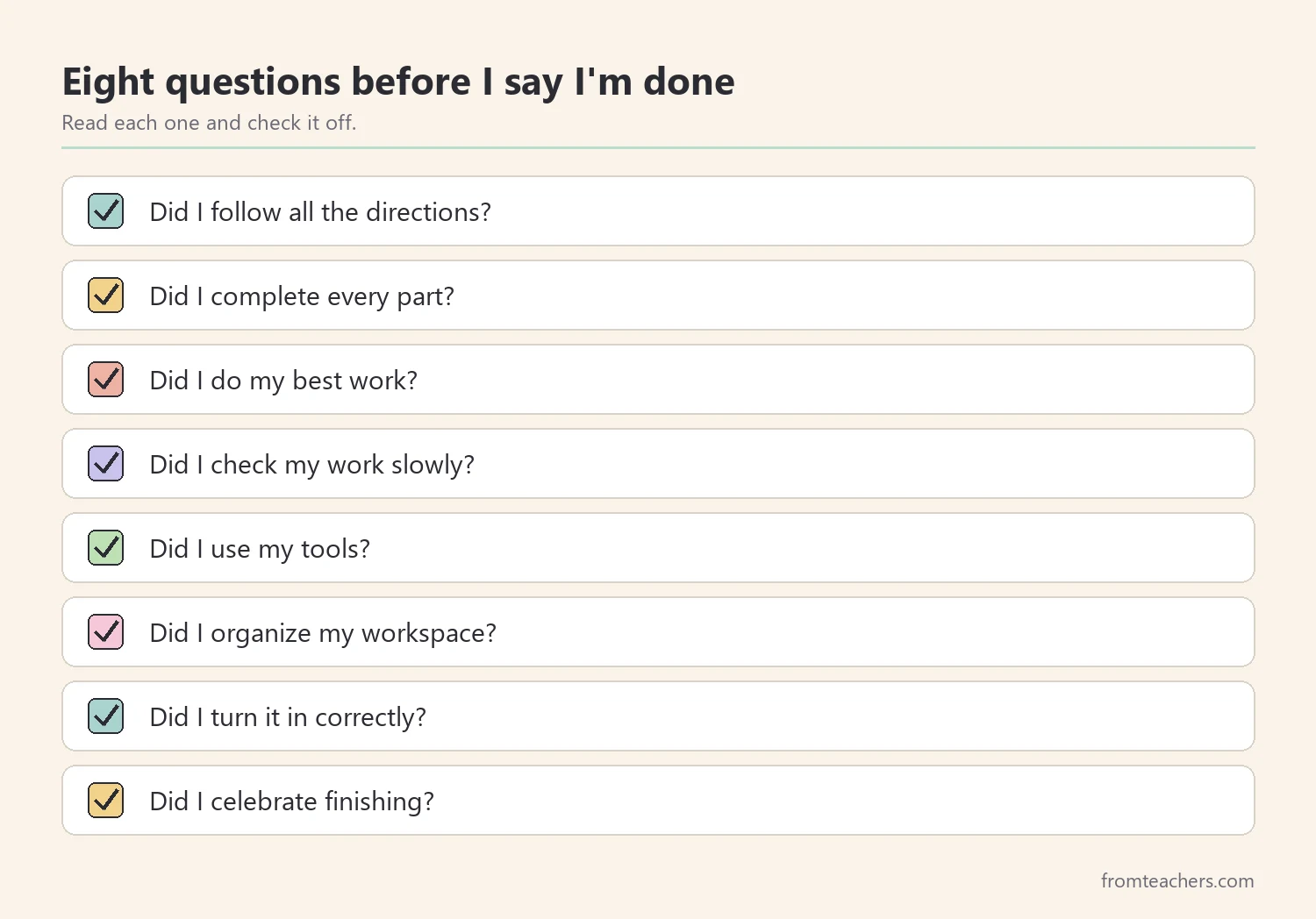
Teach what each question means in action. For example, “Did I follow all the directions?” means reading them again, checking each requirement, and making sure nothing is missing. “Did I complete every part?” means looking for skipped questions or sections, filling in anything missed, and asking for help if something is unclear.
Likewise, “Did I do my best work?” means neat handwriting or clear typing, complete sentences, and work that shows effort rather than rushing. “Did I check my work slowly?” means looking for small mistakes, fixing anything that does not seem right, and rereading important parts.
Next, “Did I use my tools?” reminds the student of supports like a visual schedule, a calculator, a word bank, a graphic organizer, a timer, or a break card. The last three questions cover finishing well: organizing the workspace, turning work in correctly, and celebrating.
It can help to turn the questions into quick actions the student can see. The table below links each question to one visible behavior an adult can notice and praise.
| Question | Visible action |
|---|---|
| Follow all the directions? | Finger traces the directions again |
| Complete every part? | Flips the page, scans each section |
| Check work slowly? | Rereads answers with a pencil pointer |
| Use my tools? | Word bank or calculator on the desk |
Do not teach all eight in one lesson. Start with the two or three that match the student’s weak points, then add the rest over a few weeks. Short, focused lessons build real habits.
Worked example. Sam’s teacher starts with “Did I complete every part?” and “Did I turn it in correctly?” She adds “Did I check my work slowly?” in week two once the first two are steady.
3. Model and practice self-checking with the task completion checklist
Students do not learn to check work by being told to check it. Instead, they need to see what checking looks like and practice it with support. A simple gradual release works well: I do, we do, you do, and on your own.
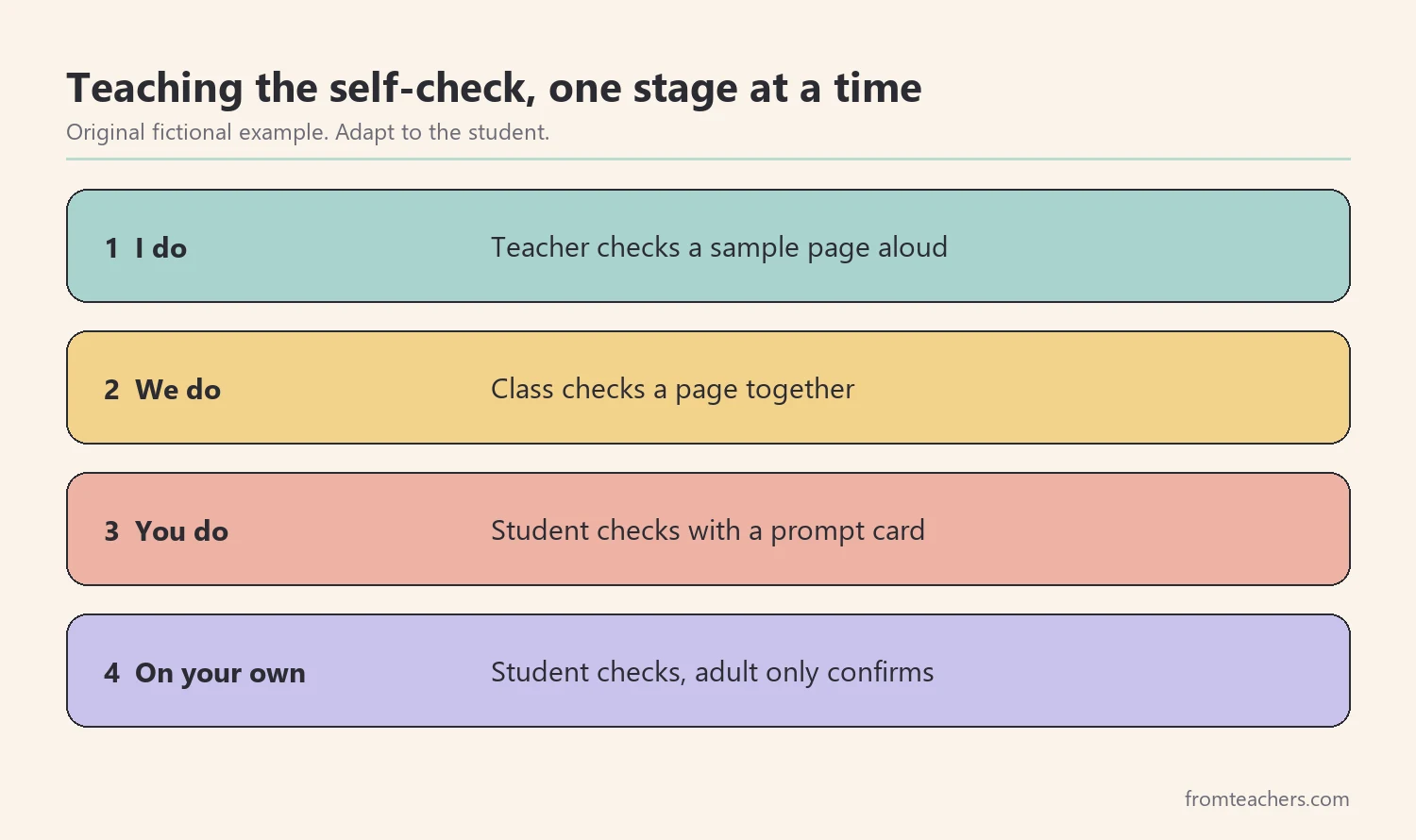
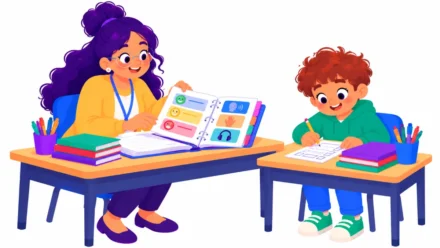
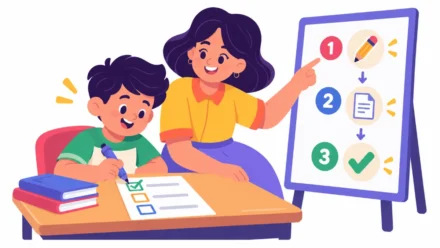
First, think aloud with a sample page that has a few planted errors. “Did I complete every part? Let me flip the page. Oh, there’s a section on the back.” Next, check a page together as a class. Then, give the student a small prompt card while they check their own work.
A clear visual makes this easier. The Task Completion Checklist poster with eight self-check questions gives the whole class the same questions to point to during modeling, and a small copy can sit on a desk or in a work folder.
Peer checking is another useful practice step. Partners trade pages and ask each other two of the questions. Students often spot a skipped section on someone else’s page more easily, and that skill transfers to their own work over time.
Keep practice short. Checking one assignment a day with the card is enough at first. Moreover, praise specific checking behavior: “You flipped the page to look for more questions. That’s exactly what finishers do.”
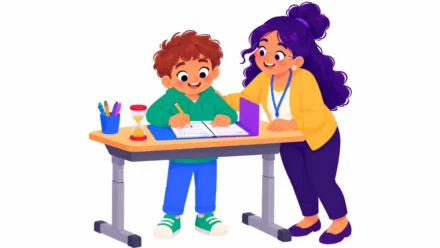
Worked example. Sam practices with a laminated card clipped to his math folder. At first, his teacher sits beside him and reads each question. By the end of week two, she only points to the card and waits.
4. Build a turn-in and wrap-up routine
Many students do the work and still lose credit because it never reaches the teacher. Therefore, turning in work deserves its own routine. Make the turn-in place clear and the same every time: a labeled bin, a folder, or a specific upload spot for digital work.
Next, teach the steps. Put the work in the turn-in bin, hand it to the teacher, or upload it if it is digital. For students who often forget, a simple visual near the door or desk can serve as the reminder.
Then, add organizing the workspace. Put materials away, clean up the area, and return items to the correct spot. This small step makes the next task easier to start and gives a clear signal that the current one is over.
Finally, celebrate finishing. Encourage the student to take a breath, say “I did it,” and enjoy the feeling of completing a task. Celebration may feel small, but it builds a positive link with finishing that helps the next time.
| Wrap-up step | What it looks like |
|---|---|
| Organize | Pencils in the cup, books on the shelf |
| Turn in | Paper in the blue bin or file uploaded |
| Celebrate | One breath and a quiet “I did it” |
Also, think about digital work. Online assignments add steps like clicking submit and checking that the file attached. Add a quick “Did I see the confirmation?” question for students who work mostly online.
Worked example. Sam’s teacher puts a small “Turn it in” picture on his desk corner. After finishing, he checks the card, puts the paper in the blue bin, tidies his pencils, and gives himself a quiet thumbs-up.
5. Track progress and fade the task completion checklist support
Finally, keep a short weekly record. Count how many assignments were given, how many were turned in complete, and how many the student self-checked without a prompt. These three numbers show both the result and the growing independence.
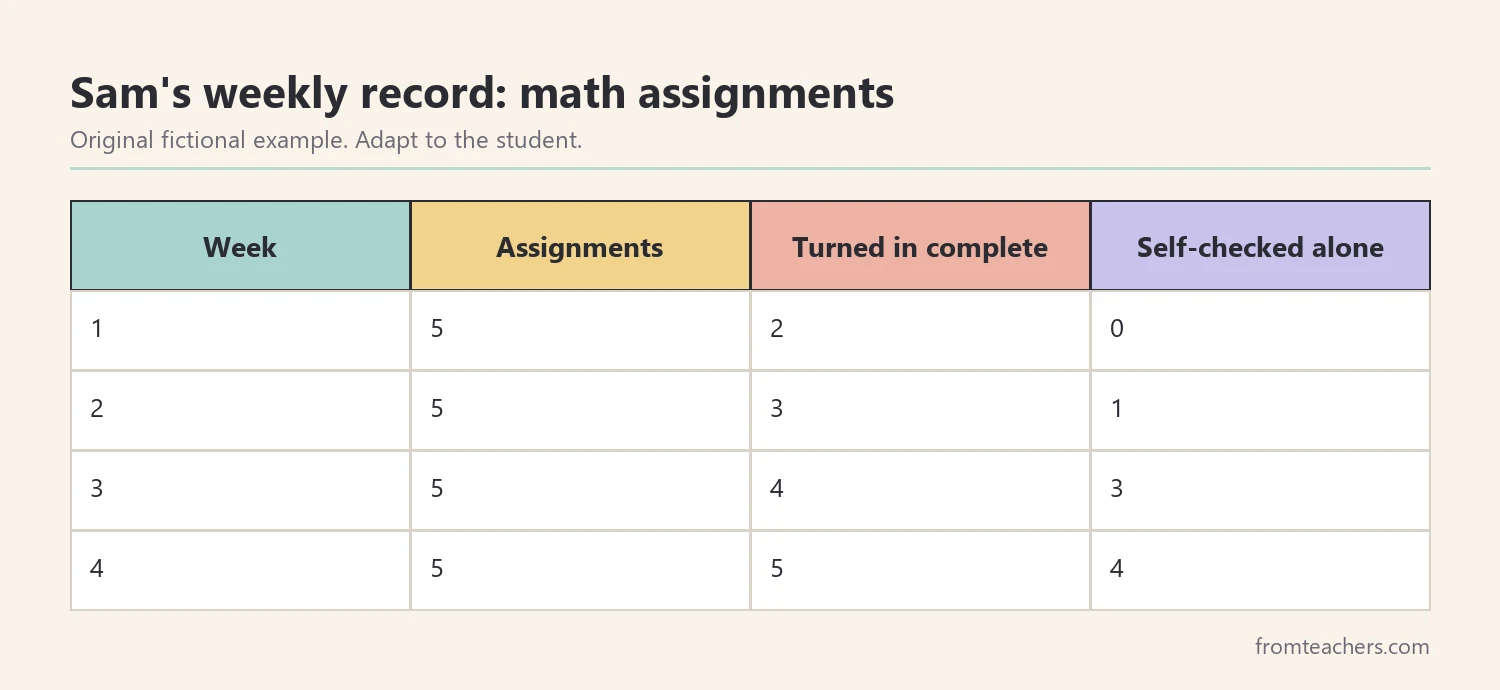
In this example, Sam went from 2 of 5 assignments complete in week one to 5 of 5 in week four. He also self-checked 4 of 5 without a prompt by the last week. That trend tells you it is time to fade support.
Look closely at the third column. Completing work with adult help is a good start, but self-checking alone is the real goal. If the first number rises while the second stays flat, the student may be relying on the adult instead of the questions.
Fade slowly. Move from an adult reading the card, to pointing at it, to the student using it alone. Later, the desk card can become a smaller sticker inside the folder. If progress slips, step back one level for a week.
Also, plan for new kinds of tasks. A student who checks math pages well may still forget the steps on a science lab or a writing project. Briefly review the questions whenever the task type changes, and point out which ones matter most for that kind of work.
Share the record with families and, where it fits, the IEP or 504 team. Families can use the same questions for homework. Consistent questions at school and home help the habit transfer across settings.
If the student still struggles, look at the task itself. Very long assignments may need to be chunked, with a mini check after each section. Sometimes the problem is not checking, but that the work is too big to finish in one sitting.
Worked example. After four weeks, Sam’s teacher moves the card from his desk to the inside of his folder. His parent starts using the same three questions for homework, and Sam’s team notes the progress at his next review.
Common mistakes and how to avoid them
- Saying “check your work” without teaching how. Fix: model checking aloud with a sample page.
- Introducing all eight questions at once. Fix: start with the student’s two weakest points.
- Ignoring the turn-in step. Fix: give it its own clear routine and location.
- Removing the checklist too soon. Fix: fade one prompt level at a time based on data.
- Only noticing mistakes. Fix: praise specific checking behaviors and celebrate finishing.
Questions teachers and parents ask about a task completion checklist
Who benefits from a finishing checklist?
Many students do, including students with ADHD, autistic students, and anyone who struggles with executive function. It also helps general education students build independent work habits. Adapt the wording and visuals to the student’s age.
Can this be an accommodation?
Checklists and self-monitoring supports are sometimes written into IEP or 504 plans. Discuss this with the student’s team. The team decides what supports fit the student’s needs.
How long does checking take?
At first, it may take a few extra minutes. As the habit grows, checking becomes faster and more automatic. Build those minutes into the work time so the student does not feel rushed.
What if the student checks but still misses errors?
Narrow the focus. Ask the student to check for one type of error at a time, such as skipped questions. Then add another type once the first is reliable.
Does it work for older students?
Yes. Older students can use the same questions in a planner, a digital note, or on the first page of a binder. Let them reword the questions in their own language.
Related reading: Accommodations vs modifications in special education, ADHD in children: classroom and home support, and Special education tracking tools.
A companion resource for using a task completion checklist:
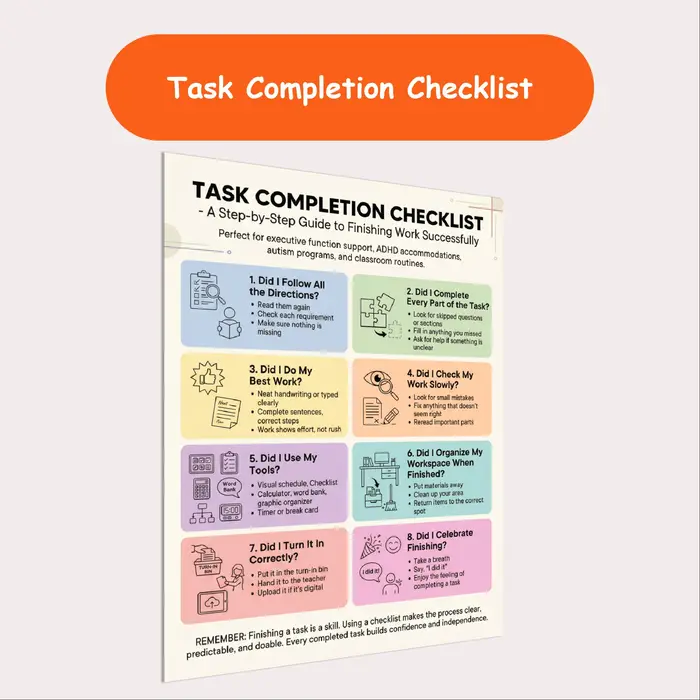
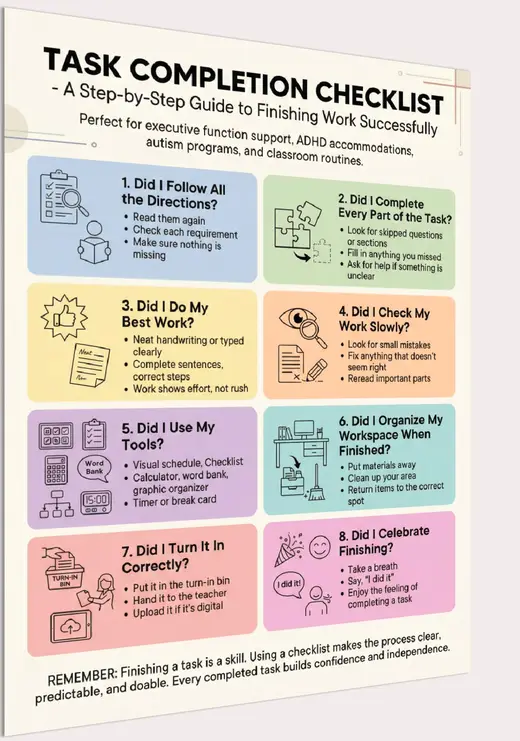
Task Completion Checklist Poster: a printable poster with eight self-check questions for finishing work successfully. Designed for executive function support, ADHD accommodations, autism programs, and classroom routines.
Sources and scope
- IRIS Center, Vanderbilt University: free modules on self-regulation strategies and evidence-based practices.
- Understood.org: practical articles on executive function and finishing schoolwork.
- CHADD: information for families and educators on ADHD and school supports.
- IDEA, U.S. Department of Education: the law behind special education services and IEPs.
This guide covers everyday classroom and home strategies for finishing work. It does not cover diagnosis or formal evaluation, which belong to qualified professionals and the student’s team.
Key takeaways
- Clear self-check questions make the finish line visible.
- Find where finishing breaks down and teach those questions first.
- Model checking aloud, then release it gradually to the student.
- Give turning in and cleaning up their own routine.
- Track complete work weekly and fade support slowly.

Leave a Comment