

Cognitive overload in students happens when the amount of information coming in is bigger than what the student can process at once. Picture a sixth grader in science class. The teacher explains a lab, points to a diagram, hands out a worksheet, and adds a reminder about tomorrow’s quiz, all in two minutes. The student nods, then stares at the page, unsure where to begin, and finally pushes it away.
This guide gives you five practical steps for preventing and easing that kind of overload. By the end, you will be able to spot overload signs, audit the load a lesson places on students, cut what is extra, chunk new material, and teach students a simple reset routine they can use on their own.
Examples are fictional. Adapt to the student’s goals and agreed supports. This is guidance, not a diagnosis.
At a glance
- Overload often looks like shutting down, losing focus, or feeling exhausted.
- Every lesson carries a load: the content itself plus everything around it.
- Remove extra noise first, then break new material into small chunks.
- A short reset routine helps students recover and return to work.
- Track overload moments to see which changes make the biggest difference.
1. Spot the signs of cognitive overload in students
First, learn what overload looks like in your room. Cognitive overload in students does not always look like stress. Often it looks like a student who has “checked out.” The student may stare, fidget, ask the same question twice, start several things and finish none, or put their head down.
Next, notice what came right before. Overload usually follows a moment with a lot happening at once: long spoken directions, a busy slide, a multistep problem with new vocabulary, or a noisy group task. The behavior is the end of the story. The cause is usually a few minutes earlier.
Then, write short notes for a week. Record the activity, what was being asked, and what the student did. For example, “Science lab intro, verbal directions plus diagram plus handout, pushed paper away after two minutes.” Patterns appear quickly once you write them down.
Meet Nadia, a fictional sixth grader with a learning disability in reading. Her teacher, Ms. Romero, notices that Nadia does well in short, focused tasks. However, in lessons where new terms, a diagram, and directions all arrive together, Nadia shuts down within minutes. On those days, she also seems very tired by the end of class.
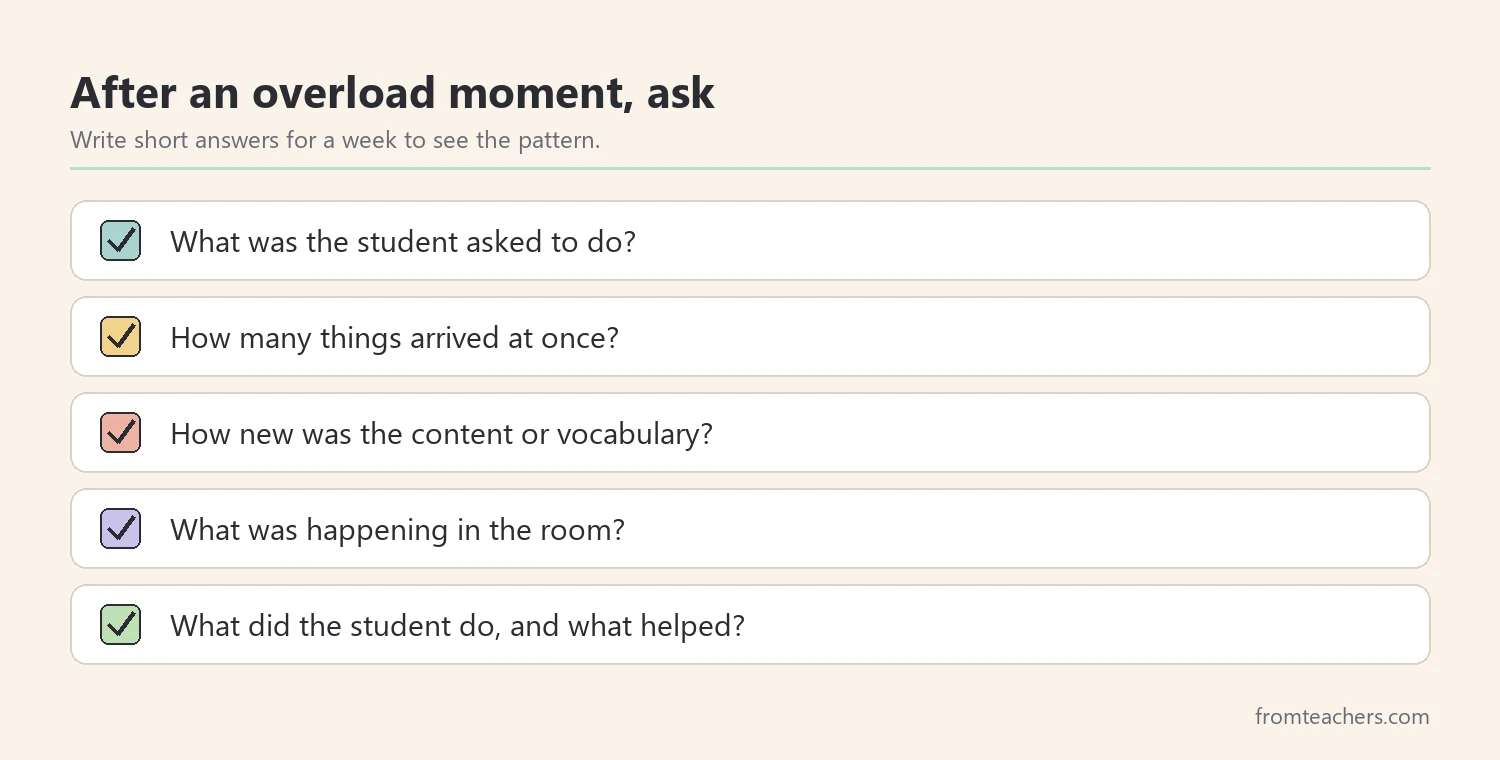
In addition, ask the family what they see at home. Homework time often shows the same pattern: a student who is fine with one short task but freezes when a packet with several sections comes home. Families can also tell you whether the student comes home unusually drained on certain days, which may match the busiest lessons at school.
Finally, remember that overload is not the same as low ability. Many students who overload easily can handle the content well when it arrives in smaller pieces. The goal is to change how the information arrives, not to lower expectations.
2. Audit the load in a lesson
Now, look at one lesson through the student’s eyes. Every lesson asks students to handle the content itself, plus everything around it: directions, visuals, materials, noise, and social demands. When all of these are high at the same time, overload becomes likely.
Next, list what the student has to process in the first five minutes. Count the number of new terms, the number of steps in the directions, the number of materials, and whether directions are spoken, written, or both. This quick audit often reveals more demands than you expected.
| Part of the lesson | What adds load | Quick fix |
|---|---|---|
| Directions | Five spoken steps at once | Two written steps at a time |
| Slides | Busy images and long text | One idea per slide |
| Vocabulary | Several new terms in one go | Preteach two key terms |
| Materials | Handout, diagram, and notebook | One page with all three |
For Nadia’s science lab, Ms. Romero counts six spoken directions, four new terms, a diagram on the board, and a separate handout. That is a lot to hold at once, especially for a student who reads slowly. So she decides to change how the lesson begins.
Then, rate each part of the lesson as low, medium, or high load for this student. You do not need a perfect score. The point is to see where the heaviest moments sit, so you can decide where a small change will help most. Usually, one or two parts of the lesson carry most of the load.
Also, notice the environment. Background noise, a cluttered wall near the student’s desk, or a seat near the door can add load that has nothing to do with the lesson. Small changes there can help as much as changes to the content.
3. Cut extra load and prevent cognitive overload in students
Next, remove what the student does not need right now. Preventing cognitive overload in students often starts with subtraction, not addition. Ask, “What can I take away without losing the learning goal?”
Start with directions. Give two steps at a time in writing, and keep the rest for later. Then, simplify visuals: one idea per slide, clear labels, and no decorative images that compete for attention. Finally, combine materials when you can, so the student is not switching between three pages.
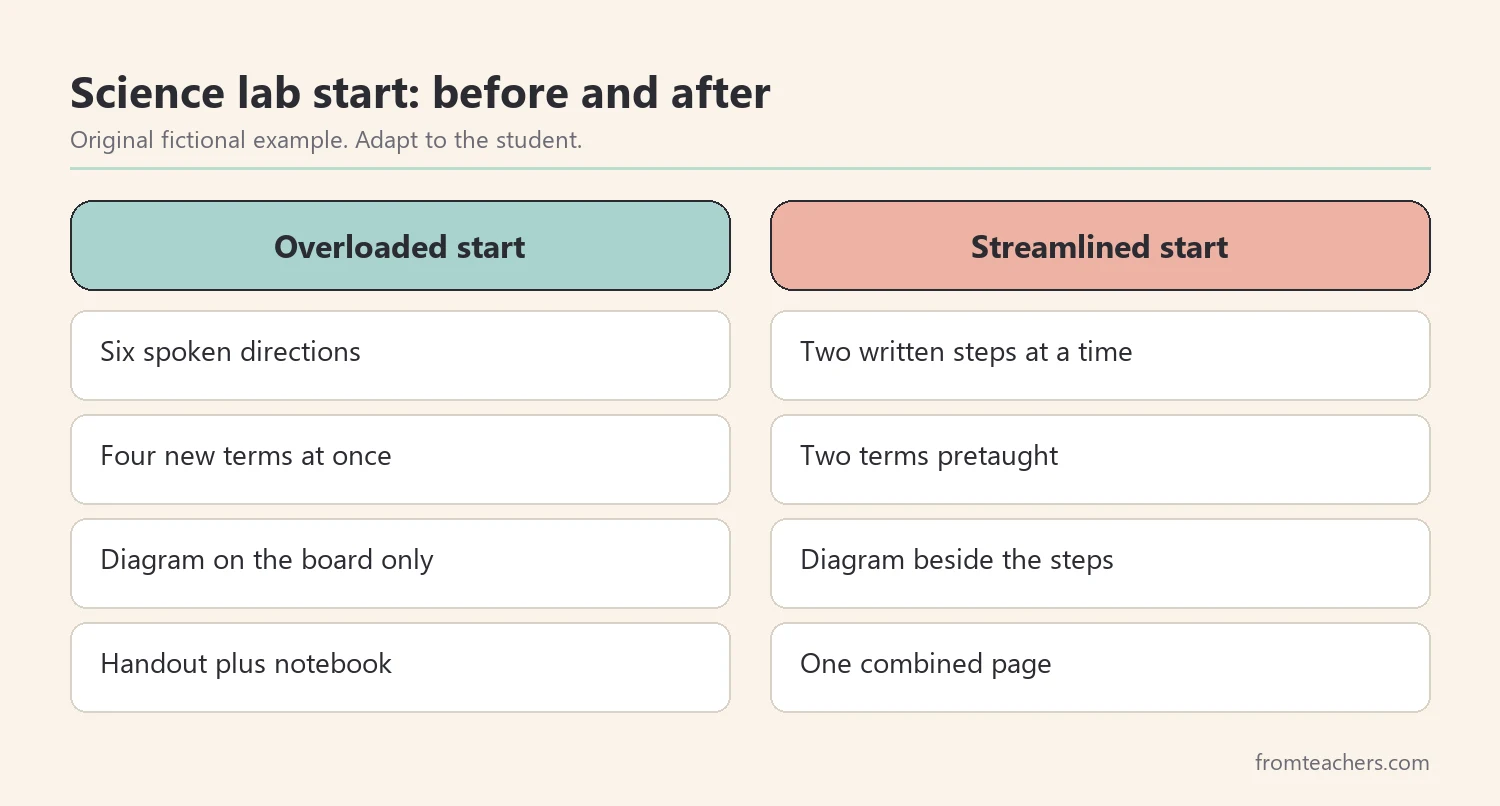
Moreover, preteach a few key terms. When a student already knows two or three important words before the lesson, those words stop competing for attention. A short preview at the start of the day, or with a support teacher, can make a big difference.
For Nadia, Ms. Romero preteaches two terms during morning work. She gives the lab directions on one page with numbered steps and the diagram printed right beside them. Nadia starts the lab with the rest of the class and keeps going for most of the period.
If you want ready-made ideas, the overwhelm and cognitive load strategy tables from berchid.com pair common overload situations with a practical tip and the effect it has. They can help you choose a fix quickly when planning.
4. Chunk new material into small pieces
Then, break new learning into short chunks with a quick check after each one. Chunking helps students hold a manageable amount of information, use it, and then move on. It is one of the simplest ways to keep load reasonable.
A useful pattern is: teach a small piece, let students try it, check quickly, and then teach the next piece. Keep each chunk short. If students need a reminder of earlier chunks, put it in writing so they do not have to hold it all in their heads.
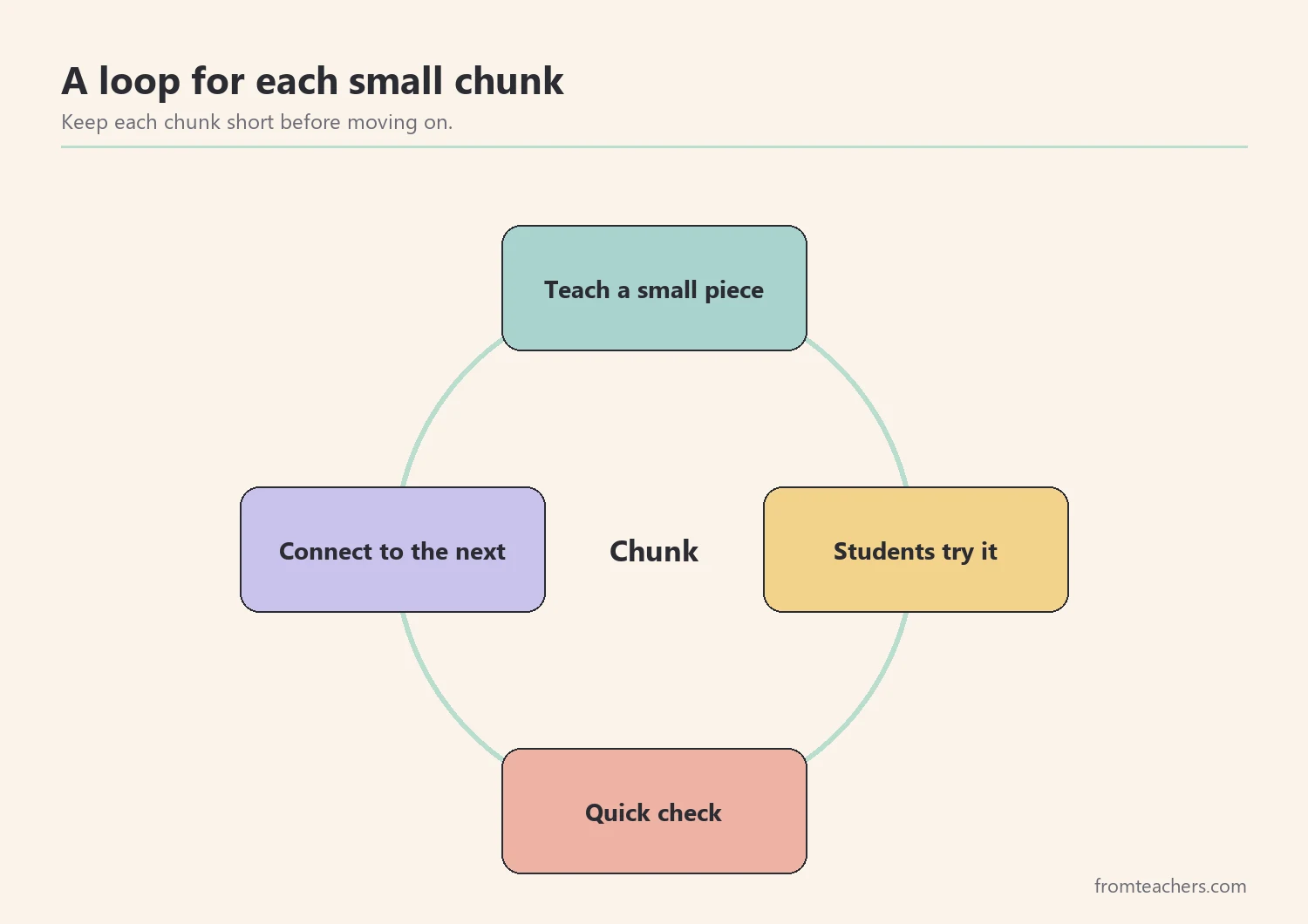
Next, use worked examples. Showing a completed example before asking students to solve a similar problem reduces the amount of figuring out they have to do at once. Then, gradually remove parts of the example as students gain confidence.
Meanwhile, watch the pace of talk. Long stretches of explanation without a pause ask students to hold everything in mind until the end. Instead, pause after each key idea and let students write a word, draw a quick sketch, or tell a partner what they just heard. Those short pauses give the brain time to store the idea before the next one arrives.
Also, connect new chunks to what students already know. A quick link, such as “This is like the food chain we drew last week,” gives the new idea a place to land. That makes it easier to remember and less tiring to process.
Next, plan where the chunks break before the lesson starts. Mark natural stopping points in your notes or on the student’s page. Clear breaks make it easier to check understanding and give the student a small sense of progress at each step.
For Nadia, the lab now has three short sections, each with a check box. After each section, Ms. Romero stops by for a ten-second check. Nadia finishes all three sections on most days, compared with one or none before.
5. Teach a reset routine and track what helps
Finally, give students a way to recover when overload happens anyway. Even with good planning, some moments will be too much. A short, predictable reset routine helps a student calm down, clear their head, and return to the task.
A simple reset might be: stop, breathe slowly three times, look at the first step again, and do just that one step. Teach it during a calm time, model it yourself, and practice it with the student before they need it. Keep a small card with the steps on the desk.
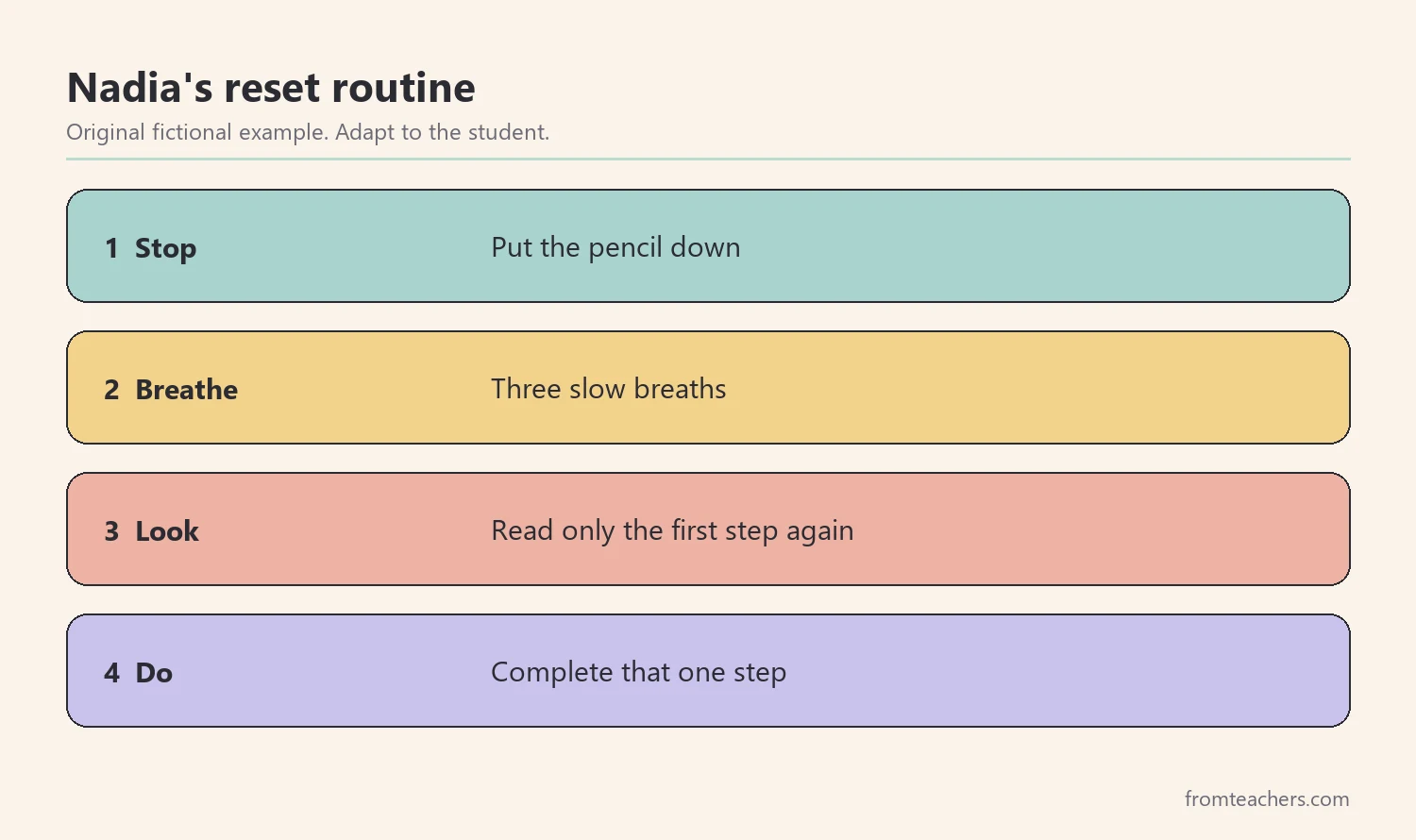
Then, track overload moments. Each week, count how often the student shuts down or abandons a task, and note which lessons it happened in. Compare weeks before and after your changes. That record tells you which fixes are working and where to focus next.
For Nadia, overload moments in science drop from five in the first week to one in the fourth week. She uses the reset card on her own twice in the last week. Ms. Romero shares these results with Nadia’s family and her special education teacher, and they agree to try the same approach in social studies.
Also, involve the student in the review. Ask which change helped most and which still feels hard. Students who understand why a support works are more likely to ask for it in new classes. Over time, that self-knowledge becomes one of the most useful tools they carry from year to year.
In addition, review the plan every few weeks. Student needs change, and new units bring new demands. A short check with the student, the family, and the team keeps supports matched to what the student needs now.
Common mistakes and how to avoid them
- Adding more help instead of removing load. Fix: first ask what you can take away, then add support if needed.
- Giving all the directions at the start. Fix: give two steps at a time, in writing.
- Reading shutdown as defiance. Fix: look at what was being asked just before and audit the load.
- Teaching the reset routine during a crisis. Fix: teach and practice it when the student is calm.
- Changing everything at once. Fix: make one or two changes, track for two weeks, then adjust.
Questions teachers and parents ask about cognitive overload in students
What is the difference between overload and a lack of motivation?
A student with low motivation may avoid tasks even when they are clear and short. A student in overload often wants to work but cannot sort through everything at once. Making the task smaller and clearer usually helps overload quickly.
Which students are most likely to overload?
Any student can overload when a lesson is very busy. Students with learning disabilities, ADHD, autism, or language differences may reach that point sooner. Focus on what you observe rather than a label.
Does reducing load mean making work easier?
No. The learning goal stays the same. You are changing how information arrives so the student can spend energy on the important thinking, not on sorting extra details.
How can parents help with homework overload?
Families can cover part of a worksheet, read directions together one step at a time, and take short planned breaks. Using the same reset routine at home and at school keeps support consistent.
Should these supports go into an IEP or 504 plan?
If overload affects learning across classes, the team may discuss accommodations such as chunked assignments, written directions, or preteaching. Bring your notes and tracking data to that conversation.
Related reading: Managing Sensory Overload: Practical Strategies for Autism and ADHD, Accommodations vs Modifications in Special Education: The Difference Explained, and 5 Practical Teaching Tips to Boost Classroom Focus and Learning.
A companion resource for cognitive overload in students:
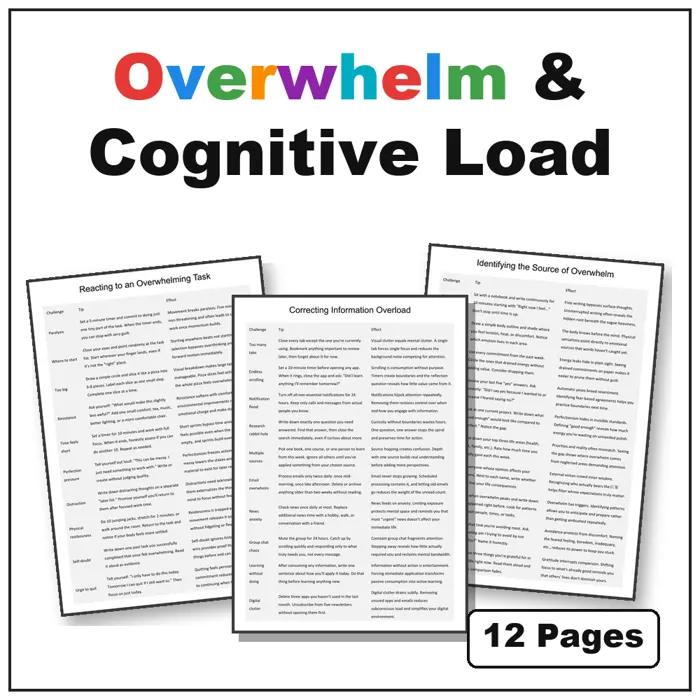
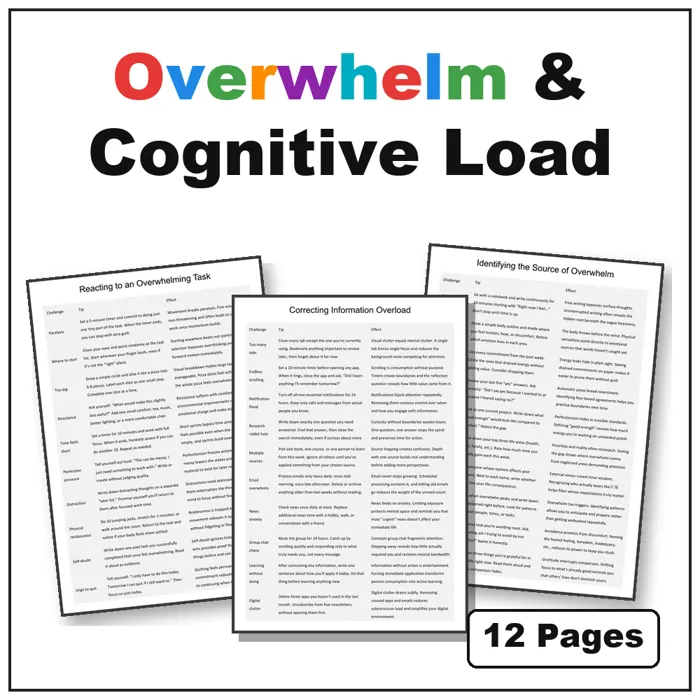
Overwhelm and Cognitive Load: Strategies for Mental Overload: 12 strategy tables that pair each overload situation with a practical tip and the effect it has.
Sources and scope
- IRIS Center, Vanderbilt University: free modules on instruction, classroom supports, and evidence-based practices.
- What Works Clearinghouse, Institute of Education Sciences: reviews of education research and practice guides.
- CAST: the organization behind Universal Design for Learning, with guidance on reducing barriers in lessons.
- Understood.org: plain-language information on learning and thinking differences for families and teachers.
This guide covers practical classroom and home strategies for reducing and recovering from mental overload. It does not replace an evaluation or individualized guidance from the student’s team.
Key takeaways
- Spot the quiet signs of overload and look at what came just before.
- Audit the load a lesson places on students in the first five minutes.
- Cut extra load first, then chunk new material with quick checks.
- Teach a short reset routine during calm times.
- Track overload moments and review with the student, family, and team.










Leave a Comment