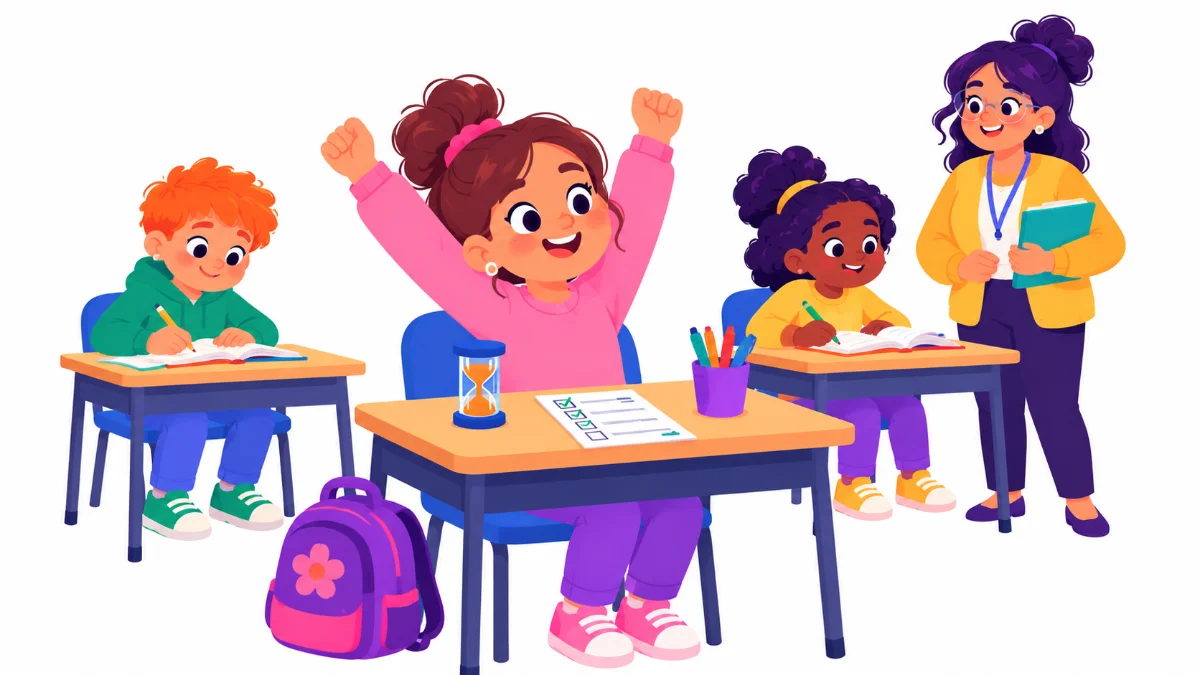

Refocus strategies give students a way to get back on track on their own when attention slips. Picture a fourth grader halfway through a reading response. She was working well, then a classmate laughed, she looked up, and ten minutes later she is still drawing in the margin. She wants to finish. She just does not know how to find her way back.
This guide shows you how to teach refocus strategies in six steps: notice when attention slips, use quick brain breaks and movement, reset with visuals and a clear space, break the task down and use a timer, teach self-talk and asking for support, and build a routine you can review. By the end, you will have a practical toolkit students can use with fewer adult prompts.
Examples are fictional. Adapt to the student’s goals and agreed supports. This is guidance, not a diagnosis.
At a glance
- Needing to refocus is normal. Focus grows with tools and practice.
- Students first need to notice when their attention has drifted.
- Short breaks and movement can bring energy back to the task.
- Small steps and short timers make restarting easier.
- Teach a simple routine and fade adult prompts over time.
1. Notice when attention slips
First, help students recognize the moment attention drifts. Common signs include staring out the window, doodling, rereading the same line, or chatting about something unrelated. Students cannot use refocus strategies until they notice they need one.
Next, watch for patterns. Attention often slips at predictable times, such as after lunch, during long independent work, or when a task feels confusing. Note the time, the task, and what happened just before. Patterns usually appear within a week or two.
Also, teach a simple self-check. Students ask themselves, “Am I on my task right now?” A small visual cue, such as a card on the desk, can prompt this check. Some teachers also use a quiet chime every few minutes during independent work.
In addition, keep the tone neutral. Drifting attention is not bad behavior. Saying “Let’s find a way back” works better than “Pay attention!” because it invites the student to act, not to feel ashamed.
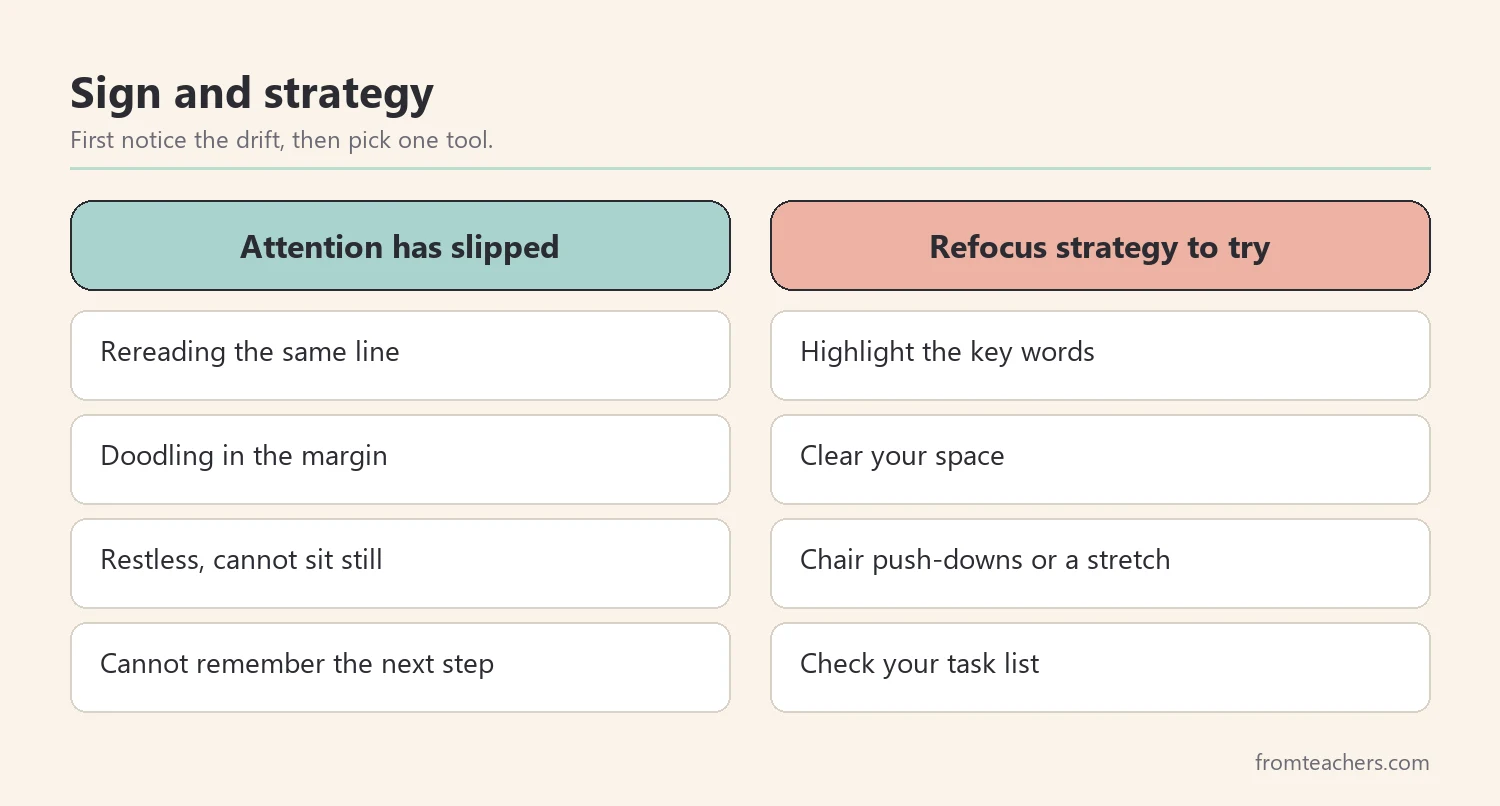
Worked example. Ava is a fictional student in grade 4. Her teacher, Ms. Patel, notices that Ava drifts most during the second half of independent reading. She looks around, then starts doodling. Ms. Patel decides to teach Ava a few refocus strategies and to watch that part of the lesson closely.
2. Use brain breaks and movement as refocus strategies
Sometimes the brain needs a short reset. A quick brain break can include standing and stretching, walking to a calm spot, getting a drink of water, or taking 10 slow breaths. A short break resets the brain and brings attention back online.
Then, add movement options that work at a desk. Chair push-downs, marching in place, shaking out hands, and slow stretching all help. Movement can increase focus and bring energy back to the task.
Importantly, agree on the rules in advance. How long is the break? Where can the student go? What happens next? Clear limits keep breaks short and make them part of the work, not a way to avoid it.
A classroom poster keeps these options visible. The refocus strategies poster with attention and focus tools shows eight tools for getting back on track, each with a short “why it works” note.
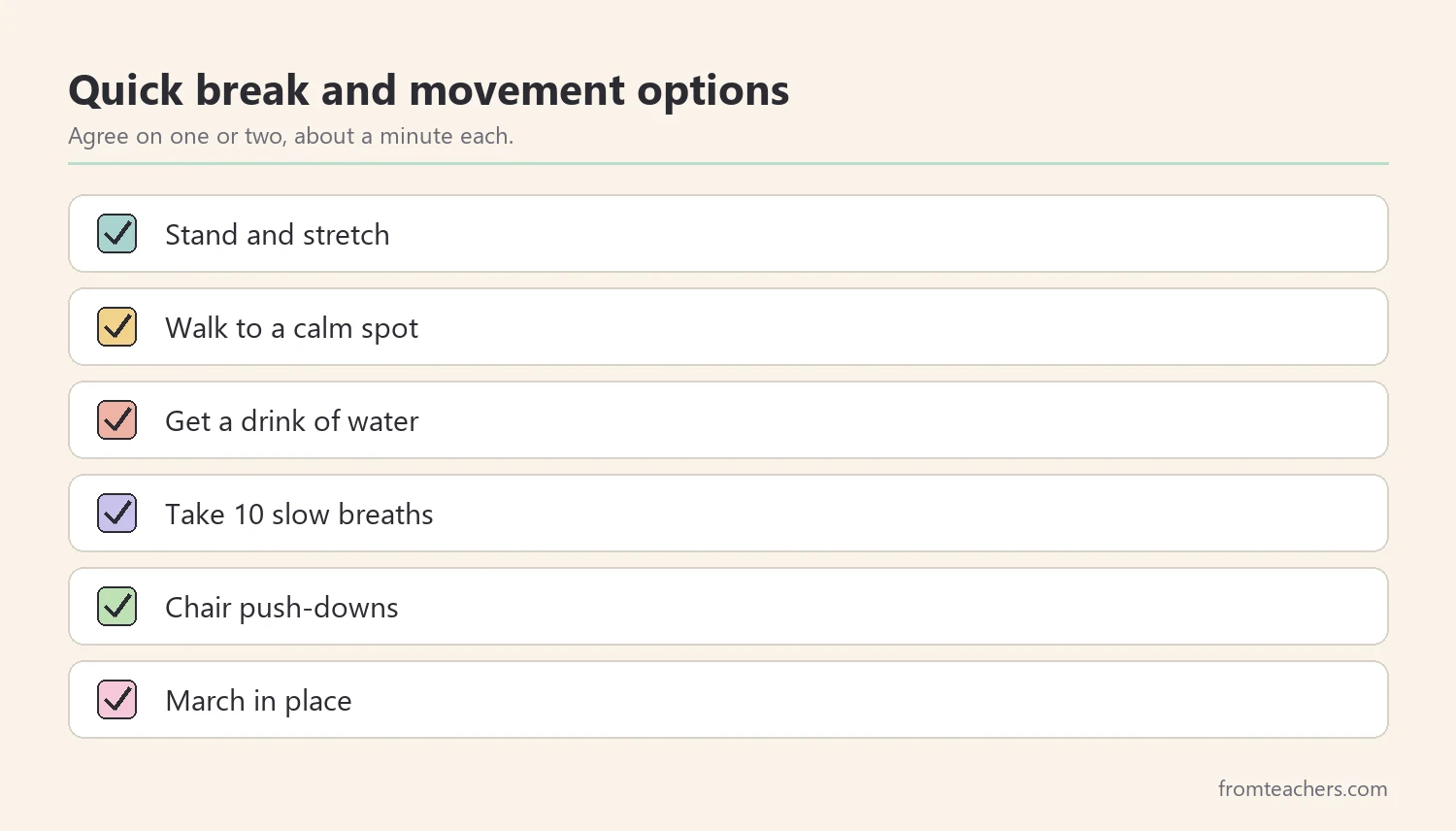
Worked example. Ms. Patel and Ava agree on two break options: stand and stretch at her desk, or get a drink of water. Each break lasts about one minute. Ava chooses stretching most often, because she likes that she does not need to leave her seat.
3. Reset with visuals and a clear space
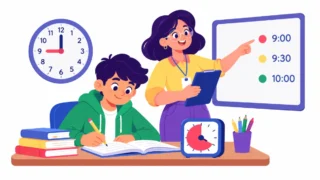
Next, teach a visual reset. Students look at their schedule, check their task list, use a “first-then” card, or highlight the key steps of the task. Visuals anchor attention and reduce overwhelm, because they show exactly where to go next.
Then, teach students to clear their space. They put away distractions, organize materials, and keep only what they need. A tidy workspace reduces visual clutter and helps the brain focus.
Also, combine the two. A good refocus routine might be: clear the desk, look at the task list, and find the next step. This takes less than a minute, and it gives the student a clear place to restart.
In addition, make visuals personal. A small first-then card on the desk, such as “First finish question 3, then choose a book,” helps many students more than a general class poster. Personal refocus strategies feel easier to use because they match the student’s own work.
| Visual | What it shows |
|---|---|
| Task list | All steps, with ticks for finished ones |
| First-then card | The next step and what follows it |
| Highlighted directions | The key words in the task |
Worked example. Ms. Patel gives Ava a small task list for reading responses: read the page, answer question 1, answer question 2, check spelling. When Ava drifts, she clears her pencils into her box, looks at the list, and finds the first unchecked step.
4. Pair refocus strategies with small steps and a timer
Large tasks can feel impossible to restart. So, teach students to break the task into small steps. They do one tiny part first, check it off, and move to the next small step. Small steps feel doable, lowering anxiety and boosting motivation.
Next, add a timer or countdown. Students set a short work timer of two to five minutes, work until it rings, then take a brief pause. Timers create structure and help students use time instead of fighting it.
Also, let students control the timer when they are ready. At first, you set it. Later, the student chooses the time and starts it. Control builds ownership, and ownership makes refocus strategies more likely to stick.
In addition, pair the timer with one clear first action. “Set the timer and answer question 2” is easier than “Set the timer and keep going.” A clear first action makes the restart almost automatic.
Worked example. When Ava refocuses, she sets a three-minute sand timer and works on one step from her list. When the timer ends, she takes a short pause, then sets it again. She finishes her reading response in four timer rounds.
5. Teach self-talk and asking for support
Next, teach short refocusing phrases. “I can do this.” “One step at a time.” “I can start now, even if it’s hard.” Positive self-talk calms the brain and increases willingness to start.
Then, teach students to ask for support. Give them exact words: “Can you help me start?” “What is the first step?” “I’m stuck and need a nudge.” A quick, supportive connection gets students unstuck and moving again.
Also, make asking easy and private. A small help card on the desk or a quiet signal lets students ask without calling out. When adults respond quickly and kindly, students learn that asking is one of the most useful refocus strategies.
Meanwhile, model self-talk yourself. “I lost my place. I’m going to look at my list and find the next step.” Hearing an adult refocus out loud shows students that everyone needs to do it sometimes.
Worked example. One afternoon Ava cannot remember what question 2 is asking. Instead of doodling, she puts her help card on the desk. Ms. Patel comes over and says, “Read the highlighted words.” Ava rereads them, says “One step at a time,” and starts writing.
6. Build a routine and review your refocus strategies
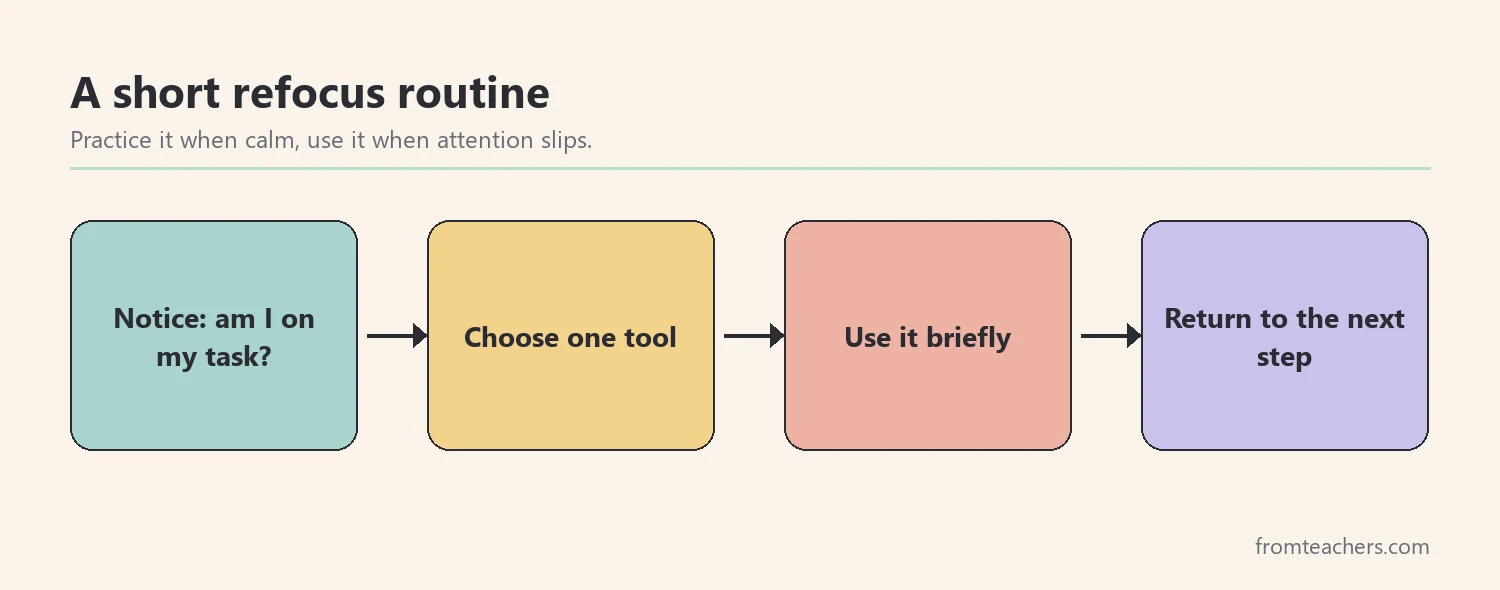
Finally, combine the tools into one simple routine: notice, choose a tool, use it briefly, and return to the next step. Practice the routine during calm times, so students can use it when attention actually slips.
Then, track progress for a few weeks. A simple method is to check every few minutes during independent work and mark whether the student is on task. Over time, the pattern shows whether the refocus strategies are working.
Also, fade adult prompts gradually. Move from a verbal reminder to a point at the poster, then to no prompt at all. Needing to refocus is normal. Focus grows stronger with tools, practice, and supportive routines.
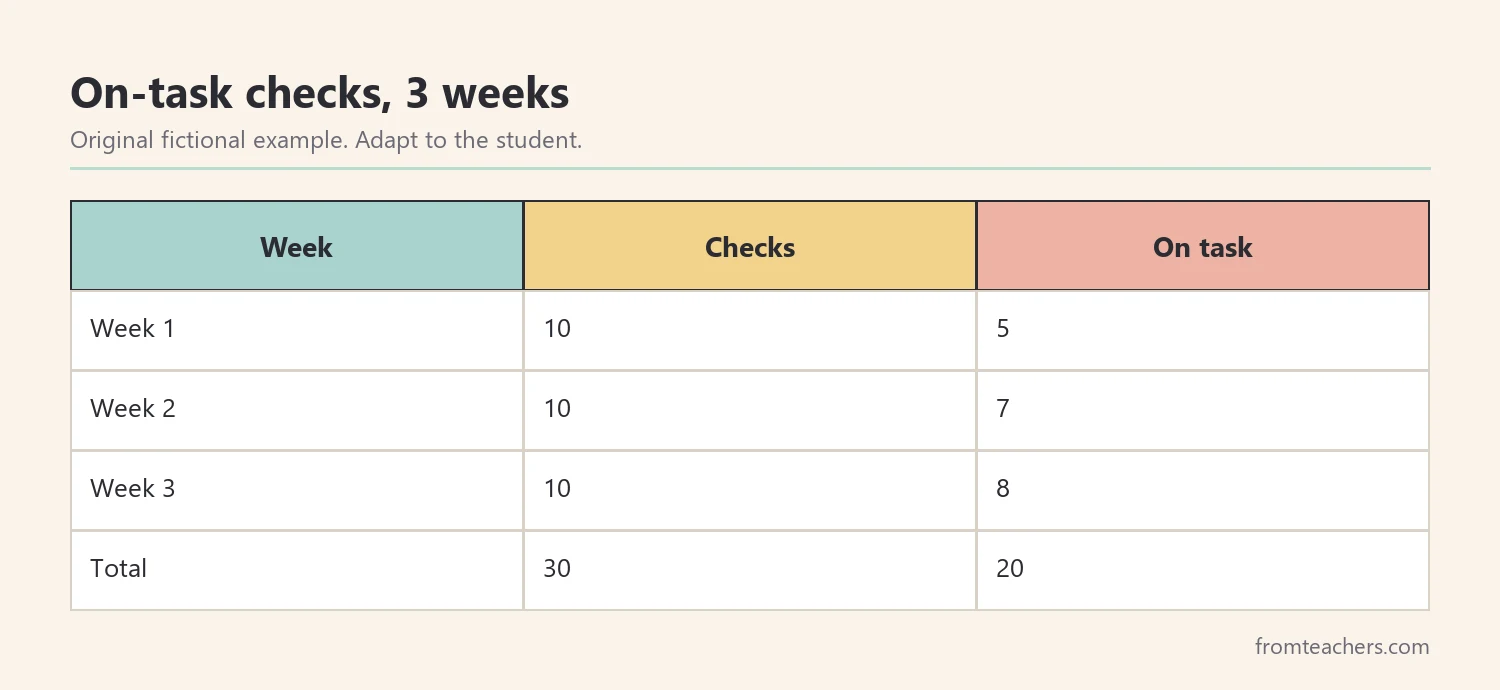
Worked example. Ms. Patel makes 10 on-task checks during independent reading each week. Ava is on task at 5 checks in week 1, 7 in week 2, and 8 in week 3. Across the three weeks, that is 20 of 30 checks. Ms. Patel moves from verbal reminders to a quick point at the poster. She keeps the checks going for another week to make sure the progress holds.
Using refocus strategies at home
Homework brings the same challenges. Families can set up a quiet space, keep a short task list on the table, and use a kitchen timer for short work blocks. A quick stretch or a glass of water works at home just as well as in class.
Also, share the same words with families. If both home and school say “Find your next step,” the routine becomes familiar faster. A short note listing the student’s favorite refocus strategies is often enough. Ask families to tell you which tools seem to work at home, because that information can shape what you try next in class.
Teaching refocus strategies to the whole class
Many students benefit from the same tools, so consider teaching them to everyone. Introduce one strategy each day for a week or two. Model it, let the class try it, and talk briefly about when it might help.
Next, practice during real lessons. Before independent work, ask, “Which tool will you use if your attention slips?” Students who name a plan in advance are more likely to use it. This short question takes seconds and keeps the tools fresh.
Also, celebrate refocusing, not just focus. Saying “I noticed you got distracted, then checked your list and got back to work” shows students that losing focus and coming back is a normal, valuable skill. Over time, the class starts to treat refocus strategies as a shared routine, and students who need them most no longer stand out.
Common mistakes and how to avoid them
- Saying “Pay attention!” It does not tell students how. Fix: name one specific strategy.
- Breaks with no limit. Students drift further. Fix: agree on short, clear breaks.
- Too many tools at once. Students cannot choose. Fix: start with two or three.
- Timers set only by adults. Students do not take ownership. Fix: hand over control gradually.
- No data. You cannot tell if it works. Fix: track a few on-task checks each week.
Questions teachers and parents ask about refocus strategies
Are refocus strategies only for students with ADHD?
No. All students lose focus sometimes. These tools help the whole class, while students with attention difficulties may need more practice and personal reminders.
How long should a brain break last?
Usually about a minute or two is enough. The aim is a quick reset, followed by a clear return to the next step.
Will movement distract other students?
Choose quiet options, such as stretching at the desk or chair push-downs. Teach them to the whole class so movement looks normal and planned.
What if the student does not notice when they drift?
Start with an external cue, such as a gentle tap or a quiet chime. Over time, pair the cue with the self-check question so the student learns to notice alone.
When should I ask for more support?
If attention problems continue despite steady use of these tools, talk with the family and school team. They can consider whether further evaluation or other supports are needed.
Related reading: 5 Practical Teaching Tips to Boost Classroom Focus and Learning, Effective ADHD Classroom Strategies to Support Student Success, and ADHD in Children: A Guide to Effective Classroom and Home Support.
A companion resource for refocus strategies:
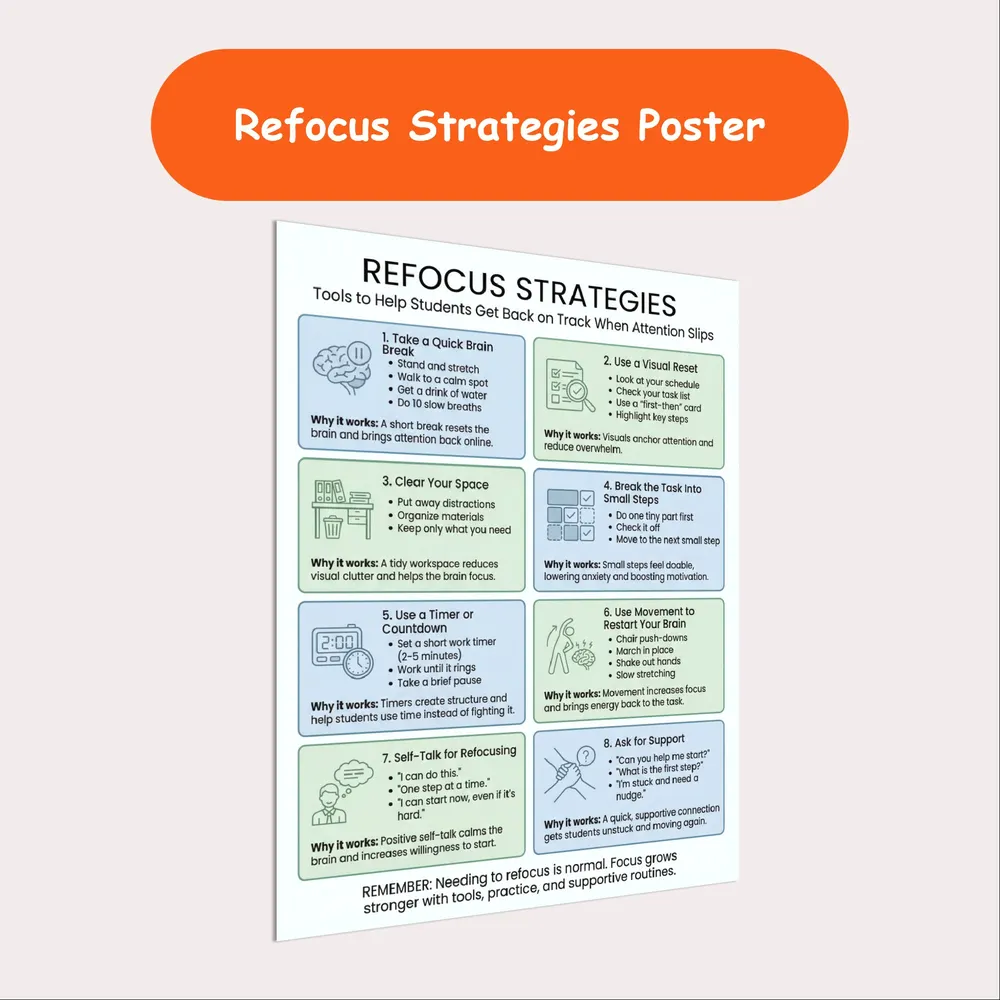
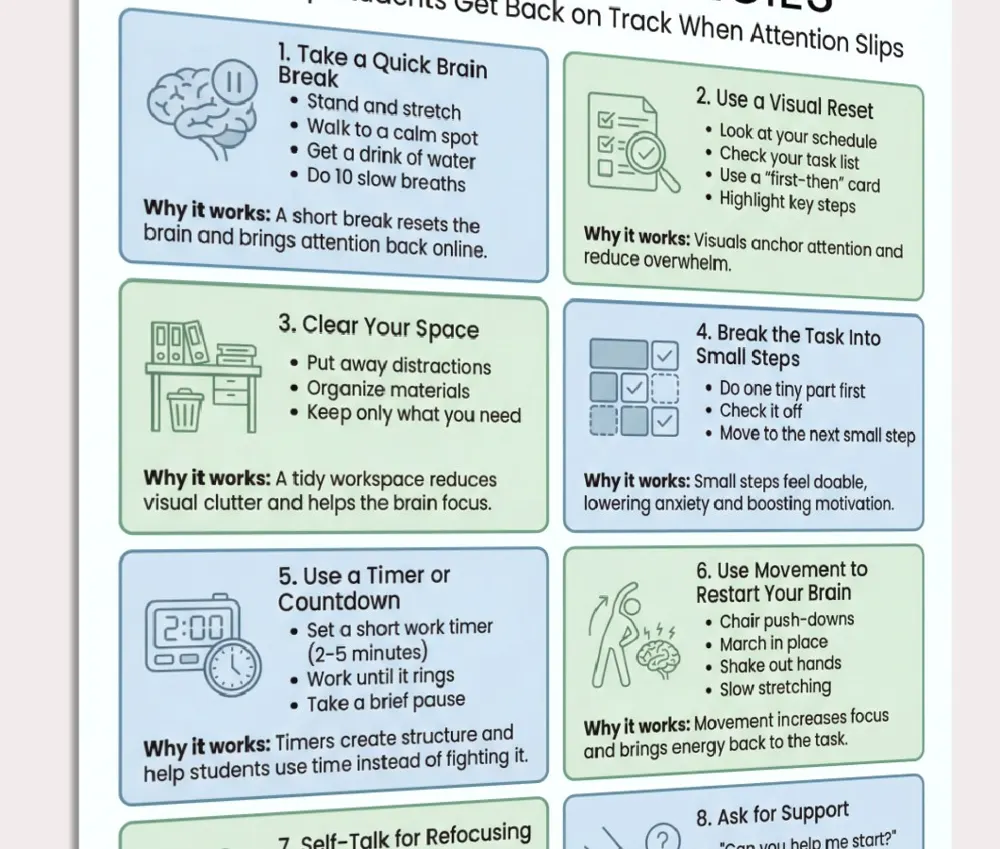
Refocus Strategies Poster: a printable poster with eight tools that help students get back on track when attention slips. Each strategy includes a “why it works” note.
Sources and scope
- CHADD: a national organization with information on ADHD and attention for families and educators.
- Centers for Disease Control and Prevention: public health information, including general information on ADHD.
- Understood.org: family-friendly guidance on focus, attention, and learning differences.
- IRIS Center, Vanderbilt University: free modules on classroom supports and evidence-based practices.
This guide covers simple classroom tools for regaining focus during tasks. It does not replace evaluation, diagnosis, or treatment for attention difficulties.
Key takeaways
- Refocus strategies start with noticing when attention slips.
- Quick breaks and movement can reset the brain.
- Visual resets and a clear space show where to restart.
- Small steps, short timers, and self-talk make restarting easier.
- Track on-task checks and fade prompts gradually.








Leave a Comment