

Teaching world religions can make even experienced teachers nervous. A student raises a hand and asks, “Which religion is the right one?” Another says something unkind about a classmate’s holiday. Suddenly a lesson about history and culture feels like a minefield. Yet religion shapes art, law, food, calendars, and conflict across human history, so students cannot understand the world without it.
This guide gives you a clear, respectful process for teaching the topic in middle and high school. After reading, you will be able to set ground rules, frame the unit around academic questions, plan balanced lessons, handle sensitive moments, and assess understanding without testing belief.
Examples are fictional. Adapt to your students, your school’s policies, and local expectations. This is guidance, not legal advice.
At a glance
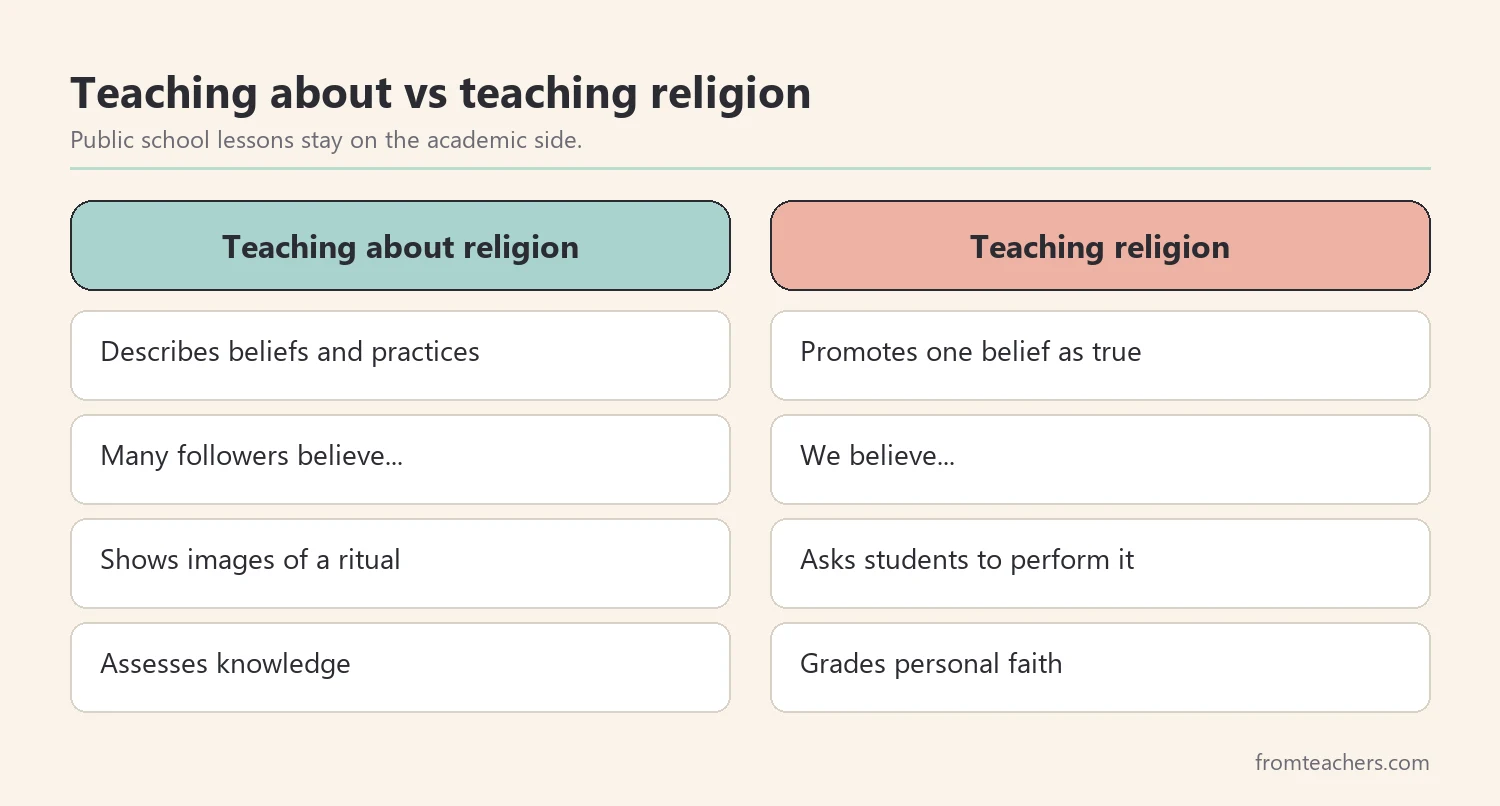
- Teach about religions, not for or against any religion.
- Set discussion norms before the first lesson, and return to them often.
- Use the same set of questions for every tradition so the treatment stays balanced.
- Prepare for sensitive moments with calm, neutral responses.
- Assess knowledge and reasoning, never personal belief.
1. Set the purpose for teaching world religions
Start by being clear with yourself, your students, and families about why the unit exists. In public schools in the United States, the widely accepted approach is to teach about religion academically: describing beliefs and practices, explaining their history, and examining their influence on culture. The goal is understanding, not persuasion.
A short purpose statement helps. For example: “In this unit we will learn what different religions teach, how they developed, and how they shape people’s lives and cultures. We will not decide which religion is true.” Share it with students on day one, and include it in a note to families.
In addition, check your school or district guidance. Some districts have policies on religious holidays, guest speakers, and sacred objects. Knowing them early prevents surprises later.
Also, prepare your own knowledge. Read about each tradition from reliable, balanced sources before you teach it, and note terms you are unsure how to pronounce or define. It is fine to tell students “I will check that and come back to you.” Modeling careful research is part of the lesson.
Worked example: Ms. Rivera’s grade 7 class
Ms. Rivera teaches world history to 28 seventh graders. Her class includes students from several faith backgrounds and students who do not follow a religion. She opens the unit with her purpose statement and a short letter home. Two families reply with questions, and she answers them before the first lesson.
2. Build classroom norms before the content
Students need a safe structure before they can talk about beliefs. Therefore, spend part of the first lesson creating discussion norms together. When students help write the norms, they are more likely to follow them.
Useful norms include:
- Use attribution language: “Many Buddhists believe…” instead of “Buddhists all think…”
- Ask, do not judge: questions are welcome, ranking religions is not.
- No one speaks for a whole group: students are never asked to represent their religion.
- Personal sharing is optional: students may share their own experience, but never have to.
- Disagree with ideas respectfully: challenge a claim, not a person.
Attribution language deserves extra practice. It keeps statements accurate, because every tradition includes a wide range of beliefs and practices. Moreover, it models the academic voice students will need in their writing.
Post the norms where everyone can see them. When a comment crosses a line, point back to the norm calmly rather than singling out the student.
Worked example: practicing attribution
| Instead of | Try |
|---|---|
| Hindus worship cows. | Many Hindus treat cows with special respect. |
| Christians believe the same thing. | Many Christians believe… though views differ. |
| That’s a weird rule. | Why is that practice important to followers? |
Worked example: building the norms
Ms. Rivera gives each table a card with one scenario, such as “A classmate says a holiday is boring” or “Someone asks you to explain your family’s beliefs.” Groups decide what a respectful response would look like. Then the class turns their answers into five norms. Because students wrote them, they refer to the norms on their own later in the unit.
3. Frame each tradition with the same questions
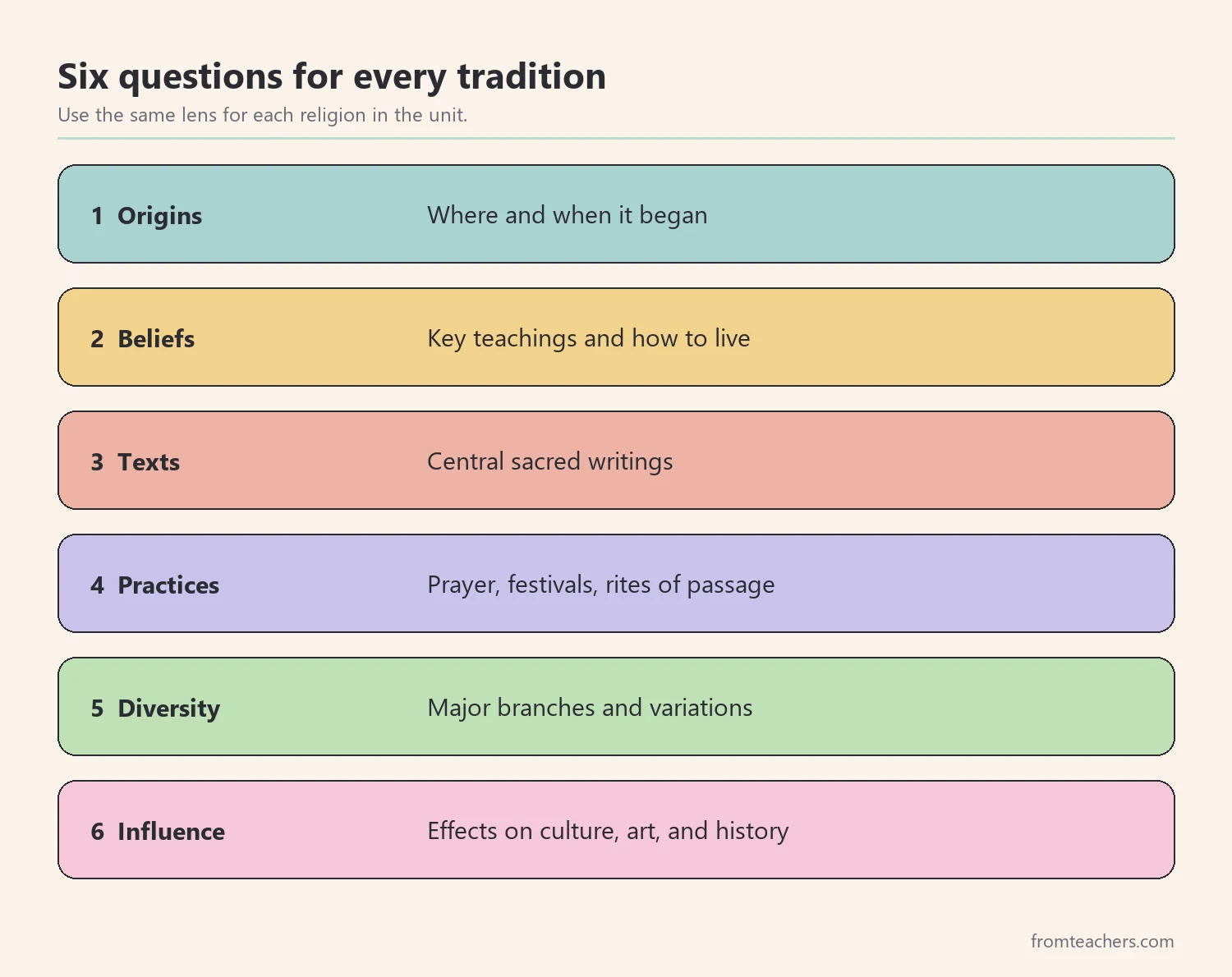
Balance is easier when every religion is studied through the same lens. Choose a small set of guiding questions and use them for each tradition. As a result, students compare like with like, and no religion receives a deeper or shallower treatment by accident.
A practical set of guiding questions:
- Origins: where and when did this tradition begin, according to historians and to followers?
- Core beliefs: what are key teachings about the divine, the world, and how to live?
- Sacred texts: which writings are central?
- Practices: what do followers do, such as prayer, festivals, or rites of passage?
- Diversity: what major branches or variations exist?
- Influence: how has it shaped culture, art, and history?
When teaching world religions with this structure, students build a comparison chart as the unit goes on. By the end, they can see similarities and differences side by side. A ready-made option is World Religions: The Complete Student Guide, which includes chapters on major faiths, a historical timeline, cultural practice pages, and comparative charts.
Worked example: one row of the class chart
After the first lesson on Judaism, Ms. Rivera’s students fill in the chart together. Under “Sacred texts,” they write that the Hebrew Bible, and especially the Torah, is central. For “Practices,” they list the weekly Sabbath and several major holidays. Under “Diversity,” they note that there are different branches with different practices. Each later tradition gets the same columns, so by week four the chart has five comparable rows.
4. Plan balanced lessons for teaching world religions
With the guiding questions in place, plan a sequence that gives each tradition comparable time. A simple unit might cover Judaism, Christianity, Islam, Hinduism, and Buddhism, with a lesson on other traditions and a closing comparison.
Vary the lesson types so students stay engaged:
- Timeline work: place each tradition’s origins on a shared class timeline.
- Primary sources: read short, age-appropriate excerpts from sacred texts, introduced as texts followers consider important.
- Images and maps: study sacred sites, symbols, and where religions are practiced today.
- Practice stations: explore festivals, food customs, and rites of passage through readings and images.
- Comparison charts: add to the class chart after each lesson.
When you use primary sources, introduce them carefully. Explain who considers the text sacred, give background on when and why it was written, and choose short passages that connect to your guiding questions. Then ask students what the passage shows about beliefs or practices, rather than whether they agree with it.
Be careful with simulations. Asking students to role-play prayer or rituals can cross the line from learning about to taking part in. Instead, describe the practice, show images, and discuss its meaning for followers.
Worked example: Ms. Rivera’s unit plan
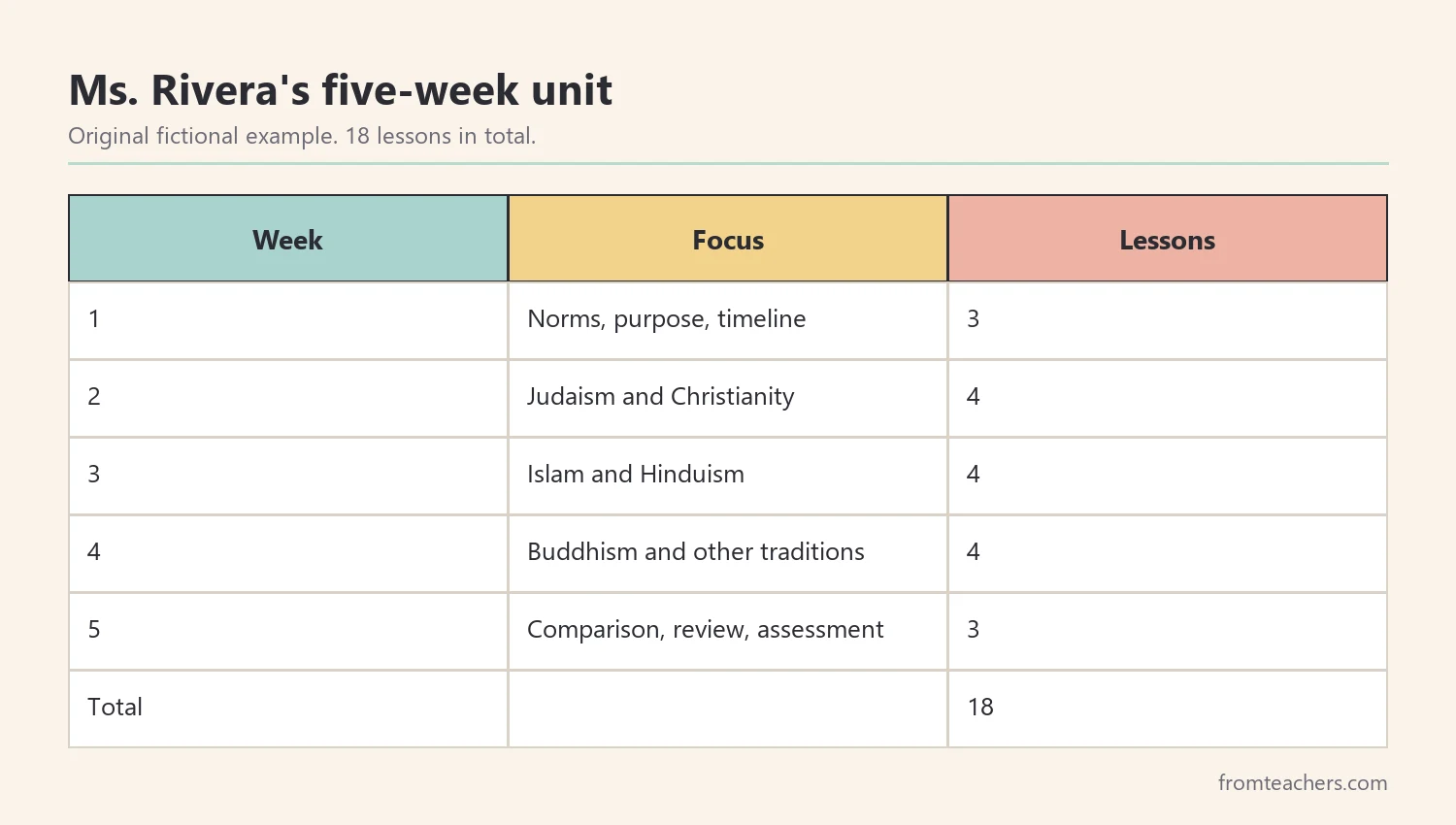
| Week | Focus | Lessons |
|---|---|---|
| 1 | Norms, purpose, timeline | 3 |
| 2 | Judaism and Christianity | 4 |
| 3 | Islam and Hinduism | 4 |
| 4 | Buddhism and other traditions | 4 |
| 5 | Comparison, review, assessment | 3 |
| Total | 18 |
Each of the five major traditions receives two lessons, and the remaining lessons cover norms, other traditions, comparison, and assessment.
5. Handle sensitive moments with calm responses
Even with good norms, hard moments will happen. A student may ask which religion is true, repeat a stereotype, or become upset when their own tradition is discussed. Planning your responses ahead of time helps you stay calm and neutral.
Some prepared responses:
- “Which one is right?” “That is an important personal question for you and your family. In this class, we study what each tradition teaches and how it shapes people’s lives.”
- A stereotype: “Let’s check that against our norms. How could we say it more accurately?”
- A personal correction: “Thank you. Traditions include many different practices. Would you like to share how your family does it, or should we look it up together?”
- Visible distress: check in privately after class and listen.
Worked example: a hard question in class
During the lesson on Hinduism, a student calls a practice “strange.” Ms. Rivera pauses and points to the norm on the wall: “Ask, do not judge.” She then asks, “What question could we ask instead?” Another student suggests, “Why is this practice meaningful to people who follow it?” The class looks up the answer together, and the lesson continues without anyone being singled out.
Furthermore, remember that students who do not follow any religion also deserve respect. Avoid assuming that everyone has a faith, and include non-religious worldviews where they fit the curriculum.
If an incident involves bullying or harassment, follow your school’s procedures. Respectful discussion norms do not replace those policies.
6. Assess understanding, not belief
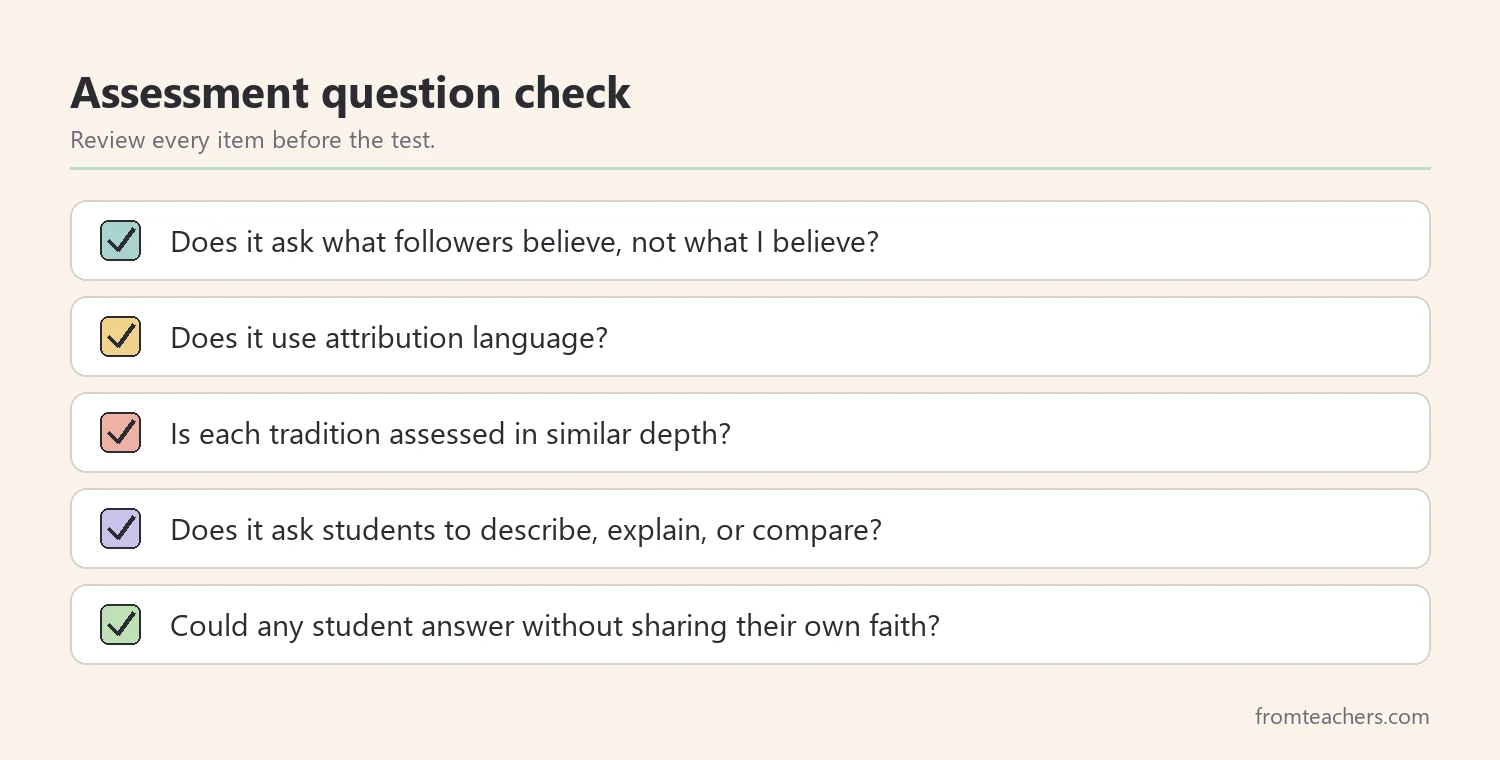
Assessment should measure what students know and how well they reason, never what they personally believe. Therefore, write questions that ask students to describe, explain, and compare.
Good assessment prompts include:
- “Describe two practices that are important to many followers of Islam.”
- “Explain how Buddhism spread from its place of origin.”
- “Compare how two traditions mark an important life event.”
- “Use attribution language to summarize a core belief of Hinduism.”
In addition, include a glossary check for key terms and a short reflection on what students learned about respectful discussion. That reflection shows growth in the norms as well as the content.
Finally, consider students who need extra support. Offer word banks for key terms, sentence starters for comparisons, and visual timelines for students who find dense text hard. These supports help students show what they know when teaching world religions with a lot of new vocabulary.
Worked example: Ms. Rivera’s assessment mix
| Part | Format | Points |
|---|---|---|
| Key terms | Glossary matching | 20 |
| Short answers | Describe and explain | 40 |
| Comparison | Chart and paragraph | 30 |
| Reflection | Norms and learning | 10 |
| Total | 100 |
After grading, return to the class comparison chart one more time. Ask students what surprised them and which similarities they had not expected. This short closing discussion often shows the deepest learning of the unit, because students explain connections in their own words.
Common mistakes and how to avoid them
- Uneven depth. Fix: use the same guiding questions and similar time for each tradition.
- Treating a religion as one single view. Fix: teach attribution language and include branches and diversity.
- Asking students to speak for their faith. Fix: make personal sharing optional and never expected.
- Role-playing worship. Fix: describe and show practices instead of simulating them.
- Grading belief. Fix: assess knowledge, reasoning, and comparison only.
Questions teachers and parents ask about teaching world religions
Is teaching world religions allowed in public schools?
In the United States, teaching about religion in an academic, neutral way is generally permitted. Promoting or disparaging a religion is not. Check your district’s guidance for local details.
What if a parent objects to the unit?
Listen to the concern, explain the academic purpose, and share materials. Follow your school’s procedures for requests about curriculum. Many concerns ease once families see the purpose statement and the norms.
Should I invite guest speakers?
Guest speakers can add depth if they speak about their tradition informatively, not to persuade. Check school policy, offer balance across traditions, and prepare speakers with your norms.
How do I include students who are not religious?
Avoid assuming everyone follows a faith. Use inclusive language, and include non-religious worldviews where your curriculum allows.
What age is best for this unit?
Many schools teach world religions in middle or high school world history or social studies. Adjust depth and texts to your students’ reading levels. Younger students can focus on festivals, symbols, and maps, while older students can handle longer texts and more historical detail.
Related reading: Learning Styles and Student Success, 5 Practical Teaching Tips to Boost Classroom Focus, and Teacher-Parent Communication.
A companion resource for teaching world religions:
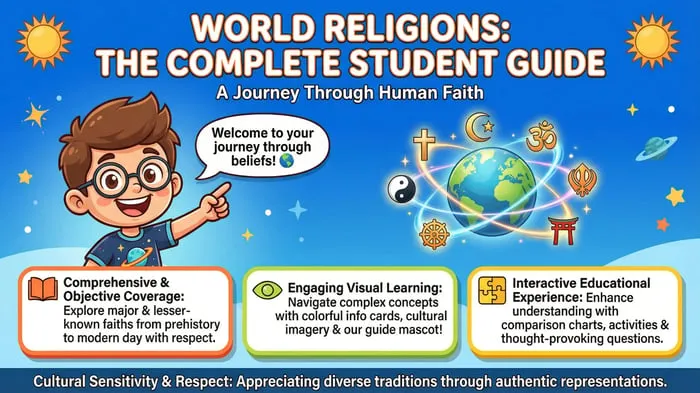
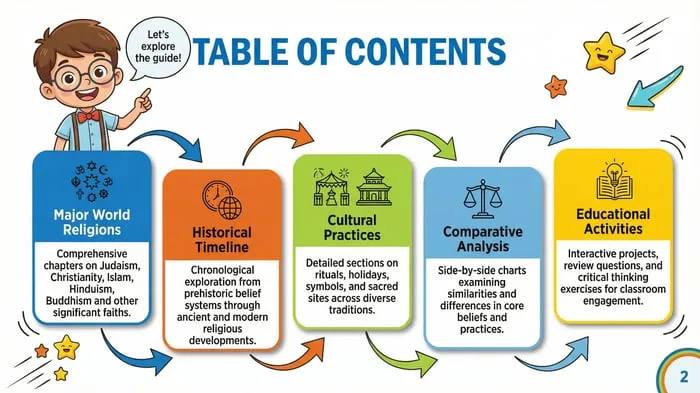
World Religions: The Complete Student Guide: in-depth chapters on Judaism, Christianity, Islam, Hinduism, Buddhism, and other faiths, with a historical timeline, cultural practice pages, comparative charts, distribution data, review questions, a final quiz, and a glossary.
Sources and scope
- U.S. Department of Education: federal guidance related to religious expression in public schools.
- National Council for the Social Studies: professional resources for social studies teaching, including the study of religion.
- Pew Research Center: Religion: research on religious populations and practices.
- CAST UDL Guidelines: a framework for planning lessons that reach diverse learners.
Scope: this guide covers planning and teaching an academic world religions unit. It does not give legal advice, and teachers should follow their own district policies.
Key takeaways
- Teach about religions, not for or against them.
- Build norms first, especially attribution language.
- Use the same guiding questions for every tradition.
- Prepare calm responses for sensitive moments.
- Assess knowledge and reasoning, never belief.




Leave a Comment