

Teaching the Big Bang theory invites students to explore one of science’s biggest questions: where did the universe come from? The story spans 13.8 billion years, so it can feel overwhelming. However, with a clear sequence and simple models, students can follow it step by step.
This guide offers a practical plan for teachers and homeschooling parents. It covers key ideas, hands-on demonstrations, and ways to answer tricky student questions.
Start Teaching the Big Bang Theory With a Story
Students remember stories better than lists of facts. Therefore, frame the lesson as a timeline from the very beginning to today. First comes a tiny, hot, dense state. Next comes expansion and cooling. Finally come stars, galaxies, and our solar system.
In addition, explain that the Big Bang was not an explosion in space. Instead, it was the expansion of space itself. This common misconception is worth addressing early.
Key Ideas Students Should Understand
- Expansion: the universe has been growing since the beginning.
- Cooling: as it expanded, it cooled, allowing particles and atoms to form.
- First elements: hydrogen and helium formed first.
- Stars and galaxies: gravity pulled gas together to form them.
- Heavier elements: stars created them, including the elements in our bodies.
For example, students are often amazed to learn that they are made of star material.
The Evidence Behind the Big Bang
Science is about evidence. Therefore, show students why scientists accept this model.
Galaxies Moving Apart
Astronomers observed that distant galaxies are moving away from us. This suggests the universe is expanding.
Cosmic Microwave Background
Also, scientists detected faint leftover radiation from the early universe. It acts like an echo of the beginning. NASA’s universe pages provide accurate images and explanations.
Hands-On Demonstrations for Teaching the Big Bang Theory
Concrete models make abstract ideas real. Here are a few classroom favorites:
- Balloon universe: draw dots on a balloon and inflate it. Every dot moves away from every other dot.
- Raisin bread: as dough rises, raisins spread apart, just like galaxies.
- Cosmic timeline rope: mark events along a long rope to show the scale of time.
As a result, students see expansion instead of just hearing about it.
Answering Tricky Student Questions
Students ask big questions, such as “What came before?” It is fine to say scientists are still investigating. In addition, this shows that science is ongoing.
Some families hold religious views about origins. Therefore, keep the focus on what the scientific evidence shows, and treat all questions respectfully. A structured text such as the complete student guide to the Big Bang helps students revisit the sequence at their own pace.
Supporting All Learners
Big ideas need extra scaffolding. First, provide a visual timeline students can refer to. Next, pre-teach vocabulary like expansion, galaxy, and element.
Also, allow students to show understanding through drawings, models, or oral explanations. Finally, check for understanding with short, frequent questions rather than one big test.
Connecting the Big Bang to Our Solar System
Students often wonder how the Big Bang connects to life on Earth. Therefore, finish the timeline with the birth of our Sun and planets. Explain that our solar system formed from a cloud of gas and dust billions of years after the beginning.
In addition, remind students that elements made in older stars became part of Earth. As a result, they see a direct link between the early universe and their own lives.
Timeline Checkpoints
- The universe begins hot and dense
- Atoms form as it cools
- First stars and galaxies appear
- Stars create heavier elements
- Our Sun and planets form
Assessment Ideas for Teaching the Big Bang Theory
Creative assessments work well for big ideas. For example, students can create a comic strip of the cosmic timeline. Also, they can explain the balloon model to a younger class.
Finally, ask students to write a short “letter from a star” describing its life. These tasks show real understanding while making teaching the Big Bang theory fun and memorable.
Getting Started This Week
First, build or print a simple cosmic timeline for the classroom wall. Next, plan the balloon demonstration for your opening lesson. Then, prepare a short list of key vocabulary with pictures. In addition, collect a few student questions in a parking lot to revisit later. Finally, choose a creative assessment so students know how they will share their learning.
Frequently Asked Questions
What grade level is right for the Big Bang?
Simple versions work in upper elementary. Middle and high school students can explore the evidence in more depth.
Was the Big Bang an explosion?
Not in the usual sense. It describes the rapid expansion of space from a hot, dense early state.
How old is the universe?
Scientists estimate the universe is about 13.8 billion years old, based on several lines of evidence.
Ready-to-use resource:
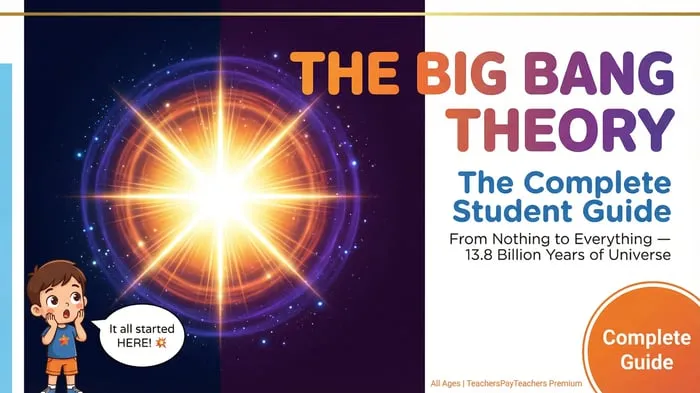
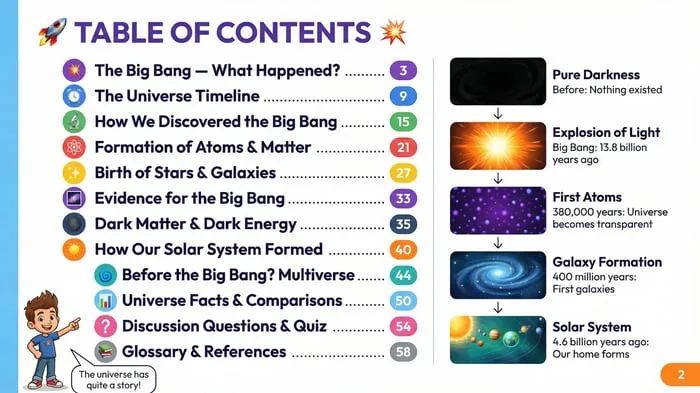
The Big Bang Theory: The Complete Student Guide: A 60-page guide that walks students from the earliest universe to the formation of our solar system.
Related reading: learning styles student success guide and homeschooling vs public schooling.
Also on FromTeachers:
Key Takeaways
- Teaching the Big Bang theory works best as a clear timeline story.
- Address the misconception that it was an explosion in space.
- Share the evidence: galaxies moving apart and leftover radiation.
- Use balloons, bread, and timelines to make expansion visible.


Leave a Comment