

Prompt fading strategies are what turn “I need help” into “I can do this myself.” Picture a morning arrival routine: a student knows how to hang up a backpack, yet he stands still until an aide points at the hook. The skill is there. However, the cue from the adult has quietly become part of the routine.
This guide works like a short course. By the end, you will be able to choose a target skill, map the prompts you use now, pick a fading method, record simple data, and check that independence holds in new places. Examples are fictional. Adapt to the student’s goals and agreed supports. This is guidance, not a diagnosis.
At a glance
- Plan the exit from support on the same day you plan the support.
- Know where each prompt sits on the hierarchy before you try to fade it.
- Pick one fading method per skill and use it the same way across adults.
- Record the level of prompt for every trial, not just “correct” or “incorrect.”
- Independence counts only when it holds in a new setting, with a new adult.
1. Define the skill and the starting point
First, choose one skill and describe it in observable words. “Be more independent” is too broad to fade. Instead, write something like “unpacks backpack and places folder in the tray within three minutes of arrival.” Now every adult can see the same target.
Next, break the skill into small steps. A task analysis lists each action in order. For the backpack routine, that might be: walk to the cubby, unzip the bag, take out the folder, hang the bag, and place the folder in the tray. As a result, you can see which steps the student already owns and which still need help.
Then, collect a baseline. Watch the routine for three to five days without changing anything. Note which steps happen independently and which need a cue. Also note the type of cue, because a pointed finger and a spoken reminder are different prompts.
Worked example: Leo, grade 4
Leo is a fictional fourth grader who knows his arrival routine. During a five-day baseline, his aide recorded the five steps each morning. That made 25 step observations in total.
| Prompt level | Steps observed |
|---|---|
| Independent | 5 |
| Verbal | 8 |
| Gestural | 10 |
| Model | 2 |
| Total | 25 |
So Leo completed 5 of 25 steps alone, which is 20 percent. Most help came as pointing. Therefore, gestures are the first prompts the team will plan to fade.
2. Map the prompt hierarchy you use now
Prompts range from most help to least help. Knowing the order lets you move in small, planned steps instead of jumping from full support to none. Many teams use a version of this ladder.
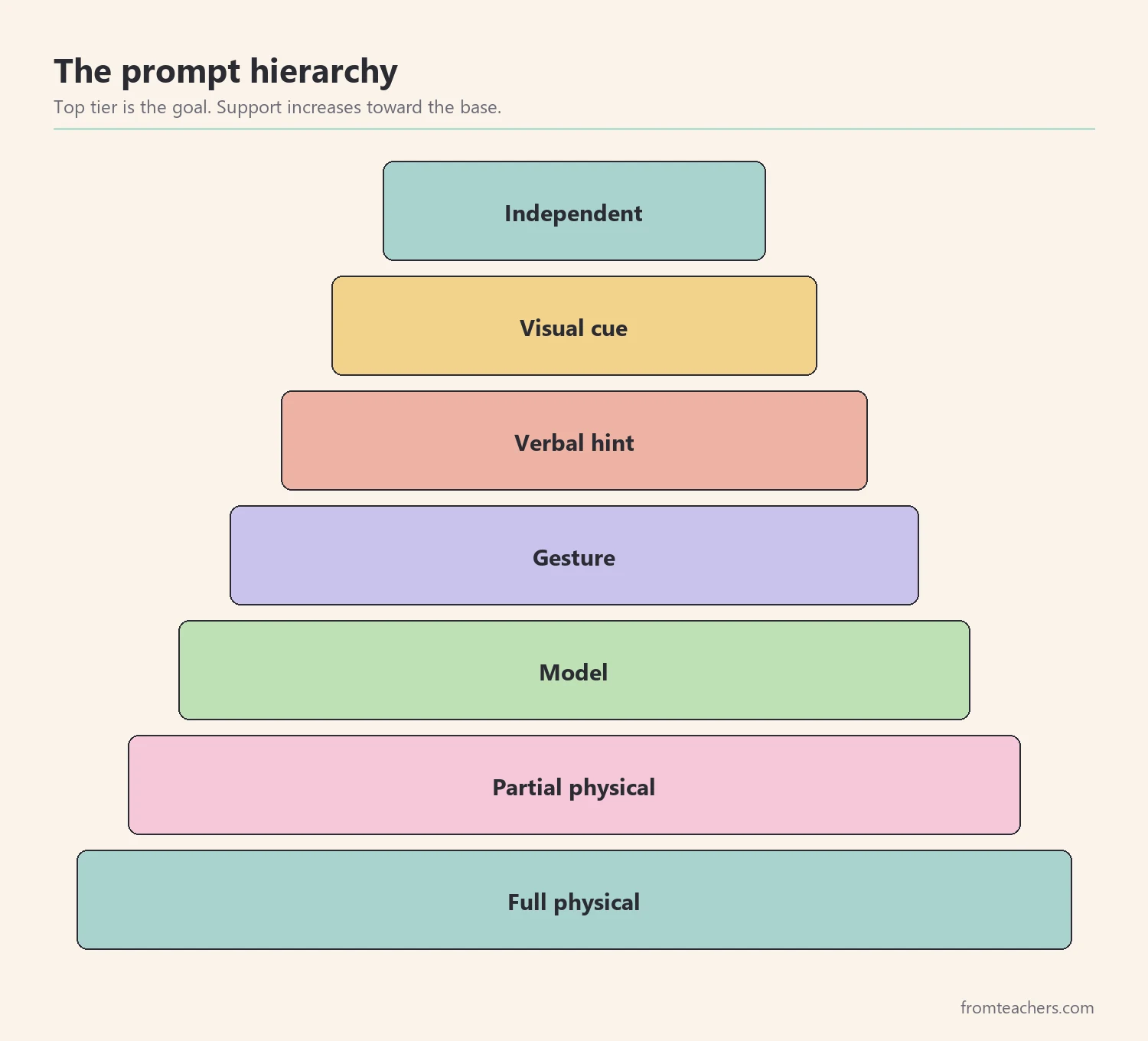
- Full physical: hand-over-hand guidance.
- Partial physical: a light touch at the elbow or wrist.
- Model: the adult shows the action first.
- Gestural: pointing or nodding toward the next step.
- Verbal: a spoken hint or direction.
- Visual: a picture, checklist, or written cue that stays in place.
- Independent: the student acts with no prompt.
Notice that visual prompts sit close to independence. Because they do not need an adult nearby, they can stay as a lasting support. For example, a small picture strip at the cubby is a fair, permanent tool for many students.
In addition, list the prompts each adult actually gives. Often one aide points, another talks, and a substitute physically guides. When prompts differ by adult, the student learns to wait for a person, not to follow the routine. In Leo’s case, the team agreed that everyone would use gestures first, then fade to a visual strip.
3. Choose prompt fading strategies that fit the skill
There are several common ways to fade support. Each one suits a different type of skill and learner. Choose one per skill, write it down, and use it consistently.
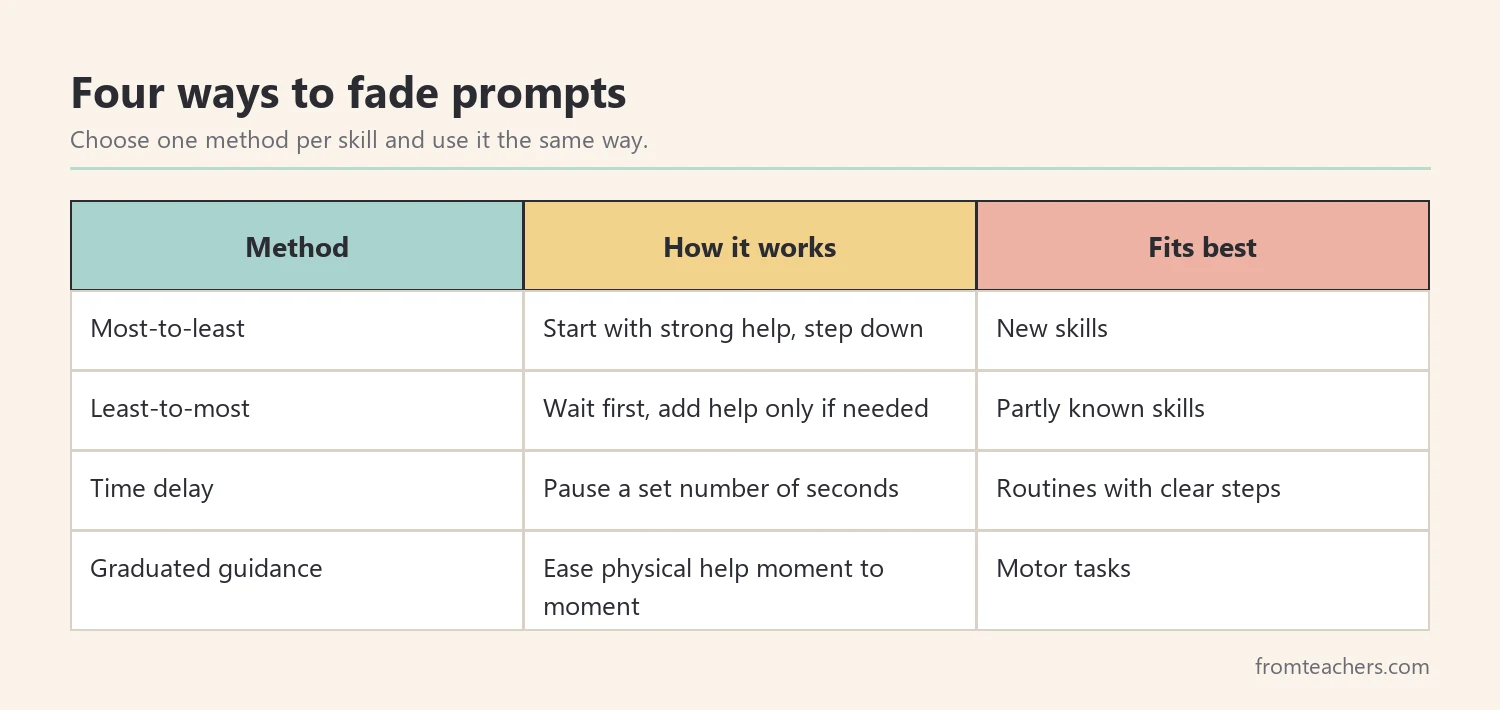
- Most-to-least: start with strong help and step down as the student succeeds. This suits new skills where errors are costly or frustrating.
- Least-to-most: give the student a chance first, then add help only as needed. This suits skills the student partly knows.
- Time delay: wait a set number of seconds before prompting. The wait gives the student room to act first.
- Graduated guidance: adjust physical help moment to moment, easing off as the student moves.
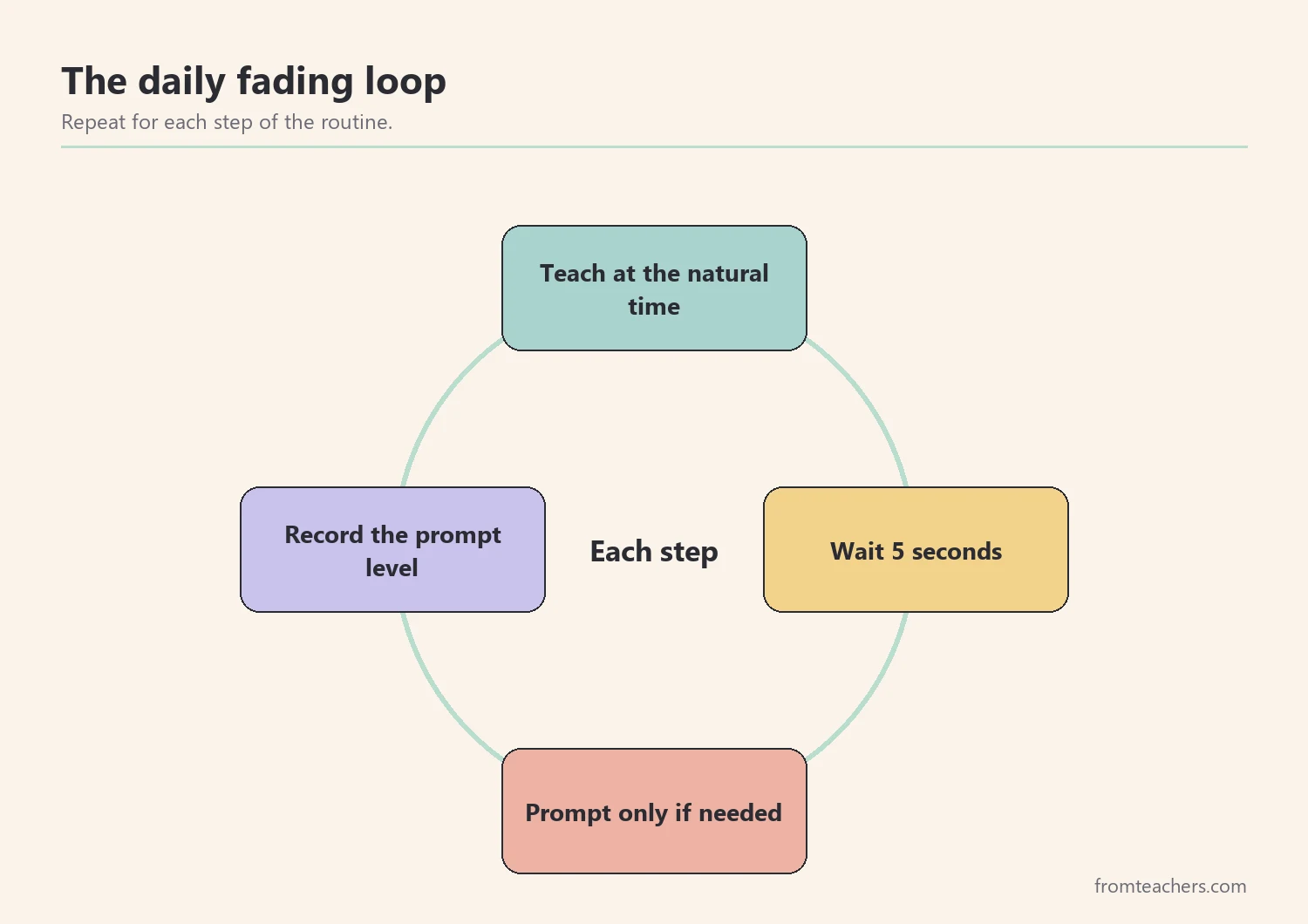
For Leo, the skill is partly known, so least-to-most with a short time delay fits well. The aide now waits five seconds at each step. If Leo does not start, she points. Only after that does she use a verbal hint.
Moreover, prompt fading strategies work best when they are written as a plan. A plan names the skill, the method, the current prompt, and the next step down. A ready-made teaching prompt fading plan and participation forms pack can save time here, since it gives you a structured page to record each of these decisions.
4. Teach and record every trial
Now the daily work begins. Teach the routine at its natural time, follow the plan, and record what happened on each step. Short, honest data beats long notes that nobody reads.
First, record the prompt level for every step, not only whether it was correct. A step completed after a gesture is real progress from a step that needed a model. However, it is not yet independence. Therefore, a simple code helps: I for independent, V for verbal, G for gestural, M for model, P for physical.
Next, reinforce independence more than prompted success. Specific praise, a quick high five, or the natural reward of finishing early all work. As a result, the student learns that acting first pays off more than waiting.
Also, watch for prompt dependence. If a student looks at the adult before each step, the adult may be the cue. Try standing a little farther away or behind the student. Similarly, keep your face neutral during the time delay, because a raised eyebrow can be a prompt too.
Leo after three weeks
The aide kept recording the same five steps each morning. In week three, she again collected 25 step observations over five days.
| Prompt level | Baseline | Week 3 |
|---|---|---|
| Independent | 5 | 16 |
| Verbal | 8 | 2 |
| Gestural | 10 | 7 |
| Model | 2 | 0 |
| Total | 25 | 25 |
So Leo moved from 20 percent to 64 percent independent steps (16 of 25). In addition, the remaining help is mostly gestures, which is the planned next prompt to fade.
5. Set rules for when to fade, hold, or step back
Data only helps if you decide in advance what it means. A clear decision rule keeps adults from fading too fast or holding support too long. Write the rule into the plan before you start.
For example, a team might agree on this: if a step is independent on four of five days, fade the prompt for that step. If a step is independent on two or three days, hold the current level. If errors rise or the student is upset, step back one level for a few days.
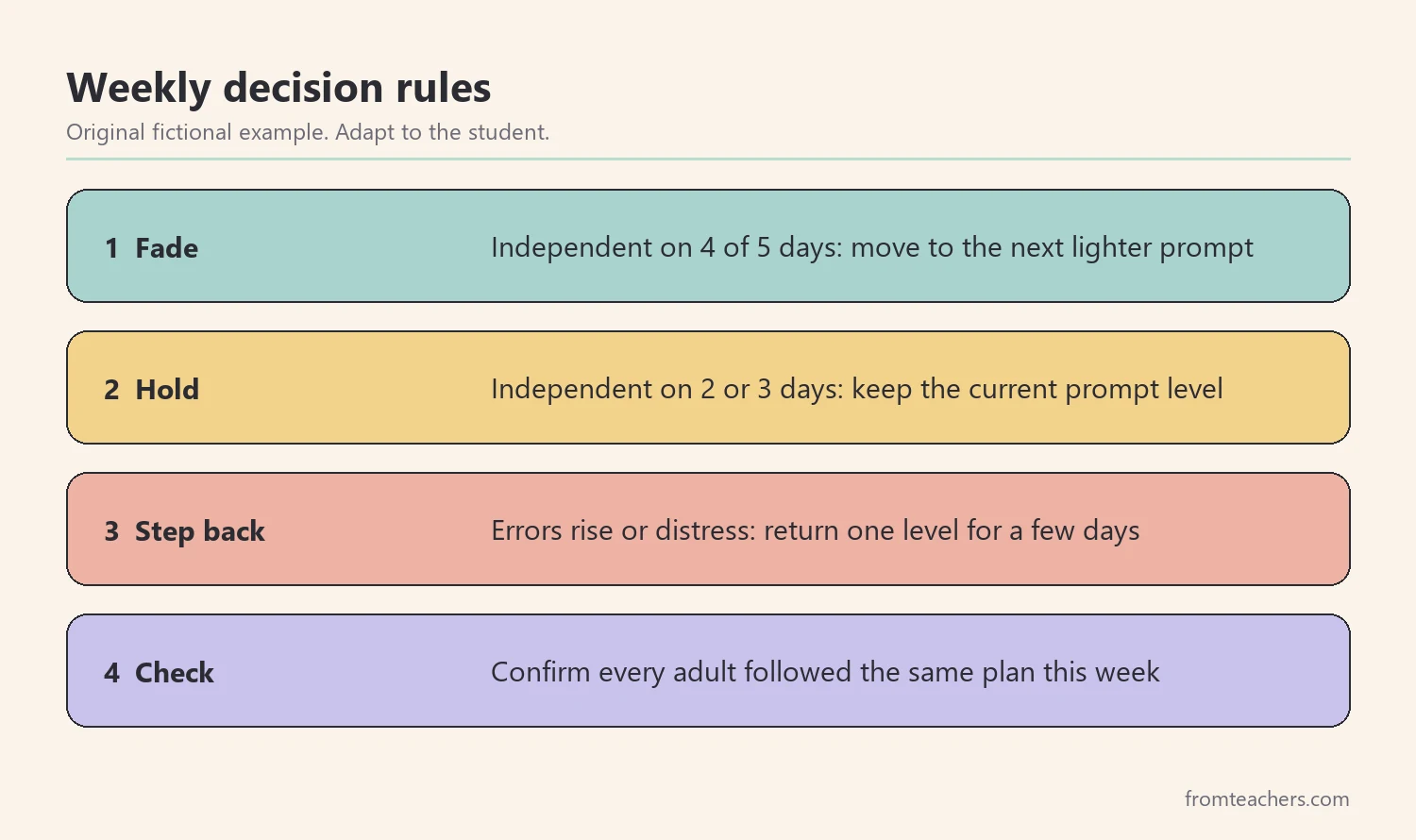
Stepping back is not failure. Instead, it is a normal part of prompt fading strategies. Illness, a new schedule, or a stressful week can all affect performance. Therefore, the goal is a steady trend, not a perfect line.
Finally, check for consistency between adults. If one adult fades and another keeps pointing, the data will look mixed. A short teaching consistency check, done once a week, shows whether the planned steps actually happened. For Leo, a quick check showed the substitute aide was still using verbal hints, so the team shared the plan with her.
6. Check that prompt fading strategies carry over
A skill is not truly independent until it works in new conditions. Generalization means the student uses the skill with a different adult, in a different place, or with different materials. Without it, the student may only be independent with one aide in one room.
First, plan small changes on purpose. Ask a different adult to stand nearby during arrival. Next, try the routine after lunch or after a fire drill, when the setting feels different. Also, change one material, such as a new folder color.
Then, record transfer separately from the main data. A simple skill transfer record lists the new condition, the date, and the prompt level. As a result, you can see whether independence holds or whether some support needs to return.
For Leo, the team tested arrival with the music teacher on duty. He completed four of five steps alone and needed one gesture at the tray. That told the team the skill was transferring, with one step still to work on.
In addition, invite the student into the process. A short self-check, such as “Did I do my morning steps?” with a picture for each step, builds self-monitoring. Over time, the student’s own checklist can replace the adult’s prompt entirely.
A simple transfer checklist
Before the team calls a skill independent, it helps to test a few conditions on purpose. Use the list below as a starting point and add conditions that matter for the student.
- A different adult is nearby, such as a specialist or substitute.
- The routine happens at a different time of day.
- One material changes, such as a new folder or a different tray.
- The setting changes, such as another classroom or the library.
- The student uses a self-check instead of an adult cue.
If independence drops in one condition, that is useful information, not a setback. Instead, plan a short burst of teaching in that condition, then test it again. Over time, the student learns that the routine belongs to them, wherever they are.
Common mistakes and how to avoid them
- Mistake: fading with no written plan. Fix: write the skill, method, current prompt, and next prompt down on one page.
- Mistake: recording only correct or incorrect. Fix: record the prompt level for each step so progress is visible.
- Mistake: every adult prompts differently. Fix: agree on one hierarchy and do a short weekly consistency check.
- Mistake: fading everything at once. Fix: fade one prompt type or one step at a time, using a decision rule.
- Mistake: hovering after fading. Fix: increase physical distance gradually, because adult closeness can act as a prompt.
- Mistake: calling a skill mastered too early. Fix: test it with a new adult, place, or material before you call it independent.
Questions teachers and parents ask about prompt fading strategies
How long does prompt fading usually take?
It varies widely by student and skill. Some routines fade in a few weeks, while complex skills may take months. Therefore, track the trend in your data rather than aiming for a fixed date.
Should visual supports ever be removed?
Not always. A visual schedule or checklist can be a lasting support, just as adults use calendars and lists. However, the student should use it on their own, without an adult pointing to it.
What if the student gets upset when prompts are reduced?
Step back one level for a few days and check the pace. In addition, increase reinforcement for independent steps. If distress continues, talk with the team about the skill, the method, and the student’s needs.
Can parents use prompt fading strategies at home?
Yes. Routines like dressing, brushing teeth, or packing a school bag work well. Also, sharing the same prompt hierarchy between home and school helps the student learn faster.
How do paraprofessionals fit into the plan?
Paraprofessionals often deliver most prompts, so they need the written plan and a short training. Next, a quick weekly check helps them see progress and ask questions. Their data is usually the most important record the team has.
Related reading: The Power of Data Tracking in Special Education, An Assistive Technology Toolkit for Special Education, and Accommodations vs Modifications in Special Education.
A companion resource for prompt fading and independence:
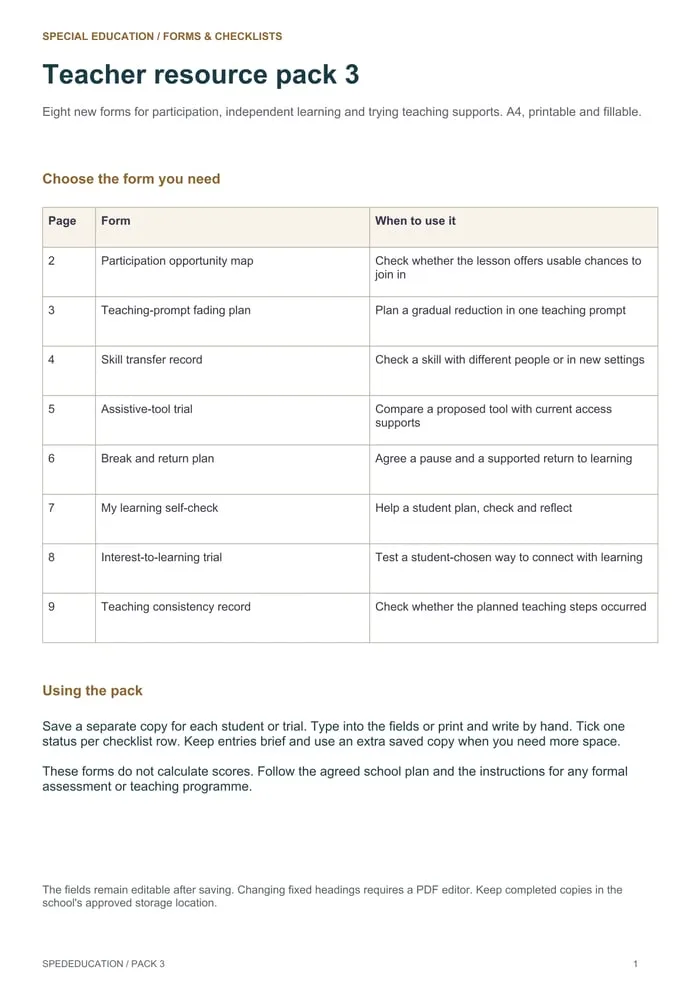
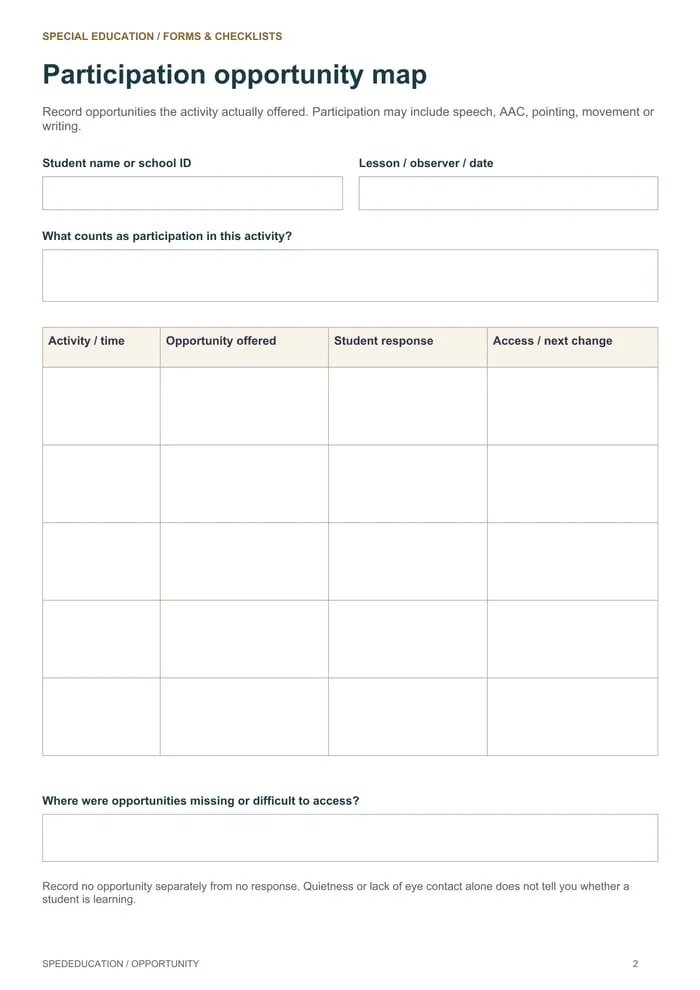
Special Education Participation and Independent Learning Forms Pack 3: Eight fillable PDF forms, including a teaching prompt fading plan, a skill transfer record, a teaching consistency record, and a student self check, with source notes for each form.
Sources and scope
- IRIS Center, Vanderbilt University: free modules on evidence-based practices, including prompting and working with paraprofessionals.
- What Works Clearinghouse: reviews of education research and practice guides.
- IDEA, U.S. Department of Education: the federal law and guidance behind IEPs and special education services.
- Understood.org: plain-language resources for families and teachers of students with learning and thinking differences.
Scope: this guide explains general prompt fading practice for classroom and home routines. It does not replace an individualized plan, a behavior analyst’s assessment, or decisions made by the student’s IEP team.
Key takeaways
- Define one observable skill, break it into steps, and take a short baseline.
- Map your prompt hierarchy and agree on it across every adult.
- Choose one fading method per skill and record the prompt level on each step.
- Use written decision rules to fade, hold, or step back.
- Check that independence carries over to new adults, places, and materials.










Leave a Comment